Adding a Mini Split AC System in Idaho
Costs, Rebates & 2026 Guide
How to Add a Mini Split AC System in Idaho, and Which 2026 Rebates You Can Still Get
A single-zone mini split installed in Idaho in 2026 typically runs $4,500 to $8,500, and your rebate now comes from your utility rather than the federal government. The federal Section 25C credit expired on December 31, 2025, so Idaho Power, Idaho Falls Power, and Avista set the incentive. One rule decides whether you keep that money: file the rebate paperwork before you sign the contract.
- Idaho Power: $500 for a ductless heat pump in an existing home with electric baseboards, ceiling cable, or wall units as primary heat. Minimum 9 HSPF / 7.6 HSPF2.
- Idaho Falls Power: a rebate, or a zero-interest loan up to $10,000 in place of it. Requires 12 months of payment history and a Notice to Proceed before install.
- Avista Idaho: single-family residential HVAC rebates in northern Idaho, including primary heat conversions. Confirm current amounts before you order equipment.
- Federal Section 25C: expired December 31, 2025. Equipment installed in 2026 does not qualify. A 2025 install may still be claimed on a 2025 return.
Multi-zone systems run $9,000 to $16,000, and a whole-home four-zone replacement can reach $22,000 before any rebate. Take the quick match quiz below to see which setup fits your climate zone, or browse ductless systems at Filterbuy.

Answer a few quick questions and we will match you to the right mini split for your Idaho home.
reason ductless mini splits keep showing up in our installer conversations across Boise, Idaho Falls, and Coeur d’Alene. Baseboard heat in this state runs hard sometimes for ninety days straight in eastern Idaho and at 11.5 cents per kWh, the math catches up fast. For the homeowners we hear from in 2026, replacing or supplementing electric resistance heat with a cold-climate heat pump is the single largest energy decision they’ll make this decade.
This guide covers what it actually costs to add a mini split AC system in Idaho in 2026, which utility rebates stack to lower that price, how to size a cold-climate unit for the state’s three different climate zones, and the filter setup that protects your indoor air when wildfire smoke rolls in. The rebate landscape shifted at the end of 2025, so the federal credit information circulating online needs an update before you sign a contract.
TL;DR: Quick Answers
How do I add a mini split AC system in Idaho with rebates in 2026?
Idaho homeowners adding a ductless mini split in 2026 work with utility-driven rebates because the federal Section 25C credit expired on December 31, 2025. Here is what currently applies:
Typical install cost: $4,500 to $8,500 for a single-zone, $9,000 to $16,000 for multi-zone, up to $22,000 for a whole-home four-zone replacement.
Idaho Power Heating and Cooling Efficiency Program: $500 rebate for a ductless heat pump in an existing home with electric baseboards, ceiling cable, or wall units as primary heat. Minimum 9 HSPF / 7.6 HSPF2.
Idaho Falls Power: rebate or zero-interest loan up to $10,000 in lieu of the rebate. Requires 12 months of payment history and a Notice to Proceed before installation begins.
Avista Idaho: single-family residential HVAC rebates for primary heat conversions and ductless heat pumps in northern Idaho.
Federal Section 25C: expired December 31, 2025. Equipment installed in 2026 does not qualify. 2025 installs may still claim on a 2025 return.
Cold-climate certification matters in eastern Idaho and the Panhandle. Hyper-heat models (HSPF2 of 10+) hold capacity to -2°F or -22°F, where standard heat pumps tap out around 17°F.
Sequence determines rebate eligibility. Idaho Power and Idaho Falls Power both require pre-approval before install. Installing first and applying second is the fastest way to lose the rebate.
Filter strategy starts day one. The mesh pre-filter catches lint, not smoke particulate. Pair the system with MERV 11 or MERV 13 filters in any parallel HVAC equipment to protect indoor air during wildfire smoke season.
Top Takeaways
Idaho mini split installs run $4,500 to $22,000 in 2026, with Boise and Meridian pricing lower than Idaho Falls and the Panhandle.
Idaho has three distinct climate zones, and each zone calls for a different mini split spec.
The federal Section 25C credit expired December 31, 2025, so Idaho Power, Idaho Falls Power, and Avista rebates now drive the 2026 incentive stack.
Cold-climate hyper-heat models (HSPF2 of 10+) are non-negotiable in eastern Idaho and the Panhandle.
Idaho Power and Idaho Falls Power require pre-approval before install, so installing first means losing the rebate.
Boise, Meridian, Nampa, Idaho Falls, and Pocatello all require HVAC permits, and skipping them voids both warranty and rebate.
The mini split's mesh pre-filter only catches lint, so MERV 11 or MERV 13 filters are what protect indoor air during smoke season.
What Is a Ductless Mini Split AC — and Why Idaho Homeowners Are Adding Them
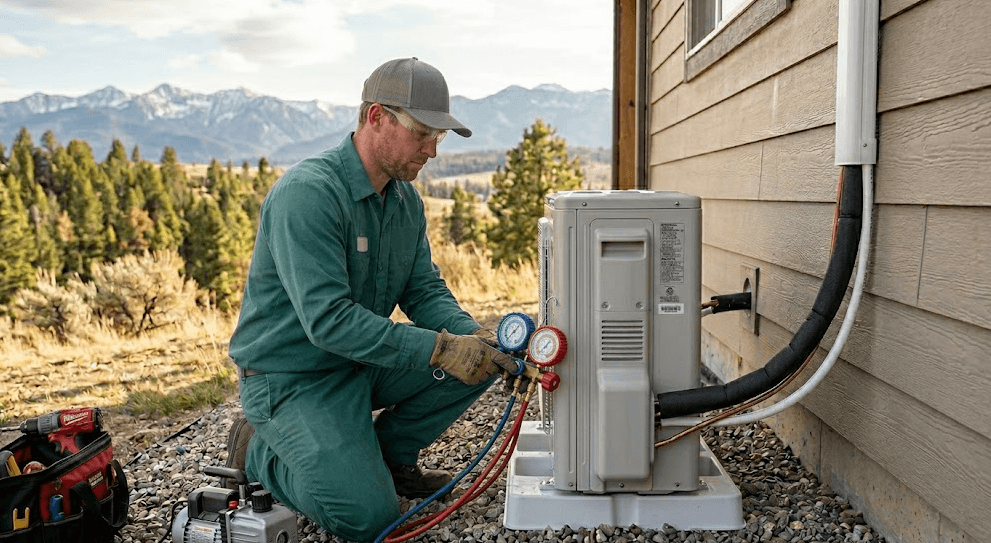
A mini split is two pieces of equipment talking to each other through a small hole in your wall. Outside, a compressor and condenser handle the refrigerant work. Inside, one or more air handlers move conditioned air directly into the room from a wall mount, a ceiling cassette, or a low floor console. Refrigerant lines, a condensate drain, and one power feed pass through that wall, and no ductwork is needed.
Most modern mini splits are also heat pumps, so the same equipment heats your house in winter and cools it in summer. Heat pumps move heat instead of making it through combustion or electric resistance. That movement is the efficiency story in one sentence.
For a fundamentals-level look at the refrigeration cycle that all of this runs on, air conditioning systems walks through the same physics that powers ducted, packaged, and ductless units alike.
Three things keep pulling Idaho homeowners toward ductless. The first is structural. A large share of Idaho homes built before 1990 either have no ductwork (especially in the Panhandle and rural southeast) or run their ducts through unconditioned crawl spaces and attics where leaks pull 25 to 30 percent of conditioned air out before it ever reaches the room. The second is electric resistance heat. It’s everywhere in this state, and every degree on the thermostat shows up on the next bill. The third is comfort by zone. Mini splits run room by room, so your unused guest bedroom doesn’t waste energy when nobody’s sleeping in it.
For a closer look at how that same logic plays out in single-room layouts and ADUs, see our broader mini split systems hub.
Why Idaho’s Climate Makes Mini Splits a Smart Fit
Idaho splits into three distinct climate zones. The Treasure Valley around Boise and Meridian runs hot, dry, and increasingly long summers, with a cooling-dominant load and wildfire smoke from August into October. Eastern Idaho around Idaho Falls and Pocatello swings into sub-zero overnight lows in winter and dry, sunny summers, with a heating-dominant load that punishes electric resistance systems. The Panhandle around Coeur d’Alene and Sandpoint sits closer to a Pacific Northwest pattern, with more humidity, longer heating seasons, and heavy snow load to plan around the outdoor unit. The right mini split for each zone is not the same unit.
How Idaho’s Cold and Dry Air Affects Heat Pump Performance
Standard heat pumps lose capacity as outdoor temperatures drop, and the cheap ones tap out around 17°F. Cold-climate or hyper-heat models use variable-speed inverter compressors and enhanced refrigerant cycles to hold capacity all the way down to ∓2°F or even −22°F. The trade-off shows up in price and HSPF2 rating, and in Idaho the trade-off is almost always worth paying for.
Dry air helps in one way and hurts in another. Defrost cycles run less often when humidity is low, which means less wasted energy melting frost off the outdoor coil. But dry air also means lower latent cooling load in summer, so an oversized unit short-cycles and never runs long enough to dehumidify. Sizing matters more in Idaho than it does in a humid southern climate. Most installers we work with target around 25 BTU per square foot for typical Idaho insulation, then adjust up for older homes and down for tightly sealed new builds.
Wildfire Smoke Season and Indoor Air Quality
From late July through early October, Idaho air can shift from clear to hazardous in a single afternoon. Smoke from regional fires carries fine particulate matter (PM2.5) small enough to bypass standard filtration and settle deep in the lungs. A mini split is part of the answer because it gives you a sealed, ductless way to recirculate and condition indoor air without pulling smoke through leaky outdoor return ducts. The other part is filter strategy, which our broader indoor air quality resource covers in detail.
Mini Split Installation Cost in Idaho (2026)
A single-zone mini split installed in Idaho in 2026 typically lands between $4,500 and $8,500 all-in. Multi-zone systems that handle two or three rooms come in between $9,000 and $16,000. A whole-home four-zone replacement for an older Idaho ranch can hit $22,000 before any rebate applies. These numbers come from current quote ranges across Boise, Meridian, Idaho Falls, and Coeur d’Alene metros and assume professional installation by a licensed contractor with permits pulled.
| System Type | Idaho Install Cost (2026) | Best Fit For |
|---|---|---|
| Single-Zone Mini Split | $4,500 – $8,500 | One room, ADU, or addition |
| Dual-Zone Multi Split | $7,500 – $12,000 | Bedroom plus living area |
| Three-Zone Multi Split | $11,000 – $16,000 | Whole-home conversion |
| Four-Zone Whole-Home | $15,000 – $22,000 | 2,000+ sq ft home replacement |
Mini Split Cost by Idaho City — Boise, Meridian, Idaho Falls
Boise and Meridian sit in the most competitive contractor market in the state, so a single-zone install in the Treasure Valley often comes in at the lower end of the range, sometimes $4,800 to $5,500 for a straightforward 12,000 BTU wall-mount install. Idaho Falls runs slightly higher because of cold-climate equipment requirements and a smaller installer pool, with single-zone hyper-heat installs starting around $5,800. Coeur d’Alene and the Panhandle generally fall between the two, with Sandpoint and rural counties pulling toward the higher end because of travel time.
What Drives the Cost Up (and Down) in Idaho
Five things move the price more than anything else:
Cold-climate hyper-heat models cost $1,500 to $3,000 more than standard mini splits, and they’re the right call for Idaho Falls, Pocatello, Sandpoint, and any home above 4,000 feet.
Older homes (pre-1980) often need an electrical service upgrade or a new dedicated 240V circuit, which adds $500 to $1,500.
Outdoor unit mounting in snow country needs a wall bracket or stand to keep the condenser above the drift line. Figure another $200 to $400.
Multi-zone systems with line hides and longer refrigerant runs add $300 to $600 per additional zone in labor.
Permit fees vary by city. Boise lands around $150 to $250, Idaho Falls is in a similar range, and rural counties may waive permits entirely.
Single-Zone vs Multi-Zone Cost Comparison
A single-zone unit conditions one room or open space and works well for an addition, ADU, master bedroom, or bonus room. A multi-zone system shares one outdoor compressor with two to five indoor heads. Multi-zone costs more upfront but lowers the per-zone price, and it leaves only one outdoor footprint on the side of your house. For most Idaho whole-home conversions, two- or three-zone systems offer the best balance of coverage, efficiency, and rebate eligibility.
Idaho Mini Split Rebates and Incentives in 2026
The federal landscape changed at the end of 2025, and Idaho’s 2026 rebate story is now driven by utility programs, not tax credits. Idaho Power, Idaho Falls Power, and Avista each run separate ductless heat pump incentives, and the eligibility rules differ enough that a Boise homeowner and an Idaho Falls homeowner are looking at completely different paperwork.
Idaho Power Ductless Heat Pump Rebate ($500)
Idaho Power’s Heating and Cooling Efficiency Program pays $500 for a ductless heat pump installed in an existing home. The home must run electric baseboards, ceiling cable, or wall units as the primary heating system in the living room or great room. The equipment must hit minimum 9 HSPF / 7.6 HSPF2. Eligible home types include single-family site-built, manufactured, duplex, triplex, and fourplex, and the home can be a primary residence, vacation, or rental. The rebate is not retroactive, and it has to be part of your purchase decision before installation begins.
Idaho Falls Power — Ductless Heat Pump Rebate or Zero-Interest Loan
Idaho Falls Power runs a different model from most utilities. Qualifying customers can take a rebate or, in lieu of the rebate, a zero-interest loan of up to $10,000 added to the monthly utility bill in equal installments. To qualify, you need 12 months of utility payment history with the City of Idaho Falls and no late payments in that window. The process matters here. You bid the project, sign the forms at Idaho Falls Power, receive a Notice to Proceed, install, and then submit for inspection. Installing first and asking for the rebate second is the fastest way to lose eligibility.
Avista Idaho Energy Efficiency Rebates
Avista serves northern Idaho with both electric and natural gas service and runs single-family residential rebates on HVAC upgrades, including primary heat conversions from electric resistance. Specific 2026 ductless heat pump amounts shift periodically, so verify the current incentive directly on Avista’s Idaho residential rebate page before committing to equipment. As of early 2026, several program tiers shifted on March 1, so 2026 paperwork should reflect the updated amounts, not the 2025 figures still circulating in some installer literature.
Federal Tax Credit Status — What Changed in 2026
The federal Section 25C Energy Efficient Home Improvement Credit was available for qualifying heat pump installations through tax year 2025 and expired December 31, 2025. The One Big Beautiful Bill Act, signed into law in July 2025, terminated the credit for equipment placed in service after that date. Idaho homeowners who installed a qualifying ductless heat pump in 2025 may still claim the credit on their 2025 return. Equipment installed in 2026 does not qualify. Check current IRS guidance before filing, and assume utility rebates are the primary incentive path for new 2026 installs.
The Best Mini Split Systems for Idaho Conditions
The best system depends on which Idaho you live in. For Idaho Falls, Pocatello, Rexburg, and the Panhandle above 3,000 feet, cold-climate hyper-heat is the right starting point. For Boise, Meridian, Nampa, and Caldwell, a high-efficiency standard heat pump rated to 5°F or 0°F handles the load with better economics. For ADUs, garages, and shop spaces, a budget single-zone unit often makes more sense than the premium tier.
Cold-Climate Hyper-Heat Tier
These units carry HSPF2 ratings of 10 or higher and are tested for capacity at 5°F, with usable output well below zero. Look for variable-speed inverter compressors, enhanced vapor injection, and a published heating capacity at −13°F or colder. This tier costs more, and in eastern Idaho it’s the difference between a heat pump that meets your heating load and a heat pump that hands the job back to your old electric strips on the coldest mornings.
High-Efficiency Tier (Rebate-Eligible)
This tier is built around hitting Idaho Power’s minimum 9 HSPF / 7.6 HSPF2 threshold while staying budget-conscious. Most ENERGY STAR-certified ductless heat pumps clear the rebate bar, and many run high enough on SEER2 to qualify as ENERGY STAR Most Efficient. For a Treasure Valley home swapping out baseboard heat, this is the sweet spot.
Budget-Friendly Tier
DIY-style mini splits and value-tier inverter units come in well below the premium brands and work in mild Idaho climates or supplemental applications. They generally don’t hit cold-climate certification and may not qualify for utility rebates. Run the math. The rebate you skip can offset the price gap to a better unit. For room-specific guidance on how this plays out in real layouts, our guide on choosing the best mini split for a bedroom walks through sizing, noise, and head placement.
How Mini Split Installation Works in Idaho
From the day you sign the contract to the day the installer hands you a remote, expect three to six weeks for a standard Idaho install. The first week covers sizing, equipment ordering, and (where applicable) utility pre-approval. Weeks two through four cover delivery and scheduling. Install day itself is typically one full day for a single-zone, two days for a multi-zone, plus a final inspection if your city requires one.
Permits and Inspections by City
Boise, Meridian, Nampa, Idaho Falls, and Pocatello all require permits for HVAC equipment installation, and most require a final inspection before the rebate paperwork can close. Coeur d’Alene and Post Falls follow similar rules. Smaller cities and rural counties vary widely. Confirm permit requirements with your installer before signing the contract, because an unpermitted install can both void your warranty and disqualify you from the utility rebate.
Why Use a Participating Contractor
Idaho Power keeps a list of Participating Contractors for the Heating and Cooling Efficiency Program, and using one is required for some measures (duct sealing in particular). For ductless heat pumps the requirement is lighter, but a Participating Contractor handles the rebate paperwork directly with Idaho Power on your behalf, which removes a step from the process. Idaho Falls Power works the same way, with the contractor receiving the loan or rebate payment directly after final inspection.
Typical Install Timeline
A typical Idaho install runs like this:
Day 1 morning: site assessment, line set routing, electrical confirmation, and permit pull (if not already filed).
Day 1 afternoon: outdoor unit pad or wall bracket set, indoor head mounted, line set drilled and run.
Day 2 (multi-zone only): additional zones run, line hides installed, system pressure-tested and vacuum-pulled.
Day 2 afternoon: refrigerant charged, system commissioned, controls programmed, walkthrough with homeowner.
Within 14 days: city inspection (if required) and rebate documentation submitted to the utility.
The Right Filterbuy Filters for Idaho Mini Split Owners
Don’t take your mini split’s pre-filter for granted. After manufacturing filters for over a decade and serving more than two million households, we’ve learned a pattern that catches new mini split owners by surprise. The mesh pre-filter that ships inside the indoor air handler is the start of your air quality strategy, not the finish. It catches lint, pet hair, and visible dust. It does not catch smoke particulate, pollen below one micron, or the fine debris that drives long-term coil fouling.
Why Wildfire Smoke Season Changes Filter Choice
If your home runs a central HVAC system or a portable air cleaner alongside your mini split, the filter rating in those systems matters more during smoke season than at any other time of year. We recommend MERV 13 air filters for any home with sensitive lungs, kids, or anyone working from home through smoke season. For homes with older HVAC blowers that struggle with higher pressure drop, MERV 11 filters hit a balance of capture rate and airflow that protects both the equipment and the lungs of the people inside.
Cleaning Your Mini Split Pre-Filter
During active heating or cooling, vacuum the pre-filter every two weeks and rinse it under cool water once a month. A clogged pre-filter cuts airflow and lowers efficiency. On most modern units, it’ll throw an error code that locks the system out until you clean it. In smoke season, double the cadence. Clean filters keep your warranty valid and your power bill honest.
“After watching Idaho homeowners convert from electric baseboard to ductless heat pumps for the past decade, the pattern is consistent. The families who stack the Idaho Power rebate with their other utility incentives, choose a properly cold-climate-rated unit, and keep their pre-filter clean during smoke season are the ones who tell us their winter electric bills dropped by half. The equipment matters, and getting those three things right matters more.”
-Filterbuy Team
7 Essential Resources for Idaho Mini Split Buyers
After helping homeowners work through state-level energy upgrades for years, these are the seven sources we send Idaho families to first. Bookmark them before you sign a contract, and pull them up again when you file your rebate paperwork.
1. Idaho Power Ductless Heat Pump Rebate Program
The official Idaho Power page covers the $500 rebate, the HSPF2 minimum, and the eligible home types in plain language.
Source: idahopower.com Ductless Heat Pump program page
2. Idaho Falls Power Heating & Air Conditioning Programs
Idaho Falls Power’s page lays out the rebate-or-loan choice, the 12-month payment-history requirement, and the Notice to Proceed sequence.
Source: ifpower.org Heating & Air Conditioning page
3. Avista Idaho Single-Family Residential Rebates
Avista’s northern Idaho residential rebate page documents current HVAC incentives, eligibility for primary heat conversions, and program changes scheduled through 2026.
Source: myavista.com Idaho residential rebates
4. Idaho Office of Energy and Mineral Resources — Programs & Incentives
The state energy office tracks Idaho-specific incentives, the residential alternative energy tax deduction, and federal program coordination.
Source: oemr.idaho.gov Programs & Incentives
5. ENERGY STAR Ductless Heating & Cooling Guide
ENERGY STAR’s ductless page covers what to look for on a label, including cold-climate certification and the low-temperature performance that matters in Idaho.
Source: energystar.gov Ductless Heating & Cooling
6. U.S. DOE — Air-Source Heat Pump Acquisition Guidance
The Department of Energy’s page explains HSPF2 and SEER2 changes, regional climate distinctions, and life-cycle cost framing for residential air-source heat pumps.
Source: energy.gov Air-Source Heat Pumps
7. IRS Energy Efficient Home Improvement Credit (Section 25C)
The IRS page documents what the Section 25C credit covered, the December 31, 2025 sunset, and how to claim it on your 2025 return if you installed eligible equipment last year.
Source: irs.gov Energy Efficient Home Improvement Credit
Supporting Statistics
Three numbers Idaho homeowners ask about most often, pulled from the most recent federal data we trust:
Idaho residential electricity averages 11.52 cents per kWh, the third-lowest in the country, largely because hydropower made up roughly 44% of the state’s 2024 generation.
Source: eia.gov Idaho State Energy Profile
ENERGY STAR-certified mini split heat pumps use up to 60% less energy than standard electric resistance radiators, which is exactly the swap most Idaho baseboard-heat homeowners are making.
Source: energystar.gov Ductless Heating & Cooling
EPA identifies fine particulate matter (PM2.5) as the greatest health concern in wildfire smoke, with documented respiratory and cardiovascular effects, especially for people with asthma or heart disease.
Source: epa.gov Wildfires and Indoor Air Quality
Final Thought & Opinion
The biggest Idaho mini split mistake in 2026 has nothing to do with brand or BTU.
After years of shipping filters into Idaho homes and trading notes with installers across the Treasure Valley, eastern Idaho, and the Panhandle, one pattern repeats. The homeowners who walk away happy share a habit set that has almost nothing to do with how much they spent on equipment.
They get three things right:
They matched the unit to their actual climate zone.
They respected the rebate paperwork sequence.
They built the filter strategy into the system from day one.
Stop waiting on the federal credit.
Section 25C is gone.
Illinois HEAR and Idaho's state rebate programs are not operational.
Idaho Power's $500 ductless heat pump rebate, Idaho Falls Power's zero-interest loan up to $10,000, and Avista's primary heat conversion incentives will move the math more in 2026 than the federal credit ever did for most baseboard-heat households.
Every additional winter on electric resistance at 11.5 cents per kWh is real money sitting in your utility's pocket instead of yours.
The opinions we'll defend openly:
Spend the extra $1,500 to $3,000 for cold-climate hyper-heat in any Idaho home above 3,000 feet, even when the upfront math looks tight. A standard mini split that loses capacity below 17°F gives back its October savings on January's coldest mornings.
MERV 13 in any parallel HVAC system that can handle the pressure drop. MERV 11 for older blowers.
Double the pre-filter cleaning cadence during smoke season. Wildfire smoke is part of the Idaho calendar now.
The home center bargain bin is the wrong place for filter decisions in any household with kids, asthma, or remote workers running through August.
One hard-earned closer.
In Idaho, the rebate paperwork comes before the contract. Talk to your utility before your installer. The $500 from Idaho Power and the zero-interest loan from Idaho Falls Power both vanish if you sign a contract first.
Next Steps
The order of operations that actually works in Idaho:
1. Confirm utility eligibility.
Idaho Power: electric baseboards, ceiling cable, or wall units as primary heat
Idaho Falls Power: 12 months of payment history, no late payments
Avista Idaho: Avista electric service.
2. Get bids from 2+ licensed Idaho contractors.
One should sit on the Idaho Power Participating Contractor list
Ask each for make, model, HSPF2 rating, and cold-climate certification
Above 3,000 feet: cold-climate certified is non-negotiable
3. File rebate paperwork before signing the contract.
Idaho Power: rebate must be part of the purchase decision
Idaho Falls Power: wait for the Notice to Proceed before install
Avista: confirm point-of-sale discount vs. post-install rebate
4. Schedule installation and inspection.
Pull city permits in Boise, Meridian, Nampa, Idaho Falls, or Pocatello
Single-zone: 1 day. Multi-zone: 2 days plus inspection
Confirm refrigerant charge, commissioning, and walkthrough before paying
5. Set up filter strategy in the first 30 days.
Pre-filter: vacuum every 2 weeks, rinse monthly
Smoke season: double the cadenceedit
Parallel HVAC: MERV 11 or MERV 13 before August
Stock 12 months of replacements at install
6. Calendar a December reminder.
Most rebates require paperwork within 90 to 120 days post-install
Catches anything that slipped, and locks records before tax season
Frequently Asked Questions
Ready to Add a Mini Split to Your Idaho Home? Start with Filterbuy
Meet the new Filterbuy mini split product line, built for the way many Idaho homes live, including Treasure Valley summers, and backed by the factory-direct pricing and real-people support homeowners across the U.S. already trust. Take the next step toward year-round comfort and lower energy bills with a Filterbuy ductless system designed for your Idaho home.