Best Mini Split for a Tiny House in 2026 | Compact Comfort Solutions
What Size Mini Split Does A Tiny House Need?
Most tiny houses need a 9,000 to 12,000 BTU mini split, and the power source decides as much as the square footage does. A 12,000 BTU 115V unit covers most single-loft tiny houses under 300 square feet. Larger or multi-loft builds up to 400 square feet do better with an 18,000 BTU 115V unit. Both run on a standard household outlet, so no dedicated 230V circuit is required.
- Single-loft tiny house under 300 sq ft: 12,000 BTU 115V mini split
- Larger or multi-loft build up to 400 sq ft: 18,000 BTU 115V mini split
- Off-grid or solar-powered build: check peak startup amperage before BTU size
- Tiny house already wired for 230V: either voltage works, so compare installed cost

Answer a few quick questions and we will match your tiny house to the right mini split size.
Professional HVAC installation is required for either model.
TL;DR
Most tiny houses need a 9,000 to 12,000 BTU mini split, and the deciding factor is rarely square footage alone. It is whether the unit runs on a standard 115V outlet or needs a dedicated 230V circuit, since many tiny houses on wheels and off-grid builds only have standard power. A 12,000 BTU 115V unit covers most single-loft tiny houses under 300 square feet, while larger or multi-loft builds up to 400 square feet do better with an 18,000 BTU 115V unit, both part of Filterbuy's 115V lineup.
Key Takeaways
A 9,000 to 12,000 BTU mini split heats and cools most tiny houses up to 300 square feet.
115V mini splits plug into a standard outlet, while 230V models need a dedicated circuit like an electric dryer.
Mini splits skip ductwork entirely, which matters when duct runs would eat into tight square footage.
Built-in mesh filters need cleaning every two to four weeks, more often where particles concentrate in a smaller air volume.
A mini split's dry mode helps manage humidity in a space too small for a separate dehumidifier.
Quick Decision Guide: Which Setup Fits Your Tiny House
Every tiny house guide covers BTU sizing. Few put power source and existing wiring into one place you can scan in ten seconds. This is that place.
This is a starting point, not a substitute for a load calculation on an unusual build.
What Size Mini Split Does A Tiny House Need
Tiny houses break standard BTU math in a specific way: a calculator built for one open room cannot account for a loft and a main floor that rarely agree on temperature. The common rule of thumb, 20–25 BTUs per square foot, assumes average insulation and an 8-foot ceiling, which most tiny houses do not have. A tiny house on wheels loses heat faster than a stick-built home, and a sleeping loft under an uninsulated roof deck can run noticeably warmer or colder than the main floor below it.
Start with the table below, then size up if the tiny house has large windows, sits on wheels, or the loft is included in the square footage count.
Estimates use a 20–25 BTU per square foot baseline for average insulation. Poor insulation, high ceilings, or heavy sun exposure can raise the BTU requirement. A professional load calculation confirms the final size.

Best Mini Split Picks For A Tiny House
The clearest advantage for a tiny house is a 115V mini split instead of a 230V model, since running new 230V wiring on a trailer or off-grid build is often impractical. New to the category? See our explainer on what a ductless mini split is and, for full-size homes, our full guide to choosing a mini split.
Both models are single-zone heat pumps with a self-cleaning coil and a washable filter, and both run on a standard 115V outlet, so no dedicated 230V circuit is required. Professional HVAC installation is required for either model.
The Filterbuy 12,000 BTU 115V mini split fits most single-loft tiny houses, while the Filterbuy 18,000 BTU 115V mini split covers larger, multi-loft builds up to 400 square feet on a standard outlet. Both are ENERGY STAR certified heat pumps. See our mini split brand comparison for noise and cost across brands.
Mini Split Vs Window AC And Portable AC For Tiny Houses
In a full-size home, the choice between a window unit, a portable AC, and a mini split is mostly about budget. In a tiny house, it stops being close. A window unit blocks a window the house cannot spare, and a portable AC eats floor space it does not have while venting warm air through a hose that undoes some of its own cooling. A mini split is the only one of the three that does not ask the house to give something up. The indoor unit mounts on a wall or ceiling, the outdoor compressor sits outside, and it runs quieter besides, since the compressor is never in the room with you. Filterbuy builds its 115V lineup around exactly that tradeoff.
Installation And Power Considerations For Tiny Houses On Wheels
Power connection matters more in a tiny house than a standard home. A 115V mini split plugs into the same outlet that powers most household appliances, so a tiny house on wheels or an off-grid build can run one without adding a 230V circuit, which needs its own dedicated circuit similar to an electric dryer. Follow standard electrical safety guidance and avoid sharing a circuit with other high-draw appliances.
“The installs that go wrong out here usually are not the unit,” says David Clark, the licensed HVAC technician who reviewed this guide for Filterbuy. “Someone buys the right BTU size, then finds out the trailer's panel cannot take a dedicated 230V line, and now they are re-shopping mid-project. Check the electrical before you check the spec sheet.”
David Clark, Licensed HVAC Technician, Reviewer
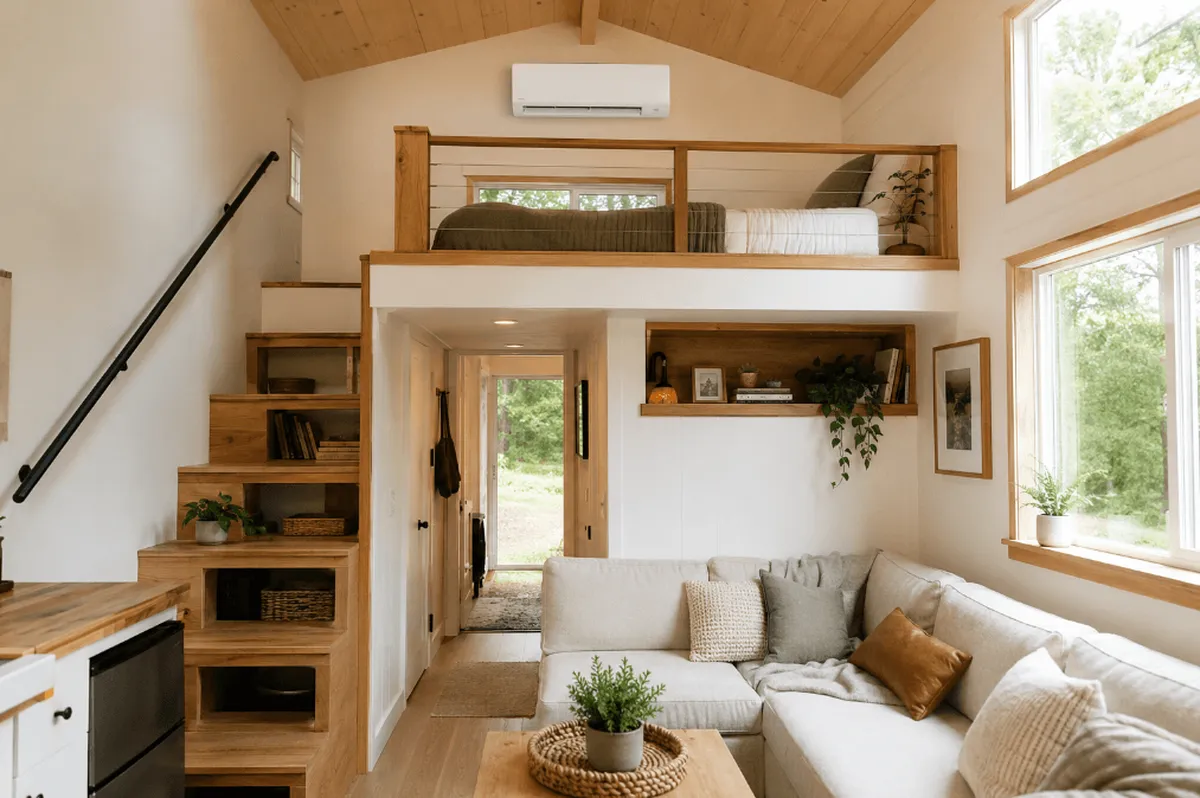
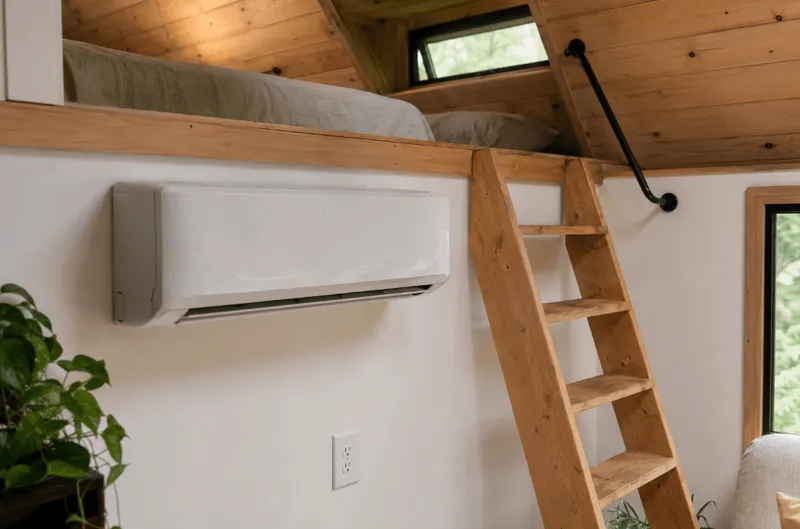
Mounting flexibility is the other advantage. A wall-mounted unit near the loft ladder, a ceiling-mounted unit over the main living area, or a compact floor console can all work, depending on where the loft cuts into the wall space. Professional installation is required. If you are weighing the cost against a window unit, our cost-versus-value breakdown walks through the numbers.
Filtration And Air Quality In A Tiny House
A tiny house has far less air volume than a standard home, so dust, cooking particles, and humidity are more concentrated. Every Filterbuy mini split, including the 12,000 BTU and 18,000 BTU 115V models, ships with a built-in mesh filter that catches dust and pet dander, but it was never designed to replace whole-home filtration, and it needs cleaning more often since the same filter works through a much smaller volume of recirculated air. See how mini splits affect indoor air quality for more.
Because a mini split recirculates indoor air rather than bringing in fresh air, a tiny house also benefits from cracking a window after cooking, in line with the minimum residential ventilation standard. Dry mode helps hold humidity in a comfortable range, and keeping indoor humidity below 50 percent matters in a small, sealed space with nowhere for moisture to go.
Common Mistakes When Sizing A Mini Split For A Tiny House
Sizing to the whole footprint but forgetting the loft, which needs its own share of BTUs.
Choosing 230V by default. A dedicated circuit on a trailer can cost more than the unit itself, which is why Filterbuy builds 115V versions of both its 12,000 BTU and 18,000 BTU mini splits.
Undersizing to save money. A unit that never catches up runs at full capacity constantly and wears out faster.
Treating the built-in mesh filter as a complete air-quality plan. It protects the coil, not your lungs.
Skipping a load calculation. An online BTU estimate is a starting point, not a professional check.
“After manufacturing filters for over a decade and serving more than two million households, we’ve learned that sizing gets all the attention and filtration gets none of it, and in a tiny house that’s backward. You have less air to work with, so whatever you put into it matters more, not less.”
David Heacock, Founder and CEO, Filterbuy
Frequently Asked Questions
Essential Resources: The Research Behind Every Recommendation
How Certified Ductless Systems Cut Energy Use
ENERGY STAR: Ductless Heating & Cooling: Certified mini splits use up to 60 percent less energy than standard resistance heat and skip ductwork losses entirely.
The Ventilation Rate Every Small Space Needs
EPA: How Much Ventilation Do I Need?: The EPA's minimum residential ventilation standard, a useful benchmark for any tightly sealed space relying on a mini split.
How Heat Pump Technology Performs Across Climates
Department of Energy: Heat Pumps: DOE's overview compares air-source, geothermal, and ductless mini-split systems across climates.
The Humidity Threshold That Keeps Mold Away
CDC: About Mold: CDC guidance on keeping indoor humidity below 50 percent, a target a mini split's dry mode can help hold.
What Actually Makes Ductless Equipment Different
AHRI: Ductless Equipment: AHRI certifies HVAC equipment performance and explains why zone-by-zone control avoids wasted conditioning.
Why Fresh Air Still Matters With A Mini Split Running
American Lung Association: Ventilation: A mini split recirculates indoor air, so the Lung Association's guidance on fresh outdoor air still applies.
The Electrical Safety Rules Behind Every Circuit Choice
NFPA: Electrical Safety In The Home: NFPA's guidance on dedicated circuits applies directly to choosing between a 115V and 230V mini split.
Supporting Statistics: Why Sizing And Filtration Carry Real Weight
1. NIST: Improper Installation Wastes Up To 30% Of Energy
The stat: Improperly installed HVAC equipment increases heating and cooling energy use by about 30 percent.
Source: National Institute of Standards and Technology (NIST)
Why it matters: Sizing and circuit choice matter as much in a tiny house as a full-size home.
2. AAFA: Indoor VOCs Run 2 To 5 Times Higher Than Outdoors
The stat: Volatile organic compounds can measure 2 to 5 times higher indoors than outdoors.
Why it matters: That effect is magnified in a tiny house's smaller air volume, so the mesh filter needs regular cleaning.
3. EIA: Space Conditioning Is 55% Of Residential Energy Use
The stat: Heating, cooling, and ventilation made up 55 percent of residential delivered energy use in 2021.
Why it matters: A correctly sized heat pump's efficiency carries real weight in the energy bill.
Glossary
Mini Split: A ductless heating and cooling system with an outdoor compressor connected to indoor units by a small refrigerant line, requiring no ductwork.
BTU: British Thermal Unit, a measure of heating and cooling capacity: the energy to raise one pound of water by one degree Fahrenheit.
115V: A standard household outlet voltage in most U.S. homes, used to power smaller appliances without a dedicated circuit.
230V: A higher voltage connection needing its own dedicated circuit, like what powers an electric clothes dryer.
Heat Pump: An HVAC system that moves heat rather than generating it, reversing refrigerant flow to heat and cool from one unit.
SEER: Seasonal Energy Efficiency Ratio, a rating of cooling efficiency over a season. Higher numbers mean better efficiency.
Tiny House On Wheels (THOW): A small dwelling on a trailer chassis, typically classified as a recreational vehicle rather than a site-built home.
Inverter Compressor: A variable-speed compressor that adjusts output continuously instead of cycling on and off, improving efficiency and reducing noise.