Installation, Costs & Filter Guide (CA Climate)
Author: Michelle Wan
Reviewed by: David Clark, Licensed HVAC Technician
Published: August 27, 2026 · Updated: August 27, 2026
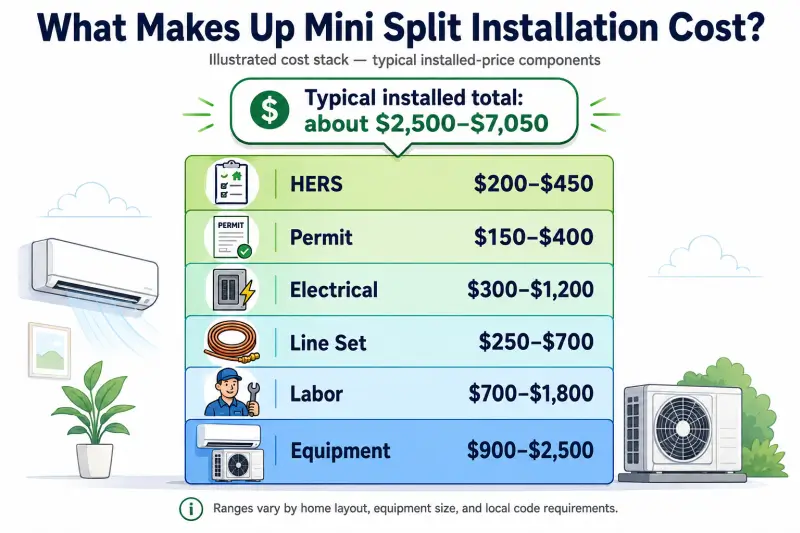
A single-zone mini split installation in Los Angeles runs $2,272 to $5,680, with most homeowners paying around $3,408. Multi-zone systems that cover a whole house run roughly $7,000 to $15,000. The size of the room is what sets the system size, and the system size is what sets the price.
Two Los Angeles specifics worth knowing before you get quotes. LADWP pays $1,500 to $2,500 per ton on qualifying ductless heat pumps, but ADUs and room additions are not eligible. And the federal 25C tax credit expired for systems placed in service after December 31, 2025.
Start by matching your room to a system size, then take the quiz below to see which one fits.

Answer 3 quick questions and we will match you to the right mini split size for your space.
Ready to look at systems? Shop Filterbuy single-zone mini split systems with published prices, free 2-day delivery on in-stock systems, and a 7-year compressor / 3-year parts warranty. Professional installation is required; the warranty is void if self-installed.
Mini split installation in Los Angeles runs about $2,272 to $5,680 for a single zone, with multi-zone whole-home projects reaching $7,000 to $15,000. Los Angeles Department of Water and Power customers can claim $1,500 to $2,500 per ton on qualifying ductless heat pumps. The federal 25C tax credit expired December 31, 2025.
Disclosure: Filterbuy manufactures air filters and sells single-zone ductless mini split systems. This guide names our products where they fit and says plainly where they do not. Filterbuy does not install HVAC in Los Angeles and is paid by no contractor mentioned here.
A single-zone ductless mini split in Los Angeles typically costs $2,272 to $5,680 installed. LADWP pays more for ductless than for central ducted heat pumps, but only on existing homes served whole-house. Additions and ADUs are excluded outright. Los Angeles requires a mechanical permit and Title 24 compliance. And a mini split is a comfort upgrade, not an air quality upgrade: the screen inside the head protects the coil, not your lungs.
Single-zone mini split installation in Los Angeles averages $3,408, in a range of $2,272 to $5,680, per Angi's May 2026 LA cost data.
LADWP pays $1,500 to $2,500 per ton for qualifying ductless heat pumps, versus $1,000 to $1,250 for central ducted. That applies only to existing homes, and only when the system serves the whole house.
New construction, additions, and ADUs are excluded from the LADWP rebate entirely. They are not paid at a lower tier. They are ineligible.
The federal Section 25C tax credit expired for equipment placed in service after December 31, 2025. Many Los Angeles contractor pages still advertise it.
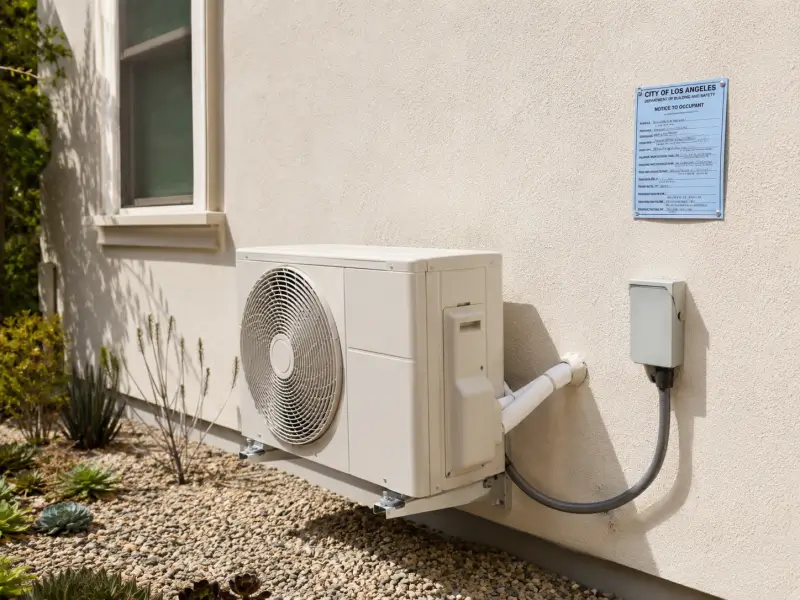
The City of Los Angeles requires a mechanical permit through LADBS, plus Title 24 refrigerant charge documentation on the CF-2R and CF-3R forms.
Ductless AC installation does not improve indoor air quality. The EPA states that mini split HVAC systems generally do not filter fine particles from the air passing through them.
LADWP's top rebate tier requires 9.1 HSPF2 heating performance that most Los Angeles homes will rarely use. Price the efficiency tiers against each other before choosing.
Mini split installation cost in Los Angeles runs $2,272 to $5,680 for a single zone, with most homeowners paying around $3,408. Multi-zone ductless AC systems run roughly $7,000 to $15,000. LA pricing sits above the national average because local labor rates and permit costs are higher.
Three things move that number more than anything else:
Zones. Each indoor head adds equipment and labor. One head for a converted garage is a different project from four heads across a two-story Craftsman in Highland Park.
Line set routing. Standard runs are 25 to 50 feet. Longer runs through walls or up to a second story add $500 to $1,500 per zone.
Electrical. Every outdoor condenser needs a dedicated circuit. Older LA homes on 100-amp panels often need panel work, adding $500 to $1,500.
One 2026 factor is easy to miss. New systems use A2L refrigerants instead of R-410A, and ductless moved mostly to R-32 rather than the R-454B common in ducted equipment. A2L costs more, though how much more is unsettled. Published 2026 estimates range from 8 to 30 percent. Be skeptical of any contractor who quotes that premium to the decimal. If you already own a working R-410A mini split, nothing requires you to replace it.
Before comparing quotes, review how to pick the best mini split for your space and how long mini splits last. A cheaper install on a shorter-lived unit is no saving.
Where our own line fits, plainly: Filterbuy single-zone systems start at $799 for 12,000 BTU with a published price, free 2-day delivery on in-stock systems, and a 7-year compressor / 3-year parts warranty. They are 17 SEER2, rated to 5°F, and single-zone only. For a whole-home multi-zone project, a cold-climate build, or the quietest possible bedroom unit, other brands are the better answer and we would rather say so here than after you have bought.
One requirement that applies before you price anything. Ductless systems require professional installation. On Filterbuy units, the warranty is void if the system is self-installed. Pre-charged DIY kits from other brands still need electrical work, condensate drainage, a wall penetration, and in Los Angeles a permit, so factor that labor in either way.
LADWP's Consumer Rebate Program lists ductless mini split and multi-split heat pumps in its highest incentive tier at $1,500 to $2,500 per ton, above the $1,000 to $1,250 per ton offered for central ducted heat pumps. The exact tier depends on the AHRI-matched SEER2 and HSPF2 ratings of the installed equipment.
Two conditions decide it. The system must serve the entire home. And you must be an LADWP residential electric customer. That covers most of the City of Los Angeles, but not Burbank, Glendale, Pasadena, or areas served by Southern California Edison. Check a recent bill before you assume.
The federal Energy Efficient Home Improvement Credit, known as Section 25C, expired for equipment placed in service after December 31, 2025. Public Law 119-21 terminated it. Installations completed in 2026 do not qualify, and there is no grandfather clause for equipment bought earlier and installed later. If your system was operational by that date, claim it on your 2025 return using IRS Form 5695. Confirm eligibility with a tax professional rather than with a contractor's sales sheet.
The internet has not caught up. Checking LA contractor sites in August 2026 while researching this guide, Filterbuy found pages published months after the credit ended still telling homeowners it "remains available through 2032," with $2,000 stacked into their sample savings math. That is almost certainly stale copy rather than bad faith. It is also live where a homeowner will read it this week. If a 2026 quote includes a federal credit line, ask to see the statute.
Statewide programs are thinner too: TECH Clean California closed single-family heat pump reservations in November 2025, and HEEHRA single-family rebates are fully reserved. LADWP is the meaningful money in LA right now. See our guide to heat pump tax credits for who can still claim it.
If your mini split is going into an ADU, a room addition, or new construction, the LADWP rebate does not apply at any tier. The Consumer Rebate Program page states directly that new construction, additions, and Accessory Dwelling Units are not eligible. Where a property has both a main residence and an ADU, only the main residence qualifies.
This is the single most expensive misunderstanding on this topic, and it is easy to fall into. Most LA mini split demand comes from exactly these projects: the garage that became an office, the ADU over the driveway, the back bedroom that was always ten degrees hotter. A homeowner reads "$2,500 per ton," multiplies by two tons, and budgets $5,000 that is never coming.
Three things to do instead:
Confirm the project type before you sign. "Existing home, whole-house system" and "addition" are different animals to LADWP, and your contractor may not volunteer the distinction.
Ask about South Coast AQMD's GO ZERO program. LADWP's own rebate page points LA-basin residents to it for up to $3,000 on a qualified heat pump. Different administrator, different rules. Worth a call.
Budget the project without the rebate, then treat any approval as upside. Funds are limited and first-come, first-served, so even eligible projects are not guaranteed.
One more thing worth knowing, flagged with no pleasure: as of August 2026, LADWP's own Consumer Rebate Program page still references homeowners receiving up to $2,000 in federal tax credit. That credit ended December 31, 2025. Utility pages go stale like everyone else's. Verify the current terms by phone before you rely on any published figure, including the ones on this page.
Here is a tension no national cost guide surfaces. LADWP sets its rebate tiers on both SEER2 (cooling) and HSPF2 (heating). The top ductless tier requires 20.5 SEER2 and 9.1 HSPF2. But most of Los Angeles barely heats. A Mar Vista bungalow may run its heat a few dozen hours a year.
So an LA homeowner chasing the top rebate tier is partly paying for heating performance the climate will never ask for. That is not automatically wrong. A heat pump that also heats can replace a gas furnace, and the rebate tier may offset part of the equipment upgrade. Run the numbers on your own quote rather than assuming either way. It should be a decision, not an accident.
Two practical consequences:
Skip cold-climate models. Hyper-heating tiers built for sub-freezing operation cost more and solve a problem Los Angeles does not have. Coastal and valley LA are not Denver.
Price the tiers against each other. Ask your contractor to quote the base efficiency tier and the top tier side by side, rebate included. Sometimes the cheaper unit nets out better. Sometimes it does not. You cannot know without both numbers.
Yes. The Los Angeles Department of Building and Safety requires a mechanical permit for every new or replacement ductless mini split installation. It covers the outdoor unit, indoor heads, refrigerant lines, and condensate drainage. A separate electrical sub-permit applies when new circuits or panel work are involved.
Title 24 adds a second layer. Because variable-refrigerant-flow mini splits do not respond reliably to standard superheat and subcooling diagnostics, installers must use the weigh-in charging method from Reference Residential Appendices RA3.2 and record the exact charge on the CF-2R and CF-3R forms. Permit fees in California generally run $250 to $700 including the electrical sub-permit, with third-party HERS verification adding $150 to $350 where required.
A contractor who suggests skipping the permit is doing you no favors. Unpermitted work surfaces during home sales and can trigger retroactive enforcement.
Hire a contractor holding an active C-20 warm-air heating, ventilating, and air-conditioning license from the California State License Board. Verify the number yourself on the CSLB Check a License tool rather than taking a business card at face value. Any mini split installer you shortlist should hold that classification. Get three quotes and compare model numbers, not just the bottom line.
Most rebate denials are not about equipment. They are about sequence. Do these in order, and make the contractor confirm each one in writing.
Confirm your utility and project type. LADWP or Southern California Edison, existing home or addition. Both answers change what money exists before you price anything.
Get the Manual J load calculation. Sizing drives tonnage, and tonnage drives both the quote and the rebate. Skipping it is how homes end up with oversized multi-head systems that short-cycle. LA plan reviewers increasingly ask for the documentation on ADU and addition projects.
Pick equipment against the AHRI certificate, not the brochure. LADWP tiers pay on the matched indoor and outdoor combination. Two components that each meet spec separately can still fail as a pair. Cross-check models against the ENERGY STAR ductless heating and cooling listings, and read our Mitsubishi mini split review if premium equipment is on the table.
Pull the LADBS permit before work starts, with the fee itemized on your quote. A permit applied for after the fact invites inspection problems, and some rebate programs want the finaled permit in the file.
Install, then complete Title 24 documentation. Ask directly who owns this. The weigh-in charge goes on the CF-2R, and any HERS verification on the CF-3R.
Apply for the rebate with the invoice, AHRI certificate, and permit. Funds are first come, first served, and deadlines run from purchase or installation depending on the program.
A contractor who handles steps 3 through 6 routinely is worth more than one who is $400 cheaper and leaves the paperwork to you.
One disclosure that should make this section more useful, not less: Filterbuy HVAC Solutions services ductless systems in Florida and Texas, and does not install in Los Angeles. No contractor on your quote list pays us, and we are not bidding against them. That is why this guide can tell you the federal credit is gone and that some LA quotes still count it.
A ductless mini split improves comfort. It does not improve air quality. The U.S. Environmental Protection Agency states that ductless mini split heat pumps generally do not filter fine particles from the air passing through the device. The mesh screen behind the front panel is a coil guard. It stops lint, pet hair, and heavy dust from coating the evaporator. It carries no MERV rating, and it was never designed to capture PM2.5.
A mini split also brings in no outdoor air. It recirculates what is already in the room.
That gap lands harder here than almost anywhere else. Los Angeles-Long Beach was again ranked the most ozone-polluted metro area in the country in the American Lung Association's "State of the Air" 2026 report, a distinction the region has held in 26 of the report's 27 years; you can pull the LA-Long Beach report card by ZIP code. Add fire-season smoke and everyday PM2.5 from freeway and port traffic, and the honest summary is this: the system you install for a hot bedroom in Sherman Oaks is not the system that handles the air.
Filterbuy is in an unusual position to say that plainly. The company manufactures air filters and also sells single-zone ductless mini split systems. That means no commercial reason to inflate what a mini split filter captures, and none to understate it either. A contractor selling the equipment has one incentive. A company selling only purifiers has the opposite one. Filterbuy sits on both sides of that gap.
If a mini split head takes a filter with a documented rating of MERV 13 or higher, it is doing real particle capture. That is the EPA's own test for any filtration claim. One caveat the rating alone does not cover: higher-MERV media restricts airflow, so it has to suit the system it goes into. Check your equipment's documentation, or ask your technician, before changing filter type. If it doesn't, the fix is a portable air cleaner sized by Clean Air Delivery Rate, plus a proper filter on whatever ducted system serves the rest of the house. We compare both in mini split vs. air purifier, and the EPA's Guide to Air Cleaners in the Home covers how to choose one.
Most Los Angeles homes that add ductless end up hybrid: a mini split in the addition or ADU, a central system everywhere else. That central return is where a MERV 13 air filter earns its keep, provided your system is rated for the airflow restriction that comes with it.
"The mistake I see in Los Angeles is treating a mini split as an air quality purchase. It isn't one. That screen behind the front panel protects the coil. It was never built to catch what LA's air is actually full of. Buy the ductless system for the hot back bedroom, absolutely. Then handle the air as a separate decision, with a rating behind it."
David Heacock, Founder and CEO, Filterbuy
Clean the mesh filter in each mini split head every two to four weeks. Power down, lift the front panel, vacuum the screen, rinse in lukewarm water, and let it dry fully before it goes back. A loaded screen chokes airflow, drops capacity, and eventually shows up as a frozen coil or a wet wall. Intervals vary by manufacturer. Our guide to cleaning mini split filters by brand covers what Mitsubishi, Daikin, LG, and MRCOOL each publish.
Mini split filter replacement is rarer than people expect. Most ductless heads use a washable screen you clean rather than replace. Specialty media that some manufacturers offer, such as deodorizing or coated panels, follow a replacement schedule rather than a wash schedule. Check your model's documentation for which type it uses.
Where replacement filters do matter is sizing, and this is the failure Filterbuy sees most in filters that come back. Mini split openings rarely match the nominal filter sizes the industry standardizes around, so homeowners trim a standard filter to fit. It does not work. A trimmed filter leaks around its own cut edges and captures well below its rating. The media is fine. The seal is gone. Measure the opening first, then order a custom-cut air filter built to those dimensions. Filterbuy stocks more than 600 standard sizes and cuts custom dimensions for openings that fall outside them, which is exactly the mini split case.
Beyond filters, plan on annual professional mini split service: coil cleaning, condensate flush, charge check, electrical inspection. Coastal salt air and canyon dust both shorten the interval between coil cleanings here. Our mini split maintenance guide and how often to service a mini split lay out the seasonal rhythm.
Some symptoms are maintenance. Others are a service call. Knowing which saves a wasted afternoon.
Clean the filter first for weak airflow, a musty smell, or a unit that cools slowly. A loaded screen causes all three, and it costs nothing to rule out.
Call a licensed technician for ice on the line set, water dripping down the wall, a breaker that trips repeatedly, or a blinking status light with an error code. Those point to refrigerant charge, a blocked condensate drain, or an electrical fault.
Never top off refrigerant yourself. A2L refrigerants require certified handling, and a system losing charge has a leak that adding refrigerant does not fix.
Los Angeles adds two local wrinkles. Coastal salt air corrodes outdoor coils faster in Santa Monica and San Pedro than inland, and fire-season ash loads filters and coils well ahead of schedule.
Filterbuy is not affiliated with or endorsed by Mitsubishi, Daikin, LG, Fujitsu, or MRCOOL. Brand references are factual and based on published manufacturer specifications.
Filterbuy sells ductless systems, so take this in the spirit it is meant. A mini split is not always the right call in Los Angeles, and three situations point elsewhere.
Your ducts are in good shape. If the home has well-sealed, correctly sized ductwork and the central system is simply old, a ducted heat pump replacement usually costs less per conditioned square foot and keeps whole-house filtration in one place. LADWP pays less per ton for ducted, but you will likely need fewer tons.
The real problem is the building, not the equipment. A west-facing room in Van Nuys that hits 90 degrees may be an insulation and shading problem. Cooling it mechanically works, and it also means paying to fight the sun every summer for fifteen years. Get an attic insulation quote before an HVAC quote.
Air quality is the actual motivation. If cleaner indoor air is the goal, a mini split is the wrong purchase to lead with. The American Lung Association orders the options as source control, then ventilation, then filtration, and a ductless head is none of the three. Talk to a qualified professional about air quality concerns specific to your household.
Three independent sources back the cost, air quality, and filtration statements on this page.
73%: AC use in the West Census Region, the lowest in the nation
92% / 93%: AC use in the Midwest and South, for comparison
49%: AC use in the Pacific Coast marine climate region
39%: pre-1950 homes in that region with AC, versus 66% of homes built 2010–2020
Why it matters: Los Angeles adds cooling to housing built without it. That is a retrofit market. It is also why line set routing and panel capacity move an LA quote more than equipment price does.
Source: U.S. Energy Information Administration, 2020 Residential Energy Consumption Survey. https://www.eia.gov/todayinenergy/detail.php?id=52558
26 of 27 years: reports ranking Los Angeles worst in the nation for ozone
Worsened: LA ozone compared with the prior year's report
152.3 million: Americans, or 44%, in counties failing on ozone or particle pollution
Why it matters: A mini split does not address ozone. It brings in no outdoor air, and per EPA its stock filter is not rated for fine particles. In Los Angeles it solves comfort. Air quality is a separate decision.
Source: American Lung Association, "State of the Air" 2026. https://www.lung.org/research/sota/key-findings
Coil protection, not air cleaning: EPA states the filters in mini split heat pumps are designed to keep large particles such as pet hair and lint off the equipment.
MERV 13: the rating EPA names as the test for any fine-particle filtration claim on a ductless unit.
One room, while running: EPA notes a ductless system filters only the room it is installed in, and only while operating.
A separate device: the U.S. Department of Energy lists lower air filtration among ductless disadvantages and notes a separate filtered air cleaner may be necessary.
Why it matters: These are functional limits stated by the agencies that set the standards, not marketing positions. They are the reason filtration is a separate decision from comfort.
Source: U.S. Environmental Protection Agency, Indoor Air Quality. https://www.epa.gov/indoor-air-quality-iaq/do-ductless-mini-split-heat-pumps-filter-fine-particles-out-indoor-air
No. Section 25C expired for equipment placed in service after December 31, 2025 under Public Law 119-21. Systems operational by that date can still be claimed on a 2025 federal return.
Generally no. The EPA states that ductless mini splits do not filter fine particles unless the unit carries a documented MERV 13 filter or higher, and they bring in no outdoor air.
Only if it is built to the opening's real dimensions. Trimming a nominal-size filter to fit creates bypass around the cut edges, and the filter then captures well below its MERV rating.
No. LADWP's Consumer Rebate Program excludes new construction, additions, and Accessory Dwelling Units. Where a property has a main residence and an ADU, only the main residence is eligible.
No. Hyper-heating models are built for sub-freezing operation and cost more to solve a problem LA does not have. Standard efficiency tiers heat the region comfortably.
Both usually mean a blocked condensate drain or low refrigerant charge, not a dirty filter. Those need a licensed technician. Clean the filter first only for weak airflow or a musty smell.
Yes. LADBS requires a mechanical permit, plus an electrical sub-permit when new circuits are added, and the install must meet California Title 24 requirements.
A2L refrigerant. Mildly flammable, lower-global-warming-potential refrigerants, R-32 and R-454B, that replaced R-410A in new U.S. residential HVAC equipment.
C-20 license. The California State License Board classification required for HVAC contractors.
Ductless mini split. A system pairing an outdoor compressor with one or more indoor head units by refrigerant line, requiring no ductwork.
HERS. Home Energy Rating System, California's third-party field verification program for HVAC energy code compliance.
LADBS. Los Angeles Department of Building and Safety, the city agency issuing mechanical permits.
LADWP. Los Angeles Department of Water and Power, the municipal utility serving most of the city and administrator of its Consumer Rebate Program.
MERV. Minimum Efficiency Reporting Value, the 1 to 16 filter scale. MERV 13 is the EPA's threshold for fine particle capture.
PM2.5. Fine particulate matter 2.5 microns and smaller, including wildfire smoke and vehicle exhaust.
Section 25C. The federal Energy Efficient Home Improvement Credit, terminated for property placed in service after December 31, 2025.
SEER2 / HSPF2. Current U.S. cooling and heating efficiency ratings. Higher is more efficient; LADWP rebate tiers are set by both.
Ton. A unit of cooling capacity equal to 12,000 BTU per hour. Rebates are often paid per ton.
Filterbuy is an American air filter manufacturer based in Talladega, Alabama, with U.S.-based phone and email support. Filterbuy manufactures its air filters in the USA and offers custom sizing alongside its standard range. The company also sells single-zone ductless mini split systems, and its service arm, Filterbuy HVAC Solutions, installs and services ductless equipment in Florida and Texas.
Why we publish guides like this one. Filterbuy does not install HVAC in Los Angeles and earns nothing from any contractor a reader hires here. That independence is the point. It lets this guide say plainly that the federal tax credit is gone, that ADUs are excluded from the LADWP rebate, and that a mini split will not clean your air. Those are three things a company bidding on the job has less reason to lead with.
Written by Michelle Wan. Reviewed by David Clark, Licensed HVAC Technician. Questions or a correction? Reach the team at (855) 345-8289 or info@filterbuy.com.