
Tip: Ensure you buy the exact air filter size for your system. Certain brands have precise dimensions that only fit their specific models. See related filters
Actual Size: 20.25x25.38x5.25"
 Free Delivery
  Factory-Direct Low Prices, Made in the USA
 Hassle-Free Returns & Free Exchanges
RESIDENTIAL AND/OR COMMERCIAL USE
Change Every 3 Months
Tip: Ensure you buy the exact air filter size for your system. Certain brands have precise dimensions that only fit their specific models. See related filters
Actual Size: 20.25x25.38x5.25"
Free Delivery Factory-Direct Low Prices, Made in the USAHassle-Free Returns & Free ExchangesRESIDENTIAL AND/OR COMMERCIAL USE
Change Every 3 Months
Tip: Ensure you buy the exact air filter size for your system. Certain brands have precise dimensions that only fit their specific models. See related filters
Actual Size: 20.25x25.38x5.25"
Free Delivery Factory-Direct Low Prices, Made in the USAHassle-Free Returns & Free ExchangesRESIDENTIAL AND/OR COMMERCIAL USE
Change Every 3 Months
Many HVAC brands have unique trimmed sizes of their 20x25x5 filters.
For example, a 20x25x5 made for Honeywell systems will not fit other brand systems.
⚠️ This quick step can save you from ordering the wrong size. ⚠️
Find Your Exact Match By Choosing Your Brand Below:
Find Your Exact Match By Choosing the Actual Size (Also known as the trimmed size):
At Filterbuy, we don't cut corners—we craft high-quality air filters right here in the USA and ship them to your doorstep for free. No delays, no gimmicks—just clean air, made easy. With thousands of five-star reviews and filters built for real life & every HVAC system, it's no wonder why over 4 million families trust Filterbuy.

Proudly Made In The USA

Fast, Free Shipping on Every Order

Premium Materials That Go The Distance

85,000+ 5-Star Reviews From Happy Customers

Save Up to 70% Per Filter with Packs


Measure length × width × depth with a tape measure to find the actual size.

Round up each dimension to the nearest whole number to get the nominal size. Example: 20.25x25.38x5.25" in → 20x25x5 nominal.

Search by nominal size on our site for the best fit.


5″ filters give you maximum filtration with minimal maintenance — lasting up to 12 months while handling higher MERV ratings without restricting airflow.
Sizing note:

If the filter you buy doesn't fit, we'll send you a better size.
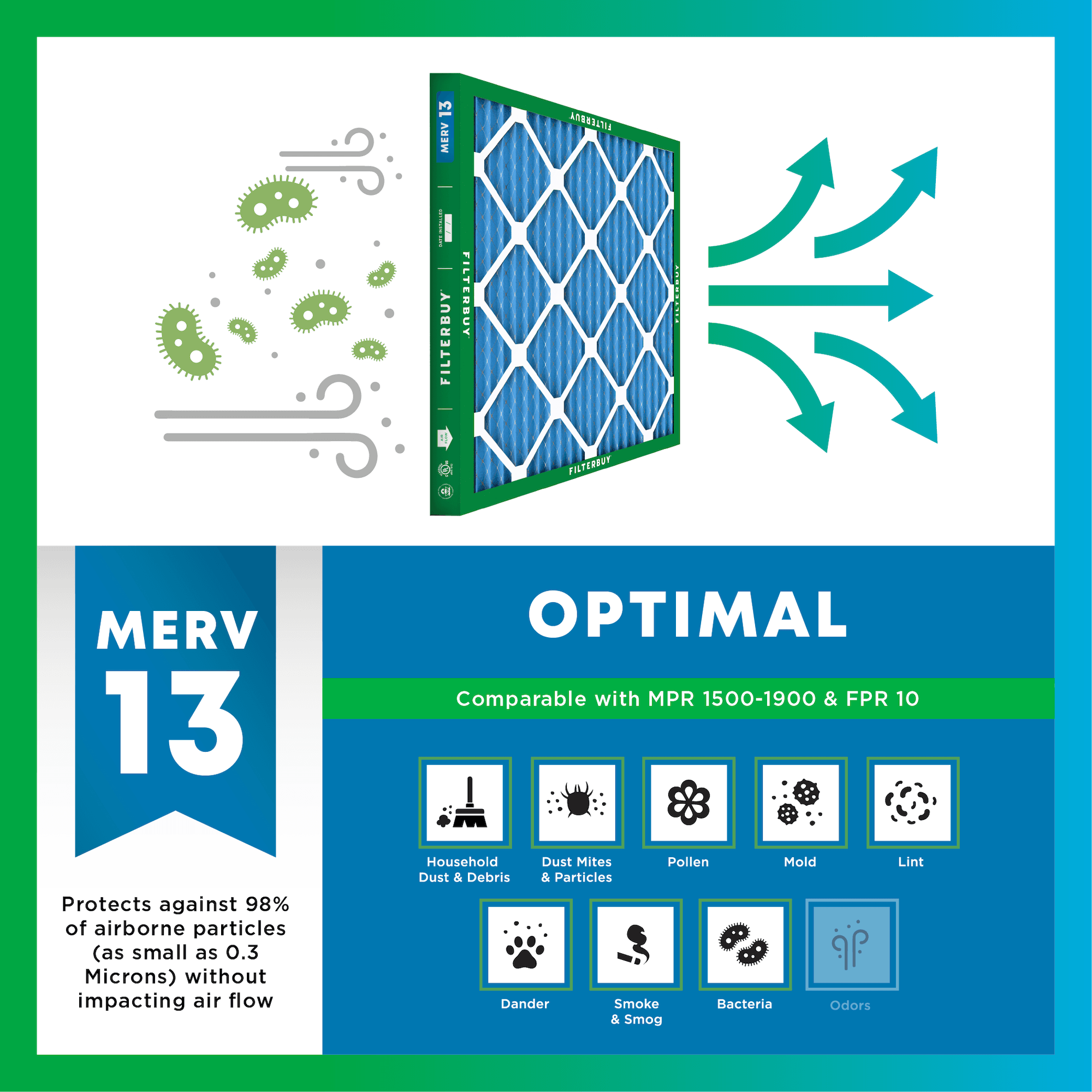
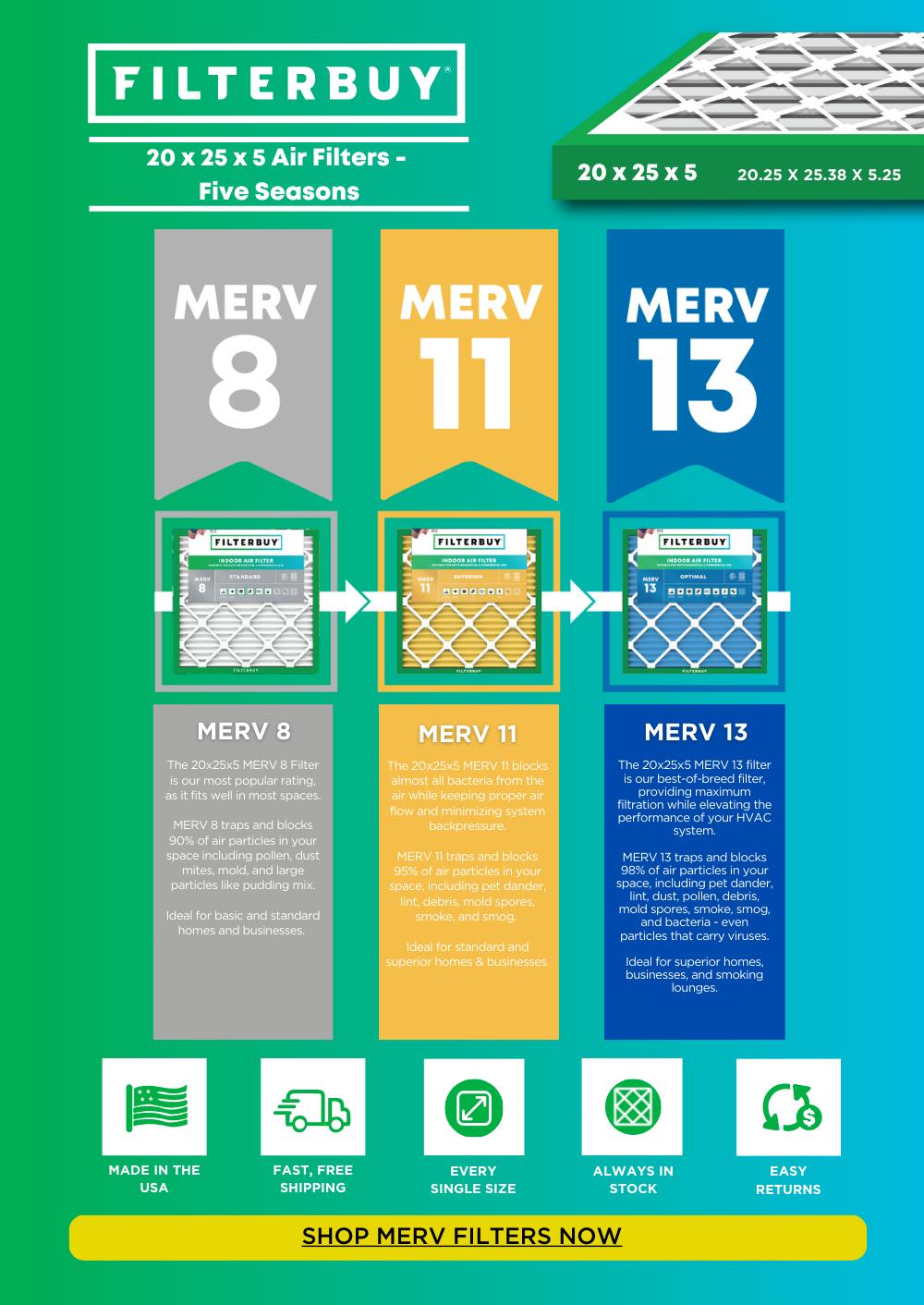
MERV stands for Minimum Efficiency Reporting Value—but don't let the technical name fool you. It's just a way to rate how well an air filter traps stuff like dust, pollen, pet dander, and smoke. The higher the MERV number, the more particles it catches—and the cleaner your air will be.

Comparable to:FPR: 4-7
MPR: 600-1000
 Dust & Debris
 Dust Mites & Particles
 Pollen
 Mold
Mold Lint
Lint Dander
Comparable to:FPR: 6-9
MPR: 1200-1550
Dust & DebrisDust Mites & ParticlesPollenMoldLintDander Smoke & Smog
Comparable to:FPR: 10
MPR: 1900-2800
Dust & DebrisDust Mites & ParticlesPollenMoldLintDanderSmoke & Smog Bacteria


We build every Filterbuy filter to deliver reliable 90-day performance—thanks to smart design and premium materials that do the heavy lifting. Here's what makes the difference:
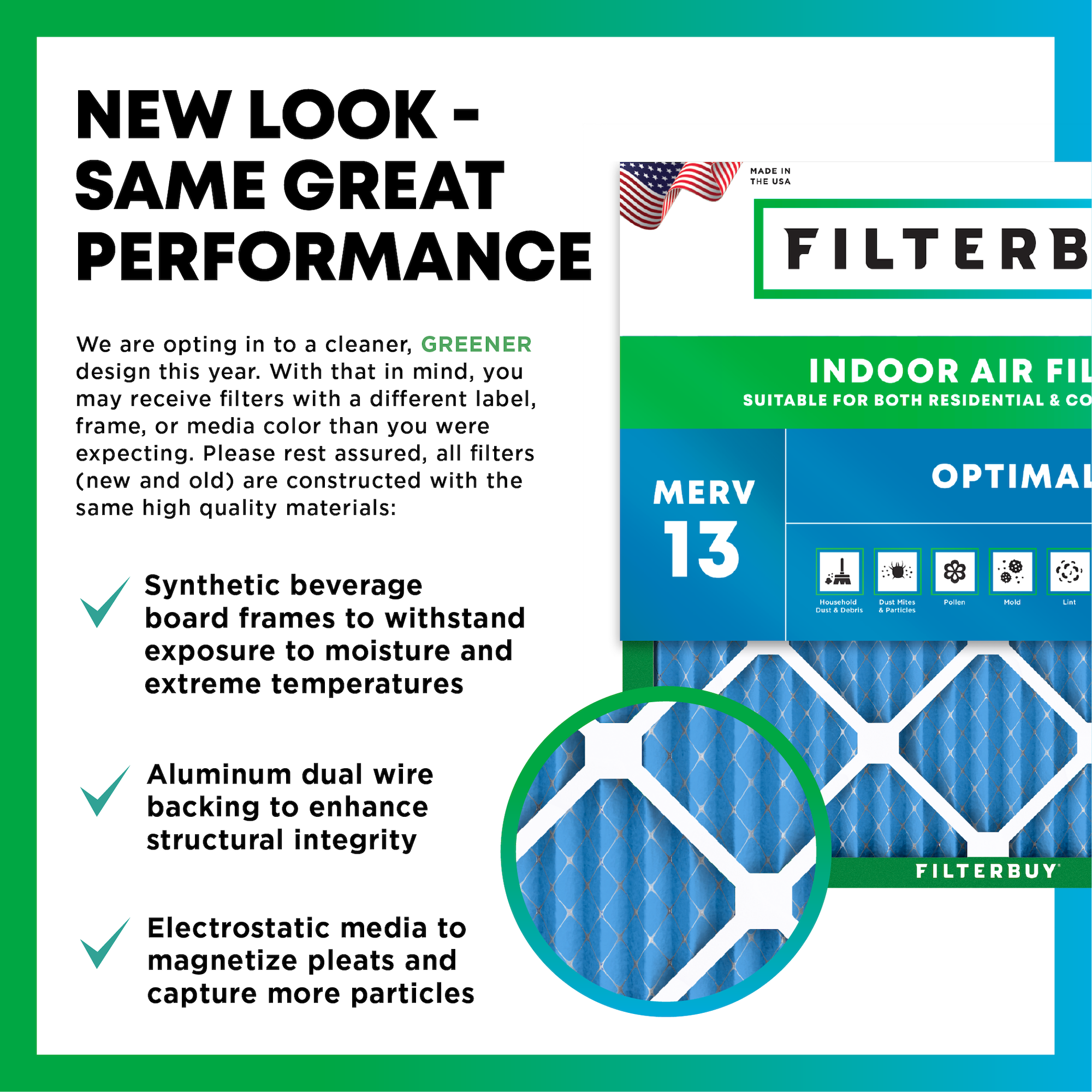
More pleats = more surface area to capture dust and debris, keeping your air cleaner longer.
Pleats are magnetized to attract and trap microscopic particles—like pet dander, pollen, and smoke.
Engineered to resist warping in extreme temperatures and high humidity.

A layer of metal reinforcement keeps pleats evenly spaced and structurally sound—no sagging, even at high airflow.
Assembled with care. Built to perform. Ships fast, free, and reliably from our U.S. facilities.

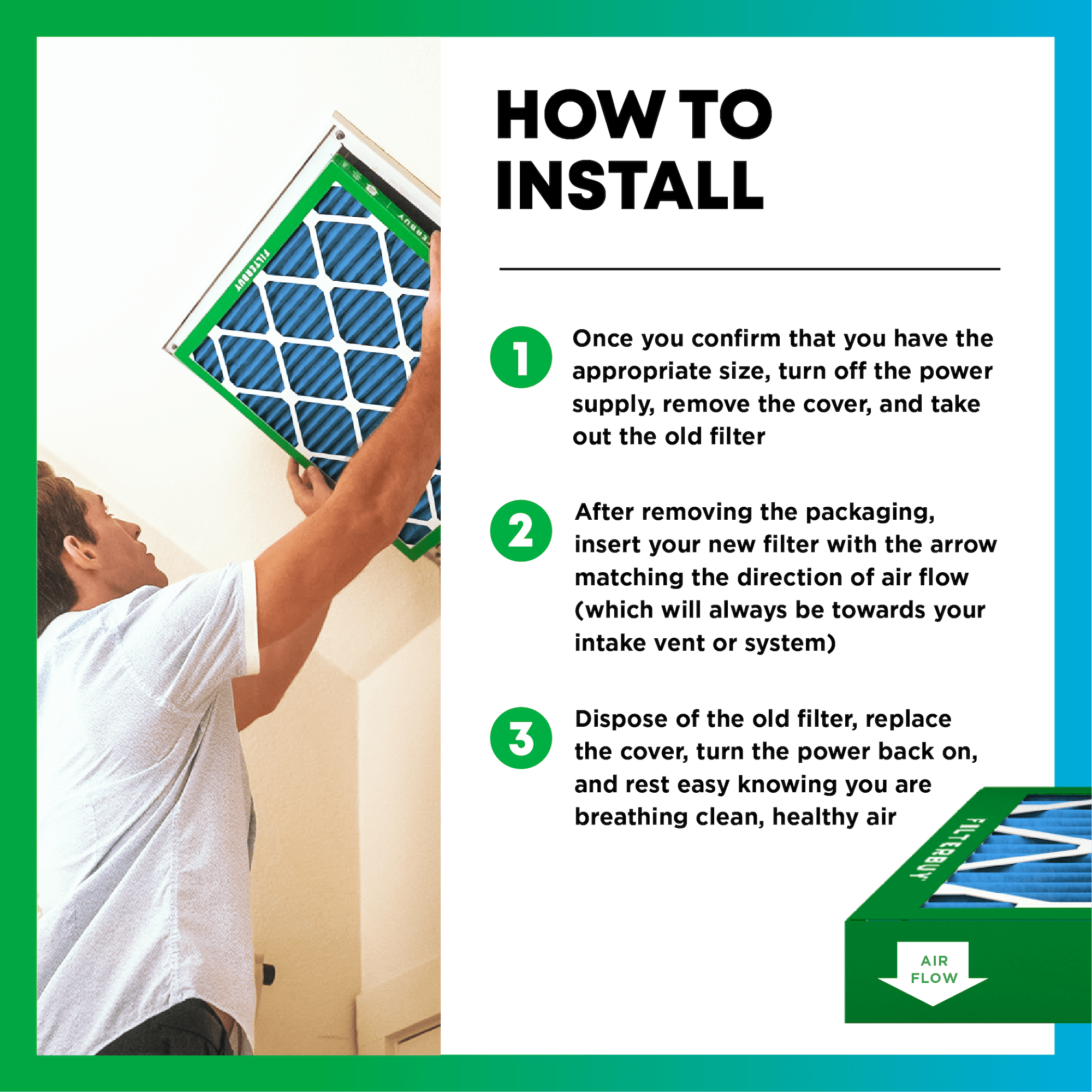
Turn Off Your HVAC SystemSafety first.

Remove The Old FilterLook for the airflow arrow and make note of the direction.

Slide In Your New FilterArrow should point toward the system (same direction as before).

Turn Your System Back OnAnd enjoy the fresh, clean air.

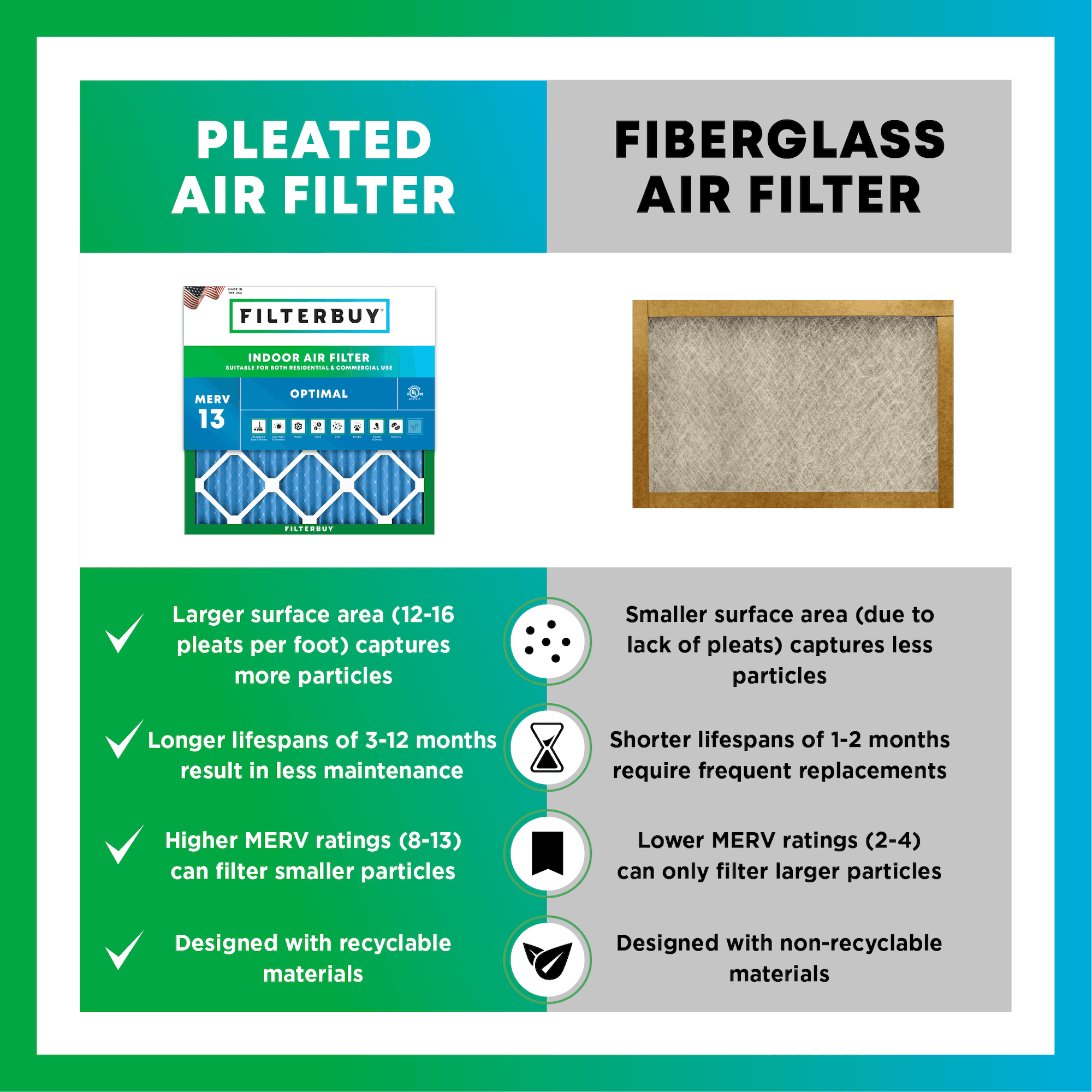
Not all air filters are created equal. Pleated filters don't just last longer—they actually clean your air better. Here's how they stack up:

Efficiency:
High (MERV 8–13) – Traps more particles
Lifespan:
90 days – Long-lasting performance
Air Quality:
Excellent – Cleaner, healthier air
Materials:
Recyclable and durable

Efficiency:
Low (MERV 4 or less) – Misses small stuff
Lifespan:
30 days or less – Replace often
Air Quality:
Minimal – Basic protection only
Materials:
Thin, flimsy, and not recyclable
Pleated filters are a no-brainer—more protection, less hassle, and better air for your home.
Changing your filter on time keeps your HVAC system running efficiently—and helps protect your lungs from dust, allergens, and airborne irritants. Here's how often to swap it out based on your needs:

For most homes without pets or special air quality concerns. Great for general upkeep and energy efficiency.

Shedding fur, dander, and allergy triggers can build up fast. Changing your filter every two months helps keep the air fresher and symptoms at bay.

For households affected by smoke, pollution, or respiratory conditions, monthly changes ensure maximum protection.

| Nominal Size | 20 x 25 x 5 inches |
| Actual Size | 20.25 x 25.38 x 5.25" inches |
| Filter Type | Pleated |
| Media | Electrostatically Charged |
| Frame | Beverage Board |
| MERV Ratings Available | 8, 11, 13 |
| Lifespan | Up to 12 Months |
| Origin | Made in USA |
Smart homes automate almost everything — but after manufacturing filters for over a decade and working with millions of customers, we've learned one thing smart technology still can't do: choose the right filter for the system it depends on. That choice matters more than most homeowners realize. A MERV 13 20x25x5 Five Seasons air filter isn't just a longer-lasting option — it's a precision match for smart HVAC systems that demand stable airflow, consistent static pressure, and fewer filter change interruptions to maintain peak sensor accuracy.
We've seen firsthand what happens when smart systems run on the wrong filtration. Energy costs climb, connected thermostats compensate for conditions they weren't designed to correct, and equipment that should last decades gets quietly worn down. A properly rated MERV 13 filter stops that cycle before it starts — capturing up to 85% of fine particles while working with your system's airflow design, not against it.
Here, we'll show you exactly how to match MERV 13 five-inch filtration to a smart home setup — and why getting this one decision right protects everything your automation is built around.
A MERV 13 20x25x5 Five Seasons air filter is a five-inch deep pleated air filter rated to capture at least 85% of airborne particles in the 1–3 micron size range — including fine dust, pet dander, mold spores, smoke, and virus-carrying droplets. Designed for residential HVAC systems with five-inch filter housings, it delivers up to 12 months of continuous protection — significantly longer than the 30–90 day service life of standard one-inch filters at the same MERV rating.
Key facts:
Filter size: 20 inches x 25 inches x 5 inches
MERV rating: 13
Particle capture: 85%+ efficiency at 1–3 microns
Service life: Up to 12 months
Compatible systems: HVAC units with five-inch filter housings
Best for: Smart homes, allergy sufferers, pet owners, wildfire-prone regions, and high-pollution areas
Why it outperforms one-inch filters:
Five inches of media depth distributes particle load more evenly.
Maintains filtration efficiency longer without rapid airflow restriction.
Supports stable smart HVAC sensor accuracy across its full service life.
Your smart home is only as effective as the filter protecting it. Thermostats, air handlers, and zoning controls all depend on stable airflow — an underrated filter undermines every smart system built around it.
Filter depth matters as much as MERV rating. A five-inch MERV 13 filter delivers fundamentally better performance than a one-inch option — more even airflow, longer efficiency, and up to 12 months of service life.
Most smart homes are running the wrong filter right now. A default MERV 8 one-inch filter left in place after a smart system upgrade drives up energy costs, reduces thermostat accuracy, and shortens equipment life — and no smart platform can correct for it.
Indoor air is the air quality problem that matters most. Indoor pollutant concentrations run 2 to 5 times higher than outdoors. With 46% of Americans living under failing outdoor air quality grades, your filter is your family's primary line of defense.
The upgrade is simpler than the problem it solves. Confirm housing compatibility, install a MERV 13 20x25x5 Five Seasons filter, set a 12-month reminder. Three steps to the clean, stable air your smart home was built to deliver.
Smart HVAC systems are only as reliable as the air flowing through them. Connected thermostats, variable-speed air handlers, and automated zoning controls all depend on stable, unobstructed airflow to read conditions accurately and respond efficiently. After working with millions of homeowners, we've found that smart system performance issues are frequently traced back to one overlooked variable — the filter.
A MERV 13 rating captures particles in the 1–3 micron range with up to 85% efficiency, targeting the fine dust, pet dander, mold spores, and virus-carrying droplets that standard filters miss entirely. For smart homes, that level of filtration isn't an upgrade — it's the baseline your system was designed to operate with.
Not all MERV 13 filters perform equally. The 20x25x5 five-inch media depth is what separates a Five Seasons filter from standard one-inch options — and that difference shows up directly in smart home performance.
Longer filter life: Up to 12 months between changes versus 30–90 days for standard filters
Lower resistance buildup: Thicker media distributes airflow load more evenly, reducing static pressure spikes that confuse smart sensors
Fewer system interruptions: Less frequent replacements mean fewer gaps in your HVAC's operating baseline
Consistent particle capture: Deep media maintains filtration efficiency longer without the rapid loading that degrades thinner filters
From our manufacturing experience, the five-inch depth is the single biggest factor homeowners underestimate when building a smart home air quality strategy.
Smart thermostats and automated HVAC controls are built around one assumption — that the system is operating under consistent conditions. When a filter loads up with debris and restricts airflow, that assumption breaks down. Sensors misread temperatures, humidity levels fluctuate, and the system compensates by running longer cycles that drive up energy costs.
A MERV 13 20x25x5 filter maintains airflow consistency across its full service life, giving your smart system the stable operating environment it needs to function as designed. Homeowners we've worked with regularly report measurable improvements in thermostat accuracy and energy efficiency simply by upgrading to the correct filter depth and MERV rating for their system.
MERV 13 is the right choice for most modern smart home HVAC systems — but there are a few factors worth confirming before making the switch.
Check your system's MERV tolerance: Most modern air handlers support MERV 13 without airflow restriction. Older systems may perform better at MERV 11.
Consider your household profile: Homes with pets, allergy sufferers, or anyone with respiratory sensitivities benefit most from MERV 13 capture efficiency.
Match the filter size precisely: A 20x25x5 filter requires a compatible five-inch filter housing. Using a one-inch filter in a five-inch slot — even at MERV 13 — eliminates most of the performance advantage.
Factor in your local air quality: Homes in high-pollution areas, wildfire-prone regions, or high-humidity climates benefit from MERV 13's broader particle capture range year-round.
When in doubt, we recommend checking your HVAC equipment manual or contacting your system manufacturer to confirm MERV 13 compatibility before upgrading.
One of the most practical advantages of pairing a smart home with a Five Seasons MERV 13 filter is the opportunity to build a maintenance schedule your automation actually supports. Most smart home platforms allow custom reminders and recurring alerts — a simple setup that eliminates the most common reason filters get changed late: forgetting.
Set an annual filter change reminder tied to a seasonal cue — spring startup or fall heating season works well for most climates
Use your smart thermostat's filter reminder feature if available
Track air quality trends through connected IAQ monitors to confirm your filter is performing between changes
Keep one replacement filter on hand so a change never gets delayed by a supply gap
After a decade of manufacturing experience and millions of customer interactions, the homes with the best indoor air quality aren't necessarily the ones with the most advanced smart systems — they're the ones with the most consistent filter maintenance habits.
"After manufacturing air filters for over a decade and working with millions of homeowners, we've learned that smart home technology performs exactly as well as the filtration supporting it — and a MERV 13 20x25x5 Five Seasons filter is the one upgrade most smart HVAC systems are already built to take advantage of, but rarely get."
At Filterbuy, we believe an informed homeowner is an empowered one. After a decade of manufacturing experience and millions of customer conversations, we know the questions that matter most when choosing the right filter for a smart home setup. These 7 authoritative resources give you the expert foundation to make that decision with confidence.
This is the starting point we point every homeowner to first. The EPA's official MERV rating guide explains exactly how filtration efficiency is measured, what particle sizes each rating targets, and why MERV 13 is the agency's own recommended minimum for residential upgrades. If you want to understand what your filter is actually doing inside your system, this is where that knowledge begins.
URL: https://www.epa.gov/indoor-air-quality-iaq/what-merv-rating
Before upgrading to MERV 13, you need to know your system can handle it. This EPA resource walks you through compatibility considerations, fan settings, and filter slot requirements — the practical checklist we recommend reviewing before any filter upgrade decision.
This is the resource most homeowners never find — but should. The EPA's filtration technical bulletin breaks down how filter depth, static pressure, and duct sizing interact directly. It's the clearest explanation available for why a five-inch MERV 13 filter like the Five Seasons performs fundamentally differently than a standard one-inch option in the same slot.
URL: https://www.epa.gov/sites/default/files/2020-06/documents/2019.11_tech_bulletin_filtration.pdf
MERV ratings don't come from marketing — they come from this standard. ASHRAE 52.2 is the governing industry test method that defines exactly how every filter's efficiency rating is measured and assigned. Understanding the standard behind the number gives you the ability to evaluate any filter performance claim with real confidence.
URL: https://www.ashrae.org/File%20Library/Technical%20Resources/COVID-19/52_2_2017_COVID-19_20200401.pdf
We've seen firsthand what happens when a high-MERV filter is installed in a system that wasn't properly sized for it. This Department of Energy resource covers exactly how to avoid that — with guidance on pressure drop tolerance, airflow compatibility, and duct sizing for residential MERV 13 installations.
URL: https://basc.pnnl.gov/resource-guides/high-merv-filters
Clean air isn't just about comfort — it's about protecting your family. The CDC's guidance on residential air filtration connects pleated MERV-rated filters directly to reduced airborne transmission risk in the home, with actionable recommendations that apply directly to your HVAC system and filter selection.
URL: https://www.cdc.gov/respiratory-viruses/prevention/air-quality.html
Smart homes and air quality monitoring are increasingly inseparable — and the science backs it up. This peer-reviewed NIH study examines how IoT-based IAQ monitoring systems work alongside HVAC filtration to create healthier, more responsive home environments. It's the authoritative research foundation behind the smart home air quality connection this page is built around.
URL: https://pmc.ncbi.nlm.nih.gov/articles/PMC7400061/
After a decade of manufacturing and millions of customer conversations, we know this: the most important air quality decisions happen inside your home — not outside it. Here's what the data confirms.
Americans spend approximately 90% of their time indoors, where concentrations of some pollutants are often 2 to 5 times higher than typical outdoor concentrations.
What this means for your smart home:
The air quality battle isn't being lost at your front door — it's being lost at your filter.
Smart systems automate lighting, climate, and security. None of them address what the EPA has documented for decades.
Indoor pollutants accumulate invisibly, at concentrations your family would never tolerate if they could see them.
A MERV 13 20x25x5 Five Seasons filter directly addresses what this statistic makes undeniable — your indoor air is the environment that needs protecting most.
Source: U.S. Environmental Protection Agency — Indoor Air Quality
URL: https://www.epa.gov/report-environment/indoor-air-quality
Asthma is a serious chronic lung disease currently affecting 26.8 million adults and 4.5 million children in the United States.
What we've seen working directly with these households:
Families with asthma sufferers are almost always running filters that weren't chosen with their household profile in mind.
A MERV 8 default factory filter wasn't designed to protect a child with asthma.
MERV 13 targets the exact particle size range — fine dust, mold spores, pet dander, and virus-carrying droplets — most responsible for triggering respiratory symptoms.
For 31 million Americans living with asthma, a correctly rated five-inch MERV 13 filter isn't a premium upgrade. It's the standard their HVAC system should have been meeting all along.
Source: American Lung Association — Asthma Trends Brief
URL: https://www.lung.org/research/trends-in-lung-disease/asthma-trends-brief
The American Lung Association's 2025 "State of the Air" report found that 46% of Americans — 156.1 million people — are living in places that receive failing grades for unhealthy levels of ozone or particle pollution.
What we've seen this shift mean on the ground:
When nearly half the country is living under failing outdoor air quality grades, indoor filtration stops being a maintenance task and starts being a health decision.
Homeowners in wildfire-prone regions, high-pollution metros, and high-humidity climates are asking the same question: what filter is actually capable of protecting my family given what's outside?
The answer, consistently, is a MERV 13 five-inch filter. Here's why:
The media depth handles the particle load.
The rating captures the particle sizes that matter most.
The extended service life means protection doesn't lapse between change intervals.
When outdoor air is failing nearly half the country, your indoor filtration needs to work harder than ever — and a MERV 13 20x25x5 Five Seasons filter is built for exactly that.
Source: American Lung Association — State of the Air 2025
URL: https://www.lung.org/research/sota/key-findings
Smart home technology has never been more impressive. Thermostats learn your schedule. Sensors measure temperature, humidity, and CO2 in real time. After a decade of manufacturing filters and working with millions of homeowners, we've watched this technology evolve firsthand — and we keep noticing the same gap in the conversation.
The most advanced HVAC system in the world is only as effective as the filter protecting it.
Smart systems optimize what they're given. An underrated filter delivers bad inputs — and no automation corrects for filtration it wasn't designed to compensate for.
The homeowners reporting the best smart HVAC performance aren't always running the most advanced equipment. They're the ones who matched their filter rating and depth to their system's actual design specs.
A MERV 13 20x25x5 Five Seasons filter isn't a supporting player in a smart home setup. For most modern systems, it's the foundation everything else performs on top of.
The smart home industry has done a remarkable job helping homeowners automate and monitor indoor environments. What it hasn't done is make filter selection simple enough to match that investment.
Here's what we see most often:
Homeowners upgrade to smart HVAC controls.
They continue running the same MERV 8 one-inch filter the system shipped with.
Not because they don't care about air quality — but because no one connected the dots for them.
That's the gap a MERV 13 20x25x5 Five Seasons filter closes. It's the upgrade that makes every other smart system perform closer to its actual potential by:
Stabilizing airflow your sensors depend on.
Reducing system strain your equipment accumulates silently.
Delivering the consistent indoor air quality your thermostats and air handlers were designed to maintain.
Clean air isn't a feature you add to a smart home. It's the environment a smart home is supposed to create. A MERV 13 Five Seasons filter is how you make sure yours actually does.
You know what separates a high-performing smart home from one that's simply automated. Here's exactly what to do next.
Locate your current filter and check the dimensions on the frame.
Confirm your HVAC unit has a five-inch filter housing — not a one-inch slot.
Check your equipment manual for MERV 13 compatibility.
Still unsure? A five-minute call to your HVAC technician eliminates the guesswork.
Pull your current filter and find the MERV rating on the frame.
MERV 8 or below? Your smart system is working against a compromised baseline.
In place longer than 90 days? Replace it now — your sensors have been reading inaccurate conditions.
Visibly gray or loaded? That filter is costing your system efficiency every hour it stays in.
Select the Filterbuy MERV 13 20x25x5 Five Seasons filter for up to 12 months of protection.
Order two — one to install now, one to have ready so a change never gets delayed.
Every Filterbuy filter is USA-manufactured and precision-sized to eliminate the airflow bypass that loose-fitting filters allow.
Installation takes under five minutes. The reminder takes under one.
Install with the airflow arrow pointing toward the air handler.
Confirm the filter seats flush — no gaps on any edge.
Set an annual change reminder in your smart home platform, thermostat app, or phone calendar immediately after installation.
Smart thermostat with a built-in filter reminder? Activate it now and set the interval to 12 months.
Over the first 30 days, note changes in thermostat accuracy, cycle frequency, and energy consumption.
Have a connected IAQ monitor? Track PM2.5 readings before and after the filter change to confirm improved particle capture.
Set air quality automation triggers to alert you when indoor air quality drops — your real-time signal that the filter may be nearing end of service life.
A: MERV 13 is the filtration efficiency rating assigned under ASHRAE Standard 52.2. It means the air filter captures at least 85% of airborne particles in the 1–3 micron size range. After manufacturing filters for over a decade, this is the question we answer most — and homeowners are consistently surprised by what MERV 13 actually captures:
Fine dust and household particulates
Pet dander and animal proteins
Mold spores and fungal fragments
Smoke particles and smog
Virus-carrying respiratory droplets
On a 20x25x5 Five Seasons filter, that MERV 13 rating is delivered through five inches of deep pleated media — giving it more surface area, higher dust-holding capacity, and consistent filtration efficiency across a full 12-month service life.
A: Up to 12 months under normal household conditions. Here's why — and what we've seen firsthand drive that extended service life:
A one-inch MERV 13 filter exhausts its media capacity in 30–90 days.
A five-inch filter at the same rating has the room to keep performing for a full year.
More media depth means more surface area — particles load gradually rather than rapidly.
Airflow restriction builds slowly, protecting your HVAC system's baseline performance far longer.
Our recommendation based on millions of customer interactions:
Homes with pets or allergy sufferers: visual check at 6 months.
Most households: annual change aligned with spring startup or fall heating season.
A: Most modern smart home HVAC systems are fully compatible with MERV 13. But after working directly with smart home setups, here's what we've learned: compatibility isn't just about MERV rating — it's about filter housing depth.
Before upgrading, confirm these three things:
Your HVAC unit has a five-inch filter housing — not a one-inch slot.
Your equipment manual confirms MERV 13 tolerance.
Your current filter frame measures 20x25x5 — not a smaller depth.
Important: A 20x25x5 filter cannot be installed in a one-inch slot. Forcing a fit creates an airflow bypass that eliminates most of the filter's performance advantage. If your system currently uses a one-inch filter, a five-inch media cabinet can often be retrofitted — a conversation with your HVAC technician almost always confirms it's worth doing.
A: The MERV rating is identical on paper. The real-world performance difference is significant. After a decade of manufacturing both filter depths and hearing directly from customers who've made the switch, here's what actually changes:
Service life: Up to 12 months for the five-inch versus 30–90 days for a one-inch filter.
Airflow consistency: Five-inch media distributes particle load more evenly — one-inch media degrades rapidly under the same conditions.
Dust-holding capacity: Five-inch depth holds significantly more captured particles before performance drops — one-inch capacity is exhausted far sooner.
Static pressure impact: Deeper media builds pressure gradually — one-inch filters spike static pressure faster, straining smart HVAC equipment.
Smart sensor accuracy: Five-inch depth supports consistent operating conditions — one-inch filters disrupt sensor readings as they load.
The bottom line: A one-inch MERV 13 filter isn't a bad filter. It's just not built for what a smart home system — or a five-inch housing — actually needs from it.
A: Yes — and based on what we've seen from homeowners in wildfire-prone regions and high-pollution markets, this has become one of the most urgent reasons customers are upgrading. Here's why it works:
MERV 13 captures fine particulate matter in the 1–3 micron range.
That range directly covers wildfire smoke, smog, and outdoor PM2.5 pollution.
When outdoor air quality fails, your HVAC becomes your home's primary filtration barrier.
Here's what we've seen happen when that barrier is a MERV 8 one-inch filter:
It loads rapidly under elevated particle conditions.
Airflow restricts and smart systems begin compensating.
Indoor air quality deteriorates faster than sensors can flag it.
A five-inch MERV 13 Five Seasons filter handles elevated particle load differently:
Deeper media absorbs the surge without rapid clogging.
Consistent protection is maintained through extended high-pollution events — not just the first few days.
Paired with a connected IAQ monitor, real-time PM2.5 tracking gives you a complete picture of how effectively your system is protecting your family when outdoor air is at its worst.
A MERV 13 20x25x5 Five Seasons air filter is the one upgrade your smart home system is already designed to take advantage of — and your family deserves. Shop Filterbuy's MERV 13 20x25x5 Five Seasons filters today and give your smart home the clean, stable air quality foundation it was built to deliver.

