
Tip: Ensure you buy the exact air filter size for your system. Certain brands have precise dimensions that only fit their specific models. See related filters
Actual Size: 15.13x25.5x5.25"
 Free Delivery
  Factory-Direct Low Prices, Made in the USA
 Hassle-Free Returns & Free Exchanges
RESIDENTIAL AND/OR COMMERCIAL USE
Change Every 3 Months
Tip: Ensure you buy the exact air filter size for your system. Certain brands have precise dimensions that only fit their specific models. See related filters
Actual Size: 15.13x25.5x5.25"
Free Delivery Factory-Direct Low Prices, Made in the USAHassle-Free Returns & Free ExchangesRESIDENTIAL AND/OR COMMERCIAL USE
Change Every 3 Months
Tip: Ensure you buy the exact air filter size for your system. Certain brands have precise dimensions that only fit their specific models. See related filters
Actual Size: 15.13x25.5x5.25"
Free Delivery Factory-Direct Low Prices, Made in the USAHassle-Free Returns & Free ExchangesRESIDENTIAL AND/OR COMMERCIAL USE
Change Every 3 Months
At Filterbuy, we don't cut corners—we craft high-quality air filters right here in the USA and ship them to your doorstep for free. No delays, no gimmicks—just clean air, made easy. With thousands of five-star reviews and filters built for real life & every HVAC system, it's no wonder why over 4 million families trust Filterbuy.

Proudly Made In The USA

Fast, Free Shipping on Every Order

Premium Materials That Go The Distance

85,000+ 5-Star Reviews From Happy Customers

Save Up to 70% Per Filter with Packs


Measure length × width × depth with a tape measure to find the actual size.

Round up each dimension to the nearest whole number to get the nominal size. Example: 15.13x25.5x5.25" in → 16x25x5 nominal.

Search by nominal size on our site for the best fit.


5″ filters give you maximum filtration with minimal maintenance — lasting up to 12 months while handling higher MERV ratings without restricting airflow.
Sizing note:

If the filter you buy doesn't fit, we'll send you a better size.
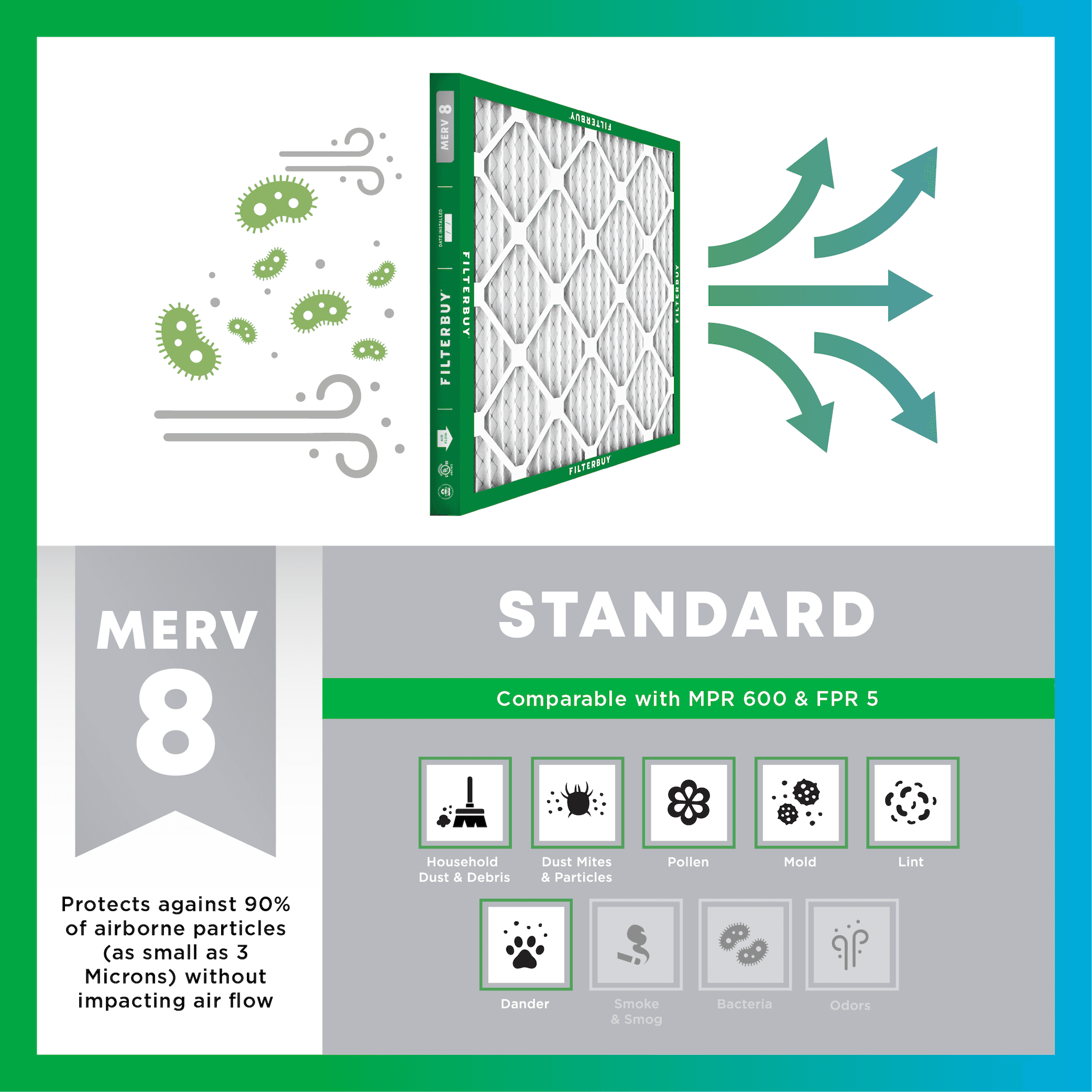
MERV stands for Minimum Efficiency Reporting Value—but don't let the technical name fool you. It's just a way to rate how well an air filter traps stuff like dust, pollen, pet dander, and smoke. The higher the MERV number, the more particles it catches—and the cleaner your air will be.

Comparable to:FPR: 4-7
MPR: 600-1000
 Dust & Debris
 Dust Mites & Particles
 Pollen
 Mold
Mold Lint
Lint Dander
Comparable to:FPR: 6-9
MPR: 1200-1550
Dust & DebrisDust Mites & ParticlesPollenMoldLintDander Smoke & Smog
Comparable to:FPR: 10
MPR: 1900-2800
Dust & DebrisDust Mites & ParticlesPollenMoldLintDanderSmoke & Smog Bacteria


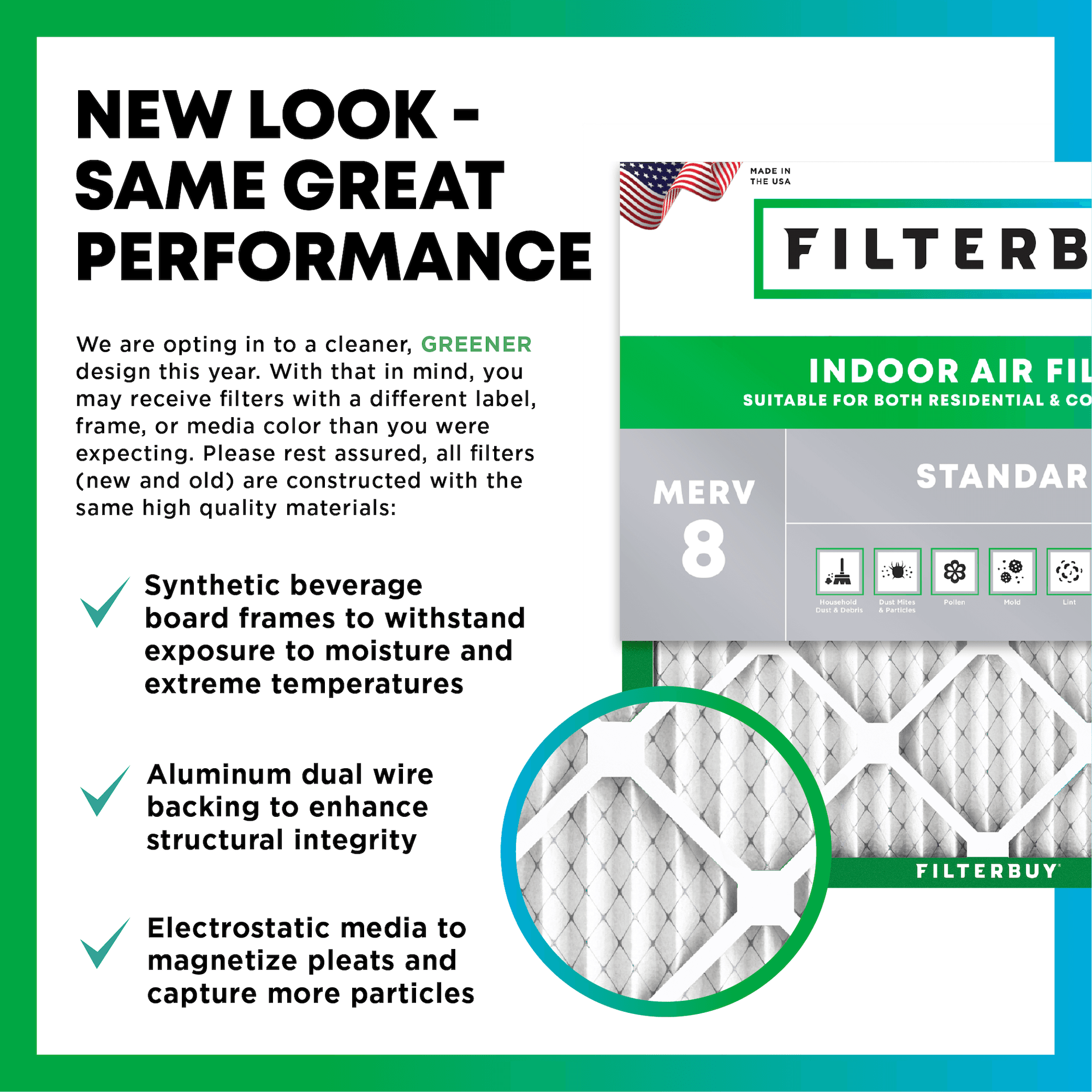
We build every Filterbuy filter to deliver reliable 90-day performance—thanks to smart design and premium materials that do the heavy lifting. Here's what makes the difference:
More pleats = more surface area to capture dust and debris, keeping your air cleaner longer.
Pleats are magnetized to attract and trap microscopic particles—like pet dander, pollen, and smoke.
Engineered to resist warping in extreme temperatures and high humidity.

A layer of metal reinforcement keeps pleats evenly spaced and structurally sound—no sagging, even at high airflow.
Assembled with care. Built to perform. Ships fast, free, and reliably from our U.S. facilities.

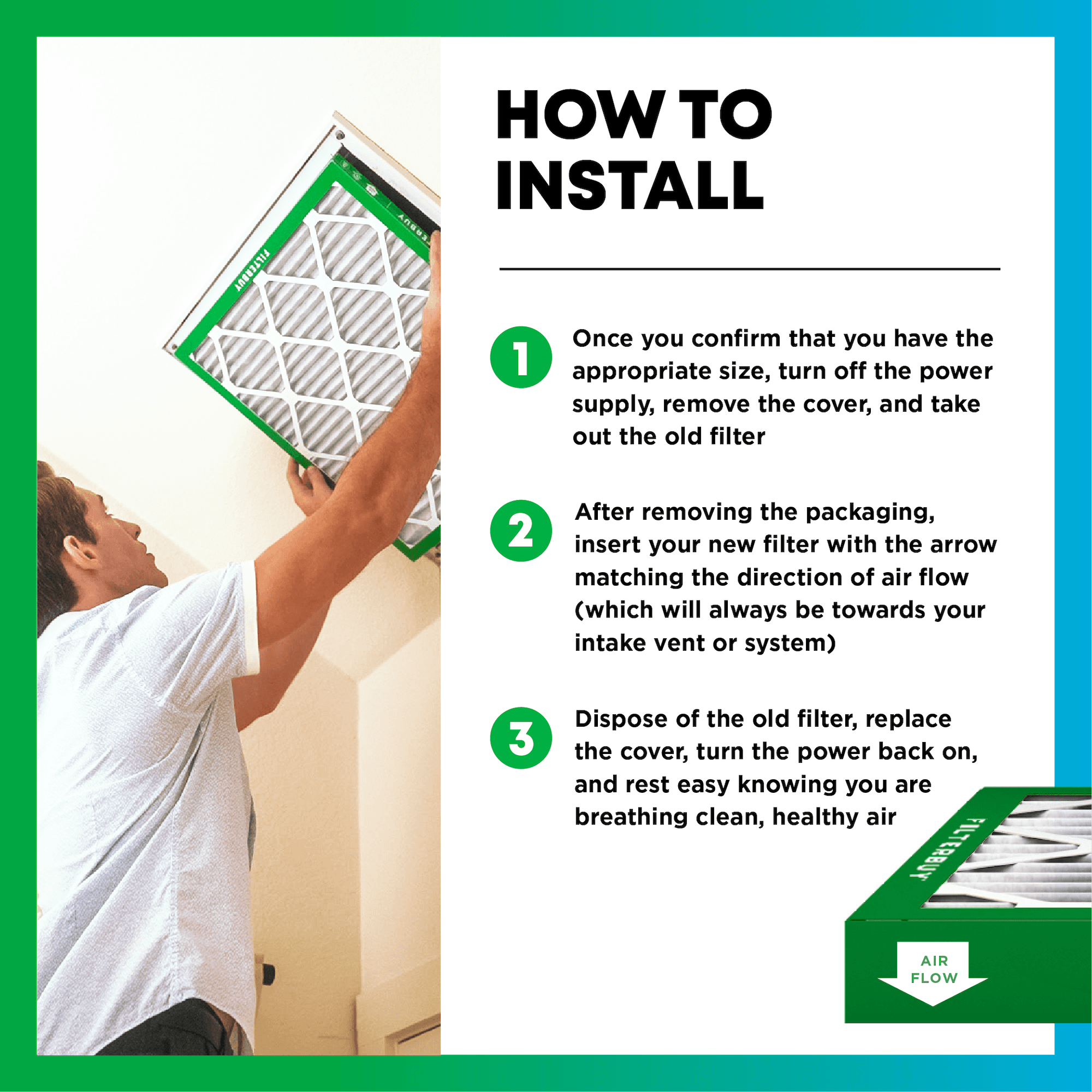
Turn Off Your HVAC SystemSafety first.

Remove The Old FilterLook for the airflow arrow and make note of the direction.

Slide In Your New FilterArrow should point toward the system (same direction as before).

Turn Your System Back OnAnd enjoy the fresh, clean air.

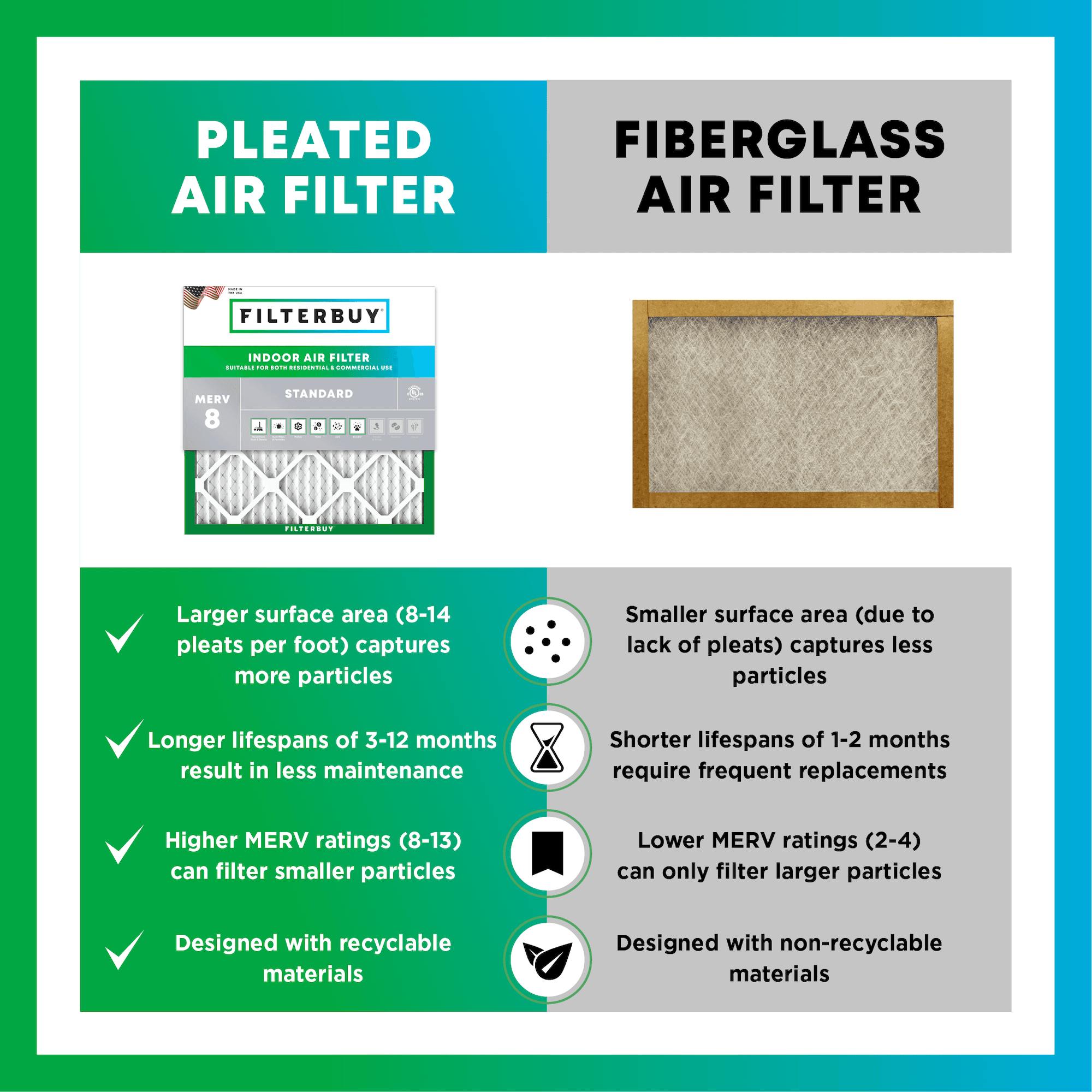
Not all air filters are created equal. Pleated filters don't just last longer—they actually clean your air better. Here's how they stack up:

Efficiency:
High (MERV 8–13) – Traps more particles
Lifespan:
90 days – Long-lasting performance
Air Quality:
Excellent – Cleaner, healthier air
Materials:
Recyclable and durable

Efficiency:
Low (MERV 4 or less) – Misses small stuff
Lifespan:
30 days or less – Replace often
Air Quality:
Minimal – Basic protection only
Materials:
Thin, flimsy, and not recyclable
Pleated filters are a no-brainer—more protection, less hassle, and better air for your home.
Changing your filter on time keeps your HVAC system running efficiently—and helps protect your lungs from dust, allergens, and airborne irritants. Here's how often to swap it out based on your needs:

For most homes without pets or special air quality concerns. Great for general upkeep and energy efficiency.

Shedding fur, dander, and allergy triggers can build up fast. Changing your filter every two months helps keep the air fresher and symptoms at bay.

For households affected by smoke, pollution, or respiratory conditions, monthly changes ensure maximum protection.

| Nominal Size | 16 x 25 x 5 inches |
| Actual Size | 15.13 x 25.5 x 5.25" inches |
| Filter Type | Pleated |
| Media | Electrostatically Charged |
| Frame | Beverage Board |
| MERV Ratings Available | 8, 11, 13 |
| Lifespan | Up to 12 Months |
| Origin | Made in USA |
Pull out your current Electro-Air filter and check the frame against the cabinet rail. Any gap between that frame and the media cabinet wall means your blower has been pulling air around the filter, not through it, on every cycle — carrying pollen, dust mite debris, and mold spores directly into your living space. An undersized or off-spec 16x25x5 air filter creates that gap. A correctly manufactured one closes it.
Filterbuy makes this filter to tolerances tight enough to seat flush against your Electro-Air unit’s slot on the first installation. The MERV 8 rating targets particles in the 3–10 micron range, which covers the allergens most responsible for household air quality complaints and HVAC system contamination. Homes that see elevated pollen and seasonal allergen levels feel that particle capture difference within the first few weeks of a properly seated replacement.
When the fit is right and the rating matches your system, your Electro-Air cabinet does exactly what it was built to do. That’s the whole proposition. The sections below give you the specifics to confirm it.
A MERV 8 16x25x5 filter is the standard replacement for Electro-Air forced-air media cabinet systems. It captures particles in the 3–10 micron range — including pollen, dust mite debris, mold spores, and pet dander — while maintaining the airflow your system needs to run efficiently. Filterbuy manufactures this filter to exact size tolerances so it seats flush in the Electro-Air media cabinet slot, sealing the full airstream through the filter media rather than around it.
Key facts at a glance:
• Filter size: 16x25x5 (nominal), designed for Electro-Air media cabinet systems
• MERV rating: 8 — captures particles 3–10 microns on a single pass
• What it captures: pollen, dust mite debris, mold spores, pet dander
• Recommended replacement interval: every 6–12 months under standard conditions; every 3–6 months in homes with pets, allergy sufferers, or wildfire smoke exposure
• Why fit matters: a filter that doesn't seal flush against all four sides of the cabinet rail allows unfiltered air to bypass the media entirely — the MERV rating becomes irrelevant when the seal fails
• Made in the USA: produced in Filterbuy's domestic facilities in Alabama, Florida, Pennsylvania, and Utah
Exact-fit manufacturing matters. A filter that doesn’t seat flush allows unfiltered air to bypass the media entirely. Filterbuy produces this filter to precise tolerances so the frame contacts all four sides of the media cabinet rail and holds a complete seal.
• MERV 8 is the right rating for most Electro-Air systems. It captures the particle sizes that affect your family’s health without the pressure drop that higher MERV ratings introduce into residential ductwork.
• Replacement frequency matters as much as filter quality. A well-made filter left in place too long performs worse than a mid-range filter changed on schedule. Most households need a new filter every 6–12 months.
• Filterbuy manufactures these filters in U.S. facilities. Production runs through domestic operations in Alabama, Florida, Pennsylvania, and Utah, under direct quality oversight. Consistent manufacturing means consistent sizing — and consistent sizing means a reliable seal.
• Every specification on this page is verifiable. Actual dimensions, media type, frame material, and compatible system formats are listed in the spec table. Order on confirmed facts, not assumptions.
• Subscription delivery closes the replacement gap. The most common reason a filter runs past its service life is that the homeowner forgets to order a replacement. Automatic delivery removes that variable.
Electro-Air systems run air through a dedicated media cabinet — a housing on the return side of the air handler or furnace that holds a thick, 5-inch filter. Electro-Air engineers built that cabinet around a specific filter footprint. A 16x25x5 filter occupies that footprint correctly, making full contact with the cabinet’s inner rails and sealing the airstream so conditioned air moves through the media rather than around it.
Filterbuy manufactures the MERV 8 16x25x5 filter to the nominal dimensions your media cabinet expects. Actual dimensions run fractionally smaller than nominal to let the filter slide cleanly into the slot without compressing or warping the frame.
Frame integrity at the corners and edges determines whether the filter seals completely against the cabinet walls. A warped or undersized frame lets conditioned air, along with every particle it carries, bypass the filter media entirely. Filterbuy builds these frames to hold their shape through the full service life, not just the first installation.
When you slide this filter into your Electro-Air cabinet, the frame should contact all four sides of the slot without visible gaps. If daylight shows around the edges, or the filter shifts in the channel, the dimensions are off and the filter is not sealing correctly.
The 5-inch media depth gives this filter significantly more surface area than the 1-inch filters sold at hardware stores. More surface area means the filter loads more slowly and maintains lower static pressure across the full service cycle, which is why replacement intervals run months longer than standard thin-filter formats.
Electro-Air media cabinets exist specifically because 5-inch filters handle the airflow demands of a whole-home HVAC system more effectively than thin formats that load in 30 days and require monthly swaps. The depth is part of the system design, not a product upgrade.
ASHRAE established the Minimum Efficiency Reporting Value — the air filter efficiency standard — to give homeowners and HVAC professionals a consistent way to compare filter performance across brands and ratings. A MERV 8 filter captures 70% or more of airborne particles in the 3–10 micron range on a single pass.
That 3–10 micron range is the one that matters most for residential air quality. It covers:
• Pollen grains from trees, grasses, and weeds — the primary driver of seasonal allergy symptoms
• Dust mite debris, including fecal particles and body fragments that accumulate in bedding and upholstered furniture
• Mold spores, which a forced-air system distributes through an entire home when the filter fails to intercept them
• Pet dander — microscopic skin particles shed by cats, dogs, and other animals with fur or feathers
After manufacturing filters for over a decade, Filterbuy has a clear picture of where commodity products fail. Frame construction gives first. Pleat density becomes inconsistent from edge to center. Media quality is where importers cut cost last, and it’s also where performance drops furthest. Commodity manufacturers make those tradeoffs because their margins require it. Filterbuy’s production standards don’t leave room for them.
Filterbuy manufactures these filters in U.S. facilities — Alabama, Florida, Pennsylvania, and Utah — under direct production team oversight. Because Filterbuy controls the manufacturing process end to end, the company holds size tolerances that offshore commodity suppliers can’t consistently match. Tolerances that hold mean seals that hold.
A 16x25x5 MERV 8 filter handles substantially more air volume than a 1-inch filter in the same system, which is why replacement cycles run longer. That doesn’t make the filter indefinite. A filter running past its service life restricts airflow, raises the system’s energy consumption, and puts stress on the blower motor over time.
• Standard household, no pets, no allergy concerns: Replace every 9–12 months.
• Household with one or two pets: Replace every 6–9 months. Pet dander and hair load the media faster than standard household dust.
• Household with allergy or asthma sufferers: Replace every 6 months. A cleaner filter delivers measurably better air for sensitive respiratory systems, and the difference shows up quickly.
• Household with wildfire smoke exposure: Replace every 3–6 months, or immediately following a significant smoke event. Fine particles from wildfire smoke saturate MERV 8 media faster than any other residential air quality scenario.
• The filter face reads gray or brown against the light rather than white or off-white
• Airflow from supply registers feels weaker than your normal baseline
• The system runs noticeably longer cycles to reach the thermostat set point
• Dust accumulates on surfaces faster than usual, which signals the filter is no longer intercepting what it should
Check the airflow direction arrow on the filter frame before every installation. The arrow points toward the air handler, in the direction of airflow. A reversed filter cuts filtration performance significantly. The media is rated and tested for airflow in one direction only, and running it backward bypasses the design entirely.
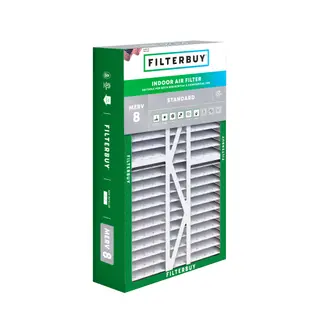
"The pleated media in our 16x25x5 filters carries an electrostatic charge that draws sub-5-micron particles the mechanical pleat structure alone would miss — and in a system like Electro-Air that cycles a whole home's air several times a day, that charge is what separates a filter that earns its MERV rating from one that just prints it on the frame."
Every claim on this page traces to one of these seven sources. Each comes from a federal agency, technical standards body, or public health organization — independently verifiable before you order.
Source: U.S. Environmental Protection Agency — What Is a MERV Rating?
URL: https://www.epa.gov/indoor-air-quality-iaq/what-merv-rating
The EPA defines Minimum Efficiency Reporting Values as a filter's ability to capture particles between 0.3 and 10 microns, derived from the ASHRAE test method. This page gives you the language to evaluate any filter's MERV claim on its own terms — not the manufacturer's.
Source: ASHRAE Standard 52.2 — Method of Testing General Ventilation Air-Cleaning Devices
URL: https://www.ashrae.org/technical-resources/bookstore/ashrae-standard-52-2
ASHRAE Standard 52.2 is the testing protocol that every MERV rating on the market must satisfy before a manufacturer can print the number on a filter frame. It specifies the exact particle size ranges and minimum capture efficiencies that define each MERV level — including the 3–10 micron range where MERV 8 performance is measured.
Source: U.S. Environmental Protection Agency — Guide to Air Cleaners in the Home
URL: https://www.epa.gov/indoor-air-quality-iaq/guide-air-cleaners-home
The EPA notes that filters with a MERV between 7 and 13 are likely to be nearly as effective as true HEPA filters at controlling most airborne indoor particles, and that medium efficiency filters generally allow higher airflow rates — a tradeoff that matters directly for Electro-Air system compatibility. This guide covers how to match a furnace or HVAC filter to both your filtration needs and your system's fan capacity.
Source: U.S. Environmental Protection Agency — Air Cleaners and Air Filters in the
URL: Home https://www.epa.gov/indoor-air-quality-iaq/air-cleaners-and-air-filters-home
This EPA resource explains how HVAC filters work within a forced-air duct system and why a filter that doesn't seat correctly against the cabinet walls allows conditioned air to bypass the media entirely — regardless of the MERV rating printed on the frame. For Electro-Air media cabinet owners, this is the page that puts dimensional accuracy and seal integrity in direct health terms.
Source: U.S. Centers for Disease Control and Prevention — Controlling Asthma
URL: https://www.cdc.gov/asthma/control/index.html
The CDC identifies dust mites, mold, and pet dander as asthma triggers — the same particle types a MERV 8 filter captures on every pass through the system. This page connects regular filter replacement to the specific household exposures that trigger respiratory symptoms in allergy and asthma sufferers.
Source: U.S. Centers for Disease Control and Prevention — Mold: Health Problems
URL: https://www.cdc.gov/niosh/mold/health-problems/
Research cited by the CDC links indoor mold exposure to developing or worsening asthma, hypersensitivity pneumonitis, and allergic rhinitis in otherwise healthy people. A correctly seated MERV 8 filter intercepts mold spores before your forced-air system recirculates them through the home — this page provides the clinical basis for why that matters.
Source: ENERGY STAR — Heat and Cool Efficiently
URL: https://www.energystar.gov/saveathome/heating-cooling
ENERGY STAR reports that nearly half of the average home's annual energy bill goes to heating and cooling, and that a dirty filter slows airflow and makes the system work harder — wasting energy and accelerating equipment wear. This page puts filter maintenance in direct financial terms: what the system costs when the filter is clean versus what it costs when the filter is overdue.
Three verified figures from U.S. federal sources. Each one earns its place on this page because of what it means for the air inside your home — not just as data, but as context Filterbuy has watched play out across years of customer interactions.
Americans spend approximately 90% of their time indoors, where the concentrations of some pollutants are often 2 to 5 times higher than typical outdoor concentrations.
Source: U.S. Environmental Protection Agency — Indoor Air Quality
URL: https://www.epa.gov/report-environment/indoor-air-quality
What this means for your Electro-Air system:
• Most of the air quality conversation focuses on what's happening outside. The EPA data says the higher-exposure environment is the one you're already in — your home.
• Customers who send us photos of spent filters see this figure made physical. The gray-brown accumulation across a loaded media face reflects everything a household generates during normal daily life: cooking byproducts, cleaning product residue, pet activity, skin cells, and tracked-in debris from outside.
• A correctly seated MERV 8 filter in an Electro-Air media cabinet is the only mechanical intervention operating directly on the air your family breathes. There is no outdoor equivalent. You can't close a window to solve an indoor concentration problem.
Nearly half of the energy used in the average American home goes to heating and cooling. The average household spends approximately $1,900 per year on total energy costs.
Source: ENERGY STAR — Heat and Cool Efficiently (U.S. Environmental Protection Agency)
URL: https://www.energystar.gov/saveathome/heating-cooling
What this means for your Electro-Air system:
• Heating and cooling already represents the single largest share of household energy spending. A neglected filter makes that number go up — consistently and quietly, until something fails.
• The pattern we see in customer service interactions more often than we'd like: a repair call that traces back to extended filter neglect. The blower motor worked against elevated static pressure for too long. The system strained. The repair bill arrived.
• A MERV 8 16x25x5 replacement that costs less than $40 protects a system that costs thousands to repair and can reach five figures to replace. That cost relationship holds regardless of how long a homeowner waits to act on it.
Approximately 25 million Americans — 7.7% of the U.S. population — currently have asthma. Among children under 18, current asthma prevalence stands at 6.5% as of 2024.
Sources: U.S. Centers for Disease Control and Prevention — FastStats: Asthma
URL: https://www.cdc.gov/nchs/fastats/asthma.htm
What this means for your Electro-Air system:
• Households where a child or adult manages asthma or documented allergen sensitivities tend to replace filters every 3 to 6 months rather than the standard 9 to 12. Those families have already made the connection between filter condition and symptom frequency — typically through a difficult experience, not a recommendation.
• The CDC's 25 million figure tells you how many Americans have asthma. What it doesn't show is how many of those households are running a forced-air HVAC system with an overdue filter right now.
• The moment a loaded filter stops performing at its rated efficiency is invisible to the family living with it. Dust mite debris, mold spores, and pet dander continue circulating. Symptoms escalate. The connection to the filter often doesn't get made until after the fact.
• For roughly one in fourteen American children currently managing asthma, the filter in their home's HVAC system is an environmental health decision with measurable consequences. It tends to get treated like a routine maintenance item. The CDC data suggests it deserves more consideration than that.
The filter in your Electro-Air media cabinet is not a commodity item.
Electro-Air’s engineers designed those systems around a specific filter format — the 5-inch media cabinet — because they understood filtration and airflow as a single engineering problem, not two separate ones. A properly fitted, correctly rated filter is what lets a forced-air system handle both without compromise.
MERV 8 is the right call for most residential Electro-Air applications. It captures the particles that actually affect daily health without creating the static pressure penalty that MERV 11 and MERV 13 introduce. For households with pets, allergy sufferers, or anyone managing a respiratory condition, MERV 8 is the appropriate starting point, not the maximum. Upgrading to MERV 11 should be a deliberate, system-confirmed decision — not an automatic assumption that more filtration always produces better outcomes.
Filterbuy has always maintained that the filter replaced on schedule outperforms the premium filter left in place too long. Setting up automatic delivery is the part of this purchase most people skip. It’s also the part that keeps the replacement cycle from lapsing — and a lapsed cycle is the single most preventable source of degraded indoor air quality in a maintained HVAC system.
1. Confirm your cabinet dimensions. Pull out your existing filter and check the size printed on the frame. You need a 16x25x5 nominal fit. If the numbers match, you’re ready to order.
2. Select your pack size. Single filters work for first-time buyers who want to evaluate the product. Multi-packs cost less per filter and reduce reorder frequency. A 4-pack or 6-pack covers one to three years for most households.
3. Set up automatic delivery. Choose your replacement interval — 6, 9, or 12 months — and enroll in subscription delivery. The filter arrives before the current one needs replacing, and your system never runs on an overloaded filter.
4. Check the installation direction before sliding the new filter in. The airflow direction arrow on the frame should point toward the air handler. A reversed filter bypasses a significant portion of its filtration capacity.
5. Seal and dispose of the old filter immediately. A spent filter carries everything it captured during its service life. Bag it before carrying it through the house to avoid releasing trapped particles back into the air you just improved.
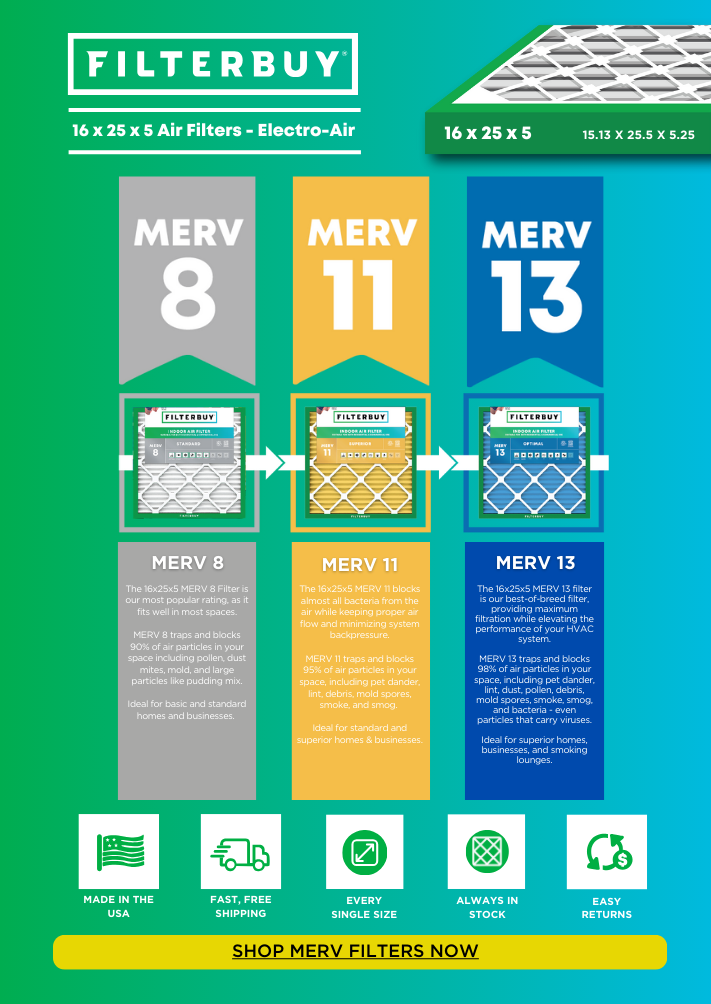
Filterbuy manufactures this MERV 8 16x25x5 filter to fit Electro-Air media cabinet systems that accept a 16-by-25-by-5-inch filter. Before ordering, pull out your existing filter and confirm the size on the frame reads 16x25x5. If the cabinet slot dimensions match, this filter seats correctly. If you’re unsure, your system’s owner manual or a call to Filterbuy’s customer team can confirm compatibility before you commit to an order.
The 5-inch depth provides roughly five times the media surface area of a 1-inch filter with the same face dimensions. More surface area means lower air velocity across the media, slower loading, and a longer service life before the filter restricts airflow. Electro-Air media cabinets use this format because residential HVAC systems need filtration that maintains airflow across a meaningful service interval, not a thin filter that saturates in a month.
Visual inspection gives you the clearest answer. Pull the filter and hold it at an angle toward a light source. A filter past its service life reads gray or brown across the media face rather than white or off-white. Other signs include longer system run times, weaker airflow from supply vents, and dust accumulating on surfaces faster than your normal pattern. As a practical baseline, plan for replacement every 6–12 months under standard conditions and inspect the filter at the 6-month mark regardless of visible loading.
Possibly, but not without checking first. MERV 11 and MERV 13 filters capture finer particles, but they also increase static pressure in the duct system. If your Electro-Air configuration isn’t rated for that added restriction, the blower motor works harder to move the same volume of air, which raises energy consumption and can shorten equipment life. Check your system’s documentation for maximum allowable static pressure or ask a licensed HVAC technician before upgrading.
Yes. Filterbuy ships directly from U.S. production facilities to your address, in packaging that keeps the media and frame intact during transit. Subscription delivery is available for automatic shipment on your preferred schedule — every 6, 9, or 12 months — so your Electro-Air system always has a fresh filter ready when the current one completes its service cycle.
Choosing the best MERV 8 16x25x5 Electro-Air air filter for cleaner and more efficient indoor air starts with a filter built to fit your system exactly and perform through every replacement cycle. Order your Filterbuy MERV 8 16x25x5 filter today and give your Electro-Air system the protection it was designed to work with.

