
Tip: Ensure you buy the exact air filter size for your system. Certain brands have precise dimensions that only fit their specific models. See related filters
Actual Size: 15.13x25.5x5.25"
 Free Delivery
  Factory-Direct Low Prices, Made in the USA
 Hassle-Free Returns & Free Exchanges
RESIDENTIAL AND/OR COMMERCIAL USE
Change Every 3 Months
Tip: Ensure you buy the exact air filter size for your system. Certain brands have precise dimensions that only fit their specific models. See related filters
Actual Size: 15.13x25.5x5.25"
Free Delivery Factory-Direct Low Prices, Made in the USAHassle-Free Returns & Free ExchangesRESIDENTIAL AND/OR COMMERCIAL USE
Change Every 3 Months
Tip: Ensure you buy the exact air filter size for your system. Certain brands have precise dimensions that only fit their specific models. See related filters
Actual Size: 15.13x25.5x5.25"
Free Delivery Factory-Direct Low Prices, Made in the USAHassle-Free Returns & Free ExchangesRESIDENTIAL AND/OR COMMERCIAL USE
Change Every 3 Months
At Filterbuy, we don't cut corners—we craft high-quality air filters right here in the USA and ship them to your doorstep for free. No delays, no gimmicks—just clean air, made easy. With thousands of five-star reviews and filters built for real life & every HVAC system, it's no wonder why over 4 million families trust Filterbuy.

Proudly Made In The USA

Fast, Free Shipping on Every Order

Premium Materials That Go The Distance

85,000+ 5-Star Reviews From Happy Customers

Save Up to 70% Per Filter with Packs


Measure length × width × depth with a tape measure to find the actual size.

Round up each dimension to the nearest whole number to get the nominal size. Example: 15.13x25.5x5.25" in → 16x25x5 nominal.

Search by nominal size on our site for the best fit.


5″ filters give you maximum filtration with minimal maintenance — lasting up to 12 months while handling higher MERV ratings without restricting airflow.
Sizing note:

If the filter you buy doesn't fit, we'll send you a better size.
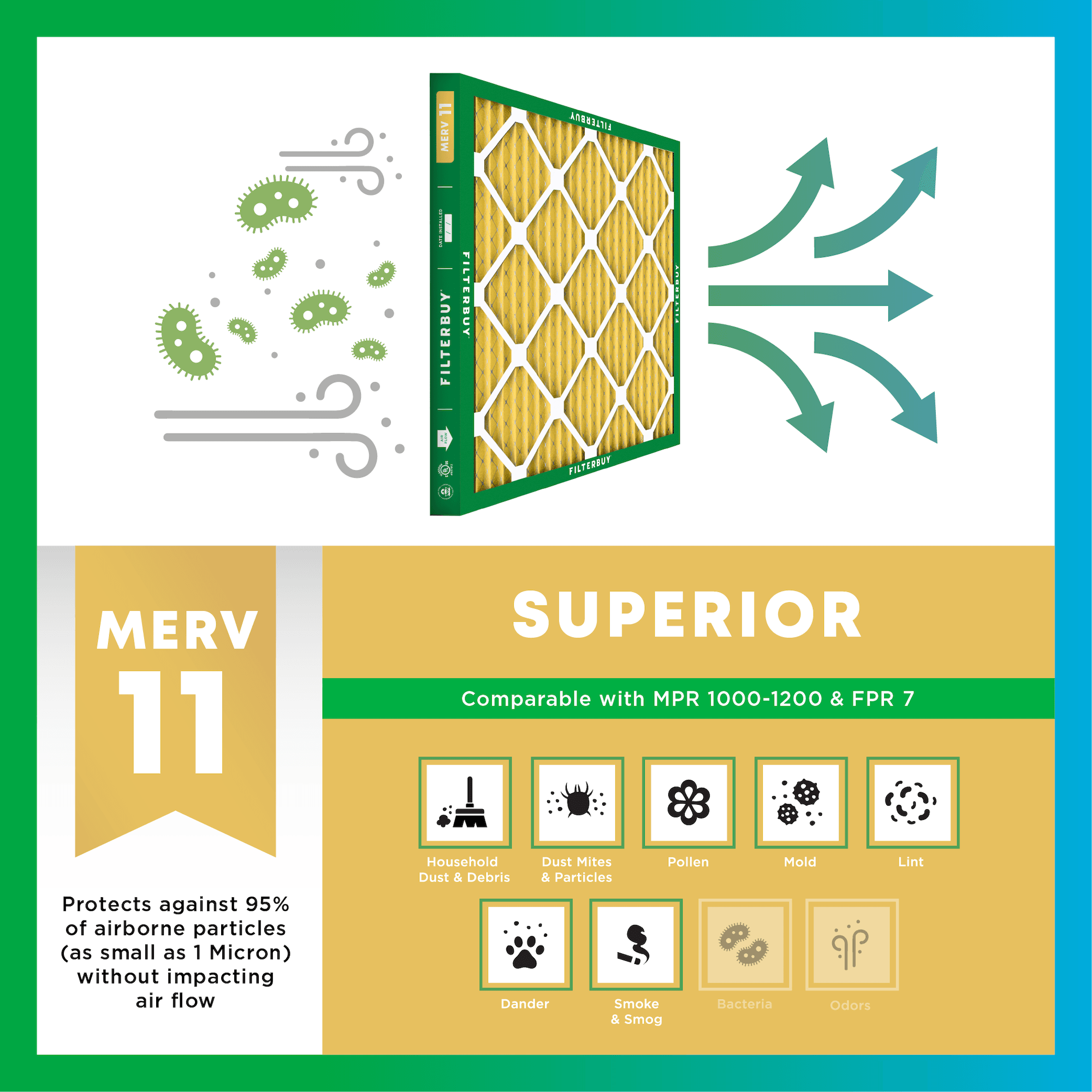
MERV stands for Minimum Efficiency Reporting Value—but don't let the technical name fool you. It's just a way to rate how well an air filter traps stuff like dust, pollen, pet dander, and smoke. The higher the MERV number, the more particles it catches—and the cleaner your air will be.

Comparable to:FPR: 4-7
MPR: 600-1000
 Dust & Debris
 Dust Mites & Particles
 Pollen
 Mold
Mold Lint
Lint Dander
Comparable to:FPR: 6-9
MPR: 1200-1550
Dust & DebrisDust Mites & ParticlesPollenMoldLintDander Smoke & Smog
Comparable to:FPR: 10
MPR: 1900-2800
Dust & DebrisDust Mites & ParticlesPollenMoldLintDanderSmoke & Smog Bacteria


We build every Filterbuy filter to deliver reliable 90-day performance—thanks to smart design and premium materials that do the heavy lifting. Here's what makes the difference:
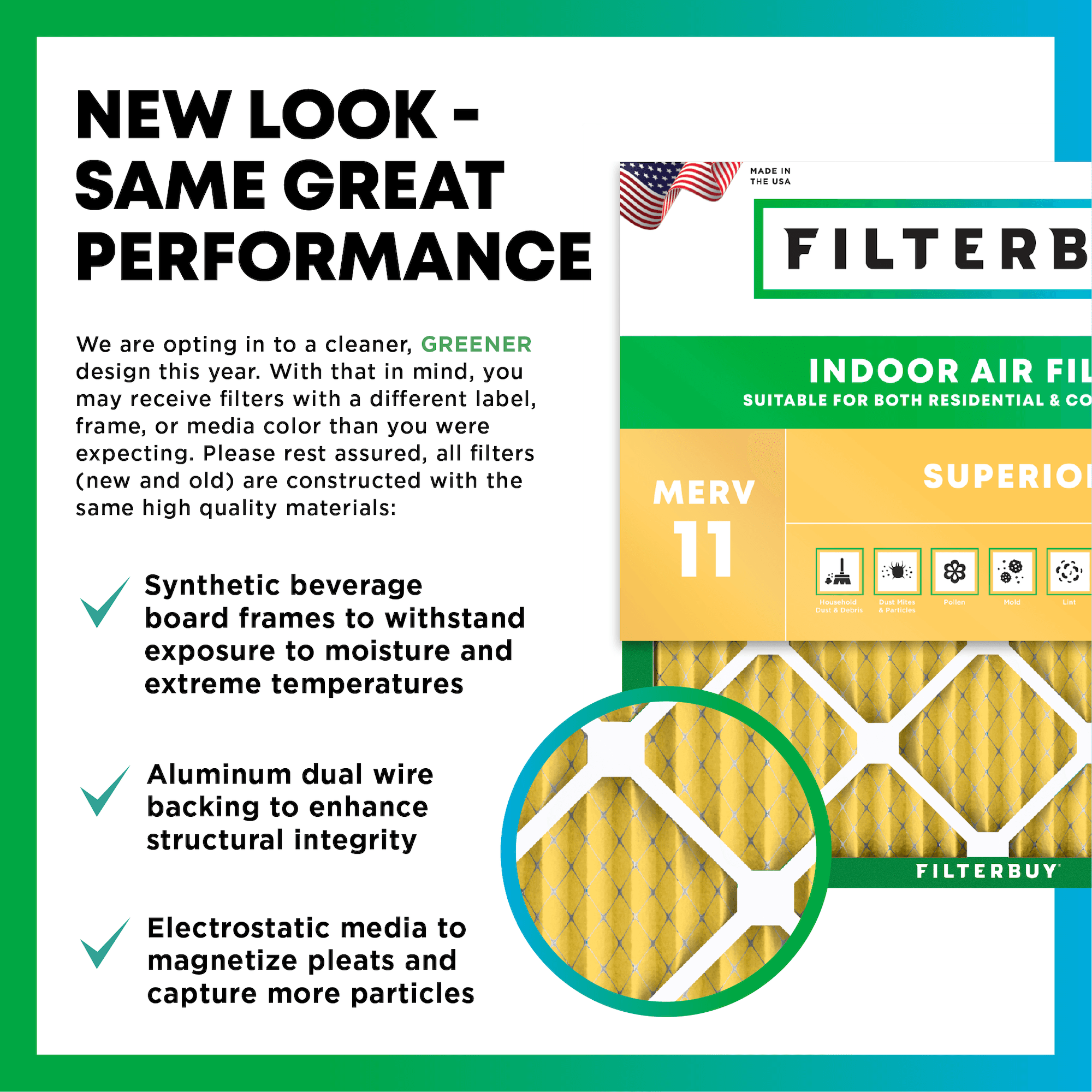
More pleats = more surface area to capture dust and debris, keeping your air cleaner longer.
Pleats are magnetized to attract and trap microscopic particles—like pet dander, pollen, and smoke.
Engineered to resist warping in extreme temperatures and high humidity.

A layer of metal reinforcement keeps pleats evenly spaced and structurally sound—no sagging, even at high airflow.
Assembled with care. Built to perform. Ships fast, free, and reliably from our U.S. facilities.

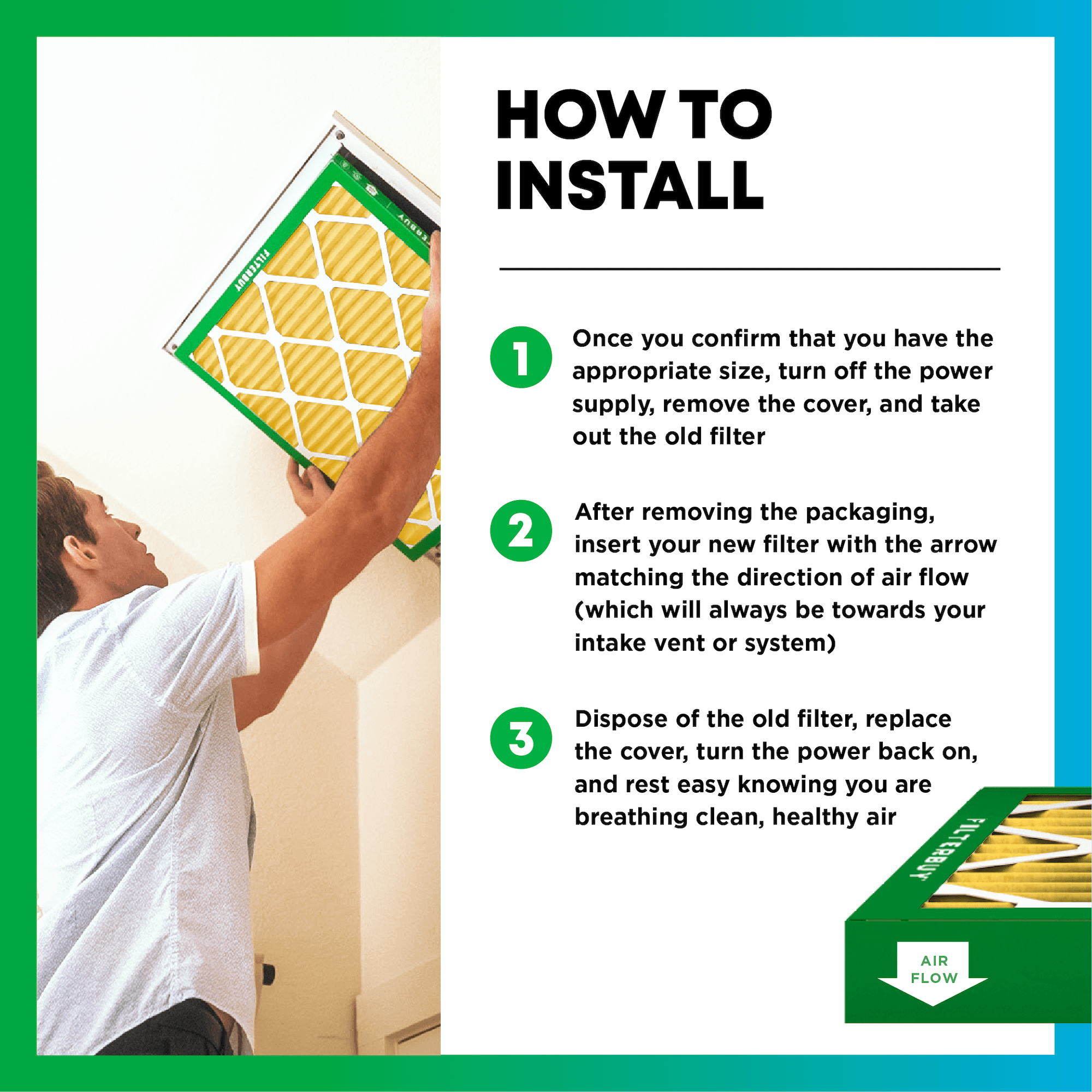
Turn Off Your HVAC SystemSafety first.

Remove The Old FilterLook for the airflow arrow and make note of the direction.

Slide In Your New FilterArrow should point toward the system (same direction as before).

Turn Your System Back OnAnd enjoy the fresh, clean air.

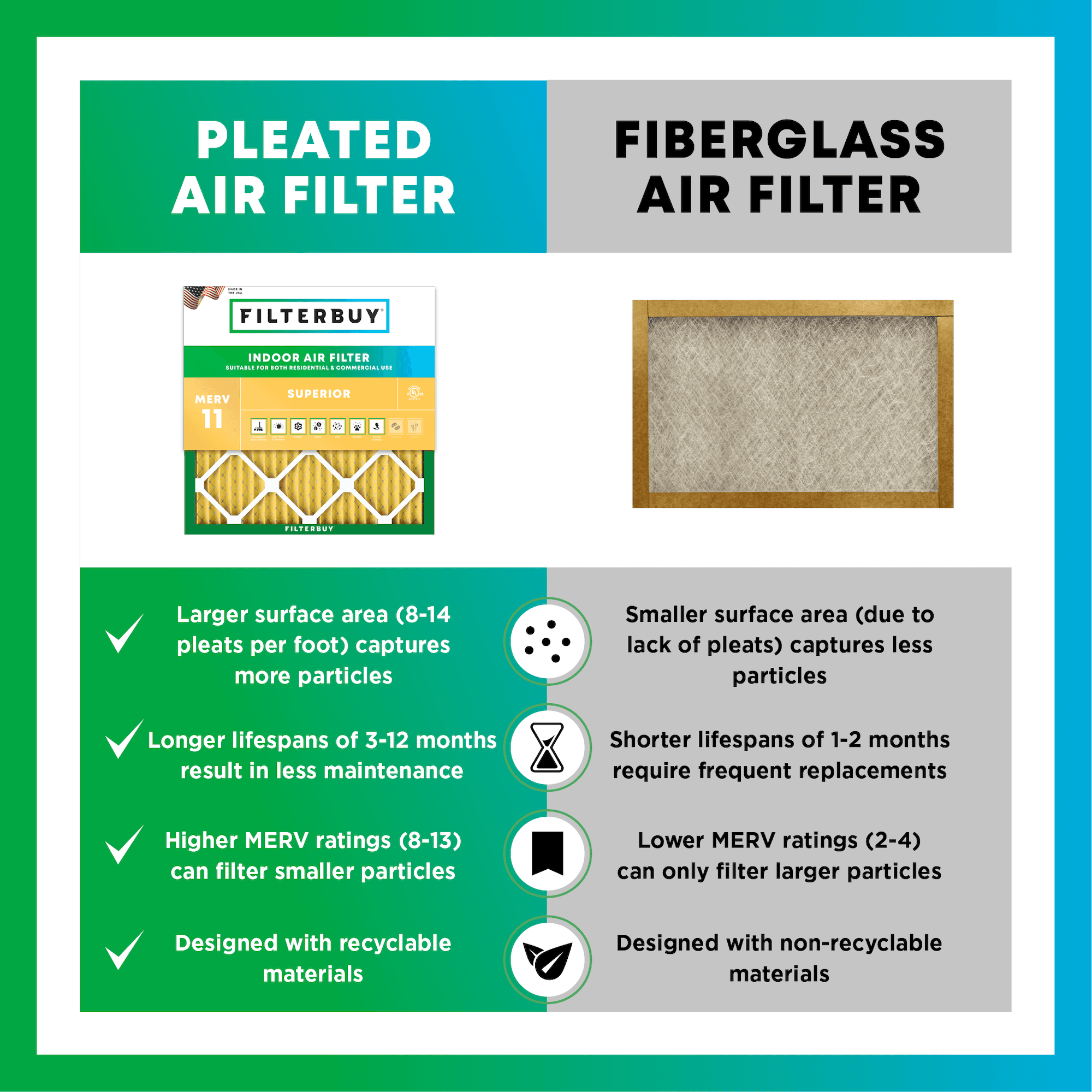
Not all air filters are created equal. Pleated filters don't just last longer—they actually clean your air better. Here's how they stack up:

Efficiency:
High (MERV 8–13) – Traps more particles
Lifespan:
90 days – Long-lasting performance
Air Quality:
Excellent – Cleaner, healthier air
Materials:
Recyclable and durable

Efficiency:
Low (MERV 4 or less) – Misses small stuff
Lifespan:
30 days or less – Replace often
Air Quality:
Minimal – Basic protection only
Materials:
Thin, flimsy, and not recyclable
Pleated filters are a no-brainer—more protection, less hassle, and better air for your home.
Changing your filter on time keeps your HVAC system running efficiently—and helps protect your lungs from dust, allergens, and airborne irritants. Here's how often to swap it out based on your needs:

For most homes without pets or special air quality concerns. Great for general upkeep and energy efficiency.

Shedding fur, dander, and allergy triggers can build up fast. Changing your filter every two months helps keep the air fresher and symptoms at bay.

For households affected by smoke, pollution, or respiratory conditions, monthly changes ensure maximum protection.

| Nominal Size | 16 x 25 x 5 inches |
| Actual Size | 15.13 x 25.5 x 5.25" inches |
| Filter Type | Pleated |
| Media | Electrostatically Charged |
| Frame | Beverage Board |
| MERV Ratings Available | 8, 11, 13 |
| Lifespan | Up to 12 Months |
| Origin | Made in USA |
Somewhere between your furnace blower and the supply vents in your living spaces, a MERV 11 16x25x5 filter is catching pollen, pet dander, mold spores, and fine household dust before they cycle back through every room. That's what this filter is built to do. For most households running an Electro-Air system, it does it well.
Whether your household is 'most' depends on who lives in your home, what your region's air carries, and how your Electro-Air system performs if the rating ever needs to change.
A MERV 11 16x25x5 air filter is a 5-inch deep-media whole-house filter designed to fit Electro-Air media cabinets. It removes pollen, pet dander, mold spores, dust mite debris, and fine household dust at 65–85% efficiency for particles in the 1.0–3.0 micron range — the size band covering the most common residential air quality concerns.
Size: 16 x 25 x 5 inches (deep-media format; not compatible with standard 1-inch return air slots)
MERV Rating: 11 Compatible System: Electro-Air whole-house media cabinet
Particle Range: 1.0–3.0 microns (pollen, mold spores, pet dander, dust mite debris)
Capture Efficiency: 65–85% for E2 particles per ASHRAE Standard 52.2
Filter Life: 6–12 months depending on household conditions
Best For: Most households, pet owners, and mild allergy sufferers without diagnosed respiratory conditions
Households with diagnosed asthma, severe allergies, or consistent wildfire smoke exposure should evaluate a MERV 13 in the same 16x25x5 size, provided the Electro-Air system is rated for the increased static pressure.
• MERV 11 targets the 1.0–3.0 micron particle range, capturing pollen, pet dander, mold spores, and fine household dust at efficiency rates suited to most residential environments.
• The 16x25x5 format is designed for deep-media whole-house cabinets. It doesn't fit the standard 1-inch return air slots found elsewhere in the home.
• Proper fit inside the Electro-Air cabinet frame eliminates bypass air, the most common reason whole-house filtration underperforms.
• MERV 13 captures finer particles and increases static pressure. Confirm your system's airflow rating before upgrading.
• Most households can run a 16x25x5 filter for 6 to 12 months before replacement is needed, compared to 1 to 3 months for a standard 1-inch filter.
• Pets, high occupancy, or wildfire smoke shorten the effective service interval. Inspect the filter face at 6 months regardless of your annual schedule.
MERV 11 is a specific performance claim. This filter removes between 65 and 85 percent of particles in the 1.0–3.0 micron range, which is the size band where the most common household air quality threats live.
The term air filter covers any media designed to pull particles from an airstream. MERV 11 specifies how efficiently this filter does that job across a standardized particle size range established by ASHRAE.
• Pollen (10–100 microns) — grass, tree, and weed pollen that drive seasonal allergy symptoms
• Mold spores (3–12 microns) — a persistent concern in humid climates and basements
• Pet dander (5–10 microns) — the protein-bearing particles behind dander-triggered reactions
• Dust mite debris (10–40 microns) — fragments and fecal matter from the most common household allergen source
• Fine household dust — skin cells, textile fibers, and tracked-in particulate
• Legionella-range bacteria — particles in the 1–4 micron band
Particles below 1.0 micron pass through at higher rates. That includes portions of tobacco smoke, some wildfire smoke particulates, combustion byproducts from gas appliances, and virus-size organisms in the 0.1–0.3 micron band. Households with those specific exposures need a MERV 13 to address a genuinely different class of airborne concerns.
A MERV 11 filter is a calibrated choice. For most American homes, the particle categories it targets are the ones that drive daily air quality and long-term household health.
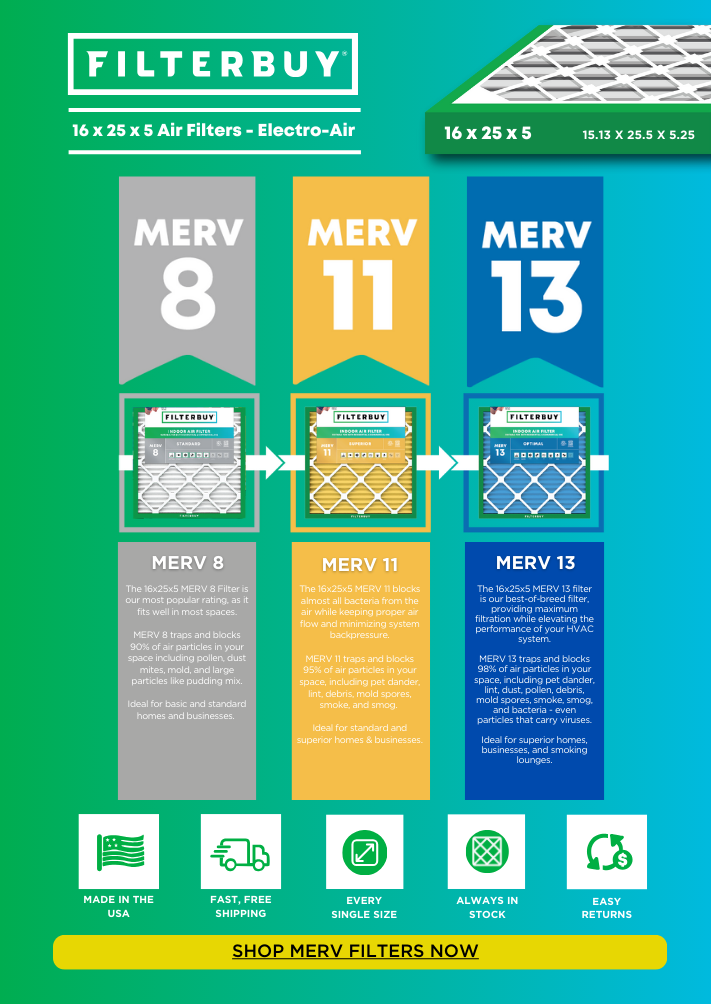
MERV 8
• Particle size range: 3.0–10.0 microns
• Capture efficiency (E2, 1–3 μm): 70%+ for E3 range; lower for E2
• Best suited for: Standard households, low-dust environments, light occupancy
MERV 11 — This Filter
• Particle size range: 1.0–10.0 microns
• Capture efficiency (E2, 1–3 μm): 65–85%
• Best suited for: Most households, pet owners, mild allergy sufferers
MERV 13
• Particle size range: 0.3–10.0 microns
• Capture efficiency (E2, 1–3 μm): 75%+ for E1 range (0.3–1.0 μm)
• Best suited for: Asthma, severe allergies, wildfire smoke regions, smokers in home
A 16x25x5 filter is not a larger version of the 1-inch filters in your return air grilles. It belongs to a different class of filtration equipment, built to process the full volume of conditioned air moving through a central system.
Electro-Air media cabinets use 5-inch deep media because depth creates surface area, and surface area is what makes whole-house performance possible. More media surface means lower face velocity across the filter, which gives it longer life and more consistent resistance over the service interval. After manufacturing filters for over a decade, Filterbuy builds the 16x25x5 to tight dimensional tolerances, because fit determines function.
When a filter sits loose in the cabinet frame, unfiltered air takes the gap. It moves around the edges rather than through the media, carrying everything the filter was installed to catch.
Why Fit Matters More Than Rating: A properly seated filter, regardless of MERV rating, outperforms a loose-fitting higher-rated filter every time. Bypass air is what defeats whole-house filtration. The MERV number on the media means nothing if the frame isn't sealed.
The difference between MERV 11 and MERV 13 is particle size. Specifically, whether your household's air quality concerns fall above or below 1.0 micron.
MERV 13 captures particles down to 0.3 microns at high efficiency, which brings fine tobacco smoke, some wildfire smoke particulates, and a portion of bacterial particles within reach. For the right home, that added capture is worth what it costs. What it costs is static pressure.
A MERV 13 filter medium is denser than MERV 11. In systems where the blower isn't rated for higher-resistance media, that density restricts airflow, reduces conditioned air delivery to living spaces, and can accelerate blower wear. Before choosing MERV 13, confirm your Electro-Air system can handle the added resistance.
• Homes without diagnosed respiratory conditions in any resident
• Households with pets where no resident has confirmed dander-triggered allergies
• Systems where maintaining airflow volume is a priority
• Environments with standard dust, pollen, and mold spore exposure
• Residents with diagnosed asthma, COPD, or severe seasonal allergies
• Homes in wildfire-prone regions or those exposed to extended smoke events
• Households where tobacco smoke is present
• Homes where a recent renovation has introduced fine particulate dust
Editorial Note: Before switching to MERV 13, confirm your Electro-Air system and connected equipment are rated for the increased static pressure. Filterbuy offers a MERV 13-compatible 16x25x5 filter for households where the upgrade is appropriate.
A 16x25x5 media filter holds considerably more particulate before airflow is restricted. Most households run this size for 6 to 12 months, versus the 1 to 3 months typical of a standard 1-inch filter.
That range reflects real household variation. A two-pet home with steady foot traffic fills the media faster. A single-occupant, low-dust household with no pets may comfortably reach the 12-month mark. In regions with extended wildfire events, heavy particulate loading can shorten filter life by months.
The clearest signals that replacement is overdue are reduced airflow from your supply vents, visible discoloration on the filter face, and energy bills starting to climb as the blower compensates for restricted media. Check the filter face at 6 months regardless of your planned annual replacement. Your filter will tell you whether it has another season left.

"What we see consistently in whole-house media systems is that filter depth does more work than the MERV rating alone. A properly seated 16x25x5 at MERV 11 outperforms a loose-fitting MERV 13 every time, because bypass air is the real enemy of whole-house filtration efficiency."
Source: U.S. Environmental Protection Agency
URL: https://www.epa.gov/indoor-air-quality-iaq/what-merv-rating
The EPA's direct explainer translates the MERV scale into plain language, showing which particle sizes each rating captures and what efficiency threshold separates MERV 11 from MERV 13. Use this before choosing a filter rating so the number on the frame means something specific to you.
Source: U.S. Environmental Protection Agency
URL: https://www.epa.gov/indoor-air-quality-iaq/guide-air-cleaners-home
This EPA guide walks homeowners through how filter efficiency ratings interact with system airflow, what particle categories matter most by household type, and when upgrading to a higher MERV rating helps versus when it creates new problems. It is the most practical government-sourced resource for a buyer deciding between MERV 11 and MERV 13.
Source: Wikipedia
URL: https://en.wikipedia.org/wiki/Air_filter
This reference covers how mechanical filter media pulls particles from an airstream, the difference between 1-inch panel filters and deep-media whole-house formats, and how the MERV system fits into the broader landscape of air filtration standards. A reliable foundation for understanding why a 16x25x5 filter behaves differently than every other filter in your home.
Source: Wikipedia — Minimum Efficiency Reporting Value
URL: https://en.wikipedia.org/wiki/Minimum_efficiency_reporting_value
This article breaks down the MERV scale ASHRAE introduced in 1987, detailing how each rating tier corresponds to specific particle size ranges and why filters in the MERV 7–13 band approach HEPA-level performance in residential systems. The most detailed free reference for understanding the technical gap between MERV 11 and the next rating up.
Source: American Society of Heating, Refrigerating and Air-Conditioning Engineers
URL: https://www.ashrae.org/File%20Library/Technical%20Resources/COVID-19/52_2_2017_COVID-19_20200401.pdf
ANSI/ASHRAE Standard 52.2-2017 is the test methodology every filter manufacturer uses to earn a MERV rating — including how particle efficiency is measured across the 0.3–10 micron size range and how those measurements produce a single MERV number. Publicly released during the COVID-19 response; this is the primary source behind every efficiency claim on this page.
Source: Filterbuy
URL: https://filterbuy.com/resources/air-filter-maintenance/how-often-to-change-your-furnace-filter/
Filterbuy's replacement frequency guide covers how pets, occupancy level, regional air quality, and filter thickness combine to determine the right service interval — with specific guidance on 5-inch deep-media filters and why they last significantly longer than standard 1-inch formats. The practical answer to how often a 16x25x5 Electro-Air filter actually needs to be changed.
Source: Filterbuy
This step-by-step guide covers how to locate the filter, confirm airflow direction, seat the replacement flush in the cabinet frame, and set a schedule based on filter thickness and household conditions — drawing on Filterbuy's manufacturing data and experience across millions of customer households. The last resource you need before pulling the old filter out.
We build air filters. We've shipped to millions of households across every climate zone in the country. The research below isn't new to us — it's the backdrop behind the filter decisions we see customers make every day.
The EPA confirms it. Americans spend approximately 90% of their time indoors, where pollutant concentrations run 2 to 5 times higher than typical outdoor levels.
What we see in practice:
• Customers who work from home or care for young children full-time replace filters closer to the 6-month mark
• Households that empty out during the day consistently get longer filter life
• A fully occupied home processes air without a break — pollen, pet dander, skin cells, tracked-in particulate — all day, every day
The 90% stat reframes what the MERV rating on your Electro-Air filter is actually doing. It's not a technical footnote on a product label. It's the daily performance specification for the only device actively cleaning the air where your family spends most of their lives.
Source: U.S. Environmental Protection Agency — Indoor Air Quality https://www.epa.gov/report-environment/indoor-air-quality
The American Lung Association puts current asthma prevalence at 26.8 million Americans — 8.2% of the population — based on CDC survey data from 2022.
In our experience, the 8.2% ask different questions than the 91.8%:
1. What does MERV 13 capture that MERV 11 doesn't?
2. Can my Electro-Air cabinet handle the static pressure before I upgrade?
3. What's my actual replacement schedule — not a general guideline?
Those are the right questions. It's exactly why we offer both MERV ratings in the 16x25x5 size. A household with a diagnosed respiratory condition is making a different filter decision than a household without one. The 26.8 million figure isn't an abstraction. For those households, the MERV rating in the media cabinet is a specific, daily health variable.
Source: American Lung Association — Asthma Trends Brief: Trends and Burden https://www.lung.org/research/trends-in-lung-disease/asthma-trends-brief/trends-and-burden
The CDC's National Center for Health Statistics reports 1.4 million emergency department visits annually with asthma as the primary diagnosis.
We make air filters, not medical devices. That distinction matters. But here's what years of shipping filters to households in every region of the country has taught us:
• An HVAC technician installs the system — the homeowner doesn't control that
• The utility company delivers the power — the homeowner doesn't control that
• The weather determines outdoor air quality — the homeowner doesn't control that
• The homeowner chooses the filter — and that one, they do control
For households where someone has asthma, COPD, or severe seasonal allergies, what's inside the Electro-Air cabinet isn't a twice-a-year maintenance call. It's an ongoing air quality management decision. A properly rated, properly seated filter won't eliminate asthma risk. What it does is remove the particle categories that sit directly in the trigger zone — consistently, before they reach the people most affected when they don't.
Source: CDC — National Center for Health Statistics, FastStats: Asthma https://www.cdc.gov/nchs/fastats/asthma.htm
MERV 11 is the right rating for most households running a 16x25x5 Electro-Air system. It handles pollen, dander, mold spores, and fine dust without driving static pressure into territory that stresses equipment designed for lighter media.
Where MERV 13 earns its place is narrower than most people expect. Diagnosed respiratory conditions, a home in a consistent smoke region, or confirmed system clearance for higher-density media are the real criteria. Without one of those, MERV 11 isn't a fallback. It's the right answer.
What matters most, regardless of MERV rating, is that the filter fits the cabinet correctly. A MERV 11 filter seated flush in your Electro-Air frame cleans your home's air more effectively than a MERV 13 filter with bypass gaps at the edges. Get fit, rating, and replacement schedule right, and the system delivers exactly what it was designed to. That's the standard Filterbuy holds its filters to.
1. Confirm your Electro-Air media cabinet accepts a 16x25x5 filter by checking the cabinet panel label or your system documentation.
2. Choose the MERV rating that matches your household. MERV 11 for most homes. MERV 13 only after verifying your system's rated airflow and blower specifications.
3. Measure your current filter before ordering. Nominal sizes and actual dimensions can differ by a fraction of an inch. Verify the fit before adding it to the cart.
4. Set up recurring delivery so the replacement interval manages itself. The right filter arrives before your air quality has a chance to slip.
5. Put a 6-month inspection reminder on your calendar regardless of your planned annual schedule. The filter face will tell you whether it has another season.
A MERV 11-rated filter removes pollen, mold spores, pet dander, dust mite debris, fine household dust, and legionella-range bacteria at between 65 and 85 percent efficiency for particles in the 1.0–3.0 micron range. Ultrafine particles below 1.0 micron pass through at higher rates. That category includes some tobacco smoke, wildfire smoke particulates, and virus-size organisms. Capturing those requires a MERV 13 or higher.
Yes, for most pet households. Pet dander typically falls in the 5–10 micron range, which MERV 11 captures effectively. If a resident has a diagnosed dander allergy that hasn't responded well to previous filtration, a MERV 13-rated filter in the same 16x25x5 size is worth evaluating, provided the system's airflow specs support the upgrade.
Most households replace a 16x25x5 media filter every 6 to 12 months. The deep-media design holds significantly more particulate before airflow is affected. Homes with multiple pets, high occupancy, or proximity to active wildfire smoke should inspect the filter face at 6 months rather than waiting for the 12-month mark.
MERV 13 captures particles down to 0.3 microns, which brings finer smoke particulates and some bacterial particles within its capture range. The cost is increased static pressure from the denser media. In systems not rated for that resistance, airflow drops and blower wear accelerates. MERV 11 is appropriate for most homes. MERV 13 is the right choice when diagnosed respiratory conditions or regular smoke exposure are factors, and when the system's specifications confirm it.
Filterbuy manufactures the 16x25x5 air filter to fit Electro-Air media cabinets designed for this nominal size. Before ordering, verify the cabinet accepts a 16x25x5 dimension by checking the panel label or your system documentation. If the actual opening differs from the nominal size, Filterbuy also offers custom filter dimensions.
Now that you know what a MERV 11 16x25x5 air filter does inside an Electro-Air system — and why the rating matters more than you think — order the right filter from Filterbuy and set up recurring delivery so the replacement interval takes care of itself.

