
Tip: Ensure you buy the exact air filter size for your system. Certain brands have precise dimensions that only fit their specific models. See related filters
Actual Size: 15.75x24.75x4.38"
 Free Delivery
  Factory-Direct Low Prices, Made in the USA
 Hassle-Free Returns & Free Exchanges
RESIDENTIAL AND/OR COMMERCIAL USE
Change Every 3 Months
Tip: Ensure you buy the exact air filter size for your system. Certain brands have precise dimensions that only fit their specific models. See related filters
Actual Size: 15.75x24.75x4.38"
Free Delivery Factory-Direct Low Prices, Made in the USAHassle-Free Returns & Free ExchangesRESIDENTIAL AND/OR COMMERCIAL USE
Change Every 3 Months
Tip: Ensure you buy the exact air filter size for your system. Certain brands have precise dimensions that only fit their specific models. See related filters
Actual Size: 15.75x24.75x4.38"
Free Delivery Factory-Direct Low Prices, Made in the USAHassle-Free Returns & Free ExchangesRESIDENTIAL AND/OR COMMERCIAL USE
Change Every 3 Months
At Filterbuy, we don't cut corners—we craft high-quality air filters right here in the USA and ship them to your doorstep for free. No delays, no gimmicks—just clean air, made easy. With thousands of five-star reviews and filters built for real life & every HVAC system, it's no wonder why over 4 million families trust Filterbuy.

Proudly Made In The USA

Fast, Free Shipping on Every Order

Premium Materials That Go The Distance

85,000+ 5-Star Reviews From Happy Customers

Save Up to 70% Per Filter with Packs


Measure length × width × depth with a tape measure to find the actual size.

Round up each dimension to the nearest whole number to get the nominal size. Example: 15.75x24.75x4.38" in → 16x25x5 nominal.

Search by nominal size on our site for the best fit.


5″ filters give you maximum filtration with minimal maintenance — lasting up to 12 months while handling higher MERV ratings without restricting airflow.
Sizing note:

If the filter you buy doesn't fit, we'll send you a better size.
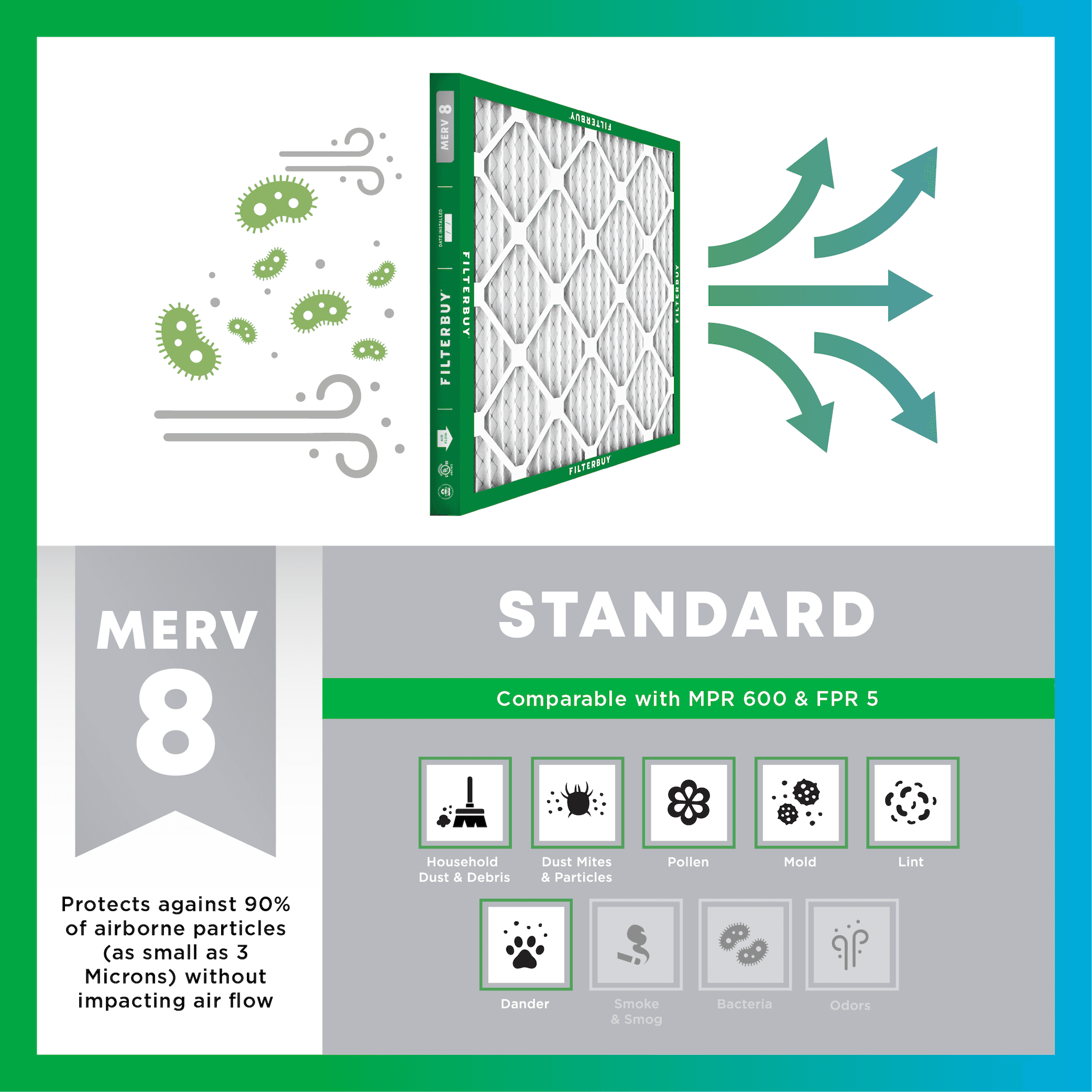
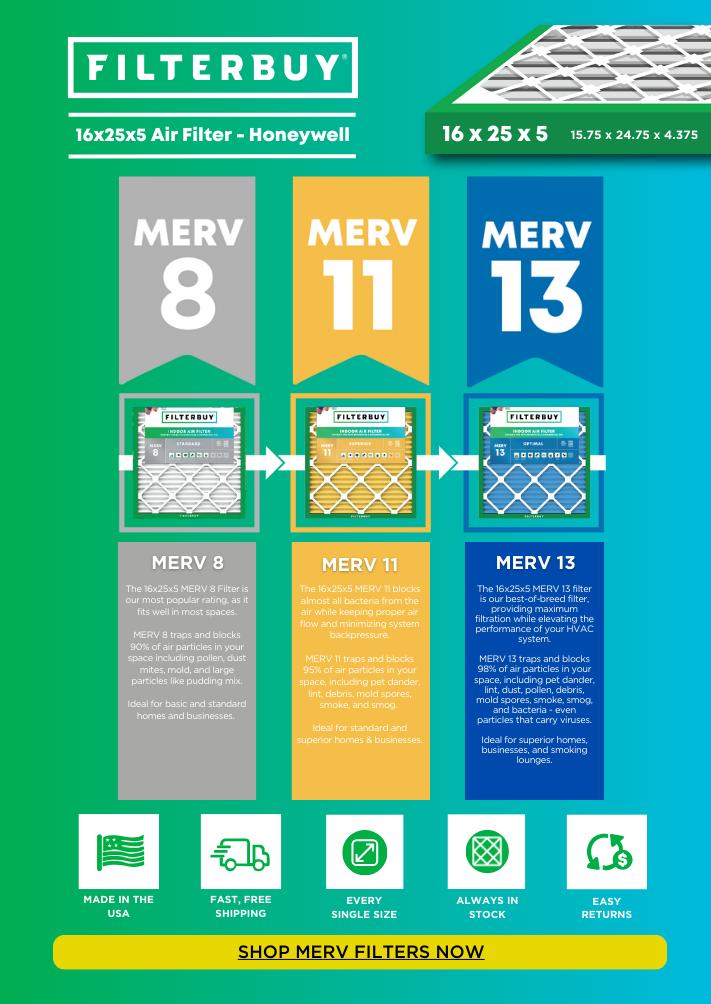
MERV stands for Minimum Efficiency Reporting Value—but don't let the technical name fool you. It's just a way to rate how well an air filter traps stuff like dust, pollen, pet dander, and smoke. The higher the MERV number, the more particles it catches—and the cleaner your air will be.

Comparable to:FPR: 4-7
MPR: 600-1000
 Dust & Debris
 Dust Mites & Particles
 Pollen
 Mold
Mold Lint
Lint Dander
Comparable to:FPR: 6-9
MPR: 1200-1550
Dust & DebrisDust Mites & ParticlesPollenMoldLintDander Smoke & Smog
Comparable to:FPR: 10
MPR: 1900-2800
Dust & DebrisDust Mites & ParticlesPollenMoldLintDanderSmoke & Smog Bacteria


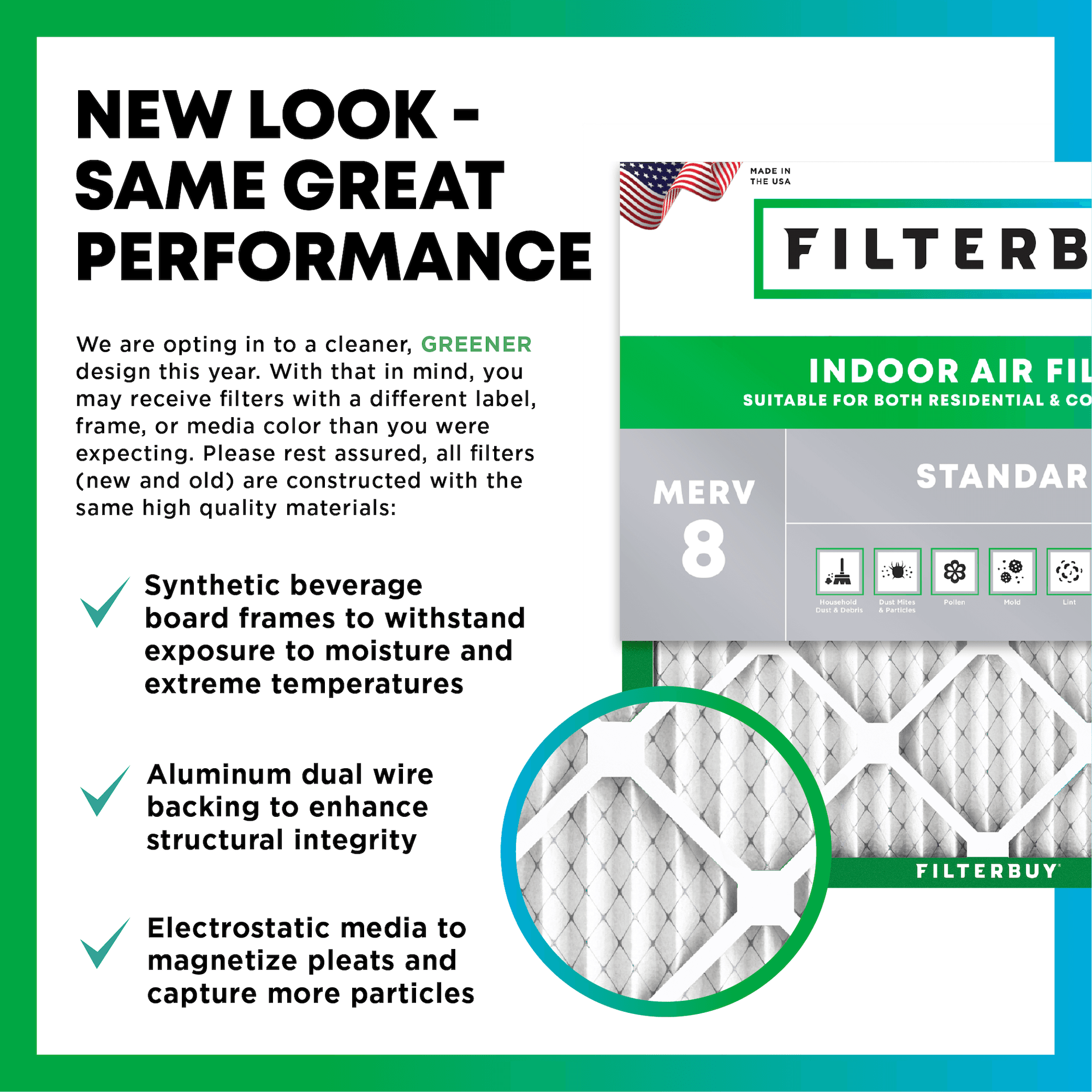
We build every Filterbuy filter to deliver reliable 90-day performance—thanks to smart design and premium materials that do the heavy lifting. Here's what makes the difference:
More pleats = more surface area to capture dust and debris, keeping your air cleaner longer.
Pleats are magnetized to attract and trap microscopic particles—like pet dander, pollen, and smoke.
Engineered to resist warping in extreme temperatures and high humidity.

A layer of metal reinforcement keeps pleats evenly spaced and structurally sound—no sagging, even at high airflow.
Assembled with care. Built to perform. Ships fast, free, and reliably from our U.S. facilities.

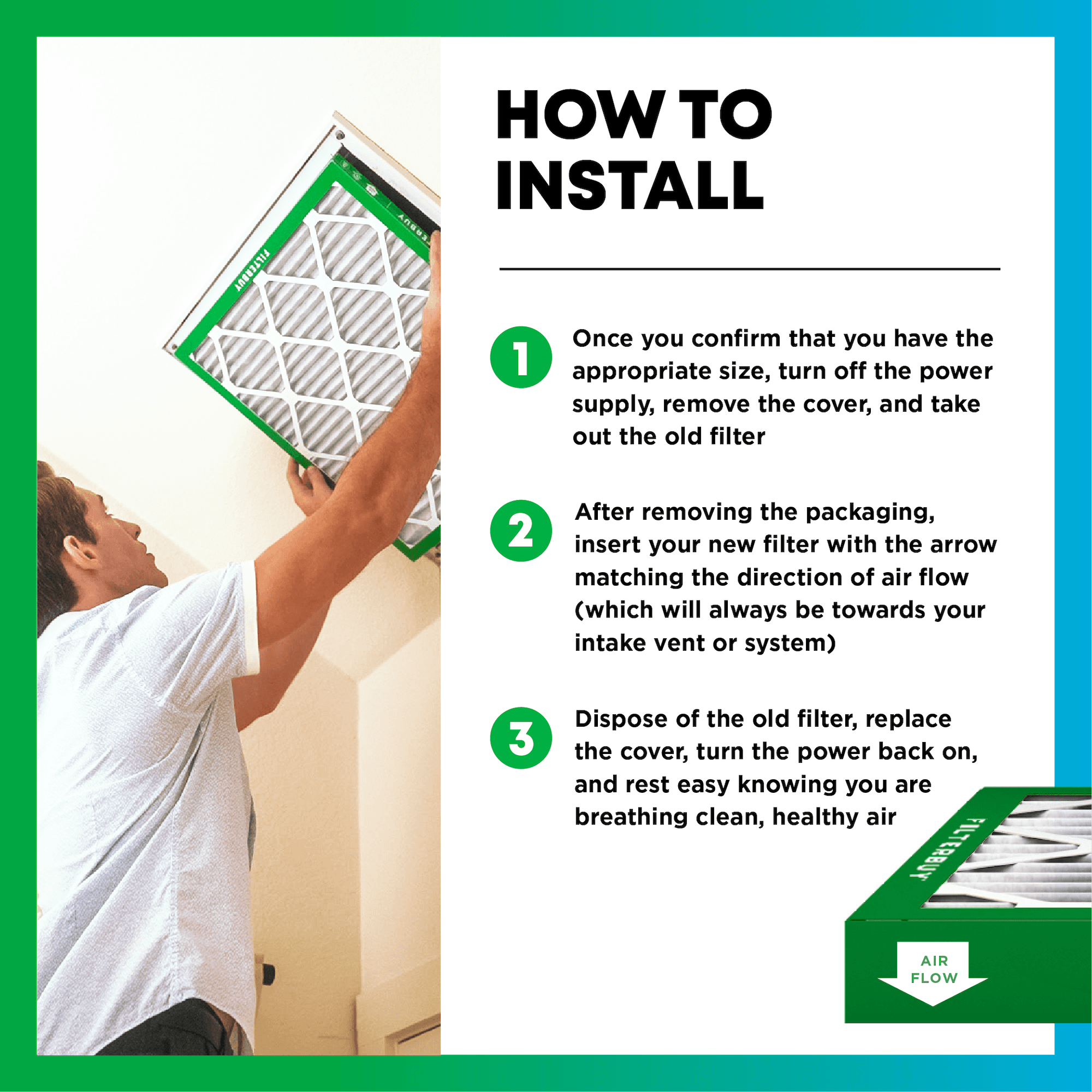
Turn Off Your HVAC SystemSafety first.

Remove The Old FilterLook for the airflow arrow and make note of the direction.

Slide In Your New FilterArrow should point toward the system (same direction as before).

Turn Your System Back OnAnd enjoy the fresh, clean air.

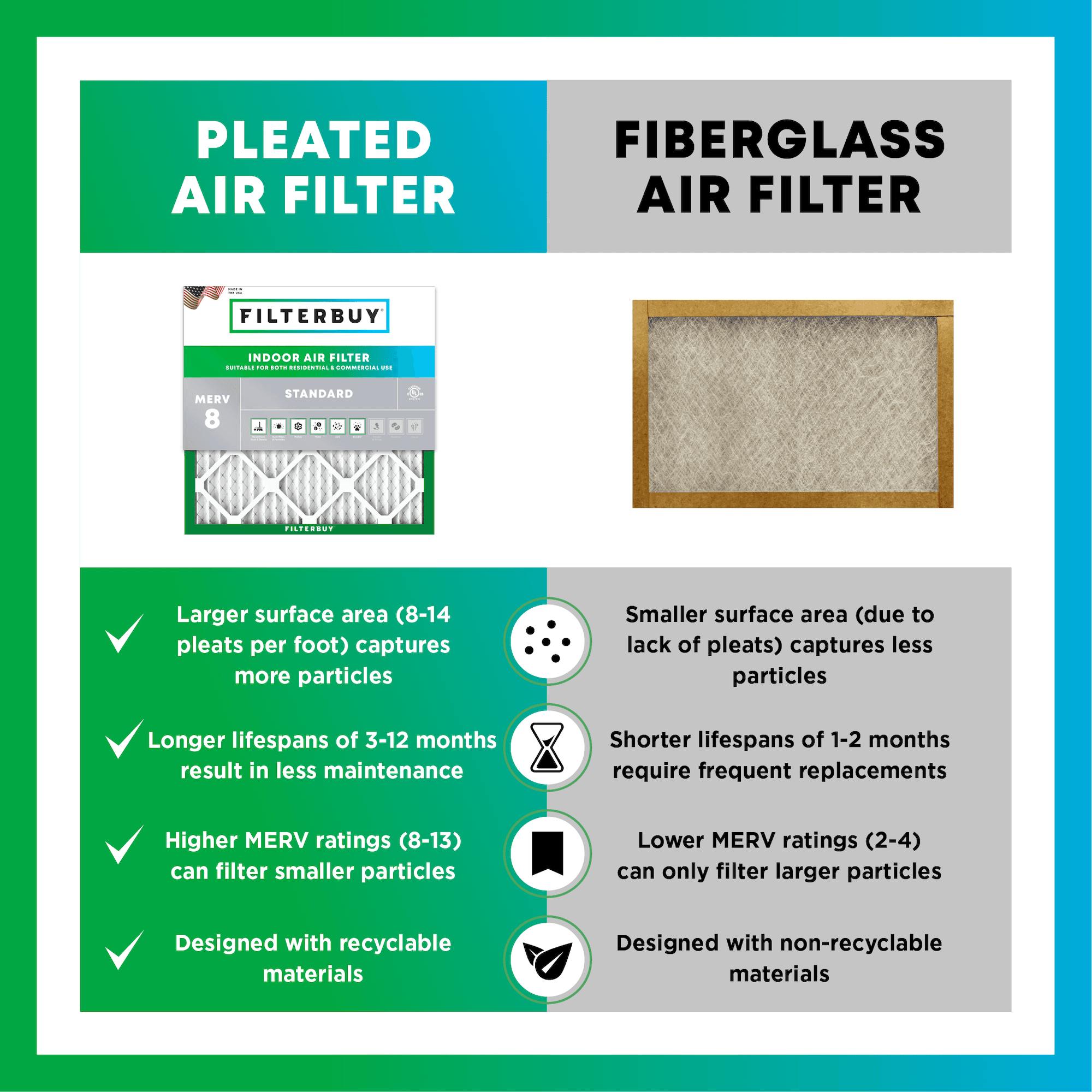
Not all air filters are created equal. Pleated filters don't just last longer—they actually clean your air better. Here's how they stack up:

Efficiency:
High (MERV 8–13) – Traps more particles
Lifespan:
90 days – Long-lasting performance
Air Quality:
Excellent – Cleaner, healthier air
Materials:
Recyclable and durable

Efficiency:
Low (MERV 4 or less) – Misses small stuff
Lifespan:
30 days or less – Replace often
Air Quality:
Minimal – Basic protection only
Materials:
Thin, flimsy, and not recyclable
Pleated filters are a no-brainer—more protection, less hassle, and better air for your home.
Changing your filter on time keeps your HVAC system running efficiently—and helps protect your lungs from dust, allergens, and airborne irritants. Here's how often to swap it out based on your needs:

For most homes without pets or special air quality concerns. Great for general upkeep and energy efficiency.

Shedding fur, dander, and allergy triggers can build up fast. Changing your filter every two months helps keep the air fresher and symptoms at bay.

For households affected by smoke, pollution, or respiratory conditions, monthly changes ensure maximum protection.

| Nominal Size | 16 x 25 x 5 inches |
| Actual Size | 15.75 x 24.75 x 4.38" inches |
| Filter Type | Pleated |
| Media | Electrostatically Charged |
| Frame | Beverage Board |
| MERV Ratings Available | 8, 11, 13 |
| Lifespan | Up to 12 Months |
| Origin | Made in USA |
That musty smell from your vents? Your MERV 8 16x25x5 Honeywell filter is trying to tell you something.
After manufacturing millions of filters, we've identified the real culprit behind filter odors: trapped moisture meeting organic particles. Most homeowners blame the filter itself. The actual problem starts earlier—with humidity levels, replacement timing, and airflow patterns unique to each home.
Customers tell us they've tried air fresheners, duct cleaning, even new HVAC units. None of it worked because they were treating symptoms, not the source.
This guide shares what we've learned from decades of filter production and thousands of customer conversations. You'll discover why MERV 8 filters are particularly susceptible to odor retention, which prevention steps actually work, and when a smell signals something more serious than a filter change can fix.
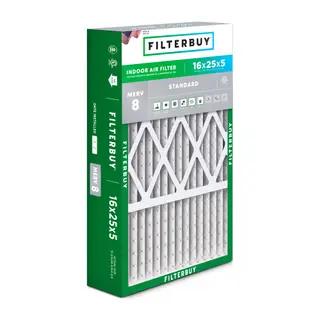
A MERV 8 16x25x5 Honeywell filter is a 5-inch deep pleated air filter designed for Honeywell whole-home air cleaning systems including FC100A1029, CF200A1008, and CF200D1625 models. The nominal size is 16x25x5 inches with an actual size of 15⅞ x 24¾ x 4⅜ inches. After manufacturing millions of these filters, we've found MERV 8 captures dust, pollen, mold spores, and pet dander effectively for standard residential needs. Replace every 4-6 months—customers tell us a MERV 8 changed on schedule outperforms a higher-rated filter left in too long.
The filter reveals problems—it rarely causes them. Odors signal humidity, airflow, or drainage issues. Replacing the filter without addressing the source means the odor returns.
Humidity control prevents most filter odors. Keep indoor levels between 30-50%. Above 60%, trapped particles become a breeding ground for bacteria. A $15 hygrometer identifies the problem before it starts.
Consistent replacement beats reactive replacement. Change your 16x25x5 every 4-6 months. Waiting until you smell something means moisture damage has already begun.
Airflow keeps filters dry. Run your system regularly, even during mild weather. Fifteen minutes of daily fan operation prevents moisture accumulation.
Check the system, not just the filter. Drip pans, condensate lines, and ductwork cause odors no filter change will fix. Five minutes of inspection saves hours of troubleshooting.
A MERV 8 16x25x5 filter captures dust, pollen, mold spores and pet dander — but it isn't designed to neutralize odors on its own. When these trapped particles accumulate and interact with moisture inside your HVAC system, they create the perfect breeding ground for bacteria and mildew. That musty smell coming from your vents is often the first sign your filter needs attention.
Oversized Honeywell whole-house systems push high volumes of air through this 5-inch media filter. While the extended depth allows for longer service intervals, it also means organic material has more time to decompose within the filter pleats if maintenance is neglected.
The single most effective way to prevent odors is timely replacement. A MERV 8 16x25x5 Honeywell replacement filter typically lasts 6 to 12 months, but households with pets, smokers or high-humidity climates should lean toward the shorter end of that range.
Mark your calendar or set a recurring reminder. Waiting until you notice a smell means odor-causing bacteria have already taken hold — and at that point, your indoor air quality has been compromised for weeks.
Excess humidity is the number one accelerator of filter odors. When moisture collects on or near the filter media, it transforms trapped particles into an active microbial environment.
Keep indoor humidity between 30% and 50% using a whole-house or portable dehumidifier. Inspect your condensate drain line regularly for clogs, and make sure the drip pan beneath your evaporator coil drains freely. These small steps eliminate the moisture that turns a clean-functioning filter into an odor source.
Swapping in a fresh MERV 8 16x25x5 filter won't solve odor problems if the filter cabinet itself is contaminated. Before every replacement, wipe down the interior of the housing with a damp cloth and mild detergent. Check the edges and gaskets for mold or residue buildup.
While you're there, visually inspect the return ductwork immediately upstream of the filter. Dust and debris that accumulate in this area get pulled directly into the new filter, shortening its effective lifespan and reintroducing odor-causing particles from day one.
A MERV 8 filter handles particulate matter effectively, but it has limited capacity for gaseous pollutants and volatile organic compounds (VOCs) that carry odors. Pairing your filter with supplemental odor control bridges that gap.
Activated carbon filter inserts or standalone air purifiers with carbon pre-filters target the gas-phase molecules a MERV 8 cannot trap. UV-C germicidal lights installed inside the air handler neutralize bacteria and mold before they ever reach the filter media. Neither solution replaces your Honeywell filter — they work alongside it to keep your air fresh between changes.
If odors return quickly after a fresh filter installation, the issue likely extends beyond the filter itself. Mold growth inside ductwork, a failing evaporator coil or a dead animal in the return plenum can all produce smells that no filter change will resolve.
A persistent sour or chemical odor after replacement warrants a professional HVAC inspection. Addressing the root cause protects both your air quality and the longevity of your system — and ensures your MERV 8 16x25x5 filter performs exactly as it should.
"Nine times out of ten, the filter isn't creating the odor—it's revealing a humidity or airflow problem that already existed. After seeing thousands of 'defective filter' returns that tested perfectly fine, we've learned that a smelly filter is actually doing its job by telling you something else in the system needs attention."
After manufacturing millions of filters, we know that informed customers make better filtration decisions. These resources answer the questions we hear most often.
Customers tell us they're unsure what MERV 8 captures versus higher ratings. The EPA breaks down particle sizes and filtration efficiency in plain language. This clarity helps you decide if MERV 8 meets your household needs.
Source: U.S. Environmental Protection Agency
URL: https://www.epa.gov/indoor-air-quality-iaq/what-merv-rating
Not every system handles every filter. We've seen homeowners install filters their equipment can't support. This federal guide explains how to match filtration levels to your specific HVAC capabilities.
Source: U.S. Environmental Protection Agency
URL: https://www.epa.gov/indoor-air-quality-iaq/guide-air-cleaners-home
ASHRAE writes the technical standards our engineering team references daily. These benchmarks determine proper airflow rates and filtration minimums for residential systems. Worth bookmarking if you want the source HVAC professionals trust.
Source: American Society of Heating, Refrigerating and Air-Conditioning Engineers
URL: https://www.ashrae.org/technical-resources/bookstore/standards-62-1-62-2
Customers tell us they replaced multiple filters before realizing humidity was the real problem. This EPA guide explains the 30-50% target range and why moisture control matters more than most homeowners realize.
Source: U.S. Environmental Protection Agency
URL: https://www.epa.gov/mold/brief-guide-mold-moisture-and-your-home
After seeing thousands of service calls, we know consistent maintenance prevents most filter issues. This consumer guide covers replacement timing, ventilation habits, and daily practices that extend filter life.
Source: U.S. Environmental Protection Agency
URL: https://www.epa.gov/indoor-air-quality-iaq/care-your-air-guide-indoor-air-quality
A well-maintained system means fewer filter replacements and better performance. The Department of Energy outlines installation best practices and maintenance schedules. Following these guidelines protects both your filter and your equipment.
Source: U.S. Department of Energy
URL: https://www.energy.gov/energysaver/air-conditioner-maintenance
We manufacture filters for families with allergies, asthma, and respiratory sensitivities. The American Lung Association explains how proper filtration supports breathing health. Essential reading for households with vulnerable members.
Source: American Lung Association https://www.lung.org/clean-air/indoor-air/protecting-from-air-pollution/air-cleaning
These numbers confirm what we observe daily on our manufacturing floor and hear in thousands of customer conversations.
Americans spend 90% of their time indoors. Indoor pollutant concentrations run 2 to 5 times higher than outdoor levels.
After manufacturing millions of filters, we understand what this means for your 16x25x5:
It processes contaminated air nearly every minute of every day
It serves as the primary barrier between your family and indoor pollutants
It accumulates debris faster than most homeowners expect
Customers tell us they assumed outdoor air was the problem. The data shows the opposite.
Source: U.S. Environmental Protection Agency
URL: https://www.epa.gov/report-environment/indoor-air-quality
Replacing a dirty filter with a clean one reduces air conditioner energy consumption by 5 to 15 percent.
The math is simple:
A 16x25x5 filter costs approximately $25
Energy savings begin immediately after replacement
The filter pays for itself within weeks
We've watched customers chase expensive HVAC repairs when a filter change would have solved the problem. Customers tell us they wish they'd learned this before their first major repair bill.
Source: U.S. Department of Energy
URL: https://www.energy.gov/energysaver/air-conditioner-maintenance
Research attributes 21% of U.S. asthma cases to dampness and mold exposure in homes. That's approximately 4.6 million people.
Building dampness raises respiratory health risks by 30 to 50 percent.
This explains a pattern we've observed for years:
Customers replace filter after filter chasing persistent odors
The real source is moisture buildup, not the filter
Humidity control and filter maintenance must work together
One without the other leaves the problem unaddressed.
Source: U.S. Department of Energy Office of Scientific and Technical Information
URL: https://www.osti.gov/biblio/925535
After manufacturing millions of MERV 8 filters and talking with thousands of homeowners, we've reached a conclusion that might surprise you.
The filter is rarely the problem.
Most customers contact us convinced they need:
A different filter
A higher MERV rating
A specialty product
Nine times out of ten, the solution involves something they already control.
It captures dust, pollen, mold spores, and pet dander efficiently. It maintains proper airflow to your system. It performs exactly as designed.
When odors develop, the filter is revealing a problem—not causing one.
The air filter industry benefits when customers believe they need constant upgrades. We could sell you a more expensive filter today and suggest a pricier option next month.
That approach doesn't solve odor problems. It delays the real fix.
Keep indoor humidity between 30-50%
Replace your filter every 4-6 months
Run your system regularly, even during mild weather
Check drip pans and condensate lines annually
These steps cost little or nothing. They prevent the conditions that cause filter odors in the first place.
We manufacture filters. We want you to buy them.
But we'd rather you buy the right filter on the right schedule than chase a problem with products that won't help.
Persistent odors after a fresh filter point to:
Humidity levels
Ductwork issues
Drainage problems
Not the filtration level.
Customers tell us this advice saved them hundreds in unnecessary purchases and service calls. A customer who understands their system becomes a customer for life.
Check your current filter. Pull it out and look for discoloration, musty smell or visible debris. Any of these mean it's time to replace.
Set a replacement reminder. Schedule every 6 months — or every 3 to 4 months if you have pets or allergy sufferers.
Clean the filter housing. Before installing a new filter:
Wipe down the interior cabinet
Check gaskets for mold
Clear debris from the return duct opening
Monitor indoor humidity. Use a hygrometer to stay between 30–50% relative humidity. Consistently higher? Add a dehumidifier.
Add supplemental odor control. For persistent cooking, pet or household odors:
Activated carbon filter inserts
UV-C germicidal lights inside the air handler
A: After manufacturing millions of filterbuy 16x25x5 filters, we've found the sweet spot.
Recommended replacement intervals:
Standard households: Every 6 months
Homes with pets: Every 4 months
Allergy sufferers: Every 4 months
The 16x25x5 format holds more debris than thinner filters. That extra capacity becomes a liability after 6 months.
What happens when you wait too long:
Trapped particles absorb moisture
Moisture enables bacterial growth
Bacterial growth creates odor
Customers tell us they used to wait for visible dirt or smells. By then, the filter had already become part of the problem.
A calendar reminder beats guesswork.
A: This confuses customers constantly. We hear it weekly.
The measurements:
Nominal size: 16 x 25 x 5 inches
Actual size: 15⅞ x 24¾ x 4⅜ inches
Why the difference:
Nominal sizing describes the filter slot
Actual sizing ensures proper fit
Clearance allows airflow and easy removal
We've manufactured these dimensions for years. They match Honeywell system specifications exactly.
If your current filter measures close to these actual dimensions, our replacement will fit.
A: Yes. We say this as the manufacturer of those compatible filters.
What's identical:
Materials
Dimensions
MERV 8 performance
What's different:
Where it's made
What you pay
Compatible Honeywell models we replace:
FC100A1029
CF200A1008
CF200D1625
Customers tell us they switched expecting a tradeoff. Most report no difference except savings.
Some say airflow improved—because lower cost meant more consistent replacements.
The best filter is the one you actually change on schedule.
A: We've tracked this through thousands of customer conversations. The pattern is clear.
Three conditions cause nearly every odor complaint:
Indoor humidity above 50%
Replacement delays beyond 6 months
Idle HVAC systems during mild weather
Notice what's missing: the filter itself.
The real sequence of odor development:
High humidity creates moisture
Filter media absorbs that moisture
Trapped organic particles decompose
Decomposition produces odor
Customers tell us they've replaced three or four filters chasing a smell from their condensate drain.
The fix, in order:
Address humidity first
Check drainage second
Replace filter third
That sequence solves most odor issues.
A: For 80% of households we serve, yes.
What MERV 8 captures:
Dust and lint
Pollen
Dust mites
Mold spores
Pet dander
Higher ratings exist. We manufacture those too.
What we've learned from customer patterns:
A MERV 8 replaced every 4-6 months outperforms a MERV 13 left in for a year.
Filtration level matters less than replacement consistency.
Customers tell us they upgraded to MERV 11 or 13, saw no improvement, then realized their old filter had been in for nine months.
The rating wasn't the problem. The schedule was.
Our recommendation:
Start with MERV 8 on a consistent cycle
Upgrade only if specific health needs require finer filtration
Verify your system can handle increased airflow restriction
The easiest way to prevent odors in your HVAC system is a quality MERV 8 16x25x5 Honeywell replacement filter installed on schedule. Shop Filterbuy's exact-fit 16x25x5 replacements today and take the first step toward cleaner, fresher indoor air.

