
Tip: Ensure you buy the exact air filter size for your system. Certain brands have precise dimensions that only fit their specific models. See related filters
Actual Size: 15.38x25.5x5.25
 Free Delivery
  Factory-Direct Low Prices, Made in the USA
 Hassle-Free Returns & Free Exchanges
RESIDENTIAL AND/OR COMMERCIAL USE
Change Every 3 Months
Tip: Ensure you buy the exact air filter size for your system. Certain brands have precise dimensions that only fit their specific models. See related filters
Actual Size: 15.38x25.5x5.25
Free Delivery Factory-Direct Low Prices, Made in the USAHassle-Free Returns & Free ExchangesRESIDENTIAL AND/OR COMMERCIAL USE
Change Every 3 Months
Tip: Ensure you buy the exact air filter size for your system. Certain brands have precise dimensions that only fit their specific models. See related filters
Actual Size: 15.38x25.5x5.25
Free Delivery Factory-Direct Low Prices, Made in the USAHassle-Free Returns & Free ExchangesRESIDENTIAL AND/OR COMMERCIAL USE
Change Every 3 Months
At Filterbuy, we don't cut corners—we craft high-quality air filters right here in the USA and ship them to your doorstep for free. No delays, no gimmicks—just clean air, made easy. With thousands of five-star reviews and filters built for real life & every HVAC system, it's no wonder why over 4 million families trust Filterbuy.

Proudly Made In The USA

Fast, Free Shipping on Every Order

Premium Materials That Go The Distance

85,000+ 5-Star Reviews From Happy Customers

Save Up to 70% Per Filter with Packs


Measure length × width × depth with a tape measure to find the actual size.

Round up each dimension to the nearest whole number to get the nominal size. Example: 15.38x25.5x5.25 in → 16x25x5 nominal.

Search by nominal size on our site for the best fit.


5″ filters give you maximum filtration with minimal maintenance — lasting up to 12 months while handling higher MERV ratings without restricting airflow.
Sizing note:

If the filter you buy doesn't fit, we'll send you a better size.
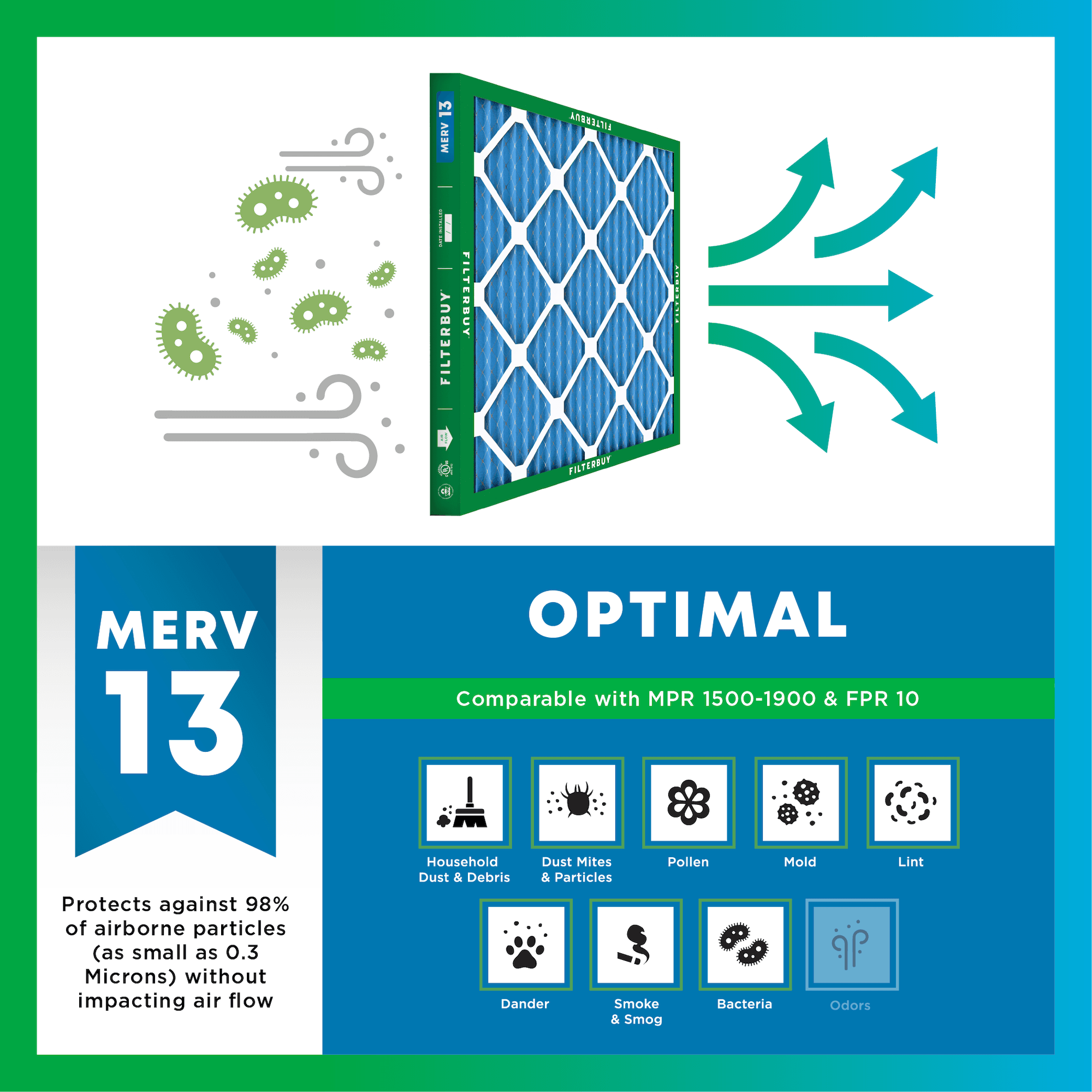
MERV stands for Minimum Efficiency Reporting Value—but don't let the technical name fool you. It's just a way to rate how well an air filter traps stuff like dust, pollen, pet dander, and smoke. The higher the MERV number, the more particles it catches—and the cleaner your air will be.

Comparable to:FPR: 4-7
MPR: 600-1000
 Dust & Debris
 Dust Mites & Particles
 Pollen
 Mold
Mold Lint
Lint Dander
Comparable to:FPR: 6-9
MPR: 1200-1550
Dust & DebrisDust Mites & ParticlesPollenMoldLintDander Smoke & Smog
Comparable to:FPR: 10
MPR: 1900-2800
Dust & DebrisDust Mites & ParticlesPollenMoldLintDanderSmoke & Smog Bacteria


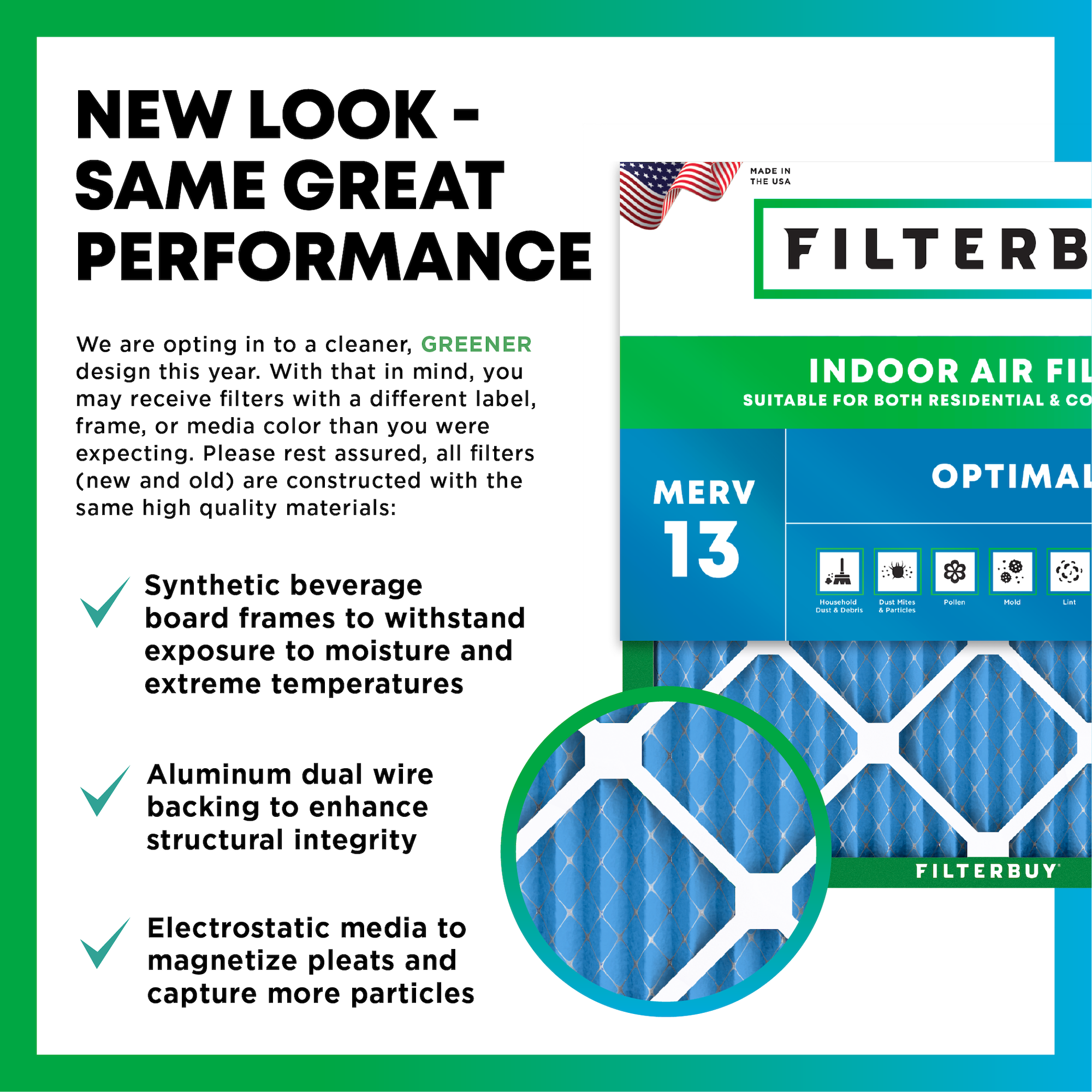
We build every Filterbuy filter to deliver reliable 90-day performance—thanks to smart design and premium materials that do the heavy lifting. Here's what makes the difference:
More pleats = more surface area to capture dust and debris, keeping your air cleaner longer.
Pleats are magnetized to attract and trap microscopic particles—like pet dander, pollen, and smoke.
Engineered to resist warping in extreme temperatures and high humidity.

A layer of metal reinforcement keeps pleats evenly spaced and structurally sound—no sagging, even at high airflow.
Assembled with care. Built to perform. Ships fast, free, and reliably from our U.S. facilities.

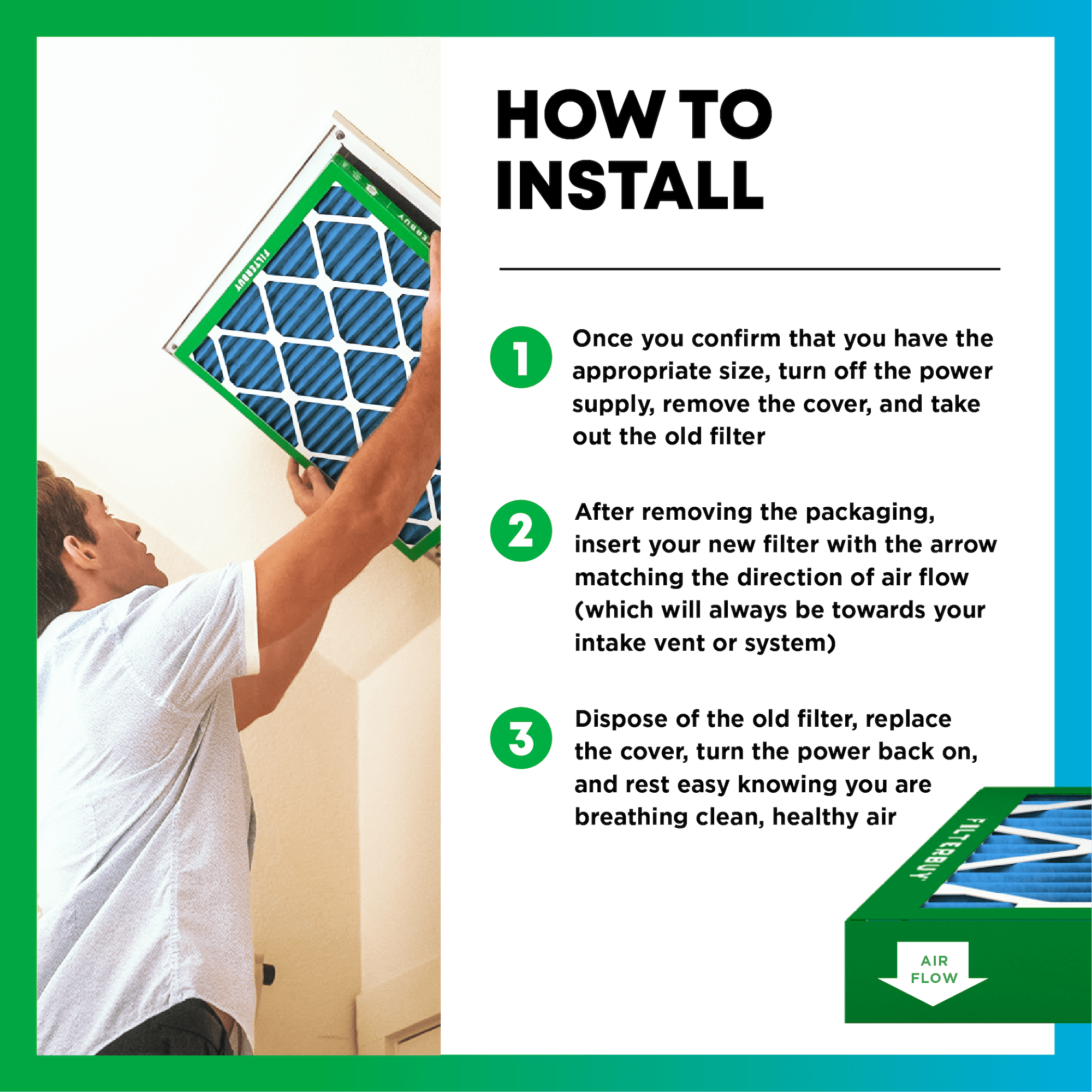
Turn Off Your HVAC SystemSafety first.

Remove The Old FilterLook for the airflow arrow and make note of the direction.

Slide In Your New FilterArrow should point toward the system (same direction as before).

Turn Your System Back OnAnd enjoy the fresh, clean air.

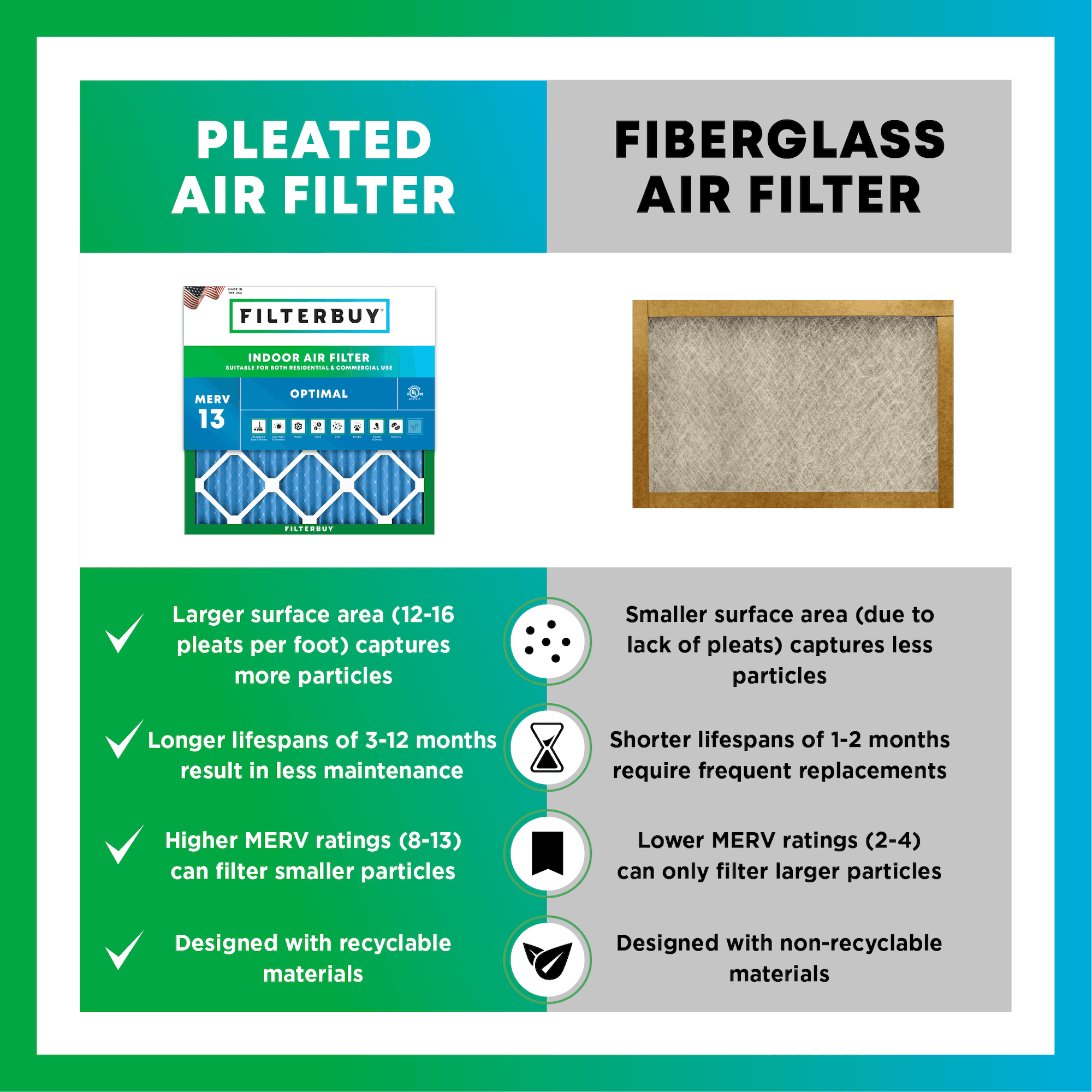
Not all air filters are created equal. Pleated filters don't just last longer—they actually clean your air better. Here's how they stack up:

Efficiency:
High (MERV 8–13) – Traps more particles
Lifespan:
90 days – Long-lasting performance
Air Quality:
Excellent – Cleaner, healthier air
Materials:
Recyclable and durable

Efficiency:
Low (MERV 4 or less) – Misses small stuff
Lifespan:
30 days or less – Replace often
Air Quality:
Minimal – Basic protection only
Materials:
Thin, flimsy, and not recyclable
Pleated filters are a no-brainer—more protection, less hassle, and better air for your home.
Changing your filter on time keeps your HVAC system running efficiently—and helps protect your lungs from dust, allergens, and airborne irritants. Here's how often to swap it out based on your needs:

For most homes without pets or special air quality concerns. Great for general upkeep and energy efficiency.

Shedding fur, dander, and allergy triggers can build up fast. Changing your filter every two months helps keep the air fresher and symptoms at bay.

For households affected by smoke, pollution, or respiratory conditions, monthly changes ensure maximum protection.

| Nominal Size | 16 x 25 x 5 inches |
| Actual Size | 15.38 x 25.5 x 5.25 inches |
| Filter Type | Pleated |
| Media | Electrostatically Charged |
| Frame | Beverage Board |
| MERV Ratings Available | 8, 11, 13 |
| Lifespan | Up to 12 Months |
| Origin | Made in USA |
Pull the old filter from an Electro-Air media cabinet and you'll immediately understand what the rest of the air filtration market doesn't have to deal with. The 16x25x5 size that housing takes is a specialty dimension. Most hardware stores don't carry it, and the quality gap between what's available online at this depth is wider than in any other filter category. Getting the replacement right matters in ways that a 1-inch swap never does.
Filterbuy builds the MERV 13 16x25x5 to fit Electro-Air media cabinets precisely and to filter at the efficiency level those systems were designed to deliver. At MERV 13, the filter catches the fine particle fractions that MERV 8 and MERV 11 alternatives miss entirely, including the particles that stay airborne longest and penetrate deepest into the respiratory tract. Whether you've owned this system for two years or fifteen, what goes back into that cabinet determines what your family breathes every hour the furnace runs.
The MERV 13 16x25x5 is a high-efficiency replacement filter for Electro-Air whole-home media cabinets. It captures particles as small as 0.3 microns at 50% or greater efficiency, covering pet dander, mold spores, and bacteria-carrying aerosols. A 5-inch media cabinet handles MERV 13 without the airflow penalty that the same rating creates in a 1-inch slot, which makes this the correct efficiency level for a system that processes all of your home's recirculated air.
• Nominal Size: 16 x 25 x 5 inches
• MERV Rating: 13
• Particle Capture (0.3–1 µm): 50% or greater efficiency per ASHRAE Standard 52.2
• Particle Capture (1–3 µm): 85% or greater efficiency per ASHRAE Standard 52.2
• Compatible System: Electro-Air whole-home media cabinet housings
• Typical Replacement Interval: Every 9–12 months for most homes
• The 16x25x5 filter processes virtually all of your home's recirculated air through a single 5-inch media cabinet, handling a fundamentally different job than a 1-inch slot filter.
• MERV 13 captures particles in the 0.3–1 micron range that MERV 8 and MERV 11 filters miss entirely, including the fine fractions of pet dander, mold spores, and smoke particles that cause the greatest respiratory impact.
• Electro-Air designed these media cabinet housings to run high-efficiency pleated media. MERV 13 is the correct efficiency level for that design.
• A properly fit 5-inch media filter holds its efficiency far longer than a 1-inch alternative. Most homes need just one replacement per year, compared to 6–12 for standard filters.
• Filterbuy cuts the 16x25x5 to the tolerances Electro-Air cabinets require. A flush fit eliminates the bypass gaps that let unfiltered air route around the media.
For an Electro-Air media cabinet, the answer is yes. The concern about MERV 13 damaging HVAC equipment targets systems with 1-inch filter slots that manufacturers built for lighter media. Electro-Air designed the whole-home cabinet for precisely this filtration level. The housing handles thick pleated media, and the deep pleat geometry of a 5-inch filter distributes airflow resistance across far more surface area than any standard thin-panel filter can offer.
Static pressure increases as MERV ratings rise, because denser media catches more particles and creates more resistance against moving air. In a 1-inch slot, a MERV 13 filter can restrict air movement enough to reduce system efficiency and strain the blower motor over time. Spread across a 5-inch Electro-Air media cabinet, that same MERV 13 media spans a surface area many times larger, producing a fraction of that pressure drop.
After manufacturing filters for over a decade, the Filterbuy team has found that homeowners who move from MERV 8 or MERV 11 to MERV 13 inside a properly sized media cabinet consistently report no change in system performance. What they do notice is cleaner air.
Homes with pets, allergy sufferers, or young children have the most to gain from MERV 13. Pet dander particles range from 0.5 to 100 microns, and the smallest fractions stay airborne the longest and penetrate deepest into airways. They fall precisely in the size range where MERV 13 outperforms lower-rated alternatives. Households managing airborne pet dander every day get the most direct return from MERV 13 because that filter catches those particles at the source, before they recirculate.
Most 5-inch media filters sold online are built for low cost and fast shipping, not for a year of performance inside a media cabinet. Filterbuy builds the 16x25x5 MERV 13 with an industrial-grade beverage board frame reinforced with dual wire backing. That construction keeps the frame square through a full 9–12 month service cycle.
A frame that warps or collapses creates bypass gaps along the cabinet walls. Unfiltered air routes through those gaps. At that point, the system runs as if there's no filter in the cabinet at all. The electrostatically charged pleated media increases particle capture beyond what the MERV 13 standard alone requires, attracting and holding fine particles before they recirculate. Every Filterbuy filter is manufactured in the United States and cut to the dimensions Electro-Air media cabinet housings require. It seats flush inside the cabinet, with no bypass gaps and full filtration capacity from installation through replacement.
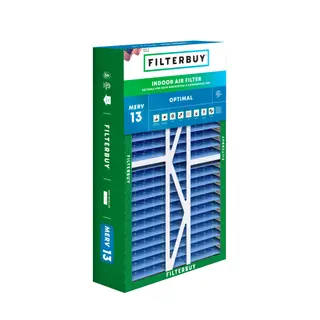
"What most homeowners never see is a filter that failed at month four of a twelve-month cycle — not because the media was full, but because the frame collapsed and opened bypass gaps that let unfiltered air route freely around the media. We built the beverage board frame with dual wire backing because we've pulled enough failed filters out of media cabinets to know that frame integrity is what separates a filter that protects your home for a full year from one that only looks like it does."
Choosing the right filter for a whole-home media cabinet is a different decision than picking up a 1-inch filter at a hardware store. The sources below cover the technical standard behind MERV ratings, the health stakes of fine particle filtration, and the allergen science that makes MERV 13 the right choice for specific households. Each one answers a distinct question this purchase raises.
National Air Filtration Association — Understanding MERV: NAFA User's Guide to ANSI/ASHRAE Standard 52.2
The NAFA user's guide is the clearest plain-language explanation of how the MERV scale works — including the three particle size ranges that determine a filter's rating and why MERV 13's 50% minimum efficiency at 0.3–1.0 microns represents the threshold where filtration starts capturing the smallest, most health-relevant particles. This is the source to read before comparing MERV ratings across filter brands or deciding whether MERV 11 covers your household's needs.
URL: https://www.nafahq.org/understanding-merv-nafa-users-guide-to-ansi-ashrae-52-2/
U.S. Environmental Protection Agency — Guide to Air Cleaners in the Home
The EPA confirms that MERV 5–13 filters are reasonably efficient at removing small to large airborne particles and are likely to perform comparably to true HEPA filters for most residential applications. This guide covers how furnace and central HVAC filters work, how to evaluate efficiency ratings, and why upgrading your filter is one of the most direct steps a homeowner can take to improve indoor air quality.
URL: https://www.epa.gov/indoor-air-quality-iaq/guide-air-cleaners-home
American Lung Association — Air Cleaning
The American Lung Association's HVAC filter guidance names MERV 13 as the specific upgrade target, noting that a higher-rated filter captures more and smaller particles from the air cycling through your home. This resource explains the relationship between central air filtration and respiratory health, and it distinguishes between what whole-home HVAC filters and portable air cleaners each do — a useful comparison for anyone evaluating a 5-inch media cabinet system.
URL: https://www.lung.org/clean-air/indoor-air/protecting-from-air-pollution/air-cleaning
Asthma and Allergy Foundation of America — Dog and Cat Allergies
The AAFA's guidance on pet allergen management recommends using a Certified Asthma and Allergy Friendly filter paired with central heating and air conditioning to remove pet allergens from the air throughout the home. Pet dander can remain airborne and circulate through HVAC systems for months, making whole-home filtration at MERV 13 the most direct way to address the problem at the source rather than room by room.
URL: https://aafa.org/allergies/types-of-allergies/pet-dog-cat-allergies/
American Society of Heating, Refrigerating and Air-Conditioning Engineers — ANSI/ASHRAE Standard 52.2
ASHRAE Standard 52.2 is the authoritative technical standard that defines the particle size efficiency testing methodology behind every MERV rating. When a filter label states that a MERV 13 captures particles at 85% or greater efficiency in the 1.0–3.0 micron range, that figure comes from this standard. Homeowners evaluating filter performance claims — or verifying that a replacement meets the efficiency level their media cabinet system requires — start here.
URL: https://www.ashrae.org/technical-resources/bookstore/ashrae-standard-52-2
National Institute of Environmental Health Sciences — Indoor Air Quality
The NIEHS overview connects long-term indoor air pollutant exposure to respiratory disease, cardiovascular effects, and cognitive outcomes, and confirms that indoor pollutant concentrations are rising in many homes due to tighter construction and increased use of synthetic materials. For homeowners weighing a MERV 8 against a MERV 13 upgrade, this resource establishes the health context that makes the efficiency gap between those ratings meaningful over years of daily whole-home air cycling.
URL: https://www.niehs.nih.gov/health/topics/agents/indoor-air
American Academy of Allergy, Asthma and Immunology — Indoor Allergens
Written and reviewed by board-certified allergists and immunologists, this AAAAI resource covers the full range of indoor allergens — dust mites, pet dander, mold spores, and cockroach proteins — and their particle sizes and behavior in the home environment. These are the specific particles that MERV 13 is rated to capture in the 0.3–3.0 micron range, and this source provides the clinical grounding for why high-efficiency filtration is a front-line recommendation for allergy and asthma households.
URL: https://www.aaaai.org/tools-for-the-public/conditions-library/allergies/indoor-allergens-ttr
Three verified figures from U.S. federal and national health authorities. Each one reflects something we've observed directly in more than a decade of manufacturing filters for American homes.
The pattern we see most often: the decision to upgrade to MERV 13 follows a diagnosis.
What the CDC confirms:
• Approximately 25 million Americans — 7.7% of the U.S. population — live with asthma today
• Indoor allergens are among the most documented asthma triggers
• The particles most responsible: dust mites, mold spores, and pet dander
Why it matters for this filter:
• All three trigger particles fall in the size range where MERV 13 outperforms lower-rated alternatives
• A whole-home media cabinet cycling air through a MERV 13 filter reduces daily contact with those particles across every room, every hour
• For 25 million households, that is home maintenance as healthcare
Source: Centers for Disease Control and Prevention — Most Recent National Asthma Data
URL: https://www.cdc.gov/asthma/most_recent_national_asthma_data.htm
Most homeowners we talk to find this surprising. You don't need a pet to have pet dander in your home. You don't need visible dust to be living with dust mites.
What the AAFA data shows:
• 8 out of 10 people in the U.S. are exposed to dust mites
• 6 out of 10 are exposed to cat or dog dander
• Both are present in homes with and without visible allergen sources — dander travels on clothing, dust mites live in bedding every home has
What we've learned from a decade of manufacturing:
Pull a MERV 8 from a whole-home cabinet after nine months. Look at what it caught. Then consider what passed through. The sub-3-micron fractions of dust mite debris and pet dander — the fractions that stay airborne longest and penetrate deepest — are exactly what MERV 13 captures at 85% or greater efficiency.
For 8 in 10 households, MERV 13 is not a theoretical upgrade. It is a direct response to what is already in the air.
Source: Asthma and Allergy Foundation of America — Control Indoor Allergens to Improve Indoor Air Quality
URL: https://aafa.org/allergies/prevent-allergies/control-indoor-allergens/
When homeowners ask why filter efficiency matters, most expect us to point to a spec sheet. We point here instead.
What EPA's Science Advisory Board found:
• Comparative risk studies consistently rank indoor air pollution among the top five environmental risks to public health in the United States
• Indoor pollutant concentrations are often 2 to 5 times higher than outdoor levels
• The people most exposed — young children, older adults, those with respiratory conditions — tend to spend the most time indoors
What we've observed in practice:
1. Homeowners upgrade filtration after a visible event — wildfire smoke, a mold discovery, a health diagnosis
2. They return to lower-efficiency filters when conditions appear normal again
3. Indoor pollutants don't announce themselves — dust mite debris, mold spores, and fine particles produce no visible haze
The risk EPA ranks at the top tier is the one building up quietly in the home most people consider their safest space. A MERV 13 in a properly fit whole-home cabinet is the most direct intervention most homeowners can make.
Source: U.S. Environmental Protection Agency — Why Indoor Air Quality Is Important
URL: https://www.epa.gov/iaq-schools/why-indoor-air-quality-important-schools
Asking whether MERV 13 is “good enough” for an Electro-Air system misframes the question. In a media cabinet built for high-efficiency filtration, MERV 13 is the right filter. It captures the particles that cause the most measurable harm to the people in a home, and it does so across a full year of whole-home air cycles. A MERV 8 does a different job at a lower efficiency tier, for households without specific air quality concerns. Homeowners choosing MERV 13 for an Electro-Air system are running the filter that cabinet was designed for.
The one real risk is fit. A MERV 13 filter that doesn’t seat precisely inside the housing performs no better than an open cabinet. Filterbuy’s 16x25x5 is cut to the dimensions that prevent that problem. For a system built for whole-home air protection, MERV 13 efficiency and exact-fit construction aren’t excessive. They’re the reason you have the system.
1. Open your Electro-Air media cabinet and check the nominal size printed on the existing filter frame. Confirm it reads 16x25x5 before ordering.
2. If the label is worn or missing, measure the interior housing width, height, and depth. Match those dimensions to a 16x25x5 nominal size.
3. Order the Filterbuy MERV 13 16x25x5. It ships directly with no hardware store trip required and no uncertainty about whether a generic 5-inch filter will fit the cabinet.
4.Install the new filter with the airflow arrow pointing toward the air handler. Note the installation date on the frame or in a home maintenance record.
5. Set a replacement reminder for 9–12 months out, or sooner if your household has pets or allergy sufferers. A calendar reminder tied to your annual HVAC service visit is a reliable system.
6.Sign up for Filterbuy’s auto-ship and receive the next filter before the current one runs past its service interval.
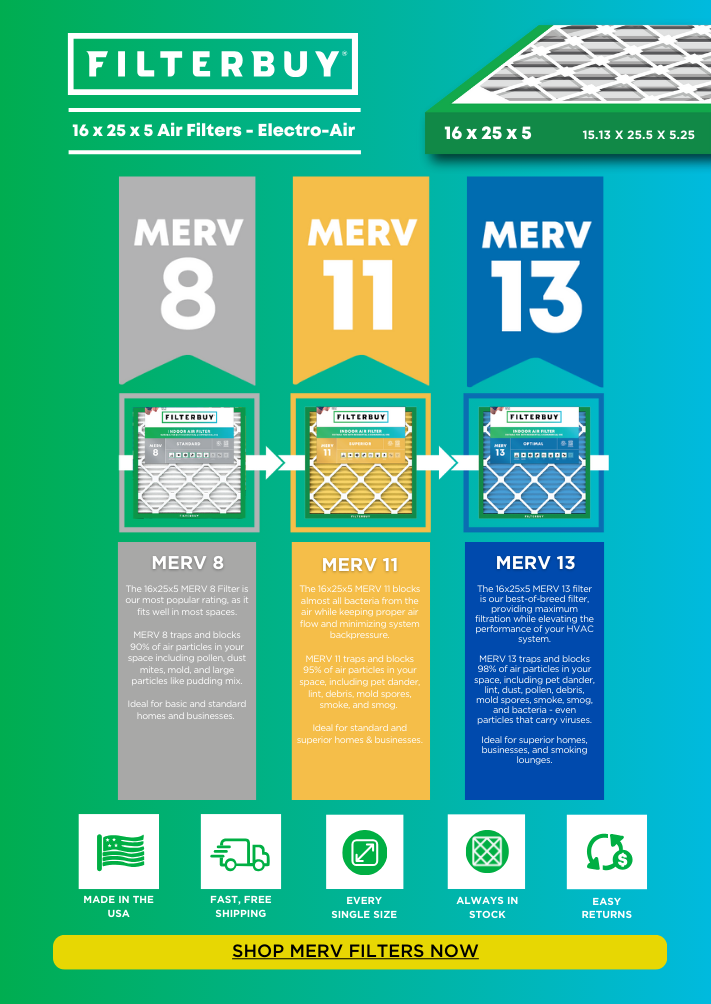
Yes. The Filterbuy MERV 13 16x25x5 is a compatible drop-in replacement for Electro-Air whole-home media cabinet housings that accept a 16x25x5 nominal filter. Actual cut dimensions are approximately 15.75 × 24.75 × 4.875 inches. Confirm the nominal size on your existing filter or housing label first. If the numbers match, the Filterbuy MERV 13 16x25x5 is the correct replacement.
MERV 13 captures particles down to 0.3 microns at 50% or greater efficiency and particles in the 1–3 micron range at 85% or better. That covers the fine fractions of tobacco smoke, most mold spores, the pet dander particles that stay airborne longest, and bacteria-carrying aerosols. MERV 8 captures particles 3–10 microns at 70%+ efficiency, which handles general dust well but misses the fine particles with the greatest respiratory impact.
Not in a properly designed Electro-Air media cabinet. The concern about MERV 13 harming HVAC equipment targets 1-inch filter slot systems that manufacturers didn’t build for high-efficiency pleated media. Electro-Air designed the whole-home media cabinet to handle thick, dense filter media. The 5-inch depth distributes static pressure across a large surface area, keeping airflow resistance at levels the system blower can manage. Switching to MERV 13 in a correctly sized media cabinet does not harm the equipment.
Every 9–12 months for most homes. Households with 1–2 pets should plan for every 9 months. Homes with allergy or asthma occupants should be replaced every 6–9 months, and high-occupancy or heavy dust environments every 6 months. The 5-inch media format holds significantly more before airflow is affected, which is why the replacement interval is so much longer than a 1-inch filter.
The nominal size (16x25x5) is a rounded label dimension, not the exact production cut. Actual dimensions are approximately 15.75 × 24.75 × 4.875 inches. Nominal dimensions are always slightly larger than the actual cut. For media cabinet filters, the actual dimensions determine whether the filter seats flush without bypass gaps, so confirming the actual size before ordering is worth the extra step.
The MERV 13 16x25x5 fits your Electro-Air media cabinet precisely, filters at the efficiency level your system was designed to deliver, and ships directly so there is no guessing at hardware store availability. Order the Filterbuy MERV 13 16x25x5 today and put a full year of whole-home air protection in place.

