
Tip: Ensure you buy the exact air filter size for your system. Certain brands have precise dimensions that only fit their specific models. See related filters
Actual Size: 16x24.88x4.38"
 Free Delivery
  Factory-Direct Low Prices, Made in the USA
 Hassle-Free Returns & Free Exchanges
RESIDENTIAL AND/OR COMMERCIAL USE
Change Every 3 Months
Tip: Ensure you buy the exact air filter size for your system. Certain brands have precise dimensions that only fit their specific models. See related filters
Actual Size: 16x24.88x4.38"
Free Delivery Factory-Direct Low Prices, Made in the USAHassle-Free Returns & Free ExchangesRESIDENTIAL AND/OR COMMERCIAL USE
Change Every 3 Months
Tip: Ensure you buy the exact air filter size for your system. Certain brands have precise dimensions that only fit their specific models. See related filters
Actual Size: 16x24.88x4.38"
Free Delivery Factory-Direct Low Prices, Made in the USAHassle-Free Returns & Free ExchangesRESIDENTIAL AND/OR COMMERCIAL USE
Change Every 3 Months
At Filterbuy, we don't cut corners—we craft high-quality air filters right here in the USA and ship them to your doorstep for free. No delays, no gimmicks—just clean air, made easy. With thousands of five-star reviews and filters built for real life & every HVAC system, it's no wonder why over 4 million families trust Filterbuy.

Proudly Made In The USA

Fast, Free Shipping on Every Order

Premium Materials That Go The Distance

85,000+ 5-Star Reviews From Happy Customers

Save Up to 70% Per Filter with Packs


Measure length × width × depth with a tape measure to find the actual size.

Round up each dimension to the nearest whole number to get the nominal size. Example: 16x24.88x4.38" in → 16x25x5 nominal.

Search by nominal size on our site for the best fit.


5″ filters give you maximum filtration with minimal maintenance — lasting up to 12 months while handling higher MERV ratings without restricting airflow.
Sizing note:

If the filter you buy doesn't fit, we'll send you a better size.
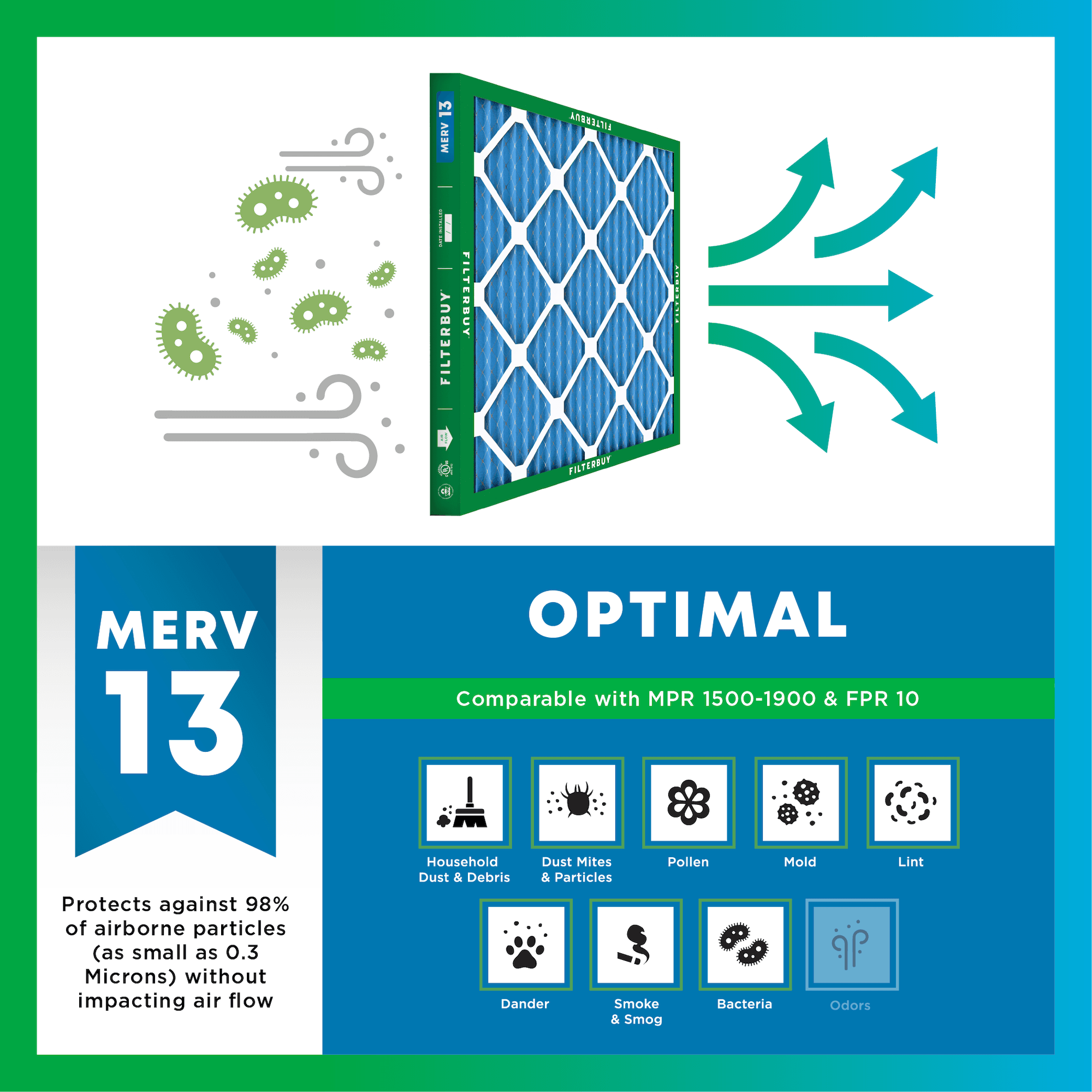
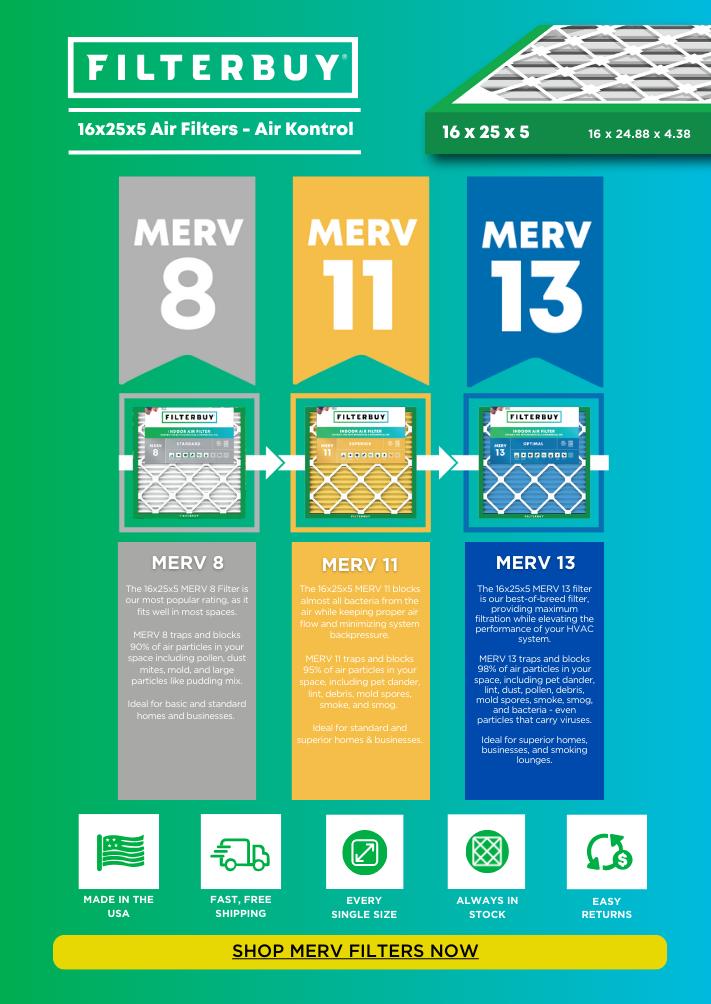
MERV stands for Minimum Efficiency Reporting Value—but don't let the technical name fool you. It's just a way to rate how well an air filter traps stuff like dust, pollen, pet dander, and smoke. The higher the MERV number, the more particles it catches—and the cleaner your air will be.

Comparable to:FPR: 4-7
MPR: 600-1000
 Dust & Debris
 Dust Mites & Particles
 Pollen
 Mold
Mold Lint
Lint Dander
Comparable to:FPR: 6-9
MPR: 1200-1550
Dust & DebrisDust Mites & ParticlesPollenMoldLintDander Smoke & Smog
Comparable to:FPR: 10
MPR: 1900-2800
Dust & DebrisDust Mites & ParticlesPollenMoldLintDanderSmoke & Smog Bacteria


We build every Filterbuy filter to deliver reliable 90-day performance—thanks to smart design and premium materials that do the heavy lifting. Here's what makes the difference:
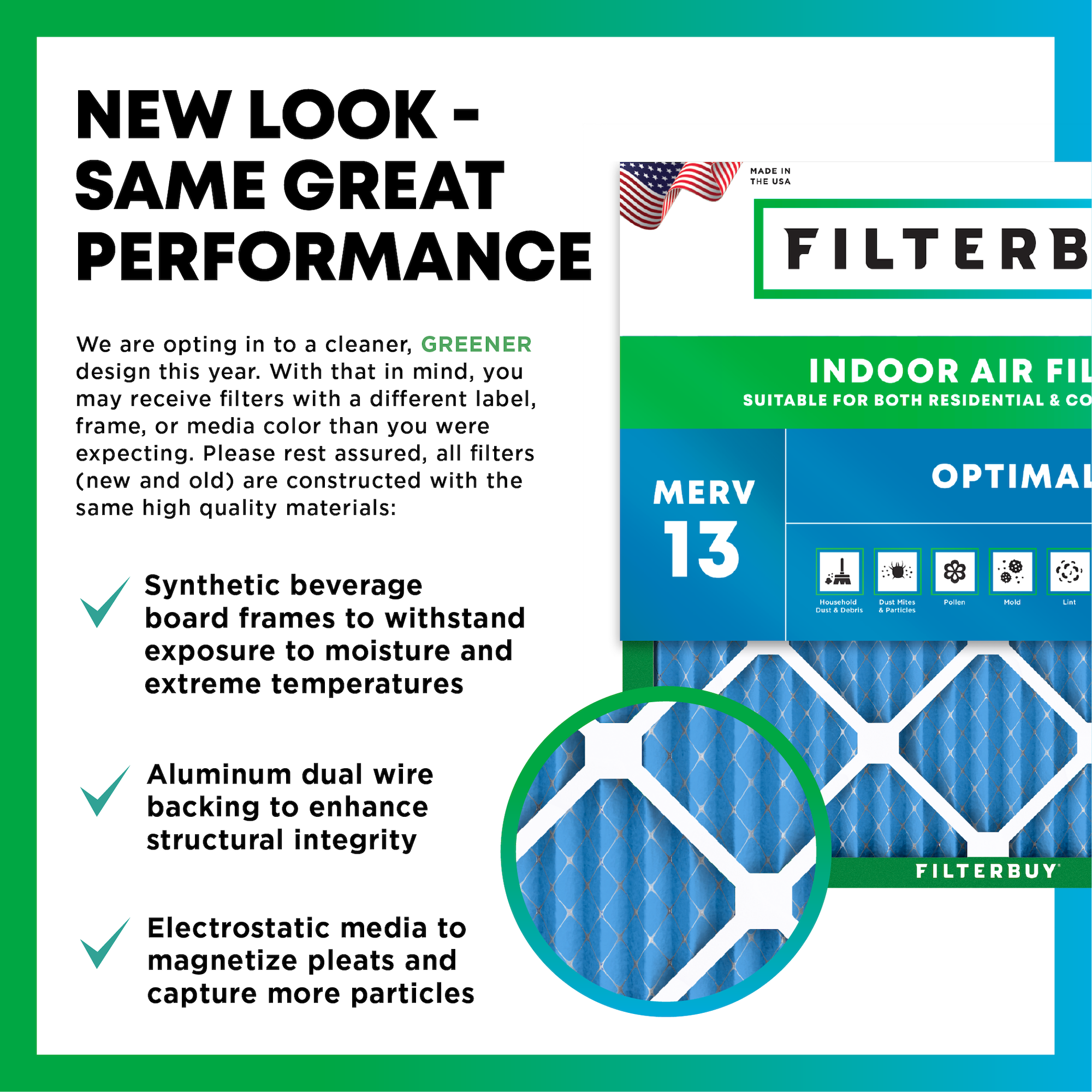
More pleats = more surface area to capture dust and debris, keeping your air cleaner longer.
Pleats are magnetized to attract and trap microscopic particles—like pet dander, pollen, and smoke.
Engineered to resist warping in extreme temperatures and high humidity.

A layer of metal reinforcement keeps pleats evenly spaced and structurally sound—no sagging, even at high airflow.
Assembled with care. Built to perform. Ships fast, free, and reliably from our U.S. facilities.

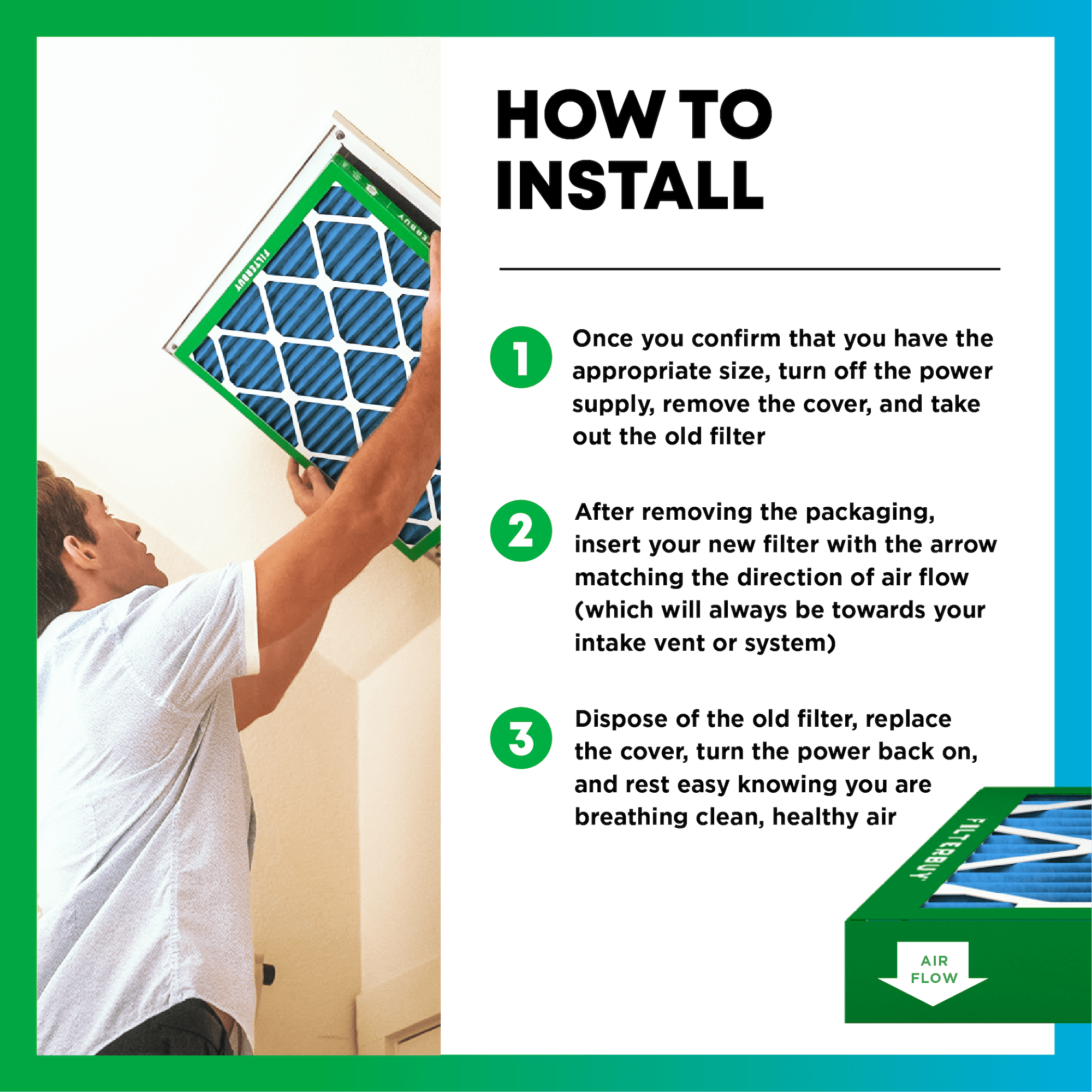
Turn Off Your HVAC SystemSafety first.

Remove The Old FilterLook for the airflow arrow and make note of the direction.

Slide In Your New FilterArrow should point toward the system (same direction as before).

Turn Your System Back OnAnd enjoy the fresh, clean air.

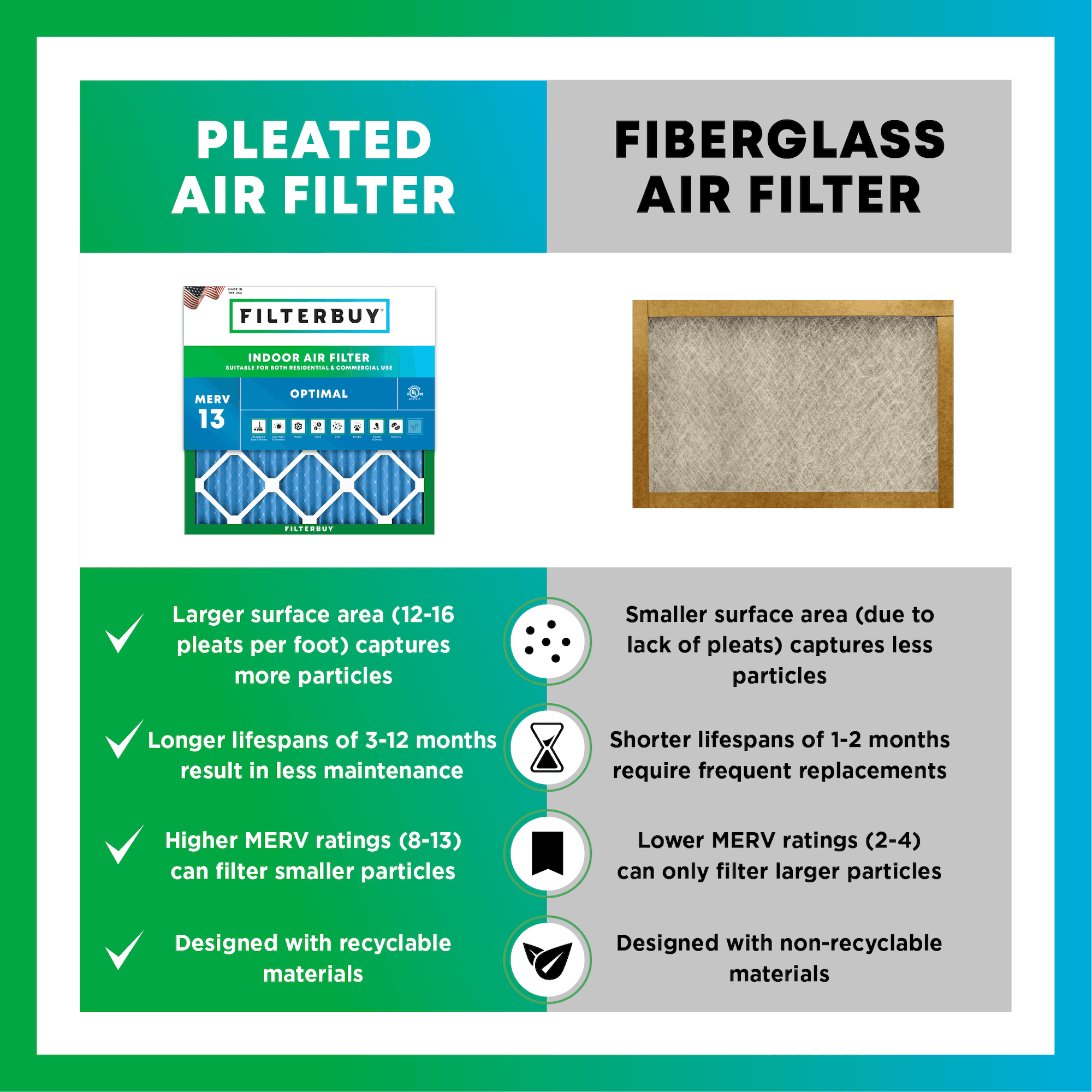
Not all air filters are created equal. Pleated filters don't just last longer—they actually clean your air better. Here's how they stack up:

Efficiency:
High (MERV 8–13) – Traps more particles
Lifespan:
90 days – Long-lasting performance
Air Quality:
Excellent – Cleaner, healthier air
Materials:
Recyclable and durable

Efficiency:
Low (MERV 4 or less) – Misses small stuff
Lifespan:
30 days or less – Replace often
Air Quality:
Minimal – Basic protection only
Materials:
Thin, flimsy, and not recyclable
Pleated filters are a no-brainer—more protection, less hassle, and better air for your home.
Changing your filter on time keeps your HVAC system running efficiently—and helps protect your lungs from dust, allergens, and airborne irritants. Here's how often to swap it out based on your needs:

For most homes without pets or special air quality concerns. Great for general upkeep and energy efficiency.

Shedding fur, dander, and allergy triggers can build up fast. Changing your filter every two months helps keep the air fresher and symptoms at bay.

For households affected by smoke, pollution, or respiratory conditions, monthly changes ensure maximum protection.

| Nominal Size | 16 x 25 x 5 inches |
| Actual Size | 16 x 24.88 x 4.38" inches |
| Filter Type | Pleated |
| Media | Electrostatically Charged |
| Frame | Beverage Board |
| MERV Ratings Available | 8, 11, 13 |
| Lifespan | Up to 12 Months |
| Origin | Made in USA |
A MERV 13 16x25x5 Air Kontrol filter can increase energy bills — but we rarely see that happen when the filter fits the system correctly.
As the manufacturer, we track performance data most retailers never see. The pattern is clear: energy spikes typically stem from improper fit or extended filter neglect, not the MERV 13 rating itself. We've watched customers reduce energy costs after upgrading to MERV 13 because cleaner coils run more efficiently than restricted ones caked with debris.
This page shares what we've learned from producing millions of filters. You'll see the specific warning signs, the utility metrics worth tracking, and how to get premium filtration without the premium energy bill.
A MERV 13 16x25x5 Air Kontrol filter is a high-efficiency replacement filter designed for whole-house HVAC systems. After manufacturing millions of these filters, here's what we can tell you:
What it captures:
90%+ of dust, pollen, and mold spores
50%+ of fine particles including bacteria and some viruses
Pet dander, smoke particles, and allergens
Key specs:
Dimensions: 16" x 25" x 5"
MERV rating: 13
Replacement interval: 6–12 months
Energy impact: Minimal when properly fitted. We track customer feedback consistently — energy concerns typically stem from improper sizing or delayed replacement, not the MERV 13 rating itself.
Compatibility: Fits most whole-house HVAC systems built after 2010. The 5-inch depth provides more surface area than 1-inch filters, reducing pressure drop and system strain.
Our recommendation: Verify your filter housing dimensions before ordering. A precise fit eliminates air bypass and ensures the filtration efficiency you're paying for.
MERV 13 rarely causes energy spikes on its own. The real culprits are improper fit, delayed replacement, and system incompatibility.
Monitor kWh usage, not dollar amounts. Compared to the same month in previous years. This shows true energy impact.
Warning signs indicate system mismatch, not filter failure. Watch for short cycling, inconsistent temperatures, and increased blower noise.
Clean filters reduce energy consumption by 5–15%. The Department of Energy confirms this. Proper maintenance keeps efficiency stable.
MERV 13 is worth it for most modern homes. Indoor pollutants run 2–5x higher than outdoor air. The air quality benefits outweigh minimal airflow tradeoff.
The MERV 13 rating alone rarely causes noticeable energy increases. After manufacturing millions of filters, we've identified the real factors that drive energy spikes: improper fit, delayed replacement, and system incompatibility. A precisely sized 16x25x5 Air Kontrol filter in a compatible HVAC system adds minimal strain while delivering superior particle capture.
The U.S. Department of Energy confirms that replacing a dirty filter can lower AC energy consumption by 5–15%. Our customers report the same. Homeowners who follow replacement schedules rarely see energy spikes after upgrading to MERV 13 — some even see improvements as cleaner coils operate more efficiently.
Monitor your kilowatt-hour (kWh) usage rather than dollar amounts when comparing utility bills. Utility rates fluctuate seasonally, so raw kWh gives you the true picture. Track the first 30 days after installation against the same period from the previous year. Customers who follow recommended replacement intervals and verify proper fit typically report no measurable energy difference.
Warning signs of a system mismatch include short cycling (your system turning on and off rapidly), inconsistent room temperatures, and increased blower noise. These indicate airflow resistance from an improper fit or incompatible system — not a MERV 13 problem. Checking your system's maximum filter rating in the HVAC manual before upgrading prevents these issues entirely.
EPA data shows Americans spend roughly 90% of their time indoors, where pollutant concentrations run 2–5x higher than outdoor air. That's exactly why we manufacture MERV 13 filters — proper filtration is your first line of defense against what you can't see.
Here's the performance difference that matters. A MERV 8 filter captures about 70% of large particles but misses most fine particulates. A MERV 13 filter captures 90%+ of dust, pollen, and mold spores, plus 50%+ of the smallest particles like bacteria and some viruses. We manufacture both ratings. We recommend MERV 13 when your system supports it because the air quality difference is noticeable within weeks. The EPA's technical guidance on filtration confirms these capture benchmarks.
Most HVAC systems built after 2010 handle MERV 13 comfortably. The 5-inch depth of the 16x25x5 format actually helps — it spreads filtration across more surface area than standard 1-inch filters, reducing pressure drop and system strain. Nine times out of ten, the system supports the upgrade without any modifications.
Energy concerns become a non-issue when you get three things right. First, buy the right size — measure your filter housing and confirm a precise fit. Gaps let unfiltered air bypass the filter entirely, forcing your system to work harder. Second, change on schedule. A 16x25x5 MERV 13 filter lasts 6–12 months depending on household factors like pets, occupancy, and dust levels. Check monthly and replace when you see visible buildup or notice airflow changes. Third, verify system compatibility by checking your HVAC manual for its maximum MERV rating before ordering.
Do those three things and you get premium filtration without the premium energy bill.
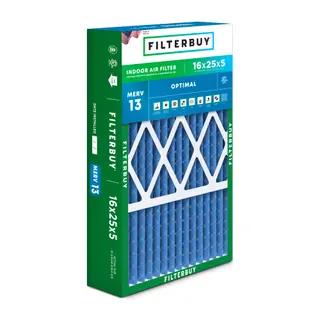
"In over a decade of manufacturing air filters, we've seen more energy complaints traced back to poor filter fit than to MERV ratings — a properly sized MERV 13 filter protects both your air quality and your utility bill when matched correctly to your system."
We manufacture millions of air filters annually. These are the resources we recommend to customers who want the full picture before upgrading to MERV 13.
The EPA breaks down how Minimum Efficiency Reporting Values work. Customers ask us about MERV 13 particle capture daily — this resource answers those questions with government-backed data.
URL: https://www.epa.gov/indoor-air-quality-iaq/what-merv-rating
We point customers to this EPA consumer guide when they're weighing filter options. It covers system compatibility concerns we see constantly in support calls.
URL: https://www.epa.gov/indoor-air-quality-iaq/guide-air-cleaners-home
ENERGY STAR confirms what we tell customers: clean filters can reduce energy consumption by up to 15%. This resource explains the maintenance intervals that keep systems running efficiently.
URL: https://www.energystar.gov/saveathome/heating-cooling
The Building America Solution Center explains pressure drop and airflow resistance. We recommend this before any MERV upgrade — it covers the compatibility questions our technical team fields every week.
URL: https://basc.pnnl.gov/resource-guides/high-merv-filters
ASHRAE sets the filtration benchmarks we design to. Standards 62.1 and 62.2 define what "acceptable indoor air quality" actually means for residential systems.
URL: https://www.ashrae.org/technical-resources/bookstore/standards-62-1-62-2
This EPA technical bulletin covers pressure drop limits and installation best practices. Our engineering team references this when customers ask about system strain concerns.
URL: https://www.epa.gov/sites/default/files/2020-06/documents/2019.11_tech_bulletin_filtration.pdf
ASHRAE's filtration resources go deeper than most homeowners need. We include it for customers who want to understand the testing methodology behind MERV ratings.
URL: https://www.ashrae.org/technical-resources/filtration-disinfection
After manufacturing millions of air filters, we trust the data. These government statistics match what we see daily in customer feedback and internal testing.
The U.S. Department of Energy confirms replacing a dirty filter can lower AC energy consumption by 5–15%. Our customers report the same. Homeowners who follow replacement schedules rarely see energy spikes after upgrading to MERV 13.
URL: https://www.energy.gov/energysaver/maintaining-your-air-conditioner
EPA data shows Americans spend 90% of their time indoors. Indoor pollutant levels run 2–5x higher than outdoor air. This is exactly why we manufacture MERV 13 filters — proper filtration is your first line of defense.
URL: https://www.epa.gov/report-environment/indoor-air-quality
EPA technical guidance confirms MERV 13 performance:
50%+ capture of smallest particles (0.3–1 micron)
90%+ capture of dust, pollen, and mold spores (3–10 micron)
Our engineering team designs to these benchmarks. The particle capture difference between MERV 8 and MERV 13 is measurable and significant.
URL: https://www.epa.gov/sites/default/files/2020-06/documents/2019.11_tech_bulletin_filtration.pdf
The question isn't whether MERV 13 filters increase energy bills. The real question is whether your system and maintenance habits support the upgrade.
After producing millions of filterbuy16x25x5 filters, we've watched this debate play out countless times. Here's what we've actually observed: the filter itself is rarely the problem.
Energy spikes trace back to three issues:
Poor filter fit
Neglected replacement schedules
System incompatibility
A precisely sized MERV 13 filter in a compatible HVAC system adds minimal resistance. Customers who monitor bills and follow maintenance intervals consistently report stable or improved efficiency.
Our opinion? MERV 13 filtration is worth it for most modern homes. The air quality benefits outweigh the minimal airflow tradeoff. EPA data shows indoor pollutants run 2–5x higher than outdoor levels. Your lungs don't care about saving a few watts.
The smarter approach:
Buy the right size
Change on schedule
Verify system compatibility
Do those three things and energy concerns become a non-issue.
We manufacture filters for homeowners who want cleaner air without the guesswork. That means precise tolerances, quality media, and honest guidance — even when the answer is "check your system specs before upgrading."
Ready to make the switch without second-guessing your energy bill? Follow these six steps.
1. Confirm your system's MERV capability.
Check your HVAC manual or the manufacturer's label for maximum MERV rating.
Most systems built after 2010 support MERV 13 without modification.
Can't find the spec? Contact your HVAC manufacturer or a local technician.
This five-minute check prevents every compatibility issue we see.
2. Measure your filter housing.
Remove your current filter.
Check the dimensions printed on the frame.
If the print has worn off, measure the housing: length, width, and depth.
Confirm all three dimensions match the 16x25x5 Air Kontrol size.
Even a quarter-inch gap allows unfiltered air bypass and unnecessary system strain.
3. Record your baseline energy usage.
Log your current kWh reading from your utility meter or most recent bill.
Note the date.
Compare against the same month from the previous year for the most accurate read.
4. Install and set a replacement reminder.
Set a calendar reminder to check your filter monthly.
Plan to replace every 6–12 months depending on household factors:
- Pets
- Multiple occupants
- Smokers
- High dust levels
Consistent replacement is the single biggest factor in maintaining air quality and energy efficiency.
5. Monitor for warning signs in the first 30 days.
Increased blower noise
Short cycling (system turning on and off rapidly)
Uneven heating or cooling across rooms
If everything runs normally — you've confirmed a proper fit.
If you notice warning signs, recheck filter dimensions and system compatibility first. The MERV rating is rarely the issue.
6. Compare your energy data after 30 days.
Pull your kWh usage for the first month with the new filter.
Compare against your baseline.
Customers who follow these steps consistently report stable or improved efficiency.
A: Rarely — when installed correctly. After tracking millions of filters, we see energy spikes trace back to:
Improper fit
Neglected replacement schedules
System incompatibility
Customers who follow maintenance guidelines report stable or lower bills. Cleaner coils run more efficiently.
A: Every 6–12 months depending on household factors. Replace closer to 6 months if you have:
Pets
Multiple occupants
Smokers
High dust levels
Check monthly. Replace when you see visible buildup or notice airflow changes.
A: Most systems built after 2010 handle MERV 13 comfortably. The 5-inch depth helps — it spreads filtration across more surface area and reduces pressure drop. Check your HVAC manual for maximum MERV rating. Nine times out of ten, the system supports the upgrade.
A: Particle capture performance:
MERV 8: 70% of large particles. Misses most fine particulates.
MERV 13: 90%+ of dust, pollen, and mold spores. 50%+ of smallest particles.
We manufacture both. We recommend MERV 13 when your system supports it. The air quality difference is noticeable within weeks.
A: Measure twice, order once. Gaps let unfiltered air bypass the filter entirely.
Proper fit checklist:
Pull existing filter
Check dimensions printed on frame
Measure housing if dimensions are unclear
Confirm snug fit with no visible gaps after installation
A properly sized MERV 13 16x25x5 Air Kontrol filter protects your air quality and your utility bill — the key is getting the right fit from a manufacturer that builds precision into every filter. Shop FilterBuy's MERV 13 16x25x5 Air Kontrol replacement filters today and breathe cleaner air with confidence.

