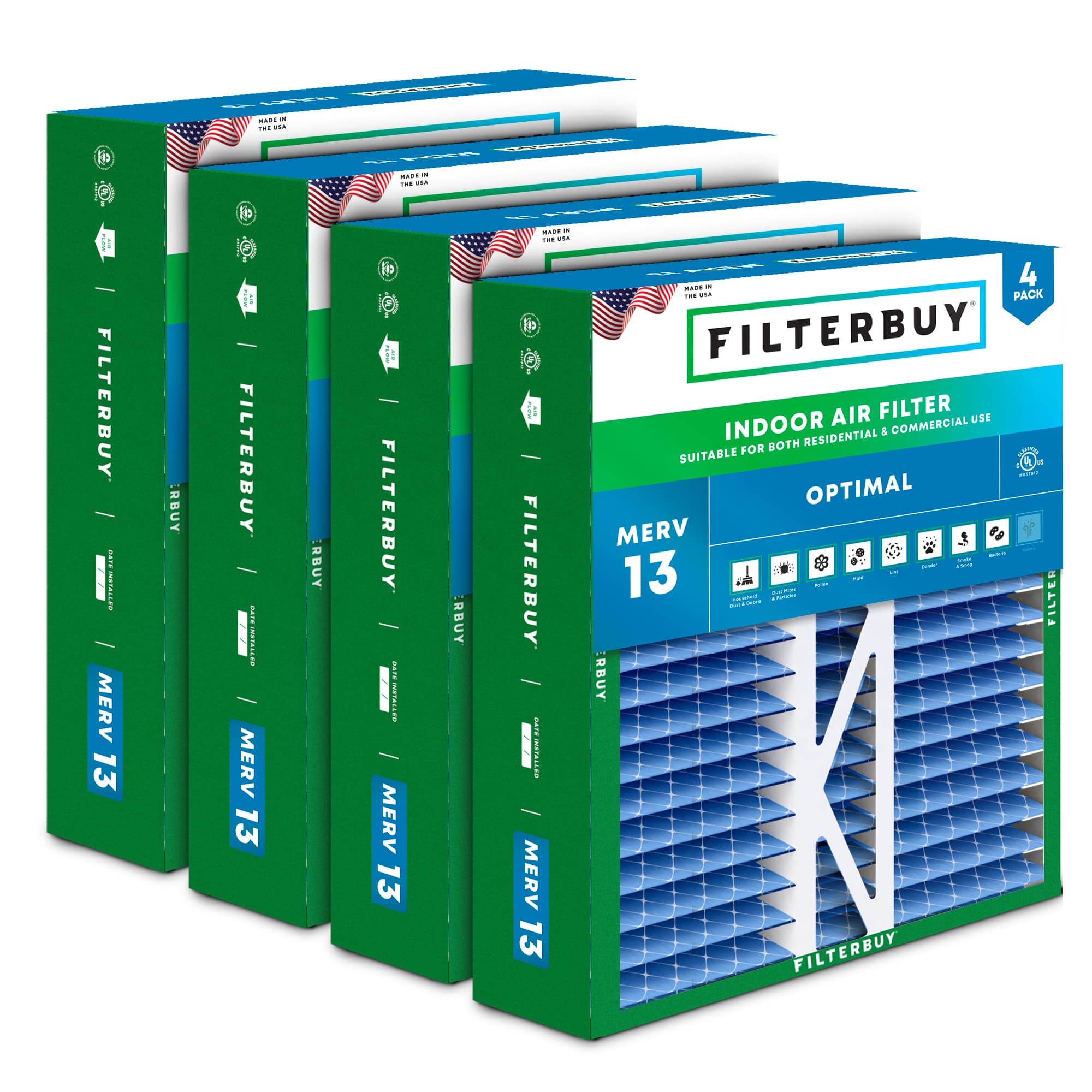
Tip: Ensure you buy the exact air filter size for your system. Certain brands have precise dimensions that only fit their specific models. See related filters
Actual Size: 15.13x21.88x5.25"
 Free Delivery
  Factory-Direct Low Prices, Made in the USA
 Hassle-Free Returns & Free Exchanges
RESIDENTIAL AND/OR COMMERCIAL USE
Change Every 3 Months
Tip: Ensure you buy the exact air filter size for your system. Certain brands have precise dimensions that only fit their specific models. See related filters
Actual Size: 15.13x21.88x5.25"
Free Delivery Factory-Direct Low Prices, Made in the USAHassle-Free Returns & Free ExchangesRESIDENTIAL AND/OR COMMERCIAL USE
Change Every 3 Months
Tip: Ensure you buy the exact air filter size for your system. Certain brands have precise dimensions that only fit their specific models. See related filters
Actual Size: 15.13x21.88x5.25"
Free Delivery Factory-Direct Low Prices, Made in the USAHassle-Free Returns & Free ExchangesRESIDENTIAL AND/OR COMMERCIAL USE
Change Every 3 Months
At Filterbuy, we don't cut corners—we craft high-quality air filters right here in the USA and ship them to your doorstep for free. No delays, no gimmicks—just clean air, made easy. With thousands of five-star reviews and filters built for real life & every HVAC system, it's no wonder why over 4 million families trust Filterbuy.

Proudly Made In The USA

Fast, Free Shipping on Every Order

Premium Materials That Go The Distance

85,000+ 5-Star Reviews From Happy Customers

Save Up to 70% Per Filter with Packs


Measure length × width × depth with a tape measure to find the actual size.

Round up each dimension to the nearest whole number to get the nominal size. Example: 15.13x21.88x5.25" in → 16X22X5 nominal.

Search by nominal size on our site for the best fit.


5″ filters give you maximum filtration with minimal maintenance — lasting up to 12 months while handling higher MERV ratings without restricting airflow.
Sizing note:

If the filter you buy doesn't fit, we'll send you a better size.
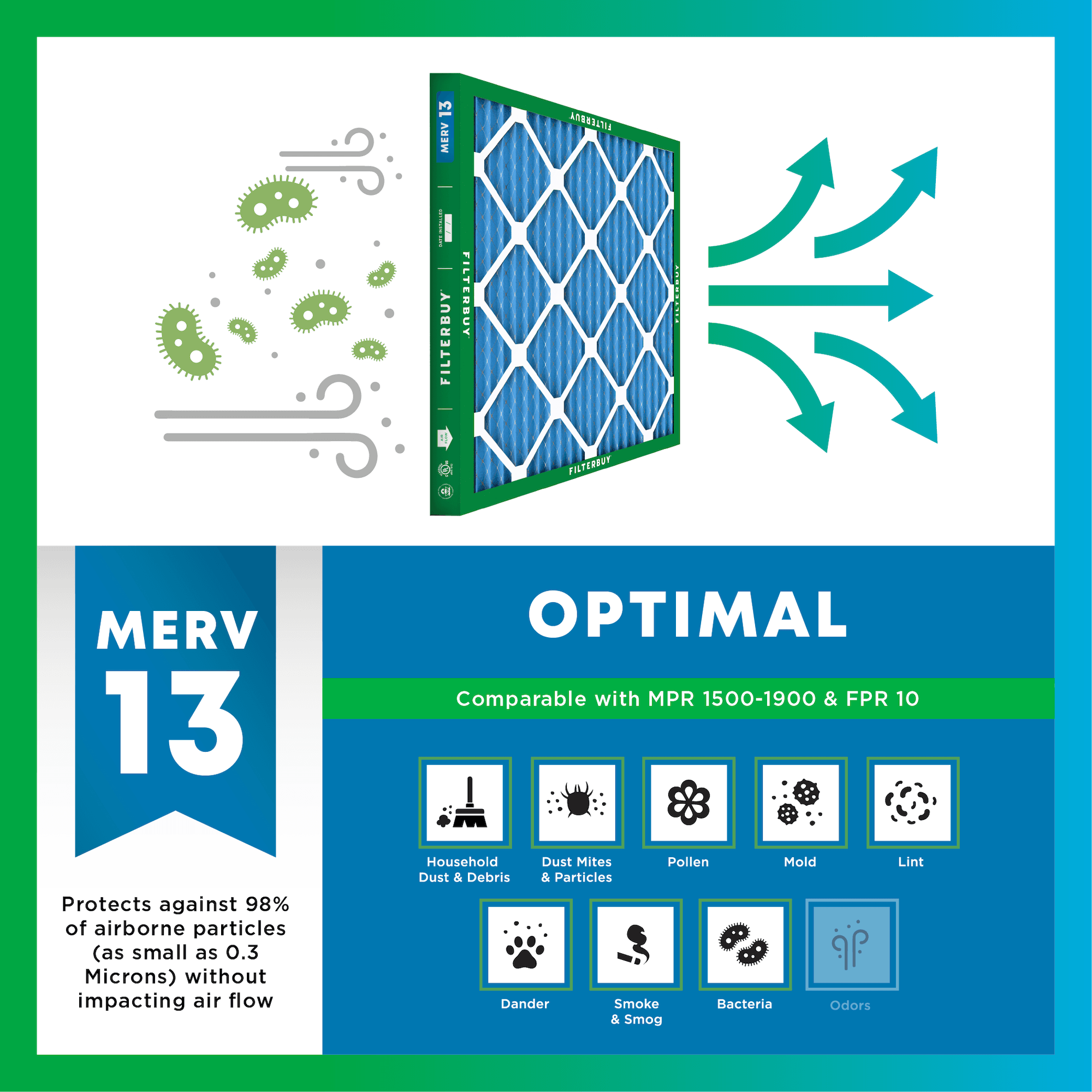
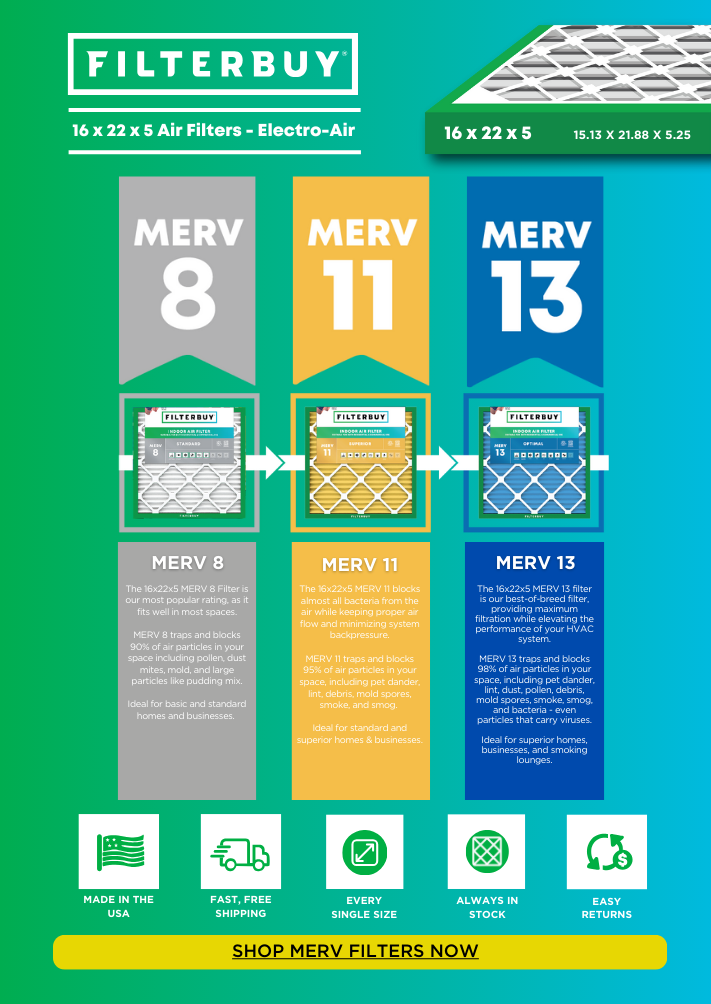
MERV stands for Minimum Efficiency Reporting Value—but don't let the technical name fool you. It's just a way to rate how well an air filter traps stuff like dust, pollen, pet dander, and smoke. The higher the MERV number, the more particles it catches—and the cleaner your air will be.

Comparable to:FPR: 4-7
MPR: 600-1000
 Dust & Debris
 Dust Mites & Particles
 Pollen
 Mold
Mold Lint
Lint Dander
Comparable to:FPR: 6-9
MPR: 1200-1550
Dust & DebrisDust Mites & ParticlesPollenMoldLintDander Smoke & Smog
Comparable to:FPR: 10
MPR: 1900-2800
Dust & DebrisDust Mites & ParticlesPollenMoldLintDanderSmoke & Smog Bacteria


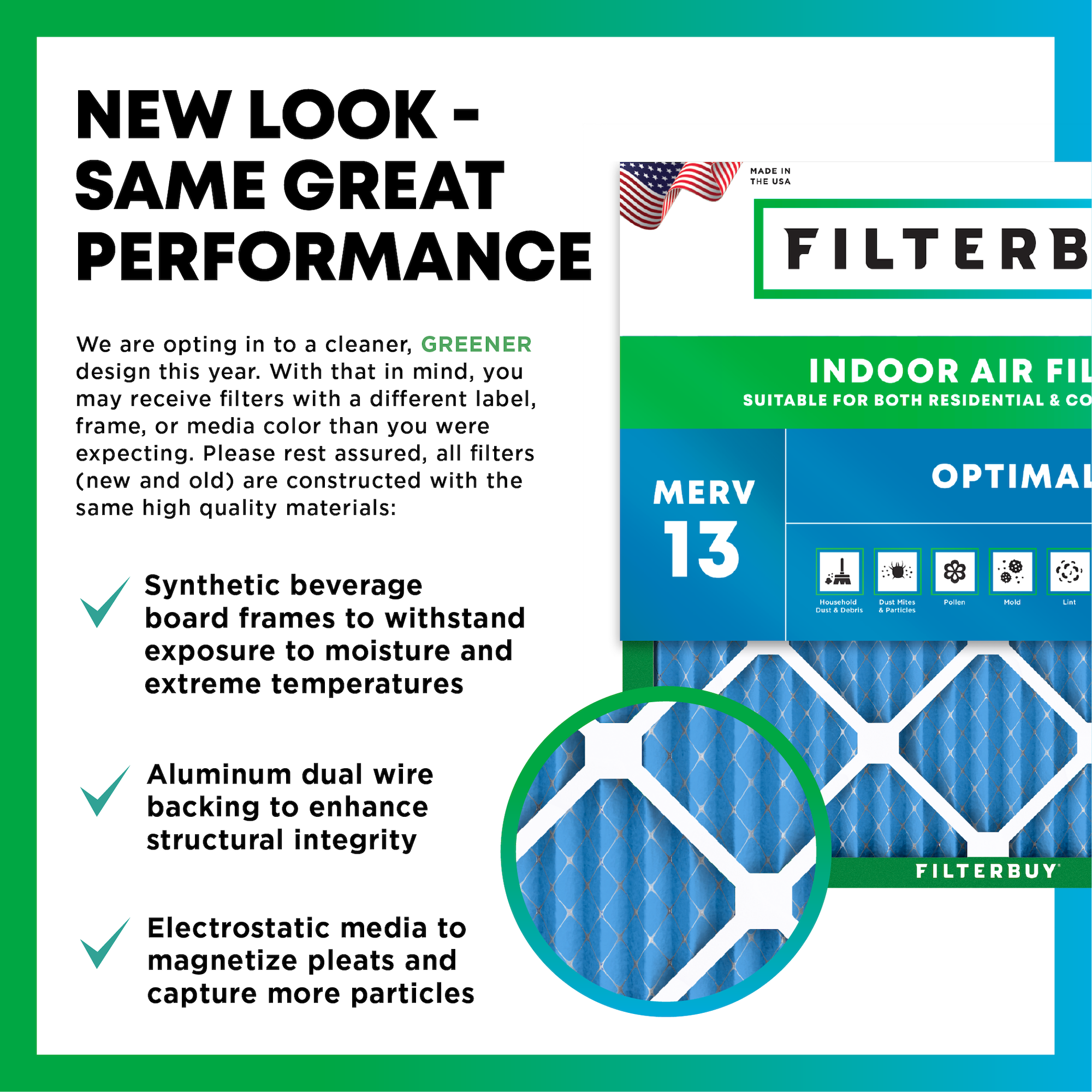
We build every Filterbuy filter to deliver reliable 90-day performance—thanks to smart design and premium materials that do the heavy lifting. Here's what makes the difference:
More pleats = more surface area to capture dust and debris, keeping your air cleaner longer.
Pleats are magnetized to attract and trap microscopic particles—like pet dander, pollen, and smoke.
Engineered to resist warping in extreme temperatures and high humidity.

A layer of metal reinforcement keeps pleats evenly spaced and structurally sound—no sagging, even at high airflow.
Assembled with care. Built to perform. Ships fast, free, and reliably from our U.S. facilities.

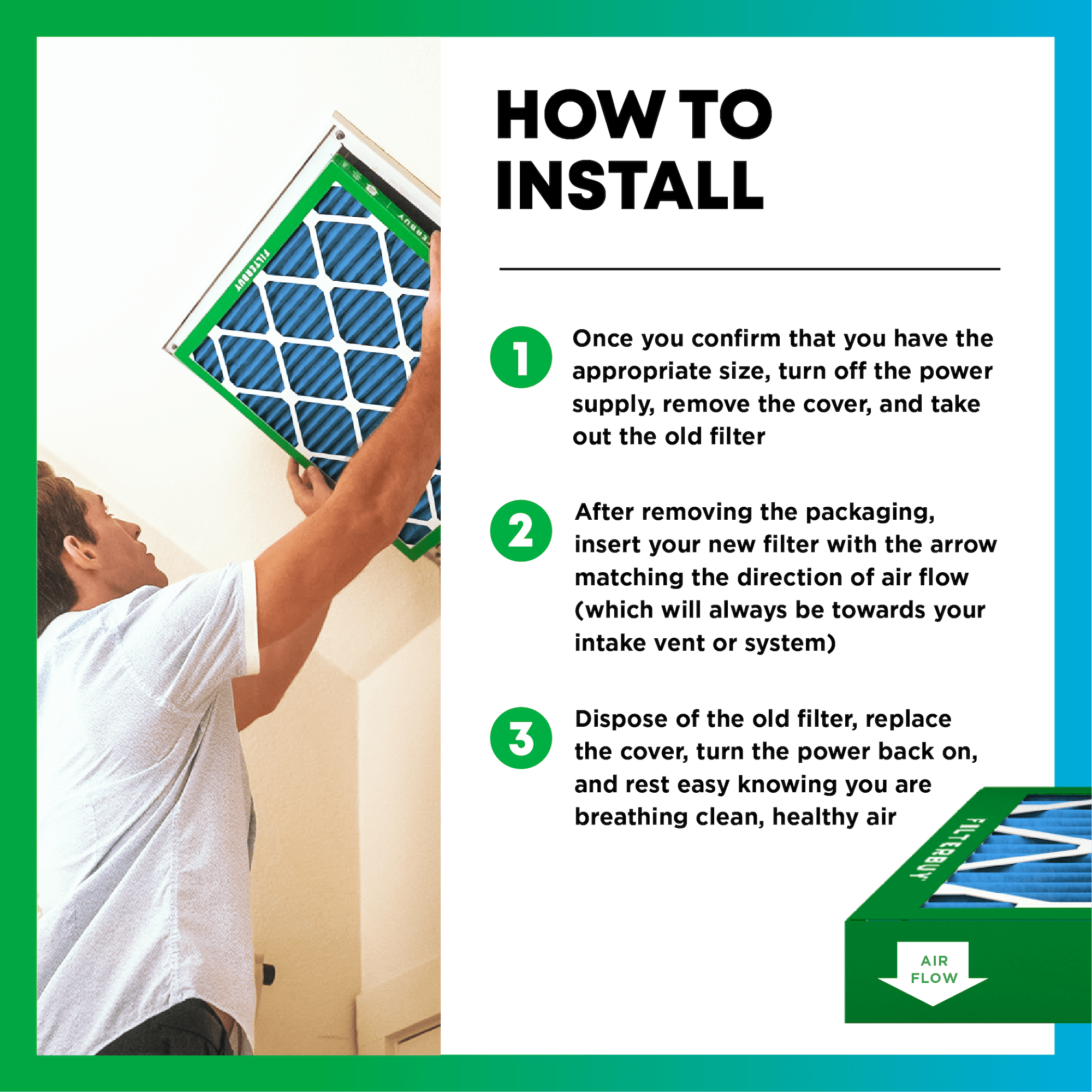
Turn Off Your HVAC SystemSafety first.

Remove The Old FilterLook for the airflow arrow and make note of the direction.

Slide In Your New FilterArrow should point toward the system (same direction as before).

Turn Your System Back OnAnd enjoy the fresh, clean air.

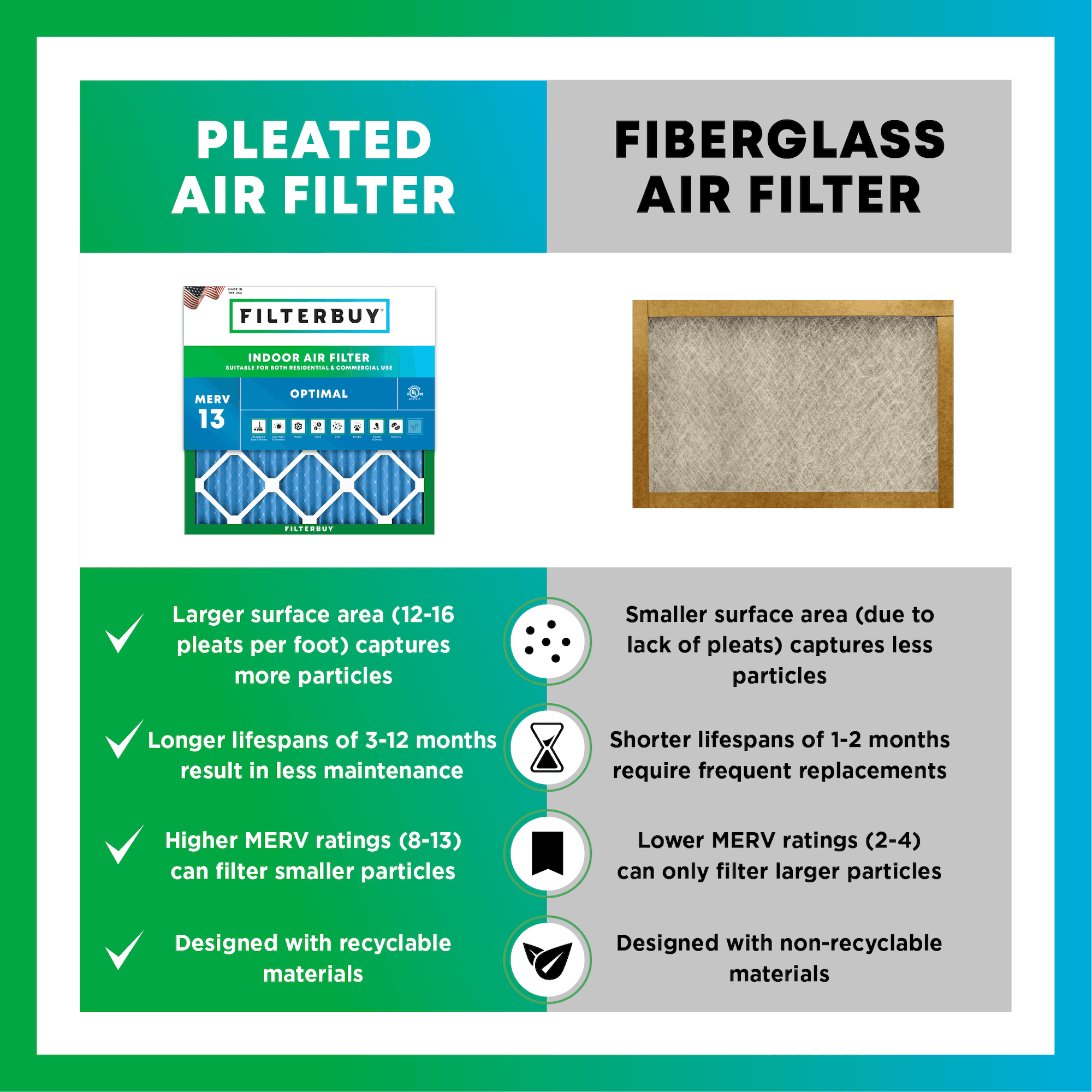
Not all air filters are created equal. Pleated filters don't just last longer—they actually clean your air better. Here's how they stack up:

Efficiency:
High (MERV 8–13) – Traps more particles
Lifespan:
90 days – Long-lasting performance
Air Quality:
Excellent – Cleaner, healthier air
Materials:
Recyclable and durable

Efficiency:
Low (MERV 4 or less) – Misses small stuff
Lifespan:
30 days or less – Replace often
Air Quality:
Minimal – Basic protection only
Materials:
Thin, flimsy, and not recyclable
Pleated filters are a no-brainer—more protection, less hassle, and better air for your home.
Changing your filter on time keeps your HVAC system running efficiently—and helps protect your lungs from dust, allergens, and airborne irritants. Here's how often to swap it out based on your needs:

For most homes without pets or special air quality concerns. Great for general upkeep and energy efficiency.

Shedding fur, dander, and allergy triggers can build up fast. Changing your filter every two months helps keep the air fresher and symptoms at bay.

For households affected by smoke, pollution, or respiratory conditions, monthly changes ensure maximum protection.

| Nominal Size | 16X22X5 |
| Actual Size | 15.13 x 21.88 x 5.25" inches |
| Filter Type | Pleated |
| Media | Electrostatically Charged |
| Frame | Beverage Board |
| MERV Ratings Available | 8, 11, 13 |
| Lifespan | Up to 12 Months |
| Origin | Made in USA |
Your Electro-Air media cabinet already solved the airflow problem. The engineers who designed it built the housing five inches deep because they knew that thick media at low air velocity outperforms thin media under pressure every time. So the question isn't whether your system can handle MERV 13. It's whether the filter going into that cabinet is the right size, the right rating, and actually doing the job the system was built to do.
The 16x22x5 MERV 13 filter is built for that cabinet. It seats flush, fills the housing completely, and captures particles down to 0.3 microns while keeping pressure drop well within the range your blower was designed to handle. That's not a compromise. That's what happens when the filter matches the system.
The MERV 13 16x22x5 is a 5-inch thick media replacement filter for Electro-Air whole-house filtration systems. It captures particles as small as 0.3 microns — including dust, pollen, pet dander, mold spores, smoke, and some bacteria — while the 5-inch media depth keeps pressure drop low enough to protect your system's blower and maintain full airflow. It's the filter rating the EPA recommends as the minimum for reducing fine particulate matter (PM2.5) indoors.
Key specs:
• Size: 16x22x5 inches — a 5-inch thick media format specific to Electro-Air whole-house filter cabinets
• MERV rating: MERV 13 — captures at least 50% of particles in the 0.3 to 1 micron range per ASHRAE Standard 52.2 testing
• Compatible with: Electro-Air whole-house media filter cabinets requiring a 5-inch filter
• Captures: Dust, pollen, mold spores, pet dander, smoke particles, and some bacteria
• Replacement interval: Every 6 to 12 months — inspect at 6 months for households with pets, smokers, or allergy concerns
• 16x22x5 is an Electro-Air-specific size — designed for whole-house media filter cabinets, not standard return vent slots
• MERV 13 captures particles as small as 0.3 microns — dust, pollen, mold spores, pet dander, smoke particles, and some bacteria
• Five-inch depth keeps pressure drop low compared to thin 1-inch MERV 13 filters, protecting your blower motor and airflow without added system strain
• The EPA recommends MERV 13 as the minimum for homeowners looking to reduce fine particulate matter (PM2.5) indoors
• MERV 13 outperforms MERV 8 and MERV 11 on fine particle capture — the difference matters most in allergy, asthma, and respiratory health households
• Inspect at 6 months, replace by 12 — pet owners, smokers, and active renovation households should check sooner
• A poor-fitting filter creates air bypass — untreated air routes around improperly sized media, defeating the whole system's purpose
Electro-Air whole-house filtration systems use a dedicated filter cabinet built directly into the HVAC air handler, a housing that accepts one filter type: 5-inch thick media, sized to fill the opening completely. The 16x22x5 dimension matches those internal cabinet specifications precisely. When a filter leaves gaps at the edges, air takes the path of least resistance and routes around the media on every single pass. High-efficiency rating on the box, zero filtration in practice.
We see this consistently: homeowners upgrade to MERV 13 but skip the fit check, and the filter does nothing because it isn't sealing the cabinet. Getting the size right isn't optional. It's what makes every other specification on that filter label actually count.
ASHRAE's MERV scale measures what a filter actually traps, across particle sizes from 0.3 to 10 microns. At MERV 13, a filter must pull out at least 50 percent of particles in the 0.3 to 1 micron range, and that specific range is where health effects concentrate. Fine dust, pollen, mold spores, pet dander, smoke, and bacteria-carrying respiratory droplets all fall in this band.
MERV 8 and MERV 11 both miss a significant share of that fine particle load. They were built primarily to protect HVAC equipment, not to clean the air your family breathes. MERV 13 does both. The EPA recommends it as the minimum for households targeting indoor PM2.5 reduction, and for a system already built to handle 5-inch media, reaching that standard costs the Electro-Air nothing in airflow performance.
Here's what we know from production: the airflow concern about high-efficiency filters is real, but it's a 1-inch problem, not a 5-inch one.
A thin MERV 13 filter compresses all airflow through a small surface area. That's where pressure drop climbs and blowers work harder. A 5-inch filter spreads that same airflow across a much larger media surface, so air passes through at lower velocity. Lower velocity means less resistance. Less resistance means the system runs at normal load while still capturing particles at full MERV 13 efficiency.
Electro-Air built the cabinet at that depth intentionally, because the physics of thick media filtration are well established. Learning how home air filters work makes the engineering clear. Your system was designed for this format from the start.
Every cycle your HVAC runs without the right filter lets particles bypass the media and land on coils, fan blades, and blower components. That buildup reduces heat transfer efficiency, contributes to coil freeze-up, and turns what would have been a $35 filter swap into a service call. After manufacturing filters for over a decade and serving more than two million households, we've seen the pattern play out in consistent ways: homeowners running the correct filter for their system's specifications spend less on HVAC repairs and go longer between service visits.
An Electro-Air system doing its job with a properly fitted, properly rated 5-inch filter isn't just cleaner. It's more reliable.
Most homeowners picture bad air as something visible — smoke, visible dust, something that triggers a cough. The particles that matter most are the ones you can't see. Mold spores, pet dander, smoke from a gas stove, pollen that came in on someone's jacket — these float through a home completely invisible and keep circulating as long as the filtration system lets them pass. Making the invisible visible is the whole point of high-efficiency whole-house filtration.
That's exactly what lower-rated filters allow. MERV 8 passes a significant share of sub-micron particles on every air cycle. MERV 11 improves on that but still doesn't hit the 50 percent minimum efficiency threshold for the finest particle range. If your Electro-Air cabinet is the only filtration source in your home — and for whole-house media systems, it almost always is — the air filter you choose is the line between air that's been treated and air that's passed through a system with a checkpoint too coarse to catch what matters.
MERV 13 closes that gap. It's the rating where filtered air and cleaner air start meaning the same thing.
"Five-inch media depth isn't a luxury spec — it's what makes MERV 13 efficiency and low pressure drop possible at the same time. We've tested this across production runs, and the data lines up with what customers report back: the right filter depth doesn't make your system work harder. It gives the whole thing room to breathe."
— Filterbuy Manufacturing Team
The guidance on this page draws on verified sources from U.S. government agencies. Each resource below covers a distinct dimension of MERV ratings, air filtration, and indoor air quality — useful starting points for any homeowner who wants to go deeper.
The EPA breaks down the MERV scale and explains how each rating corresponds to filter performance across the full particle size range, from 0.3 to 10 microns. Start here to understand exactly what any filter is rated to capture — and where it stops.
Source: https://www.epa.gov/indoor-air-quality-iaq/what-merv-rating
This guide covers how to choose HVAC filters by efficiency rating, when MERV 13 makes sense, how to check system compatibility, and why filter fit affects filtration outcomes. Useful for any homeowner moving up from a lower-rated filter.
Source: https://www.epa.gov/indoor-air-quality-iaq/guide-air-cleaners-home
NIOSH guidance recommends upgrading central HVAC filter efficiency to MERV 13 or better as the primary strategy for improving indoor air quality. The guidance covers when the upgrade matters most and how to assess whether your system can handle it.
Source: https://www.cdc.gov/niosh/ventilation/prevention/air-cleanliness.html
The EPA's IAQ fact sheet documents that indoor pollutant levels regularly run several times higher than outdoor concentrations. It frames whole-house filtration as a health baseline, not an optional upgrade.
Source: https://www.epa.gov/indoor-air-quality-iaq/factsheet-what-indoor-air-quality
The DOE's Building America Solution Center explains why a higher MERV rating doesn't automatically mean more pressure drop — filter design and depth both drive performance. Worth reading before any HVAC filter purchase decision.
Source: https://basc.pnnl.gov/resource-guides/high-merv-filters
NIOSH explains the ASHRAE Standard 52.2 testing process, how MERV values get assigned, and how that testing connects to real-world air quality in occupied spaces. A plain-language explainer for homeowners who want to understand what a MERV 13 rating actually guarantees.
Source: https://www.cdc.gov/niosh/ventilation/faq/index.html
This EPA resource covers how indoor air pollution accumulates, which household sources drive the highest particle loads, and what filtration and HVAC maintenance steps make the largest impact. Directly relevant to Electro-Air system owners assessing a filter upgrade.
Source: https://www.epa.gov/indoor-air-quality-iaq/inside-story-guide-indoor-air-quality
1. Americans spend approximately 90 percent of their time indoors, where concentrations of some pollutants are often 2 to 5 times higher than typical outdoor levels.
What that number means in a real home: indoor air isn't neutral. Every time someone cooks, cleans, or lets a pet in from outside, the particle load goes up. It doesn't vent itself. Whole-house filtration running on the right MERV 13 media filter is the only way to address that accumulation at the source, rather than chasing it room by room.
Source: https://www.epa.gov/indoor-air-quality-iaq
2. MERV 13 filters must achieve at least 50 percent removal efficiency for particles in the 0.3 to 1 micron range — the particle sizes most closely tied to respiratory health effects, including fine particulate matter (PM2.5).
That benchmark is the dividing line. Below MERV 13, no filter is required to demonstrate any minimum performance for that fine particle range under ASHRAE Standard 52.2 testing. Electro-Air system owners with a 5-inch cabinet can reach MERV 13 thickness with no system modification. Choosing a lower-rated filter gives up the only measurable standard for fine particle capture without gaining anything in return.
3. High-efficiency filters in the MERV 13 to 16 range can reduce indoor particles by as much as 95 percent when the central air system is running — a performance level that lower-rated filters can't approach for fine particulate matter.
The EPA's technical guidance puts MERV 13 filters in the same performance category as near-HEPA filtration for most indoor particle sizes linked to health effects. A MERV 13 filter in a 5-inch Electro-Air-compatible cabinet reaches that level without the pressure drop penalty a HEPA retrofit would impose on a standard residential system.
Source: https://www.epa.gov/sites/default/files/2018-11/documents/indoor_air_filtration_factsheet-508.pdf
Most air quality wins in a home aren't dramatic. They come from getting one small decision right — the right filter, the right size, the right rating — and then leaving it alone to do the work. The MERV 13 16x22x5 is that decision for an Electro-Air system. It fits the cabinet the system was built around, meets the EPA's recommended efficiency threshold for fine particle capture, and puts no extra load on the blower or ductwork to do it. Homeowners who make that call protect their family's air and their system's long-term reliability on the same install. On a schedule they can plan around. That's a decision worth making.
1. Check your filter dimensions before ordering. Read the size printed on your current filter or measure the cabinet opening directly. The 16x22x5 must seat flush with no gaps — bypassing the frame cancels the filtration entirely.
2. Find your filter cabinet. Electro-Air media cabinets mount inline with the HVAC air handler, usually in a utility room or mechanical closet, not at the return air vent on the wall.
3. Power down the system. Turn it off at the thermostat or the breaker before pulling the old filter.
4. Note the airflow direction arrow on the old filter. Install the new filter with the arrow pointing in the same direction, toward the air handler.
5. Log the install date. Set a reminder at 6 months for households with pets, allergy concerns, or multiple occupants. Standard households should plan on 12 months maximum.
A: For most Electro-Air whole-house media cabinet systems, yes. Confirm by reading the size printed on your current filter or measuring the cabinet opening before ordering. On installation, the filter should seat flush with no visible gaps — any gap around the frame means air is bypassing the media.
A: Not in a 5-inch thick media format. The depth provides enough surface area to keep air velocity through the media low, which is what holds pressure drop in check. Electro-Air systems were engineered for this filter format — the blower and ductwork are already sized to handle 5-inch media at MERV 13 efficiency.
A: MERV 8 captures large particles — dust and pollen — but passes a significant portion of fine particles including smoke, mold spores, and bacteria-carrying droplets. MERV 11 closes part of that gap but still doesn't hit the 50 percent minimum removal efficiency for the smallest particle range (0.3 to 1 micron) that MERV 13 is required to demonstrate under ASHRAE Standard 52.2 testing. In practical terms for a household:
MERV 8 protects HVAC equipment but does limited work on fine particles
MERV 11 improves on MERV 8 but falls short of the ASHRAE fine-particle efficiency benchmark
MERV 13 is the EPA-recommended minimum for PM2.5 reduction and meaningful respiratory protection
A: Inspect at 6 months, replace by 12. Households with pets, smokers, multiple occupants, or active construction nearby should check at the 6-month mark and replace when the media looks gray or visibly loaded. Don't run the system without a filter in place — unfiltered air deposits particles on coils and blower components directly, which shortens system lifespan and raises repair costs.
A: The 16x22x5 MERV 13 filter is designed to be compatible with Electro-Air whole-house media filter cabinets. Confirm the cabinet dimensions before installing. The filter should seat snugly with no gaps. If you're unsure of your housing dimensions, check the size printed on your existing filter or measure the opening directly.
Your Electro-Air system was designed to clean every cubic foot of air in your home — give it the MERV 13 16x22x5 that fits the cabinet, meets the EPA's recommended efficiency standard, and protects your system's airflow in the same install. Order yours today and start breathing better air for all.

