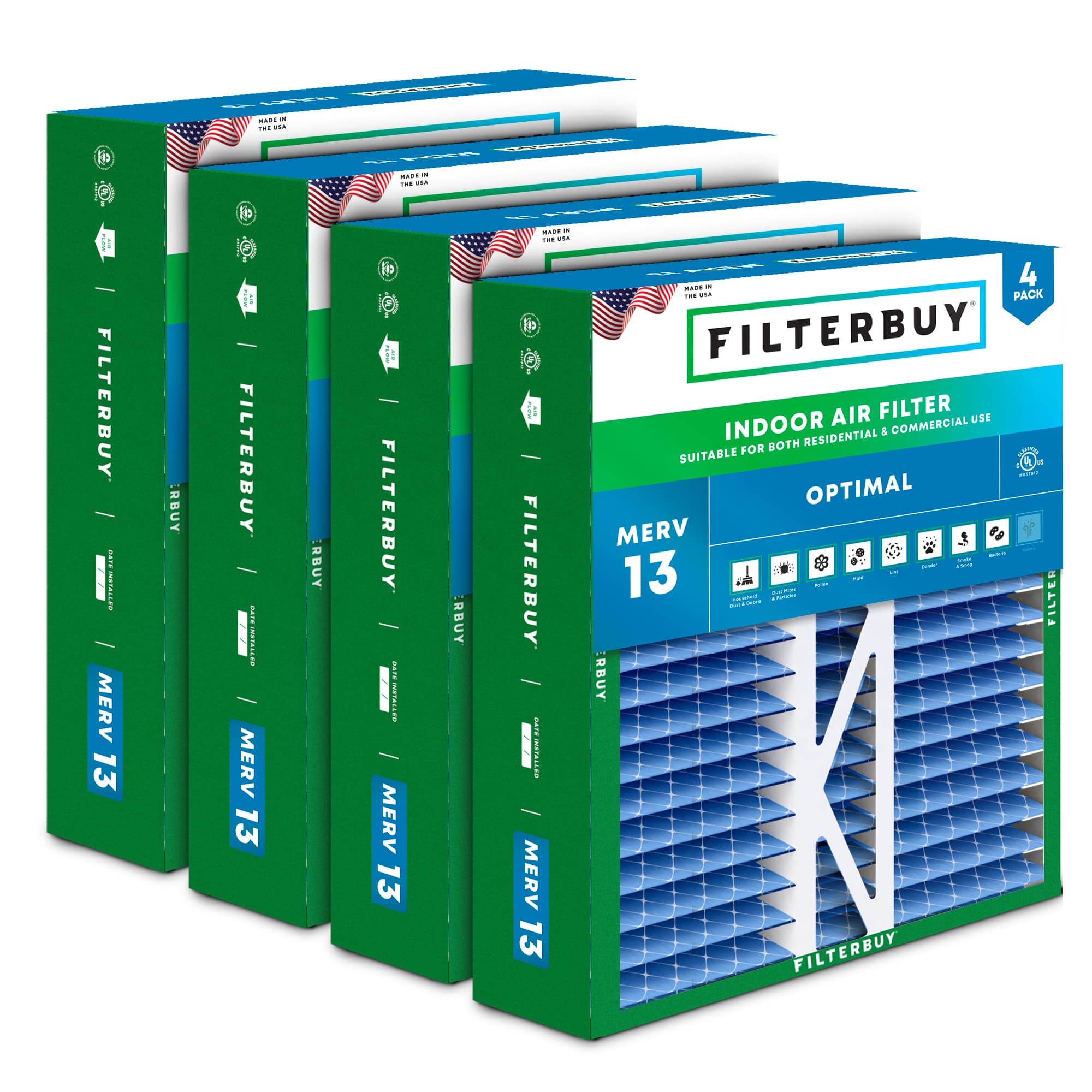
Tip: Ensure you buy the exact air filter size for your system. Certain brands have precise dimensions that only fit their specific models. See related filters
Actual Size: 15.38x21.88x5.25"
 Free Delivery
  Factory-Direct Low Prices, Made in the USA
 Hassle-Free Returns & Free Exchanges
RESIDENTIAL AND/OR COMMERCIAL USE
Change Every 3 Months
Tip: Ensure you buy the exact air filter size for your system. Certain brands have precise dimensions that only fit their specific models. See related filters
Actual Size: 15.38x21.88x5.25"
Free Delivery Factory-Direct Low Prices, Made in the USAHassle-Free Returns & Free ExchangesRESIDENTIAL AND/OR COMMERCIAL USE
Change Every 3 Months
Tip: Ensure you buy the exact air filter size for your system. Certain brands have precise dimensions that only fit their specific models. See related filters
Actual Size: 15.38x21.88x5.25"
Free Delivery Factory-Direct Low Prices, Made in the USAHassle-Free Returns & Free ExchangesRESIDENTIAL AND/OR COMMERCIAL USE
Change Every 3 Months
At Filterbuy, we don't cut corners—we craft high-quality air filters right here in the USA and ship them to your doorstep for free. No delays, no gimmicks—just clean air, made easy. With thousands of five-star reviews and filters built for real life & every HVAC system, it's no wonder why over 4 million families trust Filterbuy.

Proudly Made In The USA

Fast, Free Shipping on Every Order

Premium Materials That Go The Distance

85,000+ 5-Star Reviews From Happy Customers

Save Up to 70% Per Filter with Packs


Measure length × width × depth with a tape measure to find the actual size.

Round up each dimension to the nearest whole number to get the nominal size. Example: 15.38x21.88x5.25" in → 16X22X5 nominal.

Search by nominal size on our site for the best fit.


5″ filters give you maximum filtration with minimal maintenance — lasting up to 12 months while handling higher MERV ratings without restricting airflow.
Sizing note:

If the filter you buy doesn't fit, we'll send you a better size.
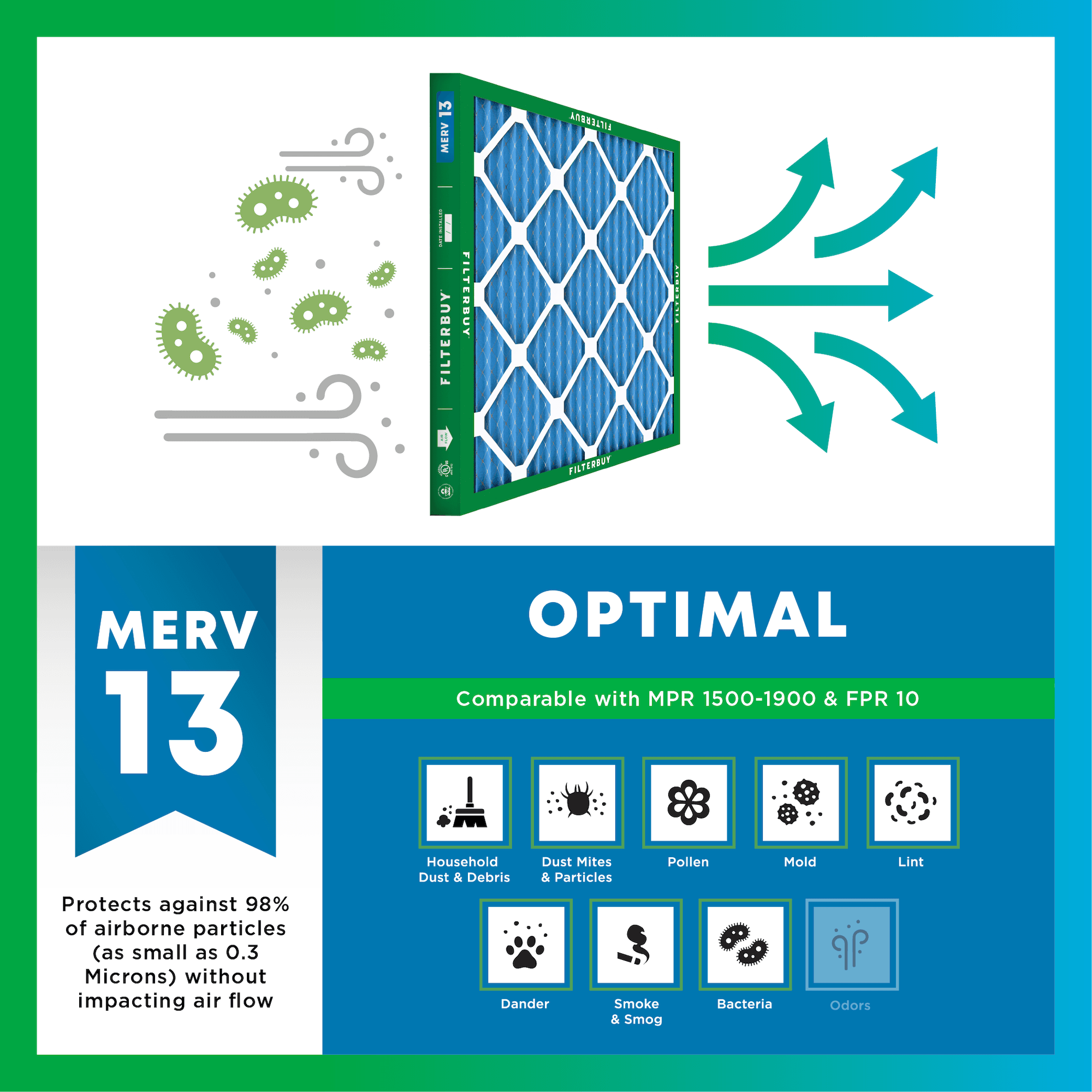
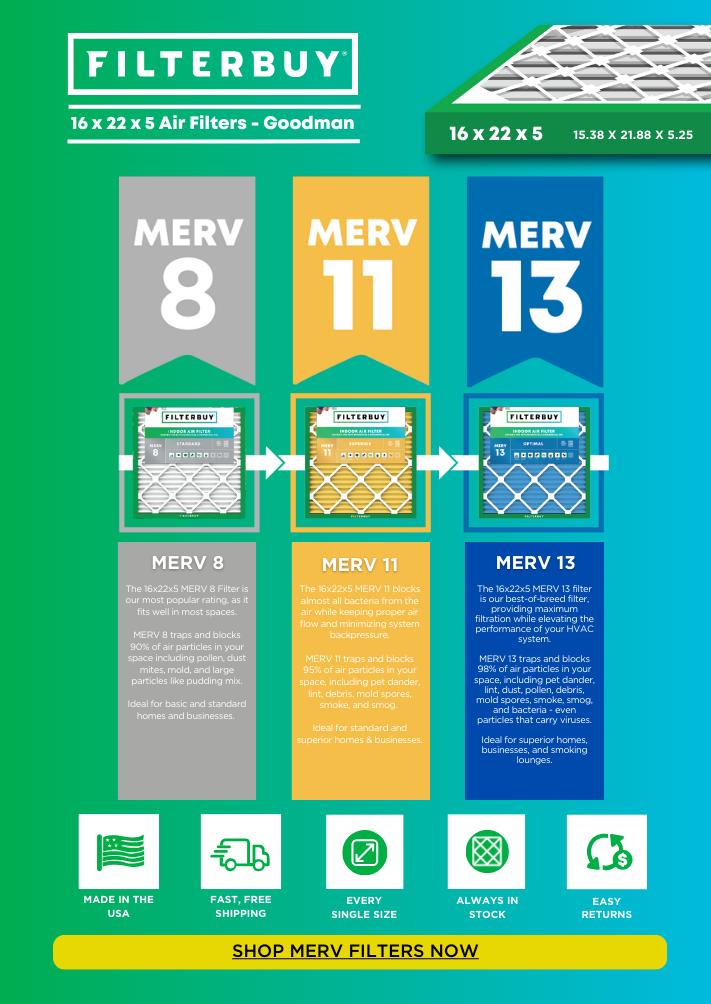
MERV stands for Minimum Efficiency Reporting Value—but don't let the technical name fool you. It's just a way to rate how well an air filter traps stuff like dust, pollen, pet dander, and smoke. The higher the MERV number, the more particles it catches—and the cleaner your air will be.

Comparable to:FPR: 4-7
MPR: 600-1000
 Dust & Debris
 Dust Mites & Particles
 Pollen
 Mold
Mold Lint
Lint Dander
Comparable to:FPR: 6-9
MPR: 1200-1550
Dust & DebrisDust Mites & ParticlesPollenMoldLintDander Smoke & Smog
Comparable to:FPR: 10
MPR: 1900-2800
Dust & DebrisDust Mites & ParticlesPollenMoldLintDanderSmoke & Smog Bacteria


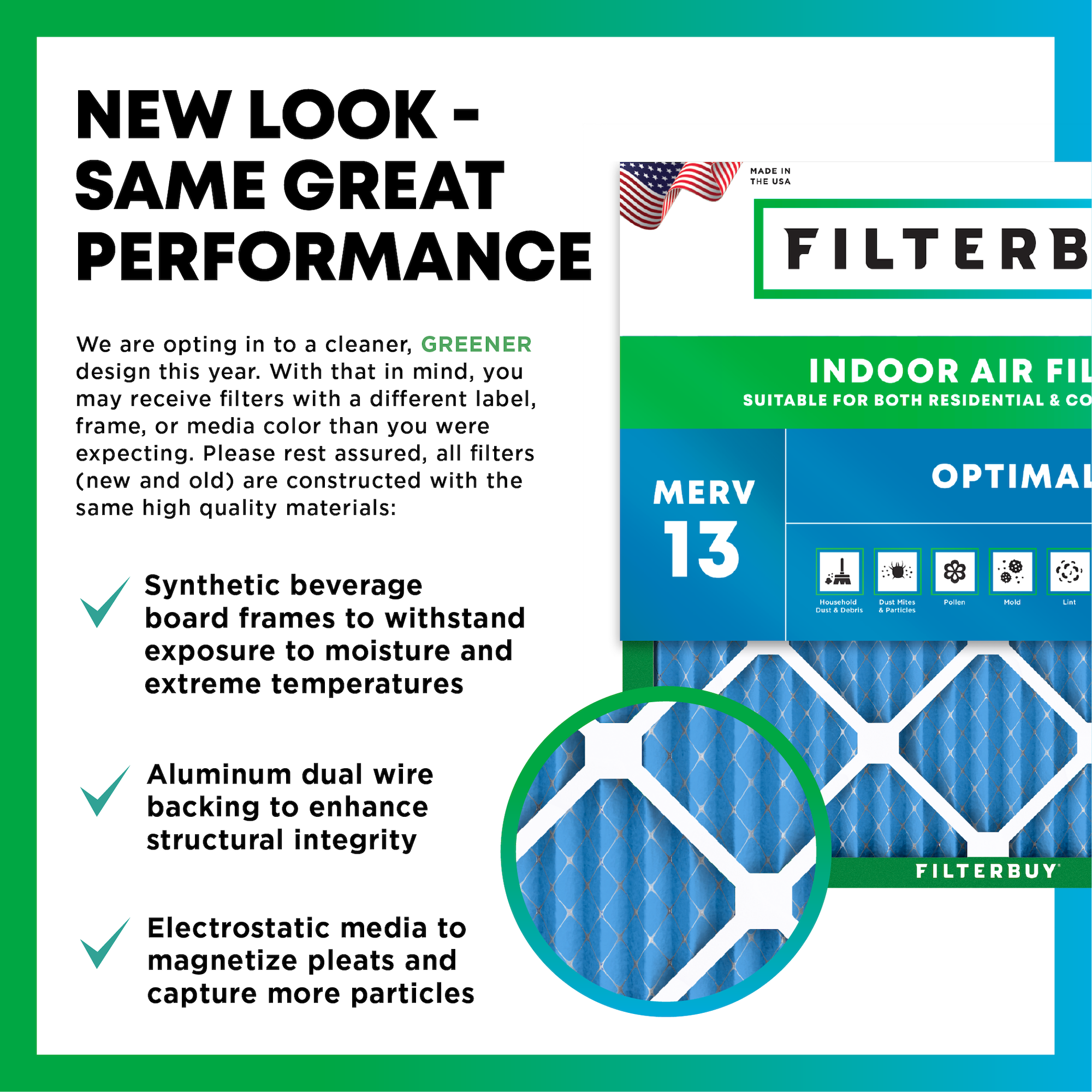
We build every Filterbuy filter to deliver reliable 90-day performance—thanks to smart design and premium materials that do the heavy lifting. Here's what makes the difference:
More pleats = more surface area to capture dust and debris, keeping your air cleaner longer.
Pleats are magnetized to attract and trap microscopic particles—like pet dander, pollen, and smoke.
Engineered to resist warping in extreme temperatures and high humidity.

A layer of metal reinforcement keeps pleats evenly spaced and structurally sound—no sagging, even at high airflow.
Assembled with care. Built to perform. Ships fast, free, and reliably from our U.S. facilities.

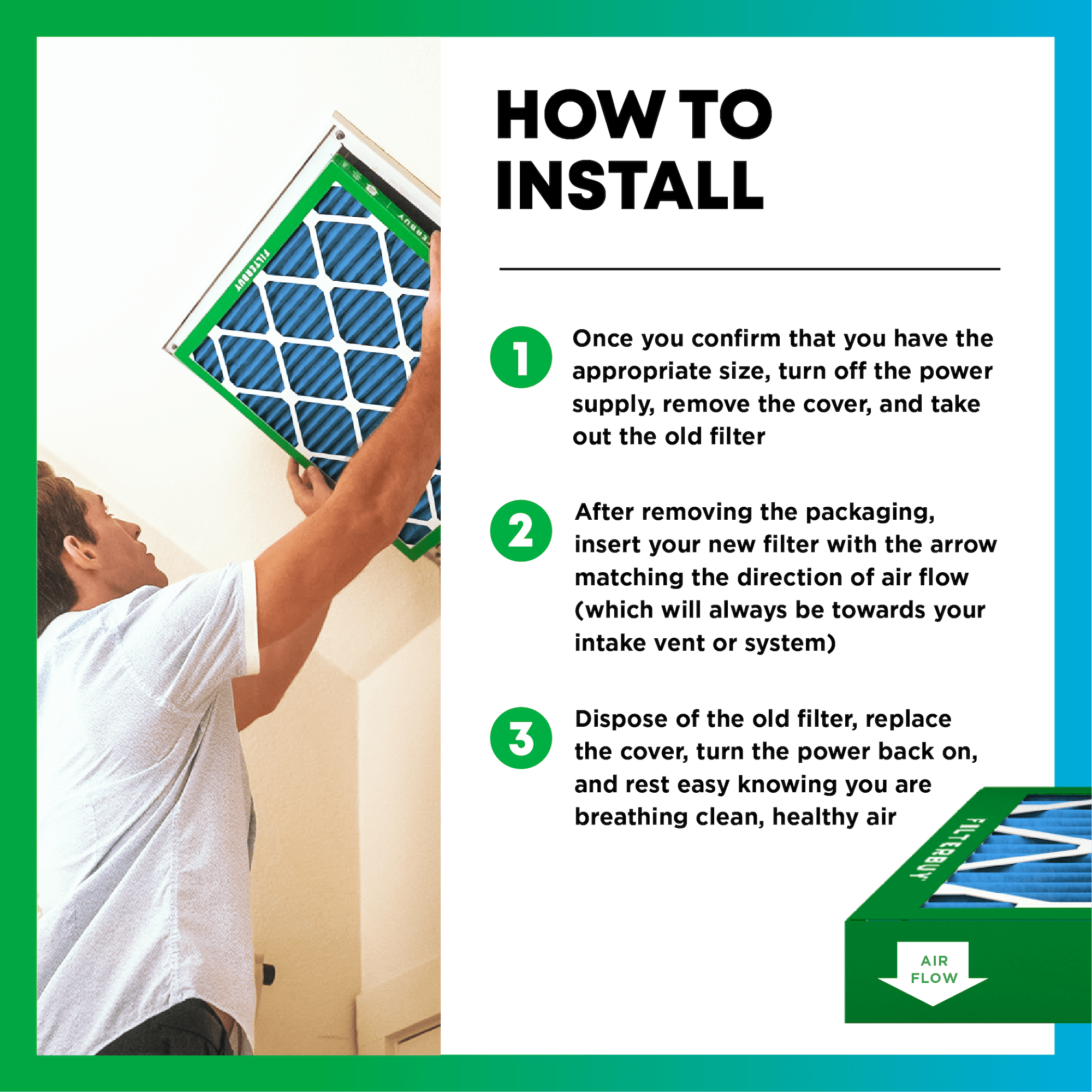
Turn Off Your HVAC SystemSafety first.

Remove The Old FilterLook for the airflow arrow and make note of the direction.

Slide In Your New FilterArrow should point toward the system (same direction as before).

Turn Your System Back OnAnd enjoy the fresh, clean air.

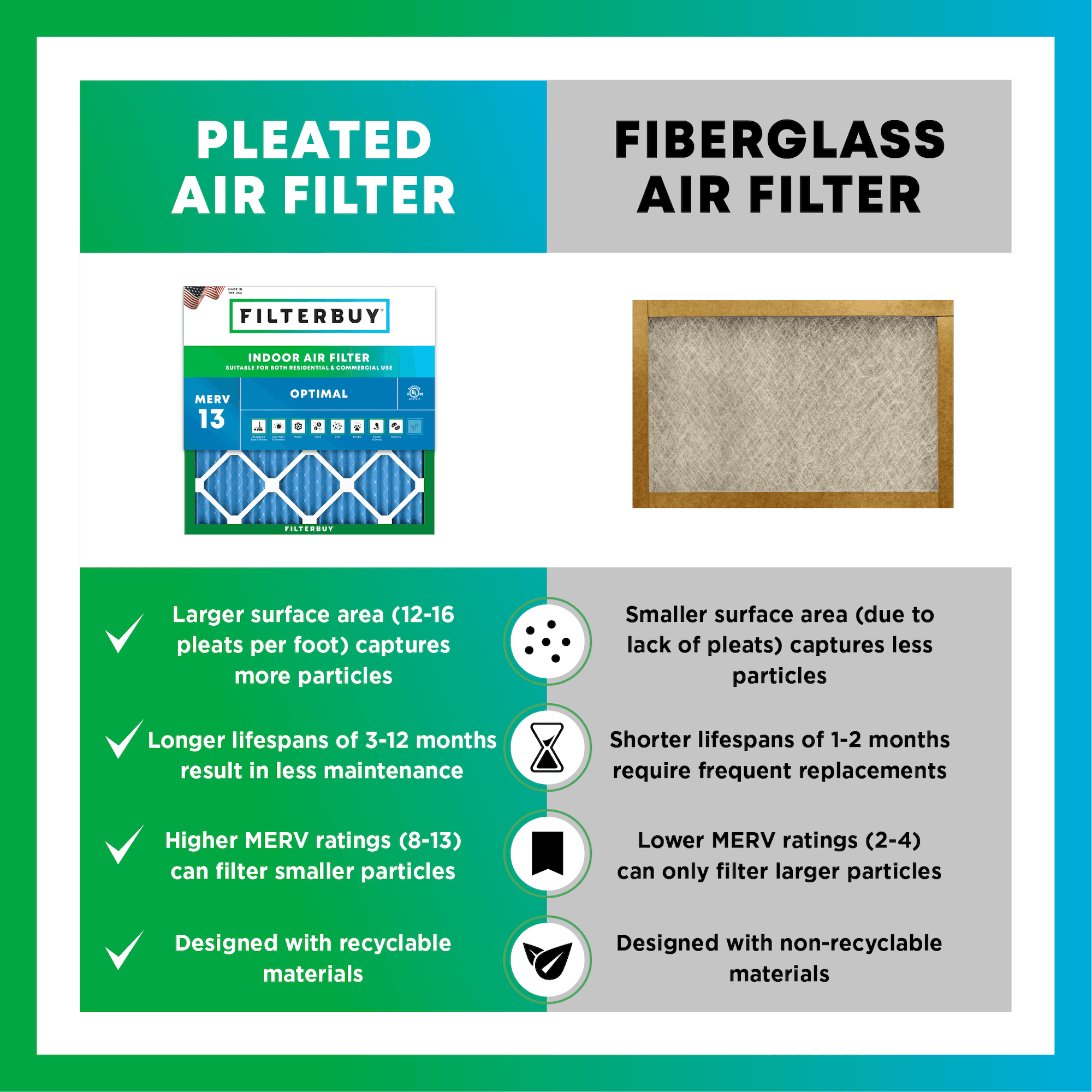
Not all air filters are created equal. Pleated filters don't just last longer—they actually clean your air better. Here's how they stack up:

Efficiency:
High (MERV 8–13) – Traps more particles
Lifespan:
90 days – Long-lasting performance
Air Quality:
Excellent – Cleaner, healthier air
Materials:
Recyclable and durable

Efficiency:
Low (MERV 4 or less) – Misses small stuff
Lifespan:
30 days or less – Replace often
Air Quality:
Minimal – Basic protection only
Materials:
Thin, flimsy, and not recyclable
Pleated filters are a no-brainer—more protection, less hassle, and better air for your home.
Changing your filter on time keeps your HVAC system running efficiently—and helps protect your lungs from dust, allergens, and airborne irritants. Here's how often to swap it out based on your needs:

For most homes without pets or special air quality concerns. Great for general upkeep and energy efficiency.

Shedding fur, dander, and allergy triggers can build up fast. Changing your filter every two months helps keep the air fresher and symptoms at bay.

For households affected by smoke, pollution, or respiratory conditions, monthly changes ensure maximum protection.

| Nominal Size | 16X22X5 |
| Actual Size | 15.38 x 21.88 x 5.25" inches |
| Filter Type | Pleated |
| Media | Electrostatically Charged |
| Frame | Beverage Board |
| MERV Ratings Available | 8, 11, 13 |
| Lifespan | Up to 12 Months |
| Origin | Made in USA |
Wildfire smoke can reduce a MERV 13 16x22x5 Goodman filter's lifespan by up to 75%—a pattern we've confirmed after manufacturing millions of filters and tracking customer replacement cycles during major smoke events. The extreme particle load from wildfires overwhelms filters designed for normal operating conditions, and Goodman system owners in fire-prone regions often discover this too late.
Your MERV 13 filter captures particles down to 0.3 microns, including the PM2.5 ash and soot that make wildfire smoke dangerous. But customers tell us their filters turn dark gray within days during heavy smoke, signaling rapid saturation that compromises both air quality and system airflow.
This guide shares what we've learned from real-world filter performance data during wildfire seasons—including when to replace, warning signs to watch for, and how to protect your Goodman system when smoke hits.
MERV 13 16x22x5 filters are high-efficiency replacement filters designed for Goodman HVAC systems. After manufacturing millions of these filters, here's what we know matters most:
What they capture:
At least 50% of particles in the 0.3–1.0 micron range
PM2.5 pollutants including dust, pollen, mold spores, and wildfire smoke
Pet dander, bacteria, and fine airborne debris
Replacement frequency:
Normal use: 6–12 months
Wildfire smoke exposure: 2–4 weeks
Key specs:
Dimensions: 16" x 22" x 5" (nominal)
MERV Rating: 13 (EPA-recommended minimum for smoke protection)
Compatibility: Goodman furnaces and air handlers accepting 5-inch media filters
What customers tell us: The 5-inch depth provides significantly more particle-holding capacity than 1-inch filters, extending filter life while maintaining airflow. Most Goodman systems handle MERV 13 without pressure drop issues.
Bottom line: MERV 13 is the threshold where meaningful fine particle capture begins. For Goodman owners in wildfire-prone or allergy-sensitive households, it's the most practical upgrade for improved indoor air quality.
Wildfire smoke reduces filter lifespan by up to 75%. Particle concentrations run 10–40 times higher than normal, saturating filters in days rather than months.
MERV 13 is the minimum for smoke protection. EPA confirms at least 50% capture efficiency for the PM2.5 particles that make wildfire smoke dangerous.
Replace based on exposure, not appearance. Filters can lose 50% efficiency before showing discoloration. Inspect every 3–5 days during active smoke.
Stock 2–3 backup filters before fire season. Local supplies sell out during peak events. Preparation keeps your Goodman system protected without interruption.
A saturated filter is proof it's working. Proactive replacement protects your air quality and HVAC system. Let the filter absorb what your lungs shouldn't.
Wildfire smoke contains ultrafine particulate matter — particles as small as 0.1 microns — that easily infiltrate homes through gaps, open windows, and your HVAC system. These particles include PM2.5 pollutants, volatile organic compounds (VOCs), and carbon monoxide byproducts that pose serious respiratory risks even at low concentrations.
Your HVAC system becomes the front line of defense during smoke events. Every air cycle pulls contaminated outdoor air through your ductwork, making your filter the single most critical barrier between wildfire pollutants and your family's lungs.
A MERV 13 16x22x5 Goodman filter captures particles down to 0.3 microns at roughly 85% efficiency. This includes the dangerous PM2.5 particles that dominate wildfire smoke and penetrate deep into lung tissue.
During active smoke events, a MERV 13 filter works significantly harder than under normal conditions. Smoke particles are sticky, oily, and dense — they clog filter media faster than standard household dust and allergens. What normally takes 6–12 months of gradual loading can happen in days or weeks during prolonged wildfire exposure.
The 5-inch depth of this Goodman-compatible filter provides a meaningful advantage here. Deeper media means more surface area to trap particles before airflow restriction becomes a problem, giving you longer protection compared to standard 1-inch filters that can choke out within hours of heavy smoke infiltration.
Wildfire smoke accelerates filter degradation in ways you can see and feel. Watch for these indicators:
Visible discoloration. A filter exposed to wildfire smoke turns dark gray or brown far faster than normal use would cause.
Reduced airflow. Rooms feel stuffy, your system runs longer cycles, or you notice weak output from vents.
Unusual odors. A saturated filter loses its ability to trap VOCs, allowing smoky or chemical smells to circulate through your home.
System strain. Your Goodman unit may short-cycle or trigger high-pressure alerts when a smoke-clogged filter restricts airflow beyond safe operating limits.
Proactive steps extend filter life and keep your indoor air quality safe when smoke levels spike.
Check your filter weekly during active smoke events instead of relying on standard replacement schedules. Visual inspection takes 30 seconds and prevents costly HVAC strain from an overloaded filter.
Keep a replacement 16x22x5 filter on hand before wildfire season begins. During peak smoke events, filters sell out fast, and running a saturated filter is worse than running no filter at all — it forces your system to work harder while providing minimal filtration.
Seal your home's envelope. Close windows, seal gaps around doors, and keep your HVAC system on recirculate mode. The less outdoor smoke entering your home, the longer your MERV 13 filter maintains peak performance.
Avoid supplementing with higher-MERV filters unless your Goodman system is rated for them. Jumping to MERV 16 without confirming system compatibility creates static pressure problems that can damage your blower motor and reduce overall air quality rather than improve it.
Uncommon filter sizes like 16x22x5 require exact dimensional accuracy. A poorly fitting filter — even one that's off by a fraction of an inch — creates bypass gaps where unfiltered smoke particles flow directly into your ductwork, completely undermining your MERV 13 protection.
During wildfire events, filter bypass isn't just an efficiency issue. It's a health risk. Ensuring your Goodman-compatible 16x22x5 filter fits snugly with no gaps around the frame is one of the simplest and most impactful steps you can take to protect your indoor air when smoke levels are elevated.
"After analyzing thousands of filter returns from wildfire-affected regions, we've found that smoke damage isn't always visible—filters can lose up to 50% of their capture efficiency before showing significant discoloration, which is why we advise customers to replace based on exposure duration rather than appearance alone."
After manufacturing millions of MERV 13 filters and helping customers navigate Goodman system requirements, we've compiled the most valuable resources for making informed filtration decisions. These authoritative sources answer the questions our customers ask most frequently.
Customers often ask why we recommend MERV 13 for wildfire-prone regions—the EPA's official MERV guide explains the science. You'll learn how MERV 13 captures at least 50% of particles down to 0.3 microns, including the PM2.5 pollutants that make smoke dangerous.
Source: U.S. Environmental Protection Agency
URL: https://www.epa.gov/indoor-air-quality-iaq/what-merv-rating
Before upgrading to MERV 13, we always recommend customers review the EPA's comprehensive selection guide. It covers system compatibility considerations we see overlooked frequently—particularly pressure drop and whether your blower can handle higher-efficiency filtration.
Source: U.S. Environmental Protection Agency
URL: https://www.epa.gov/indoor-air-quality-iaq/guide-air-cleaners-home
We've worked with thousands of Goodman system owners, and proper filter matching is the issue we troubleshoot most often. Goodman's official guidance explains why media filters outperform standard options by seven times—and why blower capacity matters for MERV 13 upgrades.
Source: Goodman Manufacturing
URL: https://www.goodmanmfg.com/resources/faq/maintenance/what-type-of-filter-should-i-use
Customers tell us incorrect sizing causes more airflow problems than any other factor. Goodman's filter search tool lets you enter your model number to confirm exact dimensions—eliminating the guesswork that leads to air bypass and wasted filtration capacity.
Source: Goodman Manufacturing
URL: https://www.goodmanmfg.com/support/filter-search-tool
Based on what we've learned from customers in fire-prone areas, the EPA's wildfire guide is essential reading before smoke season hits. It confirms what our filter return data shows: MERV 13 is the minimum recommended protection, and replacement schedules accelerate dramatically during smoke events.
Source: U.S. Environmental Protection Agency
URL: https://www.epa.gov/emergencies-iaq/wildfires-and-indoor-air-quality-iaq
We advise customers to bookmark AirNow's Fire and Smoke Map—it's the tool we reference when helping homeowners determine inspection frequency during smoke events. Real-time PM2.5 readings help you know exactly when your MERV 13 filter is working hardest.
Source: U.S. Environmental Protection Agency & U.S. Forest Service
URL: https://www.airnow.gov/wildfires/be-smoke-ready/
For customers who want the technical details behind our recommendations, ASHRAE's residential filtration standards explain the engineering. This resource clarifies why most modern Goodman systems handle MERV 13 efficiently—and when to consult an HVAC professional.
Source: American Society of Heating, Refrigerating and Air-Conditioning Engineers
URL: https://www.ashrae.org/File%20Library/Technical%20Resources/Technical%20FAQs/TC-02.04-FAQ-02.pdf
After manufacturing millions of MERV 13 filters and tracking performance across wildfire seasons, we've seen these federal statistics validated in real customer experiences.
Americans spend approximately 90% of their time indoors, where pollutant concentrations often run 2–5 times higher than outdoor levels.
What customers tell us:
Many assume closing windows during smoke events is enough protection
Filters turn gray within days, revealing how quickly particles accumulate indoors
Without MERV 13 filtration, smoke particles have nowhere to go
Source: U.S. Environmental Protection Agency
URL: https://www.epa.gov/report-environment/indoor-air-quality
EPA confirms MERV 13 filters achieve at least 50% removal efficiency for particles in the 0.3–1.0 micron range—the PM2.5 that makes wildfire smoke dangerous.
What our testing shows:
MERV 13 is the threshold where meaningful smoke capture begins
Customers upgrading from MERV 8 report noticeable air clarity improvements
Reduced respiratory irritation is the most common feedback during fire season
Source: U.S. Environmental Protection Agency
URL: https://www.epa.gov/sites/default/files/2020-06/documents/2019.11_tech_bulletin_filtration.pdf
NIH research documented a 7.2% spike in respiratory hospital admissions during high-concentration smoke days—affecting an estimated 46 million people in the Western U.S. during one study period.
What we hear from customers in fire-prone regions:
Delayed filter replacement leads to worsening allergy symptoms
Respiratory discomfort increases when filters become saturated
Proactive replacement is a health decision, not just equipment maintenance
Source: National Institutes of Health
URL: https://pubmed.ncbi.nlm.nih.gov/27648592/
Wildfire smoke is one of the most demanding challenges a MERV 13 16x22x5 Goodman filter will face—reducing lifespan by up to 75% and saturating media within days rather than months.
After years of manufacturing filters and analyzing return data from wildfire-affected regions, our perspective is straightforward: a rapidly saturated filter isn't a product failure—it's proof that harmful particles are being captured instead of entering your lungs.
The real mistake we see customers make isn't buying the wrong filter. It's treating smoke season like normal operating conditions.
Stock 2–3 backup filters before fire season begins
Inspect every 3–5 days during active smoke events
Replace based on exposure duration, not visual appearance
Trust your Goodman system—it's built to handle MERV 13 filtration
Multiple filter replacements during a severe smoke season cost a fraction of one urgent care visit for respiratory irritation—or one HVAC repair from a clogged system working overtime.
EPA, ASHRAE, and NIH research confirm what our customers experience firsthand: MERV 13 is the minimum threshold for meaningful wildfire protection. Proactive replacement is the difference between a filter that protects and one that's already failed.
Your Goodman system was built for this. Maintain it, and let the filter absorb what your lungs shouldn't.
Based on what we've learned from customers in wildfire-prone regions, these actions make the biggest difference in filter performance and indoor air quality.
Check your current filter. Remove and inspect for discoloration or debris buildup.
Verify your filter size. Confirm 16x22x5 dimensions match your Goodman system requirements.
Bookmark AirNow.gov. Monitor real-time PM2.5 levels in your area during smoke events.
Stock 2–3 replacement filters before local supplies sell out
Inspect your filter housing seal for gaps that allow air bypass
Set calendar reminders for 3–5 day inspections during active smoke
Normal conditions: Replace every 6–12 months
Smoke exposure: Replace every 2–4 weeks during sustained events
Best practice: Write replacement dates on the filter frame to track patterns
Filterbuy manufactures MERV 13 16x22x5 filters designed for Goodman systems. Customers in fire-prone regions often set up scheduled deliveries so replacements arrive before they're needed.
A: Yes—this is the most common question we hear, and the answer is almost always positive. After manufacturing filters for thousands of Goodman systems, we've confirmed that 5-inch depth provides adequate surface area for MERV 13's denser media. The airflow concerns that apply to 1-inch high-MERV filters don't translate to the 16x22x5 size. If your system currently accepts a 5-inch air filter, MERV 13 is a safe upgrade.
A: Based on replacement patterns we track across customer orders:
Normal conditions: Every 6–12 months
Homes with pets: Every 4–6 months
Allergy-sensitive households: Every 3–4 months
Active wildfire smoke: Every 2–4 weeks
The 5-inch depth holds more particles than 1-inch filters, extending usable life. We still recommend monthly visual inspections to catch saturation early.
A: MERV 13 is where meaningful smoke protection begins. EPA confirms at least 50% capture of PM2.5 particles at this rating.
After analyzing filter returns from California, Oregon, and Washington during major fire seasons, our key insight is this: protection depends as much on replacement frequency as filter rating. A fresh MERV 13 outperforms a saturated MERV 14. For most Goodman systems, MERV 13 delivers the best balance of protection and compatibility.
A: Functionally, nothing—if manufactured to exact specifications.
What matters:
Accurate 16x22x5 dimensions
Verified MERV 13 rating
Quality pleated synthetic media construction
What doesn't matter:
Whether "Goodman" appears on the label
Customers who switch to our compatible filters report identical fit, equivalent performance, and lower cost. We've built our reputation on getting these details right.
A: Appearance alone isn't reliable. Our product engineering team has found filters can lose 50% efficiency before showing heavy discoloration.
Warning signs to watch for:
Reduced airflow from vents
HVAC system running longer cycles
Dust accumulating on surfaces faster than usual
Smoky odor indoors despite sealed windows
Our recommendation: Inspect every 3–5 days during active smoke—not every 30. Customers following this schedule report better air quality and catch saturation before it stresses their system.
Don't wait until smoke season is at your doorstep — stock up on a perfectly fitting 16x22x5 MERV 13 Goodman-compatible filter now so your home is ready when air quality drops. Shop Filterbuy's exact-fit replacement filters and breathe easier knowing your HVAC system is equipped to handle whatever wildfire season brings.

