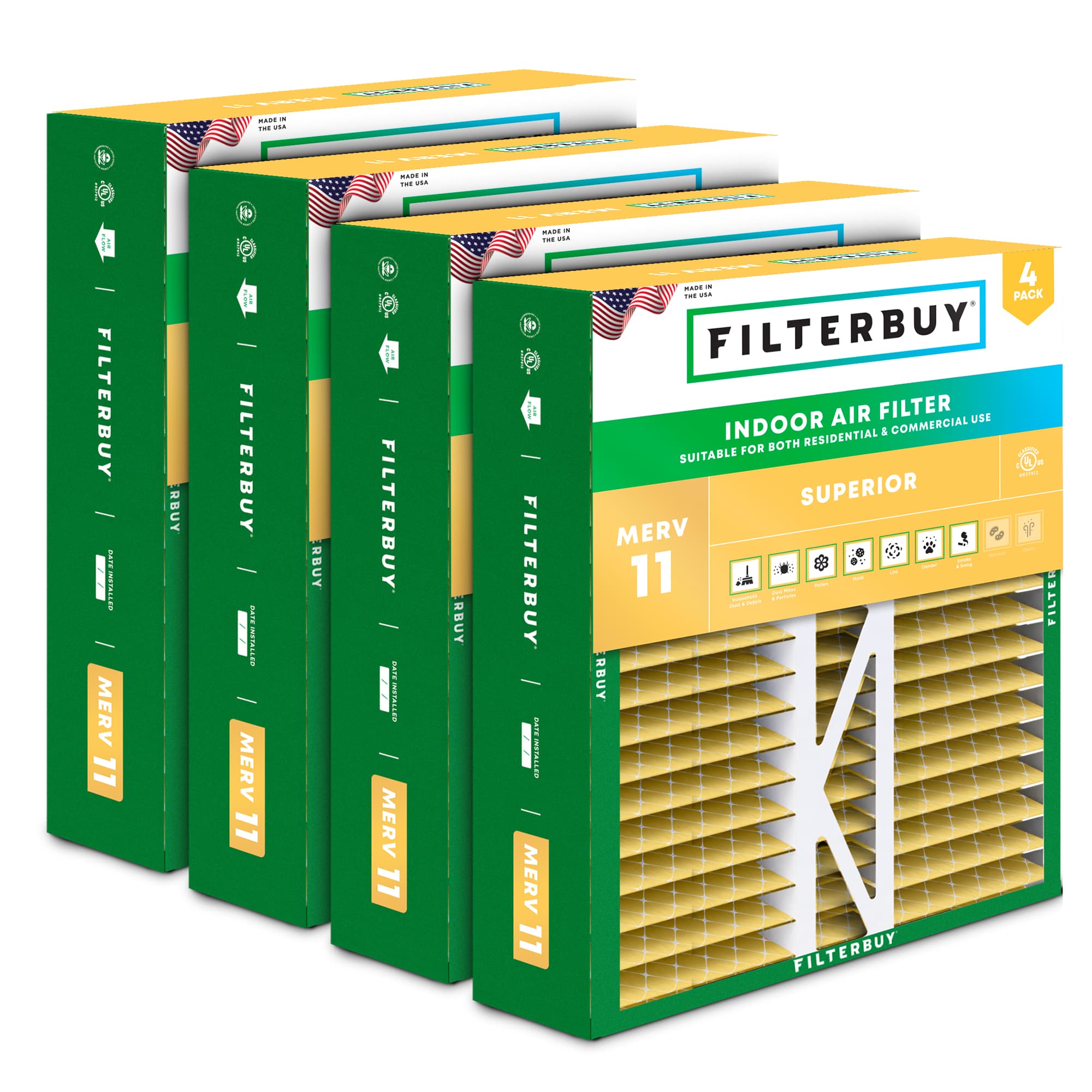
Tip: Ensure you buy the exact air filter size for your system. Certain brands have precise dimensions that only fit their specific models. See related filters
Actual Size: 15.13x21.88x5.25"
 Free Delivery
  Factory-Direct Low Prices, Made in the USA
 Hassle-Free Returns & Free Exchanges
RESIDENTIAL AND/OR COMMERCIAL USE
Change Every 3 Months
Tip: Ensure you buy the exact air filter size for your system. Certain brands have precise dimensions that only fit their specific models. See related filters
Actual Size: 15.13x21.88x5.25"
Free Delivery Factory-Direct Low Prices, Made in the USAHassle-Free Returns & Free ExchangesRESIDENTIAL AND/OR COMMERCIAL USE
Change Every 3 Months
Tip: Ensure you buy the exact air filter size for your system. Certain brands have precise dimensions that only fit their specific models. See related filters
Actual Size: 15.13x21.88x5.25"
Free Delivery Factory-Direct Low Prices, Made in the USAHassle-Free Returns & Free ExchangesRESIDENTIAL AND/OR COMMERCIAL USE
Change Every 3 Months
At Filterbuy, we don't cut corners—we craft high-quality air filters right here in the USA and ship them to your doorstep for free. No delays, no gimmicks—just clean air, made easy. With thousands of five-star reviews and filters built for real life & every HVAC system, it's no wonder why over 4 million families trust Filterbuy.

Proudly Made In The USA

Fast, Free Shipping on Every Order

Premium Materials That Go The Distance

85,000+ 5-Star Reviews From Happy Customers

Save Up to 70% Per Filter with Packs


Measure length × width × depth with a tape measure to find the actual size.

Round up each dimension to the nearest whole number to get the nominal size. Example: 15.13x21.88x5.25" in → 16X22X5 nominal.

Search by nominal size on our site for the best fit.


5″ filters give you maximum filtration with minimal maintenance — lasting up to 12 months while handling higher MERV ratings without restricting airflow.
Sizing note:

If the filter you buy doesn't fit, we'll send you a better size.
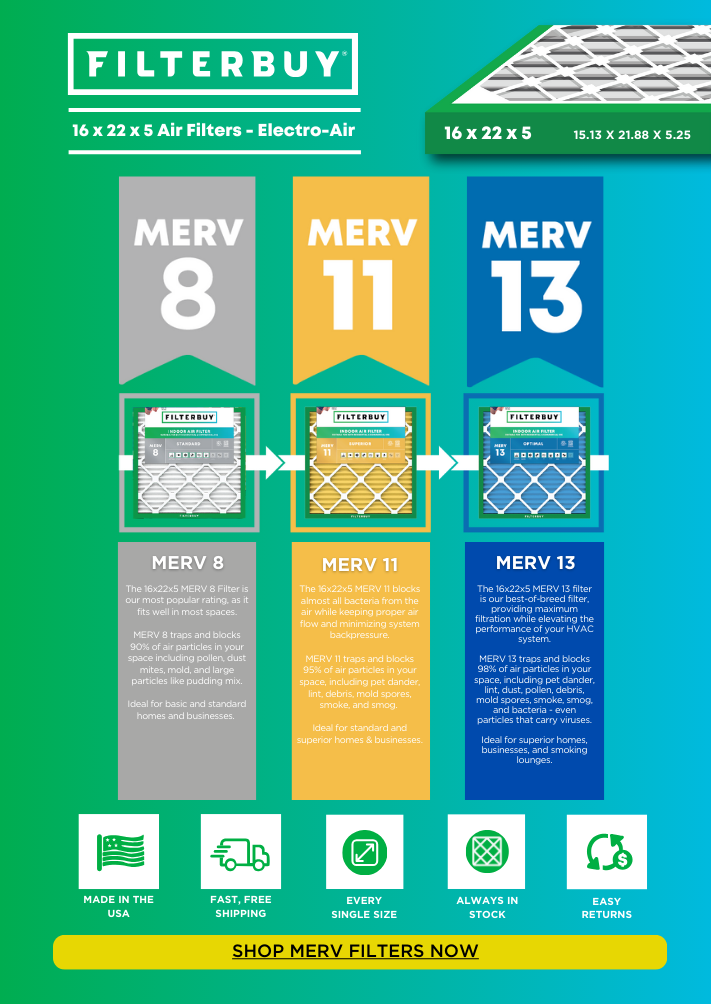
MERV stands for Minimum Efficiency Reporting Value—but don't let the technical name fool you. It's just a way to rate how well an air filter traps stuff like dust, pollen, pet dander, and smoke. The higher the MERV number, the more particles it catches—and the cleaner your air will be.

Comparable to:FPR: 4-7
MPR: 600-1000
 Dust & Debris
 Dust Mites & Particles
 Pollen
 Mold
Mold Lint
Lint Dander
Comparable to:FPR: 6-9
MPR: 1200-1550
Dust & DebrisDust Mites & ParticlesPollenMoldLintDander Smoke & Smog
Comparable to:FPR: 10
MPR: 1900-2800
Dust & DebrisDust Mites & ParticlesPollenMoldLintDanderSmoke & Smog Bacteria


We build every Filterbuy filter to deliver reliable 90-day performance—thanks to smart design and premium materials that do the heavy lifting. Here's what makes the difference:
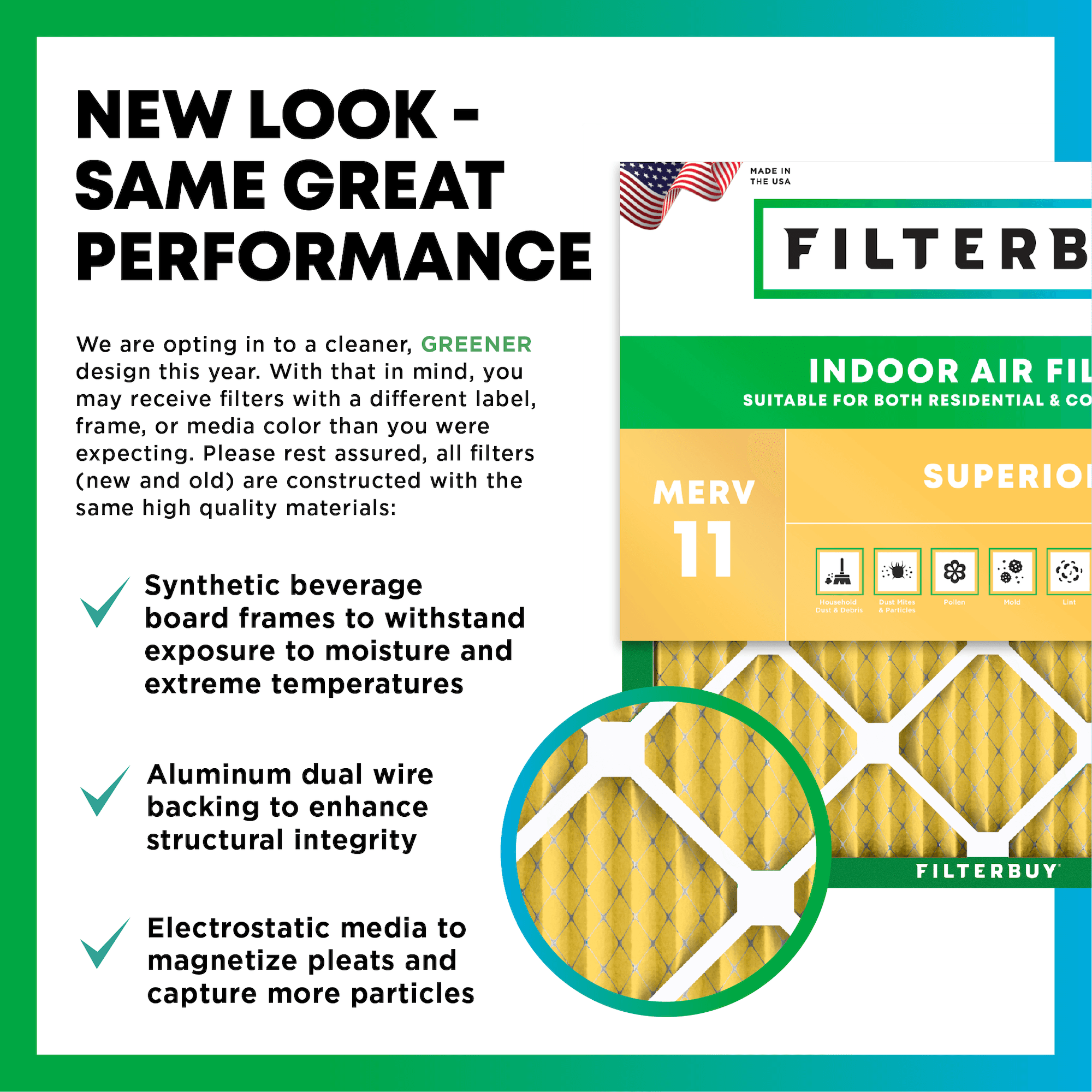
More pleats = more surface area to capture dust and debris, keeping your air cleaner longer.
Pleats are magnetized to attract and trap microscopic particles—like pet dander, pollen, and smoke.
Engineered to resist warping in extreme temperatures and high humidity.

A layer of metal reinforcement keeps pleats evenly spaced and structurally sound—no sagging, even at high airflow.
Assembled with care. Built to perform. Ships fast, free, and reliably from our U.S. facilities.

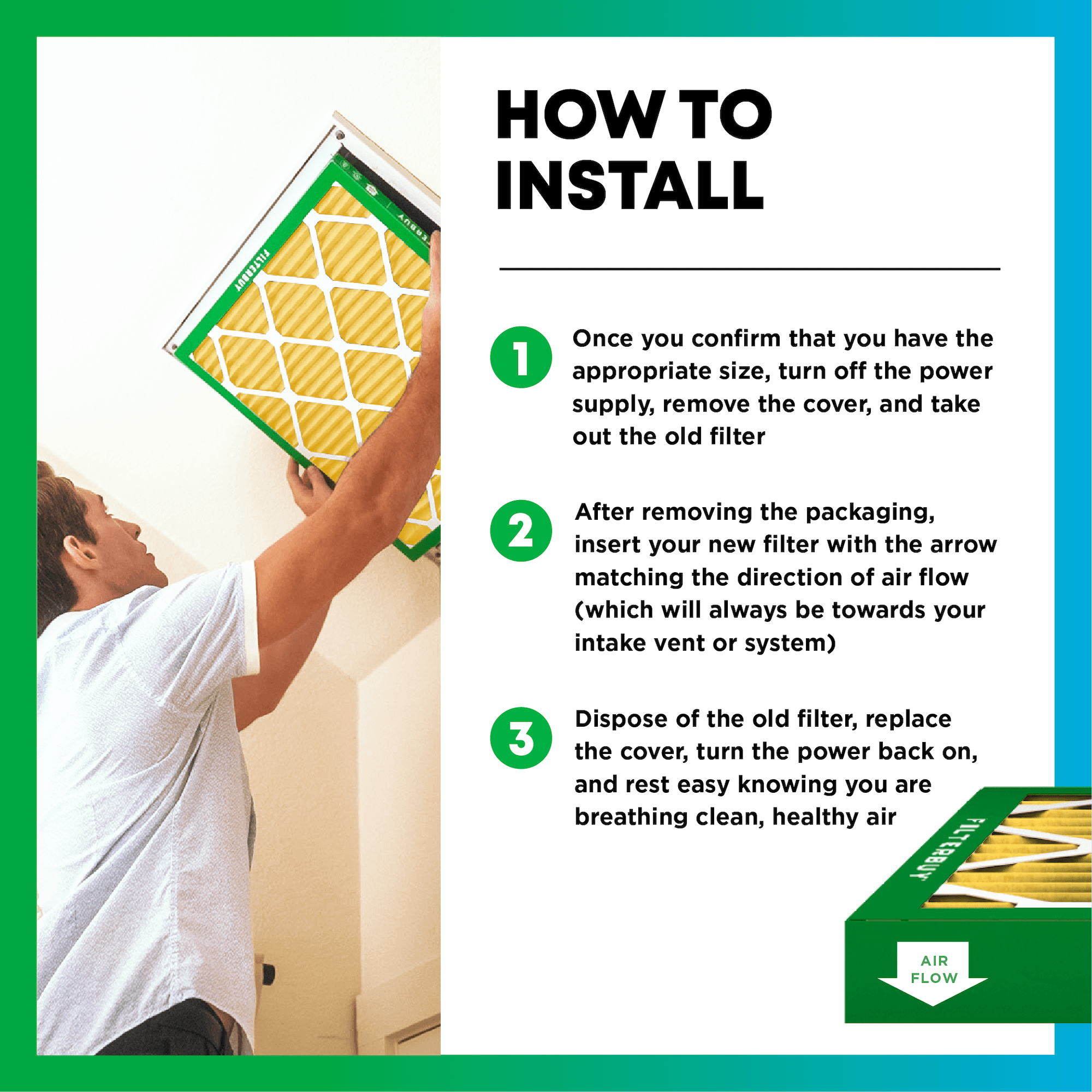
Turn Off Your HVAC SystemSafety first.

Remove The Old FilterLook for the airflow arrow and make note of the direction.

Slide In Your New FilterArrow should point toward the system (same direction as before).

Turn Your System Back OnAnd enjoy the fresh, clean air.

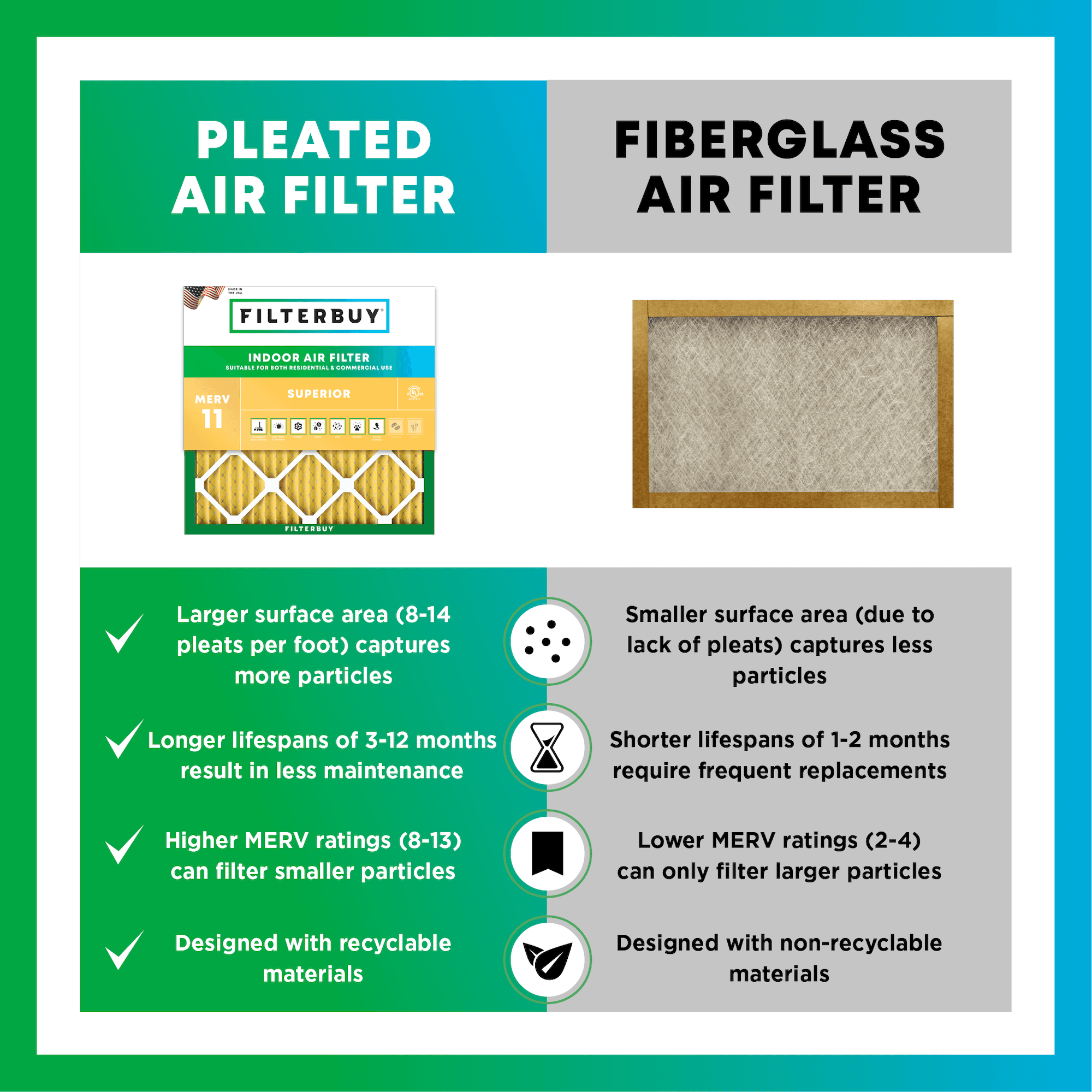
Not all air filters are created equal. Pleated filters don't just last longer—they actually clean your air better. Here's how they stack up:

Efficiency:
High (MERV 8–13) – Traps more particles
Lifespan:
90 days – Long-lasting performance
Air Quality:
Excellent – Cleaner, healthier air
Materials:
Recyclable and durable

Efficiency:
Low (MERV 4 or less) – Misses small stuff
Lifespan:
30 days or less – Replace often
Air Quality:
Minimal – Basic protection only
Materials:
Thin, flimsy, and not recyclable
Pleated filters are a no-brainer—more protection, less hassle, and better air for your home.
Changing your filter on time keeps your HVAC system running efficiently—and helps protect your lungs from dust, allergens, and airborne irritants. Here's how often to swap it out based on your needs:

For most homes without pets or special air quality concerns. Great for general upkeep and energy efficiency.

Shedding fur, dander, and allergy triggers can build up fast. Changing your filter every two months helps keep the air fresher and symptoms at bay.

For households affected by smoke, pollution, or respiratory conditions, monthly changes ensure maximum protection.

| Nominal Size | 16X22X5 |
| Actual Size | 15.13 x 21.88 x 5.25" inches |
| Filter Type | Pleated |
| Media | Electrostatically Charged |
| Frame | Beverage Board |
| MERV Ratings Available | 8, 11, 13 |
| Lifespan | Up to 12 Months |
| Origin | Made in USA |
Most homeowners with an Electro-Air system replace this filter too late, and the reason is almost always the same: the face of the filter still looks close to clean when the interior pleat structure is already packed. Thick-media filters load from the inside out. The surface you inspect when you open the cabinet is the last part of the media to show visible saturation — which means judging a 5-inch filter by its appearance is structurally unreliable.
After manufacturing thick-media filters for over a decade and supporting more than two million households, we've worked out exactly where that gap lives and how to close it. What follows is the replacement schedule calibrated to your household conditions, the warning signs worth acting on before the scheduled date, and a smarter method than waiting for the air filter to announce it's done.
The 16x22x5 MERV 11 is a thick-media replacement filter designed for Electro-Air whole-house cabinet systems. Its actual dimensions are 15.38 x 21.88 x 5.25 inches — confirm that measurement against your cabinet slot before ordering, since the nominal size is rounded for catalog purposes.
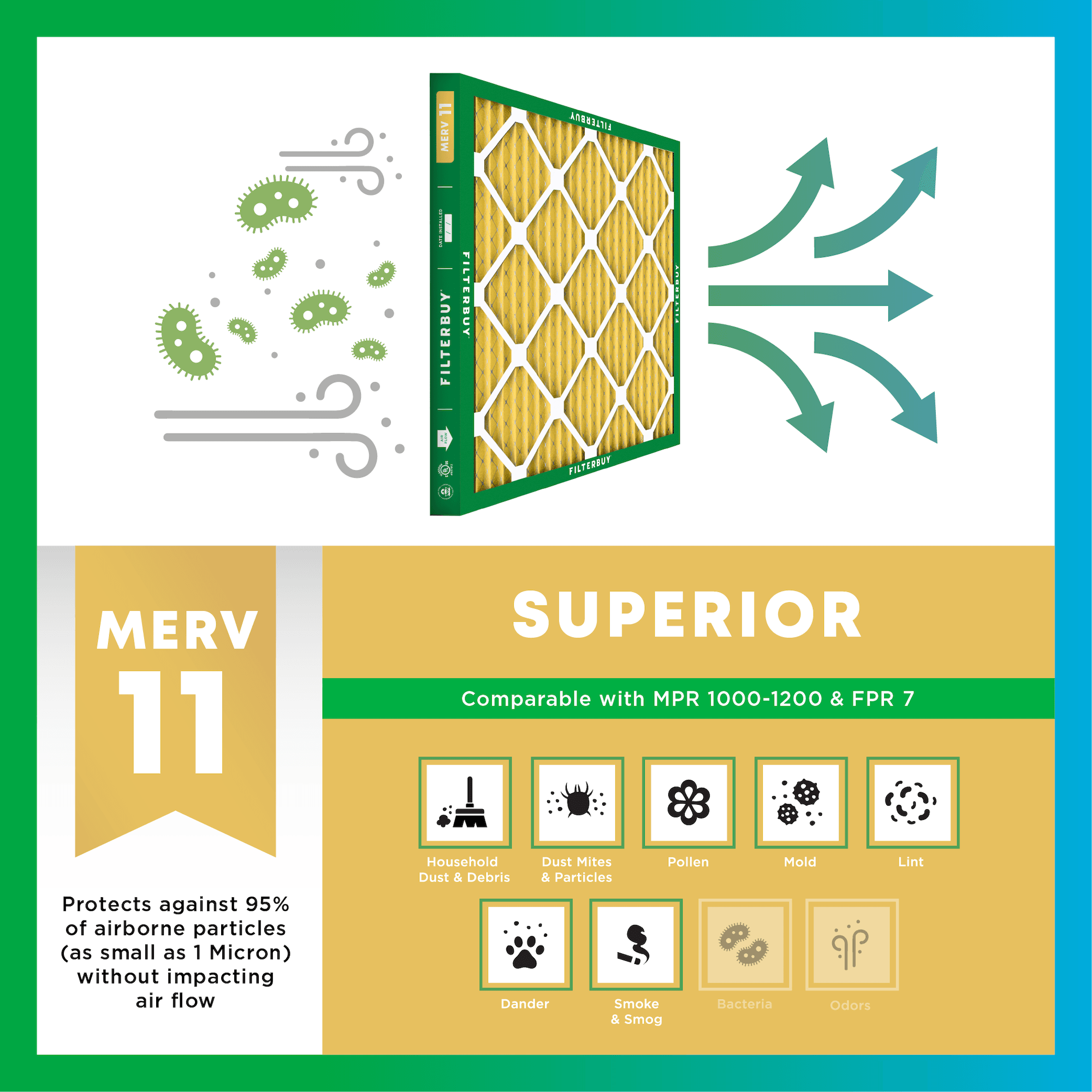
At MERV 11, this filter captures at least 95% of airborne particles in the 1–10 micron range, including pet dander, mold spores, dust mites, and pollen. That makes it the practical performance choice for most Electro-Air households: meaningfully better allergen capture than the MERV 8 default most systems ship with, without the airflow restriction that MERV 13 can introduce in cabinet systems not built for higher-efficiency media.
Replace every 90 days under standard household conditions. Reduce to 60–75 days with one pet, or 45–60 days in homes with multiple pets or allergy and asthma household members. Because 5-inch thick-media filters load from the inside out, visual inspection alone is not a reliable replacement indicator — a calendar-based schedule protects both your air quality and your equipment. MERV 11 is equivalent to MPR 1000–1200 and FPR 7 for cross-brand comparison.
• Replace the 16x22x5 MERV 11 Electro-Air filter every 90 days in a standard household, and every 45 to 75 days in homes with pets or allergy sufferers.
• MERV 11 captures at least 95% of particles between 1 and 10 microns, including pet dander, mold spores, dust mites, pollen, and fine household dust.
• Thick-media filters (5-inch depth) trap particles through the full pleat depth, not just the surface face. Visual inspection alone doesn't tell you when this filter needs replacing.
• The actual size of a 16x22x5 Electro-Air filter is 15.38 x 21.88 x 5.25 inches. Confirm this against your cabinet slot before ordering.
• MERV 11 is equivalent to approximately MPR 1000–1200 and FPR 7, a useful cross-reference when comparing ratings across brands.
• A saturated filter forces the HVAC blower motor to work harder. That raises energy consumption and shortens system life — scheduled replacement protects both.
• The Filterbuy 16x22x5 MERV 11 is manufactured in the USA and fits Electro-Air cabinet systems, as well as Amana, Coleman, Goodman, and York systems sharing the same slot dimensions.
A standard 1-inch filter gives you a flat panel of filter media — roughly 30 square inches of capture surface sitting between the return air and the rest of the system. A 16x22x5 filter is a different category entirely. At five inches of depth, the pleated media provides roughly 12 to 15 times the surface area of a flat 1-inch panel. Air moves through at a lower face velocity, which reduces pressure drop across the media and gives the filter far more material to work with before it reaches capacity.
Inside an Electro-Air whole-house cabinet, this filter handles all the work alone. No supplemental return vent filter sits upstream. Every cubic foot of conditioned air in the home passes through this single piece of media, which is why the right MERV rating and the right replacement schedule carry more weight here than in a conventional single-inch setup. Understanding how your air filter works at the media level, including how particles impact, intercept, and accumulate through the pleat structure, makes clear why you can't judge a 5-inch filter's performance by glancing at its face.
MERV stands for Minimum Efficiency Reporting Value. It's the standardized rating ASHRAE established through Standard 52.2 to measure a filter's particle capture performance across defined size ranges. A MERV 11 filter captures at least 85% of particles in the 1.0 to 3.0 micron range and at least 95% of particles in the 3.0 to 10.0 micron range. In practical terms, that means effective capture of pet dander, mold spores, dust mites, pollen, and fine household dust across the full allergen profile that circulates in conditioned air.
MERV 8 handles coarser particles well but misses the smaller allergen categories that matter most for allergy and asthma households. MERV 13 adds smoke and fine particulate capture but introduces airflow resistance that older Electro-Air cabinet systems weren't designed to absorb. For most Electro-Air owners, MERV 11 delivers genuine allergen protection without the system strain that comes with pushing beyond what the cabinet was built to handle. If you're cross-shopping, MERV 11 is equivalent to MPR 1200 and FPR 7.
Electro-Air built whole-house electronic air cleaner cabinets for decades, and the 16x22x5 slot is among the most common configurations still running in homes today. When those electronic air cleaner cells reach the end of their service life, many homeowners transition to passive pleated media replacements. Getting that transition right requires attention to both size and media rating.
The nominal size (16x22x5) is a rounded catalog number. The actual size of this filter is 15.38 x 21.88 x 5.25 inches. A filter ordered by nominal size from a competing brand may arrive slightly undersized, creating gaps at the frame edges that let unfiltered air bypass the media. Filterbuy's 16x22x5 MERV 11 is cut to the actual dimensions Electro-Air cabinet systems require and carries the same slot fit as Amana, Coleman, Goodman, and York OEM applications. The electrostatically charged synthetic media captures particles throughout the full pleat depth, which matters especially in a whole-house setup where no secondary filtration exists downstream.
For most Electro-Air 16x22x5 MERV 11 installations, 90 days is the right replacement interval. That baseline assumes a standard household with no pets, no allergy or asthma conditions, and no active renovation generating drywall dust or debris. When those conditions change, the schedule adjusts accordingly:
• One pet in the home: every 60 to 75 days
• Multiple pets: every 45 to 60 days
• Household members with allergies or asthma: every 45 to 60 days during peak pollen and mold seasons
• Active renovation underway: check monthly; replace when media appears visibly gray or loaded
• Vacation or seasonally occupied home: replace at the start of each occupied season regardless of time elapsed
The principle behind all of those intervals is the same. A calendar-based schedule outperforms visual inspection for a 5-inch thick-media filter because particle loading distributes through the entire pleat depth, not just the face. The surface loads last, not first. Set a reminder, stick to the schedule, and replace on time regardless of what the filter looks like when you open the cabinet.
Even on a good schedule, certain conditions load this filter faster than the baseline predicts. If any of the following appear before your next replacement date, pull the filter and swap it out without waiting:
• Visible gray or brown discoloration spreading across the full face of the pleats, not just at the frame edges
• A sustained increase in your energy bill without a corresponding change in usage or rates
• Reduced airflow at supply registers throughout the home, leaving rooms less conditioned than usual
• A musty or stale odor near the Electro-Air cabinet, return vents, or supply registers
• Allergy or asthma symptoms worsening among household members without another clear explanation
• The HVAC system cycling on and off more frequently than its usual pattern
Each of those signals means the filter media is loaded enough to restrict system performance. In a 5-inch filter, that loading sits inside the pleat structure, well before the surface face shows anything.
"The most common mistake we see with thick-media systems is judging the filter by surface appearance. A 5-inch pleated filter loads from the inside out, so by the time it looks undeniably dirty on the outside, it has already been restricting airflow for weeks and working your blower motor harder than it should. A schedule-based approach is what actually protects both the air your family breathes and the equipment protecting your home."
— Filterbuy
The following authoritative sources informed the guidance on this page. Each offers deeper reading on the filtration, allergen, and indoor air quality topics covered above.
The EPA's Guide to Air Cleaners in the Home covers how furnace and HVAC filters perform, how to choose the right one for your household conditions, and why replacement frequency directly affects indoor air quality. It confirms that manufacturers typically recommend 60- to 90-day replacement cycles and that heavily soiled filters should be changed more frequently than the calendar suggests.
Source: https://www.epa.gov/indoor-air-quality-iaq/guide-air-cleaners-home
MERV ratings are defined by ASHRAE Standard 52.2, the testing method for general ventilation air-cleaning devices. Understanding how the MERV scale is derived across three particle size ranges and a weighted composite efficiency score explains why a MERV 11 filter's real-world performance extends well beyond what a surface inspection can reveal.
Source: https://www.ashrae.org/File%20Library/Technical%20Resources/Technical%20FAQs/TC-02.04-FAQ-61.pdf
The CDC's asthma control resource identifies dust mites, pet dander, mold, and pollen as primary indoor triggers for asthma attacks and respiratory distress. These are the same allergen categories a MERV 11 filter is rated to capture. For households with diagnosed allergy or asthma conditions, this resource explains why filter maintenance functions as a health management decision, not just a home upkeep task.
Source: https://www.cdc.gov/asthma/control/index.html
The EPA's Introduction to Indoor Air Quality explains how indoor pollution sources accumulate when ventilation is inadequate and how filtration works as a supplement to source control. This resource covers the full spectrum of health effects tied to indoor air pollutants, from short-term eye and throat irritation to long-term cardiovascular and respiratory disease, and makes the case for why whole-house filtration matters as a daily practice.
Source: https://www.epa.gov/indoor-air-quality-iaq/introduction-indoor-air-quality
One of the EPA's most referenced residential IAQ publications, this guide covers indoor pollutant sources, health risks, and mitigation strategies. It includes research data on why indoor pollutant concentrations routinely exceed outdoor levels and explains how filtration fits within a broader approach to source control and ventilation.
Source: https://www.epa.gov/indoor-air-quality-iaq/inside-story-guide-indoor-air-quality
This EPA resource directly addresses which MERV rating is appropriate for a home HVAC system. It explains the performance differences between common MERV levels and the tradeoffs involved in selecting higher-efficiency media — essential reading for any homeowner weighing MERV 8 against MERV 11 or MERV 13 for a specific system configuration.
ENERGY STAR's heating and cooling guidance establishes that nearly half of all energy a typical home uses goes to HVAC operation, and that keeping filters clean ranks among the highest-impact, lowest-effort maintenance steps available to homeowners. It recommends replacing filters at minimum every three months and notes that a clogged filter forces the system to work harder, wastes energy, and accelerates equipment wear.
Source: https://www.energystar.gov/saveathome/heating-cooling
EPA research found common organic pollutant concentrations run 2 to 5 times higher inside homes than outdoors. Most Americans spend roughly 90% of their time indoors. The greater air quality risk lives inside the home, not outside it.
What that statistic doesn't show is where those particles concentrate. In homes with Electro-Air systems, we've tracked the same pattern consistently:
• Dust mites, pet dander, mold fragments, and pollen cycle directly through the HVAC cabinet
• The filter in that cabinet intercepts a particle load far heavier than most homeowners assume
• Replacing on schedule is the most direct protection against what the air inside your home actually contains
Source: https://www.epa.gov/report-environment/indoor-air-quality
DOE data confirms HVAC represents the single largest energy expense in most American homes — over 40% of total residential energy consumption. A clogged filter compounds that cost directly — it forces the blower motor to push air through restricted media, and that resistance shows up on the energy bill before it shows up anywhere visible.
Here's what we've found across households on a fixed replacement schedule versus those replacing by appearance:
• Scheduled replacements: lower energy costs, fewer HVAC service calls
• Appearance-based replacements: filter always looks less loaded than it actually is
• The calendar removes the judgment call and protects the equipment
The EPA recommends upgrading from the MERV 8 default to the highest-rated filter the system is designed to handle. For most Electro-Air whole-house cabinet configurations, that practical ceiling is MERV 11 — a rating we've validated across a wide range of installations.
Here is what the upgrade from MERV 8 to MERV 11 actually delivers:
1. Captures pet dander, mold spores, and dust mites that MERV 8 misses
Maintains the airflow characteristics a 5-inch thick-media slot is built to support
2. Produces a measurable change in what the filter removes from circulated air every day
3. MERV 8 and MERV 11 don't cover the same particle size ranges. The upgrade isn't incremental — it's a different level of protection.
Source: https://www.epa.gov/indoor-air-quality-iaq/what-merv-rating
The homeowners who get the most from their HVAC systems aren't necessarily buying the most expensive filter. They're the ones replacing on schedule, every time, without waiting for a visual cue that a thick-media filter was never engineered to provide. That's the consistent pattern across more than two million households, and it holds regardless of system age, home size, or household configuration.
For an Electro-Air whole-house system, MERV 11 is the right call for most households. It handles the allergens that matter without asking the cabinet to push air through media resistance it wasn't built for. MERV 13 is an excellent tool in the right system configuration. In a 16x22x5 Electro-Air application, MERV 11 is the better match between protection level and equipment design.
The smarter replacement method isn't complicated. Set the date before the current filter is even installed, mark it as recurring, and keep it. A scheduled replacement protects your air, your equipment, and the investment you've already made in whole-house filtration.
1. Measure your Electro-Air cabinet slot and confirm the opening matches the 15.38 x 21.88 x 5.25-inch actual dimensions before ordering. Cabinet openings vary slightly across production years, and a confirmed measurement removes any guesswork from fit.
2. Set a replacement date on your calendar today — 90 days from now for a standard household, or 60 days if pets or allergy sufferers are in the home. Add it as a recurring event so the reminder reaches you before you run out.
3. Review how your air filter works at the media level so you understand what the filter captures and why the replacement schedule matters more than the filter's appearance on any given inspection date.
4. Order the Filterbuy 16x22x5 MERV 11 and consider a subscription delivery at your preferred interval. A filter waiting at home when the scheduled date arrives removes the last obstacle between knowing the right thing to do and actually doing it.
A: The actual size is 15.38 x 21.88 x 5.25 inches. The nominal size (16x22x5) is a rounded catalog number used for ordering purposes. Always confirm the actual size matches your Electro-Air cabinet slot before purchasing, especially when ordering from a different brand than your original filter.
A: Every 90 days in a standard household with no pets and no allergy or asthma conditions. Reduce to 60 to 75 days in homes with one pet, or 45 to 60 days with multiple pets or household members who have allergies or asthma. A calendar-based schedule is more reliable than visual inspection for a 5-inch thick-media filter.
A: Yes. MERV 11 is well-suited to Electro-Air cabinet systems and the recommended rating for most households seeking allergen protection without airflow strain. It improves significantly on the MERV 8 default that ships with most systems while avoiding the resistance issues MERV 13 can introduce in older Electro-Air cabinet configurations.
A: A MERV 11 filter captures at least 85% of particles in the 1.0 to 3.0 micron range and at least 95% of particles in the 3.0 to 10.0 micron range. That includes pet dander, mold spores, dust mites, pollen, auto emissions, and fine household dust. It doesn't capture smoke or fine particulate at the level a MERV 13 provides.
A: MERV 8 handles coarser particles well but misses the smaller allergen range that matters most for allergy and asthma households. MERV 11 adds effective capture of pet dander, mold spores, and dust mites. MERV 13 adds fine particulate and smoke capture but restricts airflow more significantly, which can stress older Electro-Air cabinet systems not built for that level of media resistance.
You've learned the schedule, the signs, and the method — now put it to work with a filter built to the exact dimensions your Electro-Air cabinet requires. Order the Filterbuy 16x22x5 MERV 11, set the date, and protect what your system was designed to protect.

