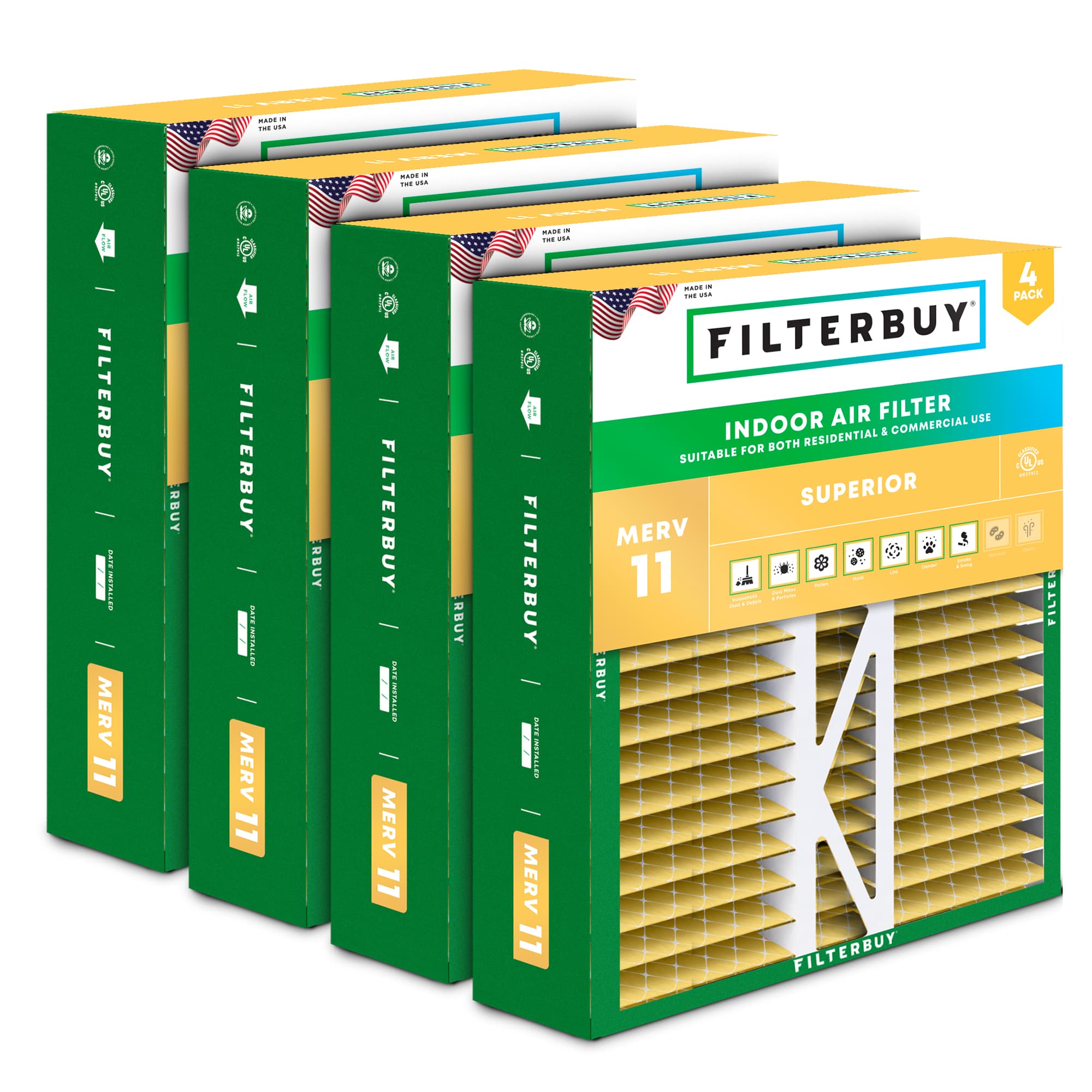
Tip: Ensure you buy the exact air filter size for your system. Certain brands have precise dimensions that only fit their specific models. See related filters
Actual Size: 15.38x21.88x5.25"
 Free Delivery
  Factory-Direct Low Prices, Made in the USA
 Hassle-Free Returns & Free Exchanges
RESIDENTIAL AND/OR COMMERCIAL USE
Change Every 3 Months
Tip: Ensure you buy the exact air filter size for your system. Certain brands have precise dimensions that only fit their specific models. See related filters
Actual Size: 15.38x21.88x5.25"
Free Delivery Factory-Direct Low Prices, Made in the USAHassle-Free Returns & Free ExchangesRESIDENTIAL AND/OR COMMERCIAL USE
Change Every 3 Months
Tip: Ensure you buy the exact air filter size for your system. Certain brands have precise dimensions that only fit their specific models. See related filters
Actual Size: 15.38x21.88x5.25"
Free Delivery Factory-Direct Low Prices, Made in the USAHassle-Free Returns & Free ExchangesRESIDENTIAL AND/OR COMMERCIAL USE
Change Every 3 Months
At Filterbuy, we don't cut corners—we craft high-quality air filters right here in the USA and ship them to your doorstep for free. No delays, no gimmicks—just clean air, made easy. With thousands of five-star reviews and filters built for real life & every HVAC system, it's no wonder why over 4 million families trust Filterbuy.

Proudly Made In The USA

Fast, Free Shipping on Every Order

Premium Materials That Go The Distance

85,000+ 5-Star Reviews From Happy Customers

Save Up to 70% Per Filter with Packs


Measure length × width × depth with a tape measure to find the actual size.

Round up each dimension to the nearest whole number to get the nominal size. Example: 15.38x21.88x5.25" in → 16X22X5 nominal.

Search by nominal size on our site for the best fit.


5″ filters give you maximum filtration with minimal maintenance — lasting up to 12 months while handling higher MERV ratings without restricting airflow.
Sizing note:

If the filter you buy doesn't fit, we'll send you a better size.
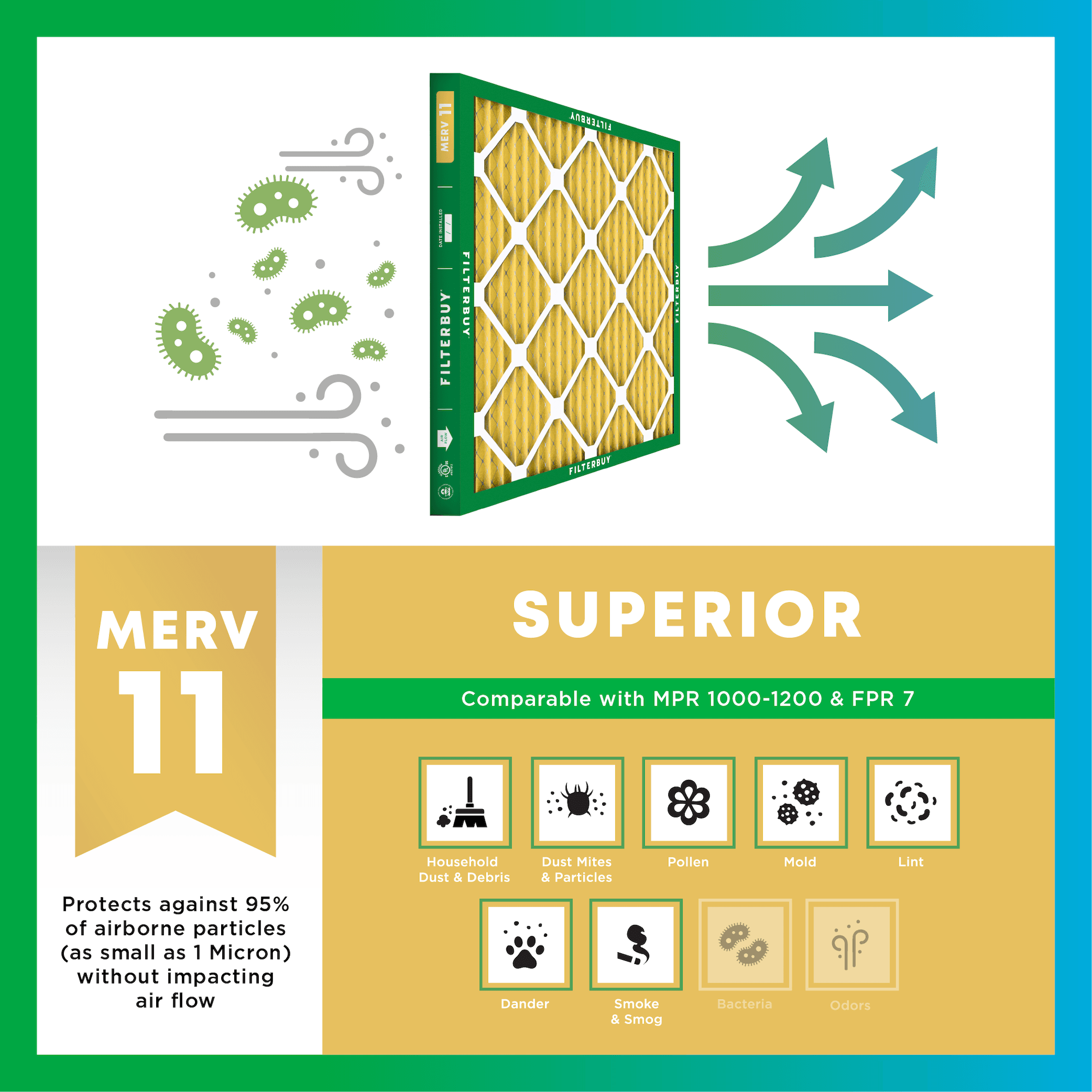
MERV stands for Minimum Efficiency Reporting Value—but don't let the technical name fool you. It's just a way to rate how well an air filter traps stuff like dust, pollen, pet dander, and smoke. The higher the MERV number, the more particles it catches—and the cleaner your air will be.

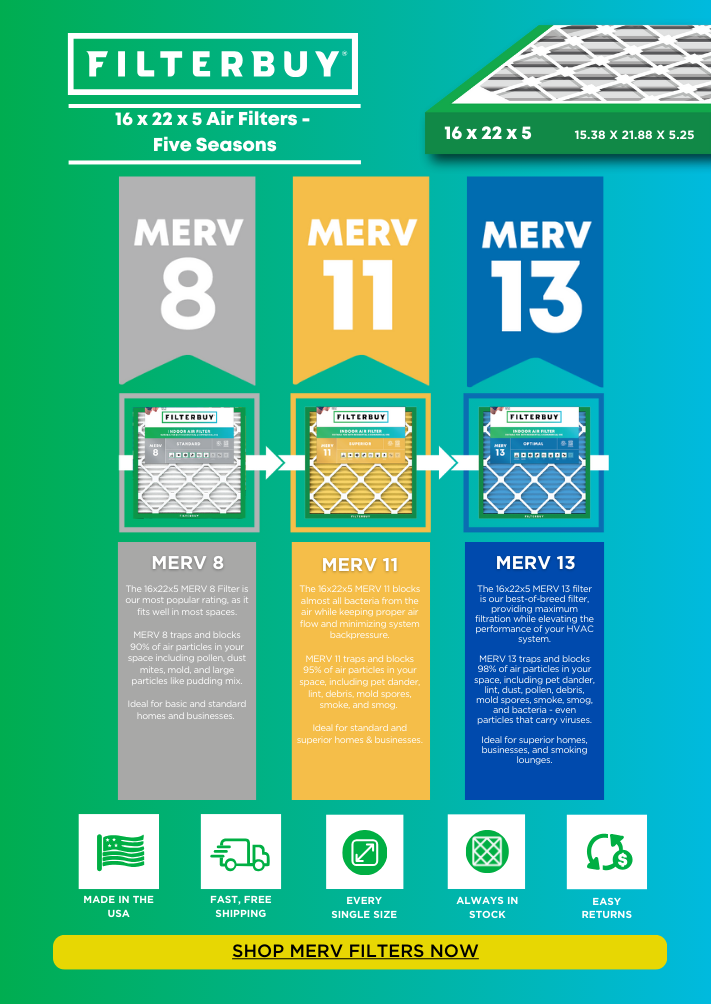
Comparable to:FPR: 4-7
MPR: 600-1000
 Dust & Debris
 Dust Mites & Particles
 Pollen
 Mold
Mold Lint
Lint Dander
Comparable to:FPR: 6-9
MPR: 1200-1550
Dust & DebrisDust Mites & ParticlesPollenMoldLintDander Smoke & Smog
Comparable to:FPR: 10
MPR: 1900-2800
Dust & DebrisDust Mites & ParticlesPollenMoldLintDanderSmoke & Smog Bacteria


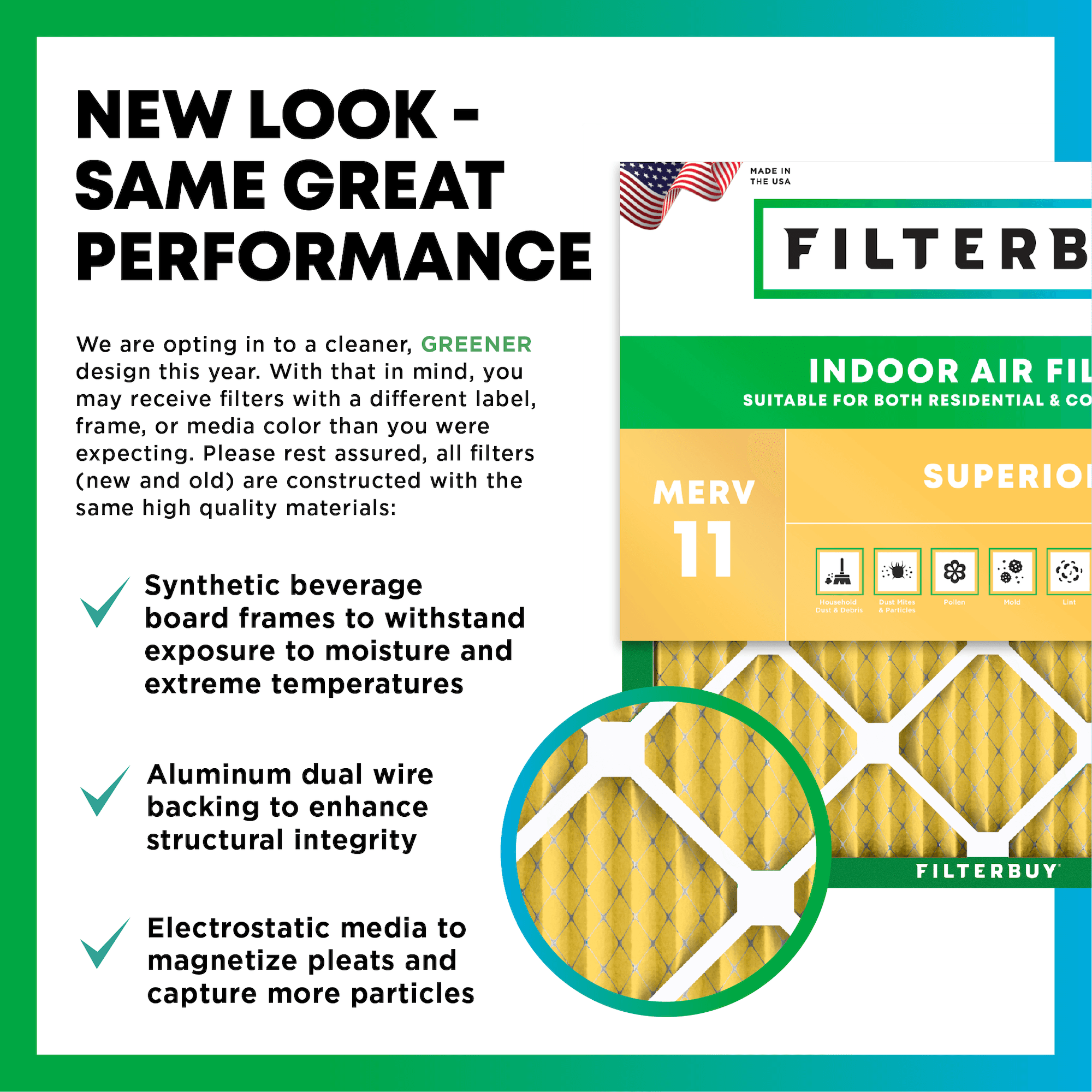
We build every Filterbuy filter to deliver reliable 90-day performance—thanks to smart design and premium materials that do the heavy lifting. Here's what makes the difference:
More pleats = more surface area to capture dust and debris, keeping your air cleaner longer.
Pleats are magnetized to attract and trap microscopic particles—like pet dander, pollen, and smoke.
Engineered to resist warping in extreme temperatures and high humidity.

A layer of metal reinforcement keeps pleats evenly spaced and structurally sound—no sagging, even at high airflow.
Assembled with care. Built to perform. Ships fast, free, and reliably from our U.S. facilities.

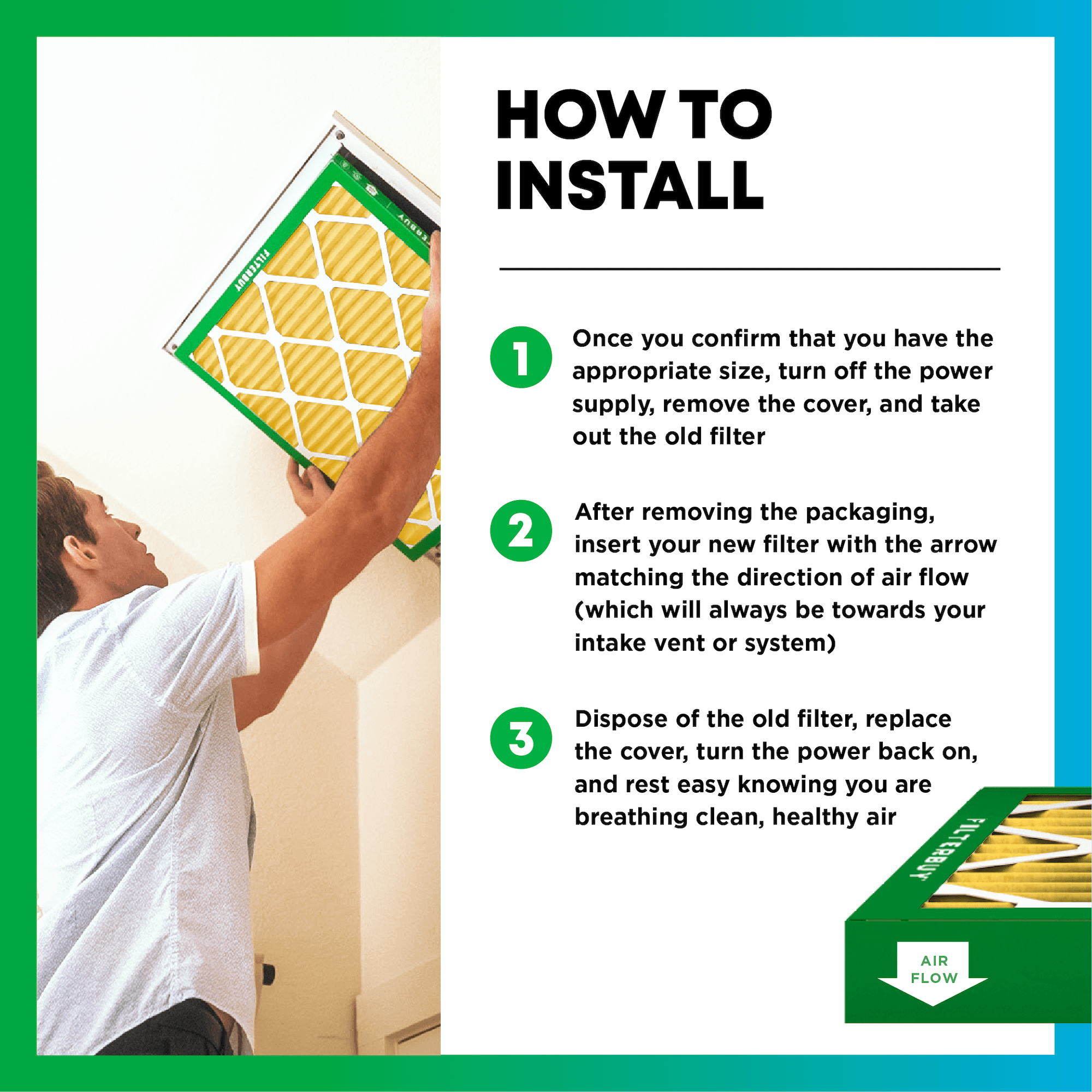
Turn Off Your HVAC SystemSafety first.

Remove The Old FilterLook for the airflow arrow and make note of the direction.

Slide In Your New FilterArrow should point toward the system (same direction as before).

Turn Your System Back OnAnd enjoy the fresh, clean air.

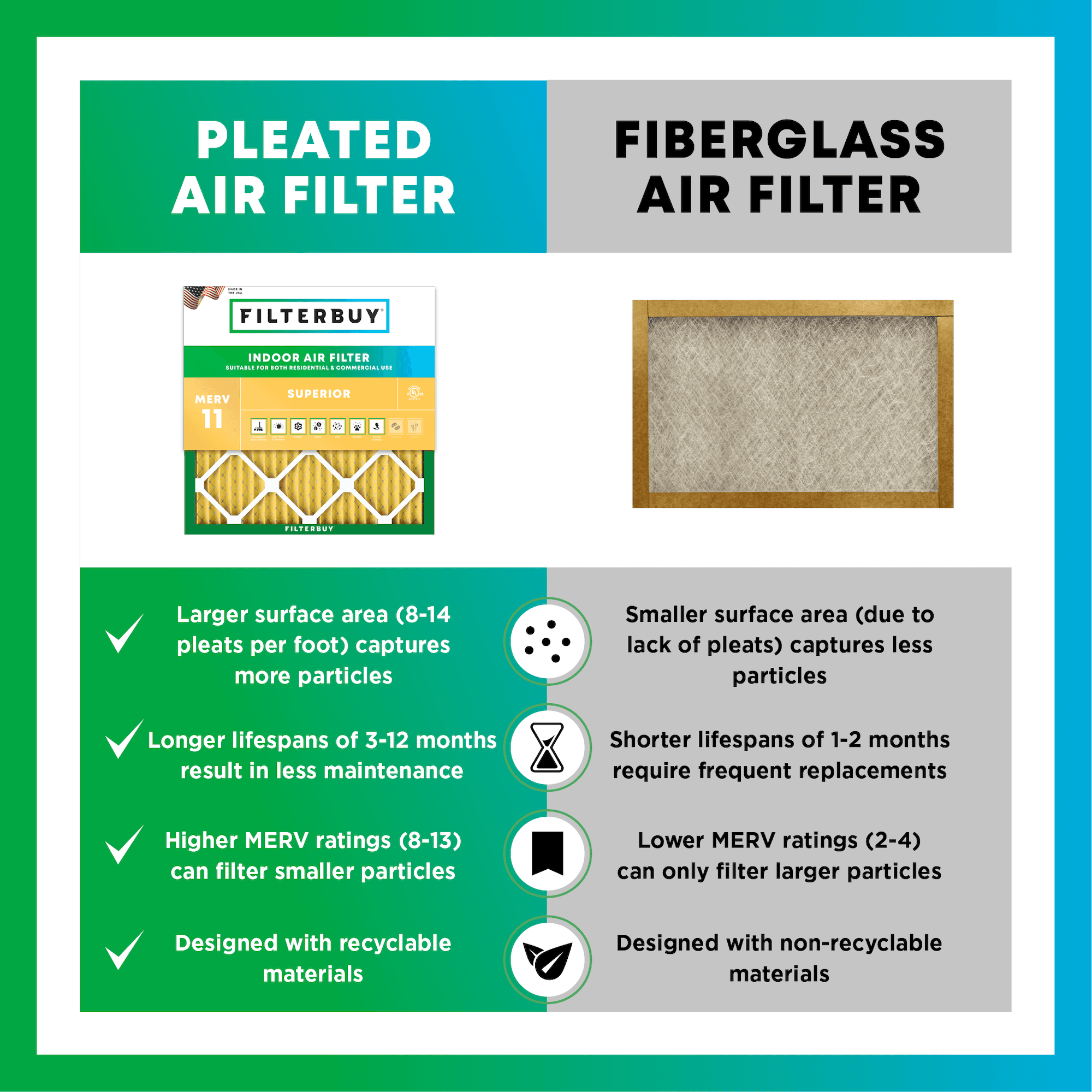
Not all air filters are created equal. Pleated filters don't just last longer—they actually clean your air better. Here's how they stack up:

Efficiency:
High (MERV 8–13) – Traps more particles
Lifespan:
90 days – Long-lasting performance
Air Quality:
Excellent – Cleaner, healthier air
Materials:
Recyclable and durable

Efficiency:
Low (MERV 4 or less) – Misses small stuff
Lifespan:
30 days or less – Replace often
Air Quality:
Minimal – Basic protection only
Materials:
Thin, flimsy, and not recyclable
Pleated filters are a no-brainer—more protection, less hassle, and better air for your home.
Changing your filter on time keeps your HVAC system running efficiently—and helps protect your lungs from dust, allergens, and airborne irritants. Here's how often to swap it out based on your needs:

For most homes without pets or special air quality concerns. Great for general upkeep and energy efficiency.

Shedding fur, dander, and allergy triggers can build up fast. Changing your filter every two months helps keep the air fresher and symptoms at bay.

For households affected by smoke, pollution, or respiratory conditions, monthly changes ensure maximum protection.

| Nominal Size | 16X22X5 |
| Actual Size | 15.38 x 21.88 x 5.25" inches |
| Filter Type | Pleated |
| Media | Electrostatically Charged |
| Frame | Beverage Board |
| MERV Ratings Available | 8, 11, 13 |
| Lifespan | Up to 12 Months |
| Origin | Made in USA |
A MERV 11 16x22x5 Five Seasons filter delivers 6 to 12 months of effective filtration—but that range varies more than most homeowners realize. After manufacturing millions of filters in this exact size, we've identified the real-world factors that determine whether yours lasts closer to six months or a full year.
Customers tell us they're often surprised by how much household conditions affect filter longevity. Pets, cooking habits, nearby construction, and even seasonal pollen surges can cut lifespan in half—while single-occupant homes with minimal dust sources often exceed the 12-month mark.
Below, we share what our manufacturing data and customer feedback reveal about maximizing Five Seasons filter performance in your specific environment.
A MERV 11 16x22x5 Five Seasons filter is a 5-inch deep replacement air filter designed for Five Seasons HVAC air cleaning systems. After manufacturing millions of these filters, here's what we know:
Lifespan: 6-12 months depending on household conditions
Actual dimensions: 15⅜ x 21⅞ x 5¼ inches
Replaces: FS1620, M0-1056, MU1620, 9183940
Captures: Dust mites, mold spores, pet dander, fine particles down to 1.0 micron
Best for: Households seeking improved air quality without airflow restriction
Why MERV 11: Balances effective filtration with system-safe airflow—our most recommended rating for residential Five Seasons systems
Effective lifespan: 6 to 12 months. Actual duration depends on pets, occupancy, outdoor air quality, and HVAC usage.
MERV 11 is the residential sweet spot. Captures dust mites, mold spores, pet dander, and fine particles—without restricting airflow or straining blower motors.
Replace based on condition, not calendar. Watch for visible discoloration, reduced airflow, increased dust, and longer HVAC cycles.
Delayed replacement costs money and health. Clogged filters increase energy use by up to 15%. Americans spend 90% of their time indoors breathing recirculated air.
5-inch depth means extended performance. More filtration media than 1-inch filters. Months of protection instead of weeks.
A MERV 11-rated 16x22x5 Five Seasons filter typically stays effective for 6 to 12 months under standard residential conditions. That extended lifespan is one of the key advantages of a 5-inch-deep media filter over standard 1-inch panels, which need swapping every 30 to 90 days. The deeper pleated design holds significantly more particulate before airflow restriction becomes a problem.
MERV 11 filtration captures particles between 1.0 and 3.0 microns at 65% efficiency or higher. That includes common household irritants like dust mite debris, pet dander, mold spores, and Legionella bacteria. As the filter loads with trapped contaminants over weeks and months, it actually becomes more efficient at capture — up to a point. Once the media reaches saturation, static pressure rises and your HVAC system works harder to push air through.
No single replacement timeline fits every home. Several variables directly influence how quickly a MERV 11 16x22x5 filter reaches the end of its useful life:
Pets in the household. Homes with multiple dogs or cats generate substantially more airborne dander and fur, often cutting filter life by 25–30%.
Local air quality. Homes near construction zones, high-traffic roads, or in regions prone to wildfire smoke load filters faster than average.
HVAC runtime. Systems that run continuously — common in extreme climates — push more air through the media and accelerate particle accumulation.
Occupancy levels. A four-person household generates more skin cells, fabric fibers, and cooking particulates than a single occupant.
Ductwork condition. Leaky or poorly sealed ducts introduce unfiltered air and debris that add unnecessary load to the filter.
Calendar reminders help, but visual and performance-based checks give you a more accurate picture. Pull the filter and hold it up to a light source. If little to no light passes through the pleats, the media is nearing capacity. A noticeable dust buildup on the intake side — especially a uniform gray or dark coating — confirms heavy loading.
Performance signs matter just as much. Reduced airflow from supply registers, longer HVAC cycle times, and a slight increase in dust settling on furniture all point toward a filter that's lost its effectiveness. Some homeowners also notice a faint musty smell when a saturated filter begins to restrict airflow enough to create moisture retention in the system.
The 16x22x5 is a less common dimensional specification originally designed for Five Seasons whole-house air cleaners. That 5-inch depth provides roughly five times the surface area of a standard 1-inch filter in the same footprint. More surface area means more space for particulates to accumulate before the media reaches the pressure drop threshold that compromises system performance.
Getting the exact size right is critical. A filter that's even slightly undersized allows unfiltered bypass air around the edges, which reduces both indoor air quality and the effective working life of the filter since the restricted portion of the media bears a disproportionate load.
Maximizing the lifespan of your MERV 11 16x22x5 filter starts with proper installation — arrow facing the direction of airflow, sealed snugly in the cabinet with no visible gaps. From there, check the filter every 2 to 3 months during heavy-use seasons and every 4 to 6 months during milder periods. Keeping return vents unobstructed and maintaining clean ductwork reduces the overall particulate burden reaching the filter, stretching its useful life closer to that 12-month mark.
"After producing millions of 16x22x5 filters, we've seen that homeowners who monitor their filter based on visual cues and household conditions—rather than a rigid calendar schedule—consistently get better performance from their HVAC systems and avoid both premature replacement costs and the efficiency losses that come from waiting too long."
EPA's official MERV rating guide explains exactly what particles a MERV 11 filter captures—including dust mites, mold spores, and pet dander down to 1.0 micron. Essential reading for comparing filtration levels before purchase.
Source: U.S. Environmental Protection Agency
URL: https://www.epa.gov/indoor-air-quality-iaq/what-merv-rating
ASHRAE developed the MERV testing methodology and sets filtration standards for residential HVAC systems. Their technical FAQ answers critical questions about filter efficiency, airflow resistance, and system compatibility.
Source: American Society of Heating, Refrigerating and Air-Conditioning Engineers
URL: https://www.ashrae.org/technical-resources/filtration-and-disinfection-faq
EPA's comprehensive air cleaner guide compares rating systems, explains how filters remove health-critical PM2.5 particles, and helps homeowners match filtration to specific health concerns like allergies or respiratory conditions.
Source: U.S. Environmental Protection Agency
URL: https://www.epa.gov/indoor-air-quality-iaq/guide-air-cleaners-home
The Department of Energy outlines how dirty filters reduce system efficiency by up to 15%, increase energy costs, and shorten HVAC equipment life. Includes maintenance schedules and replacement best practices.
Source: U.S. Department of Energy
URL: https://www.energy.gov/energysaver/air-conditioner-maintenance
The official Five Seasons manufacturer site provides product specifications, system compatibility details, and technical documentation for their air cleaning equipment—critical for confirming your 16x22x5 filter requirements.
Source: Five Seasons Comfort Limited
URL: https://www.fiveseasonsaircleaners.com/
Filterbuy's Five Seasons product page confirms actual dimensions (15⅜ x 21⅞ x 5¼), lists OEM cross-reference numbers (FS1620, M0-1056, MU1620), and provides MERV 8, 11, and 13 options for your specific system.
Source: Filterbuy.com
URL: https://filterbuy.com/brand/five-seasons-air-filters/
EPA's foundational indoor air quality guide explains how filtration works alongside ventilation to reduce contaminant levels—helping you understand why proper filter selection matters for respiratory health and home comfort.
Source: U.S. Environmental Protection Agency
URL: https://www.epa.gov/indoor-air-quality-iaq/inside-story-guide-indoor-air-quality
The EPA reports Americans spend 90 percent of their time indoors—where pollutant concentrations measure 2 to 5 times higher than outdoor levels.
After manufacturing millions of air filters, we see this reality in what customers return: filters saturated with dust, dander, and particulates that would otherwise circulate through living spaces.
Source: U.S. Environmental Protection Agency
URL: https://www.epa.gov/report-environment/indoor-air-quality
The U.S. Department of Energy confirms clogged filters force HVAC systems to consume up to 15 percent more energy.
Customers consistently tell us they notice lower utility bills after adopting a proper replacement schedule. Our manufacturing data confirms why:
Saturated filters restrict airflow
Restricted airflow forces harder system operation
Harder operation increases energy consumption
HVAC accounts for nearly half of typical home energy costs
The 16x22x5 Five Seasons filter's extended lifespan delivers both convenience and measurable savings—when replaced at the right interval.
Source: U.S. Department of Energy
URL: https://www.energy.gov/energysaver/air-conditioner-maintenance
The American Lung Association reports over 25 million Americans live with asthma. Indoor air pollutants rank among the most common symptom triggers.
From customer feedback, we know many households choose MERV 11 because family members experience allergies or respiratory sensitivity. This rating captures what standard filters miss:
Dust mites
Pet dander
Mold spores
Fine particulate matter
MERV 11 provides meaningful protection without the airflow restriction of higher ratings that can strain residential systems.
Source: American Lung Association
URL: https://www.lung.org/blog/asthma-and-indoor-air
A MERV 11 16x22x5 Five Seasons filter represents one of the most practical investments a homeowner can make for indoor air quality—but only when replacement timing matches actual household conditions.
After manufacturing millions of filters in this exact size, we've developed a clear perspective: most homeowners either replace too early or wait too long. Both mistakes cost money.
Premature replacement wastes a filter with remaining capacity
Delayed replacement strains HVAC equipment and increases energy bills
Both compromise the air quality the filter was designed to protect
The 6 to 12 month lifespan range exists because homes differ dramatically. We've seen filters in low-demand environments last a full year while high-demand households show heavy loading at four months.
Our recommendation: Trust visual inspection and system performance over rigid schedules. Replace when you observe:
Visible gray or brown discoloration on filter media
Faster dust accumulation on furniture and surfaces
Longer HVAC run cycles to reach set temperatures
Reduced airflow from supply vents
MERV 11 hits the efficiency sweet spot for most residential Five Seasons systems. It captures the particles that matter—dust mites, mold spores, pet dander, fine dust—without creating airflow resistance that higher MERV ratings impose.
The bottom line: A quality MERV 11 filter maintained on a condition-based schedule protects indoor air, reduces energy costs, and extends HVAC equipment life. That's not marketing—it's what we've observed across millions of filters and thousands of customer households.
Take these steps to maximize your Five Seasons filter's performance.
Verify your system requires 16x22x5 before ordering:
Check your current filter's label
Review Five Seasons system documentation
Measure housing dimensions (actual size: 15⅜ x 21⅞ x 5¼)
Determine where you fall on the 6-12 month replacement timeline.
Expect 4-6 months if you have:
Multiple pets
High-occupancy household
Recent renovation or construction
Poor outdoor air quality
Continuous fan operation
Expect 10-12 months if you have:
Single or dual occupancy
No pets
Well-sealed, newer home
Moderate HVAC usage
Regular cleaning routine
Set a calendar reminder. Check for:
Visible gray or brown discoloration
Reduced airflow from vents
Increased dust accumulation
Longer HVAC run cycles
Don't wait until your filter is overdue. Stock at least one backup to avoid running a saturated filter that strains your system.
Customers who subscribe maintain more consistent schedules—and avoid efficiency losses from delayed replacement.
Q: How long does a MERV 11 16x22x5 Five Seasons filter last?
A: Standard lifespan is 6 to 12 months. After manufacturing millions of filters in this size, we've learned actual duration varies significantly based on:
4-6 months typical: Multiple pets, high occupancy, poor outdoor air quality
10-12 months typical: Single occupant, no pets, well-sealed home
We recommend monthly visual inspections rather than rigid calendar replacement.
Q: What are the actual dimensions of a 16x22x5 Five Seasons filter?
A: Actual dimensions: 15⅜ x 21⅞ x 5¼ inches. We manufacture to precise specifications—even slight variations cause unfiltered air bypass.
Replaces OEM part numbers:
FS1620
M0-1056
MU1620
9183940
Fits Five Seasons housings:
FSBB1620
FSMU1620
FSNC1620
Measure your existing filter or housing before ordering if unsure.
Q: Is MERV 11 the right rating for my Five Seasons system?
A: For most residential Five Seasons systems, yes. Our production testing confirms MERV 11:
Captures particles down to 1.0 micron
Removes dust mites, mold spores, pet dander, fine dust
Maintains airflow Five Seasons systems require
We've seen customers try MERV 13 for severe allergies, then return to MERV 11 after noticing system strain. Higher isn't always better when it compromises airflow balance.
Q: How do I know when my Five Seasons filter needs replacement?
A: Your filter will tell you. Based on thousands of customer interactions, watch for:
Visible gray or brown discoloration
Reduced airflow from vents
Faster dust accumulation on surfaces
Longer HVAC cycles to reach set temperature
Musty odors during system operation
Still looks clean? You likely have capacity remaining. Maximum recommended lifespan: 12 months regardless of appearance.
Q: Can I use a different MERV rating in my Five Seasons system?
A: Yes. The 16x22x5 housing accepts MERV 8, 11, and 13. From customer ordering patterns and feedback:
MERV 8: Basic dust control, maximum airflow, best for older systems
MERV 11: Most frequently ordered—best balance of air quality and filter longevity
MERV 13: For asthma or severe allergies—some customers note shorter filter life
Our recommendation: Start with MERV 11. It delivers meaningful improvement without tradeoffs higher ratings introduced in residential systems.
Don't wait until airflow drops and your system starts working overtime — replace your 16x22x5 Five Seasons filter on schedule to maintain peak MERV 11 performance year-round. Shop Filterbuy's exact-fit 16x22x5 MERV 11 filters built with quality media designed to deliver the full 6-to-12-month lifespan your HVAC system depends on.

