
20x23x1 Air Filters
Actual Size: 19.5x22.5x0.75

3 month filters
2. Select Quantity
Buying multiple sizes?


Made in the USA
Ships in 24 hours
20x23x1 Air Filters Air Filter Description
Available In MERV Rating: 8, 13, 11
Made in the USA
Ships in 24 hours
Merv comparison
Scroll to see more.
 MERV 8 |  MERV 11 |  MERV 13 | |
|---|---|---|---|
| Best for | Standard Residential/Commercial Healthy Families | Superior Residential/Commercial Allergy Sufferers | Optimal Residential/Commercial Hospital Grade |
| Comparable ratings | MPR 600 & FPR 5 | MPR 1000-1200 & FPR 7 | MPR 1500 - 1900 & FPR 10 |
| Filtration | Captures 90% of Airborne Particles | Captures 95% of Airborne Particles | Captures 98% of Airborne Particles |
| Dust, lint & debris | |||
| Mold, pollen | |||
| Dander, dust mites | |||
| Smoke & Smog | |||
| Bacteria | |||
| Odor, vocs |
Is it time to change your filter?
Generally, we recommend you replace your air filters every 90 days. Find out below if you should change your filters more often.

If someone in your home has asthma or allergies...
Change your filter every
6 weeks
to ensure indoor air quality is at its best.
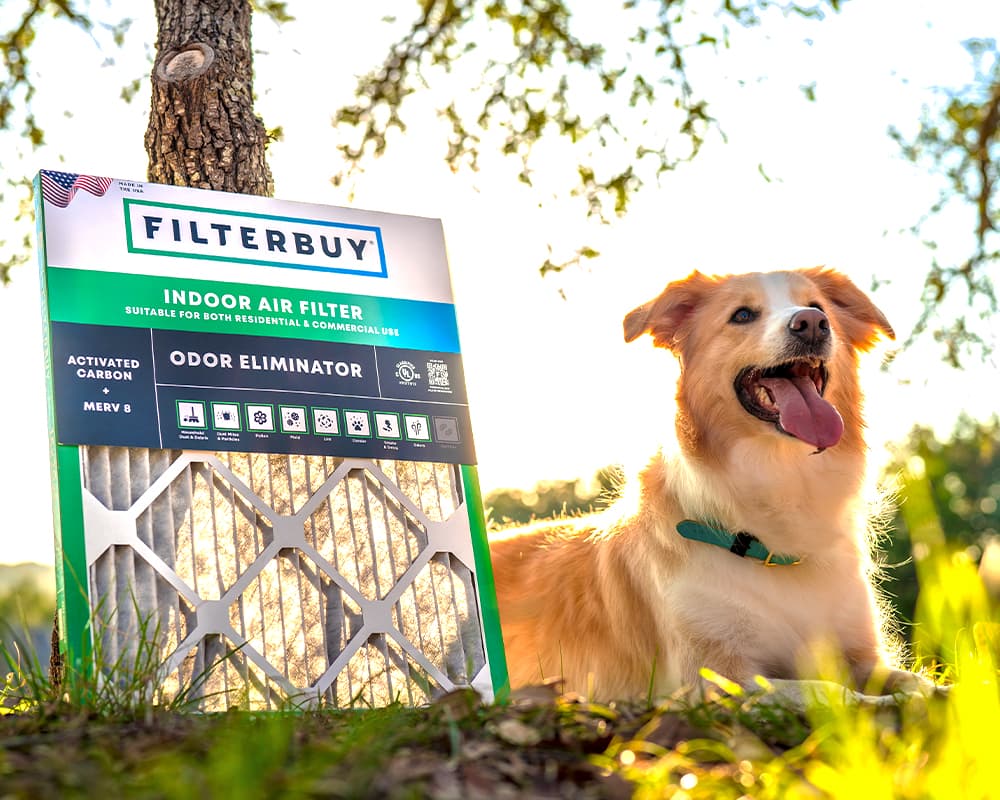
If you have pets...
Change your filter every
2 months
to avoid shedding and odor buildup.

If you have young children...
Change your filter every
2-3 months
as having clean air is even more important with children in your home.
If someone in your home has asthma or allergies...
Change your filter every
6 weeks
to ensure indoor air quality is at its best.
If you have pets...
Change your filter every
2 months
to avoid shedding and odor buildup.
If you have young children...
Change your filter every
2-3 months
as having clean air is even more important with children in your home.
TL;DR
A 20x23x1 air filter is a one-inch pleated HVAC filter that measures 19.50 x 22.50 x 0.75 inches actual, and it fits furnaces, air conditioners, and heat pumps built for a nominal 20 x 23 x 1 slot. It's a size most hardware stores don't stock, so you'll usually order it online. Filterbuy cuts, pleats, and frames 20x23x1 filters to order in our own US plants, in MERV 8, 11, and 13, from $9.16 to $35.99 each with fast and free 2-day delivery to most US states.
Key Takeaways
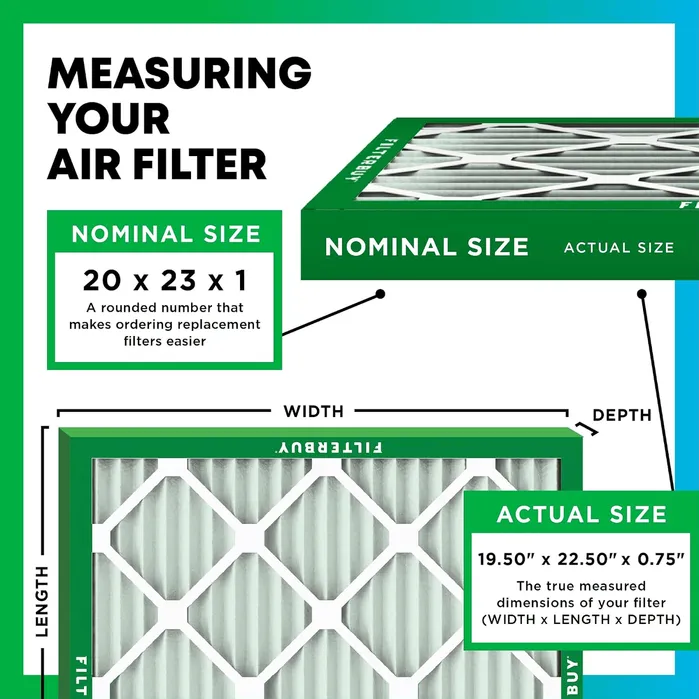
A 20x23x1 air filter measures 19.50 x 22.50 x 0.75 inches actual. The 20 x 23 x 1 label is the nominal size, rounded up by industry convention.
MERV 8 suits most homes, MERV 11 covers allergies and asthma as well as pets and pollen, and MERV 13 handles smoke. Check your HVAC manual to confirm which rating your system takes.
Finding your size is easy even though shelves rarely carry this one. Read the size off your old filter, or measure the slot, then order that nominal size.
A filter that leaves a gap does nothing, because air takes the path of least resistance and slips around it.
Replace a 20x23x1 filter every 90 days, or every 60 days with pets or allergies.
Filterbuy cuts, pleats, and frames 20x23x1 filters to order in our own US plants, from $35.99 down to $9.16 each at twelve or more, with fast and free 2-day delivery to most US states.
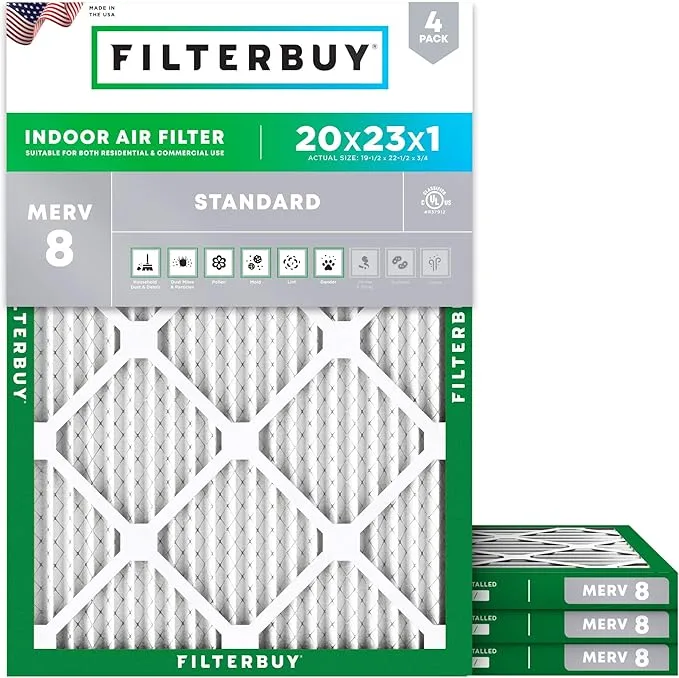
What Is A 20x23x1 Air Filter?
A 20x23x1 air filter is a one-inch-deep pleated air filter measuring 19.50 x 22.50 x 0.75 inches actual, and it sits on the return side of a residential furnace, air handler, or air conditioning system. It catches dust, pollen, pet dander, mold spores, and smoke before they reach the blower and circulate through the house again.
Finding your size is usually the easy part. Read 20x23x1 off the frame of the filter you're replacing, or measure the slot if there's no filter in it, and order that nominal size. The actual cut runs smaller by design, and that clearance is what lets the filter slide in and seat. So if your tape reads 19.5 by 22.5, you're holding a 20x23x1 and nothing's wrong.
20x23x1 Air Filter Specifications
Nominal size is the rounded label printed on the frame. Actual size is the true measured dimension of the filter.
Which MERV Rating Should I Choose For A 20x23x1 Filter?
MERV 8 is the standard choice for most homes, MERV 11 is built for allergies and asthma as well as pets and pollen, and MERV 13 is the one to pick for smoke. All three come in 20x23x1, all three are pleated and made to order in our own US plants, and all three fit the same slot. Filterbuy also makes an Odor Eliminator carbon filter if odors are what you're dealing with.
MERV stands for Minimum Efficiency Reporting Value, which is simply the industry scale for how much a filter captures. Higher numbers capture more.
Check your HVAC manual to confirm which rating your system takes. It's a normal fit check, the same as confirming the size, and it takes a minute.
Filterbuy also makes an Odor Eliminator carbon filter for odors. Check your HVAC manual to confirm which rating your system takes, the same way you would confirm a size.
Shop by rating: 20x23x1 MERV 8 air filters, 20x23x1 MERV 11 air filters, and 20x23x1 MERV 13 air filters. Our complete MERV rating guide covers the full scale, and MERV vs MPR vs FPR explains the two third-party scales you'll see on other brands' packaging.
"The call I get most on this size is from someone with a tape measure who's certain they've measured wrong, because it reads 19.5 by 22.5. They haven't; that's exactly what a 20x23x1 is, and once that lands, choosing between MERV 8, 11, and 13 is the easy part."
— Customer Service, Filterbuy
Where Can I Buy A 20x23x1 Air Filter Near Me?
You can order a 20x23x1 filter today and have it in a couple of days, which is usually faster than tracking one down locally. Shelf space at hardware stores follows sales volume, so it goes to sizes like 16x25x1 and 20x20x1. That's why people search for 20x23x1 near them, often after a trip that didn't turn one up.
We're a manufacturer, not a reseller, so 20x23x1 gets cut, pleated, and framed to order in our own US plants rather than waiting on a retailer to restock it. Delivery is fast and free, 2 days to most US states. Our guide to buying HVAC air filters near you covers when a local run is worth making.
Before you drive anywhere:
1. Measure the housing opening: width, height, depth. Do not trust the old label alone.
2. Ask for 20 x 23 x 1 specifically, not "something about that size." Substitutions are where fit problems start.
3. Never force a smaller filter into a larger housing. A gap on any edge lets air bypass the media entirely.
4. Set up auto-delivery. An air filter subscription means the next one shows up without you thinking about it.
Need service as well as filters? Find HVAC service locations.
Why Is 20x23x1 Such An Uncommon Filter Size?
20x23x1 is uncommon because housings at that dimension served a narrower set of furnace and air handler configurations than the returns behind industry-standard sizes. Fewer systems means less retail demand, less shelf space, and a shorter list of manufacturers willing to tool for it. Filterbuy makes over 600 sizes, including this one, browsable in our one-inch air filter index.
If your housing measures outside 20 x 23 x 1, our custom air filter tool cuts to your exact dimensions. That is the practical difference between buying from a manufacturer and from a reseller.
What We Have Learned Manufacturing An Uncommon Size
We cut, pleat, and frame air filters to order in our own US plants, and 20x23x1 runs on the same lines as our highest-volume sizes. We're a manufacturer rather than a reseller, and that shapes what we can tell you about this size.
We choose the clearance. A nominal 20x23x1 is cut to 19.50 x 22.50 x 0.75 inches so it slides in and seats. Other manufacturers cut to their own clearances, so if you're switching brands, read the actual dimensions printed on the frame rather than assuming two filters labelled 20x23x1 measure alike.
Fit is part of filtration. A filter that sits loose lets air slip around the edges instead of passing through the pleats, so we treat a quarter-inch difference as a real problem. If your slot falls between sizes, we cut custom filters to the eighth of an inch.
Here's the practical version. If you can't confirm a filter's actual cut, you can't confirm it'll seat. Ours is printed above and on every frame we ship.
Filterbuy filters are compatible replacement options designed to fit select systems from other brands. Filterbuy is an independent manufacturer and is not affiliated with or endorsed by those companies.
How Much Do 20x23x1 Air Filters Cost?
A single Filterbuy 20x23x1 air filter costs $35.99, and the per-filter price drops to $9.16 at twelve or more, a 75% saving. Delivery is fast and free, 2 days to most US states, and Auto Delivery takes another 5% off.
Every order ships free in 3 days. Auto Delivery takes an additional 5% off. Pricing shown is per filter.
Prices shown are per filter and drop automatically as quantity increases.
What A Year Of 20x23x1 Filters Actually Costs
At the standard 90-day interval a household uses four filters a year. Run that against the prices above and the gap between buying patterns is larger than most people expect.
One at a time, four times a year: $143.96.
One six-pack: $57.96, covering 18 months, or $38.64 a year.
A difference of about $105 a year for the same filter on the same schedule.
That's the case for buying ahead on a size the shops don't carry, so the next change doesn't turn into an errand.
How Do I Install A 20x23x1 Air Filter?
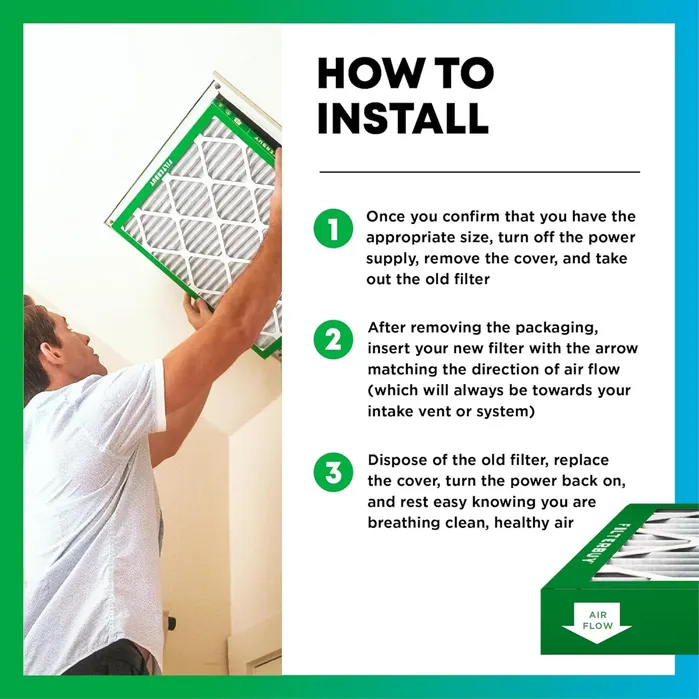
The arrow on the frame points toward the furnace or air handler, away from the return duct. That's the detail people most often get backwards. The whole swap takes under ten minutes.
1. Turn the system off at the thermostat so the blower cannot run with the compartment open.
2. Find the filter slot. 20x23x1 filters usually sit in a filter cabinet or a slot near the blower, sometimes in a return grille.
3. Slide the old filter out and note which way its arrow points. If there is no arrow, airflow runs toward the equipment with the blower motor.
4. Measure the opening. A Filterbuy 20x23x1 filter is 19.50 x 22.50 x 0.75 inches actual; an opening well outside that needs a custom air filter. Here is how to measure an air filter.
5. Slide the new filter in, arrow toward the furnace. It should seat snugly. If you have to flex the frame, the size is wrong.
6. Check all four edges for gaps before you close the panel.
7. Secure the panel and restore power. A whistle from the vents usually means the filter isn't seated properly, so pull it and reseat it.
Why Doesn't My 20x23x1 Filter Fit?
Usually it's because the slot was framed to a rough opening rather than to a nominal filter size. Three things account for most fit trouble, and all three are fixable.
The slot measures outside 19.50 x 22.50. Measure all three dimensions, then order a custom air filter cut to the eighth of an inch. If your opening is exactly 19.5 by 22.5, we stock that as its own size: 19.5x22.5x1 air filters.
The frame is bent. Filters stored on edge can warp, and a warped frame won't seal. Keep spares flat and dry. If one arrives damaged, get in touch and we'll sort it out.
It's in backwards. If something feels off right after a change, check the arrow. Pull the filter out, turn it around, and point the arrow at the furnace.
Still stuck? Send your measurements to info@filterbuy.com or call (855) 345-8289 and we'll confirm the size before you order.
Supporting Statistics: What The Research Says About Indoor Air And Filtration
Three primary-source findings back the guidance Filterbuy gives on this page. Each comes from a U.S. federal agency or a national health organization rather than from us, and each is linked so you can check it independently.
1. Americans spend about 90% of their time indoors
Concentrations of some indoor pollutants run 2 to 5 times higher than typical outdoor levels.
What it means for your filter: every cubic foot your home recirculates passes through the return. The Filterbuy 20x23x1 sitting in that slot is the only thing removing particles from it.
Source: U.S. EPA, Report on the Environment
2. Neglected maintenance costs 10% to 25% more energy
That is the gap between a well-maintained system and a severely neglected one.
The Department of Energy lists filter replacement first among maintenance tasks.
A clogged filter obstructs airflow. Dirt then bypasses the media and settles on the evaporator coil.
What it means for your filter: this is the evidence behind the 90-day interval Filterbuy recommends.
An overdue filter does not just stop catching particles, it makes the equipment work harder.
Source: U.S. Department of Energy, Energy Saver
3. 152.3 million Americans live in counties with failing air quality grades
That is 44% of the U.S. population.
Grades cover ground-level ozone and both short-term and year-round particle pollution.
What it means for your filter: outdoor air gets indoors, and what your filter captures is the part you control. Filterbuy makes 20x23x1 in MERV 13, the tier to choose for smoke.
Source: American Lung Association, State of the Air 2026
Frequently Asked Questions About 20x23x1 Air Filters
Is 20x23x1 the same as 23x20x1?
Yes. Dimensions are listed width x height x depth, and many housings take the filter either way. Keep the arrow pointing at the furnace.
How often should I change a 20x23x1 air filter?
Every 90 days in a standard home, every 60 with pets or allergies. Not sure? Hold it up to a light. If light does not pass through the pleats, it is time.
Can I use a MERV 13 filter in a 20x23x1 slot?
Yes. 20x23x1 comes in MERV 13, and MERV 13 is the tier to choose for smoke. Check your HVAC manual to confirm which rating your system takes, the same way you would confirm a size.
What if my slot is not exactly 20x23x1?
Filterbuy makes over 600 sizes, so check the list first. If yours is not there, we cut custom filters to the eighth of an inch.
Related Filter Sizes
Filterbuy manufactures each of the sizes below. If your housing measures differently, one of these is likely the fit:
20x22x1 air filters, one inch shorter
20x24x1 air filters, one inch taller
19x23x1 air filters, one inch narrower
21x23x1 air filters, one inch wider
20x23x2 air filters, two-inch depth option
For a dimension between standard sizes, use the custom air filter tool.
Glossary
20x23x1 air filter: A one-inch pleated HVAC filter measuring 19.50 x 22.50 x 0.75 inches actual, for residential furnaces, air handlers, and air conditioners.
Nominal size vs actual size: Nominal is the rounded label printed on the frame and used in listings. Actual is what the filter measures. A Filterbuy 20x23x1 is nominally 20 x 23 x 1 and actually 19.50 x 22.50 x 0.75 inches.
MERV: Minimum Efficiency Reporting Value, the industry scale for how much a filter captures. Higher numbers capture more. See our complete MERV rating guide.
MPR and FPR: Two third-party rating scales you will see on other brands. MPR is 3M's and FPR is The Home Depot's. Neither is ours, and neither maps exactly onto MERV. See MERV vs MPR vs FPR.
ASHRAE: The American Society of Heating, Refrigerating and Air-Conditioning Engineers, publisher of Standard 52.2, the test method behind MERV.
Return duct: The ductwork carrying air from your rooms back to the furnace. The filter sits on this side; the frame arrow points away from it.
Filter bypass: Air going around a filter instead of through it, caused by gaps between the frame and the slot.
About This Page
Written by Michelle Wan, Brand Manager and Air Quality Writer at Filterbuy. Michelle earned her B.A. in Sociology from the University of California, Santa Cruz, and works directly with Filterbuy's US manufacturing team, so her writing is grounded in how filters are actually cut, pleated, and tested. She also fronts much of Filterbuy's educational video content. Read articles by Michelle Wan.
Technically reviewed by David Clark, Licensed HVAC Technician. David reviews Filterbuy's filtration and HVAC guidance for technical accuracy.
Last updated: August 17, 2026
Sources: U.S. Environmental Protection Agency, Guide to Air Cleaners in the Home and What is a MERV rating?; ASHRAE Standard 52.2.