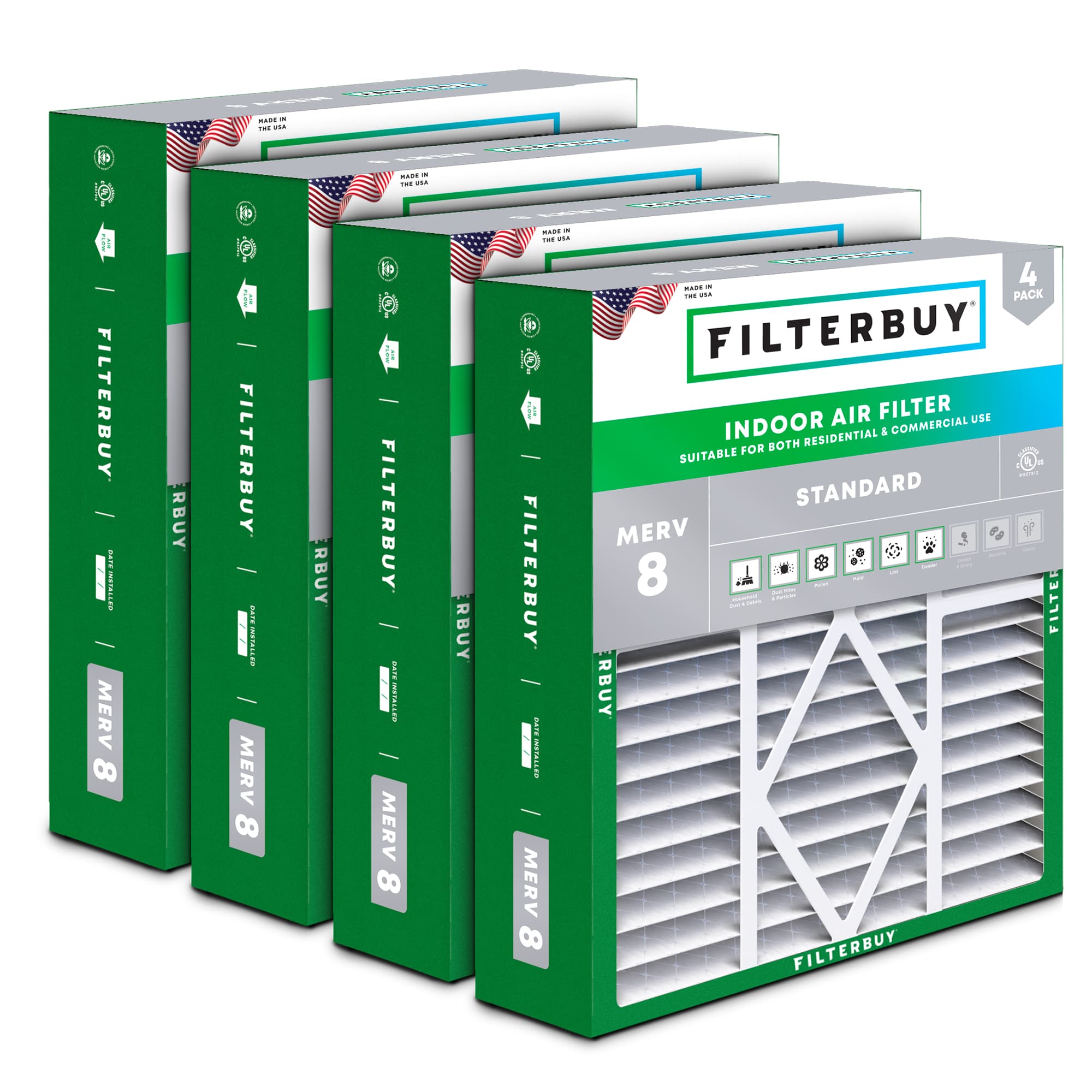
Tip: Ensure you buy the exact air filter size for your system. Certain brands have precise dimensions that only fit their specific models. See related filters
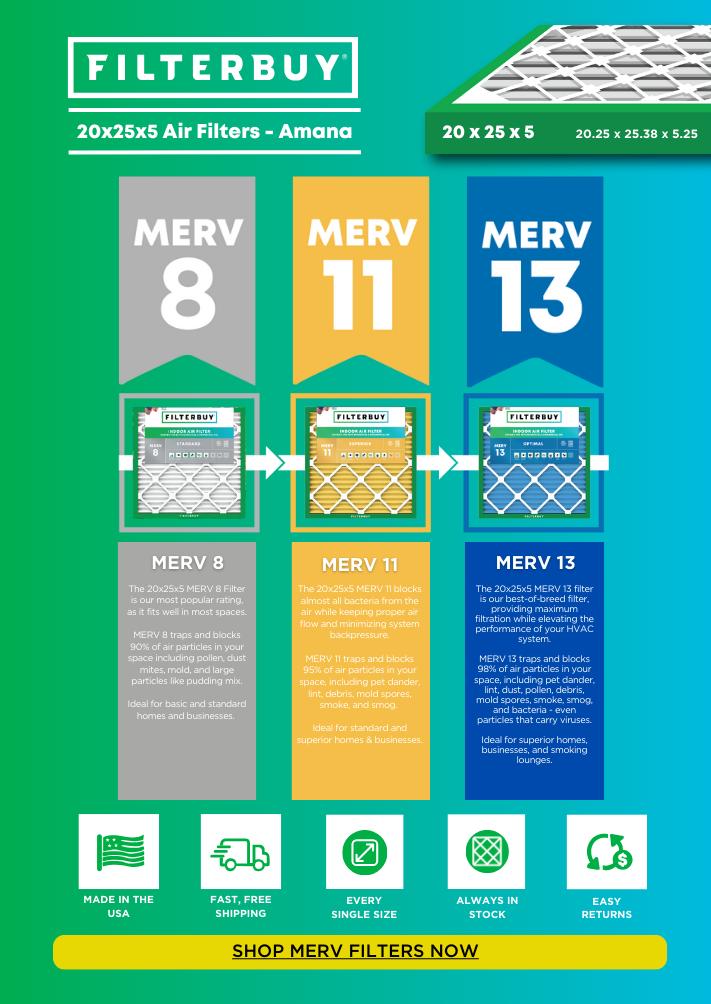
Actual Size: 20.25x25.38x5.25"
 Free Delivery
  Factory-Direct Low Prices, Made in the USA
 Hassle-Free Returns & Free Exchanges
RESIDENTIAL AND/OR COMMERCIAL USE
Change Every 3 Months
Tip: Ensure you buy the exact air filter size for your system. Certain brands have precise dimensions that only fit their specific models. See related filters
Actual Size: 20.25x25.38x5.25"
Free Delivery Factory-Direct Low Prices, Made in the USAHassle-Free Returns & Free ExchangesRESIDENTIAL AND/OR COMMERCIAL USE
Change Every 3 Months
Tip: Ensure you buy the exact air filter size for your system. Certain brands have precise dimensions that only fit their specific models. See related filters
Actual Size: 20.25x25.38x5.25"
Free Delivery Factory-Direct Low Prices, Made in the USAHassle-Free Returns & Free ExchangesRESIDENTIAL AND/OR COMMERCIAL USE
Change Every 3 Months
Many HVAC brands have unique trimmed sizes of their 20x25x5 filters.
For example, a 20x25x5 made for Honeywell systems will not fit other brand systems.
⚠️ This quick step can save you from ordering the wrong size. ⚠️
Find Your Exact Match By Choosing Your Brand Below:
Find Your Exact Match By Choosing the Actual Size (Also known as the trimmed size):
At Filterbuy, we don't cut corners—we craft high-quality air filters right here in the USA and ship them to your doorstep for free. No delays, no gimmicks—just clean air, made easy. With thousands of five-star reviews and filters built for real life & every HVAC system, it's no wonder why over 4 million families trust Filterbuy.

Proudly Made In The USA

Fast, Free Shipping on Every Order

Premium Materials That Go The Distance

85,000+ 5-Star Reviews From Happy Customers

Save Up to 70% Per Filter with Packs


Measure length × width × depth with a tape measure to find the actual size.

Round up each dimension to the nearest whole number to get the nominal size. Example: 20.25x25.38x5.25" in → 20x25x5 nominal.

Search by nominal size on our site for the best fit.


5″ filters give you maximum filtration with minimal maintenance — lasting up to 12 months while handling higher MERV ratings without restricting airflow.
Sizing note:

If the filter you buy doesn't fit, we'll send you a better size.
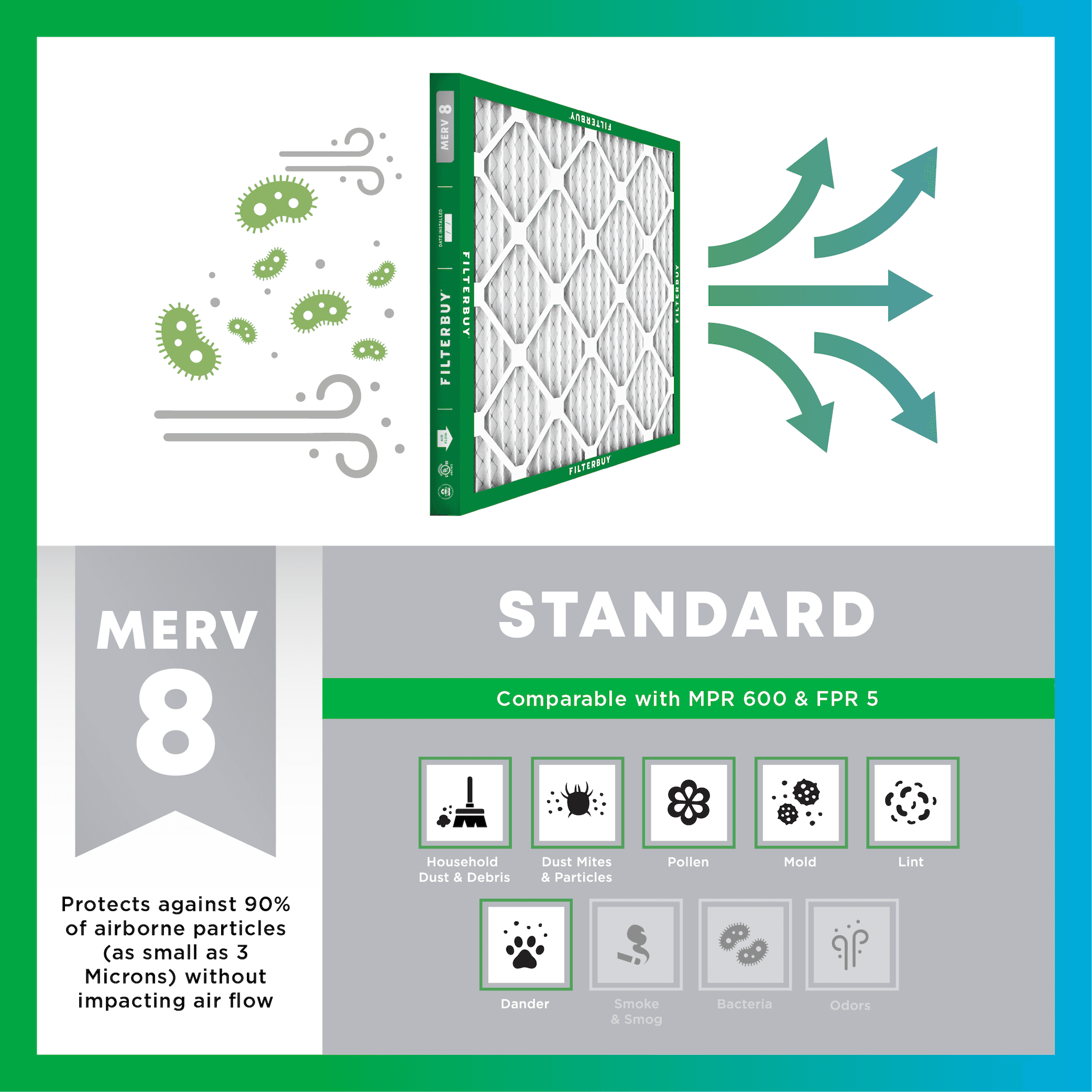
MERV stands for Minimum Efficiency Reporting Value—but don't let the technical name fool you. It's just a way to rate how well an air filter traps stuff like dust, pollen, pet dander, and smoke. The higher the MERV number, the more particles it catches—and the cleaner your air will be.

Comparable to:FPR: 4-7
MPR: 600-1000
 Dust & Debris
 Dust Mites & Particles
 Pollen
 Mold
Mold Lint
Lint Dander
Comparable to:FPR: 6-9
MPR: 1200-1550
Dust & DebrisDust Mites & ParticlesPollenMoldLintDander Smoke & Smog
Comparable to:FPR: 10
MPR: 1900-2800
Dust & DebrisDust Mites & ParticlesPollenMoldLintDanderSmoke & Smog Bacteria


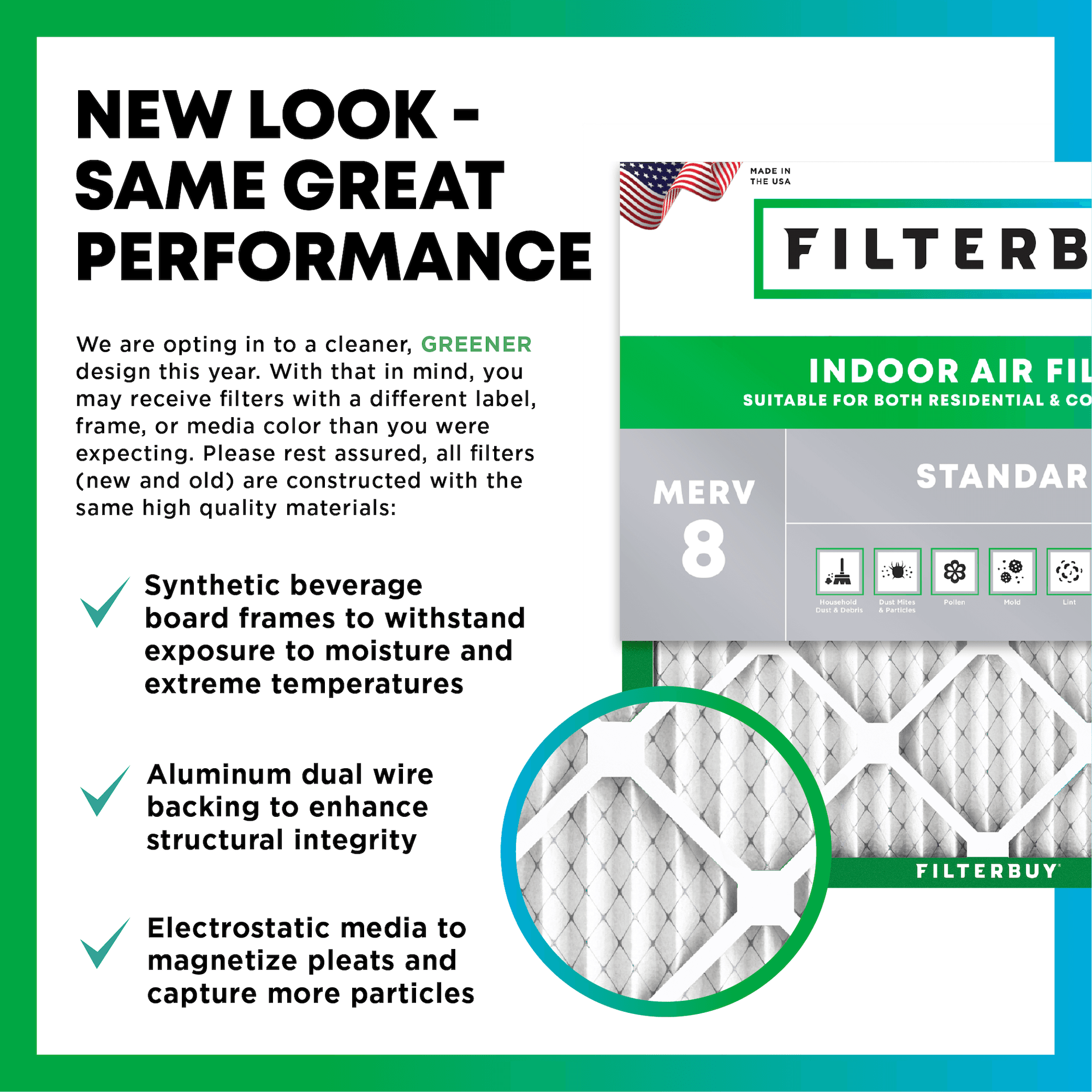
We build every Filterbuy filter to deliver reliable 90-day performance—thanks to smart design and premium materials that do the heavy lifting. Here's what makes the difference:
More pleats = more surface area to capture dust and debris, keeping your air cleaner longer.
Pleats are magnetized to attract and trap microscopic particles—like pet dander, pollen, and smoke.
Engineered to resist warping in extreme temperatures and high humidity.

A layer of metal reinforcement keeps pleats evenly spaced and structurally sound—no sagging, even at high airflow.
Assembled with care. Built to perform. Ships fast, free, and reliably from our U.S. facilities.

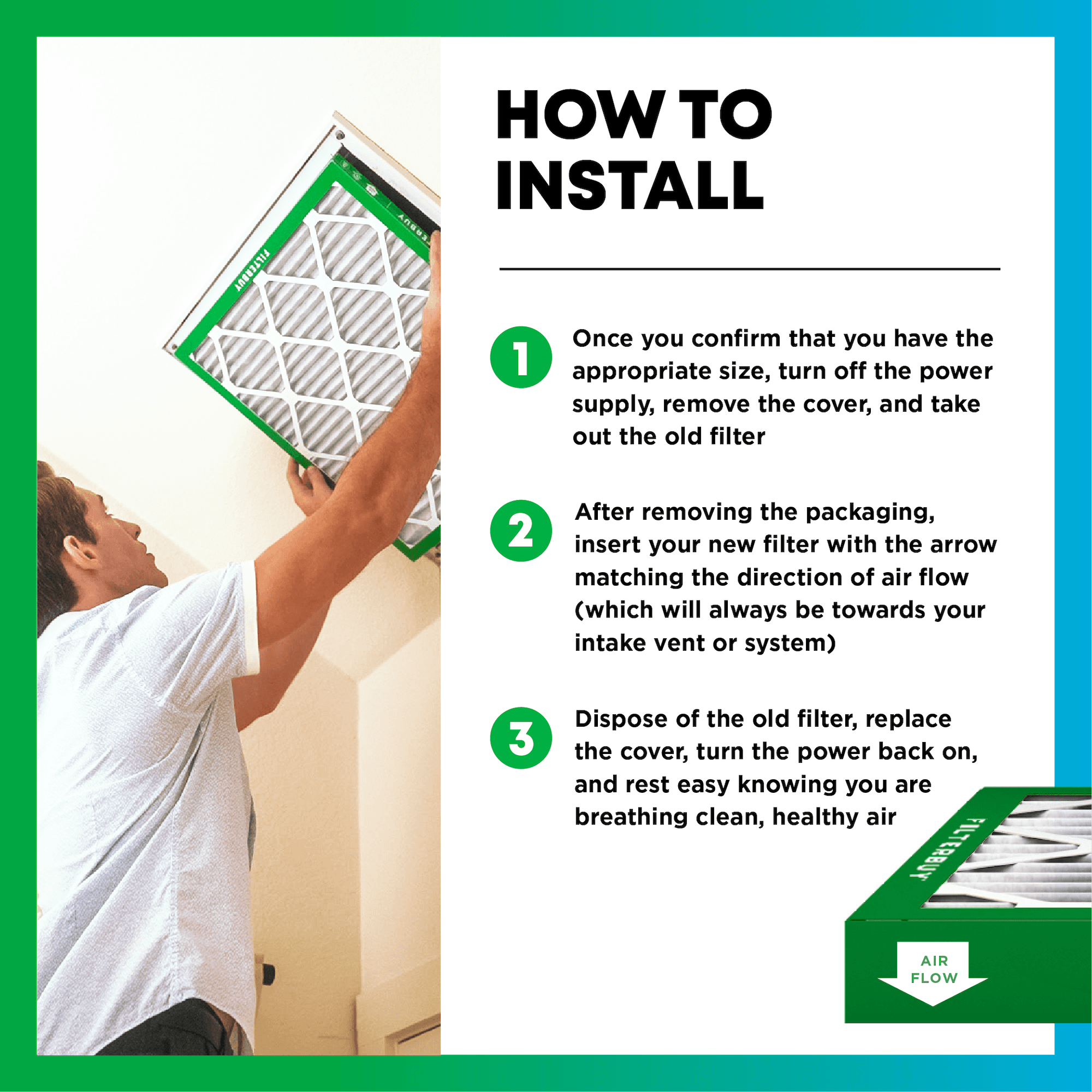
Turn Off Your HVAC SystemSafety first.

Remove The Old FilterLook for the airflow arrow and make note of the direction.

Slide In Your New FilterArrow should point toward the system (same direction as before).

Turn Your System Back OnAnd enjoy the fresh, clean air.

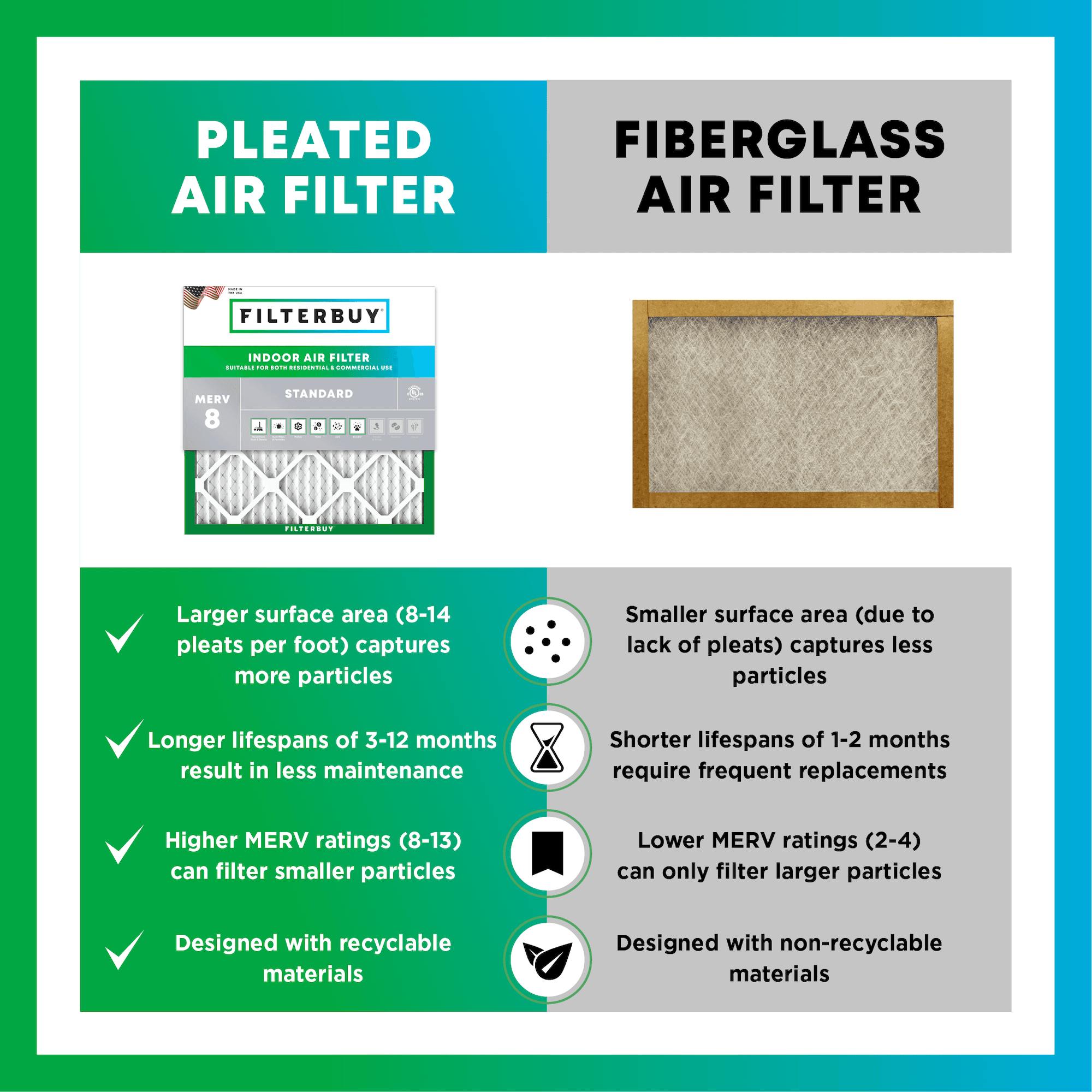
Not all air filters are created equal. Pleated filters don't just last longer—they actually clean your air better. Here's how they stack up:

Efficiency:
High (MERV 8–13) – Traps more particles
Lifespan:
90 days – Long-lasting performance
Air Quality:
Excellent – Cleaner, healthier air
Materials:
Recyclable and durable

Efficiency:
Low (MERV 4 or less) – Misses small stuff
Lifespan:
30 days or less – Replace often
Air Quality:
Minimal – Basic protection only
Materials:
Thin, flimsy, and not recyclable
Pleated filters are a no-brainer—more protection, less hassle, and better air for your home.
Changing your filter on time keeps your HVAC system running efficiently—and helps protect your lungs from dust, allergens, and airborne irritants. Here's how often to swap it out based on your needs:

For most homes without pets or special air quality concerns. Great for general upkeep and energy efficiency.

Shedding fur, dander, and allergy triggers can build up fast. Changing your filter every two months helps keep the air fresher and symptoms at bay.

For households affected by smoke, pollution, or respiratory conditions, monthly changes ensure maximum protection.

| Nominal Size | 20 x 25 x 5 inches |
| Actual Size | 20.25 x 25.38 x 5.25" inches |
| Filter Type | Pleated |
| Media | Electrostatically Charged |
| Frame | Beverage Board |
| MERV Ratings Available | 8, 11, 13 |
| Lifespan | Up to 12 Months |
| Origin | Made in USA |
Switching to a MERV 8 20x25x5 filter for your Amana system? Smart move — but fit and performance aren't always as straightforward as they seem. After manufacturing over a decade's worth of filters and hearing directly from Amana owners about airflow issues, incorrect sizing, and underperforming replacements, we've learned what actually matters when making this switch. This guide shares what we've found works — and what doesn't — so you can get the right filter in your system the first time.
A MERV 8 20x25x5 is one of the most common whole-house replacement filters for Amana HVAC systems. After manufacturing millions of these filters and working directly with Amana owners, here's what matters most:
Filtration: MERV 8 captures dust, pollen, mold spores, pet dander, and dust mite debris — the pollutants found in most homes
Airflow: Delivers effective filtration without restricting airflow or straining your Amana system
Sizing: Nominal size is 20x25x5 but actual dimensions are slightly smaller — always verify before ordering
Fit: Even a 1/4-inch gap lets unfiltered air bypass the media entirely
Replacement: Every 6 months for most households; every 3 to 4 months with pets or allergies
Compatibility: Suitable for most standard residential Amana units — check your owner's manual to confirm
Bottom line: The right MERV 8 20x25x5 amana air filter, manufactured to precise dimensions and replaced on schedule, is the most effective and efficient choice for the majority of Amana systems. Higher MERV isn't always better — proper fit and consistent replacement are what actually protect your air, your equipment, and your energy bill.
Fit matters more than MERV rating. A properly sealed MERV 8 outperforms a higher-rated filter with gaps. Always verify actual dimensions — not just the nominal size.
MERV 8 is the sweet spot for most Amana systems. Captures dust, pollen, mold spores, and pet dander without restricting airflow or straining your equipment.
Your filter directly impacts your energy bill. A clogged or poorly fitted filter can increase energy consumption by 5% to 15%.
Indoor air is dirtier than you think. The EPA reports indoor pollutant levels can be 2 to 5 times higher than outdoor levels. Your filter is the first line of defense.
Stay on a replacement schedule. Every 6 months for most households. Every 3 to 4 months with pets, allergies, or heavy system use. The best filter can't protect you if it stays in too long.
Not every home needs the highest-rated filter on the shelf. From our experience manufacturing filters across every MERV rating, MERV 8 consistently delivers the best balance of filtration and airflow for standard residential Amana units. It captures dust, pollen, mold spores, and pet dander effectively without forcing your system to work harder than it should. We've seen homeowners jump straight to MERV 11 or 13 thinking more filtration is always better — only to end up with restricted airflow and higher energy bills. For most households, MERV 8 does the job without the trade-offs.
Size matters more than most people realize. A 20x25x5 filter is a common whole-house size for Amana systems, but not all 20x25x5 filters are built to the same actual dimensions. We manufacture our filters to precise specs because even a fraction of an inch can mean air bypassing the filter entirely — which defeats the purpose. Before switching, check your Amana unit's filter housing and compare it against the filter's actual measurements, not just the nominal size printed on the label. If you're unsure, our team can help you confirm the right fit.
Homeowners who switch to a properly fitted MERV 8 20x25x5 tell us they notice a few things right away. Dust accumulation on surfaces slows down. Allergy symptoms ease up, especially during peak pollen seasons. And their HVAC system runs more quietly because it's not straining against a restrictive filter. The key is consistent replacement — we recommend checking your 5-inch filter every six to nine months depending on household factors like pets, local air quality, and how often your system runs. A filter that's doing its job will look noticeably dirty when it's time for a change.
After working with millions of customers, we've seen the same missteps come up repeatedly. Buying based on nominal size alone without verifying actual dimensions. Choosing a higher MERV rating than the system can handle. Waiting too long between replacements because a thicker filter seems like it should last longer. Each of these can reduce your system's efficiency and shorten its lifespan. The simplest way to avoid all three is to match your filter to your specific Amana model, stick with MERV 8 unless your system is rated for higher, and set a regular replacement schedule.
"After manufacturing filters for over a decade and hearing from thousands of Amana owners, one thing is clear — the right MERV 8 filter matched to your exact system does more for your home's air quality than the highest-rated filter that doesn't fit properly."
At Filterbuy, we're obsessed with making sure you have everything you need to make the right filter decision — not just the right filter. After manufacturing millions of filters and working with Amana owners across the country, we know the questions that come up most often. These seven resources answer them, so you can protect your family's air quality, your system's performance, and your peace of mind.
Most homeowners pick a MERV rating without fully understanding what it captures — and that's where costly mistakes start. The EPA's official MERV breakdown shows you exactly which particle sizes a MERV 8 filter removes and how it compares to higher-rated options. We recommend starting here because an informed choice beats a guess every time, and this resource sets realistic expectations for what MERV 8 will and won't do in your home.
Source: U.S. Environmental Protection Agency
URL: https://www.epa.gov/indoor-air-quality-iaq/what-merv-rating
Here's something we've learned after over a decade of manufacturing filters at every MERV level: the best rating for your home isn't always the highest one. We built this guide from real customer data and hands-on production experience to help you match your MERV rating to what actually matters — your pets, your allergies, your system's capacity, and your budget. It's the resource we point customers to before they default to a higher rating their system may not be equipped to handle.
Source: Filterbuy
URL: https://Filterbuy.com/resources/air-filter-basics/which-merv-rating-should-I-use/
Don't take your system's compatibility for granted. Before switching filter types or ratings, check what Amana recommends directly. Their resource covers which MERV ratings work with their residential units and how the right filtration supports equipment longevity. We've seen homeowners install filters their systems weren't designed for — and the airflow problems that follow aren't worth the upgrade. Verify your unit's specs here first.
Source: Amana Heating and Air Conditioning
URL: https://www.amana-hac.com/resources/hvac-learning-center/operation/air-filters-and-merv-ratings
We manufacture Amana-compatible filters in MERV 8, 11, and 13 — all in the exact 20x25x5 size, all made in the U.S.A., and all backed by our fit guarantee. This page lets you compare options side by side, read verified reviews from other Amana owners, and order with free shipping. After manufacturing filters across more than 600 sizes, we've made finding the right one as easy as protecting your family should be.
Source: Filterbuy
URL: https://Filterbuy.com/brand/amana-air-filters/
Here's what most homeowners don't realize until it's too late: a clogged filter doesn't just compromise your air quality — it actively damages your HVAC system. The Department of Energy explains how restricted airflow forces your equipment to work harder, drives up energy consumption, and accelerates wear on expensive components like your evaporator coil. We see the results of neglected filters every day through customer feedback, and this resource makes the case for consistent replacement better than we ever could.
Source: U.S. Department of Energy
URL: https://www.energy.gov/energysaver/air-conditioner-maintenance
Every MERV rating on every filter we manufacture is grounded in ASHRAE Standard 52.2 — the industry-standard testing methodology that measures particle removal efficiency across specific size ranges. Understanding this standard helps you evaluate filter performance based on verified testing, not marketing claims. We believe an educated customer is our best customer, and this is the technical foundation behind the ratings you see on our packaging.
Source: American Society of Heating, Refrigerating and Air-Conditioning Engineers (ASHRAE)
URL: https://www.ashrae.org/technical-resources/ashrae-standards-and-guidelines
A great filter is one of the most important things standing between your family and invisible indoor pollutants — but it's not the only thing. The EPA's residential guide shows how filtration works alongside ventilation and source control to reduce pollutant concentrations throughout your home. We're obsessed with clean air, and this resource helps you think about indoor air quality the same way we do: as a complete system, not a single purchase.
Source: U.S. Environmental Protection Agency
URL: https://www.epa.gov/indoor-air-quality-iaq/protect-indoor-air-quality-your-home
After manufacturing millions of air filters and helping Amana owners find the right fit, we've seen how a single filter decision affects everything — your air quality, your energy bill, and your system's lifespan. These three federal statistics confirm what our production data and customer feedback have shown us for years.
The EPA reports that Americans spend approximately 90 percent of their time indoors, where pollutant concentrations are often 2 to 5 times higher than typical outdoor levels.
Most homeowners don't believe this until they pull out a used filter and see what it caught. After over a decade of manufacturing, here's what a MERV 8 typically traps in just a few months:
Household dust and lint
Pet dander and hair
Pollen and mold spores
Dust mite debris
What you can't see in your air is exactly what a properly fitted filter is designed to stop. It's why we built our entire business around this invisible problem.
Source: U.S. Environmental Protection Agency — Indoor Air Quality
URL: https://www.epa.gov/report-environment/indoor-air-quality
The U.S. Department of Energy confirms that dirty, clogged filters reduce airflow and system efficiency, and that replacing a dirty filter helps your air conditioner operate efficiently while protecting it from premature failure.
We hear this reflected in customer feedback constantly. Here's what gives a 20x25x5 MERV 8 a distinct advantage:
Thicker media holds more particulate. Your Amana system maintains consistent airflow longer between changes.
Precise dimensions prevent air bypass. We manufacture actual measurements — not just nominal sizing — so unfiltered air doesn't sneak around the edges.
Fit guarantee on every filter. Because that energy advantage disappears entirely if the filter doesn't seal against the housing.
Source: U.S. Department of Energy — Air Conditioner Maintenance
URL: https://www.energy.gov/energysaver/air-conditioner-maintenance
According to ENERGY STAR, the average household spends more than $2,200 a year on energy bills, with nearly half going to heating and cooling.
That's over $1,100 a year riding on how efficiently your system operates. From our experience on the manufacturing side, the filter is the most overlooked variable in that equation.
What actually moves the needle on energy costs:
The right MERV rating for your system — not necessarily the highest one
A filter manufactured to precise dimensions that seals properly in your Amana unit
A consistent replacement schedule based on your household conditions
Higher MERV isn't always the answer. The right MERV, installed correctly and replaced on time, is what protects both your air and your wallet.
Source: ENERGY STAR — Heating and Cooling Guide
URL: https://www.energystar.gov/products/heating_cooling/guide/savings-calculator/standalone
Here's what over a decade of manufacturing air filters has taught us that most guides won't tell you: the MERV rating on the box matters far less than most homeowners think.
What actually determines whether your Amana system runs efficiently and your family breathes cleaner air comes down to three things:
Correct dimensions. Not the nominal size printed on the label — the actual measurements that determine whether your filter seals against the housing or lets air slip past.
Proper fit. A filter with gaps around the frame isn't filtering. It's just occupying space while unfiltered air bypasses the media entirely.
Consistent replacement. Even the best filter loses effectiveness as it loads with particulates. A regular schedule based on your household conditions is what keeps protection consistent.
We've seen every mistake firsthand:
Homeowners who spent hours researching MERV ratings only to install a filter that didn't seal
Amana owners whose energy bills climbed after upgrading to a MERV 13 their system couldn't handle
Families who didn't realize their 20x25x5 filter was off by a fraction of an inch — enough to defeat the entire purpose
The bottom line is simple. A MERV 8 20x25x5 that fits your Amana unit precisely and gets replaced on schedule will outperform a higher-rated filter that doesn't seal, restricts airflow, or stays in the system too long. Every time.
That's not a sales pitch. It's what our manufacturing data, our customer feedback, and every federal source cited in this guide all confirm. The EPA, the Department of Energy, and ENERGY STAR reinforce the same principle we've built our business around:
A clean, properly fitted filter is the single most impactful thing you can do to protect your indoor air quality, your HVAC investment, and your monthly energy costs.
If you take one thing from this page — don't overthink the rating. Get the fit right. Stay on schedule. And trust what your used filter tells you when you pull it out. That's where the real story of your home's air quality lives.
You've done the research. Here's exactly how to put it into action.
Don't rely on the nominal size alone. Pull out your current filter and check the actual dimensions printed on the frame. If no dimensions are listed:
Measure the interior of your filter housing to the nearest 1/8 inch
Record length, width, and depth
Round up to the nearest standard size
A fraction of an inch is the difference between a filter that protects and one that doesn't.
Check your owner's manual or unit specifications for the maximum supported MERV rating.
MERV 8 — Effective filtration without restricting airflow. Best for most Amana systems.
MERV 11 — Better for households with pets or mild allergies if your system supports it.
MERV 13 — Highest residential-grade filtration. Requires confirmation your system can handle the added resistance.
When in doubt, start with MERV 8. It's what we recommend for most Amana owners based on years of customer data.
Shop Amana-compatible 20x25x5 filters
Manufactured in the U.S.A.
Available in MERV 8, 11, and 13
Backed by our fit guarantee
Free shipping on every order
It takes less than five minutes. Makes all the difference.
Turn off your HVAC system
Remove the old filter and note the airflow direction arrow
Clean the housing of any dust or debris
Insert the new filter with the arrow pointing toward the unit
Confirm a snug fit with no gaps along any edge
Restore power
A 5-inch filter lasts longer than a standard 1-inch — but it still needs regular replacement.
Every 6 months — Standard for most households
Every 3 to 4 months — Multiple pets, allergies, or high-dust environments
Check monthly — During peak HVAC usage seasons
Pro Tip: Sign up for Filterbuy's auto-delivery program. A replacement filter arrives at your door exactly when you need it — no reminders necessary.
A: It should — but "fit" isn't as simple as matching the numbers on the label. After manufacturing filters for hundreds of thousands of Amana owners, here's what we know:
A 20x25x5 is one of the most common whole-house sizes for Amana units
Actual dimensions vary between manufacturers — even within the same nominal size
A filter that's too loose leaves gaps; one that's too tight won't slide into the housing
Before ordering:
Check the dimensions printed on your current filter's frame
If unlisted, measure the interior of your housing to the nearest 1/8 inch
Match to the correct actual size — not just the nominal label
We manufacture to precise actual dimensions and back every filter with a fit guarantee.
A: For most Amana households, yes. After over a decade of manufacturing filters at every MERV level, here's what we consistently see:
MERV 8 captures dust, pollen, mold spores, pet dander, and dust mite debris — the most common residential pollutants
MERV 8 maintains airflow without forcing your system to work harder than it should
Higher ratings create more resistance. If your system isn't built for it, you're trading cleaner air for higher energy bills and accelerated wear
Consider stepping up to MERV 11 or 13 only if:
Your household has severe allergies or respiratory conditions
You have multiple pets
Your Amana system's specifications confirm it can handle the added resistance
A: A 5-inch filter holds substantially more particulate than a standard 1-inch. Based on our customer data and production testing:
Every 6 months — Standard for most households
Every 3 to 4 months — Multiple pets, allergy sufferers, or high-dust environments
Check monthly — During peak heating and cooling seasons
Pro Tip from our manufacturing team: Don't guess on a calendar. Pull the filter out and look at it. If it's visibly gray and loaded with debris, it did its job — and it's telling you it's time. Homeowners who check regularly have better air quality and fewer surprise HVAC issues.
A: We see the consequences more often than we'd like. Homeowners upgrade to MERV 13 thinking it's the best choice — then call us months later about:
Rising energy bills
Uneven temperatures and hot/cold spots
System cycling on and off more frequently
Excess strain on the blower motor and evaporator coil
Potential overheating or premature system failure
The cause is airflow restriction. Denser media forces the blower to work harder to push air through. The best filter for your system isn't the one with the highest number — it's the one that matches your unit's rated capacity. For most standard residential Amana systems, that's MERV 8.
A: This is one of the biggest reasons filters fail to perform. Here's the distinction:
Nominal size — The rounded, standardized ordering number: 20x25x5
Actual size — The physical measurement of the filter: often closer to 19-3/4" x 24-3/4" x 4-3/8"
After manufacturing over 600 filter sizes, we can tell you the gap between those two numbers is where most fit problems live.
Even a 1/4-inch gap creates a bypass channel for unfiltered air
Dust, allergens, and particulates pass directly into your ductwork
Your MERV rating becomes irrelevant if the filter doesn't seal
We engineer every filter to exact actual specifications — not approximations. Every order is backed by our fit guarantee because a filter that doesn't fit isn't filtering.
Now that you know what to look for, take the next step and browse our full selection of Amana-compatible filters — manufactured to precise dimensions, backed by our fit guarantee, and shipped free to your door. Shop MERV 8 20x25x5 Amana Air Filters at Filterbuy.

