
Tip: Ensure you buy the exact air filter size for your system. Certain brands have precise dimensions that only fit their specific models. See related filters
Actual Size: 20.25x25.38x5.25"
 Free Delivery
  Factory-Direct Low Prices, Made in the USA
 Hassle-Free Returns & Free Exchanges
RESIDENTIAL AND/OR COMMERCIAL USE
Change Every 3 Months
Tip: Ensure you buy the exact air filter size for your system. Certain brands have precise dimensions that only fit their specific models. See related filters
Actual Size: 20.25x25.38x5.25"
Free Delivery Factory-Direct Low Prices, Made in the USAHassle-Free Returns & Free ExchangesRESIDENTIAL AND/OR COMMERCIAL USE
Change Every 3 Months
Tip: Ensure you buy the exact air filter size for your system. Certain brands have precise dimensions that only fit their specific models. See related filters
Actual Size: 20.25x25.38x5.25"
Free Delivery Factory-Direct Low Prices, Made in the USAHassle-Free Returns & Free ExchangesRESIDENTIAL AND/OR COMMERCIAL USE
Change Every 3 Months
At Filterbuy, we don't cut corners—we craft high-quality air filters right here in the USA and ship them to your doorstep for free. No delays, no gimmicks—just clean air, made easy. With thousands of five-star reviews and filters built for real life & every HVAC system, it's no wonder why over 4 million families trust Filterbuy.

Proudly Made In The USA

Fast, Free Shipping on Every Order

Premium Materials That Go The Distance

85,000+ 5-Star Reviews From Happy Customers

Save Up to 70% Per Filter with Packs


Measure length × width × depth with a tape measure to find the actual size.

Round up each dimension to the nearest whole number to get the nominal size. Example: 20.25x25.38x5.25" in → 20X25X5 nominal.

Search by nominal size on our site for the best fit.


5″ filters give you maximum filtration with minimal maintenance — lasting up to 12 months while handling higher MERV ratings without restricting airflow.
Sizing note:

If the filter you buy doesn't fit, we'll send you a better size.
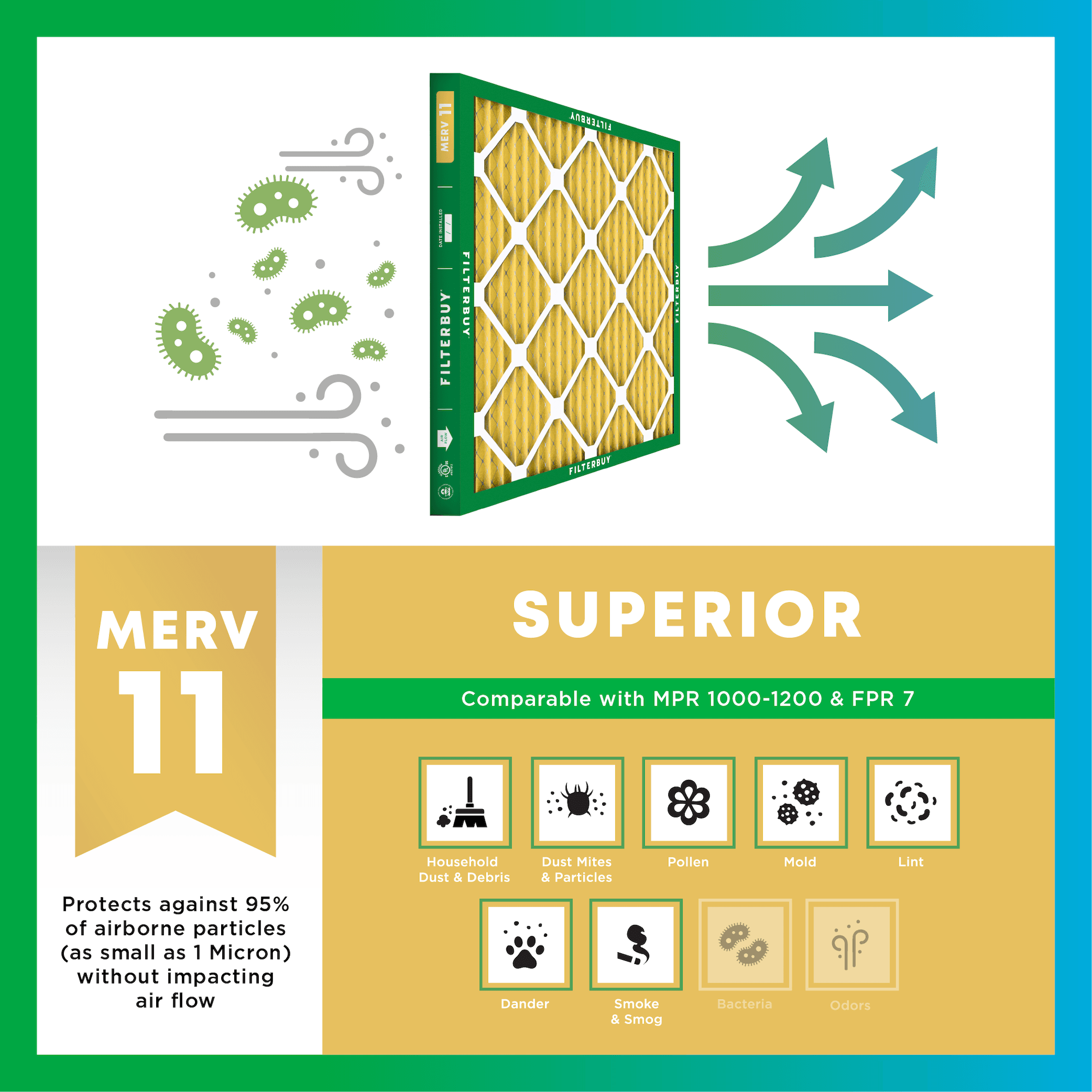
MERV stands for Minimum Efficiency Reporting Value—but don't let the technical name fool you. It's just a way to rate how well an air filter traps stuff like dust, pollen, pet dander, and smoke. The higher the MERV number, the more particles it catches—and the cleaner your air will be.

Comparable to:FPR: 4-7
MPR: 600-1000
 Dust & Debris
 Dust Mites & Particles
 Pollen
 Mold
Mold Lint
Lint Dander
Comparable to:FPR: 6-9
MPR: 1200-1550
Dust & DebrisDust Mites & ParticlesPollenMoldLintDander Smoke & Smog
Comparable to:FPR: 10
MPR: 1900-2800
Dust & DebrisDust Mites & ParticlesPollenMoldLintDanderSmoke & Smog Bacteria


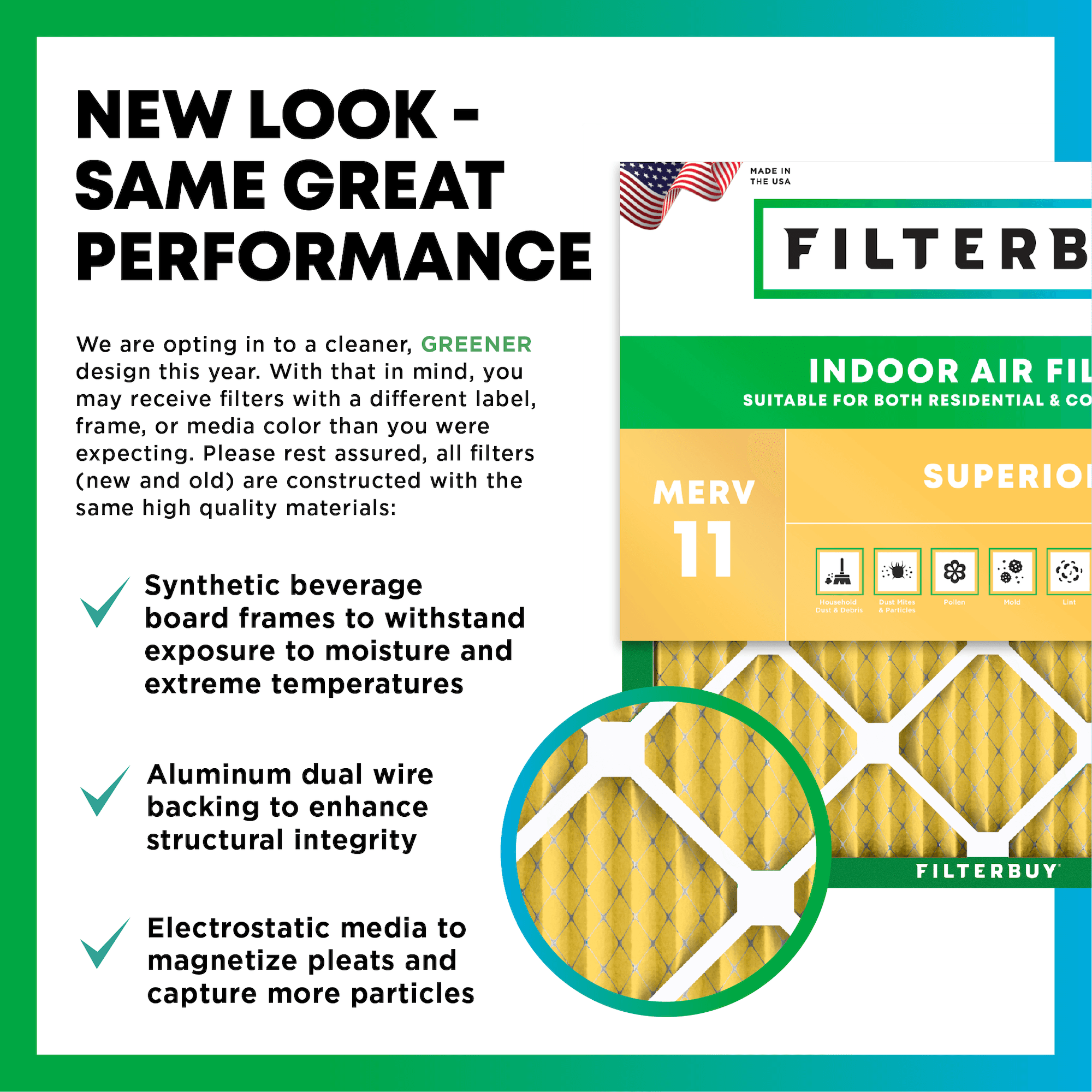
We build every Filterbuy filter to deliver reliable 90-day performance—thanks to smart design and premium materials that do the heavy lifting. Here's what makes the difference:
More pleats = more surface area to capture dust and debris, keeping your air cleaner longer.
Pleats are magnetized to attract and trap microscopic particles—like pet dander, pollen, and smoke.
Engineered to resist warping in extreme temperatures and high humidity.

A layer of metal reinforcement keeps pleats evenly spaced and structurally sound—no sagging, even at high airflow.
Assembled with care. Built to perform. Ships fast, free, and reliably from our U.S. facilities.

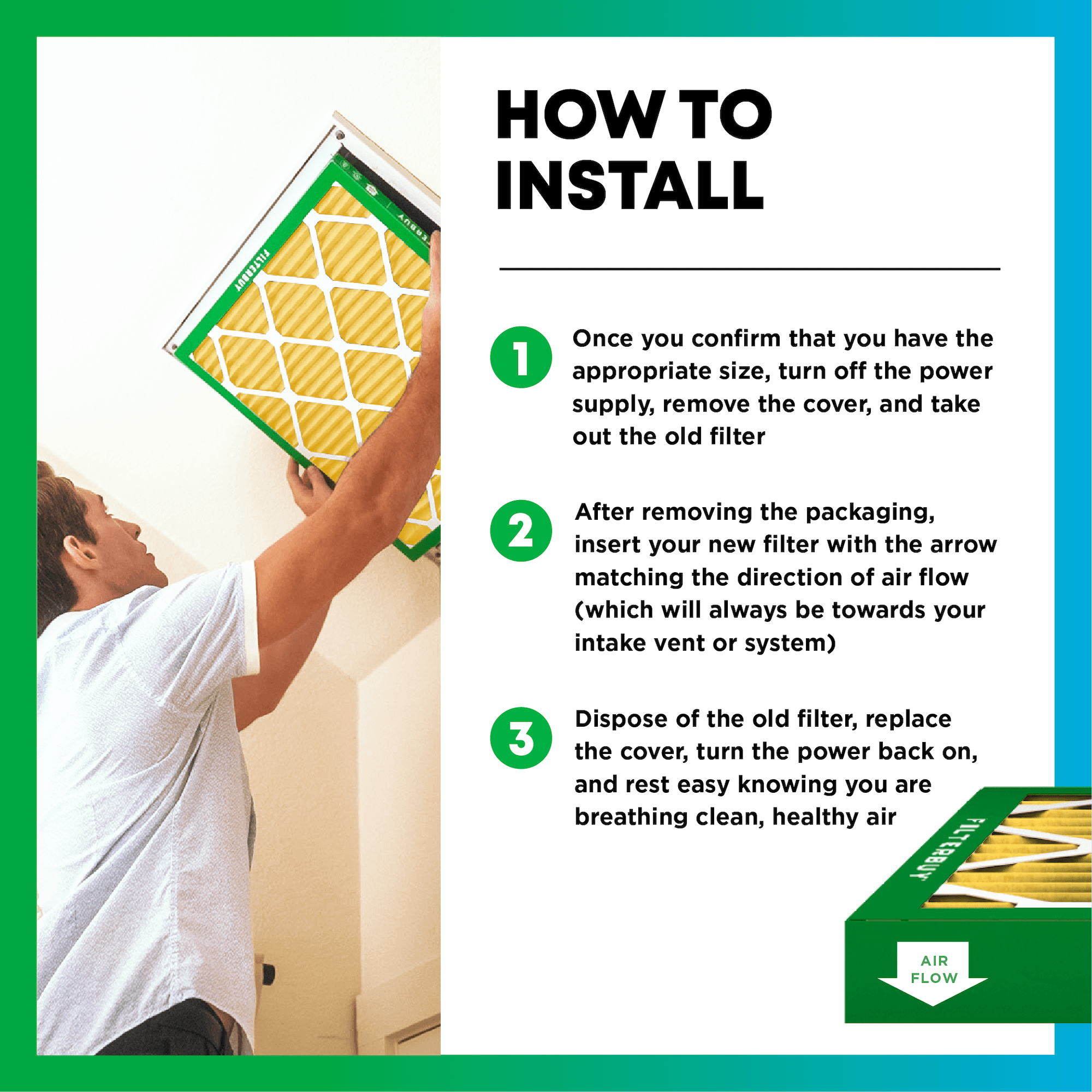
Turn Off Your HVAC SystemSafety first.

Remove The Old FilterLook for the airflow arrow and make note of the direction.

Slide In Your New FilterArrow should point toward the system (same direction as before).

Turn Your System Back OnAnd enjoy the fresh, clean air.

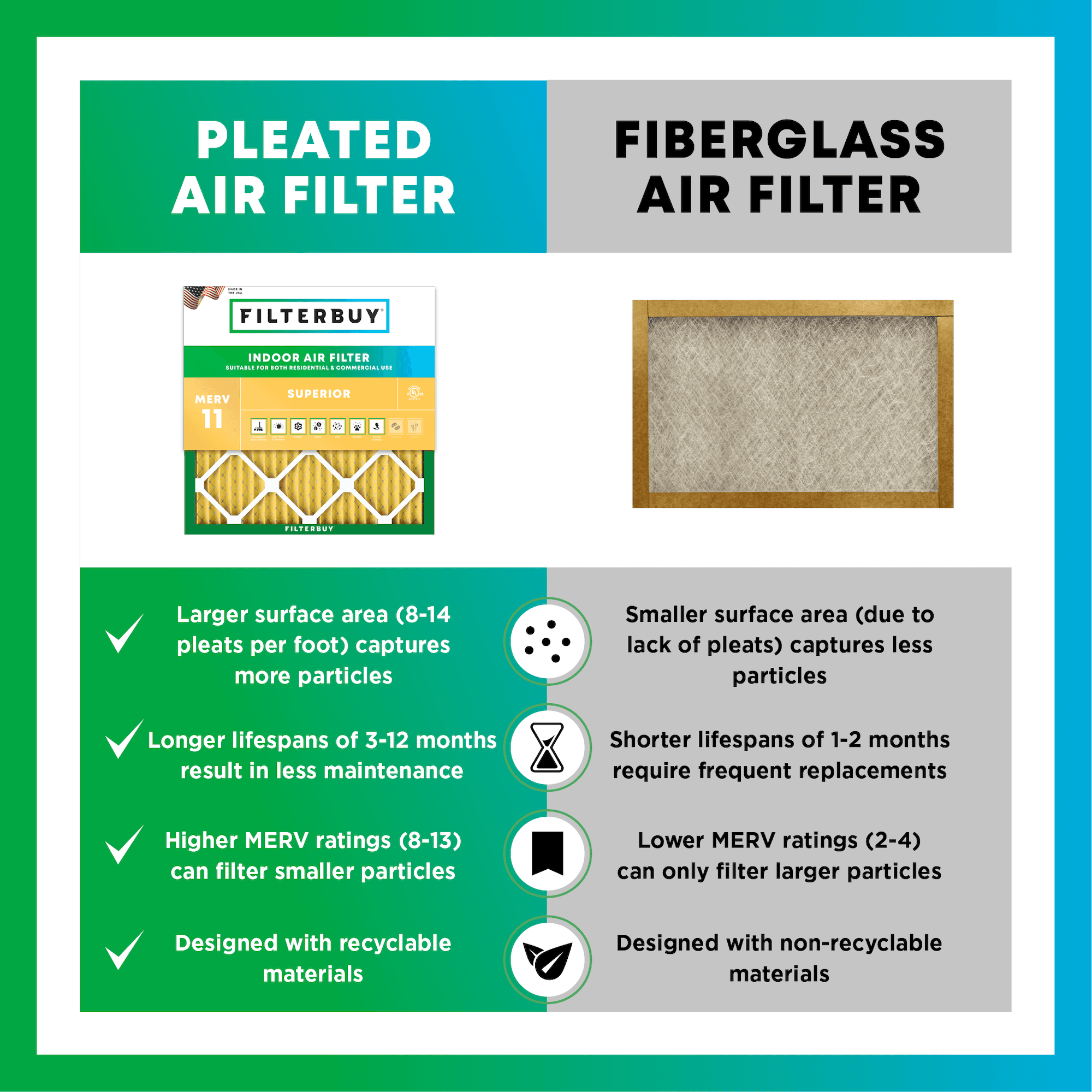
Not all air filters are created equal. Pleated filters don't just last longer—they actually clean your air better. Here's how they stack up:

Efficiency:
High (MERV 8–13) – Traps more particles
Lifespan:
90 days – Long-lasting performance
Air Quality:
Excellent – Cleaner, healthier air
Materials:
Recyclable and durable

Efficiency:
Low (MERV 4 or less) – Misses small stuff
Lifespan:
30 days or less – Replace often
Air Quality:
Minimal – Basic protection only
Materials:
Thin, flimsy, and not recyclable
Pleated filters are a no-brainer—more protection, less hassle, and better air for your home.
Changing your filter on time keeps your HVAC system running efficiently—and helps protect your lungs from dust, allergens, and airborne irritants. Here's how often to swap it out based on your needs:

For most homes without pets or special air quality concerns. Great for general upkeep and energy efficiency.

Shedding fur, dander, and allergy triggers can build up fast. Changing your filter every two months helps keep the air fresher and symptoms at bay.

For households affected by smoke, pollution, or respiratory conditions, monthly changes ensure maximum protection.

| Nominal Size | 20X25X5 |
| Actual Size | 20.25 x 25.38 x 5.25" inches |
| Filter Type | Pleated |
| Media | Electrostatically Charged |
| Frame | Beverage Board |
| MERV Ratings Available | 8, 11, 13 |
| Lifespan | Up to 12 Months |
| Origin | Made in USA |
After manufacturing millions of air filters and analyzing real customer replacement data, we've seen firsthand what happens when Amana systems run on the wrong filter — and the difference the right one makes. A MERV 11 20x25x5 delivers the filtration sweet spot most households need, trapping dust, pollen, pet dander, and mold spores without choking airflow or straining your blower motor. Here's what our production floor experience and customer feedback reveal about protecting your Amana investment.
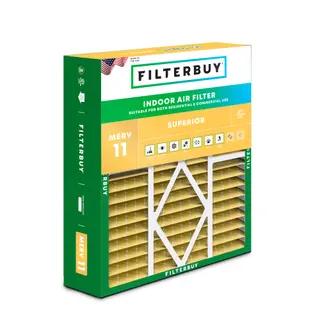
A MERV 11 20x25x5 is a 5-inch-deep pleated air filter designed to fit Amana whole-house air cleaner cabinets. The actual dimensions are 20.25" x 25.38" x 5.25".
What it does:
Captures up to 85% of particles between 1.0 and 3.0 microns
Traps dust, pollen, pet dander, mold spores, and smog
Maintains proper airflow without straining your blower motor
What makes it different:
The 5-inch depth holds significantly more debris than a standard 1-inch filter
MERV 11 rating delivers the optimal balance of filtration and system protection for most residential Amana units
Designed as a direct replacement for Amana part numbers M8-1056, MU2025, FS2025, and 9183970
Who it is for:
Homeowners with Amana, Goodman, Coleman, Maytag, York, or compatible HVAC systems
Households with pets, seasonal allergies, or average to moderate dust levels
Anyone looking to protect their HVAC investment while maintaining clean indoor air
From our manufacturing experience: This is the filter size and rating combination we recommend most often for standard residential Amana systems. It is the sweet spot where air quality and equipment protection meet — and the one our own engineers would install in their homes.
MERV 11 is the sweet spot for most Amana systems. Captures up to 85% of particles between 1.0 and 3.0 microns. Traps dust, pollen, pet dander, and mold spores. Do it without straining your blower motor.
Fit matters as much as rating. A quarter-inch gap lets unfiltered air bypass the media entirely. That debris lands directly on your evaporator coil and blower components. We engineer every 20x25x5 to seat flush inside Amana cabinets with zero bypass.
A dirty filter is the number one cause of preventable HVAC failure. The DOE confirms a clean filter can reduce energy use by 5% to 15%. Our customer data backs it up — homeowners on schedule spend less on repairs and get more years from their systems.
The 5-inch depth buys you more time between changes. More surface area means more debris capacity before airflow drops. Most households get 9 to 12 months per filter. Do not wait until you feel the difference — by then, your system is already overworking.
The filter is the one thing you can control. Right size. Right rating. Right schedule. Energy savings, equipment longevity, and cleaner air all follow from that single decision.
Not all MERV ratings are created equal, and higher isn't always better. We've seen customers jump straight to MERV 13 or higher thinking more filtration means more protection — but in many Amana systems, that extra density creates static pressure that forces the blower motor to work harder. MERV 11 captures up to 85% of particles between 1.0 and 3.0 microns, including dust mites, mold spores, and pet dander, without the airflow penalty. It's the rating our manufacturing team recommends most often for standard residential Amana units based on years of performance data and customer feedback.
A 5-inch-deep filter holds significantly more surface area than a standard 1-inch filter, which translates directly into longer filter life and more consistent airflow between replacements. From our production line, we engineer these filters to precise tolerances so they seat flush inside your Amana filter cabinet with no gaps or bypass air. That tight fit matters more than most homeowners realize — even small gaps let unfiltered air slip past and deposit debris directly on your evaporator coil and blower components.
The number one cause of preventable HVAC breakdowns we hear about from customers is a dirty or ill-fitting filter. When airflow drops, your system compensates by running longer cycles, driving up energy costs and accelerating wear on the compressor and blower motor. A properly fitted MERV 11 20x25x5 keeps air moving freely while still pulling harmful particles out of circulation. Our customer data consistently shows that homeowners who stay on a regular replacement schedule with the correct filter size spend less on service calls and get more years out of their equipment.
The 5-inch depth buys you more time between changes compared to thinner filters, but replacement timing still depends on your household. Homes with multiple pets, allergy sufferers, or heavy dust exposure may need a fresh filter every 6 to 9 months. For average households, a 9 to 12 month cycle typically keeps performance where it should be. Our recommendation from seeing thousands of used filters returned and inspected: don't wait until airflow drops noticeably. By that point, your system has already been working harder than it should.
"After producing millions of filters and hearing directly from homeowners about what works and what fails, we can say with confidence that a properly fitted MERV 11 20x25x5 is the single most cost-effective thing you can do to protect an Amana system — it's the filter rating and size our own engineers would put in their homes."
We built this filter on our own production lines in the USA with precise tolerances to fit Amana, Goodman, Coleman, Maytag, and York air cleaner cabinets without gaps or bypass air. Our product page gives you exact dimensions (20.25" x 25.38" x 5.25"), every compatible part number, volume pricing, and auto-delivery so you never run a dirty filter again.
Source: Filterbuy — Filterbuy.com/brand/amana-air-filters/amana-20x25x5-air-filters/merv-11/
We produce filters across every MERV rating and see the performance data firsthand, so we built this guide to show you exactly how MERV 8, 11, and 13 compare in particle capture and airflow resistance. It is the resource we wish every Amana owner would read before choosing a filter, because the right rating protects your system and the wrong one can strain it.
Source: Filterbuy — Filterbuy.com/resources/air-filter-basics/all-about-merv-ratings/
We always point our customers to this EPA explainer because it gives you the unbiased science behind the rating system we use every day on our manufacturing floor. Understanding how MERV quantifies particle capture between 0.3 and 10 microns empowers you to evaluate any filter claim with confidence.
Source: U.S. Environmental Protection Agency — epa.gov/indoor-air-quality-iaq/what-merv-rating
Your MERV 11 filter is one of the most impactful steps you can take, but it works best as part of a bigger picture. This EPA consumer guide walks you through how source control, ventilation, and consistent filter replacement work together — and it reinforces what we tell customers every day: a quality filter is the foundation, not the finish line.
Source: U.S. Environmental Protection Agency — epa.gov/indoor-air-quality-iaq/care-your-air-guide-indoor-air-quality
ASHRAE Standard 52.2 is the testing methodology that governs how every MERV rating is assigned — including the ones on the filters rolling off our production lines. This technical FAQ from the organization that created the standard gives you the engineering-level detail behind the numbers we stake our reputation on.
Source: ASHRAE — ashrae.org/File Library/Technical Resources/Technical FAQs/TC-02.04-FAQ-61.pdf
We manufacture the filter, but Amana sets the maintenance rules that keep your warranty intact. Their official FAQ recommends at least one annual professional tune-up and regular filter replacement to catch issues before they become expensive problems — advice that aligns perfectly with what our customer data confirms every single day.
Source: Amana — goamana.com/frequently-asked-questions.html
After manufacturing millions of filters, we can tell you that filtration never works in isolation. This EPA resource explains how pollution sources, ventilation, and humidity interact with your filter's performance — and why the homeowners who understand the full picture get the most value out of every MERV 11 filter they install.
Source: U.S. Environmental Protection Agency — epa.gov/indoor-air-quality-iaq/protect-indoor-air-quality-your-home
We have been building air filters in our U.S. facilities since 2013. The data from government agencies below lines up with what our production teams, engineers, and customer service reps observe every single day.
The U.S. Department of Energy published this statistic. After years of manufacturing MERV 11 filters and talking with Amana owners, we can tell you exactly how that energy waste happens.
When a filter clogs, airflow drops and dirt bypasses the media, depositing directly onto the evaporator coil and reducing its ability to absorb heat.
We have inspected thousands of returned filters. The pattern is always the same:
Homeowners push a filter past its service life
Coil buildup forces longer run cycles
Utility bills climb month over month
Emergency service calls follow
Our 20x25x5 MERV 11 with 8-pleat-per-foot design holds more debris before reaching that tipping point. That gives your Amana system a wider margin of protection between changes.
Source: U.S. Department of Energy — energy.gov/energysaver/maintaining-your-air-conditioner
According to the EPA, concentrations of some pollutants indoors are often 2 to 5 times higher than typical outdoor concentrations.
On our production floor, this statistic drives every tolerance decision we make. Here is why fit matters as much as rating:
Even a quarter-inch gap lets unfiltered air bypass the media
Dust, pollen, pet dander, and mold spores slip past and deposit on internal components
A MERV 11 rating means nothing if contaminated air is going around the filter
We engineer our 20x25x5 filters to seat flush inside Amana air cleaner cabinets. Most filter manufacturers talk about MERV ratings. We obsess over the fit just as much.
Source: U.S. Environmental Protection Agency — epa.gov/report-environment/indoor-air-quality
ENERGY STAR reports that nearly half the energy used in a home goes to heating and cooling, and that a dirty filter forces the system to work harder, wasting energy and potentially leading to expensive maintenance or early system failure.
We track replacement frequency across our subscriber base. The trend is clear:
Amana owners on a consistent replacement schedule report fewer emergency service calls, more stable energy costs, and systems that outlast the national average lifespan
Amana owners who contact us after a blower motor failure or frozen coil almost always share the same story — they stretched their filter well beyond its service window or used a filter that did not fit their cabinet
That is the kind of firsthand pattern recognition you only get from manufacturing the product and hearing directly from the people who use it.
Source: ENERGY STAR (.gov) — energystar.gov/saveathome/heating-cooling
After manufacturing millions of air filters and hearing from homeowners across the country, we have arrived at one conclusion. The data, the government research, and our own production floor experience all support it:
The air filter is the single most undervalued component in any HVAC system. It is also the one part every homeowner can control.
We have seen both sides:
Premature failures: Amana systems with top-of-the-line compressors and variable-speed blower motors failing years ahead of schedule — not from mechanical defects, but from a $40 filter that was ignored or never fit correctly
Long-term success: Customers running 15-year-old Amana units that still perform like day one — because they used a correctly sized MERV 11 20x25x5 filter, replaced on schedule, every time
The difference is never complicated.
What we believe most homeowners get wrong:
They focus on MERV rating and overlook fit. A high-rated filter with bypass gaps performs worse than a properly sealed lower-rated one.
They wait until airflow drops before replacing. By that point, the evaporator coil and blower motor have already absorbed weeks of preventable strain.
They treat the filter as a commodity. It is a precision component engineered to match a specific system.
Our recommendation is simple. If you own an Amana system and you do nothing else for maintenance, get the filter right:
Get the size right
Get the rating right
Get the replacement schedule right
Everything else — the energy savings, the equipment longevity, the cleaner indoor air — follows from that single decision.
That is not a marketing claim. That is what we have watched happen across millions of filters, thousands of customers, and every production run since 2013.
You have the research, the data, and the manufacturing perspective. Here is exactly what to do next.
Open your Amana air cleaner cabinet and check the printed dimensions on the current filter frame. Verify the actual size reads 20.25" x 25.38" x 5.25". No dimensions printed? Measure width, length, and depth with a tape measure. Round up to the nearest inch.
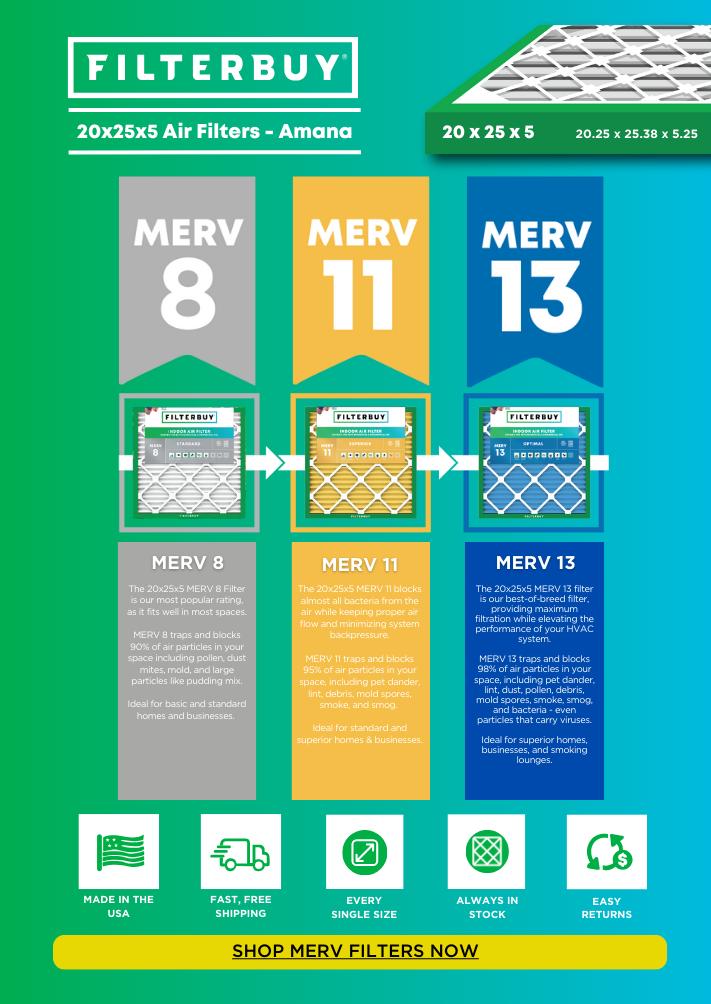
MERV 8 — Baseline protection for low-dust homes without pets or allergies
MERV 11 — The sweet spot most Amana owners need for pets, pollen, and everyday dust
MERV 13 — Maximum residential filtration for asthma, heavy smoke, or severe allergies
Not sure? Start with MERV 11. It is the rating our engineers recommend most.
Pull it out. Hold it up to light.
Can't see light through the media? Past due for replacement.
Visible dust caking, discoloration, or sagging? Replace immediately.
Does the airflow already feel weak? Your system has been overworking for weeks.
Do not wait for symptoms. By then, the damage is already adding up.
Multiple pets or allergy sufferers — every 6 to 9 months
Average households — every 9 to 12 months
Light use or single occupant — up to 12 months with quarterly inspections
Mark your calendar. Or subscribe to auto-delivery and never think about it again.
Made in our U.S. facilities
Ships within 24 hours
Multi-pack pricing and auto-delivery available
The bottom line: The best time to replace your filter was before it got dirty. The second best time is right now.
A: The nominal size is 20x25x5. The actual dimensions we manufacture to are 20.25" x 25.38" x 5.25".
We cut every filter to these exact tolerances on our U.S. production lines. Even a fraction of an inch matters inside an Amana air cleaner cabinet. When customers call with airflow issues, the first thing we ask is whether they verified actual size — not nominal — before ordering.
How to confirm your size:
Check the dimensions printed on your current filter frame
Match the actual size to 20.25" x 25.38" x 5.25"
If no dimensions are printed, measure with a tape measure and round up to the nearest inch
A: It depends on your household. We track replacement patterns across our subscriber base and inspect returned filters regularly. Here is what the data shows:
Multiple pets or allergy sufferers — every 6 to 9 months
Average households — every 9 to 12 months
Light use or single occupant — up to 12 months with quarterly inspections
The 5-inch depth holds far more debris than a 1-inch filter. That extra capacity can create a false sense of security.
Our recommendation from inspecting thousands of spent filters: Pull the filter quarterly and hold it to light. If you cannot see through the media, your system is already working harder than it should.
A: This is the question our customer service team fields more than any other. The short answer: MERV 11 is the rating our own engineers would put in their homes.
We produce filters at every MERV level and test airflow resistance across all of them. Here is what we have found:
MERV 11 captures dust, pollen, pet dander, mold spores, and smog particles effectively
MERV 13 and above increases media density to the point where many Amana blower motors compensate with longer run cycles
That extra strain does not show up on day one — it shows up 18 months later when the motor fails prematurely
When MERV 13 may be appropriate:
Severe asthma
Wildfire-prone regions
Specific medical need for higher filtration
For everyone else, MERV 11 delivers the best return on both air quality and equipment longevity.
A: We built this filter to be a direct replacement across a wide range of systems.
Compatible brands:
Amana, Goodman, Coleman, Electro-Air, Day & Night
Five Seasons, Gibson, Maytag, Nordyne, Totaline, York
Common cross-referenced part numbers:
M8-1056
MU2025
FS2025
9183970
How to verify your match:
Check the label on your existing filter
Check inside your air cleaner cabinet door
Visit our product page to confirm by part number
In our experience, the number one reason customers receive a filter that does not fit is ordering by nominal size alone without verifying the part number.
A: We hear about this more often than we would like. An undersized or poorly fitting filter creates gaps between the frame and cabinet housing. What happens next is predictable because we have seen the pattern repeat across thousands of customer interactions:
Unfiltered air bypasses the media through the gaps
Dust, dander, and mold spores deposit directly onto the evaporator coil
Coil buildup reduces heat transfer and forces longer run cycles
Energy bills rise steadily over weeks and months
The blower motor compensates until it eventually fails
The homeowners who call us after a costly repair almost always trace it back to one of two causes:
A filter left in too long
A filter that never fit properly
Both are entirely preventable. That is why we engineer our 20x25x5 to exact Amana cabinet dimensions and recommend verifying the actual size before every order.
Stop letting a dirty or ill-fitting filter shorten the life of your HVAC investment. Shop the exact MERV 11 20x25x5 Amana replacement air filter we build on our U.S. production lines and get it delivered to your door within 24 hours.

