
Tip: Ensure you buy the exact air filter size for your system. Certain brands have precise dimensions that only fit their specific models. See related filters
Actual Size: 20.25x25.38x5.25"
 Free Delivery
  Factory-Direct Low Prices, Made in the USA
 Hassle-Free Returns & Free Exchanges
RESIDENTIAL AND/OR COMMERCIAL USE
Change Every 3 Months
Tip: Ensure you buy the exact air filter size for your system. Certain brands have precise dimensions that only fit their specific models. See related filters
Actual Size: 20.25x25.38x5.25"
Free Delivery Factory-Direct Low Prices, Made in the USAHassle-Free Returns & Free ExchangesRESIDENTIAL AND/OR COMMERCIAL USE
Change Every 3 Months
Tip: Ensure you buy the exact air filter size for your system. Certain brands have precise dimensions that only fit their specific models. See related filters
Actual Size: 20.25x25.38x5.25"
Free Delivery Factory-Direct Low Prices, Made in the USAHassle-Free Returns & Free ExchangesRESIDENTIAL AND/OR COMMERCIAL USE
Change Every 3 Months
At Filterbuy, we don't cut corners—we craft high-quality air filters right here in the USA and ship them to your doorstep for free. No delays, no gimmicks—just clean air, made easy. With thousands of five-star reviews and filters built for real life & every HVAC system, it's no wonder why over 4 million families trust Filterbuy.

Proudly Made In The USA

Fast, Free Shipping on Every Order

Premium Materials That Go The Distance

85,000+ 5-Star Reviews From Happy Customers

Save Up to 70% Per Filter with Packs


Measure length × width × depth with a tape measure to find the actual size.

Round up each dimension to the nearest whole number to get the nominal size. Example: 20.25x25.38x5.25" in → 20X25X5 nominal.

Search by nominal size on our site for the best fit.


5″ filters give you maximum filtration with minimal maintenance — lasting up to 12 months while handling higher MERV ratings without restricting airflow.
Sizing note:

If the filter you buy doesn't fit, we'll send you a better size.
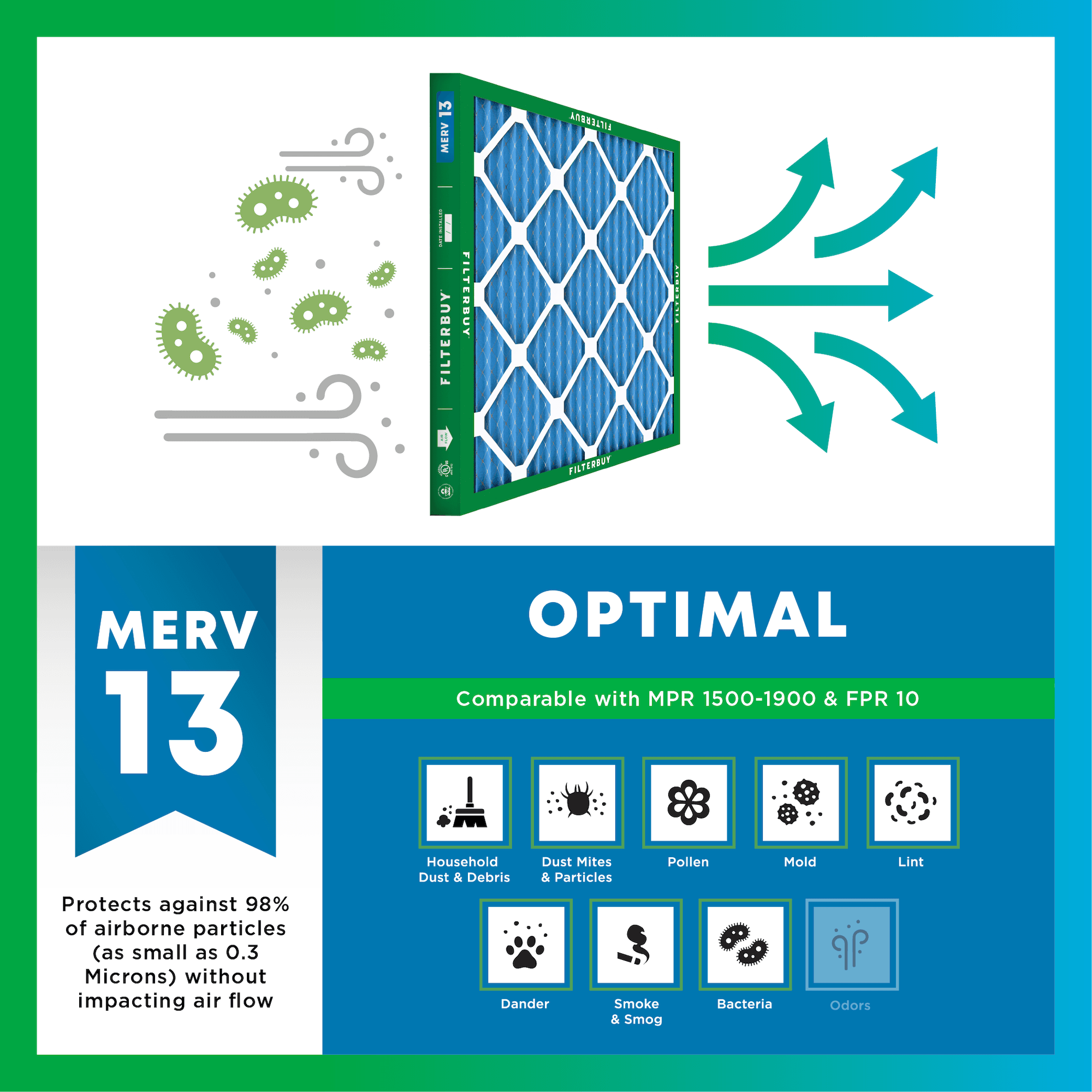
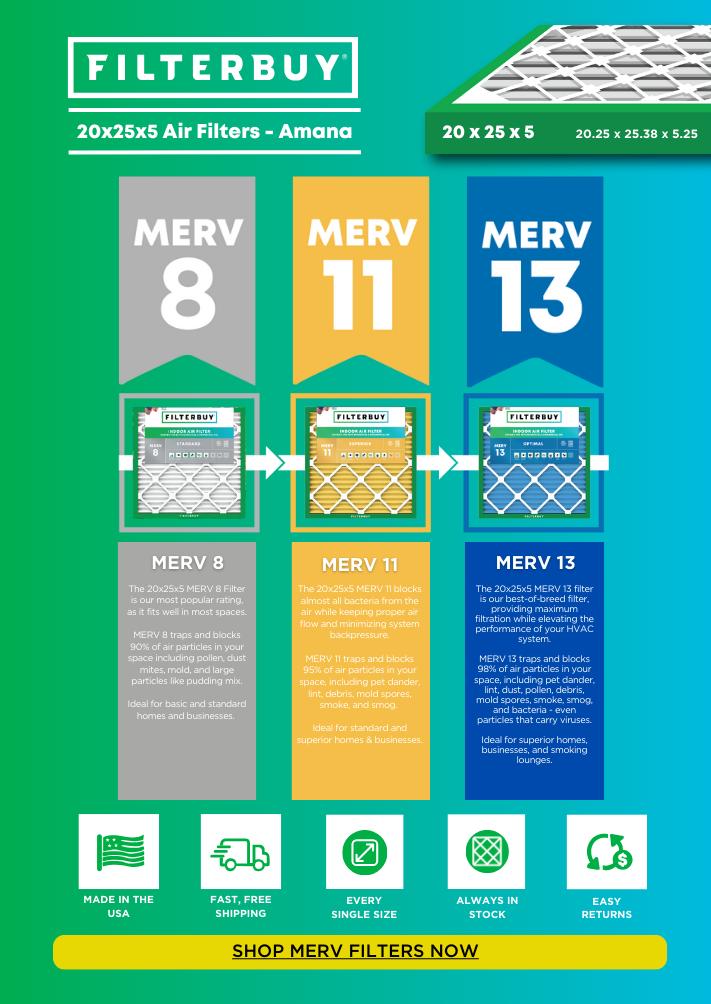
MERV stands for Minimum Efficiency Reporting Value—but don't let the technical name fool you. It's just a way to rate how well an air filter traps stuff like dust, pollen, pet dander, and smoke. The higher the MERV number, the more particles it catches—and the cleaner your air will be.

Comparable to:FPR: 4-7
MPR: 600-1000
 Dust & Debris
 Dust Mites & Particles
 Pollen
 Mold
Mold Lint
Lint Dander
Comparable to:FPR: 6-9
MPR: 1200-1550
Dust & DebrisDust Mites & ParticlesPollenMoldLintDander Smoke & Smog
Comparable to:FPR: 10
MPR: 1900-2800
Dust & DebrisDust Mites & ParticlesPollenMoldLintDanderSmoke & Smog Bacteria


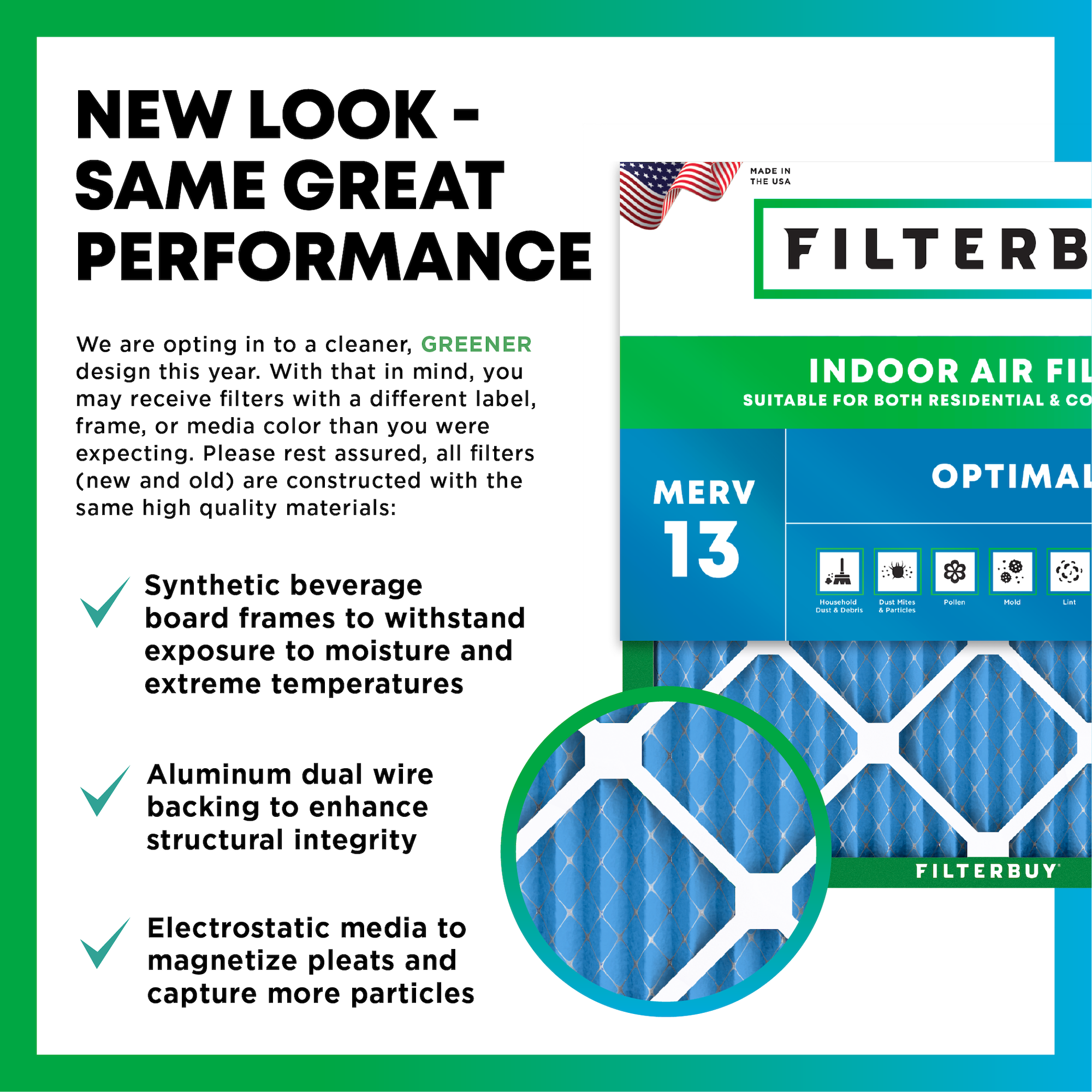
We build every Filterbuy filter to deliver reliable 90-day performance—thanks to smart design and premium materials that do the heavy lifting. Here's what makes the difference:
More pleats = more surface area to capture dust and debris, keeping your air cleaner longer.
Pleats are magnetized to attract and trap microscopic particles—like pet dander, pollen, and smoke.
Engineered to resist warping in extreme temperatures and high humidity.

A layer of metal reinforcement keeps pleats evenly spaced and structurally sound—no sagging, even at high airflow.
Assembled with care. Built to perform. Ships fast, free, and reliably from our U.S. facilities.

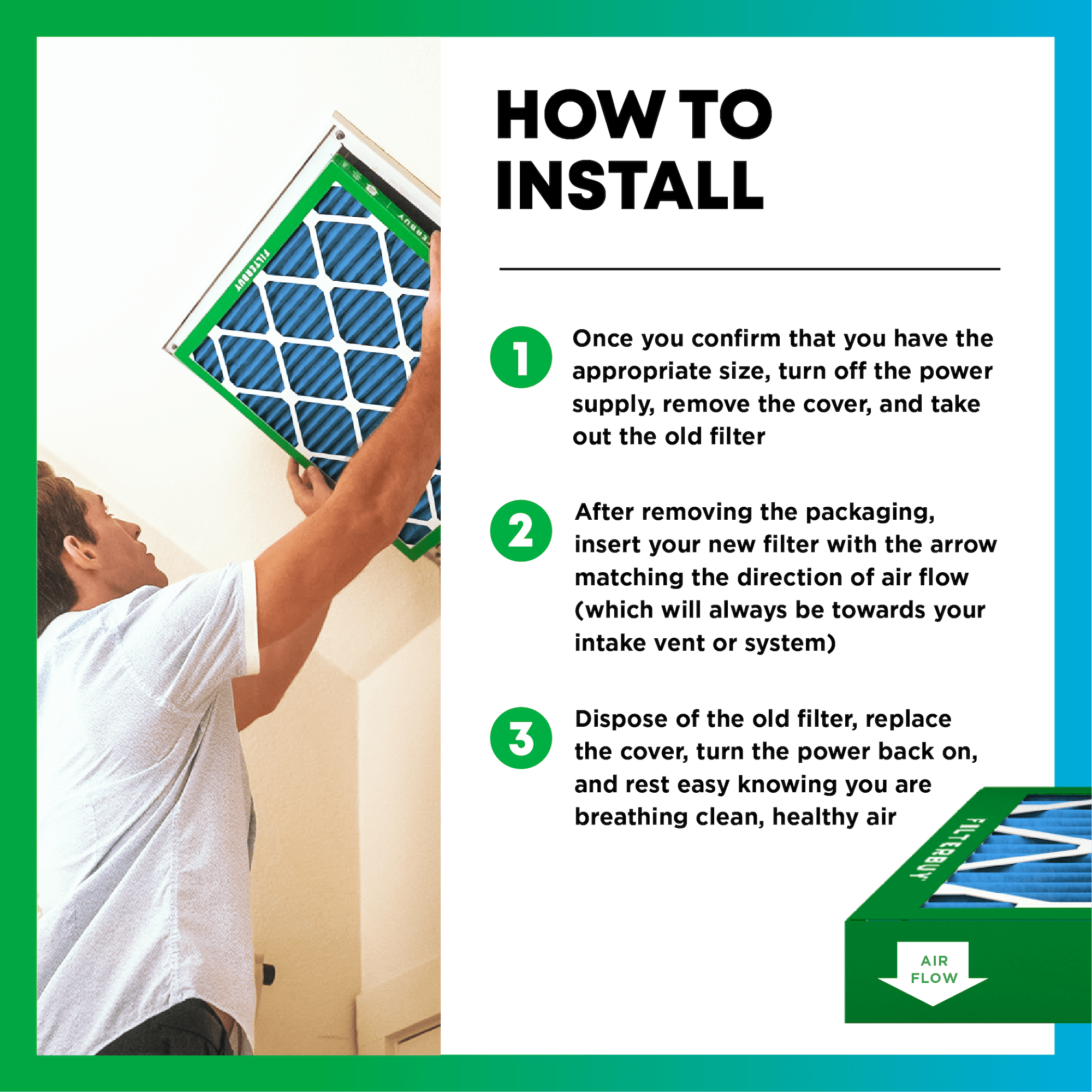
Turn Off Your HVAC SystemSafety first.

Remove The Old FilterLook for the airflow arrow and make note of the direction.

Slide In Your New FilterArrow should point toward the system (same direction as before).

Turn Your System Back OnAnd enjoy the fresh, clean air.

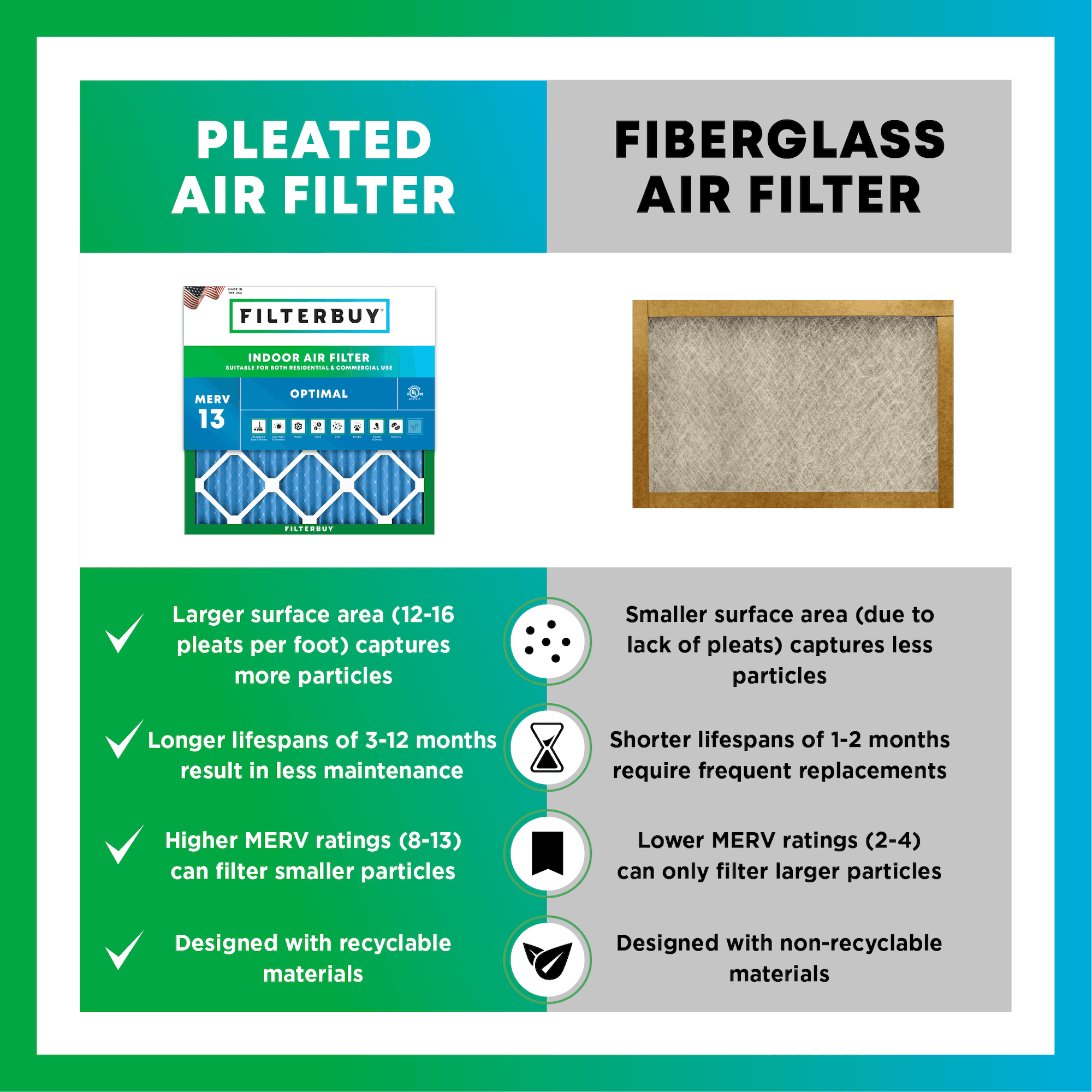
Not all air filters are created equal. Pleated filters don't just last longer—they actually clean your air better. Here's how they stack up:

Efficiency:
High (MERV 8–13) – Traps more particles
Lifespan:
90 days – Long-lasting performance
Air Quality:
Excellent – Cleaner, healthier air
Materials:
Recyclable and durable

Efficiency:
Low (MERV 4 or less) – Misses small stuff
Lifespan:
30 days or less – Replace often
Air Quality:
Minimal – Basic protection only
Materials:
Thin, flimsy, and not recyclable
Pleated filters are a no-brainer—more protection, less hassle, and better air for your home.
Changing your filter on time keeps your HVAC system running efficiently—and helps protect your lungs from dust, allergens, and airborne irritants. Here's how often to swap it out based on your needs:

For most homes without pets or special air quality concerns. Great for general upkeep and energy efficiency.

Shedding fur, dander, and allergy triggers can build up fast. Changing your filter every two months helps keep the air fresher and symptoms at bay.

For households affected by smoke, pollution, or respiratory conditions, monthly changes ensure maximum protection.

| Nominal Size | 20X25X5 |
| Actual Size | 20.25 x 25.38 x 5.25" inches |
| Filter Type | Pleated |
| Media | Electrostatically Charged |
| Frame | Beverage Board |
| MERV Ratings Available | 8, 11, 13 |
| Lifespan | Up to 12 Months |
| Origin | Made in USA |
Most filter guides tell you MERV 13 is simply "better." After manufacturing filters for over a decade and analyzing real performance data across thousands of Amana system installs, we've learned the truth is more nuanced—MERV 13 delivers exceptional protection, but only when your home and system are built to support it. We've identified the specific household profiles where this filter consistently outperforms, and where forcing it can quietly strain your HVAC instead. If you own an Amana system and want a clear, experience-backed answer on whether the 20x25x5 MERV 13 is your ideal match, you're in the right place.
A MERV 13 20x25x5 Amana air filter is a high-efficiency, thick-media filtration solution designed for compatible Amana HVAC systems. Here's what you need to know:
MERV 13 = captures particles as small as 0.3 microns, including pollen, mold spores, pet dander, bacteria, smoke, and virus-carrying aerosols
20x25x5 = a high-capacity filter size whose larger surface area reduces static pressure, extends filter life, and protects HVAC coils more effectively than standard 1-inch alternatives
Amana compatible = engineered to work with Amana's variable-speed air handlers and high-efficiency blower motors — among the most MERV 13-ready residential systems available
Best for:
Allergy and asthma households
Homes with multiple pets
Wildfire-prone or high-pollution regions
Newer, tightly sealed construction
Replace every: 45–90 days depending on household air quality demands
After manufacturing millions of filters, we consistently find that the right home paired with the right Amana system and a genuine MERV 13 20x25x5 filter delivers cleaner air, better system efficiency, and stronger long-term HVAC protection than any lower-rated alternative.
MERV 13 is a system decision, not just a filter upgrade. Always confirm your Amana unit's compatibility before installing.
The right home matters. Allergy households, pet owners, high-occupancy homes, wildfire regions, and newer sealed construction benefit most.
The 20x25x5 size is a real advantage. Larger surface area means less static pressure, longer filter life, and better coil protection than 1-inch alternatives.
Indoor air quality is not a passive concern. Indoor pollutants run 2 to 5 times higher than outdoor levels — your filter is one of the few active defenses your family has.
Filtration only works when maintained. Change on schedule, monitor performance, and treat clean air as the ongoing priority it deserves.
MERV 13 filters capture particles as small as 0.3 microns—including bacteria, fine dust, smoke, and pet dander—making them among the most effective residential filters available. But higher filtration density means increased airflow resistance. Through years of manufacturing experience and direct customer feedback, we've found that homes with older or undersized HVAC equipment often struggle to maintain proper airflow with MERV 13 media, leading to higher energy bills, uneven heating and cooling, and accelerated system wear. The homes that thrive with MERV 13 share specific characteristics—and Amana systems, known for their variable-speed technology and robust blower motors, are frequently among the best candidates.
Based on our firsthand experience working with Amana system owners, these household profiles consistently see the greatest return from MERV 13 filtration:
Allergy and asthma households: MERV 13 captures the microscopic triggers—pollen, mold spores, and fine particulates—that lower-rated filters routinely miss. Families managing respiratory sensitivities report measurable improvements in symptom frequency when upgrading from MERV 8 or MERV 11.
Homes with multiple pets: Pet dander is persistent and ultrafine. MERV 13 media intercepts particles that pass straight through standard filters, keeping both air and HVAC coils cleaner between changes.
High-traffic or densely occupied homes: More occupants means more skin cells, dust, and airborne debris cycling through your system daily. MERV 13 handles elevated particle loads more effectively than mid-range ratings.
Homes in wildfire-prone or high-pollution regions: Fine particulate matter from smoke and outdoor pollution infiltrates homes constantly. MERV 13 provides a meaningful indoor barrier when outdoor air quality is compromised.
Newer, well-sealed construction: Tightly built homes trap pollutants with fewer opportunities for natural air exchange. MERV 13 compensates by actively capturing what recirculates through your system.
Not all HVAC systems handle MERV 13's denser media equally. Amana's variable-speed air handlers and high-efficiency blower motors are engineered to maintain consistent airflow even under increased filter resistance—a critical advantage over single-speed systems. The 20x25x5 air filter size compounds this benefit. Its larger surface area distributes airflow across more filter media, reducing static pressure and extending filter life compared to thinner 1-inch alternatives. We've consistently observed that Amana systems paired with the correct 20x25x5 MERV 13 filter maintain efficiency ratings longer and require fewer service calls related to dirty coils or restricted airflow.
Even in the right home, MERV 13 requires a system capable of handling the added resistance. If your Amana unit is older, operating near its capacity, or hasn't been serviced recently, a MERV 11 may deliver cleaner air without the performance trade-offs. We always recommend confirming your system's minimum efficiency reporting value tolerance with your HVAC technician before upgrading filter ratings—especially in homes with existing airflow complaints or ductwork that hasn't been inspected.
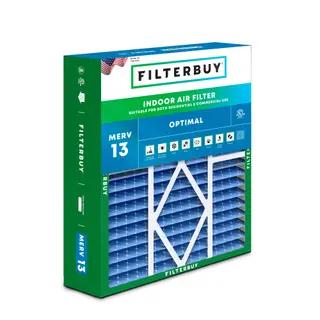
"After manufacturing millions of filters and working directly with Amana system owners across the country, we've seen firsthand that MERV 13 doesn't just perform better—it performs smarter in the right home, consistently protecting air quality, HVAC efficiency, and family health in ways that lower-rated filters simply can't match." — The Filterbuy Manufacturing Team
At Filterbuy, we've spent over a decade manufacturing filters and we always tell customers the same thing: start with the science. The EPA's official MERV rating guide gives you the authoritative foundation to understand exactly what your filter is capturing — and why MERV 13 is the rating we consistently recommend for households serious about protecting their family's air.
URL: https://www.epa.gov/indoor-air-quality-iaq/what-merv-rating
We've helped millions of customers navigate this exact question — and we always point them back to the EPA's practical household guidance first. This resource cuts through the confusion by addressing real-world MERV 13 upgrade decisions, system compatibility considerations, and the fan runtime adjustments that most homeowners overlook but that make a measurable difference in the air your family breathes every day.
One of the most important lessons we've learned after manufacturing millions of filters is this: a great filter in the wrong system creates more problems than it solves. The U.S. Department of Energy's technical guide on high-MERV filters gives Amana owners the pressure drop and airflow compatibility information they need to confirm their system is ready — before they install anything.
URL: https://basc.pnnl.gov/resource-guides/high-merv-filters
We're obsessed with how filters perform inside real HVAC systems — and Amana shares that commitment. Their official MERV learning center gives you brand-specific context on how different filter ratings affect your system's efficiency, air quality output, and long-term equipment health, so you can make a filter decision that protects your investment as confidently as it protects your family.
URL: https://www.amana-hac.com/resources/hvac-learning-center/operation/air-filters-and-merv-ratings
Don't take our word for it — take Amana's. When compatibility questions arise, going straight to the manufacturer removes all uncertainty. Amana's official filter FAQ addresses the real questions homeowners ask about selecting the right filter for their system, covering everything from standard to high-efficiency options so you can move forward with the confidence of knowing your choice is manufacturer-approved.
URL: https://www.amana-hac.com/resources/faq/maintenance/what-type-of-filter-should-i-use
The MERV rating system didn't appear out of nowhere — ASHRAE created it, and their residential ventilation and indoor air quality standards remain the technical backbone behind every filter efficiency claim on the market. At Filterbuy, we build every filter we manufacture to perform against these standards, and we believe every homeowner serious about clean air should understand the benchmark their filter is measured against.
URL: https://www.ashrae.org/technical-resources/bookstore/standards-62-1-62-2
We don't just manufacture MERV 13 filters — we've tracked their real-world performance across thousands of homes and HVAC configurations. This Filterbuy resource translates that first-hand manufacturing and customer experience into clear, actionable guidance on which households consistently benefit most from MERV 13 filtration, making it the most practical final stop before upgrading your Amana system.
URL: https://Filterbuy.com/resources/health-and-wellness/merv-13-standard-air-filter-for-healthy-homes/
Numbers tell part of the story. After manufacturing millions of filters and analyzing performance data across thousands of real homes, we know what these statistics mean for families — and why the right MERV 13 filter in the right Amana system changes everything.
Statistic 1: Americans spend approximately 90% of their time indoors, where concentrations of some pollutants are often 2 to 5 times higher than typical outdoor concentrations.
Filterbuy Perspective: Most homeowners are shocked by this number. After a decade of manufacturing, we're not. Here's what we've learned:
Indoor pollutants recirculate constantly — especially in newer, tightly sealed homes
Your HVAC filter is one of the only active defenses against that invisible contamination
Getting the MERV rating right for your Amana system matters more than most homeowners realize
Source: U.S. Environmental Protection Agency — Indoor Air Quality
URL: https://www.epa.gov/report-environment/indoor-air-quality
Statistic 2: Approximately 25 million Americans — 7.7% of the U.S. population — currently have asthma, according to CDC surveillance data spanning 2001 to 2021.
Filterbuy Perspective: Behind that number are real households managing real symptoms daily. Working directly with thousands of these families, here's the consistent pattern we see after upgrading to MERV 13 in a compatible system:
Fewer respiratory symptom flare-ups reported
Less frequent filter-related HVAC performance issues
Greater confidence in the air quality their children breathe every day
That's not a marketing claim — it's what over a decade of manufacturing experience and direct customer feedback has shown us, filter after filter.
Source: Centers for Disease Control and Prevention — Asthma Surveillance in the United States
URL: https://www.cdc.gov/asthma/asthma-prevalence-us-2023-508.pdf
Statistic 3: In 2021, nearly one-third of U.S. adults had a diagnosed seasonal allergy, eczema, or food allergy, with seasonal allergies being the most common condition — affecting approximately 25.7% of adults nationwide.
Filterbuy Perspective: When we look at this stat alongside our own customer data, one thing becomes clear: allergy season is no longer seasonal — it's a year-round indoor air quality problem. Here's why:
Pollen, mold spores, and fine particulates don't disappear when windows close
They get pulled into your HVAC system and redistributed through your home on every air cycle
The 20x25x5 filter size paired with MERV 13 media delivers a meaningful advantage in allergy-sensitive homes specifically
Its larger surface area maintains airflow while capturing persistent symptom triggers
All without putting unnecessary strain on your Amana system
Source: CDC National Center for Health Statistics — Data Brief No. 460
URL: https://www.cdc.gov/nchs/products/databriefs/db460.htm
Most filter guides stop at the rating. We go further.
After manufacturing millions of filters and working directly with Amana system owners across the country, we've learned that MERV 13 is a decision that either protects your family's health and your system's longevity — or quietly works against both.
Our honest, experience-backed opinion: The MERV 13 20x25x5 Amana filter isn't for every home — but for the right home, it's one of the most impactful air quality decisions you can make.
MERV 13 is a system decision, not just a filter decision. The homes that benefit most have the right equipment to support it. Amana's variable-speed technology makes that compatibility more achievable than most systems on the market.
The 20x25x5 size is a genuine performance advantage. Larger media surface reduces static pressure, extends filter life, and protects HVAC coils in ways 1-inch filters structurally cannot.
Upgrading without confirming compatibility is the most common — and costly — mistake we see. A filter your system can't support delivers higher energy bills and accelerated equipment wear, not cleaner air.
The families who benefit most treat filtration as part of a larger air quality strategy — not a one-time purchase.
Allergy or asthma households
Homes with multiple pets
High-occupancy or densely populated living spaces
Homes in wildfire-prone or high-pollution regions
Newer, tightly sealed construction
If your home fits this profile and your Amana system is confirmed compatible, the MERV 13 20x25x5 is the filter we'd put in our own homes — without hesitation.
We've spent over a decade obsessing over better air for all. That obsession doesn't mean recommending the highest-rated filter every time. It means helping you understand exactly when and why it's the right one for your home.
You've done the research. Here's exactly what to do next.
Check your existing filter frame for printed dimensions
Consult your Amana owner's manual for specifications
Measure your filter slot directly if no filter is currently installed
Review your system documentation for maximum filter resistance ratings
Remember: nominal size and actual size are often different — always measure first
If you have existing airflow complaints or uneven temperatures, consult a licensed HVAC technician before upgrading to MERV 13.
Answer these questions before upgrading:
Does anyone in my home have allergies, asthma, or respiratory sensitivities?
Do we have multiple pets contributing to dander?
Is our home newer construction with tighter sealing?
Are we in a wildfire-prone or high outdoor pollution region?
Is our home frequently occupied with multiple family members?
Two or more "yes" answers = strong MERV 13 candidate
Look for:
Genuine MERV 13 rated media — not MERV 13 equivalent or FPR-rated alternatives
American-manufactured construction for consistent dimensional accuracy
A filter designed specifically for the 20x25x5 slot for a snug, gap-free seal
Power down your Amana system before opening the filter compartment
Remove the old filter carefully — avoid shaking loose debris
Note the airflow direction arrow before inserting the new filter
Slide the filter in firmly — no gaps around the edges
Replace the compartment cover completely before restoring power
Record your installation date for future reference
Recommended filter change frequency by household type:
Standard household: Every 90 days
Allergy or asthma household: Every 45–60 days
Multiple pets: Every 60 days
High occupancy: Inspect monthly
Watch for these positive signs after installation:
Reduced dust accumulation on surfaces
Fewer allergy or asthma symptom flare-ups
Consistent airflow from all registers
No increase in energy consumption
Pro Tip: Sign up for Filterbuy's auto-delivery — never miss a change, never compromise your air quality.
Reduced airflow or rising energy bills after installation? Consult your HVAC technician — your system may need a step down to MERV 11.
A: Not all Amana systems handle MERV 13 equally. Compatibility depends on your specific unit.
What we've learned working directly with Amana system owners:
Amana variable-speed air handlers are among the most MERV 13-ready residential systems available
Older or single-speed Amana units are more likely to struggle with increased airflow resistance
An incompatible installation quietly drives up energy bills and accelerates equipment wear
Before upgrading, take these steps:
Review your Amana system documentation for filter resistance ratings
Check for existing airflow complaints — uneven temperatures or weak register output
Consult a licensed HVAC technician if compatibility is uncertain
A: Most homeowners wait too long. By the time a filter looks dirty, it's already been restricting airflow for weeks.
Recommended replacement schedule based on household type:
Standard household: Every 90 days
Allergy or asthma household: Every 45–60 days
Multiple pets: Every 60 days
High-occupancy home: Inspect monthly
Key insight from our manufacturing experience:
The 20x25x5 configuration holds more particles than 1-inch filters before performance degrades
Even so — never let a schedule slip
A clogged filter is the single most preventable cause of HVAC performance problems we see
A: The 20x25x5 isn't just thicker — it's a fundamentally different filtration experience.
Three performance advantages we've measured directly in our manufacturing process:
Lower static pressure — larger media surface distributes airflow more efficiently and reduces blower motor strain
Extended filter life — more surface area means significantly more particle-holding capacity before performance degrades
Better coil protection — reduced pressure drop keeps your Amana evaporator coil cleaner between service calls
What our decade of manufacturing data shows:
Fewer coil-related service issues in homes running the 20x25x5 configuration
Better long-term system efficiency compared to thinner filter alternatives
The physics simply work in its favor
A: MERV 13 captures a significantly broader particle range than standard residential filters. The difference compared to a MERV 8 is not marginal — it's significant.
Particles actively intercepted at MERV 13 rating:
Dust, lint, and larger debris
Pollen and mold spores
Pet dander and fine hair particles
Smoke and wildfire particulates
Bacteria and fine airborne particles as small as 0.3 microns
Virus-carrying droplets and fine respiratory aerosols
What this means for sensitive households:
Allergy sufferers experience fewer airborne triggers recirculating through their system
Asthma households benefit from measurably cleaner air on every cycle
Pet owners see less dander accumulation on surfaces between filter changes
A: Yes — in the wrong system, it can. This is something we're always upfront about.
What happens when a MERV 13 is installed in an incompatible system:
Static pressure increases beyond the system's design tolerance
Airflow becomes restricted across registers
The blower motor works harder than it was built to sustain
Energy bills climb before anyone identifies the filter as the cause
The good news: it's entirely preventable. One step stops all of it:
Confirm your Amana system's static pressure tolerance before upgrading
Have a licensed HVAC technician assess compatibility if your unit is older or undersized
When in doubt — a MERV 11 in a confirmed-compatible system outperforms a MERV 13 in one that isn't ready
A well-matched filter protects your family and your system. A mismatched one compromises both.
If your home fits the profile and your Amana system is ready, there's no better time to upgrade the air your family breathes every day. Shop Filterbuy's American-made MERV 13 20x25x5 Amana air filters now and take the next step toward cleaner, healthier air — filter after filter, year after year.

