
Garland Real-Time AQI Tracker


Get Alerts For Unhealthy AQI In Your Area
When air quality in your area reaches unhealthy levels, we'll send you a quick alert, along with expert tips on how to reduce your exposure.
What's Actually In Garland Air Today?
What High AQI Means for Your Lungs in Garland
How to Read AQI
The Air Quality Index (AQI) measures how polluted the air is and how it may affect your health.
0–50 (Good): Air quality is satisfactory.
51–100 (Moderate): Acceptable, but some pollutants may pose minor concerns.
101–150 (Unhealthy for Sensitive Groups)
151–200 (Unhealthy)
201–300 (Very Unhealthy)
301+ (Hazardous)
Moderate
Still okay for most, but if you have asthma or allergies, take it easy and avoid long outdoor workouts.
Shop MERV 11 filters→What's the Right Filter for Your AQI Level?
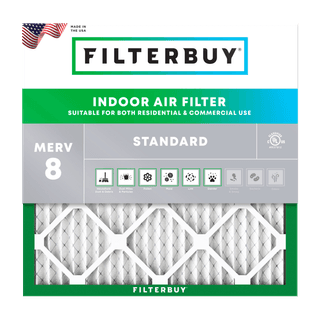
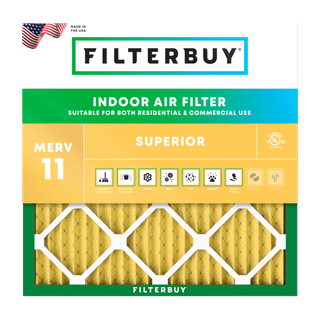
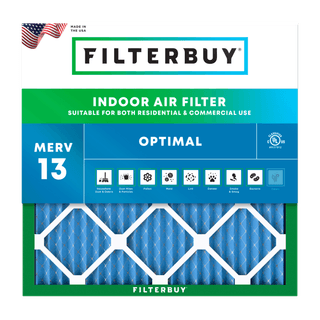


Check Today's Live Real Time Air Quality Index AQI Map in Garland, TX Now
TL;DR
The live AQI map on this page shows Garland's air quality from EPA monitoring data. Filterbuy treats AQI 100 as the line to act on indoors. Ozone drives the worst days from March through November, and fine particulate arrives with smoke and dust. The map tells you what is outside. Your filter decides what you breathe inside.
Start with the Live Garland Air Quality Map Above
Check the color before the number. Green and yellow mean carry on. The map draws on EPA stations across North Texas.
It names the pollutant behind that number, because Ozone and fine particulate call for opposite responses. The right move on a smoke day is the wrong one on a smog day.
Key Takeaways
Ozone sets most of Garland's high readings, peaking twice a year, spring and early fall.
Garland has no regulatory air monitor. The nearest TCEQ stations sit in Dallas, Rockwall County and Frisco, so any figure here is interpolated.
Dallas County, which holds most of Garland, failed the Lung Association's year-round particle grade in State of the Air 2026.
Dallas-Fort Worth is Serious nonattainment for the federal ozone standard, attainment deadline August 3, 2027.
EPA recommends a filter rated MERV 13 or higher in a central system during smoke events. AQI 100 is where Filterbuy tells customers to act.
What Each AQI Band Asks of You in Garland
Match the color to the row below. These thresholds follow EPA AirNow guidance.
Categories, ranges and colors per EPA AirNow.
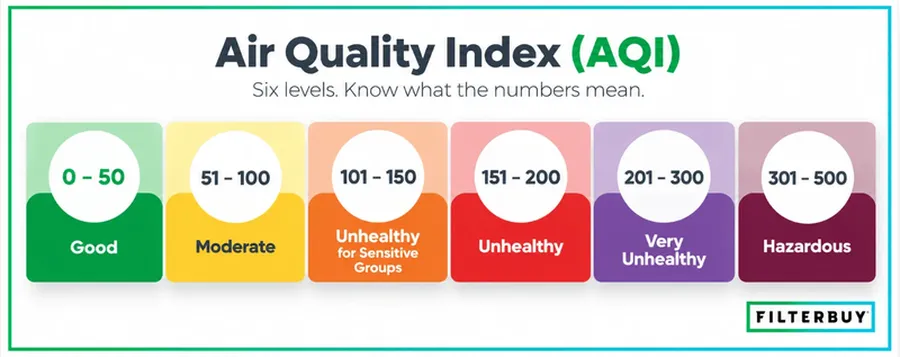
Categories, ranges and colors per EPA AirNow.
Filterbuy treats AQI 100 as the line to act on. That threshold is ours, not an EPA category change, since 100 is still the top of Moderate. At 100 and above, put a MERV 13 filter in the HVAC, set the thermostat fan to On, run a portable HEPA air cleaner in each occupied room starting with bedrooms, and close the house up.
Why Garland's Reading Can Lag What You See Outside
EPA publishes current AQI as a NowCast, an average of up to twelve prior hours weighted toward the last three. When a plume moves fast, the index trails what you see and smell.
Geography matters too. We went through TCEQ site list expecting to find Garland's station, and it is not there. TCEQ ran one, Garland Hwy Dept C197, until it was deactivated in March 2003, and the long-running Dallas Hinton Street site closed in February 2025. So any Garland reading is an estimate rather than a measurement on your block.
Which stations fill that gap matters. Frisco carries the highest ozone design value in the region, while Rockwall Heath has long sat near the bottom. Garland falls between them, which is why two apps disagree about one afternoon.
The map is honest about what it measures, and what it measures is three stations that are not in Garland. On a smoke afternoon, your own eyes are the closer sensor.
Michelle Wan, Brand Manager and Air Quality Writer, Filterbuy
Trust your eyes and nose, then check the AirNow Fire and Smoke Map.
Is Garland's Air Safe to Breathe Today?
EPA puts 0 to 50 in Good and 51 to 100 in Moderate, flags 101 to 150 as unhealthy for sensitive groups, and 151 and above as unhealthy for everyone. With asthma, COPD or a heart condition, follow your doctor and AirNow rather than a general page like this one.
Where to Check North Texas Forecasts and Alerts
TCEQ forecasts air quality for Dallas-Fort Worth and issues an Ozone Action Day when ozone looks likely to reach the unhealthy range. Ozone season runs March through November, and NCTCOG tracks the regional design value across it.
An Ozone Action Day is a forecast, not a measurement. The City of Garland's air quality page carries local alert guidance.
How Garland Air Quality Varies by ZIP Code
Readings differ across the city. Blocks near I-635, I-30 and the rail lines carry more traffic particulate than blocks toward Lake Ray Hubbard. Enter your ZIP above.
Compare Garland on our Texas air quality map, the Dallas AQI map or the Irving AQI map.
What Is Actually in Garland's Air
Six pollutants feed the AQI, and whichever scores highest sets the number. In Garland that is almost always ozone or PM2.5, the fine particles in smoke and haze.
Ozone is the regional problem, forming when nitrogen oxides and volatile organic compounds cook in sunlight. TCEQ's conceptual model for Dallas-Fort Worth records what most pages miss: ozone here peaks twice, April through June and August through October, with a midsummer dip. A hot July afternoon is not automatically the worst air of the year.
The same model puts the highest readings north and northwest of the metroplex, at Denton, Keller and Grapevine, because prevailing east and southeast winds push the urban plume that way. Garland sits northeast of downtown Dallas, so the plume usually passes west of you, and only on southwesterly days does it track overhead.
PM2.5 behaves differently. It does not break down indoors, so a closed window handles ozone but particulate has to be filtered out.
Smoke and Dust: Garland's Particulate Episodes
North Texas has no local fire season, so its spikes arrive from elsewhere. TCEQ’s daily forecast tracks Canadian wildfire smoke, burning in Mexico and the central US, and Saharan dust on summer southerlies.
When one settles over Garland, the order Filterbuy works through with customers:
Close windows and doors, and keep indoor sources down: no candles, no frying, no vacuuming without a sealed unit.
Set the HVAC to recirculate and the thermostat fan to On. Auto filters only while the system runs.
Fit a MERV 13 filter. EPA recommends MERV 13 or higher in a central system during smoke events.
Run a portable HEPA air cleaner in each occupied room, bedrooms first. Size it so its smoke CADR is at least two-thirds of the room area, so a 300 square foot bedroom needs roughly 200. Skip anything that produces ozone.
Check the filter during the event and replace it when it looks dark brown or black, well before the normal interval if needed. Keep spares on hand.
If your home runs on window units with no ductwork, there is no whole-home layer to upgrade, so portable HEPA cleaners are the primary defense, not a supplement. Filterbuy does not make portable purifiers. Follow AirNow wildfire smoke guidance and local authorities before anything on this page.
Filter Slots in Garland's Older Homes
Garland's housing stock has a median construction year around 1978, and the city grew as a postwar suburb built for central air, so almost every house already has a filter slot.
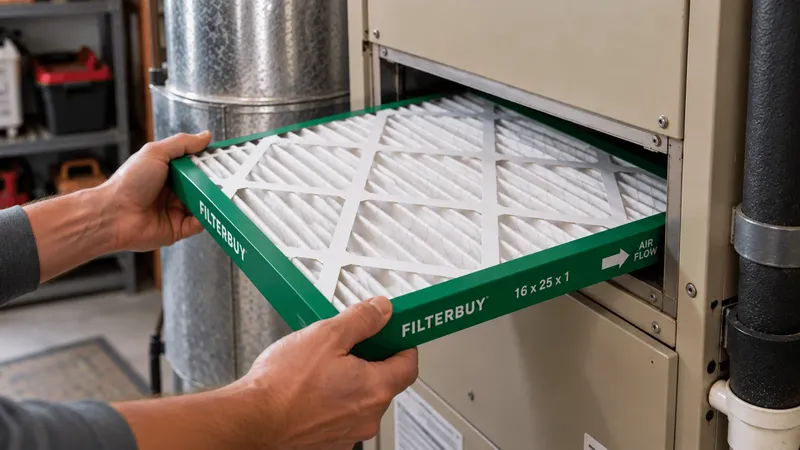
The catch is what fits in it. Check the slot depth the same way you check a size, since a one-inch slot takes a one-inch filter, then order MERV 13 to fit. Our guide to choosing a MERV rating, and see which MERV rating fits a high-AQI day covers the tier.
Our Read on Garland's Numbers
Most air quality pages stop at the outdoor figure. Filterbuy makes the filters that decide what happens once that air is inside, so we read the numbers differently.
No monitor sits inside the city. Every Garland number is inferred from stations elsewhere, so trust your eyes on smoke days.
Filtration is preparation, not reaction. A filter ordered the morning the sky turns brown arrives days late.
We have built filters in Talladega, Alabama for more than a decade. The nearest monitor sits miles away in another city, so by the time the number catches up to the smoke, the filter you want is the one that went in before it.
David Heacock, Founder and CEO, Filterbuy
Matching a Filter to the Garland AQI Reading
EPA recommends a filter rated MERV 13 or higher in a central system during smoke events. This is the part we make, so here is how we choose.
We recommend a tier and a size, never a single product as the smoke filter.
We recommend a tier and a size, never one product as the smoke filter.
Shop Filterbuy MERV 8, MERV 11, MERV 13 or the Odor Eliminator.
Pull the old filter and read the slot before you order. One inch is common in Garland houses, so that is the size you want in MERV 13. Change it on the normal schedule, and sooner during smoke, when it loads up fast.
David Clark, Licensed HVAC Technician
Supporting Statistics
North Texas ozone runs above the federal limit.
Design value: 83 ppb as of August 31, 2026, highest at Frisco.
Federal standard: 70 ppb. The season opened at 74 ppb.
What it means: Ozone Action Days here are routine, not emergencies.
Source: NCTCOG, Current Ozone Activity
Failing-ozone metros carry most of the state's asthma burden.
Four Texas metros fail the federal ozone standard, and Garland sits in one.
Together they account for roughly 59 percent of asthma-related emergency visits statewide.
Source: Texas DSHS, Strategic Plan for Asthma Control 2025-2028
EPA sets the filter standard for smoke events.
A filter rated MERV 13 or higher in a central HVAC system during smoke events.
Most furnaces and HVAC systems accommodate MERV 13 without equipment problems when the filter is replaced often.
Replace it when it looks dark brown or black, which can be sooner than the manufacturer recommends.
Sources: EPA Wildfire Smoke Factsheet: Indoor Air Filtration and EPA, Wildfires and Indoor Air Quality
Frequently Asked Questions
Glossary
AQI (Air Quality Index): EPA's 0 to 500 pollution scale, in six categories.
Ozone (O3): A lung irritant formed when sunlight reacts with vehicle and industrial emissions, and Garland's main driver of unhealthy days.
PM2.5: Fine particulate 2.5 micrometers or smaller, and what high-MERV filtration targets.
NowCast: The EPA algorithm behind current AQI, averaging up to twelve prior hours.
MERV: Minimum Efficiency Reporting Value, the 1 to 16 filter scale.