
Cary Real-Time AQI Tracker


Get Alerts For Unhealthy AQI In Your Area
When air quality in your area reaches unhealthy levels, we'll send you a quick alert, along with expert tips on how to reduce your exposure.
What's Actually In Cary Air Today?
What High AQI Means for Your Lungs in Cary
How to Read AQI
The Air Quality Index (AQI) measures how polluted the air is and how it may affect your health.
0–50 (Good): Air quality is satisfactory.
51–100 (Moderate): Acceptable, but some pollutants may pose minor concerns.
101–150 (Unhealthy for Sensitive Groups)
151–200 (Unhealthy)
201–300 (Very Unhealthy)
301+ (Hazardous)
Moderate
Still okay for most, but if you have asthma or allergies, take it easy and avoid long outdoor workouts.
Shop MERV 11 filters→What's the Right Filter for Your AQI Level?
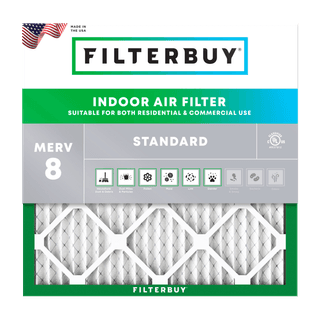
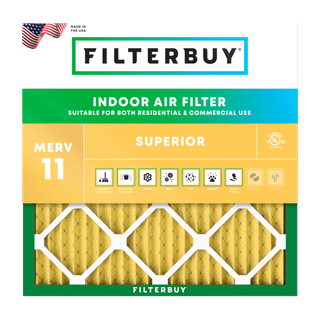
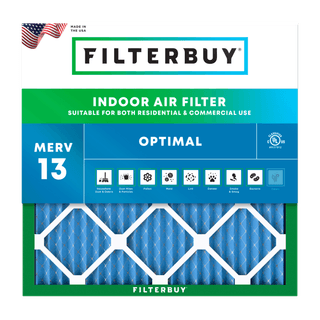


Check Today's Live Real Time Air Quality Index AQI Map in Cary, NC Now
By Michelle Wan, Brand Manager and Air Quality Writer at Filterbuy. Technically reviewed by David Clark, Licensed HVAC Technician, Filterbuy HVAC Solutions. Published August 18, 2026. Updated August 18, 2026.
Check Cary's Air, Then Match Your Filter to It
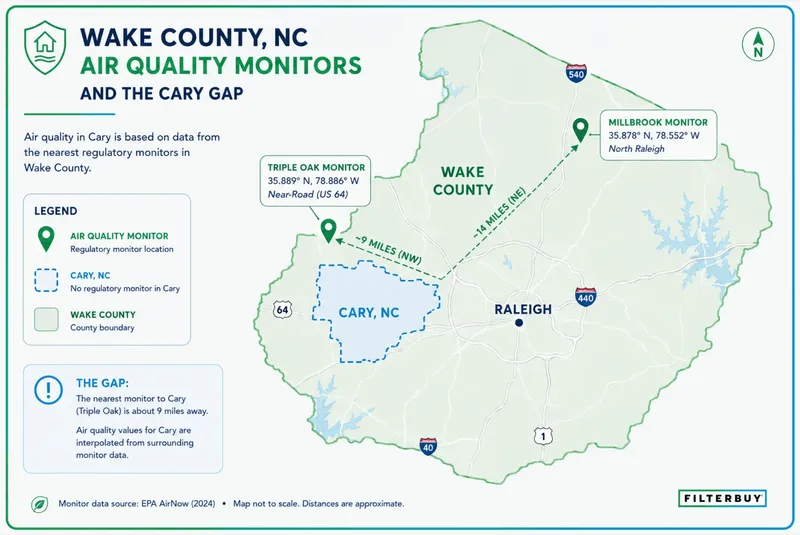
Cary has no air quality monitor of its own. The number on this page comes from Wake County monitors 9 and 14 miles away, so treat it as your region rather than your street. What you can control is the filter the air passes through once it gets inside. Find your AQI band below, then the rating built for it.
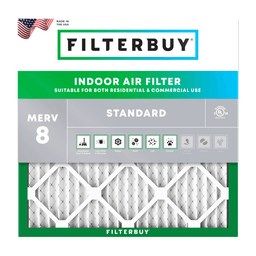
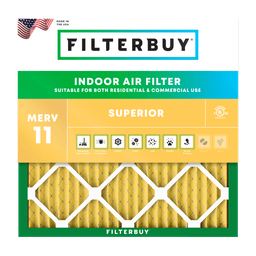
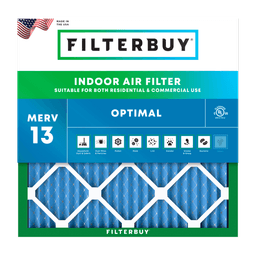
Capture rates: MERV 8 traps 90% of airborne particles, MERV 11 traps 95%, MERV 13 traps 98%. Check your HVAC manual before moving up a rating.
Not Sure Which MERV Rating Your Home Needs?
Answer three quick questions and we will match you to the right size and rating for your system.
“The mistake I see most in the Triangle is a filter that was fine in February and is still in the slot in June. Pine pollen loads a filter fast. By the time smoke arrives, that filter is already working against the system instead of for it.”
David Clark, Licensed HVAC Technician, Filterbuy HVAC Solutions
Cary asks for three filter changes a year: MERV 11 through the April pollen peak, MERV 13 if smoke arrives in June, and a fresh filter for the furnace in January.
Server-rendered with a text fallback stating the current AQI value, category, and dominant pollutant.
TL;DR
Cary's air quality changes by the hour, so the live Filterbuy AQI map above is the only reliable answer to "what is it right now." The Raleigh-Durham-Cary metro carries a B for ozone and a C for short-term particle pollution, so most days land in the Good (0–50) or Moderate (51–100) range. Ground-level ozone drives the highest numbers on hot summer afternoons, and fine particles (PM2.5) drive them during wildfire smoke events and cold, still winter nights. Once the map turns orange, the useful work moves indoors.
Key Takeaways
Cary has no air quality monitor of its own. Cary's AQI is drawn from two Wake County monitors run by the NC Division of Air Quality: Millbrook in north Raleigh and Triple Oak near the I-40 corridor.
Ozone is Cary's warm-season pollutant; PM2.5 is its cold-season and smoke pollutant. NC DAQ forecasts ozone from March 1 through October 31 and forecasts PM2.5 year-round.
The Raleigh-Durham-Cary metro earned a B for ozone and a C for short-term particle pollution in the American Lung Association’s “State of the Air” 2026 report, which graded 2022–2024 data.
Pollen is not part of the AQI. Cary can post a green AQI on a day when tree pollen is punishing, because pollen is not one of the six pollutants the index measures.
AQI 101 is the action line. At orange, children, older adults, and people with asthma, COPD, or heart disease should ease up outdoors, close the windows, and run a clean, well-fitted filter.
What Is the Air Quality in Cary, NC Today?
Cary's air quality today is whatever the live map above reports, and that number moves through the day. The Air Quality Index runs 0 to 500 across six color-coded categories, and it reports the single worst pollutant rather than an average. In Cary, that worst pollutant is usually ground-level ozone on hot afternoons or PM2.5 when smoke or a winter inversion settles over the Triangle.
Read three things off the map, not one: the number, the color band, and the dominant pollutant. Take a reading of 78 as an example. Driven by ozone, it peaks mid-to-late afternoon and eases after sunset. Driven by PM2.5, it can hold steady overnight. Same number, different plan for your evening. If you want the same reading for another address, our AQI near me guide walks through it.
What Do the AQI Colors Mean in Cary?
Cary reads on the same six-category EPA scale as the rest of the country. Green (0 to 50) and yellow (51 to 100) cover most days here. Orange starts at 101 and is the line where children, older adults, and anyone with asthma or heart disease should ease off outdoors and shut the windows. Red at 151 applies to everyone. Purple and maroon are rare in Wake County, though heavy smoke has pushed the Triangle close.
Source: U.S. EPA Air Quality Index. Category colors shown at darkened values for legibility on white.
The scale itself shifted recently. In 2024 the EPA lowered the annual PM2.5 standard from 12.0 to 9.0 micrograms per cubic meter and revised the AQI breakpoints to match. The categories did not change, but the bar did, so Cary now records more yellow days than it would have under the old scale for identical air. For the arithmetic behind the bands, see our guide on how the air quality index is calculated, or the full AQI scale explained.
Which Monitors Actually Measure Cary's Air?
There is no regulatory air quality monitor inside Cary town limits. Wake County’s two NC DAQ monitoring sites are Millbrook, about 14 miles northeast of downtown Cary in north Raleigh, and Triple Oak, a near-road site about 9 miles northwest near the I-40 corridor that tracks PM2.5, nitrogen dioxide, and carbon monoxide close to traffic.
That matters for how you read the map. Millbrook anchors the region’s ozone record: in June 2023 it logged four Code Orange days in a single month, something that had not happened since July 2012. Triple Oak, being roadside, reads higher for traffic pollutants than a backyard in Preston or Amberly would. You can pull live readings from either site through the NC Air Quality Portal.
We checked the distances ourselves rather than repeating them from another site. NC DEQ publishes coordinates for every monitor it runs. We pulled both Wake County sites and measured to downtown Cary: Millbrook is 14.2 miles northeast, Triple Oak is 8.9 miles northwest. Neither one is in Cary. That gap is the single most useful thing to understand about the number on the map, and it is the reason we treat this page as a starting point rather than a verdict.
So Cary's AQI is a well-founded regional estimate, not a reading from your street. Air near I-40, US-1, or Cary Parkway at rush hour runs dirtier than the number suggests; a wooded neighborhood a mile off the highway usually runs cleaner. Use the map for the day's decision.
When Is Cary's Air Worst, and Why?
Cary's air is worst on hot, still summer afternoons, when ozone peaks, and during wildfire smoke episodes between June and October, when PM2.5 climbs. Winter brings a second particle season as wood smoke and exhaust settle under cold, calm nights. Spring is the mildest stretch for AQI, though it is the hardest for pollen, which the index does not measure. The calendar below shows which months to watch.
Ozone is forecast by NC DAQ from March 1 through October 31. PM2.5 is forecast year-round.
The smoke risk is not theoretical here. On June 7, 2023, smoke from Canadian wildfires more than 1,000 miles away pushed Wake County to a Code Red alert, the Triangle’s first in over a decade. Wake County Public Schools limited outdoor activities that day. During active smoke, the EPA points people to the AirNow Fire and Smoke Map rather than the standard dial. If smoke has already been through, our guide on recovering from wildfire smoke exposure covers what to do next.
Same AQI, Different Pollutant, Different Plan
Most air quality pages stop at the number. The number alone will not tell you whether tonight is fine. The pollutant driving it will.
An AQI of 85 from ozone and an AQI of 85 from wildfire smoke call for opposite evenings. Ozone is built by sunlight, so it fades after sundown. Smoke ignores the sun and can sit over the Triangle for days. The live map names the dominant pollutant. Once you have it, this is what to do with your day.
Cary-specific guidance built from EPA pollutant behavior and NC DAQ forecast seasons. The live map names the dominant pollutant.
Why Pollen Doesn't Show Up in Cary's AQI
The AQI measures six pollutants: PM2.5, PM10, ozone, nitrogen dioxide, sulfur dioxide, and carbon monoxide. Pollen is not one of them. That is why Cary can post a green reading on a morning when your car is buried under yellow dust and your eyes are streaming. (For the other reasons a number spikes, see why air quality is bad today.)
This gap hits the Triangle harder than most places. Raleigh ranked seventh out of 100 metro areas on the 2026 Allergy Capitals list from the Asthma and Allergy Foundation of America. North Carolina’s Division of Air Quality runs the state’s only pollen monitoring station, located in Raleigh, and tree pollen typically peaks from late March into early April.
The pine pollen that coats everything is relatively large and less allergenic. The grains actually making you miserable come from oak, hickory, and other hardwoods. Those grains are small enough that a good filter is your best defense once they get inside.
Supporting Statistics
Three findings shaped this page. Each comes from a primary U.S. source.
45 million+ Americans live within 300 feet of a major road.
Pollutant levels near busy roads run higher than area-wide readings.
EPA ties that exposure to asthma, reduced lung function, and heart disease.
In Cary: the nearest monitor is 9 miles out. Homes along I-40, US-1, or Cary Parkway can breathe worse air than the map shows.
Wildland fires produced 52% of U.S. fine particle pollution.
Smoke is the single largest source of PM2.5 nationally.
Western states are not the only ones affected.
In Cary: this is why the calendar above reserves June through October for particles, not ozone.
269,794 North Carolina children breathe unhealthy air.
Based on 2022–2024 monitoring data.
Children are the group the orange AQI band exists to protect.
In Cary: a green map day still deserves a clean, correctly sized filter.
Figures drawn from primary federal and national public health sources. Source links appear in the list above.
The practical takeaway from all three: EPA’s ASPIRE study found a box fan paired with a MERV 13 filter cuts indoor smoke effectively, and that keeping spare filters on hand matters as much as the rating.
What Should You Do When Cary's AQI Climbs?
At 101 and above, the useful work moves inside your house. You cannot change what is outside. You can control what circulates through the rooms you actually sit and sleep in.
Close the windows and doors. Free outdoor air is a bargain only when the air is clean.
Run the HVAC fan on "on" rather than "auto," but watch the humidity. Continuous circulation means continuous filtration. The catch most pages skip: in Triangle summer humidity, leaving the fan running after the compressor stops blows air across a still-wet evaporator coil and pushes that moisture back into the house. EPA advises keeping indoor relative humidity between 30 and 50 percent. The workable middle ground is to run "on" through the hours smoke or smog is worst, then return to "auto" so the system can dehumidify again.
Check the filter you have in there now. A filter loaded with spring pollen will not perform when smoke arrives in June.
Skip the indoor smoke. No candles, no fireplace, no pan-searing without the range hood on a bad-air day.
Re-check the map before evening plans. Ozone falls after sunset; smoke often does not. The EPA AirNow walkthrough shows how to read the forecast tab.
The Filter Is the Part You Control
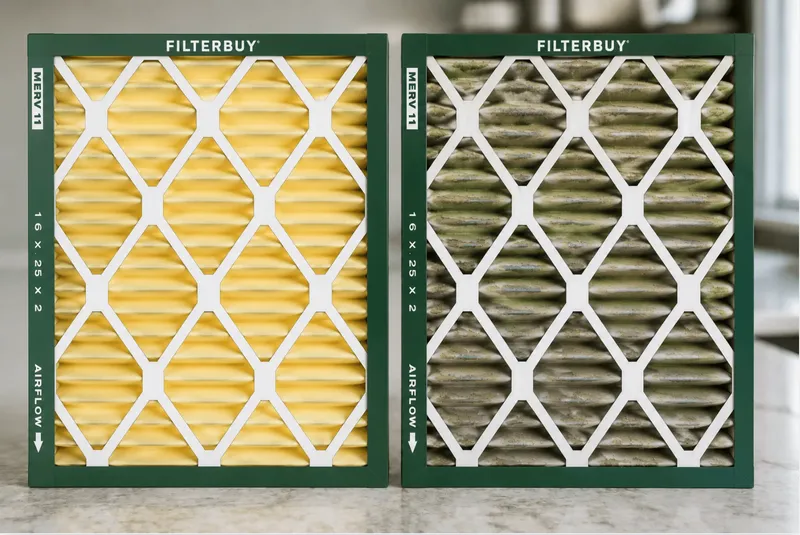
Your HVAC system pushes your home's air through the return vent over and over, so on a bad-air day your filter is either helping or quietly redistributing what got inside. MERV rating is the shorthand for how much it catches.
We build these ourselves, so we publish the numbers rather than a tier name. Filterbuy has manufactured filters in the United States since 2013, in plants in Alabama, Florida, Pennsylvania, and Utah. Every rating below lists the share of airborne particles it captures, taken from our own product specifications.
Capture rates per Filterbuy product specifications. Check your HVAC manual before moving up a MERV rating.
The mistake I see most in the Triangle is a filter that was fine in February and is still in the slot in June. Pine pollen loads a filter fast. By the time smoke arrives, that filter is already working against the system instead of for it.
David Clark, Licensed HVAC Technician, Filterbuy HVAC Solutions
For smoky periods the EPA recommends MERV 13 or the highest rating your system accepts, and notes most furnaces handle it as long as the filter is changed often. That last part is where Cary homes tend to slip. The Triangle asks for three different filters a year: MERV 11 through the April pollen peak, MERV 13 if smoke arrives in June, and a fresh filter for the furnace in January. Filterbuy auto-delivery is built for exactly that pattern, and if your slot is an odd size, Filterbuy builds custom to fit. Either way you are not hunting for a filter in the middle of a Code Orange day.
Shop MERV 8 · Shop MERV 11 · Shop MERV 13 for smoke season · Shop Odor Eliminator
Four Things This Map Will Not Tell You
A tool is more useful when you know its edges. Here is where the AQI stops being the right instrument.
Pollen. Not one of the six measured pollutants. In Cary that gap is at its widest in late March.
The air inside your house. The AQI is an outdoor index. Cooking, candles, and a loaded filter never touch it.
Radon and carbon monoxide. Neither appears in the index, and no HVAC filter removes either one, including Filterbuy’s. Those need a radon test kit and a CO detector, not a filter.
Your block. The nearest monitor is roughly 9 miles from downtown Cary. Treat the reading as your region, not your driveway.
Frequently Asked Questions
Glossary
AQI (Air Quality Index): The U.S. EPA's 0-to-500 scale for reporting daily outdoor air quality, divided into six color-coded categories. It reports the single highest-scoring pollutant, not an average.
PM2.5: Fine particulate matter 2.5 microns or smaller. Small enough to reach deep lung tissue and enter the bloodstream. The main pollutant in wildfire smoke.
PM10: Coarse particulate matter 10 microns or smaller, including dust and some larger pollen fragments.
Ground-level ozone (O3): A lung irritant formed when sunlight reacts with vehicle and industrial emissions. The core of summer smog and Cary's warm-season pollutant.
Code Orange / Code Red: NC Division of Air Quality shorthand for AQI 101–150 and 151–200 forecast days.
MERV: Minimum Efficiency Reporting Value, the 1-to-16 scale rating how effectively an HVAC filter captures airborne particles.
NC DAQ: The North Carolina Division of Air Quality, part of the Department of Environmental Quality, which operates the state monitoring network and issues daily AQI forecasts.
AirNow: The EPA's official public site for real-time U.S. air quality, run with NOAA, NASA, the CDC, and the U.S. Forest Service.
Millbrook: The NC DAQ air monitoring site in north Raleigh (35.878, -78.552), the primary ozone and PM2.5 monitor for the Cary area.
Triple Oak: A near-road NC DAQ monitoring site in Wake County (35.889, -78.886) measuring PM2.5, nitrogen dioxide, and carbon monoxide.
Filterbuy: A family-owned American manufacturer of pleated HVAC air filters, founded in 2013 and headquartered in Talladega, Alabama. Publisher of this page and of the live AQI map above.
About the Author and Reviewer
Michelle Wan is Filterbuy’s Brand Manager and Air Quality Writer, covering AQI trends, wildfire smoke, and indoor air quality across Filterbuy’s resource library.
David Clark is a Licensed HVAC Technician with Filterbuy HVAC Solutions and reviews Filterbuy’s air quality content for technical accuracy.
Filterbuy is a family-owned American air filter manufacturer selling factory-direct in 600+ standard sizes plus custom, with free shipping. Headquarters: 101 Pope St, Talladega, AL 35160.