
Overland Park Real-Time AQI Tracker


Get Alerts For Unhealthy AQI In Your Area
When air quality in your area reaches unhealthy levels, we'll send you a quick alert, along with expert tips on how to reduce your exposure.
What's Actually In Overland Park Air Today?
What High AQI Means for Your Lungs in Overland Park
How to Read AQI
The Air Quality Index (AQI) measures how polluted the air is and how it may affect your health.
0–50 (Good): Air quality is satisfactory.
51–100 (Moderate): Acceptable, but some pollutants may pose minor concerns.
101–150 (Unhealthy for Sensitive Groups)
151–200 (Unhealthy)
201–300 (Very Unhealthy)
301+ (Hazardous)
Moderate
Still okay for most, but if you have asthma or allergies, take it easy and avoid long outdoor workouts.
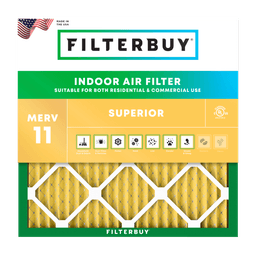
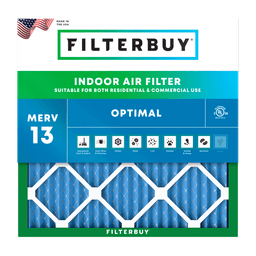
Shop MERV 11 filters→What's the Right Filter for Your AQI Level?



Check Today's Live Real Time Air Quality Index AQI Map in Overland Park, KS Now
Author: Michelle Wan | Reviewer: David Clark, Licensed HVAC Technician | Publish Date: July 23, 2026 | Updated Date: July 23, 2026
TL;DR
The live air quality index (AQI) map above shows current outdoor conditions in Overland Park, Kansas, updated from EPA-monitored stations across the Kansas City metro. Overland Park's air quality typically swings between Good and Moderate, with ground-level ozone driving summer readings and fine particulate matter (PM2.5) driving winter and wildfire-smoke spikes. Most air quality tools stop at that outdoor number. This page pairs it with the one variable a resident can actually control indoors: which filter is running in the HVAC system pulling that same air through the house.
Key Takeaways
Overland Park's AQI is monitored as part of the Kansas City regional airshed, which spans Johnson and Wyandotte Counties in Kansas and three counties in Missouri.
Ground-level ozone is the primary summer pollutant in Overland Park, while fine particulate matter (PM2.5) tends to drive readings the rest of the year.
An AQI of 50 or below is Good, 51 to 100 is Moderate, and above 100 means sensitive groups should reduce outdoor exposure.
Canadian and Western U.S. wildfire smoke can push Overland Park's PM2.5 higher for days at a time, even when no fire burns nearby.
MERV 11 or MERV 13 air filters catch the small particles that drive most unhealthy AQI days, including wildfire smoke and vehicle exhaust.
A live AQI reading only answers half the question. The other half, what that reading means for the air actually moving through your home, is where Filterbuy's perspective as a filter manufacturer adds something a weather widget cannot.
What The Overland Park AQI Reading Means Right Now
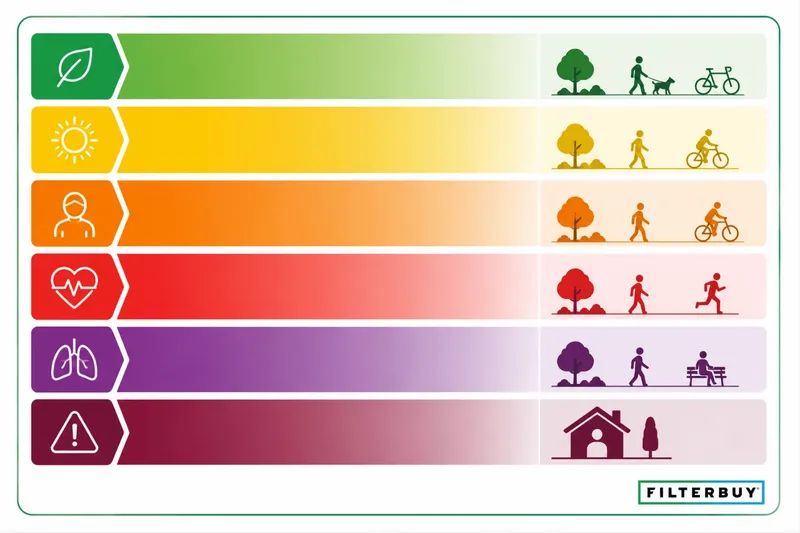
The Air Quality Index is a 0-to-500 scale that EPA uses to report how clean or polluted outdoor air is on a given day. The AQI translates raw pollutant concentrations into six color-coded categories, and the live map above reflects the highest of these categories for whichever pollutant, ozone or particulate matter, is driving conditions in Overland Park at the moment.
AQI Range |
Category |
What It Means For Overland Park |
|---|---|---|
0–50 |
Good |
Air quality is satisfactory. Normal outdoor activity is safe for everyone. |
51–100 |
Moderate |
Acceptable for most people. Those with asthma or heart disease may notice mild symptoms. |
101–150 |
Unhealthy for Sensitive Groups |
Children, older adults, and people with respiratory or heart conditions should limit prolonged outdoor exertion. |
151–200 |
Unhealthy |
Everyone may begin to experience health effects. Sensitive groups face more serious risk. |
201–300 |
Very Unhealthy |
Health alert. Reduce outdoor activity across the board. |
301+ |
Hazardous |
Emergency conditions. Stay indoors with windows closed and HVAC filtration running. |
Why Overland Park's Air Quality Changes Hour By Hour
Overland Park sits in Johnson County, Kansas, inside the Kansas City metropolitan airshed, a region that Johnson County and the Mid-America Regional Council jointly monitor for ozone and particulate pollution. The city is home to roughly 203,677 residents as of the U.S. Census Bureau's most recent estimate. Summer heat, sunlight, and light winds let vehicle emissions and other volatile compounds react and form ground-level ozone, which typically peaks on hot, still afternoons between roughly March and October. Winter readings shift toward fine particulate matter, since cold-weather heating, temperature inversions, and calm air trap PM2.5 closer to the ground.
Local traffic corridors, seasonal agricultural activity in the surrounding plains, and weather patterns moving through the Midwest all shift the numbers day to day. That is why a Good morning reading in Overland Park can slide to Moderate by afternoon rush hour, and why checking the live map more than once a day gives a more accurate picture than a single morning glance.
David Clark, the HVAC technician who reviewed this page, notes that service calls across the metro tend to cluster around two points in the year: late-summer ozone spikes and whichever week wildfire smoke rolls through. Both are moments when a filter that looked fine in June is already overdue for a look.
Overland Park's Seasonal AQI Calendar
No single AQI reading tells the whole story across a Kansas City year. This calendar lays out which pollutant typically drives Overland Park's air quality season by season, so residents know what to watch for before it shows up on the live map.
Season |
Typical AQI Driver |
What To Watch For |
|---|---|---|
Winter (Dec-Feb) |
Fine particulate matter (PM2.5) |
Temperature inversions trap heating exhaust close to the ground on cold, calm mornings. |
Spring (Mar-May) |
Rising ozone |
Ozone season begins as sunlight and heat increase, building toward summer peaks. |
Summer (Jun-Aug) |
Ground-level ozone and wildfire smoke |
Hot, still afternoons peak ozone readings, and Canadian or Western wildfire smoke can arrive with little warning. |
Fall (Sep-Nov) |
Tapering ozone, lingering smoke |
Ozone levels decline as days shorten, but wildfire smoke can still drift in through October. |
Filterbuy's own filter recommendations shift with this calendar. A MERV 11 that handles spring pollen well is often not the right call once summer wildfire smoke moves in.
For a broader regional picture, compare today's reading with the live maps for Kansas City, KS, Wichita, and Lawrence, or zoom out to the statewide Kansas air quality map and the nationwide AQI map for conditions across the rest of the country.
How To Read And Use This Live AQI Map
Find your ZIP code or neighborhood on the map above to see the current localized reading rather than a citywide average.
Note the AQI number and its color category using the scale table above.
Identify the dominant pollutant shown on the map, typically ozone or PM2.5, since each carries different health guidance.
Match the reading to the health guidance for that category before finalizing outdoor plans.
Recheck later in the day if temperatures rise, winds shift, or a wildfire smoke advisory is issued for the region, since Overland Park's AQI can move a full category within a few hours.
Filterbuy built this page around that habit: check the map like you would check the forecast, then let today's reading decide what happens next inside the house.
Matching Your Air Filter To Today's AQI Reading
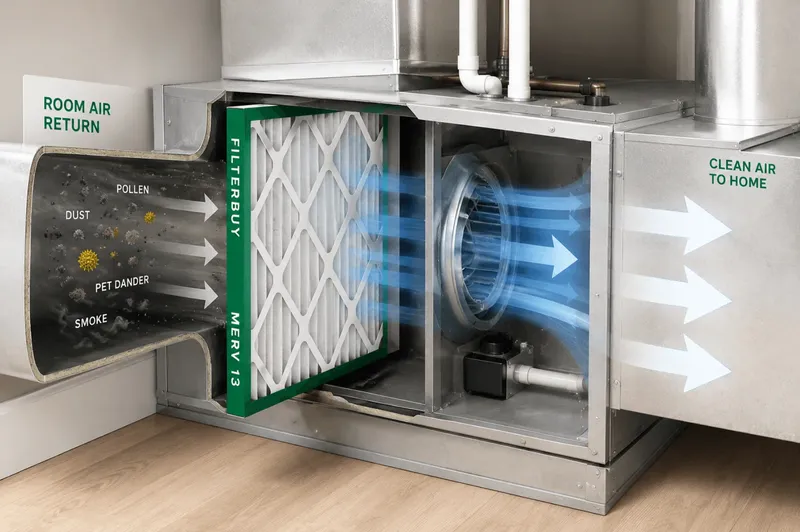
Overland Park's outdoor air quality reading tells you what is happening outside, but it does not stop those same pollutants from drifting indoors through open windows, doors, and gaps around your home's exterior. The HVAC filter installed in your furnace or air handler is what determines how much of that outdoor pollution actually reaches the air you breathe inside.
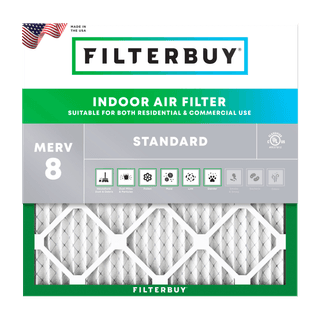
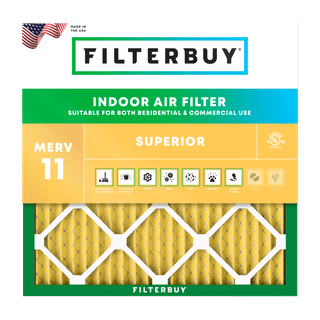
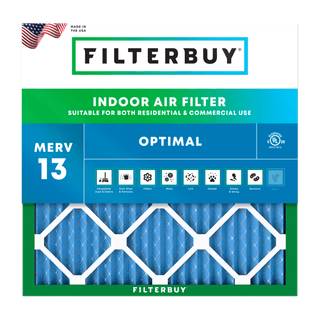
Filterbuy manufactures MERV 8, 11, and 13 filters in the USA in more than 600 sizes, which matters most on the days when a close-enough fit lets outdoor pollutants slip past the frame instead of through the media.
The clean-looking filter test most homeowners rely on does not hold up during a smoke event. Fine particulate loads a filter's capacity well before it looks dirty to the eye, which is exactly why the AQI reading, not the filter's appearance, should decide when it is time to check it.
When Wildfire Smoke Reaches Overland Park
Overland Park does not need a nearby fire to see its AQI spike. Smoke from Canadian wildfires and large Western U.S. fires regularly travels hundreds of miles across the Great Plains, and when it settles over the Kansas City metro, PM2.5 readings can climb into Unhealthy territory for days at a time even under otherwise clear skies. National wildfire activity has already run well above a typical year, which is exactly why smoke drift reaches Kansas even when nothing is burning nearby. Particles small enough to reach deep into the lungs, like the PM2.5 in wildfire smoke, are linked to aggravated asthma and other respiratory harm.
Wildfire-specific PM2.5 is not interchangeable with everyday urban particulate matter. Peer-reviewed research shows it drives a meaningfully higher rate of respiratory hospitalizations than particulate matter from ordinary urban sources. That gap is part of why federal energy efficiency guidance recommends stepping up to a MERV 13 filter, or the highest efficiency your system's fan and filter slot can safely handle, specifically during smoke events.
Protecting Indoor Air While You Wait For Better Air Outside
A high outdoor AQI reading does not have to mean a high indoor exposure. Close windows and doors once the AQI crosses into Moderate territory, and switch your HVAC fan setting to “on” or “circulate” rather than leaving it on automatic, so air keeps passing through your filter continuously rather than only when heating or cooling cycles run. Both ground-level ozone and particle pollution can worsen symptoms for people with asthma or COPD, which is why avoiding indoor pollution sources on bad-air days, including frying food, burning candles, or using aerosol sprays, matters just as much as watching the outdoor number. Ozone and particle pollution can trigger asthma attacks and worsen respiratory symptoms even at moderate AQI levels. Swap your filter as soon as a smoke event ends rather than waiting for its usual replacement date, since a filter that just captured several days of elevated particulate load loses efficiency faster than one used during clean-air stretches.
Expert Quote
After manufacturing filters for over a decade and serving more than two million households, we’ve learned that the AQI tells you what’s happening outside your door, but what actually reaches your family’s lungs depends on what’s installed inside your HVAC system. Checking the map is step one. Matching your filter to the day’s reading is what finishes the job.
David Heacock, Founder and CEO of Filterbuy
Filterbuy has manufactured air filters in the USA since 2012, a history detailed on the company's About Us page.
Reviewer's Field Note
In my service calls across the Kansas City metro, the units I check most often during ozone season are still running a basic filter that was never upgraded for wildfire years. Bumping up to at least a MERV 11 before summer, and checking it again the first time smoke rolls through, catches most of the problem before it ever reaches a customer’s living room.
David Clark, Licensed HVAC Technician
7 Trusted Air Quality Resources For Overland Park Residents
Checking today's AQI is the first step. Filterbuy pulled these seven resources from federal agencies, national health organizations, and the U.S. Census Bureau because each one shaped a specific recommendation on this page, not as a generic reading list.
Understand Exactly What Your AQI Number Means
AirNow's AQI Basics guide breaks down all six AQI color categories and the five pollutants the scale tracks. A reading of 62 or 162 stops being an abstract number once you know exactly which category and health guidance it maps to.
Learn Why Fine Particles Pose The Real Health Threat
EPA's page on the health and environmental effects of particulate matter explains how PM2.5 gets past the body's natural defenses and reaches the lungs and bloodstream. It is the clearest federal explanation of why the fine-particle side of the AQI scale carries so much weight for Overland Park during smoke events.
See How Ozone And Particle Pollution Affect Your Lungs
CDC's overview of air pollutants covers the six criteria pollutants regulated nationwide and gives practical steps for people with asthma or COPD to follow on high-pollution days. It is a fast reference for matching a symptom to its likely outdoor trigger.
Get The Full Picture On Long-Term Exposure Risks
The American Lung Association's Health Impact of Air Pollution report distills decades of research into what daily air pollution exposure does to the body over months and years, not just on a single bad-air day. It is the resource to read for anyone managing a chronic heart or lung condition.
Find Out How Air Pollution Triggers Asthma Attacks
AAFA's guide to air pollution and asthma explains how ozone, PM2.5, and other gases specifically aggravate asthma, plus the AQI thresholds where AAFA recommends limiting outdoor time. It fills in the asthma-specific detail the general AQI scale leaves out.
Cross-Check Your Reading With The National Weather Service
The National Weather Service's Air Quality Index overview ties the AQI directly into daily weather forecasting. Reading it alongside the live map above helps Overland Park residents plan outdoor activity around both the forecast and the air at the same time.
See The Real Population Behind Overland Park's Air Quality Data
The U.S. Census Bureau's QuickFacts for Overland Park confirms the city's population at 203,677 residents. Grounding this page in an official, current population figure keeps the local context accurate rather than relying on outdated estimates.
Supporting Statistics: The Research Behind This Page's Guidance
Three sourced statistics back the wildfire and filtration guidance above. Each comes from a federal agency or peer-reviewed research indexed by the National Institutes of Health.
Wildfire PM2.5 Raises Respiratory Hospitalizations Up To 10 Percent
A 10 µg/m³ increase in wildfire-specific PM2.5 raises respiratory hospitalizations by 1.3 to 10 percent.
The same increase in non-wildfire PM2.5 raises hospitalizations by only 0.67 to 1.3 percent.
Source: Nature Communications, indexed by the National Institutes of Health (Aguilera et al., 2021).
Nearly 4 Million Acres Have Already Burned Nationwide This Year
3,960,623 acres have burned nationwide year-to-date, as of July 20, 2026.
74 large fires are still being actively suppressed.
Source: The National Interagency Fire Center's live statistics.
A Properly Sized Air Cleaner Removes 80 Percent Of Smoke Particles
Size a room air cleaner to a Clean Air Delivery Rate (CADR) of at least two-thirds of the room's square footage.
That sizing removes 80 percent of smoke particles from the air.
The same size-to-performance logic applies to matching a MERV 13 HVAC filter to your system's airflow capacity.
Source: ENERGY STAR's wildfire smoke air cleaner sizing standard.
Frequently Asked Questions
Glossary
AQI (Air Quality Index): A 0-to-500 scale developed by EPA that converts pollutant concentrations into six color-coded health categories.
PM2.5: Fine particulate matter measuring 2.5 micrometers or smaller in diameter, small enough to reach deep into the lungs and bloodstream.
Ground-Level Ozone: A gas that forms when vehicle and industrial emissions react with sunlight and heat, distinct from the protective ozone layer high in the atmosphere.
MERV Rating: Minimum Efficiency Reporting Value, a 1-to-20 scale rating how effectively an air filter captures airborne particles.
Sensitive Groups: Children, older adults, and people with asthma, COPD, or heart disease, who experience health effects at lower AQI levels than the general population.
Airshed: A geographic region, such as the Kansas City metro spanning Kansas and Missouri counties, that shares air quality conditions and is monitored jointly.
Temperature Inversion: A weather pattern where a layer of warm air traps cooler air, and the pollutants in it, close to the ground instead of letting them disperse upward.