
West Covina Real-Time AQI Tracker


Get Alerts For Unhealthy AQI In Your Area
When air quality in your area reaches unhealthy levels, we'll send you a quick alert, along with expert tips on how to reduce your exposure.
What's Actually In West Covina Air Today?
What High AQI Means for Your Lungs in West Covina
How to Read AQI
The Air Quality Index (AQI) measures how polluted the air is and how it may affect your health.
0–50 (Good): Air quality is satisfactory.
51–100 (Moderate): Acceptable, but some pollutants may pose minor concerns.
101–150 (Unhealthy for Sensitive Groups)
151–200 (Unhealthy)
201–300 (Very Unhealthy)
301+ (Hazardous)
Moderate
Still okay for most, but if you have asthma or allergies, take it easy and avoid long outdoor workouts.
Shop MERV 11 filters→What's the Right Filter for Your AQI Level?
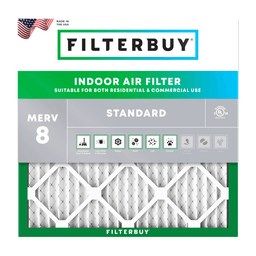
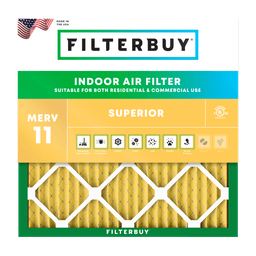
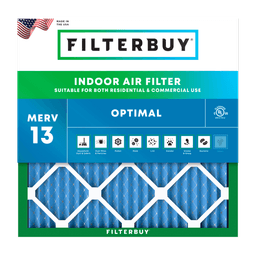

Check Today's Live Real Time Air Quality Index AQI Map in West Covina, CA Now
West Covina's air can change from one hour to the next, so the live AQI map above is the first place to look. It shows West Covina's current air quality and main pollutant, using South Coast AQMD and EPA AirNow monitors. Filterbuy has built air filters in U.S. plants since 2013, and this guide covers what the number means and what to do inside.
TL;DR
The live map above tracks West Covina's air pollution today in real time. Afternoon ozone is the usual problem, while wildfire and wood smoke drive the sharpest spikes in PM2.5, the fine particles in smoke and exhaust. At AQI 100, Filterbuy recommends a closed house, a MERV 13 filter in the HVAC, and a portable HEPA cleaner in each occupied room.
Key Takeaways
Los Angeles-Long Beach had the nation's worst ozone in the American Lung Association's 2026 "State of the Air" report.
Pleated HVAC filters capture particles like smoke, not ozone gas.
The EPA recommends a MERV 13 or higher filter during smoke events. Filterbuy's action line is AQI 100.
How to Read West Covina's Live AQI Map
West Covina's live AQI map turns pollutant readings from local monitors into one number from 0 to 500 and a color. Check the number, then the listed pollutant, since ozone and PM2.5 call for different responses.
Behind the map are South Coast Air Quality Management District (South Coast AQMD) monitors; a 2018 City of West Covina analysis drew on stations in Azusa, about 5 miles north, and Pico Rivera, about 8 miles southwest. For wider views, see Filterbuy's Los Angeles and California AQI maps.
The number can lag behind a fast smoke plume, because AirNow builds the AQI on 8-hour ozone and 24-hour particle averages. If you smell smoke but the map looks fine, close up anyway.
What Each AQI Color Means for a West Covina Household
Each color on West Covina's AQI map matches an EPA AirNow AQI category. The table adds what to do at home.
Categories, ranges, and colors: EPA AirNow. At-home steps: Filterbuy recommendations. Check the live map above for West Covina's current category.
Filterbuy's action line is AQI 100. That's still the top of the Moderate range on EPA's scale, but it's where we tell customers to move, before the map turns orange. Check AirNow and South Coast AQMD guidance first:
Put a MERV 13 filter in your HVAC system to treat the whole home.
Set the thermostat fan to "On" so the system filters around the clock, instead of just while heating or cooling.
Run a portable HEPA air cleaner in each occupied room, bedrooms first.
Close up the house, and skip candles, frying, smoking, and vacuuming unless it's a HEPA vacuum.
Above AQI 200, filtration is just one layer. Follow AirNow and local guidance, and set up a clean room.
Is the Air Safe to Breathe in West Covina Today?
Whether West Covina's air is safe today depends on what the live map shows. For most healthy adults, Good and Moderate readings are fine. At Unhealthy for Sensitive Groups and above, South Coast AQMD flags kids, older adults, pregnant people, and people with heart or lung disease as more sensitive. If you have a heart or lung condition, follow your doctor's plan and official guidance.
Ozone builds through the afternoon, so a morning walk at Galster Wilderness Park beats a 3 p.m. practice. Smoke can arrive anytime.
What's in West Covina's Air
Two pollutants drive most of West Covina's bad-air days: ground-level ozone and fine particulate matter (PM2.5). The city sits at the eastern end of the San Gabriel Valley, framed by the San Gabriel Mountains to the north, the Puente Hills to the south, and the San Jose Hills to the east, per the city's 2016 General Plan EIR.
Ozone forms when sunlight reacts with nitrogen oxides and volatile organic compounds. Sea breezes push emissions from the Los Angeles basin, about 18 miles west, inland until a temperature inversion traps them against the foothills. Interstate 10 adds to the load with over half a million vehicles a day, per the same EIR. That helps explain why West Covina's metro, Los Angeles-Long Beach, ranked worst in the nation for ozone in the American Lung Association's State of the Air 2026, as it has in 26 of 27 reports.
Wildfire Smoke Seasons in the San Gabriel Valley
Wildfire smoke is West Covina's biggest short-term air quality risk, with the San Gabriel Mountains just north.
Bobcat Fire (September 2020): It started September 6 near Cogswell Dam, north of Azusa, and burned over 180 square miles, among LA County's largest fires on record, per NASA.
Eaton Fire (January 2025): It started January 7 near Altadena, and South Coast AQMD followed with smoke, dust, and No-Burn alerts.
During a fire, track the plume on Filterbuy's California wildfire and smoke map.
What a West Covina Air Quality Alert Means for Your Day
Most South Coast AQMD warnings for West Covina are one of these:
Smoke Advisory: Wildfire smoke may push PM2.5 into unhealthy ranges.
Windblown Dust Advisory: Strong winds may stir up coarse particles (PM10).
No-Burn Day: A mandatory 24-hour wood-burning ban, issued November through February when high PM2.5 is forecast (South Coast AQMD Check Before You Burn).
Get them as they're issued through South Coast AQMD Air Alerts.
A West Covina Air Quality Calendar
West Covina's air risks follow the seasons, so Filterbuy built this calendar from cited records.
Compiled by Filterbuy from City of West Covina, NASA, and South Coast AQMD records. Timing varies by year, so check the live map daily.
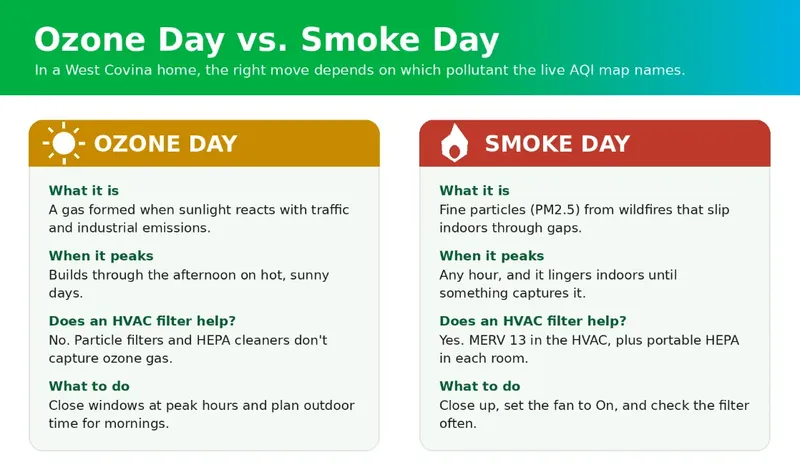
Filterbuy's Take: An Ozone Day and a Smoke Day Need Different Plans
After more than a decade of building filters and answering customer questions, we've found it helps to know what each pollutant does indoors.
Ozone is a gas, and pleated filters do not capture it. Ozone breaks down on indoor surfaces, so indoor levels usually stay lower when windows are shut. On an ozone day, timing and a closed house do the most.
PM2.5 is a particle, and it does not break down indoors. Smoke lingers until something captures it, which is why filtration reduces it on a smoke day.
That's why Filterbuy's AQI 100 steps pair a closed house with two filtration layers.
Matching Your Filter to West Covina's AQI
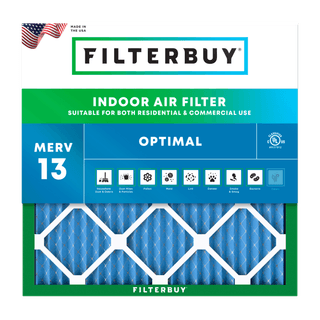
For wildfire smoke, use MERV 13. The EPA recommends a filter rated MERV 13 or higher in a central system during smoke events. EPA has also noted that most furnaces and HVAC systems can use MERV 13 without equipment problems when the filter is changed often. The only check is fit, as with any filter.
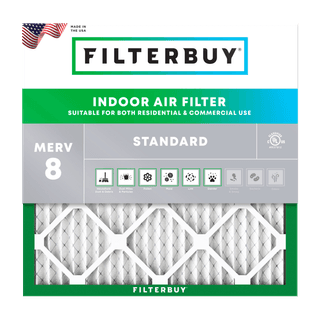
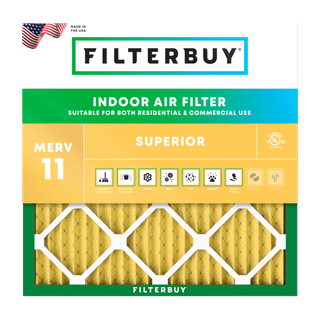
Filterbuy makes MERV 8, MERV 11, and MERV 13 filters on the same lines in the same plants, so we don't earn more when you move up a rating.
Most people don’t want a lecture on filtration. They want to know whether the filter in the hallway closet is the right one, and whether it can stay another month.
Michelle Wan, Guide Author and Brand Manager, Filterbuy
Filterbuy recommends a MERV tier and your size, not a single product. Portable HEPA air cleaners go in the room, never in the HVAC filter slot.
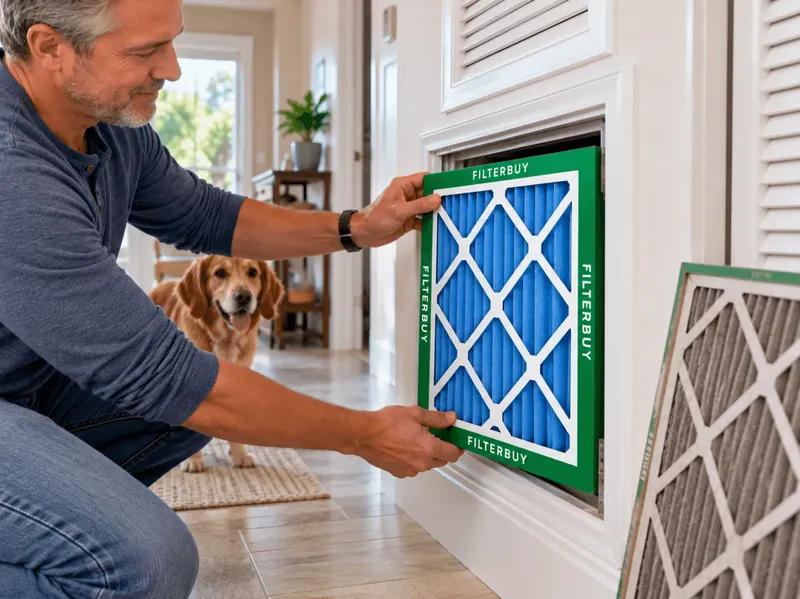
During smoke, check the filter often; EPA says to change it when it gets dirty. Keep spares on hand, or let auto-delivery send them on schedule. Licensed HVAC technician David Clark, who reviews Filterbuy's guidance, keeps the check simple: pull the filter and hold it up to a light.
No Central Air? What to Do in a Home Without Ducts
In apartments and homes with window units or wall heaters, there's no filter slot, so portable HEPA air cleaners are the primary defense, not a backup. Filterbuy doesn't make portable air cleaners, so this isn't a sales pitch. The EPA's sizing rule is a smoke CADR of at least two-thirds of the room's square footage, so a 300-square-foot bedroom needs a smoke CADR of about 200. Choose a model from the California Air Resources Board (CARB) certified list, since EPA advises against ionizers and other cleaners that may produce ozone. Our MERV 13 vs. HEPA comparison explains why HEPA belongs in a room unit, not a furnace slot.
Swamp coolers and whole-house fans pull outdoor air inside, so South Coast AQMD advises avoiding them during smoke.
Supporting Statistics: The Research Behind This Guide
82% of Californians live in counties with unhealthy air.
Covers 2022–2024 ozone and particle data.
Americans spend about 90% of their time indoors.
Source: EPA Report on the Environment
Some pollutants run 2 to 5 times higher inside.
Fireplaces emit about 5 tons of PM2.5 a day in the South Coast Air Basin.
Source: South Coast AQMD, March 2023
That equals the PM2.5 from all passenger vehicles in the basin.
It can double during burn season.
West Covina Air Quality FAQs
What Is the Air Quality in West Covina Today?
The live map at the top of this page shows the current reading and the pollutant behind it.
Is the Air Quality Bad in West Covina Today?
Check the map's color. Orange (101–150) means sensitive groups cut back outdoors; red (151–200) or worse means everyone limits time outside.
Where Can I See West Covina PM2.5 Today?
Select PM2.5 on the live map above. For smoke, the AirNow Fire and Smoke Map adds satellite plumes and sensors.
What MERV Rating Do I Need for Wildfire Smoke?
MERV 13. Filterbuy recommends switching at AQI 100 and adding a portable HEPA cleaner in each occupied room.
How Often Should I Change My Air Filter During Wildfire Smoke?
Check it during smoke and replace it once it turns dark brown or black, which can be well before the normal interval. Keep spares on hand.
Glossary
Air Quality Index (AQI): The EPA's 0–500 health scale.
Ground-level ozone (O3): Smog's main gas.
PM2.5: Fine particles 2.5 micrometers or smaller.
MERV: Minimum Efficiency Reporting Value, a 1–16 HVAC filter efficiency rating.
HEPA: Filtration that captures at least 99.97% of 0.3-micron particles, used in portable cleaners.
CADR: Clean air delivery rate, a portable air cleaner's output.