
Santa Rosa Real-Time AQI Tracker


Get Alerts For Unhealthy AQI In Your Area
When air quality in your area reaches unhealthy levels, we'll send you a quick alert, along with expert tips on how to reduce your exposure.
What's Actually In Santa Rosa Air Today?
What High AQI Means for Your Lungs in Santa Rosa
How to Read AQI
The Air Quality Index (AQI) measures how polluted the air is and how it may affect your health.
0–50 (Good): Air quality is satisfactory.
51–100 (Moderate): Acceptable, but some pollutants may pose minor concerns.
101–150 (Unhealthy for Sensitive Groups)
151–200 (Unhealthy)
201–300 (Very Unhealthy)
301+ (Hazardous)
Moderate
Still okay for most, but if you have asthma or allergies, take it easy and avoid long outdoor workouts.
Shop MERV 11 filters→What's the Right Filter for Your AQI Level?


Check Today's Live Real Time Air Quality Index AQI Map in Santa Rosa, CA Now
Author: Michelle Wan, Brand Manager and Air Quality Writer | Reviewed by: David Clark, Licensed HVAC Technician, Filterbuy | Published: July 31, 2026 | Updated: July 31, 2026
TL;DR
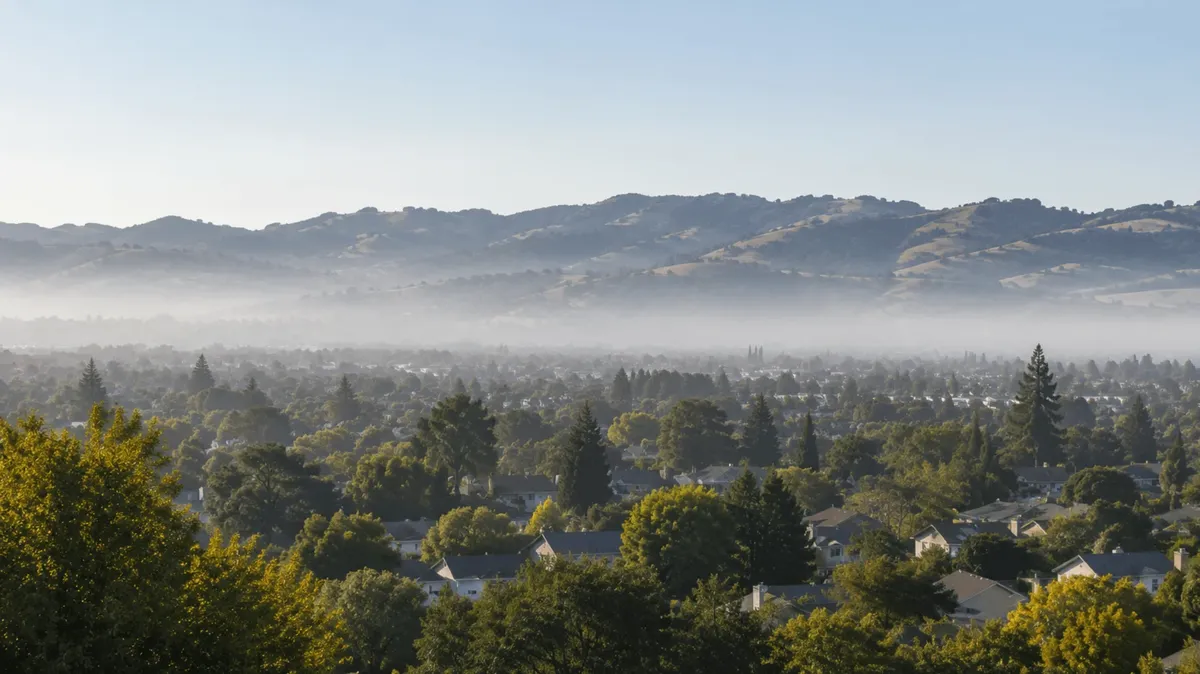
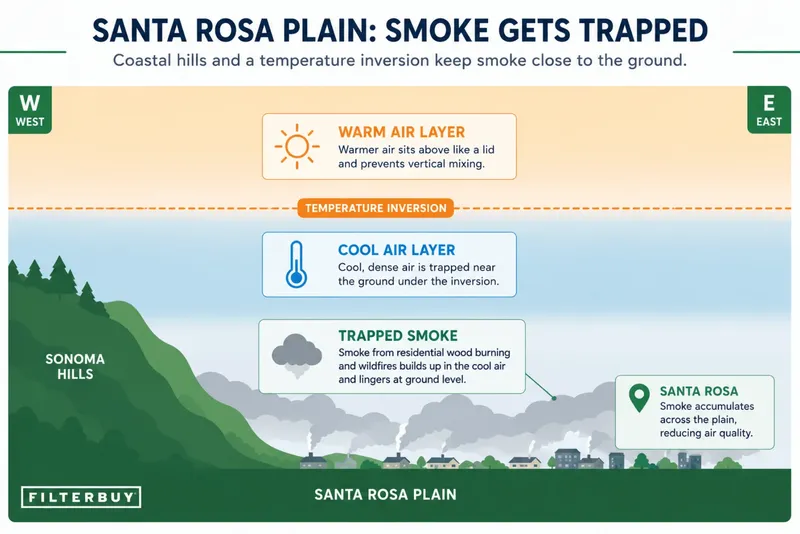
Santa Rosa air quality changes hour to hour, so the Filterbuy live map above carries today’s real-time reading for Sonoma County. Fine particulate matter drives most of the city’s unhealthy days, and wildfire smoke is the usual reason the number climbs fast. Santa Rosa sits in a basin that holds smoke overnight instead of clearing it, which is why a bad afternoon often becomes a bad morning.
The live map above shows the current Air Quality Index for Santa Rosa, California. A reading of 50 or below is good, 51 to 100 is moderate, and 101 or higher means people with asthma, COPD, or heart conditions should shorten outdoor activity. Fine particulate matter, known as PM2.5, causes most of Santa Rosa’s poor-air days, and smoke from Northern California fires is the usual cause of a sharp spike.
Key Takeaways
Santa Rosa’s Air Quality Index runs on the U.S. EPA scale of 0 to 500, where 101 and above is unhealthy for sensitive groups.
PM2.5 from wildfire smoke and winter wood burning is Santa Rosa’s dominant pollutant, not industrial emissions.
Santa Rosa falls under Bay Area Air Quality Management District jurisdiction, while Healdsburg, Guerneville, and the Sonoma coast fall under the Northern Sonoma County Air Pollution Control District.
Consumer sensors near Santa Rosa read high because they are not routinely calibrated, so Sonoma County health officials point residents to AirNow.
The U.S. EPA recommends a MERV 13 filter or higher during smoke events, with the HVAC fan set to run continuously rather than on auto.
A filter upgrade does not help on an ozone day, because residential HVAC filters capture particles and ozone is a gas.
What Is The Air Quality In Santa Rosa Today
Most Santa Rosa air quality pages publish a number and stop. The number is the easy part, and not what a household needs to decide anything.
Santa Rosa’s current AQI appears on the Filterbuy live map above, because no static page can report a number that changes every hour. The Air Quality Index is the U.S. EPA measure for outdoor air, running from 0 to 500 across six color-coded categories, and our guide to the AQI scale explained covers what each band means. In Santa Rosa the reading usually reflects PM2.5, and during summer heat it can reflect ground-level ozone. To check a specific ZIP code, use our real-time air quality index and wildfire smoke maps.
AQI categories and breakpoints follow the U.S. EPA Air Quality Index. Check the live map above for the current Santa Rosa reading.
Why Three Air Quality Apps Show Three Different Numbers For Santa Rosa
Santa Rosa residents routinely see three different AQI values at the same moment, because each source measures or models something different. Filterbuy treats AirNow as the tiebreaker, and so does the Sonoma County Department of Health Services, which warns that non-calibrated sensors tend to read high and points residents to federally certified monitors.
Sonoma County Department of Health Services notes that non-calibrated sensors run high and directs residents to federally certified AirNow monitors.
The lag has a technical cause. EPA converts hourly readings into a current AQI using an algorithm called NowCast, which averages over shorter windows when conditions shift quickly, such as during a fire. That is why the federal figure trails a fast-moving plume.
Which Air District Covers Santa Rosa And Why That Changes Your Advisory
Most air quality pages treat Sonoma County as one place. Filterbuy checked the boundary, and it is not. Santa Rosa falls under the Bay Area Air Quality Management District, which regulates the southern portion of the county, and the boundary follows historic Rancho survey lines rather than roads or city limits.
Bay Area Air Quality Management District covers Santa Rosa, Petaluma, Rohnert Park, Cotati, Sonoma, Glen Ellen, Graton, and Kenwood, plus portions of Windsor and Sebastopol.
Northern Sonoma County Air Pollution Control District covers Healdsburg, Cloverdale, Geyserville, Guerneville, Forestville, Bodega Bay, and the Sonoma coast.
This split explains a common source of confusion. A Santa Rosa household and a Healdsburg household can receive different advisories during the same fire, because two agencies issue them under different rules. It also determines which wood-burning restrictions apply to your address. In October 2025 the Bay Area Air Quality Management District board lowered the PM2.5 forecast level that triggers a Spare the Air Alert from 35 to 25 micrograms per cubic meter, which the district estimated would raise annual alerts to between 19 and 41 from a historic average of 15. Santa Rosa residents should expect more no-burn days.
What Drives Santa Rosa Air Quality Month By Month
Santa Rosa’s air quality problem changes character across the year, so Filterbuy built this calendar around drivers rather than a single annual average, which says little about any given day.
Periods overlap because Santa Rosa can face smoke and ozone in the same week during late summer.
Terrain amplifies all of it. Warm air moving over the hills west of the Santa Rosa Plain acts as a lid on cooler ground-level air, so an afternoon plume settles into the city and holds overnight rather than dispersing. That is usually why residents wake to a smoke smell with no fire nearby. To see which fires are producing it, our California wildfire and smoke map tracks perimeters and plume direction statewide.
How To Protect Indoor Air When Santa Rosa AQI Rises
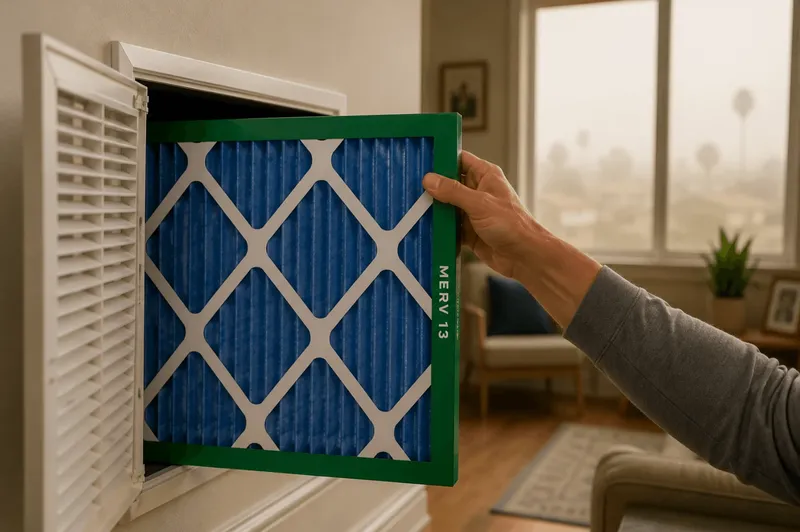
Indoor air is where Santa Rosa households have real control, and five steps do most of the work. The U.S. EPA recommends a filter rated MERV 13 or higher during smoky periods, noting that most residential furnaces and HVAC systems handle MERV 13 without trouble as long as the filter is replaced frequently.
Close windows and doors, and switch your HVAC fresh-air intake to recirculate so the system stops pulling smoke inside.
Set the thermostat fan to ON rather than AUTO. The California Air Resources Board recommends this during smoke events, because AUTO only filters when the system is heating or cooling.
Install the highest-rated filter your equipment supports. Filterbuy MERV 13 air filters capture the fine particles that define smoke, and MERV 11 air filters suit older systems that cannot handle the added resistance.
Inspect the filter every two weeks during active smoke and replace it when it looks dark, which is often sooner than the label suggests. Our breakdown of which MERV rating to use on high-AQI days maps each AQI band to a rating.
Add a portable HEPA air cleaner in the bedroom. MERV 13 is not HEPA, and true HEPA media is too restrictive for most residential blowers, so keep HEPA in portable units rather than the ducts. If your home has no central system, common along the Northern California coast, that portable unit is your primary tool rather than a supplement.
For rating detail, see our guidance on the best MERV rating for wildfire smoke and on MERV 13 compared with HEPA for smoke. The Los Angeles air quality index map covers Southern California.
One Case Where A Filter Upgrade Is Not The Answer
On a Santa Rosa ozone day the filter is not the lever. Ozone is a gas, and the EPA guide to air cleaners in the home states that residential furnace and HVAC filters are designed to capture particles. A MERV 13 does close to nothing for ozone however high the reading climbs. Filterbuy makes that filter, and we would rather say so than sell it into a problem it cannot solve.
What helps instead on a hot, still afternoon between July and September:
Keep windows closed so less ozone drifts indoors, and set the system to recirculate.
Move hard outdoor exertion to early morning, when ozone is lowest.
Check which pollutant is driving the reading before you decide anything.
What We See From The Manufacturing Side
Filterbuy makes the filters it sells, which shapes what we can say usefully about a smoke event.
Smoke loads a filter faster than anything else a home system meets. We cut our one-inch filters half an inch under nominal so they slide without binding, and during a smoke event that clearance is exactly where air escapes if the filter is not seated square in the slot. A MERV 13 sitting crooked in a Santa Rosa return does less than a MERV 8 sitting flush.
David Heacock, Founder and CEO, Filterbuy
Nobody should need three apps and a chemistry degree to decide whether their kid can play outside. Pick the federal number, learn your own household’s threshold, and check it once before you go out.
Michelle Wan, Brand Manager and Air Quality Writer, Filterbuy
Where our advice stops. Filterbuy manufactures filters. Weigh our filtration guidance with that in mind. Every health threshold here comes from the EPA, the CDC, and the American Lung Association rather than from us, and no filter prevents illness or replaces a clinician.
Frequently Asked Questions
Seven Sources We Keep Open During A Santa Rosa Smoke Event
Every live AQI reading traces back to a small number of federal, state, county, and nonprofit sources. These seven let you verify the number and see what is heading toward Sonoma County. Each one also tells you what to do about it.
Settle Which AQI Number Is Correct
When two apps disagree about Santa Rosa, the federal reading decides it. The AirNow guide to using the Air Quality Index explains the NowCast calculation behind the current hour’s value and why certified monitors trail a fast-moving plume.
Source: https://www.airnow.gov/aqi/aqi-basics/using-air-quality-index/
Choose The Right Filter Before Smoke Arrives
EPA guidance on preparing for smoke and heat names MERV 13 or higher as the target during smoky periods. It also explains the replacement frequency that makes the upgrade work rather than choke your system.
Source: https://www.epa.gov/wildfire-smoke-course/preparing-smoke-and-heat
Check Whether Your Household Is In A Higher Risk Group
The CDC list of people most at risk from wildfire smoke covers asthma, COPD, heart disease, diabetes, kidney disease, pregnancy, and age. Read it once so you know your own threshold before an event starts.
Source: https://www.cdc.gov/wildfires/risk-factors/index.html
Confirm Which Air Agency Governs Your Address
Sonoma County’s air district lookup tells you whether your address sits in BAAQMD or NSCAPCD territory. That answer determines which advisories reach you and which burn rules apply.
Source: https://sonomacounty.gov/air-quality-districts
Get Notified Before Smoke Reaches Sonoma County
Bay Area Air Quality Management District wildfire season guidance explains how to subscribe to Spare the Air Alerts and incident notifications, so an advisory reaches you before you smell smoke.
Source: https://www.baaqmd.gov/en/News-and-Events/Page-Resources/2026-News/061726-Wildfire-Season
Set Your HVAC System Correctly During A Smoke Event
Smoke Ready California carries the state-specific instruction most national guides omit. Run the system fan on ON instead of AUTO, and close the fresh-air intake so the system stops drawing smoke inside.
Source: https://ww2.arb.ca.gov/smokereadyca
Match Outdoor Activity To Your Asthma Risk
AAFA guidance on air pollution and asthma is the clearest explanation of why an asthma household should not treat 100 as a safe ceiling. It also covers how to adjust activities and medication on high-pollution days.
Source: https://aafa.org/asthma/asthma-triggers-causes/air-pollution-smog-asthma/
Supporting Statistics
Three findings explain why Santa Rosa’s numbers behave the way they do.
Wildfire Smoke Is More Harmful Than Other Fine Particle Pollution
Wildfire PM2.5 raised respiratory hospitalizations 1.3 to 10 percent per 10 micrograms per cubic meter.
PM2.5 from other sources raised them 0.67 to 1.3 percent.
What it means in Santa Rosa. The same AQI number carries more risk when smoke is the cause.
Research. Aguilera and colleagues, Nature Communications 2021, Scripps Institution of Oceanography.
Source: https://www.ncbi.nlm.nih.gov/pmc/articles/PMC7935892/
The Bay Area Ranks Among The Nation’s Worst For Short-Term Particle Spikes
The San Jose-San Francisco-Oakland metro area includes Santa Rosa and Petaluma.
It ranks among the 25 worst U.S. metros for short-term particle pollution, and wildfire smoke drives those spikes.
The region posted its lowest weighted average for the second consecutive year.
What it means in Santa Rosa. The air quality problem here is episodic, not constant.
Research. State of the Air 2026 short-term particle pollution findings.
Source: https://www.lung.org/research/sota/key-findings/short-term-particle-pollution
Many Santa Rosa Homes Have No Central System To Filter With
Household air conditioning use in 2020, from national down to the coast:
United States: 88 percent.
West Census Region: 73 percent.
Pacific Coast marine climate region: 49 percent, the lowest of any climate region.
What it means in Santa Rosa. Without central equipment, a portable HEPA cleaner is the primary defense rather than an add-on, and no Filterbuy filter changes that.
Research. EIA Residential Energy Consumption Survey.
Source: https://www.eia.gov/todayinenergy/detail.php?id=52558
How We Built This Page
Which number we trust. We treat AirNow as authoritative because the Sonoma County health department does, and because its monitors are federally certified. We say so plainly rather than averaging three disagreeing sources.
Why the air district split is here. It appears on no other Santa Rosa air quality page we found, and it is the reason two Sonoma County households get different advisories during one fire.
What we did not include. No estimated AQI figures, no health-outcome promises, and no claim that a filter protects anyone from illness.
About The Author And Reviewer
Michelle Wan is Brand Manager and Air Quality Writer at Filterbuy, where she turns MERV ratings, filtration, and HVAC efficiency into plain-English guidance and fronts much of the brand’s educational video work. She holds a B.A. from the University of California, Santa Cruz, and works directly with Filterbuy’s manufacturing teams, writing from how filters are built and used rather than from spec sheets.
David Clark, Licensed HVAC Technician with Filterbuy HVAC Solutions, reviewed the filtration, MERV, and HVAC operating guidance on this page for technical accuracy. He did not review the air quality monitoring or public health sections, which are sourced to the agencies cited above.
Filterbuy is a second-generation, family-owned American manufacturer. It began in the 1950s as Talladega Machinery and Supply, became Filterbuy in 2012, and sold its first filter in 2013. Filterbuy makes 100 percent of its products in the USA, in Alabama, Pennsylvania, Texas, and Utah, in more than 600 sizes plus custom, shipped factory-direct.
Glossary Of Santa Rosa Air Quality Terms
AQI (Air Quality Index): The U.S. EPA scale from 0 to 500 that reports outdoor air quality in six color-coded health categories.
PM2.5: Fine particulate matter 2.5 microns or smaller, the pollutant dominating wildfire smoke and Santa Rosa’s unhealthy air days.
Ozone: A gas formed when sunlight reacts with vehicle and industrial emissions, and Santa Rosa’s main summer afternoon pollutant.
NowCast: The EPA algorithm converting hourly monitor readings into a current AQI value, using shorter averaging windows when air quality changes quickly.
BAAQMD: The Bay Area Air Quality Management District, the regional regulator for Santa Rosa and southern Sonoma County.
NSCAPCD: The Northern Sonoma County Air Pollution Control District, covering Healdsburg, Cloverdale, Guerneville, and the Sonoma coast.
Spare the Air Alert: A BAAQMD advisory issued when fine particle pollution is forecast to reach unhealthy levels, during which wood burning is illegal across the Bay Area.
MERV: Minimum Efficiency Reporting Value, the ASHRAE scale rating how effectively an HVAC filter captures airborne particles.
Temperature inversion: A layer of warm air above cooler ground-level air that prevents pollution from dispersing upward.
AirNow: The federal interagency website publishing air quality data from certified regulatory monitors nationwide.