
Concord Real-Time AQI Tracker


Get Alerts For Unhealthy AQI In Your Area
When air quality in your area reaches unhealthy levels, we'll send you a quick alert, along with expert tips on how to reduce your exposure.
What's Actually In Concord Air Today?
What High AQI Means for Your Lungs in Concord
How to Read AQI
The Air Quality Index (AQI) measures how polluted the air is and how it may affect your health.
0–50 (Good): Air quality is satisfactory.
51–100 (Moderate): Acceptable, but some pollutants may pose minor concerns.
101–150 (Unhealthy for Sensitive Groups)
151–200 (Unhealthy)
201–300 (Very Unhealthy)
301+ (Hazardous)
Moderate
Still okay for most, but if you have asthma or allergies, take it easy and avoid long outdoor workouts.
Shop MERV 11 filters→What's the Right Filter for Your AQI Level?


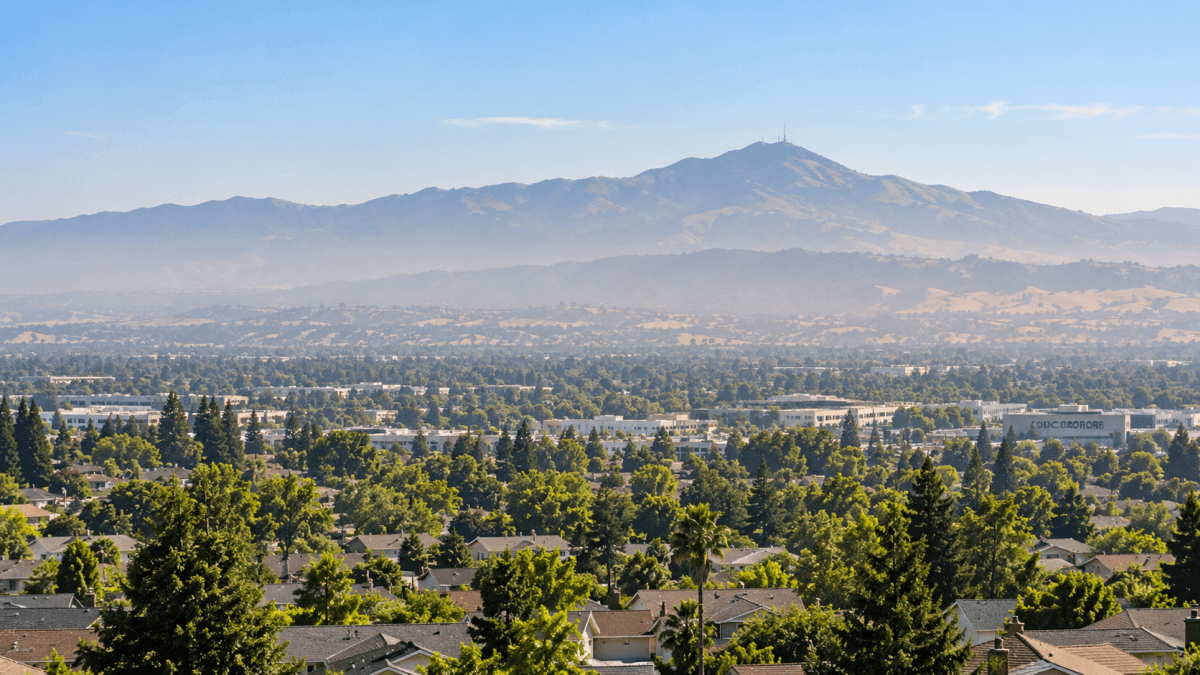
Check Today's Live Real-Time Air Quality Index AQI Map in Concord, CA Now
TL;DR
Concord, California, sits in the Diablo Valley in central Contra Costa County, where outdoor air is Good most days but swings on a predictable seasonal schedule. Summer heat builds ozone, late summer and fall bring wildfire smoke, and winter inversions trap wood smoke near the ground. Filterbuy's live AQI map above gives the current number so you can decide whether to open windows, move exercise indoors, or change your filter.
Key Takeaways
The U.S. Air Quality Index runs from 0 to 500, and Concord readings are reported on that same national scale.
The Bay Area Air District operates the regulatory monitoring site that reports Concord's official air quality data, located on Treat Boulevard.
Concord has three air quality seasons: summer ozone, late summer and fall wildfire smoke, and winter wood smoke held down by inversions.
When a Spare the Air Alert is called for fine particle pollution, burning wood in Concord is illegal both indoors and outdoors.
EPA recommends a MERV 13 or higher filter in a central system during smoke events. Filterbuy's action line is AQI 100, with a portable HEPA air cleaner in each occupied room.
What Is The Air Quality In Concord, CA Today?
Concord's air quality today appears on the Filterbuy live AQI map at the top of this page, drawn from the monitoring network covering Contra Costa County. That number is the Air Quality Index, a 0 to 500 scale set by the U.S. Environmental Protection Agency. Anything at or below 50 counts as Good, and once the reading passes 100, sensitive groups should scale back outdoor effort.
The AQI is not a live thermometer reading. For fine particles the EPA reports a value called the NowCast, weighted toward the most recent of the previous 12 hours. That design keeps the number responsive during fast-moving smoke without letting one noisy hour swing it. The practical consequence is that a Concord reading of 90 during a smoke episode may still be climbing, so check again in an hour rather than treating it as settled.
What Each AQI Color Means For Concord Households
Concord's AQI is reported in six color-coded categories, each mapped to a concentration of PM2.5, the fine particles that make up most wildfire and wood smoke. The table below pairs those categories with the concentration that triggers them and the indoor step that makes sense at that level.
PM2.5 shown in micrograms per cubic meter, per the current EPA AQI breakpoints. EPA recommends a high-efficiency filter rated MERV 13 or higher in a central system during smoke events. AQI 100 is where Filterbuy tells customers to act. Our recommendation of a portable HEPA air cleaner in each occupied room goes beyond EPA's single clean room. Homes without central forced air can rely on the room cleaners alone.
The index has two blind spots. It does not track pollen, so a Good reading can still be a hard morning for allergy sufferers during the Diablo Valley's spring bloom. It also says nothing about a neighbor burning through a Spare the Air Alert, which the Air District takes reports on at 1-877-4NO-BURN.
Concord's Three Air Quality Seasons
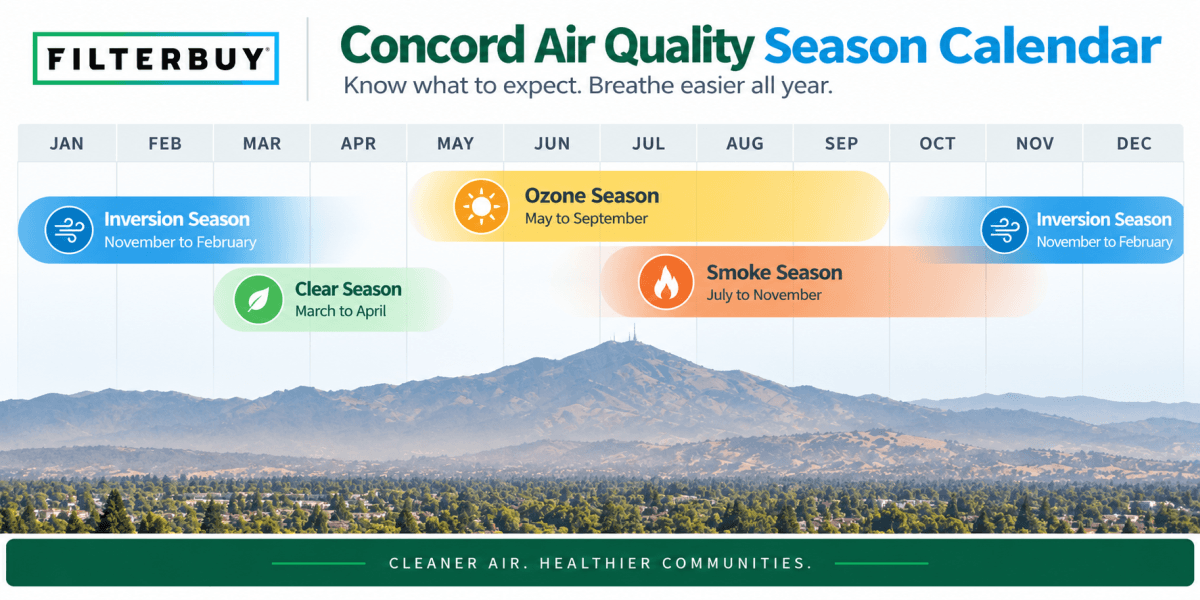
Concord air quality behaves as three separate conditions, each arriving on a reliable schedule set by the Diablo Valley's geography. The season you are in tells you what the AQI number is made of and which filter belongs in your system.
Ozone is a gas rather than a particle, so pleated HVAC filter media does not capture it. Ozone season calls for reduced outdoor exposure, not a filter upgrade.
Wood smoke is the largest source of Bay Area air pollution in winter, accounting for more than a third of regional fine particulate matter. Our guide to wildfire smoke and the AQI covers how smoke drives the index.
When Concord's Number Peaks During The Day
Ozone season: worst on hot afternoons, after sunlight has worked on the day's emissions. Morning is the better window for outdoor exercise.
Inversion season: worst overnight and early morning, when cold, still air pins wood smoke near the ground. Readings often ease by midday.
Smoke season: no daily clock. Wildfire smoke moves with wind shifts, so a clear morning does not predict the afternoon.
Why Concord's Number Differs From Nearby Bay Area Cities
Concord sits inland, behind the California Coast Range, which blocks the marine air flow that ventilates coastal Bay Area cities. The Air District describes the San Ramon and Diablo Valleys as warm in summer and cool in winter for that reason. The same geography is why a Concord reading can run higher than a shoreline reading on the same afternoon.
Two local factors sharpen the gap. Interstate 680 and State Route 242 funnel Bay Area traffic toward the Delta through central Concord, lifting particle levels along that corridor. Winter adds the second, because tule fog and cold, still nights are common across Contra Costa County, and those are the conditions that lock smoke near the ground. The Air District documents a transport path that matters here too. Fine particles move west through the Carquinez Strait from the Central Valley and settle on top of local wood smoke. That is how Concord can exceed health standards on a night when little is burning nearby. Compare today's reading against the Oakland air quality map or the California statewide AQI map to see how far the difference runs. A neighborhood two miles from the Treat Boulevard monitor can read differently, so treat the official number as your citywide baseline rather than your street-level one.
What To Do In A Concord Home When The AQI Climbs
When Concord's AQI passes 100, the goal is to stop outdoor air from coming in and to keep filtering the air already inside. Five steps do most of the work.
Close windows and doors, and keep them closed until the reading drops back below 100.
Switch the thermostat fan from Auto to On so the system keeps pulling air through the filter between heating and cooling cycles.
Set the system to recirculate rather than drawing in outdoor air.
Fit a MERV 13 filter, in a standard or custom Filterbuy size cut to your slot, and run a portable HEPA air cleaner in each occupied room, bedrooms first. If your home has no central forced air, the room cleaners are your primary defense rather than a supplement.
Check the filter during the smoke event rather than on a calendar. Replace it when it looks dirty, dark brown or black, which can be well before the normal interval. Keep spares on hand.
Avoid adding indoor sources while the house is sealed. Candles, unvented gas appliances, and frying all raise indoor particle levels when you can least ventilate them away.
Which MERV Rating Fits Today's Concord AQI
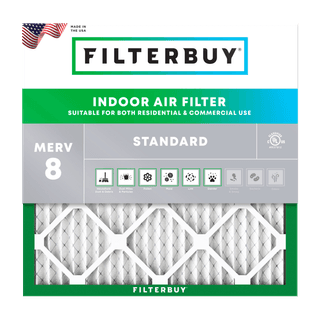
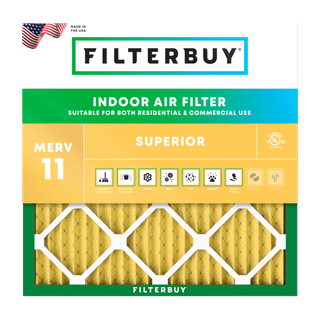
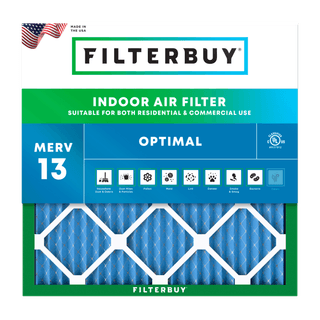
Match the filter to the season. Filterbuy manufactures pleated filters in MERV 8, MERV 11, and MERV 13, and the difference between them is how much of the airborne particle load each one captures.
Capture figures are Filterbuy pleated media ratings for airborne particles. MERV 13 is the tier we recommend for smoke. It is a high-efficiency pleated filter and is not the same thing as a true HEPA air cleaner, which is tested under a different standard and belongs in a portable unit rather than a furnace slot.
Most furnaces and HVAC systems accommodate MERV 13 without equipment problems, provided the filter is replaced often. Check your slot size the way you would for any filter. Our breakdown of MERV 13 compared with true HEPA covers where each one fits, and our guide to matching MERV rating to today's AQI walks through the choice season by season. When you are ready to order, shop MERV 13 air filters for smoke days, shop MERV 11 air filters for everyday use, or shop MERV 8 air filters for routine dust. All three come in standard and custom sizes.
Supporting Statistics
Three findings from federal research and U.S. standards bodies back the guidance above. They cover whether layered filtration works, how to size the room unit, and what is legal to buy in California.
Layering A Filter And A Room Cleaner Cuts Indoor Smoke Further
Portland home monitored through the September 2020 megafires.
MERV 13 alone: indoor-to-outdoor PM2.5 ratio of 0.55.
MERV 13 plus one portable air cleaner: 0.22.
Mean indoor PM2.5 fell from 134.9 to 28.2 micrograms per cubic meter.
Both still exceeded the EPA 24-hour threshold. Layering lowers exposure without eliminating it.
Source: NIH-archived study on MERV 13 and portable air cleaners.
Wildfire Smoke Calls For A Larger Room Air Cleaner
EPA clean-room rule: pick a unit whose smoke clean air delivery rate is at least two-thirds of the room's floor area.
Worked example: a 300 square foot bedroom wants a smoke CADR of about 200.
AHAM goes further for wildfire smoke, recommending a rating equal to the full square footage, which would be 300 for that same room.
Skip ionizers and ozone generators. EPA advises against air cleaners that produce ozone.
Source: AHAM air filtration standards, which defines the CADR test method.
California Regulates Which Air Cleaners Can Be Sold
Certification required on portable air cleaners sold in California since 2010.
More than 9,000 devices from 800-plus manufacturers are certified.
Electronic models are capped at 0.050 parts per million of ozone.
Check the packaging label: Meets California ozone emissions limit: CARB certified.
Uncertified devices cannot legally be shipped into California.
Source: California Air Resources Board air cleaner guidance.
Where To Check Concord Air Quality Right Now
Beyond the Filterbuy map above, six sources cover Concord, each answering a different question.
AirNow Fire and Smoke Map. Block-level readings during fires.
Bay Area Air District Contra Costa County page. Regional alerts and official monitoring.
Spare the Air wood burning rule. Whether burning is legal tonight.
EPA guidance on reducing smoke exposure. The indoor playbook.
CDC guidance on who is most at risk from smoke. Highest-risk groups.
American Lung Association Contra Costa report card. Annual county grades.
Expert Perspective From Filterbuy
Filterbuy manufactures pleated MERV 8, MERV 11, and MERV 13 filters in the United States, in more than 600 standard sizes plus custom cuts. That vantage point shaped two calls on this page.
The season calendar above is our own framework, built around the Diablo Valley rather than a generic fire-season chart. Concord's winter inversions matter as much here as summer smoke.
We also priced both halves of the above-100 recommendation from our own catalog. A MERV 13 covers a 2,000 square foot home for roughly 3 to 12 cents per square foot over a 90-day smoke season. A portable HEPA unit for a single 300 square foot bedroom runs near a dollar per square foot in year one. The result that surprised us was that running the blower continuously costs more than the filters do. And for a home with no ducts, or a renter who cannot change the equipment, the portable unit is the better first buy, even though we do not sell one. The full math sits in our portable air purifier compared with an HVAC filter analysis.
Frequently Asked Questions
Glossary
Air Quality Index (AQI): a 0 to 500 scale set by the U.S. EPA that converts pollutant concentrations into one number across six color-coded health categories.
PM2.5: fine particulate matter 2.5 micrometers or smaller, the dominant pollutant in wildfire smoke and residential wood smoke.
Ozone: a gas formed when sunlight reacts with vehicle and industrial emissions. Ozone is a gas rather than a particle, so pleated HVAC filter media does not capture it.
NowCast: the EPA calculation turning recent hourly particle data into a current AQI value, weighted toward the most recent 12 hours.
MERV: Minimum Efficiency Reporting Value, the ASHRAE scale rating how much of the airborne particle load an HVAC filter captures.
Spare the Air Alert: a Bay Area Air District advisory making wood burning illegal region-wide when fine particle pollution is forecast to exceed the district threshold.
Inversion: a layer of warm air above cooler air near the ground, acting as a lid that traps pollution at breathing level.