
Subaru Forester Cabin Air Filter:
Which One Fits Your Year (and How to Change It)
By Michelle Wan · Reviewed by David Clark, Licensed HVAC Technician · Published July 22, 2026 · Updated July 22, 2026
Which Cabin Air Filter Fits Your Subaru Forester?
Your Forester's cabin air filter is set by chassis generation, not by trim or engine. 2025–2026 cars use OEM interchange 72880FN00A, 2019–2024 use 72880FL000, and 2009–2018 use 72880FG000. The filter sits behind the glove box on every generation, and Subaru recommends replacing it every 12,000 miles.
- 2025–2026 (sixth generation): 72880FN00A — frameless, no tools needed
- 2019–2024 (SK): 72880FL000 — no tools needed
- 2009–2018 (SH / SJ): 72880FG000; built after 03/2018, 72880FJ000
- 2003–2008 (SG): varies by market
Not sure which generation you have? Take the quick match below, or find your Forester in the vehicle selector.

Answer 3 quick questions and we'll match you to your perfect filter.
TL;DR
Every Subaru Forester built since 2009 uses a cabin air filter behind the glove box, and the right one depends on your generation: OEM interchange 72880FG000 for 2009–2018, 72880FL000 for 2019–2024, and 72880FN00A for 2025 and newer. Subaru recommends replacing it every 12,000 miles. The swap takes about ten minutes and needs no tools on 2019 and newer cars.
Key Takeaways
The 2019–2024 Subaru Forester uses OEM interchange part 72880FL000, which is also shared with the 2022 and newer WRX.
The 2025 Forester changed parts. The sixth-generation car uses 72880FN00A, a frameless design that is not interchangeable with the 2019–2024 filter.
The 2009–2018 Forester uses 72880FG000; late-build 2018 cars take 72880FJ000.
Subaru recommends replacement every 12,000 miles, though some Subaru dealer parts catalogs list 15,000. The shorter interval is the safer default.
The filter sits behind the glove box on every generation, reachable by squeezing the glove box stops.
Fitment matters as much as filtration media. A slightly undersized filter lets unfiltered air bypass the frame entirely.
Which Cabin Air Filter Fits Your Subaru Forester?
The right cabin air filter for a Subaru Forester is set by chassis generation, not trim or engine. Four OEM interchange numbers cover nearly every Forester on the road, and Subaru changed the housing between generations, so the wrong one will not seal.
The filter sits behind the glove box on every generation. The 2009–2018 split is by build date, not model year: late-build 2018 Foresters take 72880FJ000.
We cross-checked Subaru’s catalog against the aftermarket listings and hit two traps a model-year lookup will not catch. The 2018 Forester splits by build date, not model year, so two cars badged the same take different filters. The 2025 car moved to a frameless design that plenty of listings still file under the old number. Subaru’s entries for the 2025 Forester and the 2009–2018 cars are the tiebreaker.
A boundary year takes ten seconds to settle. Federal rules put a certification label on the driver-side hinge pillar or door-latch post of every US-market vehicle, showing the month and year of manufacture (49 CFR 567). Built 02/18? You want 72880FG000. Built 05/18? 72880FJ000. March 2018 builds fall in the gap between the two catalog listings, so confirm that one before you buy.
“If you check one thing before you order, check the build date, not the model year. The Forester changed filters mid-2018 and again for 2025, and a model-year lookup will quietly hand you the wrong part.”
Michelle Wan, Filterbuy
Find your Forester in the vehicle selector to confirm the match before you order.
Where Is the Cabin Air Filter on a Subaru Forester?
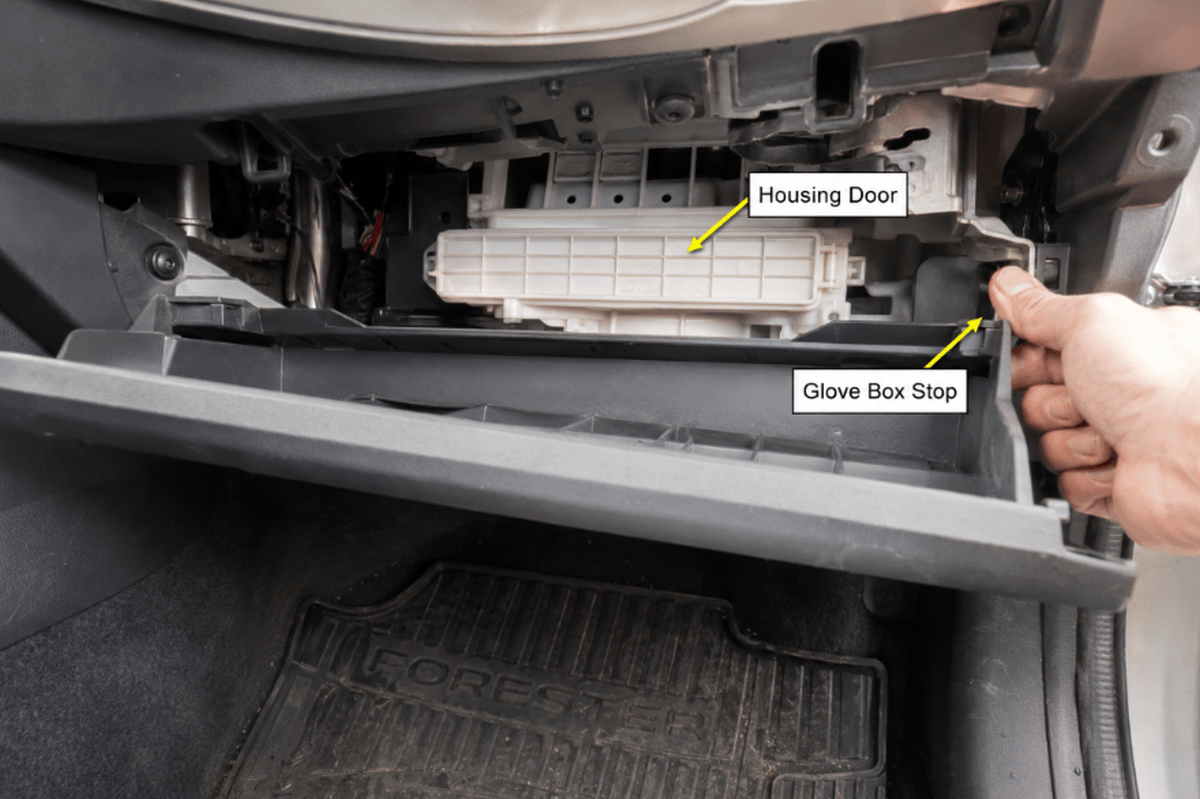
The cabin air filter on a Subaru Forester sits behind the glove box, inside the HVAC housing. On 2014 and newer cars, empty the box, squeeze the stops on either side of the tray inward, and let it swing down past its normal stop. A plastic door behind it holds the filter.
Older Foresters take a little more work. On 2008–2013 models you unhook the glove box retention arm, release the catch ramps on each side with a screwdriver tip, and lift the box off its hinge points. iFixit’s step-by-step teardown for those model years confirms it needs only a flat screwdriver. The Filterbuy guide to where the cabin air filter is located in a car covers the three places automakers put it.
How to Change a Subaru Forester Cabin Air Filter
Budget ten minutes, engine off. The step people get wrong is the airflow arrow: upside down the filter still fits, but the pleats load unevenly and clog early.
Empty the glove box and open it fully.
Release the glove box stops. Squeeze the tab on each side so the tray drops below its normal travel.
Open the housing door. Press its tab and pull the cover free.
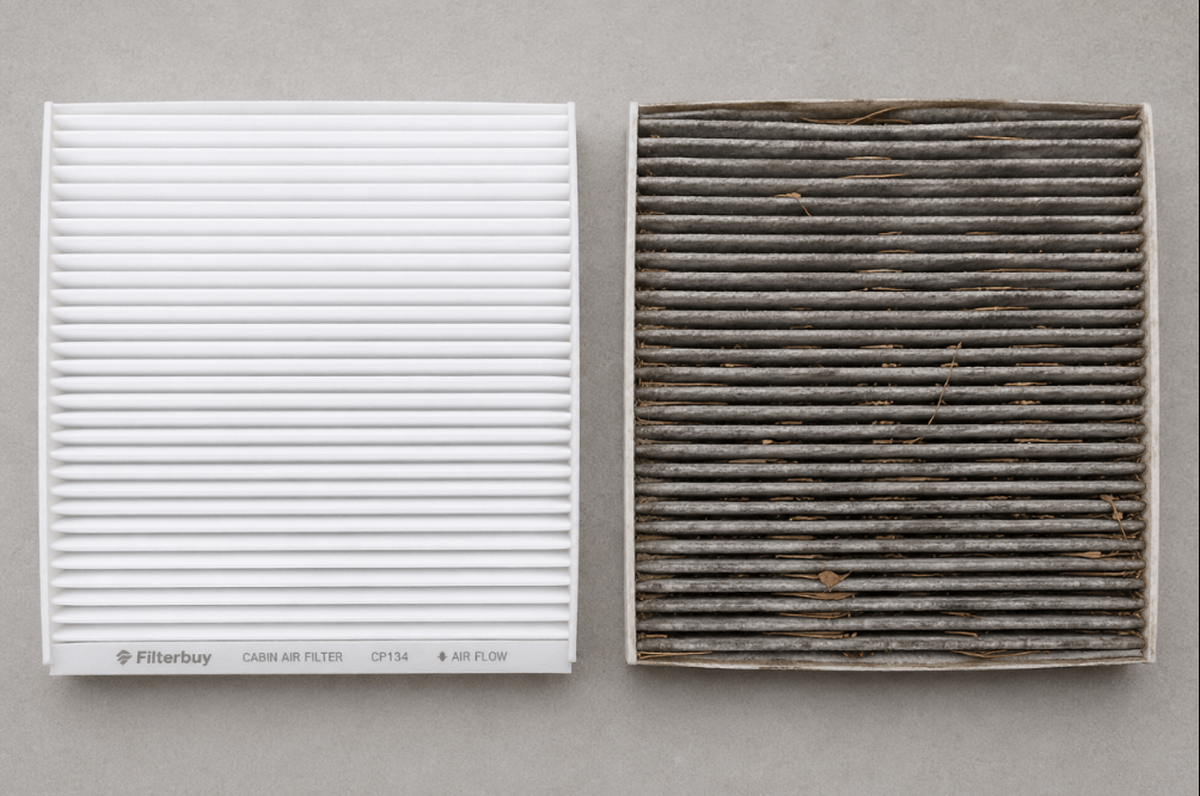
Slide the old filter out level; a loaded one sheds debris into the footwell.
Note the airflow arrow on the old filter’s frame before you discard it. On the Forester it points down, toward the floor.
Slide the new filter in with its arrow the same way, close the door, and lift the glove box back past its stops.
Run the fan on high afterward; airflow should be stronger if the filter was overdue.
How Often Should You Replace a Forester Cabin Air Filter?
Subaru’s parts documentation says every 12,000 miles, and traces the figure to the maintenance schedule in your Warranty and Maintenance Booklet. Several Subaru dealer parts catalogs list 15,000 miles instead, which is where the confusion comes from. When sources disagree, Filterbuy takes the shorter one: a filter changed early costs a few dollars, a clogged one strains the blower motor. Subaru of America’s own cabin air filter replacement care tip covers it on video.
Mileage alone is blunt. Foresters see more gravel and forest road than most crossovers, which loads a filter faster than commuting does. Adjust from the 12,000-mile baseline.
Baseline of 12,000 miles follows Subaru parts documentation. Some Subaru dealer catalogs list 15,000 miles; the shorter interval is the safer default.
Do not wait for the interval if you notice weak airflow at full fan speed, a musty smell when the AC starts, windows that fog and clear slowly, or dust settling on the dash faster than it used to. Those are the signs a cabin filter is already overdue. Smoke season is its own case: soot and ash load a filter far faster than road dust, so during a heavy wildfire smoke event inspect the filter every few months rather than waiting on mileage.
Standard, Carbon, or HEPA: Which Is Right for a Forester?
For most Foresters, HEPA is the right call, and the one to pay for if anyone in the car has allergies or you drive through smoke and heavy pollen. Pick carbon instead when exhaust odor in traffic is the main complaint. All three share the same housing, so this is a media choice, not a fitment one.
All three media types use the same Forester housing. Fitment is set by generation, not by filter media.
Filterbuy HEPA cabin air filters capture 99.97% of particles down to 0.3 microns, and hydrocharging magnetizes every fiber so capture rises without the airflow loss that makes a dense filter feel weak. For more, see the complete buyer’s guide to cabin air filters.
Why Fitment Beats Media on a Forester
Most Forester owners never hear this: an exact-fit standard filter often beats a premium one a fraction of an inch undersized. The reason is bypass air. When a gap opens between the filter frame and the housing wall, unfiltered air flows around the media, and a HEPA rating means nothing to particles that never touch it.
Bypass air is the failure Filterbuy builds against. We cut every Forester filter to exact OEM tolerances in our own US plants, because filtration the air skips past is filtration you paid for. Get the part number right first, then pick the media.
Essential Resources for Your Subaru Forester Cabin Air Filter
Seven places to check before you order.
1. Make Sure It Fits Before You Hit Buy
Enter your year and trim, and the Filterbuy vehicle selector matches the filter for you.
2. Double-Check the Part Number With Subaru
When a listing and a dealer quote clash, the Subaru genuine parts catalog settles it.
3. Get the Real Service Interval for Your Forester
Each model year has its own Warranty and Maintenance Booklet at Subaru Vehicle Resources. That settles the mileage question for your car.
4. See What You’re Getting Into Before You Start
On a 2008–2013 Forester the glove box lifts off its hinges instead of swinging down. iFixit’s teardown guide photographs it.
5. Figure Out If the Dealer Part Is Worth It
The Filterbuy OEM versus aftermarket guide covers where each wins, and why aftermarket won’t void your warranty.
6. Don’t Buy the Wrong Filter: You Have Two
Your Forester has a cabin filter and an engine filter, part numbers side by side in search. This side-by-side guide sorts them out.
7. Hear It From Other Forester Owners First
The Subaru Forester Owners Forum caught the frameless 72880FN00A switch before most catalogs did. Treat threads as a tip to check, not gospel.
What the Research Says About the Air You Breathe While Driving
Three findings from US government and public-health sources.
Closed windows cut fine-particle exposure by about two-thirds.
5.21 micrograms per cubic meter with windows up. 15.21 with them down.
Six commuting modes, one Salt Lake City route, measured at once.
Protection is “dependent on the vehicle’s air filter,” the authors note.
Source: PLOS ONE, via PubMed Central
45 million Americans live within 300 feet of a major road.
The EPA links that proximity to reduced lung function, asthma, and heart disease.
44% of Americans breathe air that earns a failing grade.
152.3 million people, in counties failing on ozone or particle pollution.
What to do with that: on a smoky or high-pollen day, windows up, hit recirculate. A filter only cleans air that passes through it.
Frequently Asked Questions
Ready to breathe easier on your next drive?
Find the exact cabin air filter for your Forester. Factory-direct, made in the USA, with free shipping.
Glossary
Cabin air filter. The filter that cleans outside air before it enters a vehicle’s interior through the HVAC system.
Bypass air. Unfiltered air that flows around the edges of a poorly fitted filter instead of passing through the media.
OEM interchange number. The manufacturer’s part number, used to match an aftermarket filter to the factory part. For the 2019–2024 Forester it is 72880FL000.
HEPA. High-Efficiency Particulate Air, a standard requiring capture of 99.97% of particles at 0.3 microns.
Activated carbon. A treated carbon layer added to a filter that adsorbs gases and odors that particulate media cannot trap.
Hydrocharging. A Filterbuy process that permanently charges filter fibers, increasing particle capture without adding airflow restriction.
Blower motor. The fan that pushes air through a vehicle’s vents. Restricted airflow shortens its life.