
Hyundai Sonata Cabin Air Filter: Where It Is, Which One Fits, and How to Swap It in 10 Minutes
Author: Michelle Wan | Reviewed by: David Clark, Licensed HVAC Technician
Published: July 22, 2026 | Updated: July 22, 2026
Where Is the Cabin Air Filter on a Hyundai Sonata?
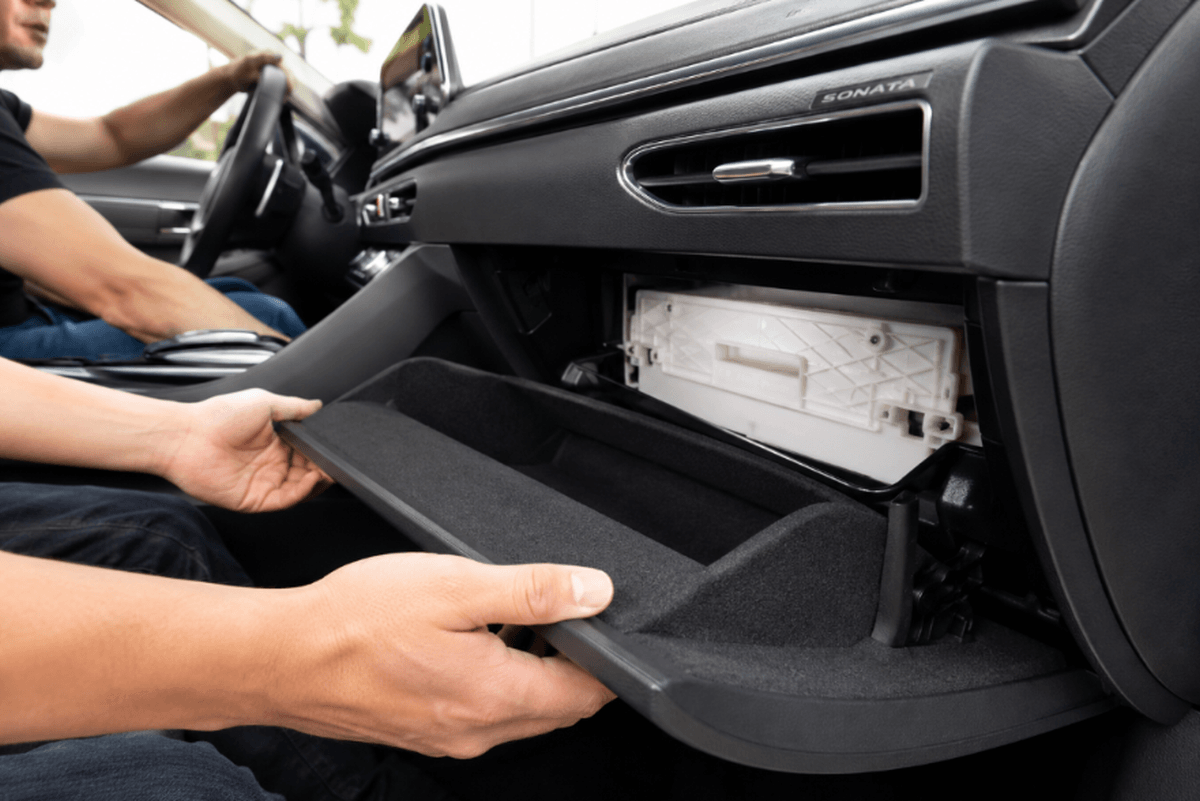
Your Hyundai Sonata's cabin air filter sits directly behind the glove box, and it takes about 10 minutes to swap with no tools. The detail most sites skip: Sonata Hybrid and non-hybrid trims from the same model year use two physically different filters, so ordering by year alone is how the wrong part ends up in your cart. Answer three quick questions below and we will match you to the filter built for your exact Sonata.

Answer 3 quick questions and we'll match you to your perfect filter.
TL;DR
The cabin air filter in a Hyundai Sonata sits behind the glove box, and you can replace it yourself in about 10 minutes with no tools. Hyundai’s schedule calls for replacing the climate control air filter every 15,000 miles or 24 months. Filterbuy recommends 12,000 miles or once a year for U.S. driving conditions, and we explain why below. The single most common mistake is ordering by model year alone: Sonata Hybrid and non-hybrid trims from the same year use different filters.
Key Takeaways
The Sonata’s cabin air filter is located behind the glove box on every generation from 2006 forward, reachable by releasing the glove box damper and hinge stops.
Hyundai lists the climate control air filter as a 15,000-mile / 24-month item. Filterbuy recommends 12,000 miles or once a year for U.S. driving conditions.
Hybrid and non-hybrid Sonatas of the same model year can take physically different filters. A 2016 Sonata Hybrid uses OEM 97133-C1010; a 2016 non-hybrid Sonata uses 97133-C2000, roughly an inch smaller in both dimensions.
Weak airflow at full fan speed, slow-clearing window fog, and a musty smell when the A/C first kicks on are the three symptoms that most often trace back to a clogged cabin filter.
A cabin air filter is not the same part as an engine air filter. The cabin filter cleans the air you breathe; the engine filter protects the intake.
Cabin air filtration reduced in-vehicle PM2.5 by 30% in a 2023 randomized crossover study of 48 commuters published in Environmental Science & Technology.
Where Is the Cabin Air Filter on a Hyundai Sonata?
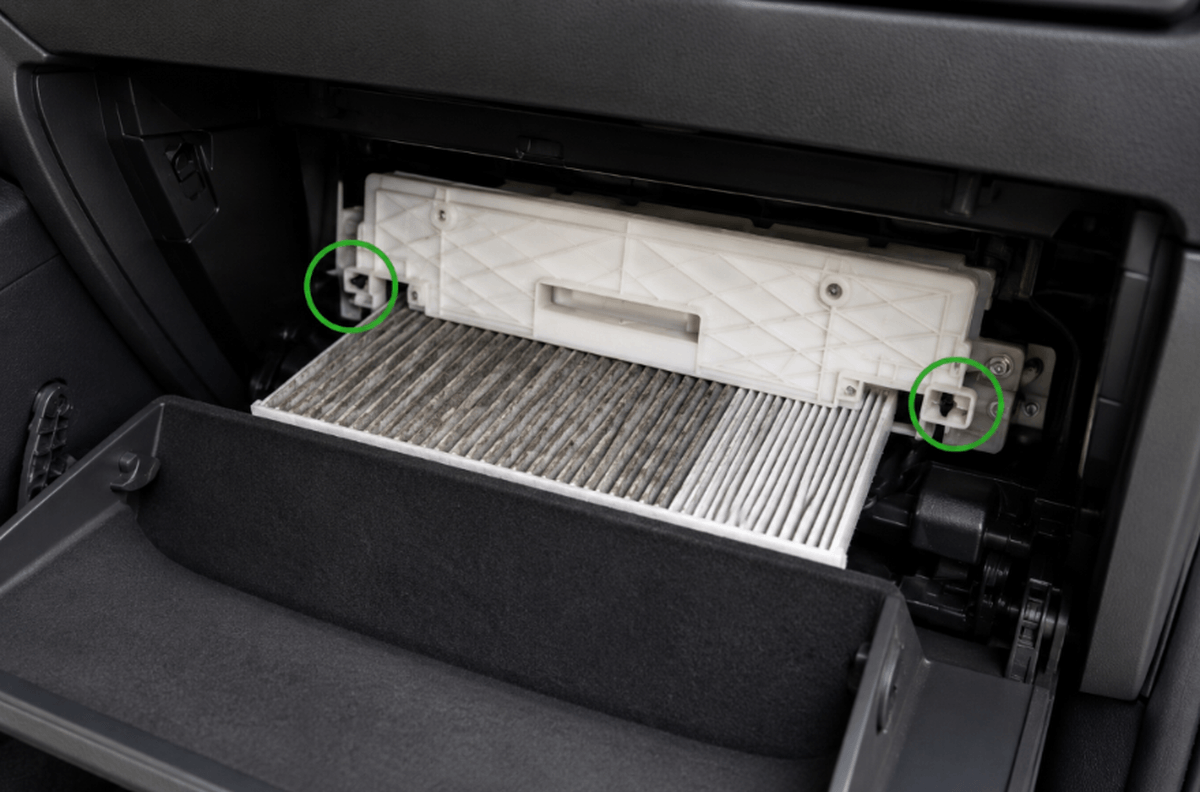
The Hyundai Sonata’s cabin air filter is located behind the glove box, inside the blower housing on the passenger side of the dashboard, which is where cabin air filters sit in roughly 70 to 80 percent of modern vehicles. On 2006 and newer Sonatas, you reach it by emptying the glove box, rotating the damper arm counterclockwise to release it, and squeezing the hinge stops so the glove box door swings all the way down. That exposes a rectangular plastic filter cover with pinch tabs on each side.
No tools are required on any Sonata generation from 2006 onward. The whole job is hand pressure and patience with two plastic tabs.
Which Cabin Air Filter Fits Your Hyundai Sonata?
Sonata cabin air filters are not interchangeable across generations, and the sharpest trap is the hybrid split. Owners of 2016–2017 Sonata Hybrid and Plug-In Hybrid models report ordering a filter listed for a 2016 Sonata and finding it roughly an inch short in both dimensions, because the hybrid uses a different housing.
We went looking for why so many Sonata owners end up returning a filter, and the answer is sitting in Hyundai’s own catalog. The hybrid carries part number 97133-C1010. The non-hybrid of the same year carries 97133-C2000. Almost every retailer, including the big marketplaces, organizes fitment by year and model and stops there. Trim is where the split actually happens, so a page that only asks for your model year will confidently sell you the wrong part.
Match your trim, not just your year. That single habit prevents the most common ordering mistake on this vehicle.
Cross-referenced from Hyundai OEM parts catalogs and aftermarket suppliers. Note the 2009 trap: Hyundai dealer catalogs scope 97133-0A000 to Sonatas built from 1/12/09, which is a build date, not a model year. Two 2009 Sonatas off the same lot can take different filters. Confirm against your VIN or the frame you pull out.
The 2009 build-date trap. Hyundai dealer parts catalogs do not scope 97133-0A000 by model year. They scope it to Sonatas built from 1/12/09, which is a build date. Two 2009 Sonatas sold off the same lot can take different filters depending on which side of that January cutoff they left the line. None of the retailer fitment tools we checked ask for a build date, which is why this one quietly generates returns.
The safest path: pull the existing filter first, read the frame, then order. It costs you five minutes and saves a return.
How to Find Your Sonata Trim and Build Date
Match your trim is useless advice without telling you where to look. Three places, most reliable first:
Driver’s door jamb sticker. Open the driver’s door and read the placard on the pillar. It carries the build date as a month and year. This is the one that settles a 2009 Sonata.
The 10th character of your VIN. That single character is the model year, not the build year. A car built in late 2008 can still be a 2009 model, which is exactly how the 1/12/09 split catches people.
Hybrid or not. Check the badging, the instrument cluster for a battery or energy-flow display, and your registration. On a 2016–2017 Sonata this decides which of two differently sized filters you need.
Thirty seconds at the door jamb is cheaper than a return shipping label.
How to Replace a Hyundai Sonata Cabin Air Filter
Replacing the cabin air filter in a Hyundai Sonata takes about 10 minutes and requires no tools. The sequence below follows the same method as our step-by-step cabin air filter replacement guide, with the details specific to the Sonata. Empty the glove box, release the damper and hinge stops, pinch the filter cover tabs, slide the old filter out, note the airflow arrow, and slide the new one in facing the same direction. Reattach the glove box and you are done.
Empty the glove box completely. Anything left inside will fall into the footwell when the door drops.
Release the damper arm. On 2007 and newer Sonatas, rotate the small cylindrical damper counterclockwise and unclip it from the glove box side.
Squeeze the hinge stops inward on both sides so the glove box door swings fully down and hangs free.
Pinch the tabs on the filter cover and pull the cover toward you to expose the filter tray.
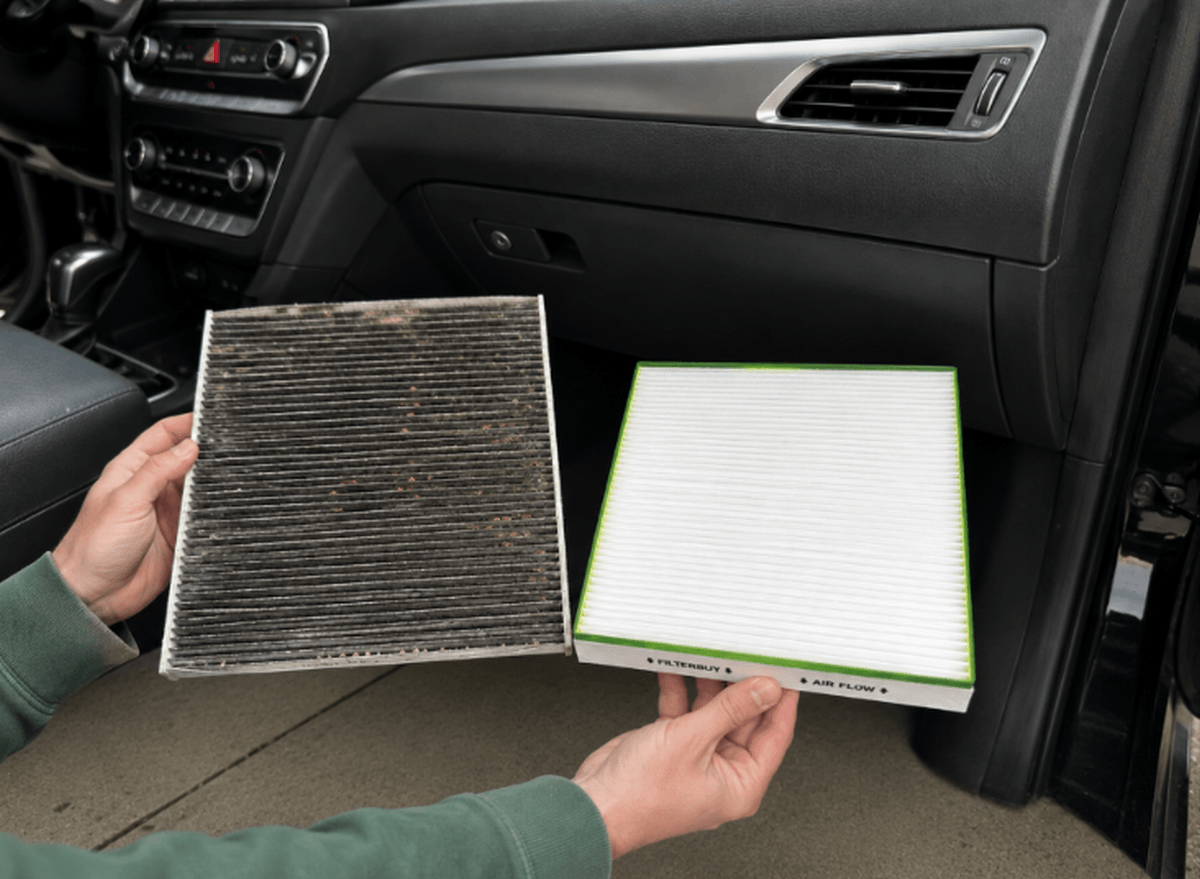
Slide the old filter straight out. Do it slowly, because a loaded filter sheds debris and tilting it dumps that debris into the blower.
Match the airflow arrow to the filter you just removed. On the Sonata the arrow points down, toward the blower. Do not trust memory here: look at the old filter before it leaves your hand. Backward installation cuts filtration efficiency and makes the filter load faster.
Slide the new filter in, replace the cover, and reattach the glove box. Run the fan on high for 30 seconds and confirm the airflow feels stronger than it did before.
How Often Should You Replace a Sonata Cabin Air Filter?
Hyundai’s normal maintenance schedule lists the climate control air filter, the filter serving the evaporator and blower unit, as a 15,000-mile or 24-month replacement item. That number assumes ordinary conditions. Real driving frequently is not ordinary.
A working filter measurably changes what you breathe on a commute. In a randomized, double-blind crossover study of 48 commuters published in Environmental Science & Technology (Mallach et al., 2023), cabin air filtration cut in-vehicle PM2.5 by 30%, ultrafine particles by 28%, and black carbon by 32% compared with a placebo filter. A saturated filter does not deliver that.
A useful habit: check your local air quality before you set your interval. If your area regularly runs above an AQI of 100, your cabin filter is doing considerably more work than the manual assumed. You can check your local air quality on the Filterbuy live AQI map and adjust from there.
Where We Disagree With Hyundai
Hyundai’s 15,000-mile interval is a reasonable engineering number. We think it is too generous for most American drivers in 2026, and we would rather say so plainly than quote the manual and leave it there.
Our recommendation: replace your Sonata cabin air filter every 12,000 miles or once a year, whichever lands first. The 15,000-mile figure assumes national-average air, and 44% of Americans do not live in it. Three reasons, all of them from the statistics above:
45 million Americans commute through near-road corridors where pollutant concentrations run measurably higher.
A quarter of adult drivers have a diagnosed seasonal allergy, and a loaded filter stops catching pollen before it stops moving air.
Cabin filtration delivered that 30% cut in in-vehicle PM2.5 only while the filter still had capacity. A saturated filter is a filter that stopped working.
The cost is roughly one extra filter every few years. What you breathe on the commute is worth considerably more than that.
“The cabin filter never fails loudly. It just quietly stops working, and most people adapt to the weaker airflow without noticing the slide. The moment that changes is when you pull the old one out and actually look at it.”
– Michelle Wan, Brand Manager and Air Quality Writer, Filterbuy
What Filterbuy Brings That a Parts Catalog Does Not
We have manufactured filters in our own U.S. plants since 2013. That vantage point sits behind two specifics on this page.
Fit is a filtration spec, not a convenience feature. Building to OEM tolerances is not about the filter sliding in easily. A filter that sits loose in the Sonata housing lets unfiltered air slip around the edges, and that bypass air undoes the media entirely. It is why we treat the hybrid dimension difference as a real problem rather than a rounding error.
Airflow and filtration pull against each other. The obvious way to catch smaller particles is denser media, which chokes the blower and leaves you with weak-feeling A/C. Hydrocharging avoids that trade: an electrostatic charge does the capture work, so the media stays open enough to breathe.
Signs Your Sonata’s Cabin Air Filter Is Overdue
Weak airflow is the earliest signal. Fan on high, vents like a whisper: pull the filter and look at it before diagnosing anything more expensive.
When It Is Not the Cabin Air Filter
A new filter fixes most of the symptoms above. It does not fix all of them, and we would rather you know that before you buy one.
The smell comes back within days of a fresh filter. That usually points to mold or standing water on the evaporator, further inside the HVAC box. A filter cannot reach it.
Airflow is still weak with a clean filter installed. Look at the blower motor or a failing resistor, not the media.
Air blows but the temperature is wrong or one side differs. That is a blend door or actuator issue, unrelated to filtration.
All three are technician work. Another filter will not help, and a shop will diagnose it faster than another parts order.
Which Type of Cabin Air Filter Should You Choose?
Three media types fit the Sonata. Pick by what actually bothers you.
Particulate: dust, pollen, road debris. The OEM standard and the baseline.
Activated carbon: adds odor and gas control for traffic fumes and pet smells. Carbon media handles gases, not every ultrafine particle.
HEPA: the step up for fine particulate, and the tier that matters for wildfire smoke and exhaust soot. The U.S. EPA defines HEPA as removing at least 99.97% of particles at 0.3 microns, the hardest size to catch. Filterbuy auto cabin filters are built to that standard, to OEM tolerances, in our own U.S. factories.
Our guide to choosing a cabin air filter compares all three in depth.
If you commute through smoke season, or anyone in the car has asthma, HEPA is the upgrade worth paying for. Filterbuy auto cabin filters are being released by vehicle, so you can get notified when the Sonata filter is available.
Trusted Sources Behind This Guide
The guidance on this page is built on primary sources rather than other retailers’ product copy. These are the references worth reading yourself.
Hyundai Sonata Owner’s Manual, normal maintenance schedule: The scheduled-maintenance table that lists the climate control air filter for the evaporator and blower unit on a 15,000-mile interval. Your VIN-specific schedule is the authority for your car.
Mallach et al., Environmental Science & Technology (2023): Randomized, double-blind crossover study of 48 commuters. Cabin air filtration reduced in-vehicle PM2.5 by 30%, ultrafine particles by 28%, and black carbon by 32%. The peer-reviewed basis for the claim that a fresh filter changes your exposure.
U.S. EPA, What is a HEPA filter?: The federal definition of HEPA, including the 99.97% capture standard at 0.3 microns and why that particle size is the hardest to catch.
Supporting Statistics on In-Vehicle Air Quality
Three numbers explain why your interval should track your environment, not just your odometer.
45 million Americans live within 300 feet of a major road, railroad, or airport.
Pollutant levels from cars and trucks run measurably higher near those corridors.
The EPA links that exposure to asthma, reduced lung function, heart disease, and premature death.
What it means for you: on that kind of commute, the cabin filter is the last barrier before your lungs.
Source: U.S. EPA, Research on Near Roadway and Other Near Source Air Pollution. Updated June 2, 2026.
25.2% of U.S. adults have a diagnosed seasonal allergy.
That is roughly one in four drivers.
Allergic rhinitis drives 4.1 million physician office visits a year.
What it means for you: if that is you, replace each spring instead of waiting for a mileage number.
Source: CDC / National Center for Health Statistics, FastStats: Allergies and Hay Fever. Last reviewed January 9, 2026.
152.3 million people, or 44% of Americans, live in counties with failing air quality grades.
The grades cover ozone and particle pollution.
Unhealthy ozone reached more people than in any of the previous five reports.
What it means for you: a national interval assumes national-average air. For nearly half the country, it is not.
Source: American Lung Association, “State of the Air” 2026, Key Findings. 27th annual edition, 2022–2024 monitoring data.
Frequently Asked Questions
About the Author
Michelle Wan is Filterbuy’s Brand Manager and Air Quality Writer. She earned her B.A. in Sociology from the University of California, Santa Cruz, and works directly with Filterbuy’s U.S. manufacturing team across its factories in Alabama, Florida, Pennsylvania, and Utah, basing her writing on how filters are built and tested rather than on spec sheets alone.
Reviewed by
David Clark, Licensed HVAC Technician, verified the airflow, filtration, and maintenance-interval guidance in this article.
About Filterbuy. We are a family-owned American manufacturer. We have built air filters in the USA since 2013, in our own factories in Alabama, Florida, Pennsylvania, and Utah, and we ship more than 600 standard sizes plus custom filters factory-direct.
Glossary
Cabin air filter: The filter that cleans outside air before it enters a vehicle’s passenger compartment through the vents. Also called a pollen filter or glove box filter.
Climate control air filter: Hyundai’s term in the Sonata owner’s manual for the cabin air filter serving the evaporator and blower unit.
Activated carbon: A treated carbon layer in some cabin filters that adsorbs odors and gases such as exhaust fumes.
HEPA: High-Efficiency Particulate Air. A filter type defined by the U.S. Department of Energy that removes at least 99.97% of airborne particles at 0.3 microns, the size hardest to capture.
Hydrocharging: A process that gives filter fibers a permanent electrostatic charge, raising particle capture without adding airflow resistance.
PM2.5: Fine particulate matter 2.5 microns or smaller. This is the fraction of wildfire smoke and exhaust that reaches deepest into the lungs.
AQI: Air Quality Index. The EPA 0–500 scale for reporting outdoor air quality; readings above 100 are considered unhealthy for sensitive groups.
OEM: Original Equipment Manufacturer. The part number and spec assigned by the vehicle maker, here Hyundai.
Build date: The month and year a specific car was assembled, printed on the driver’s door jamb placard. Different from model year, and the deciding factor for some Sonata parts.
DN8 / LF / YF / NF: Hyundai’s internal generation codes for the Sonata. Parts catalogs often organize fitment by generation rather than model year.