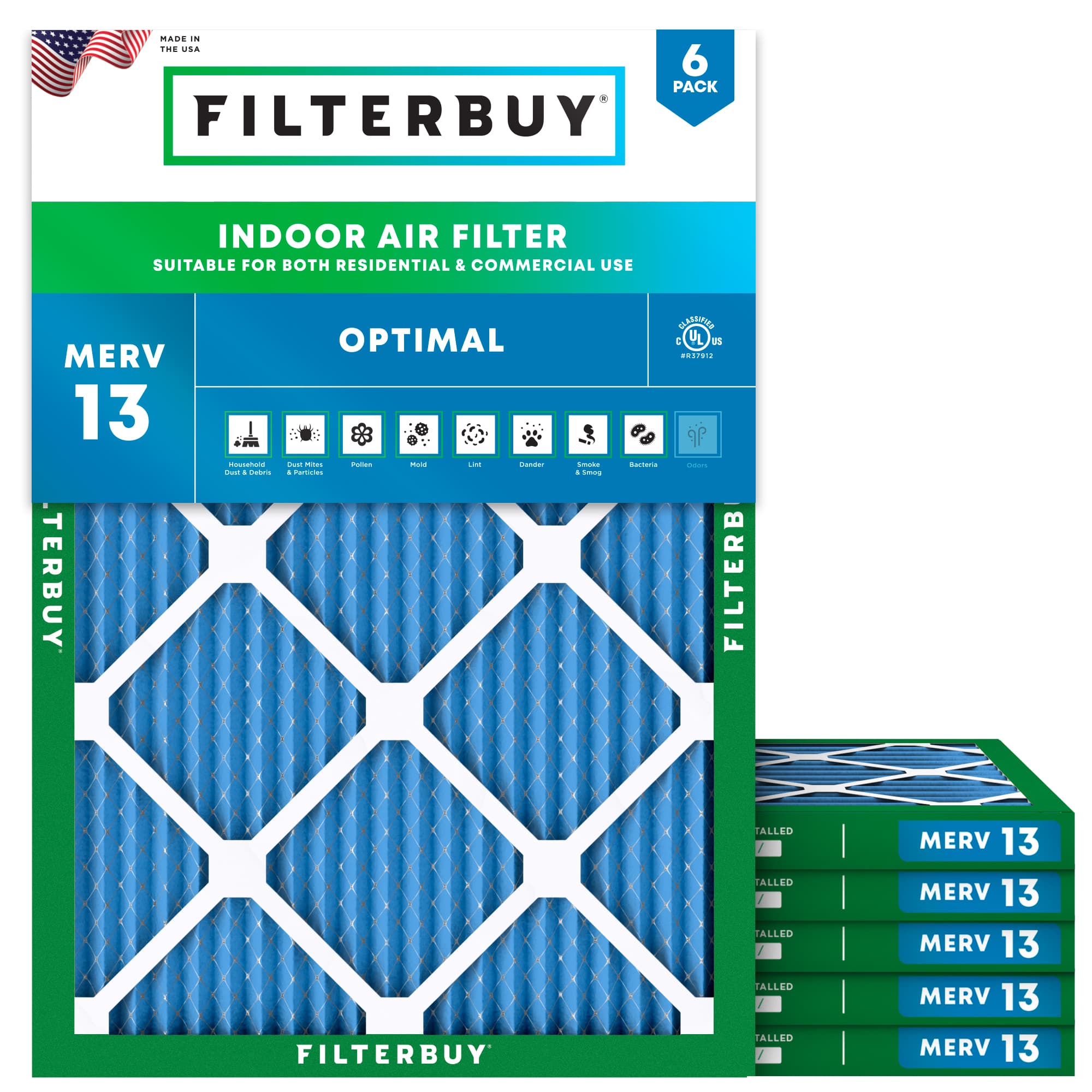
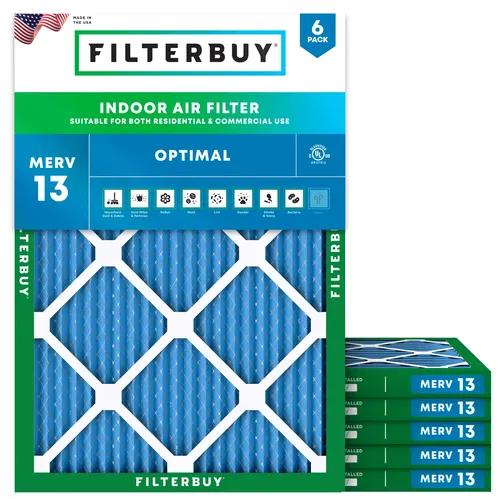
Actual Size: 17.75x21.75x0.75
 Free Delivery
  Factory-Direct Low Prices, Made in the USA
 Hassle-Free Returns & Free Exchanges
RESIDENTIAL AND/OR COMMERCIAL USE
Change Every 3 Months
Actual Size: 17.75x21.75x0.75
Free Delivery Factory-Direct Low Prices, Made in the USAHassle-Free Returns & Free ExchangesRESIDENTIAL AND/OR COMMERCIAL USE
Change Every 3 Months
Actual Size: 17.75x21.75x0.75
Free Delivery Factory-Direct Low Prices, Made in the USAHassle-Free Returns & Free ExchangesRESIDENTIAL AND/OR COMMERCIAL USE
Change Every 3 Months
At Filterbuy, we don't cut corners—we craft high-quality air filters right here in the USA and ship them to your doorstep for free. No delays, no gimmicks—just clean air, made easy. With thousands of five-star reviews and filters built for real life & every HVAC system, it's no wonder why over 4 million families trust Filterbuy.

Proudly Made In The USA

Fast, Free Shipping on Every Order

Premium Materials That Go The Distance

85,000+ 5-Star Reviews From Happy Customers

Save Up to 70% Per Filter with Packs


Measure length × width × depth with a tape measure to find the actual size.

Round up each dimension to the nearest whole number to get the nominal size. Example: 17.75x21.75x0.75 in → 18x22x1 nominal.

Search by nominal size on our site for the best fit.


If the filter you buy doesn't fit, we'll send you a better size.
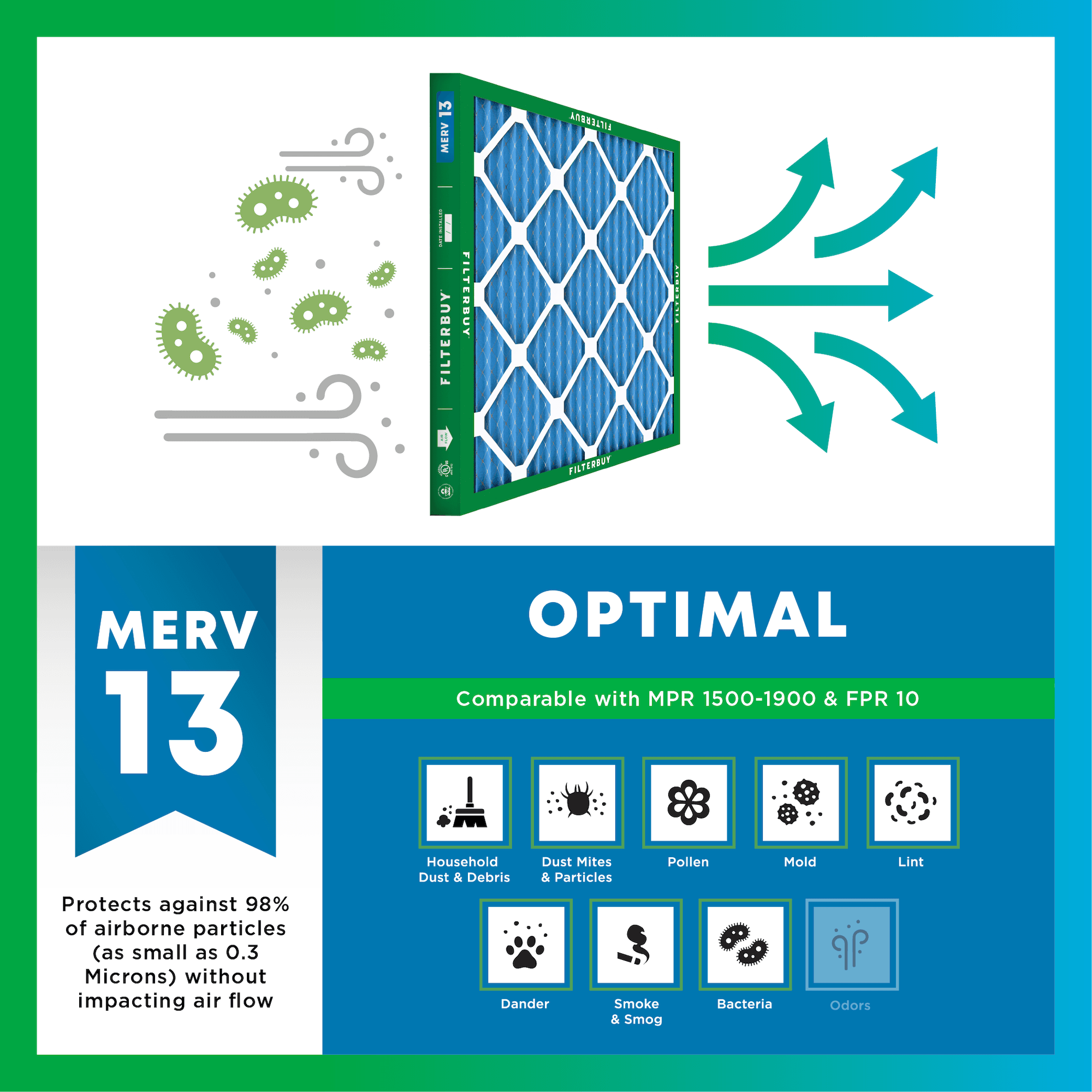
MERV stands for Minimum Efficiency Reporting Value—but don't let the technical name fool you. It's just a way to rate how well an air filter traps stuff like dust, pollen, pet dander, and smoke. The higher the MERV number, the more particles it catches—and the cleaner your air will be.

Comparable to:FPR: 4-7
MPR: 600-1000
 Dust & Debris
 Dust Mites & Particles
 Pollen
 Mold
Mold Lint
Lint Dander
Comparable to:FPR: 6-9
MPR: 1200-1550
Dust & DebrisDust Mites & ParticlesPollenMoldLintDander Smoke & Smog
Comparable to:FPR: 10
MPR: 1900-2800
Dust & DebrisDust Mites & ParticlesPollenMoldLintDanderSmoke & Smog Bacteria


We build every Filterbuy filter to deliver reliable 90-day performance—thanks to smart design and premium materials that do the heavy lifting. Here's what makes the difference:
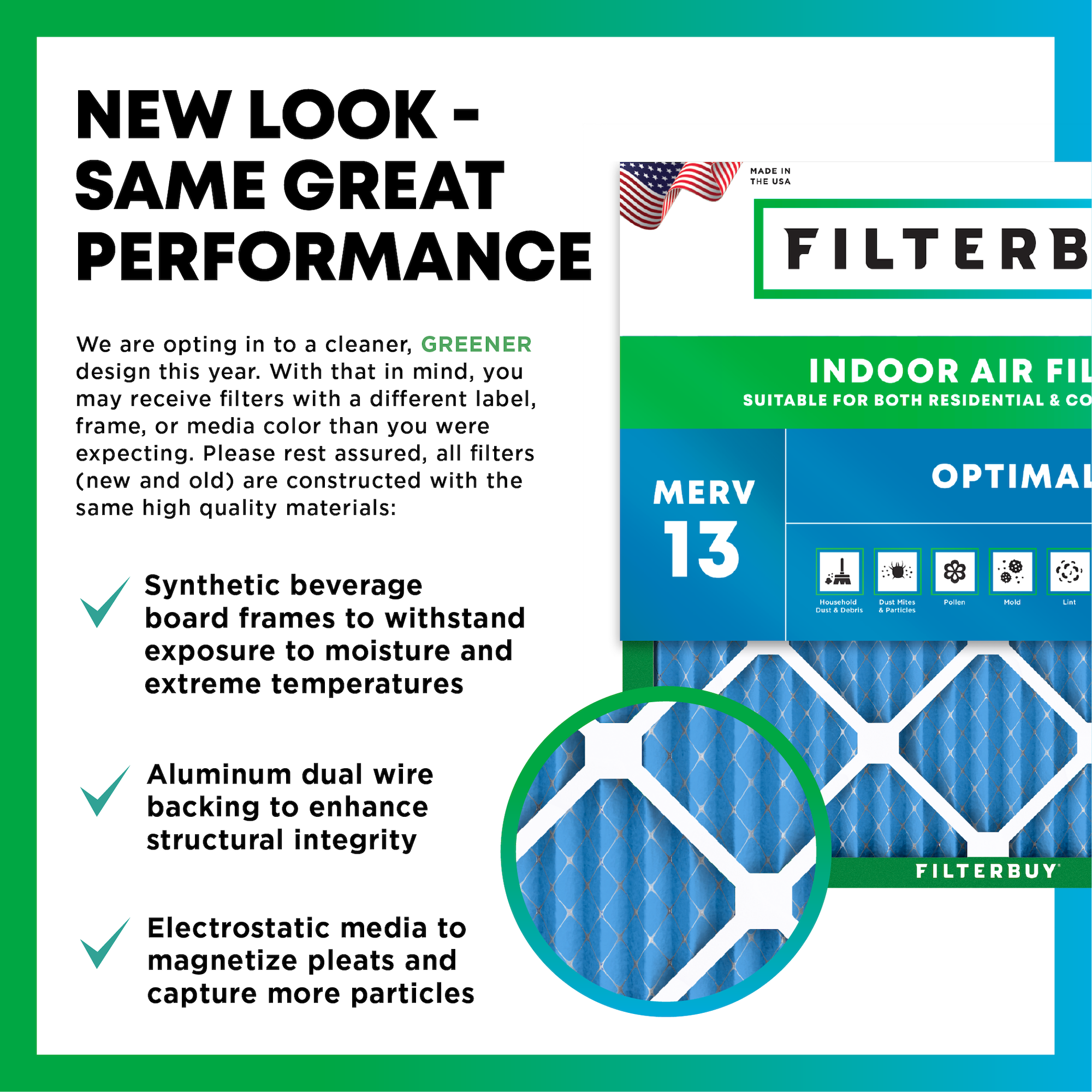
More pleats = more surface area to capture dust and debris, keeping your air cleaner longer.
Pleats are magnetized to attract and trap microscopic particles—like pet dander, pollen, and smoke.
Engineered to resist warping in extreme temperatures and high humidity.

A layer of metal reinforcement keeps pleats evenly spaced and structurally sound—no sagging, even at high airflow.
Assembled with care. Built to perform. Ships fast, free, and reliably from our U.S. facilities.

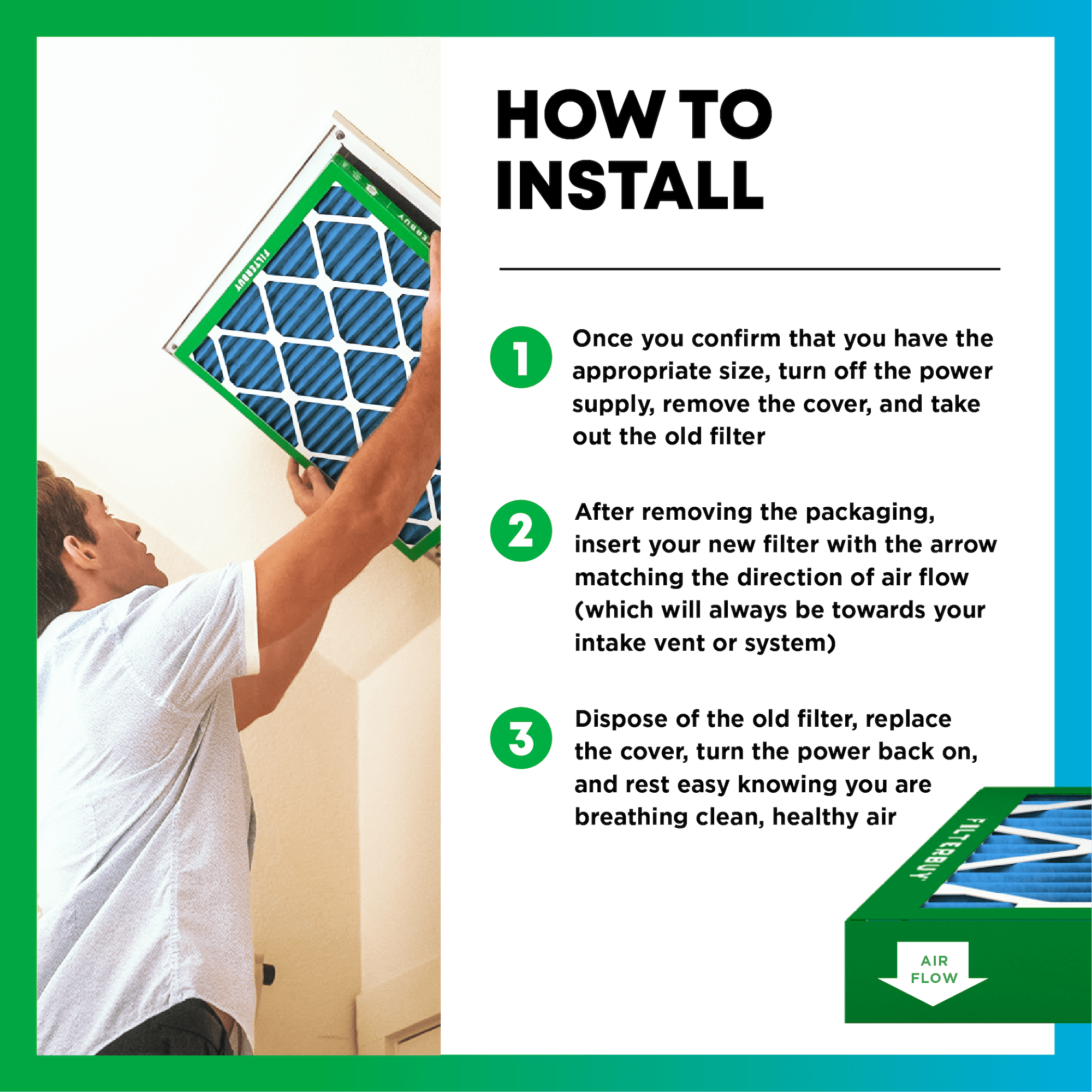
Turn Off Your HVAC SystemSafety first.

Remove The Old FilterLook for the airflow arrow and make note of the direction.

Slide In Your New FilterArrow should point toward the system (same direction as before).

Turn Your System Back OnAnd enjoy the fresh, clean air.

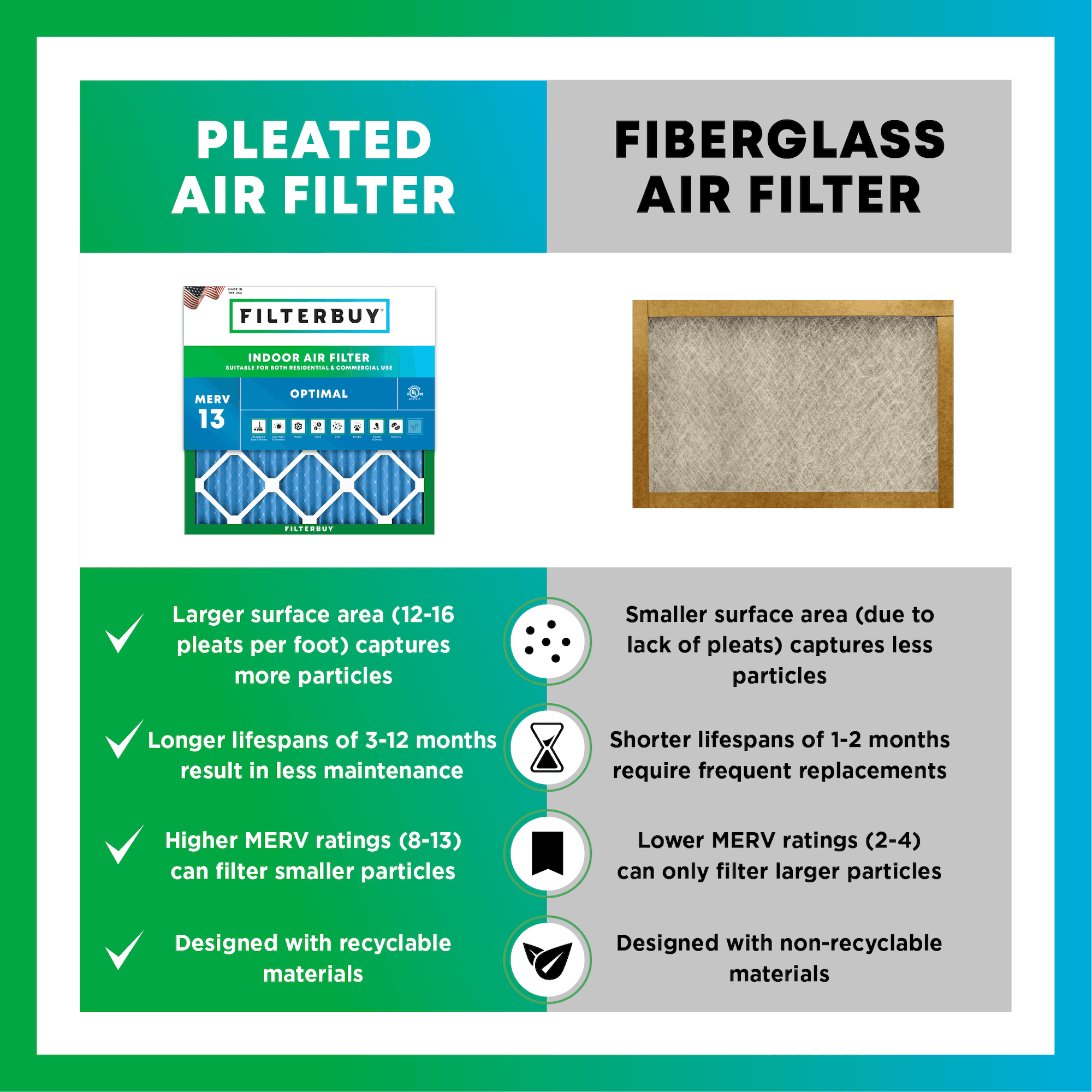
Not all air filters are created equal. Pleated filters don't just last longer—they actually clean your air better. Here's how they stack up:

Efficiency:
High (MERV 8–13) – Traps more particles
Lifespan:
90 days – Long-lasting performance
Air Quality:
Excellent – Cleaner, healthier air
Materials:
Recyclable and durable

Efficiency:
Low (MERV 4 or less) – Misses small stuff
Lifespan:
30 days or less – Replace often
Air Quality:
Minimal – Basic protection only
Materials:
Thin, flimsy, and not recyclable
Pleated filters are a no-brainer—more protection, less hassle, and better air for your home.
Changing your filter on time keeps your HVAC system running efficiently—and helps protect your lungs from dust, allergens, and airborne irritants. Here's how often to swap it out based on your needs:

For most homes without pets or special air quality concerns. Great for general upkeep and energy efficiency.

Shedding fur, dander, and allergy triggers can build up fast. Changing your filter every two months helps keep the air fresher and symptoms at bay.

For households affected by smoke, pollution, or respiratory conditions, monthly changes ensure maximum protection.

| Nominal Size | 18 x 22 x 1 inches |
| Actual Size | 17.75 x 21.75 x 0.75 inches |
| Filter Type | Pleated |
| Media | Electrostatically Charged |
| Frame | Beverage Board |
| MERV Ratings Available | 8, 11, 13 |
| Lifespan | Up to 90 Days |
| Origin | Made in USA |
When wildfire smoke starts creeping into your home, it’s natural to hope the HVAC filter you already have installed will be enough. But after more than a decade of manufacturing filters — and running thousands of in-house tests on everything from real wildfire smoke to lab-generated PM2.5 — we’ve seen exactly how a well-built MERV 13 18×22×1 filter can make a meaningful difference. What most homeowners don’t realize is that not all MERV 13 filters behave the same once they’re inside a running system. The filters that consistently protect homes during major smoke events share three essentials: dense, electrostatically charged media that captures fine particles, rigid frames that prevent air bypass under pressure, and reliable airflow performance proven in both real homes and controlled testing environments.
In this guide, we’re sharing what we’ve learned from helping families through major smoke seasons and from testing filtration performance every single day in our American manufacturing facility. You’ll learn how MERV 13 filtration truly interacts with wildfire smoke, what results you can realistically expect on heavy smoke days, and the specific steps that make your HVAC system far more effective at capturing PM2.5. Our goal is simple: to equip you — the hero of your household — with the practical, behind-the-scenes insights you need to protect your family’s air with confidence when smoke becomes an immediate concern.
Quick Answers
18×22×1 Air Filter
An 18×22×1 air filter is a specific HVAC filter size that fits systems requiring an 18" × 22" × 1" slot.
Choose a high-quality, rigid-framed filter to prevent air bypass and ensure consistent filtration.
For cleaner indoor air—especially during smoke or high-PM2.5 days—select a MERV 13 version for finer particle capture.
Replace every 60–90 days, or every 2–4 weeks during heavy smoke or high-use periods.
A properly built and fitted filter turns your HVAC system into a whole-home air cleaning engine, improving comfort, health, and protection.
A well-built MERV 13 filter can meaningfully reduce wildfire smoke and PM2.5 — but quality matters. Filters designed with dense, electrostatically charged media and a rigid frame consistently capture far more fine particles than lower-quality look-alikes.
Proper fit is essential for protection. Even small gaps or a filter that bows under pressure allow smoke to bypass the media, dramatically reducing filtration performance.
Your HVAC system can act as whole-home filtration when set to continuous circulation. Keeping air moving helps your filter capture more of the fine particles that settle quickly during smoke events.
Expect faster filter loading during heavy smoke days. Based on our testing and customer experience, filters often need replacement every 2–4 weeks during smoke season to maintain airflow and effectiveness.
Upgrading to a high-quality 18×22×1 MERV 13 filter is one of the fastest ways to improve your indoor air during wildfire smoke. It’s a simple change that provides immediate, measurable protection for your home and family.
Most homeowners don’t realize how much their air filter influences the health of their indoor air. MERV — or Minimum Efficiency Reporting Value — tells you how effectively a filter captures airborne particles. The higher the MERV rating, the better the filter is at trapping the small, often invisible pollutants that quietly move through your home, including dust, pollen, bacteria, and smoke. After manufacturing millions of filters and testing every MERV level in our facility, we’ve seen firsthand how choosing the right rating can dramatically change the quality of the air your family breathes.
MERV ratings matter because they give you a clear, standardized way to understand a filter’s performance — especially if your home faces specific challenges like allergies, wildfire smoke, or high dust levels. Selecting the right MERV level ensures your HVAC system runs efficiently while delivering cleaner, healthier air throughout your home.
PM2.5 refers to fine particulate matter that’s 2.5 micrometers or smaller — roughly 30 times thinner than a human hair. Because these particles are so tiny, they can slip deep into your lungs and even enter your bloodstream. That’s why health experts and indoor air professionals (including our team) take PM2.5 so seriously.
These fine particles can:
Aggravate asthma, bronchitis, and other respiratory conditions
Increase the risk of cardiovascular issues with long-term exposure
Reduce overall air quality, especially for children, older adults, and those with sensitivities
Become especially abundant during wildfire smoke, industrial activity, and vehicle emissions
Understanding PM2.5 is the first step toward protecting your home — and your family — from one of the most harmful forms of air pollution.
After years of testing MERV 13 filters in both controlled labs and real homes, we’ve seen exactly how they help protect indoor air. MERV 13 filters are engineered with dense, electrostatically charged synthetic fibers that capture a wide range of particles — including PM2.5 — while maintaining the airflow your system needs to run efficiently.
Because these filters work harder to catch smaller pollutants, they naturally accumulate particles faster. Regular checks and timely replacements help you maintain the ideal balance between strong filtration and healthy airflow. When used correctly, a high-quality MERV 13 filter becomes one of the most effective, practical tools for improving indoor air during smoke events.
Wildfire smoke is one of the most challenging pollutants to manage indoors. Based on our extensive testing, a well-constructed MERV 13 filter stands out for its ability to reduce smoke and fine particulate levels throughout the home. Here’s why:
Captures particles as small as 0.3 microns, including PM2.5 and smoke
Maintains strong airflow when built with rigid framing and high-quality media
Lowers allergens and irritants, improving comfort during smoke events
Provides sustained performance when replaced regularly (especially during peak smoke season)
For families navigating wildfire smoke, upgrading to a trusted MERV 13 filter is one of the most immediate ways to create safer indoor air.
The best filter is the one that meets your family’s unique air quality needs. Different filter types serve different purposes, and understanding those differences helps you make a confident, informed choice.
HEPA Filters - Excellent for extreme filtration needs, capturing the smallest particles — but often too restrictive for standard residential HVAC systems.
MERV 13 Filters The most practical balance for most homes, offering outstanding protection against smoke, PM2.5, allergens, and fine particles while maintaining strong airflow. This is why we recommend MERV 13 for wildfire smoke and high-demand indoor air quality situations.
Electrostatic Filters Useful for larger particles like dust but require regular cleaning and may not be sufficient during smoke events.
As always, regular replacement is key. Even the best filter can’t protect your home once it becomes saturated with particles — especially during wildfire smoke season, when filters load faster.
When you’re trying to protect your home’s air—especially from fine particles like smoke and PM2.5—the right information makes all the difference. These essential resources will guide you through sizing, performance, and what to look for in a filter that truly safeguards your family’s air.
1. Filterbuy Product Specs — Confirm the Fit and Build Behind Cleaner Air
Resource: 18×22×1 MERV 13 Pleated Air Filter
URL: https://filterbuy.com/air-filters/18x22x1/merv-13/ Why It’s Valuable: Start with the essentials: exact dimensions, media construction, airflow data, and performance ratings. Understanding how a filter is built helps you choose one that won’t just “fit”—but will actually perform when smoke or fine particles enter your home.
2. Filter Sizing Guide — Make Sure Your System Gets the Right-Sized Protection
Why It’s Valuable: A filter only performs at its best when it fits correctly. This guide walks you through measuring your return and understanding how size impacts airflow and filtration—key steps for anyone serious about improving indoor air quality.
3. MERV 13 Explained — Know Exactly What This Level of Filtration Protects Against
Why It’s Valuable: Get a clear breakdown of how MERV 13 captures smoke-sized particles, how it interacts with HVAC systems, and why it’s the go-to rating for families looking to block PM2.5 and airborne irritants.
4. Side-by-Side Filter Comparison — See How MERV Levels Stack Up in Your Size
Why It’s Valuable: Comparing MERV 8, 11, and 13 filters in the exact same 18×22×1 size makes it easy to visualize what you gain as filtration becomes more protective. It’s a quick way to see which level meets your home’s air challenges.
5. MERV Rating Chart — Visualize the Particle Sizes You’re Protecting Against
Why It’s Valuable: If you're unfamiliar with particle sizes, this chart instantly clarifies what different MERV levels capture. It’s a great way to see why MERV 13 is the smart choice when smoke or fine particulate pollution is a concern.
6. Replacement Frequency Guide — Know When Your Filter Stops Working at Full Strength
Why It’s Valuable: Filters don’t protect indefinitely. This guide helps you understand how usage, climate, and particle load influence replacement intervals—especially during wildfire season, when filters may need changing far sooner than expected.
7. Technical Media Specs — Understand What Sets High-Quality MERV 13 Filters Apart
Why It’s Valuable: Peek under the hood with technical specs on pressure drop, electrostatic charge, media density, and frame durability. When you understand the construction, you can quickly spot the difference between a filter that merely claims MERV 13 and one that actually performs like it.
“After testing thousands of filters against real wildfire smoke and lab-generated PM2.5 in our own manufacturing facility, we’ve learned something most homeowners never hear: true protection is about far more than a MERV number. A well-built MERV 13 filter — one with rigid framing, dense electrostatic media, and a proper, airtight fit — can turn your HVAC system into a genuine whole-home filtration engine. And when smoke hits, that difference is anything but subtle. You see it in how quickly the filter loads, you feel it in the clarity of your home’s air, and you breathe easier knowing your system is actually capturing the particles that matter most.”
1. PM2.5 Is the Most Harmful Particle Size
What the EPA Shows: The EPA identifies PM2.5 as the particle size that poses “the greatest risk to health.” Source: EPA – PM Basics
What We See at FilterBuy: After testing thousands of filters in our manufacturing facility, we’ve seen how easily PM2.5 passes through low-efficiency filters like MERV 6–8. In homes using basic filters, smoke haze and odor appear almost immediately because these tiny particles slip straight through the media. Upgrading to a high-quality MERV 13 often delivers noticeable improvement within just a few hours of continuous system circulation — clearer air, reduced odor, and a filter that begins capturing what cheaper filters simply miss.
2. PM2.5 Exposure Comes With Serious Health Risks
What the EPA Shows: There is strong evidence linking PM2.5 exposure to cardiovascular and respiratory issues, especially during heavy smoke events. Source: EPA – PM & Cardiovascular Disease
What We See at FilterBuy: During wildfire season, filter lifespan shrinks dramatically — from the typical 90 days to just 7–21 days — because high-quality filters rapidly load with large amounts of fine smoke particles. Homeowners who switch to stronger filtration frequently report fewer symptoms like itchy eyes, coughing, and throat irritation. The filter loads faster because it’s doing its job: catching the most harmful particles before your lungs do.
3. MERV 13 Filters Capture Smoke-Sized Particles
What EPA and ASHRAE Standards Show:
≥ 50% capture of particles 0.3–1.0 microns
≥ 85% capture of particles 1.0–3.0 microns These ranges include the most common particle sizes found in wildfire smoke. Source: EPA – MERV Rating Guidance
What We See at FilterBuy: Our in-house testing shows that MERV 13 directly targets PM2.5 and smoke-sized particles, making it one of the most effective upgrades for protecting indoor air during wildfire events. Filters built with dense media, rigid frames, tight pleats, and electrostatic charge hold their efficiency longer — even under heavy smoke. In contrast, many low-quality “MERV 13” filters lose performance quickly once airflow pressure increases inside real HVAC systems.
After years of testing filters against both real wildfire smoke and lab-generated PM2.5 in our own manufacturing facility, one conclusion is unmistakable: a well-built MERV 13 filter can make a meaningful difference in your home’s air during smoke events. But that protection depends on far more than the number printed on the label. Construction quality — the part most homeowners never see — plays a defining role in whether a filter actually performs once it’s inside a running HVAC system.
What We Consistently See in Testing
Across thousands of tests, a clear pattern emerges:
Build quality matters just as much as the MERV rating itself.
Weak frames and loose pleats often collapse, leak, or allow bypass under system pressure.
Many generic “MERV 13” filters lose efficiency the moment they’re installed and exposed to real airflow.
High-quality MERV 13 filters — with rigid frames and dense, electrostatically charged media — hold their efficiency and consistently capture smoke-sized particles.
Why Our Perspective Is Different
We’re not guessing. We’ve tested thousands of filters in both controlled lab environments and real homes during major smoke seasons. Every time, the same truths show up:
Poorly built filters struggle immediately under load.
Low-grade media allows PM2.5 to slip straight through.
Strong frames + dense media = reliable, repeatable protection when you need it most.
Our Recommendation
If your home faces wildfire smoke, persistent PM2.5, or recurring air-quality concerns, upgrading to a high-quality 18×22×1 MERV 13 filter is one of the fastest, most effective steps you can take to protect your indoor air. It’s a simple change that delivers real, measurable peace of mind — especially when the air outside becomes a serious concern.
1. Confirm Your Filter Size
Start by checking the size printed on your current filter or measuring your return grille. If your system uses an 18×22×1 filter, you’re in the right place to upgrade your home’s smoke protection.
2. Choose a High-Quality MERV 13 Filter
Not all MERV 13 filters perform the same. Look for rigid framing, dense pleats, and electrostatically charged media — the construction features proven to capture more smoke-sized particles. Avoid bargain or generic filters; many fail to maintain true MERV 13 performance once installed.
3. Install for a Proper, Airtight Fit
Slide the filter in carefully and check for zero gaps, bending, or looseness. A snug, airtight fit ensures that air is pulled through the filter media — not around it — improving PM2.5 and smoke capture.
4. Run Your HVAC System During Smoke Events
Switch your system to “On” instead of “Auto” during heavy smoke days. Continuous circulation keeps air moving through the filter, allowing your HVAC system to function like a true whole-home filtration engine.
5. Replace Filters More Frequently in Smoke Season
Wildfire smoke loads filters fast. Expect to replace your filter every 2–4 weeks during heavy smoke periods. If the filter darkens early or your airflow begins to drop, replace it sooner to maintain protection.
A:
Captures fine particles that lower MERV filters miss.
Most noticeable improvements: smoke reduction, clearer air, less odor.
Based on our testing, MERV 13 is the point where PM2.5 filtration becomes meaningful.
A:
Most systems handle MERV 13 without issues.
Problems usually come from poor-quality filters, not the rating.
Well-built filters with rigid frames maintain steady airflow.
A:
Normal use: every 60–90 days.
Smoke season: every 2–4 weeks.
Replace sooner if airflow drops or the filter darkens.
A:
Yes—especially with continuous HVAC run-time.
Works best when sealed tightly with no air bypass.
Real-world use during wildfire events shows clear air-quality improvements.
A:
Rigid frame construction.
Dense, evenly spaced pleats.
Electrostatic media.
Accurate sizing for a tight fit and better particle capture.

