
10x30x1 Air Filters
Actual Size: 9.5x29.5x0.75

3 month filters
2. Select Quantity
Buying multiple sizes?


Made in the USA
Ships in 24 hours
10x30x1 Air Filters Air Filter Description
Available In MERV Rating: 8, 13, 11
Made in the USA
Ships in 24 hours
Merv comparison
Scroll to see more.
 MERV 8 |  MERV 11 |  MERV 13 | |
|---|---|---|---|
| Best for | Standard Residential/Commercial Healthy Families | Superior Residential/Commercial Allergy Sufferers | Optimal Residential/Commercial Hospital Grade |
| Comparable ratings | MPR 600 & FPR 5 | MPR 1000-1200 & FPR 7 | MPR 1500 - 1900 & FPR 10 |
| Filtration | Captures 90% of Airborne Particles | Captures 95% of Airborne Particles | Captures 98% of Airborne Particles |
| Dust, lint & debris | |||
| Mold, pollen | |||
| Dander, dust mites | |||
| Smoke & Smog | |||
| Bacteria | |||
| Odor, vocs |
Is it time to change your filter?
Generally, we recommend you replace your air filters every 90 days. Find out below if you should change your filters more often.

If someone in your home has asthma or allergies...
Change your filter every
6 weeks
to ensure indoor air quality is at its best.
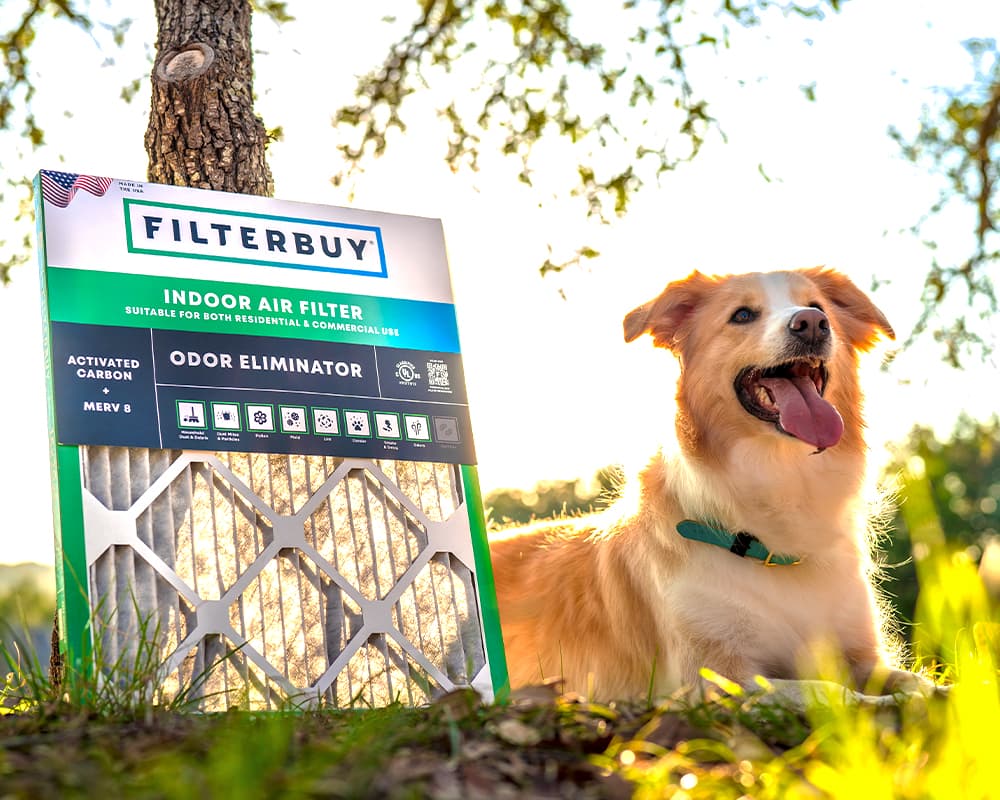
If you have pets...
Change your filter every
2 months
to avoid shedding and odor buildup.

If you have young children...
Change your filter every
2-3 months
as having clean air is even more important with children in your home.
If someone in your home has asthma or allergies...
Change your filter every
6 weeks
to ensure indoor air quality is at its best.
If you have pets...
Change your filter every
2 months
to avoid shedding and odor buildup.
If you have young children...
Change your filter every
2-3 months
as having clean air is even more important with children in your home.
By Michelle Wan, Brand Manager and Air Quality Writer | Reviewed by David Clark, Licensed HVAC Technician | Updated September 15, 2026
TL;DR
A 10x30x1 air filter measures 9.5 x 29.5 x 0.75 inches actual, and 10x30x1 is the nominal size you order by. Filterbuy cuts, pleats, and frames this size to order in our own US plants, in MERV 8, MERV 11, and MERV 13, with fast and free 2-day delivery to most US states. Read the size printed on your old filter, then check your HVAC manual to confirm which MERV rating your system takes.
Key Takeaways
A Filterbuy 10x30x1 measures 9.5 x 29.5 x 0.75 inches actual. Nominal is the name you order by.
Filterbuy cuts the 10x30x1 in MERV 8, MERV 11, and MERV 13.
MERV 8 captures 90% of airborne particles, MERV 11 captures 95%, and MERV 13 captures 98%.
Six other sizes we cut share the same 29.5-inch length, so the 10-inch side is the one to double-check.
Check your HVAC manual to confirm which MERV rating your system takes, the same way you confirm the size.
What Size Is A 10x30x1 Air Filter?
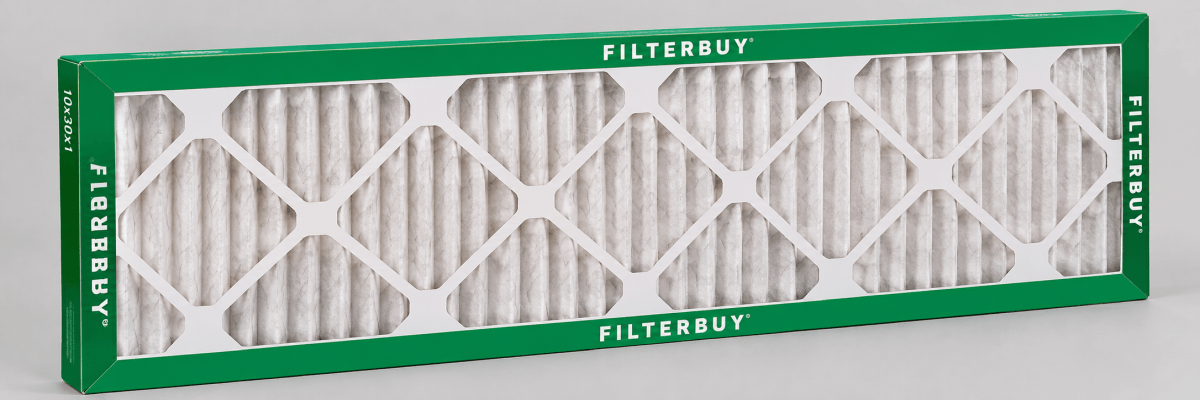
A 10x30x1 air filter has a nominal size of 10 by 30 by 1 inches and an actual size of 9.5 by 29.5 by 0.75 inches. Nominal is the rounded name printed on the frame, and it's the one you order by. Actual is what the filter measures. Filterbuy cuts every 1-inch filter half an inch under nominal on length and width, and that clearance is what lets it slide in and seal. The Filterbuy air filter sizes chart lists every size we cut.
How To Find Your 10x30x1 Size
Finding your size is usually the easy part. Pull the old filter out and read the size printed along the frame. That's your nominal size, and it's what you order by. If the slot's empty, measure the opening instead and round each dimension up to the nearest whole inch. The 10-inch side is worth a second look, since every 30-inch filter looks alike in a dim utility closet.
One-Inch Filterbuy Sizes Cut On A 29.5-Inch Frame
Actual dimensions are Filterbuy cut specifications.
Every size in that table is 29.5 inches long, and only the short side changes. That's why a mismeasured order in this family usually still slides into the slot and still leaks. If your slot lands on a true fraction like 10.5 or 29.25 inches, don't round it. Filterbuy cuts custom sizes to the eighth of an inch.
Which MERV Rating Should You Choose For A 10x30x1?
Filterbuy cuts the 10x30x1 in three ratings. MERV stands for Minimum Efficiency Reporting Value, which is the industry scale for how much a filter captures. MERV 8 is the standard choice for most homes. MERV 11 is the tier for pets and pollen. MERV 13 is the tier for smoke.
The Filterbuy Filtration Ladder
MPR and FPR are third-party rating systems operated by other companies, shown here for comparison only.
Before you order, check your HVAC manual to confirm which MERV rating your system takes. It's the same quick fit check as confirming the size, and it applies to every tier.
Why 10x30x1 Air Filters Are Hard To Find In Stores
Most big-box retailers don't stock 10x30x1. Shelf space rewards inventory that turns over fast, so stores carry a short list of high-volume sizes, and this isn't one of them. Filterbuy makes 600+ sizes plus custom, which is why you'll find it here. The EPA states the rule plainly: a filter must fit snugly, without leaking air around it or being bent to fit.
How Often Should You Change A 10x30x1 Air Filter?
Change a Filterbuy 10x30x1 every 90 days in a typical home, every 60 days if you've got shedding pets, and every 30 days when wildfire smoke is in the air. Here's a quick test you can do today. Hold the used filter up to a light. If light doesn't pass through the pleats, it's done. Auto-delivery ships replacements on whatever schedule you pick.
How To Install A 10x30x1 Air Filter
Turn the HVAC system off at the thermostat.
Slide the old filter out and note which way its airflow arrow points.
Slide the new 10x30x1 in with the arrow pointing the same way, toward the blower.
Check that the frame sits flat against the slot on all four sides, with no gap at either end.
Turn the system back on.
Support the filter at both ends as it goes in, so the 29.5-inch span stays flat. Filterbuy builds every 1-inch filter with aluminum dual wire backing, which keeps the pleats evenly spaced.
Supporting Statistics
Three findings from federal and industry sources on why exact size matters.
Ducted Systems Are The Default
88% of US households use air conditioning.
Two-thirds rely on a central system or central heat pump.
Central equipment means ductwork, and ductwork means a fixed filter opening.
Source: US Energy Information Administration, 2020 Residential Energy Consumption Survey.
Most US Homes Are Old Enough To Have Odd Filter Slots
The median owner-occupied US home is 42 years old.
47% are at least 45 years old.
Ductwork in that stock got framed to the house, not to a catalog.
Source: National Association of Home Builders, American Community Survey analysis.
One Inch Is The Residential Default
Home systems usually take a rectangular 1-inch filter in the return ducts.
The default is a low-efficiency filter costing around $12.
Typical guidance is to change it about every two months.
Source: American Lung Association, Air Cleaning.
Frequently Asked Questions
Can I Use A 12x30x1 Instead Of A 10x30x1?
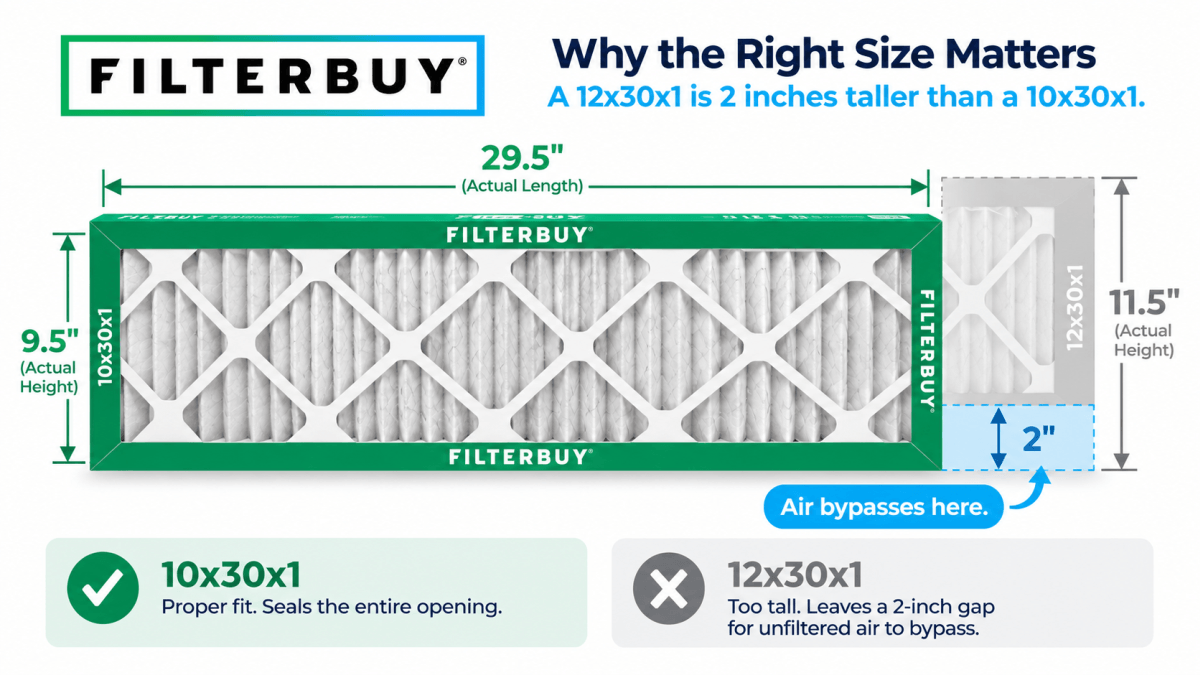
No. A 12x30x1 is two inches wider on the short side, so it won't seat properly in a 10x30x1 slot, and forcing it breaks the seal that makes the filter work. Order the size your slot takes, or have a custom one cut.
Does A 10x30x1 Fit Carrier, Trane, Lennox, Or Goodman Systems?
Filter size is set by your filter slot, not by the brand on your equipment. Two homes with the same model can take different filters depending on the ductwork. Read the old filter, then match it. Filterbuy isn't affiliated with or endorsed by Carrier, Trane, Lennox, or Goodman.
Where Can I Buy A 10x30x1 Air Filter Near Me?
Almost certainly not on a local shelf. Filterbuy cuts, pleats, and frames the 10x30x1 to order in our own US plants, with fast and free 2-day delivery to most US states.
How Much Should A 10x30x1 Cost?
The useful number is cost per day. A 10x30x1 runs 90 days in a typical home, so a six-pack works out to roughly a nickel a day per filter. Multi-packs cut the per-filter price sharply.
What If I Order The Wrong Size?
Send it back. If a Filterbuy filter doesn't fit, we'll send you a better size, because we'd rather handle one exchange than have you run a leaking filter for the next 90 days.
Glossary
Nominal Size. The rounded name printed on an air filter frame and the one you order by. This filter's nominal size is 10x30x1.
Actual Size. What the filter measures. A Filterbuy 10x30x1 is 9.5 x 29.5 x 0.75 inches.
MERV. Minimum Efficiency Reporting Value, the industry scale for how much a filter captures.
Return Grille. The wall, ceiling, or floor vent that pulls air back into your HVAC system. Some homes hold the filter here instead of at the furnace.
Pleated Filter. Media folded into pleats so more of it fits in the same frame. Filterbuy 1-inch filters carry 14 pleats per foot.
About The Author And Reviewer
Michelle Wan is Brand Manager and Air Quality Writer at Filterbuy, where she turns MERV ratings, filtration and HVAC efficiency into plain-English advice and fronts much of the brand's educational video content (B.A., University of California, Santa Cruz). Working directly with Filterbuy's manufacturing teams, she writes from how filters are built and used, not from spec sheets. Reviewed by David Clark, Licensed HVAC Technician, Filterbuy HVAC Solutions.
Filterbuy is a second-generation, family-owned American manufacturer, not a reseller. We cut, pleat, and frame every filter to order in our own US plants, in 600+ sizes plus custom, and ship factory-direct.
Sources
US Environmental Protection Agency, Guide to Air Cleaners in the Home | US Energy Information Administration, Residential Energy Consumption Survey | National Association of Home Builders, American Community Survey analysis | American Lung Association, Air Cleaning | Filterbuy cut specifications