
Signs Your Furnace Filter Is Clogged This Winter
February 10, 2026
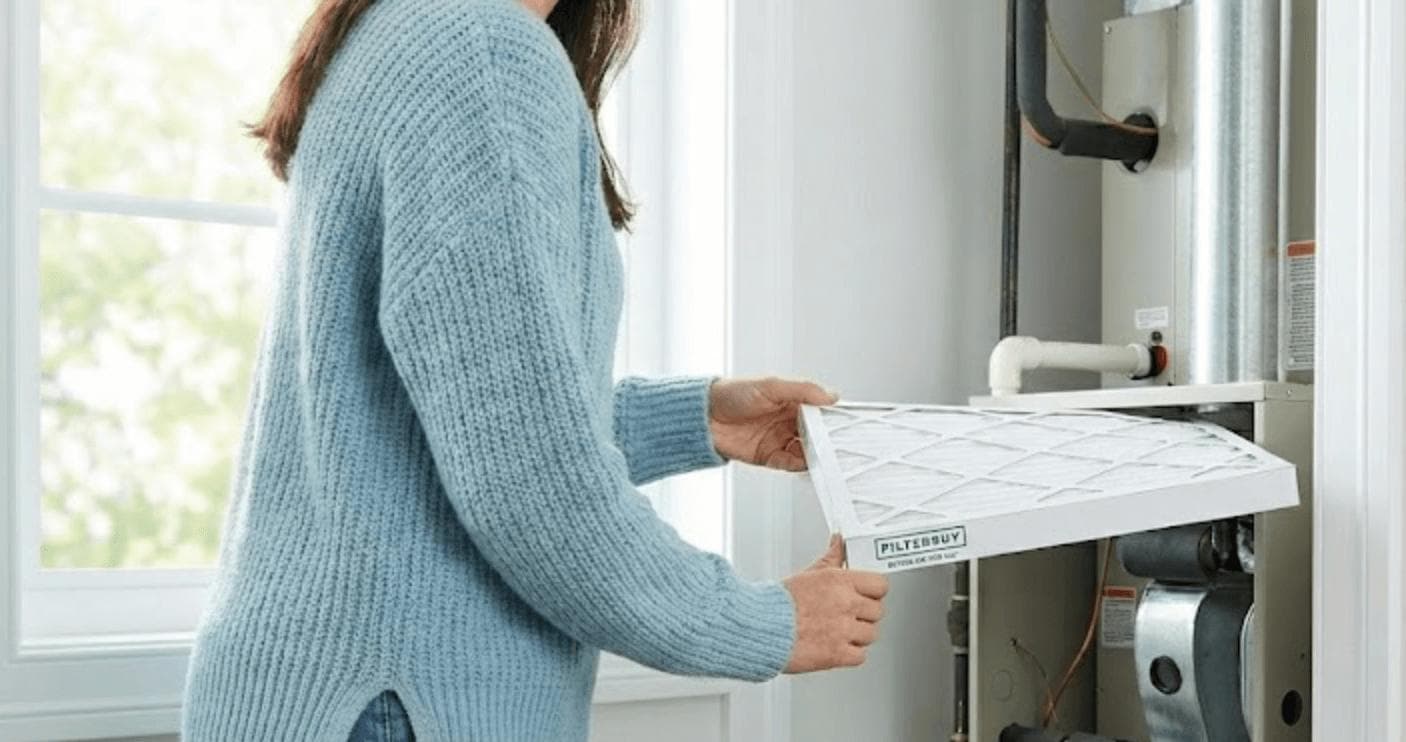
It's frustrating to turn up the thermostat on a cold day and only feel a weak stream of lukewarm air. Before you call for an expensive HVAC repair, check a simpler culprit first: your furnace filter.
During winter, your heating system works overtime, so your filter traps more dust and debris. A clogged filter won't just leave you cold; it can increase your energy bills and damage your furnace.
This guide will cover the top signs your filter is clogged and help you choose the right replacement to keep your home warm during the winter.
TL;DR Quick Answers
Signs Your Furnace Filter Is Clogged This Winter
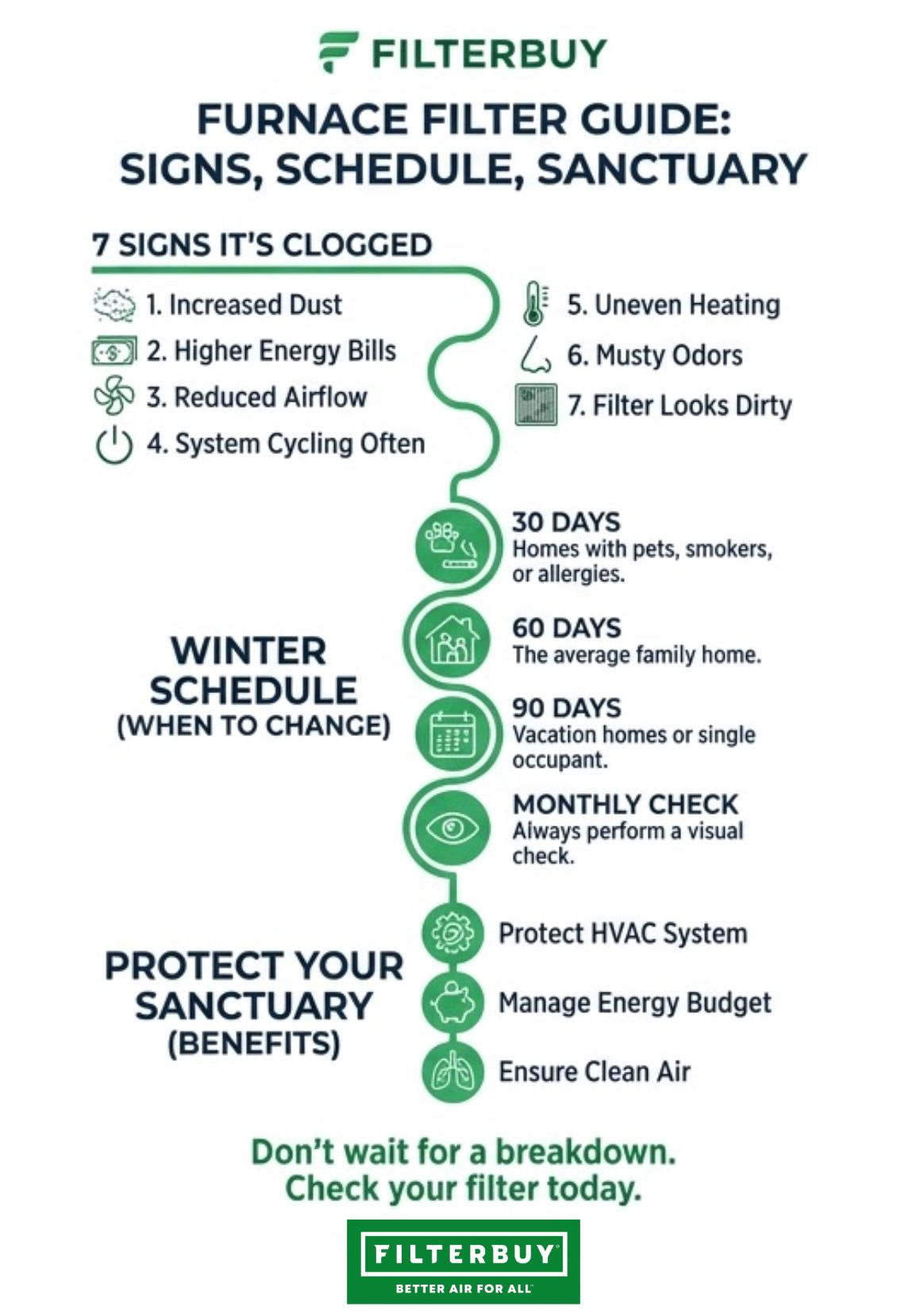
After manufacturing millions of filters and hearing from homeowners every winter, these are the telltale signs we see come up again and again:
Weak airflow from vents — your blower is fighting to push air through a packed filter
Uneven temperatures — some rooms warm, others cold, especially upstairs
Higher energy bills — your furnace is running longer and harder to compensate
Excess dust on surfaces — a full filter can't trap particles, so they recirculate
Burning or musty smell — dust is collecting on overheated internal components
Furnace short cycling — the system turns on and off repeatedly as the heat exchanger overheats and the safety switch trips
Increased allergy or asthma symptoms indoors — allergens are bypassing the filter and circulating through your home
The quick fix: Pull your filter out and hold it up to a light. If you can't see through it, it's done. Replace it immediately — a clean filter can lower your energy use by 5% to 15% (U.S. Department of Energy) and prevent heat exchanger damage that can lead to carbon monoxide leaks.
How often to check in winter: Monthly at minimum. Homes with pets or allergies may need a new filter every 30 days during peak heating season.
Top Takeaways
Your home warns you before your furnace breaks down. Weak airflow, uneven temperatures, rising bills, excess dust, and strange smells are all early signs. Catch them early and you can save hundreds in repairs.
A clogged filter costs you three ways at once:
Health — indoor air can be up to 5× more polluted than outdoor air (EPA)
Money — energy consumption rises 5%–15% (DOE)
Safety — an overheated heat exchanger can crack and leak carbon monoxide
Winter is the hardest season on your filter. More furnace run time. Sealed windows. Holiday cooking, candles, and extra guests. Check monthly — no matter what the packaging says.
The biggest risk isn't the wrong filter — it's forgetting to change it. Most problems we see trace back to a filter that stayed in too long. Auto-delivery, a phone reminder, a note on the fridge — pick one and stick with it.
A $15 filter change protects your system, your budget, and your family. No tools. No technician. Two minutes and you're done.
Why Your Furnace Filter Works Harder in Winter
Your HVAC system operates on a simple principle: it pulls air in, heats it, and pushes it back out. The air filter stands as the guardian at the gate, trapping contaminants before they can enter the blower fan or circulate back into your rooms.
In the spring and fall, your system might only run for a few hours a day. However, during a cold snap, your furnace might run almost constantly. This heavy usage accelerates the accumulation of debris on the filter media.
Many homeowners mistakenly believe that high-efficiency filters restrict airflow. The truth is that pleated filters, like the MERV 8–13 options from Filterbuy, are designed to balance superior filtration with optimal airflow. The real problem isn't the type of filter—it's neglecting to change it once it becomes packed with winter dust.
7 Clear Signs Your Furnace Filter Is Clogged This Winter
If you aren't sure if your system is struggling, look out for these seven common symptoms.
1. Weak or Reduced Airflow From Vents
This is often the first indicator of trouble. Place your hand near a vent while the heat is running. If the airflow feels faint, like the system is struggling to exhale, you likely have furnace airflow problems caused by a blockage. The blower fan has to work much harder to push air through a solid wall of dust, resulting in weak output.
2. Rooms Feel Colder or Heat Unevenly
Is your living room toasty while the bedroom feels like an icebox? A clogged filter restricts the volume of warm air circulating through your ductwork. This lack of pressure prevents heat from reaching the furthest rooms in your house, leading to uncomfortable hot and cold spots.
3. Rising Energy Bills With No Weather Change
If your utility bill spikes but the outdoor temperature hasn't dropped drastically, check your filter. When a furnace struggles to breathe, it consumes more energy to do the same amount of work. Swapping out a dirty filter is one of the easiest ways to lower heating costs.
4. Furnace Is Running Longer Than Normal
You might notice your furnace running constantly without ever seeming to reach the set temperature. Alternatively, it might "short-cycle" turn on for a few minutes and then shut off abruptly. This happens because the restricted airflow causes the internal heat exchanger to overheat, triggering a safety switch to shut the system down.
5. More Dust Around Your Home
Your furnace filter is supposed to trap dust. Once the filter is completely saturated, it can no longer hold any more particles. As a result, dust begins to bypass the filter or settle in the ducts, eventually blowing back into your living space. If you find yourself dusting surfaces more often than usual, check your HVAC unit.
6. Burning Smell When the Heat Turns On
While a slight smell is normal the very first time you turn your heat on in autumn, a persistent burning odor in the middle of winter is a red flag. It often means the furnace is overheating due to a lack of airflow, or dust inside the unit is burning off.
7. Visible Dirt or Dark Spots on the Filter
The most definitive test is a visual inspection. Turn off your furnace, pull out the filter, and hold it up to a light source. If you can't see light coming through the material, or if the surface is covered in a gray, fuzzy mat of dust, it is time for a replacement.
Why Pleated Filters Are the Best Choice This Winter
When buying a replacement, you will see two main options: flat fiberglass filters and pleated filters. Fiberglass filters are generally cheaper, but they are designed only to protect the furnace from large debris, not to clean the air you breathe.
Pleated Filters Capture More Particles Than Fiberglass
Filterbuy’s pleated filters use a synthetic media with a larger surface area. This design allows them to capture a much higher percentage of airborne particles—including pollen, pet dander, and mold spores—without sacrificing airflow.
Why MERV 8–13 Is the Sweet Spot
The efficiency of a filter is measured by its MERV rating (Minimum Efficiency Reporting Value).
MERV 8: The standard for most homes. It catches dust, lint, and pollen.
MERV 11: Ideal for pet owners. It traps finer particles like pet dander.
MERV 13: The best option for indoor air quality. It captures bacteria and virus carriers while still allowing your furnace to breathe.
Why Filterbuy Filters Perform Better
Quality matters when protecting your expensive HVAC equipment. Filterbuy filters are manufactured in the USA using industrial-grade beverage board frames that won't buckle under high airflow. With thousands of custom sizes available, you can ensure a perfect fit that prevents unfiltered air from sneaking around the edges.
How Often to Replace Your Furnace Filter in Winter
While the general rule of thumb is every 90 days, winter demands a tighter schedule. During peak heating season, you should check your filter every 30 days.
Vacation home/Single occupant: Every 60–90 days.
Average family home: Every 30–60 days.
Pets or allergies: Every 30 days.
With Filterbuy’s auto-delivery subscription, you can set your schedule based on your household's needs so you never forget a change.
When a Clogged Filter Leads to HVAC Damage
Ignoring a clogged filter is a gamble with your bank account. The restricted airflow causes heat to build up inside the system. This can crack the heat exchanger (a dangerous carbon monoxide risk) or cause the blower motor to burn out from the strain of pushing against resistance. Replacing a filter costs a few dollars; replacing a blower motor costs hundreds.
How to Replace Your Furnace Filter (Simple Winter Guide)
Safety First: Turn off your furnace at the thermostat and the switch on the unit.
Locate the Slot: Find the filter compartment, usually located where the return duct meets the main unit.
Remove the Old Filter: Note the direction of the arrow on the frame.
Insert the New Filter: Ensure the arrow points toward the furnace (the direction of airflow).
Power Up: Turn the system back on and enjoy the improved airflow.
Where to Buy High-Quality Furnace Filters This Winter
Don't wait for your furnace to shut down on the coldest night of the year. Filterbuy offers a massive inventory of MERV 8, 11, and 13 pleated filters in every size imaginable.
By ordering directly from the manufacturer, you get American-made quality delivered straight to your door. Support better winter airflow and keep your home warm by finding your exact filter size today.
"After manufacturing millions of filters and hearing from homeowners every winter, we've found that a clogged furnace filter is behind most cold-weather HVAC complaints—and it's the one fix that costs a few dollars but can save hundreds in repair bills."
7 Resources That Actually Help
Swapping out a clogged filter is the fastest fix — but if you want to keep your home warm, your air clean, and your energy bills in check all winter, these resources are worth bookmarking. We pulled together the most useful guides from trusted sources (including a couple of our own) so you can make smart decisions without spending hours researching.
1. What's Really Floating Around Your Home
Most homeowners are surprised by what's lurking in their indoor air — dust mites, pet dander, cooking fumes, and more. The EPA's Care for Your Air guide breaks it all down in plain language and gives you simple steps to clean things up, starting today. Source: U.S. Environmental Protection Agency (EPA) URL: https://www.epa.gov/indoor-air-quality-iaq/care-your-air-guide-indoor-air-quality
2. MERV Ratings Explained (Without the Jargon)
You've probably seen "MERV" printed on your filter and wondered what it actually means. This EPA explainer covers the rating scale developed by ASHRAE, what each level captures, and why the highest number isn't always the best choice for your system. It's a quick read that saves you from buying the wrong filter. Source: U.S. Environmental Protection Agency (EPA) URL: https://www.epa.gov/indoor-air-quality-iaq/what-merv-rating
3. MERV 8, 11, or 13 — Here's How to Pick
Once you understand the scale, the real question is: which one do I actually need? We built this guide from over a decade of manufacturing experience and feedback from millions of customers. Whether you've got pets, seasonal allergies, or just want cleaner air for your family, we'll help you find the right match in a few minutes. Source: Filterbuy URL: https://filterbuy.com/resources/air-filter-basics/which-merv-rating-should-I-use/
4. How to Measure Your Filter So It Actually Fits
Here's something most people don't realize: even a half-inch gap around your filter lets unfiltered air sneak right past it. We see it all the time. This step-by-step guide walks you through measuring nominal vs. actual dimensions so you get the exact size your system needs — no guesswork, no wasted trips to the hardware store. Source: Filterbuy URL: https://filterbuy.com/resources/air-filter-basics/measure-air-filter/
5. Simple Ways to Cut Your Winter Heating Bills
A clean filter helps your system run more efficiently, but it's one piece of a bigger puzzle. The Department of Energy's winter energy tips cover thermostat strategies, duct sealing, and other low-cost changes that can save you up to 30% on your heating bill when combined with regular filter changes. Source: U.S. Department of Energy URL: https://www.energy.gov/energysaver/fall-and-winter-energy-saving-tips
6. The Full HVAC Maintenance Checklist You'll Want to Keep
If your filter was clogged, there's a good chance other parts of your system need attention too. This ENERGY STAR checklist covers electrical connections, lubrication, condensate drains, and when to call a pro — everything you need to keep your furnace running strong and avoid a breakdown on the coldest night of the year. Source: ENERGY STAR (U.S. EPA) URL: https://www.energystar.gov/saveathome/heating-cooling/maintenance-checklist
7. Carbon Monoxide Safety: What Every Homeowner Needs to Know
We mentioned that a clogged filter can overheat your heat exchanger — and a cracked heat exchanger can leak carbon monoxide into your home. CO is colorless and odorless, which makes it especially dangerous. This CPSC guide covers where to place detectors, what symptoms to watch for, and exactly what to do if your alarm goes off. It's one of those things you hope you'll never need, but you'll be glad you read it. Source: U.S. Consumer Product Safety Commission (CPSC) URL: https://www.cpsc.gov/Safety-Education/Safety-Education-Centers/Carbon-Monoxide-Information-Center/Carbon-Monoxide-Questions-and-Answers
The Numbers Behind Why Your Furnace Filter Matters
After manufacturing millions of filters and hearing from homeowners across the country, we've seen firsthand what happens when a clogged filter goes ignored. The data from federal agencies backs up exactly what our customers experience every winter.
1. Indoor Air Can Be Up to 5× Worse Than the Air Outside
What the research says: The U.S. Environmental Protection Agency reports that Americans spend roughly 90% of their time indoors, where concentrations of some pollutants are often two to five times higher than typical outdoor levels. US EPA
What we see every winter:
Customers tell us, "I keep my house clean — why is there so much dust?" This is why.
Windows stay sealed. The furnace runs nonstop. Every particle your system pulls in has to go somewhere.
A fresh filter traps those particles. A clogged one sends them right back into the rooms where your family sleeps, eats, and breathes.
We see it in the photos customers send us of filters they've pulled out mid-January — packed solid after 60 to 90 days of heavy use.
Source: U.S. Environmental Protection Agency — Indoor Air Quality
2. A Clean Filter Can Cut Energy Use by 5% to 15%
What the research says: The U.S. Department of Energy confirms that replacing a dirty, clogged filter with a clean one can lower your system's energy consumption by 5% to 15%. Department of Energy The U.S. Energy Information Administration adds that heating and air conditioning account for more than half — 52% in 2020 — of a household's annual energy consumption. U.S. Energy Information Administration
Why that percentage hits harder than it sounds:
Heating and cooling is already the single biggest line item on your energy bill.
A clogged filter forces your furnace to work harder to push air through a wall of trapped dust — burning more fuel every cycle.
Customers on our auto-delivery program have told us they noticed lower utility bills within the first billing cycle of getting on a regular replacement schedule.
The bottom line: A replacement filter costs a few dollars. Running your furnace through a clogged one month after month costs a lot more.
Sources: U.S. Department of Energy — Maintaining Your Air Conditioner U.S. Energy Information Administration — Use of Energy in Homes
3. CO From Heating Equipment Kills Hundreds of Americans Every Winter
What the research says: The U.S. Consumer Product Safety Commission reports that on average, more than 200 people in the United States die every year from carbon monoxide produced by non-automotive consumer products, including malfunctioning fuel-burning appliances such as furnaces. CPSC Their data also shows more than half of consumer product-related CO deaths occur during the four coldest months — November, December, January, and February. CPSC
What HVAC technicians tell us:
Restricted airflow from a neglected filter forces the heat exchanger to overheat.
Over time, that thermal stress can crack it.
A cracked heat exchanger is how carbon monoxide — odorless, colorless, and impossible to detect without an alarm — enters your living space.
Why this shapes everything we do: This is the reason we built our auto-delivery subscription. It's not just about convenience or clean air. It's about making sure no one forgets a filter change during the months when the stakes are highest.
Sources: U.S. Consumer Product Safety Commission — Carbon Monoxide Fact Sheet U.S. Consumer Product Safety Commission — Non-Fire CO Fatalities Report
Our Take: The Clogged Filter Problem Isn't Really About Filters
Here's something we've learned after more than a decade of manufacturing air filters in the U.S. and shipping them to millions of homes: a clogged furnace filter is almost never the real problem. It's the symptom of a bigger one.
The real problem is forgetting. Life gets busy. The holidays hit, the weather drops, and the last thing on anyone's mind is checking the furnace filter. We get it. That's exactly why this article exists — and why we built our business the way we did.
What We've Seen That Most People Haven't
We don't just make filters — we hear from the people using them every single day. After years of those conversations, three clear patterns have emerged:
The "I didn't know" group. No idea the filter needed changing more than once a year. By the time they pulled it out, it was solid gray and their energy bills had been climbing for months.
The "I kept meaning to" group. Knew it needed changing, just hadn't gotten around to it. Then came the short cycling, the strange smell, or the $400 repair bill.
The "I didn't realize it mattered this much" group. Found out from an HVAC technician that a clogged filter cracked their heat exchanger — and that carbon monoxide had been a risk they never knew about.
Every section of this article was written with those three groups in mind. The warning signs, the statistics, and the resources aren't theoretical. They reflect real customer experiences, week after week, winter after winter.
The Opinion We're Not Afraid to Share
Most content about furnace filters treats it like a minor chore — right alongside changing smoke detector batteries or cleaning the gutters. We think that undersells the stakes.
A dirty furnace filter isn't a chore you put off. It's a decision that affects three things at once:
Your family's health. Indoor air can be two to five times more polluted than what's outside. You can't see it, but your body responds — especially kids, older adults, and anyone managing allergies or asthma.
Your money. A clogged filter adds a 5% to 15% premium on the single largest energy expense in your home. Over a full winter, that's not pocket change.
Your safety. Restricted airflow overheats the heat exchanger. An overheated heat exchanger can crack. A cracked heat exchanger can leak carbon monoxide. A $15 filter change eliminates that risk.
We don't say this to scare anyone. We say it because homeowners who understand all three dimensions don't forget to change their filter. They make it a priority — and their homes are healthier, more efficient, and safer for it.
What We'd Tell a Friend
If someone asked us, "What's the single easiest thing I can do to protect my HVAC system, lower my bills, and keep my family breathing clean air this winter?" — the answer is always the same.
Check your furnace filter right now. Not tomorrow. Not this weekend. Now.
If it's gray, packed, or you can't remember when you last changed it — replace it. Then set yourself up so it doesn't happen again:
Set a phone reminder
Mark it on the calendar
Sign up for auto-delivery so a fresh filter shows up on schedule
The method doesn't matter. What matters is that it gets done.
We've made it our job to make sure clean air is never more than a few clicks away — over 600 standard sizes, custom options for hard-to-fit systems, and free shipping on every order. All factory-direct. No markups. No middlemen.
Because in our opinion, the best furnace filter is the one that's actually in your furnace when you need it.
What to Do Right Now (And What to Do Next)
You've read the warning signs. You've seen the data. Here's your game plan — six straightforward steps to get your furnace back on track and keep it there all winter.
Step 1: Check Your Filter Right Now
Takes less than two minutes.
Slide it out and hold it up to a light. No light coming through? It's done.
Check the color. White or off-white means it's still working. Gray, dark, or matted means it's not.
Look at the edges. Bowing, warping, or sagging means restricted airflow has been straining your system.
If it fails any of these checks, replace it today.
Step 2: Know Your Size Before You Buy
A wrong-size filter lets unfiltered air bypass it entirely. We see this mistake constantly.
Check the frame. The size is usually printed as length × width × depth (e.g., 20×25×1).
Print worn off? Measure all three dimensions with a tape measure and round to the nearest inch.
Still not sure? Our filter sizing guide walks you through it.
Step 3: Pick the Right MERV Rating
Not every home needs the same level of filtration.
MERV 8 — Everyday protection. Captures dust, pollen, and lint. Great for homes without pets or allergy concerns.
MERV 11 — Our most popular. Traps pet dander, mold spores, and finer particles. Ideal for families with pets or mild allergies.
MERV 13 — Hospital-grade for the home. Catches bacteria, smoke, and microscopic allergens. Best for asthma, severe allergies, or anyone who wants the cleanest air possible.
Need help choosing? Our MERV rating guide matches your needs to the right filter in minutes.
Step 4: Set Yourself Up So You Never Forget Again
The biggest risk isn't the wrong filter — it's forgetting to change it. Pick what works for your life:
Phone reminder every 60–90 days (every 30 if you have pets or allergies)
Calendar you actually check — kitchen whiteboard, planner, whatever you'll see
Auto-delivery — we ship a fresh filter on your schedule so it's at your door when it's time to swap
Step 5: Schedule a Professional HVAC Inspection
A fresh filter fixes airflow, but if the old one was clogged for a while, have a tech check for damage.
Ask about the heat exchanger. Cracks can leak carbon monoxide — especially important if you noticed headaches, dizziness, or a yellow furnace flame.
Request a full tune-up. Electrical connections, blower components, condensate drains — all of it.
Make it annual. One inspection before each heating season catches small problems before they get expensive.
ENERGY STAR's maintenance checklist tells you exactly what to ask for.
Step 6: Check Your CO Alarms
If a clogged filter has been straining your furnace, take five minutes to confirm your safety net is solid.
Press the test button on every CO alarm in your home.
Replace batteries if they're more than six months old.
Install alarms on every level and outside each sleeping area.
Replace any alarm older than 5–7 years. Sensors lose accuracy over time.
The CPSC's carbon monoxide safety guide covers everything you need.
Quick-Reference Checklist
Your at-a-glance action plan:
Pull out your current filter and inspect it
Note the size (or measure it)
Order the right MERV-rated replacement
Install with the airflow arrow pointing toward the furnace
Set a reminder or enroll in auto-delivery
Schedule an annual HVAC inspection
Test and update all CO alarms
Every step takes minutes. Together, they protect your air, your budget, and your family's safety all winter long.
Frequently Asked Questions
Q: How do I know if my furnace filter is clogged without pulling it out?
A: After years of talking with customers and working alongside HVAC technicians who install our filters, we've identified five red flags that show up consistently. Your home is already giving you the clues:
Uneven temperatures room to room. The number one complaint we hear in January and February. Upstairs freezing, living room fine. Nine times out of ten, it's a clogged filter choking airflow to the farthest registers.
Weak airflow at the vents. Hold your hand up to a register. If it feels like your system is barely breathing, the blower is struggling to push air through a wall of trapped dust.
An energy bill that spiked for no reason. We've had customers call confused about a $40–$60 winter increase. When we ask how long since the last filter change, the answer is usually "I'm not sure" — and that's the answer.
Dust accumulating faster than you can clean it. Once the filter hits capacity, particles blow right past it and settle on everything in your home.
A musty or burning smell when the furnace kicks on. That's dust burning off overheated components. In our experience, it means the filter should have been changed days or weeks earlier.
One sign is worth investigating. Two or more together, and we can say with near certainty it's the filter. We've just seen the pattern too many times.
Q: How often should I change my furnace filter in winter?
A: This is the question we get more than any other. After shipping millions of filters to homes across the country, we've learned the real answer isn't a fixed number — it's a range based on how hard your home works the filter.
What our data and customer feedback have taught us:
Every 30 days — multiple pets, smokers, or family members with asthma or severe allergies. Pet hair alone can fill a standard pleated filter in three to four weeks during heavy use.
Every 60 days — one pet or mild seasonal allergies. The sweet spot for a large portion of our auto-delivery customers.
Every 90 days — no pets, newer construction, no significant air quality concerns. Even then, we recommend monthly visual checks.
What most filter guides won't tell you: Winter breaks every "standard" replacement timeline. Your furnace runs more hours per day than any other season. Windows stay sealed. Holiday cooking, candles, fireplace use, and extra guests all add particulate load. We've seen filters rated for 90 days look completely spent after 45 in a cold January.
Our standing advice: Check monthly. Pull it out. Hold it to a light. If it's gray and packed, it's done — don't wait for the calendar to tell you what your eyes already can.
Q: Can a clogged furnace filter actually stop my furnace from producing heat?
A: Yes — and HVAC technicians tell us a clogged filter is one of the top reasons for no-heat emergency calls in winter. We've heard this story so many times we can walk through it step by step:
The clogged filter chokes airflow. The blower runs, but barely any air gets through.
The heat exchanger overheats. Not enough air is moving across it to distribute the heat.
The high-limit safety switch trips. The furnace shuts itself down to prevent structural damage.
The thermostat calls for heat again. The cycle restarts — on, off, on, off. This is called short cycling, and it's one of the most stressful things your furnace can endure.
Left unchecked, this cycle can lock the furnace out entirely — no heat until a technician resets the system. We've talked to HVAC pros who walk into these calls, swap the filter, and the furnace fires right back up. A $15 fix for what felt like a $500 emergency.
The part we want every homeowner to understand: If short cycling has been going on for weeks, the damage may go beyond the filter. Constant restarts wear down the blower motor. Repeated overheating is exactly how heat exchangers develop cracks. We always recommend a professional inspection if the problem wasn't caught early — not to create fear, but because we've seen what happens when the underlying stress goes unaddressed.
Q: Is a clogged furnace filter dangerous, or just inefficient?
A: Both — and this is the question that shapes how we think about our entire business.
The efficiency cost is real: The U.S. Department of Energy says a clean filter can lower your system's energy consumption by 5% to 15%. Over a full heating season, that's meaningful money on the single biggest line item on your energy bill.
The safety risk is what most people never hear about:
A severely clogged filter can overheat the heat exchanger. We've talked with technicians who've pulled cracked exchangers from furnaces where the filter hadn't been changed in six months or more.
A cracked heat exchanger can leak carbon monoxide — odorless, colorless, zero warning — directly into your living space.
The CPSC reports over 200 people in the U.S. die every year from CO linked to consumer products including furnaces. More than half of those deaths happen during the four coldest months.
Our honest perspective: The line between "inefficient furnace" and "dangerous furnace" is shorter than most homeowners think. A filter that costs less than a pizza is the barrier between those two outcomes. That's what drove us to build auto-delivery into the core of our business. It's not a convenience feature. It's a safety net.
Q: What's the best MERV rating for a furnace filter in winter?
A: We've manufactured filters across the full MERV spectrum for over a decade. If there's one thing we've learned, it's that "best" is personal. The right rating depends on your household's needs and what your HVAC system can handle — and those two things don't always point to the same number.
How we guide customers based on what we've seen work in real homes:
MERV 8 — Dependable, no-nonsense filtration. Captures dust, pollen, and lint without extra system strain. Best for homes without pets or allergy concerns, and a safe choice for older furnaces.
MERV 11 — Our bestseller for a reason. Traps pet dander, mold spores, and finer particles while maintaining strong airflow on most residential systems. For families with pets or mild allergies, this is the filter we'd put in our own homes.
MERV 13 — The highest rating most residential systems support without modification. Catches bacteria, smoke, and microscopic allergens. Best for asthma, severe allergies, or anyone who wants the cleanest air possible.
The insight most people miss: Jumping to the highest MERV rating without checking your system's specs can recreate the same problem as a clogged filter. A filter too restrictive for your blower starves the system of air, drives up static pressure, and forces the furnace to work harder — the exact scenario this entire article helps you avoid.
Before upgrading:
Check your furnace manual for the manufacturer's maximum recommended MERV rating.
Use our MERV rating guide to match your needs to the right level.
Still unsure? Our team is a phone call or chat away — we'd rather help you find the right filter than sell you one that doesn't fit your system.
Spotted the Signs of a Clogged Furnace Filter? Find Your Perfect Replacement in Seconds.
Don't let a packed filter drive up your energy bills, strain your HVAC system, or put your family's air quality at risk this winter. Shop your size now — with 600+ sizes, fast free shipping, and auto-delivery options, clean air is never more than a few clicks away.