
Furnace Blinking Light Codes By Brand: Carrier, Goodman, Trane, Lennox & More
October 5, 2026
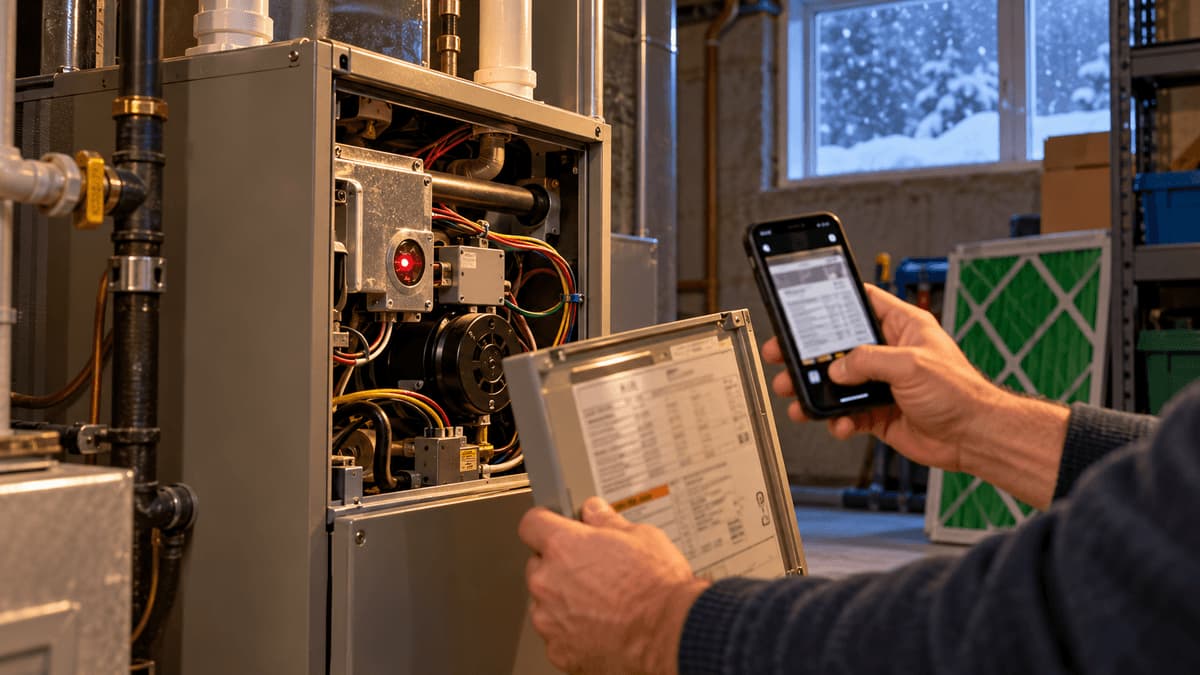
Furnace blinking light codes are diagnostic signals from the control board that tell you which safety check stopped the heat. Filterbuy makes the filters that feed air into furnaces like yours, so this guide centers on the one code a filter can clear: the open limit switch.
Answer a few quick questions and we'll match you to your filter.
Already know your filter size?
Shop air filters at FilterbuyTL;DR
Every furnace brand numbers its fault codes differently. Limit switch codes (Carrier 33, Goodman 4, Trane 4, Lennox E250, Rheem 3) usually mean restricted airflow, so start with the filter. Rollout and gas valve codes, or an ignition lockout that keeps coming back, need a licensed technician, especially in winter.
Key Takeaways
The same flash count can point to different faults on different brands, so read the brand name before you count.
An open high limit switch is the one fault a clogged filter commonly causes, whatever number your brand's board gives it.
In winter, pressure switch codes on high-efficiency furnaces often trace to snow-blocked PVC vents or a frozen condensate line.
A gas smell or a flame rollout code calls for a licensed HVAC technician, and so does any code that returns after a new filter.
How To Read A Furnace Blinking Light Code
To read a furnace blinking light code, count the flashes between pauses on the control board LED and match that count to the fault chart inside the furnace door. On most furnaces, the LED shows through a sight glass in the lower panel.
Read the light before you touch the power switch, because cutting power clears most codes.
Watch two full cycles to confirm the count.
No light at all usually means no power, so check the breaker and the furnace service switch.
Furnace Codes By Brand: The Cross-Brand Fault Decoder
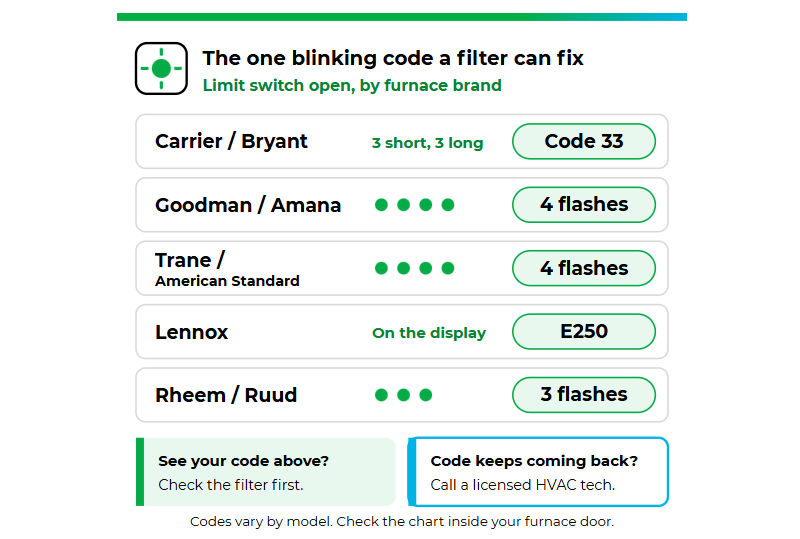
This decoder matches each brand's codes to the safety switch behind them. The Filterbuy team built it from each brand's published fault codes, and only the limit switch row is a filter problem.
Why The Same Flash Count Means Different Faults
The same flash count can mean different faults on different brands. Three flashes point to the pressure switch on Goodman and Trane furnaces, usually a venting or drain problem, but on many Rheem and Ruud furnaces they mean the limit or rollout switch opened, which a fresh filter often clears. Four flashes flip the other way: an open limit on Goodman and Trane, a stuck pressure switch on Rheem.
Carrier And Bryant Furnace Codes
On Carrier and Bryant furnaces, code 33 means the high limit or flame rollout switch opened. If it stays open longer than three minutes, the board switches to code 13, a limit lockout. Codes flash as short blinks for the first digit and long blinks for the second, so three short and three long read as 33.
Goodman And Amana Furnace Codes
On a Goodman furnace, four flashes mean an open high limit switch, which a dirty filter commonly causes. Three flashes point to the pressure switch. Amana furnaces often use the same control boards.
Trane And American Standard Furnace Codes
On Trane and American Standard furnaces, four red flashes mean an open limit switch. A slow blink means standby, and a fast blink means a normal call for heat. Five flashes mean the board sensed flame with the gas valve off, which needs a technician.
Lennox Furnace Codes
On Lennox furnaces, E250 means the limit switch circuit is open, most often from a clogged filter or closed registers. Current models such as the SL280 and EL296 scroll codes on a small display, while older SureLight boards use two flashing LEDs. Some Lennox cabinets take odd filter sizes, so Filterbuy cuts custom air filters to the eighth of an inch to match them.
Rheem And Ruud Furnace Codes
On many Rheem and Ruud furnaces, three flashes mean the main limit or rollout switch opened, and four flashes mean a stuck pressure switch. The sister brands share one flash chart on standard models, but newer furnaces with digital displays use their own numeric codes.
Winter Furnace Codes: Snow, Ice, And Heavy Runtime
Winter codes often trace to heavy runtime clogging the filter faster, or to ice and snow blocking a high-efficiency furnace's vents and drain. The National Fire Protection Association names December, January, and February as the peak months for home heating fires, which makes fall the right time for a professional tune-up.
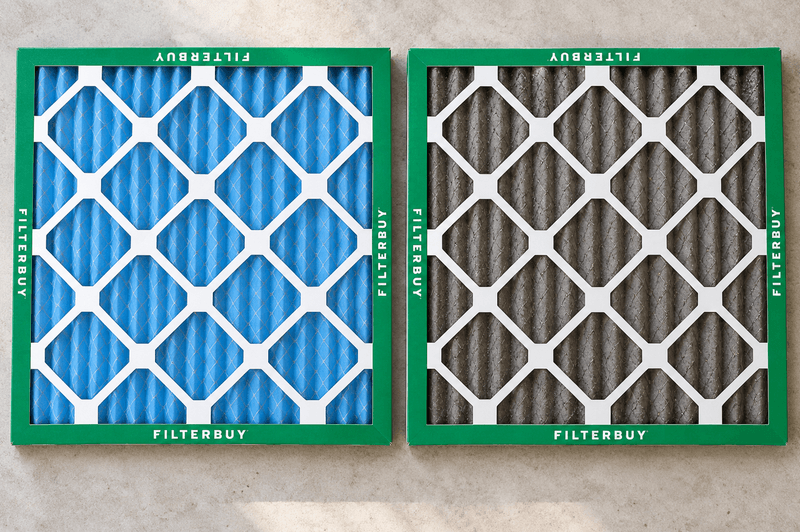
Heavy runtime loads the filter faster. Near-constant heating can fill a filter before a 90-day schedule suggests, so Filterbuy recommends a monthly check all heating season. Our guide on how often to change your furnace filter in winter lays out the timing.
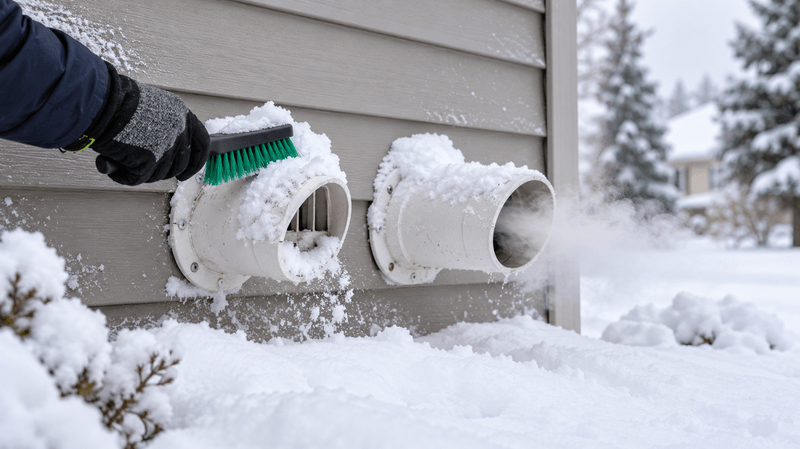
Snow and ice can block PVC vents. When snow covers the white PVC intake and exhaust pipes, the draft drops and the furnace throws a pressure switch code, such as Goodman 3 flashes or Lennox E223. Brush the openings clear after every storm.
Condensate lines can freeze. A frozen condensate line or clogged trap backs water into the pressure switch tubing and trips the same kind of code. A line frozen in an unheated space usually needs a technician.
When A Blinking Light Means Call A Licensed HVAC Technician
Call a licensed HVAC technician for flame rollout or gas valve codes, or when an ignition or limit code keeps returning after a fresh filter. These faults involve combustion and venting, which carry carbon monoxide risk.
If you smell gas, leave the house and call your gas utility from outside, without resetting the furnace or flipping switches. Keep carbon monoxide alarms working on every level of your home, and before the technician arrives, note the brand, the flash count, your reset attempts, and your last filter change. The Consumer Product Safety Commission urges a yearly professional inspection of fuel-burning heating systems.
Supporting Statistics
Three federal numbers shaped how Filterbuy wrote this guide.
In 2024, 47% of U.S. homes are heated mainly with natural gas.
Our read: many of those homes run a gas furnace with the switches described above.
More than 400 Americans die each year from unintentional carbon monoxide poisoning not linked to fires.
The CDC names gas and oil furnaces among the household sources. Our read: rollout and pressure switch codes are safety stops, not nuisances to reset.
Source: Centers for Disease Control and Prevention, Carbon Monoxide Poisoning Basics
Fire departments reported 27,900 residential heating fires in 2023.
That is 31% fewer than in 2014. Our read: a warning code is an early request for attention, while the fix is still simple.
Source: U.S. Fire Administration, Residential Building Heating Fire Trends (2014-2023)
"Every filter we make has one job at the furnace, keeping air moving, and the only blinking code a filter can clear is the limit switch. If a fresh filter does not stop the light, call a licensed technician, because the furnace is flagging something no filter can fix."
David Heacock, Founder and CEO, Filterbuy
Frequently Asked Questions About Furnace Blinking Light Codes
Why Is My Furnace Blinking But Not Heating?
The control board stopped the heating sequence at a safety check, and the flash count tells you which one. An open limit switch is a common culprit, so check for clogged furnace filter symptoms first.
Will Resetting My Furnace Clear The Code?
Usually, yes. A power cycle clears most codes, so write the code down first. If it returns after one reset, stop resetting, because repeated resets can hide a failing blower motor or a cracked heat exchanger.
Does A Furnace Lockout Clear On Its Own?
Some do. Many Goodman and Rheem boards retry after about an hour, and an airflow-related limit code usually clears once the furnace cools. A hard lockout waits for a manual reset or a technician.
What Does A Solid Red Light On A Furnace Mean?
On Trane and American Standard boards, a steady red light signals a control board or wiring problem. On many other brands, a steady light means the furnace is on standby.
Keep Your Filter Off The Fault Chart This Winter
At Filterbuy, we would rather you never see the limit code, so replace the filter before it clogs. A Filterbuy air filter subscription ships your exact size, cut to order, on the schedule you choose, with fast and free 2-day delivery to most US states.
Glossary
Control board
The circuit board that runs the heating sequence and flashes diagnostic codes.
High limit switch
A temperature safety switch that shuts off the burners when the furnace overheats.
Flame rollout switch
A heat-sensing switch near the burners that opens if flames spill outside the combustion area.
Pressure switch
A switch that confirms the inducer fan is drawing proper draft through the vent before the furnace lights.
Heat exchanger
The metal chamber that heats household air while keeping combustion gases separate.
Lockout
A safety shutdown after repeated failures. Soft lockouts retry later, and hard lockouts need a manual reset.
Condensate drain
The line that carries water away from a high-efficiency furnace.
MERV
Minimum Efficiency Reporting Value, the ASHRAE scale for how well an air filter captures airborne particles.