
Furnace Airflow & Heating System Efficiency: What Homeowners Should Know
April 30, 2026

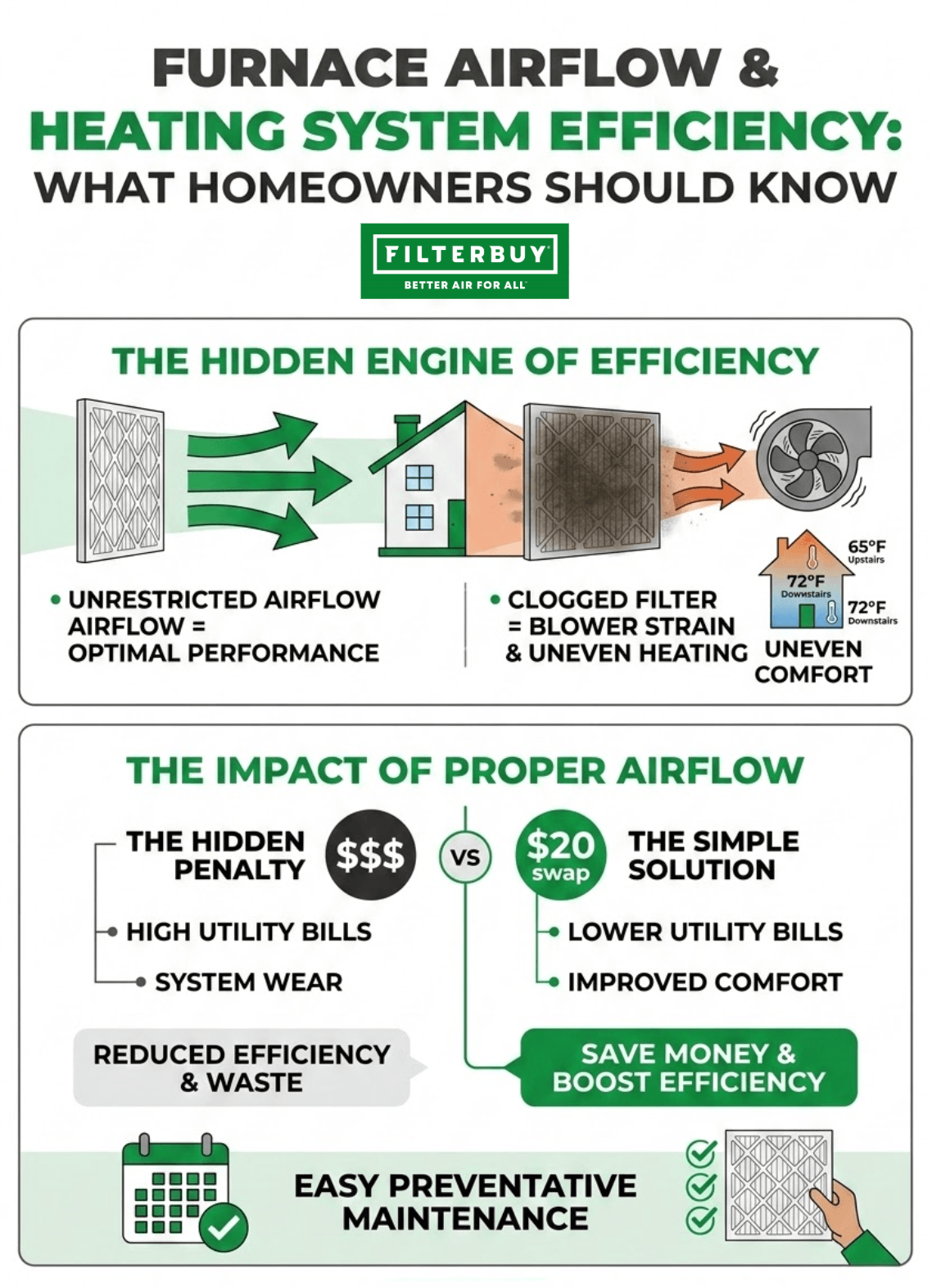
We hear from homeowners every December who think their furnace is dying. The heat runs all day, the upstairs is still freezing, and the utility bill jumped sixty bucks. Most of the time, the fix is a $20 filter swap.
That's not a sales pitch. After more than ten years of building pleated filters in the U.S. and shipping over 600 sizes to families across the country, we keep seeing the same pattern. What looks like a furnace problem is usually an airflow problem. And the cheapest, most controllable airflow variable in your whole heating system is the filter sitting behind your return grille.
This guide walks you through how filter choice and replacement timing decide your winter heating efficiency, and which MERV rating actually fits the way your furnace runs.
TL;DR — Quick Answers
How does a furnace filter affect heating system efficiency?
A clean furnace filter is the cheapest, most controllable lever for airflow and efficiency in your whole heating system. After more than ten years of building pleated filters in the U.S., here's what we've seen:
• A clogged filter can raise HVAC energy use by up to 15% (ENERGY STAR, U.S. Department of Energy), which lands hardest on your December and January bills.
• Restricted airflow forces your furnace to work harder. The blower draws more current, the heat exchanger runs hotter, and rooms heat unevenly because less warm air actually reaches them.
• Best MERV rating for winter for most homes: MERV 11. It catches pet dander, mold spores, and fine dust without overworking modern residential furnaces.
• Replace every 30 to 60 days during peak heating season — every 30 days for homes with pets, allergies, or smokers.
• Quick test: hold the filter up to a light. If you can't see through it, replace it regardless of the date on the calendar.
The shortest path to a more efficient winter heating system is a quality pleated filter, sized correctly for your furnace, swapped on a real schedule.
Top Takeaways
1. Airflow is the hidden engine of heating efficiency. Your furnace can only deliver heat as fast as it can move air. Choke the airflow and efficiency drops every cycle.
2. MERV is one variable inside a bigger equation. Higher MERV traps more particles. But if the filter is poorly built or you leave it in too long, the airflow penalty cancels the benefit.
3. Quality pleated construction matters more than the number on the box. A well-built MERV 11 with extra surface area beats a flimsy MERV 13 in real-world airflow.
4. Winter shortens filter life. Your furnace runs more hours, your home stays sealed up tight, and the filter loads faster than the box label suggests.
5. A neglected filter is a safety risk, not just an efficiency issue. Restricted airflow can overheat the heat exchanger and trip safety shutoffs in the middle of a cold night.
Why Airflow Drives Heating Efficiency
A forced-air furnace heats metal, and a fan pushes air across it. That's the whole job. The burners warm a heat exchanger. The blower pulls return air across that exchanger. Then your supply ducts carry the warmed air to every room. Every step depends on a steady volume of air moving at a predictable rate.
When something blocks the return air, the whole system slows down. A clogged filter is the most common culprit. Closed return registers and crushed ducts cause the same problem. With less air moving, the heat exchanger gets hotter than it should because nothing is carrying the heat away. The blower motor draws more current trying to compensate. The thermostat keeps calling for heat because the air reaching your rooms arrives in smaller volumes. Every step of that chain costs you efficiency.
Picture a vacuum cleaner with a clogged hose. The motor still spins. The pitch goes up. But nothing actually moves across the floor. Your furnace works the same way when its filter is choking it.

Furnace Filter MERV Rating Explained
MERV stands for Minimum Efficiency Reporting Value. It's an industry rating from 1 to 16 that measures how well a furnace filter catches airborne particles. Higher MERV numbers trap smaller particles, but they also fight airflow harder. For most homes in winter, MERV 8 to MERV 13 is the practical range. High enough to protect your indoor air. Low enough to keep your heating system running efficiently.
Quality pleated filters earn their MERV rating without strangling airflow because of one design choice: surface area. The pleats multiply the filtering surface, so air has more pathways through even as particles build up. A flat fiberglass filter can't do that. Cheap pleated filters with shallow folds can't either. That's part of why we've made pleated filters since 2013, the geometry simply works better in residential systems.
Best MERV Rating for Winter: MERV 8 vs MERV 11 vs MERV 13
Here's the honest, system-by-system breakdown we share with customers every heating season.
MERV 8 is the safe baseline. It catches dust, lint, pollen, and bigger debris. Choose it for older furnaces, lower-capacity systems, or installations where the manual calls for a low-static-pressure filter. It won't catch pet dander or fine smoke particles, but it'll keep your air handler clean without restricting airflow.
MERV 11 is the sweet spot for most modern residential furnaces. It catches everything MERV 8 catches plus pet dander, mold spores, and fine dust. The pressure drop sits well within most furnace tolerances. Homes with pets or mild allergies see a real difference inside two weeks. If we had to pick one filter for a typical winter household, this is it.
MERV 13 delivers the strongest residential filtration most furnaces can handle. It catches bacteria, smoke particles, and virus-carrying droplets. Pick it if anyone in the house has asthma, severe allergies, or wildfire-smoke exposure. One important caveat: check the installation manual for the maximum allowable pressure drop before upgrading. If the manual doesn't say MERV 13 is okay, stay at MERV 11.
When MERV 13 Is the Wrong Call
We've talked customers out of MERV 13 more than once. If your furnace is over fifteen years old, if you've ever had short-cycling problems, or if the manual specifies a static pressure ceiling that MERV 13 would push past, stay at MERV 11. The honest answer is the right answer.
How Often to Change Your Furnace Filter in Winter
Winter is the hardest season on a furnace filter. Your system runs more hours than in spring or fall. Your home stays sealed tight against the cold. Dust, dander, and combustion byproducts recirculate instead of escaping. A filter that looked fine in October is often packed solid by mid-December.
After shipping millions of filters and hearing from homeowners every winter, here's the cadence we recommend during the heating season:
• Every 30 days for homes with pets, allergies, asthma, or smokers
• Every 30 to 60 days for an average household running the furnace daily
• Every 60 days minimum for low-use households in mild winter climates
• Quick check anytime: hold the filter up to a light. If you can't see through it, replace it regardless of the date.
Restricted airflow does more than hurt efficiency. It can push your system into unsafe territory. If your heat has ever shut off mid-cycle, that may not be the furnace failing. It may be a safety switch protecting it.
Winter Indoor Air Quality and Filtration Together
Winter air quality is uniquely worse than the rest of the year. Sealed homes trap pollutants. Furnaces recirculate dust, dander, and combustion byproducts. People spend more time indoors than any other season. The same filter decision that affects your heating bill controls how much of that pollution you and your family breathe.
Filtration is one tool inside a bigger category. For context on how every type of air filter works, the broader category covers everything from car cabin filters to clean-room HEPA. For residential heating, what matters is matching the filter to your specific system, not chasing the highest possible rating.
After more than ten years of making pleated filters in the U.S. and shipping over 600 sizes to families across the country, we keep seeing the same thing every winter. The homeowners who treat their filter as a system component, not a hardware-store afterthought, keep their furnaces running longer, breathe cleaner air, and pay the lowest heating bills on their block.
— The Filterbuy Team
7 Essential Resources
These are the outside references we point customers to when they want to dig deeper into furnace airflow, filtration, and heating efficiency. Every link goes to a government agency or recognized standards body.
1. ENERGY STAR: Heat & Cool Efficiently
https://www.energystar.gov/saveathome/heating-cooling
EPA-backed guide that walks through filter checks, duct sealing, and HVAC efficiency strategy. The single best starting point for winter homeowners.
2. U.S. Department of Energy: Air Conditioner & HVAC Maintenance
https://www.energy.gov/energysaver/air-conditioner-maintenance
Official DOE guidance on filter replacement, coil care, and how dirty filters drag down airflow and system efficiency.
3. EPA: Guide to Air Cleaners in the Home
https://www.epa.gov/indoor-air-quality-iaq/guide-air-cleaners-home
Plain-language EPA breakdown of MERV ratings, filter sizing, and when to consider upgrading filtration in a residential HVAC system.
4. EPA: The Inside Story — A Guide to Indoor Air Quality
https://www.epa.gov/indoor-air-quality-iaq/inside-story-guide-indoor-air-quality
Foundational EPA reference on indoor pollutants, ventilation, and the role filtration plays in home air quality. Essential winter reading.
5. DOE Building Science Education: HVAC Proper Installation of Filters
https://bsesc.energy.gov/energy-basics/hvac-proper-installation-filters
Technical guidance on filter placement, sizing, and the airflow consequences of clogged or improperly installed filters.
6. DOE Energy Saver 101: Home Heating Infographic
https://www.energy.gov/energysaver/articles/energy-saver-101-infographic-home-heating
Visual breakdown of how home heating systems work, where the energy goes, and which maintenance steps deliver the biggest efficiency gains.
7. U.S. Consumer Product Safety Commission: Home Heating Equipment
CPSC safety guidance on furnaces, including the carbon monoxide risks tied to poorly maintained heating systems and restricted airflow.
3 Statistics Every Homeowner Should Know
These figures come straight from federal energy and environmental agencies, the same data we built our recommendations on.
1. Up to 15%
A clogged air filter can raise HVAC energy consumption by up to 15%, according to ENERGY STAR and the U.S. Department of Energy. In peak heating months, that lands as a real, recurring spike on your utility bill, and the fix costs less than dinner for two.
Source: ENERGY STAR: Heat & Cool Efficiently
2. 2 to 5 Times Higher
EPA studies have found that indoor concentrations of common pollutants are often two to five times higher than typical outdoor levels, and the gap widens in winter when homes stay sealed for months. Your furnace filter is one of the few daily defenses against that recirculating pollution.
Source: U.S. Environmental Protection Agency: Indoor Air Quality
3. 52% of Home Energy
The U.S. Energy Information Administration reports that space heating and air conditioning together accounted for 52% of the average household's annual energy use. Heating efficiency isn't a niche concern. It's more than half of your annual energy bill.
Source: U.S. Energy Information Administration: Use of Energy in Homes
Final Thoughts and Opinion
Most articles on this topic push you toward the highest MERV rating you'll buy. We've been making filters long enough to know that approach hurts more homeowners than it helps.
Here's our honest take. The best winter furnace filter is the highest MERV rating your system can move enough air through, replaced often enough to stay clean. For about 80% of the homes we ship to, that means a quality pleated MERV 11, swapped every 30 to 60 days during the heating season. For households with allergies or smoke exposure, MERV 13, but only after a quick check of the installation manual. For older systems showing pressure issues, MERV 8 stays the right call.
The number on the box matters less than the construction behind it, the cadence of replacement, and the honesty of the recommendation. A filter you change on time will protect your furnace, your air, and your wallet better than a higher-rated one that gets ignored until March.
Next Steps
If you want to act on what you just read, here's the order we'd do it in.
1. Find your filter size. Pull the filter out and read the dimensions on the cardboard frame. Write them down. Take a photo if it helps.
2. Check your furnace manual. Look for the maximum allowable static pressure or any specific filter recommendation. Most manuals are searchable as PDFs by model number.
3. Pick the right MERV. Default to MERV 11 unless you have a specific reason to go up to MERV 13 or down to MERV 8.
4. Order a multi-pack. Buying one filter at a time is how filter changes get skipped. Stock the next two or three before winter peaks.
5. Set a calendar reminder, or skip the manual step entirely with auto-delivery. The most common reason a filter sits past its date is forgetting it exists.
6. Walk the rest of the system. Make sure return registers aren't blocked by furniture, your thermostat fan is set to AUTO, and you've scheduled a pre-season HVAC tune-up.
Frequently Asked Questions
What is the best MERV rating for winter?
MERV 11 hits the sweet spot for most homes. It catches pet dander, mold spores, and fine dust without overworking modern residential furnaces. Step up to MERV 13 if anyone in the house has allergies, asthma, or wildfire-smoke exposure, and your furnace manual confirms it can handle the extra pressure drop.
Will a higher MERV filter make my furnace less efficient?
Only if the filter is poorly built or your furnace can't handle the pressure drop. Quality pleated MERV 11 and MERV 13 filters use extra surface area to keep airflow steady at higher ratings. The right MERV from a quality manufacturer protects efficiency. The wrong filter, flimsy or mismatched to your system, does the opposite.
How often should I change my furnace filter in winter?
Every 30 to 60 days during peak heating season for most homes. Households with pets, allergies, or smokers should check monthly. Hold the filter up to a light. If you can't see through it, replace it regardless of the date. Winter loads filters faster because furnaces run more hours and homes stay sealed.
Can a dirty filter actually raise my heating bill?
Yes. ENERGY STAR and the U.S. Department of Energy report that a clogged filter can raise HVAC energy use by up to 15%. In winter, when heating is your biggest utility cost, a fresh filter typically pays for itself within a few weeks of cold weather.
MERV 8 vs MERV 11 in winter, which should I choose?
MERV 8 is the safe baseline for older or low-capacity systems. MERV 11 catches pet dander, mold spores, and fine dust without overworking modern furnaces, and it's the better default for most homes during the sealed-up winter months. If your home has people, pets, or any allergy concerns, MERV 11 is almost always the right call.
Is MERV 13 safe for residential furnaces?
For most modern residential furnaces, yes. Quality pleated MERV 13 filters from established U.S. manufacturers fit within standard residential pressure tolerances. Confirm by checking your furnace manual's maximum static pressure rating before upgrading. If your system has ever shown pressure stress, like short-cycling, weak airflow, or frequent safety shutoffs, stay at MERV 11.
What is a cold weather HVAC filter, and is it different?
There's no separate "cold weather HVAC filter" category. The same pleated furnace filters work year-round. What changes in winter is replacement frequency and the priority you put on catching fine particles. Your sealed-up winter home recirculates more pollutants, so MERV 11 to MERV 13 filtration matters more than it does in spring or fall.
Find the Right Furnace Filter for Your Home
Better Air for All, Even When It's 18° Outside.
Filterbuy makes pleated furnace filters in the United States in over 600 standard sizes, plus custom builds for non-standard openings. Free factory-direct shipping. No middlemen. Set up auto-delivery once, and the right filter shows up the moment it's time to swap. Your furnace, your bill, and your indoor air will all notice the difference.