June 19, 2026

By Michelle Wan · Reviewed by David Clark, EPA-Certified HVAC Technician and President of Filterbuy HVAC Solutions · Published June 19, 2026 · Updated June 19, 2026
A SEER rating measures how efficiently an air conditioner or heat pump cools your home over a full cooling season. SEER stands for Seasonal Energy Efficiency Ratio, and the higher the number, the less electricity the system uses to keep you cool — which usually means lower energy bills.
Since January 1, 2023, new systems are rated on the updated SEER2 scale. The same unit scores slightly lower on SEER2 than on the old SEER test, because the new test is tougher and more realistic — not because the equipment got worse.
If you want the highest efficiency, ductless mini-split systems reach the top of the scale — Filterbuy's are 17 SEER2 and variable-speed. Take the quick quiz below to find the right one for your space.
Browse Filterbuy mini-split systems →
Need help? Answer 5 quick questions and we'll match you to the right mini-split for your space.
Quick answer: A SEER rating is a measure of how efficiently an air conditioner or heat pump cools your home over a full cooling season. SEER stands for Seasonal Energy Efficiency Ratio, and it’s calculated by dividing a system’s total cooling output (in BTUs) by the total electricity it uses (in watt-hours) across that season. The higher the SEER number, the less electricity the system burns to keep you cool, which usually means lower energy bills.
That’s the short version. If you’re shopping for a new system, comparing two units, or just trying to decode the yellow EnergyGuide sticker, here’s everything that number is actually telling you, including the 2023 rule change that quietly lowered the SEER numbers on every new unit sold today.
Think of SEER the way you’d think of miles per gallon for a car. A car’s MPG tells you how far you can drive on a gallon of gas. A system’s SEER rating tells you how much cooling you get for the electricity you pay for. A higher number means more cooling per dollar.
The “seasonal” part matters. SEER isn’t a single-moment measurement. It’s an average across a whole cooling season, accounting for the fact that your AC works harder on a 100°F afternoon than on a mild evening. The rating comes from standardized lab testing developed by the Air Conditioning, Heating, and Refrigeration Institute (AHRI), which simulates a typical season’s worth of temperatures so two units can be compared on an even playing field.
So when someone asks what does SEER rating mean on an air conditioner, the honest one-sentence answer is: it’s the efficiency score for cooling, and bigger is better.
Here’s the actual formula, in plain terms:
SEER = Total cooling output (BTUs) ÷ Total electricity used (watt-hours), both measured over a typical cooling season.
A BTU (British Thermal Unit) is the standard unit for measuring heat, specifically the heat your system pulls out of your home. Watt-hours measure the electricity it consumes doing that work. Divide one by the other and you get the seasonal efficiency ratio.
You don’t need to run this math yourself. The SEER number is already printed on the unit. But seeing how it works makes it obvious why a higher number saves money. Watch what happens when you estimate the yearly electricity use of three 3-ton (36,000 BTU) systems:
| 14 SEER2 the minimum | 17 SEER2 efficient | 20 SEER2 high-efficiency | |
|---|---|---|---|
| Electricity used per year | ~3,860 kWh | ~3,180 kWh | ~2,700 kWh |
| Cooling cost per year | ~$655 | ~$540 | ~$460 |
| Saved vs. the minimum, per year | $0 | ~$115 | ~$195 |
| Saved vs. the minimum, over 15 years | $0 | ~$1,725 | ~$2,925 |
Illustrative estimate only, for a 3-ton (36,000 BTU) system at ~1,500 cooling hours/year and $0.17/kWh. Your real numbers depend on your climate, how often you run the system, and your local utility rate.
Cost figures perEIA Electric Power Monthly (Table 5.6.A)
Over the 15-plus years a system typically lasts, that gap adds up, which is the whole reason SEER ratings exist on the sticker in the first place.
This is the part most older guides get wrong, so read this section closely.
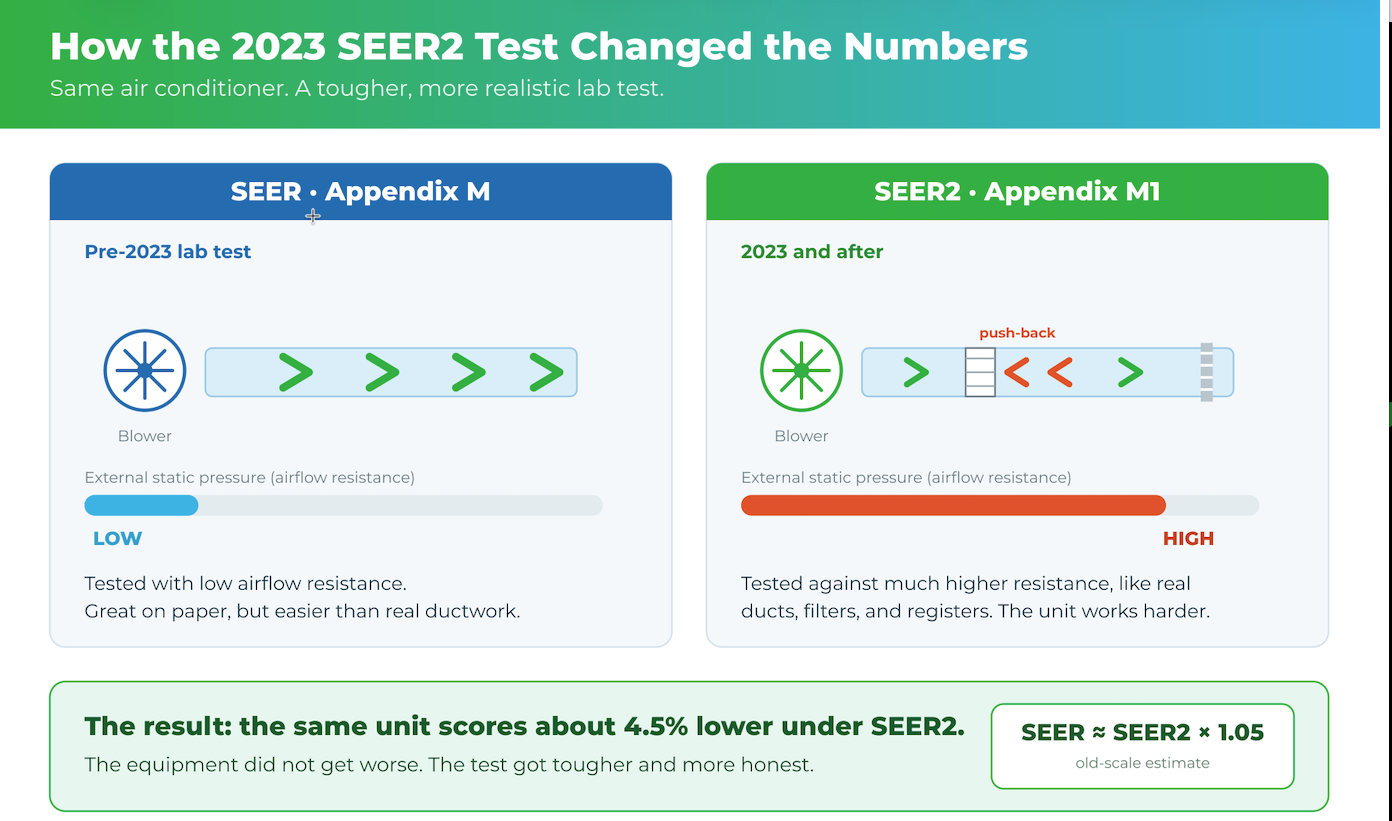
On January 1, 2023, the U.S. Department of Energy replaced SEER with an updated metric called SEER2. Every new central air conditioner and heat pump sold in the U.S. is now rated in SEER2. The change wasn’t cosmetic: the new “M1” test pushes air against much higher static pressure, closer to what real-world ductwork actually creates, so the test better reflects how systems perform once they’re installed in an actual home.
Here’s the catch that confuses a lot of shoppers: the same physical unit scores a slightly lower number under SEER2 than it did under the old SEER test. The equipment didn’t get worse. The test got tougher and more honest. As a rough rule of thumb:
SEER ≈ SEER2 × 1.05 (so an old 18 SEER unit is roughly 17 SEER2)
Here’s a quick cheat sheet for translating an older rating to today’s scale:
| If the old label said… | …it’s about this in SEER2 |
|---|---|
| 14 SEER | 13.4 SEER2 |
| 15 SEER | 14.3 SEER2 |
| 16 SEER | 15.2 SEER2 |
| 18 SEER | 17.2 SEER2 |
| 20 SEER | 19.1 SEER2 |
| 22 SEER | 21.0 SEER2 |
If you’re comparing a system you bought years ago to one you’re shopping for today, you’re often comparing two different scales. A 16 SEER unit from 2019 and a 16 SEER2 unit from 2026 are not the same. The 2026 unit is actually more efficient. When in doubt, compare SEER2 to SEER2.
What Is a Good SEER Rating?
There’s no single magic number, but here’s the simple way to think about it for 2026:
| Tier | SEER2 range | What it means for you |
|---|---|---|
| Standard | ~13.4–15 | Meets code and keeps the upfront cost down. A sensible pick in milder climates or if you won’t be in the home long. |
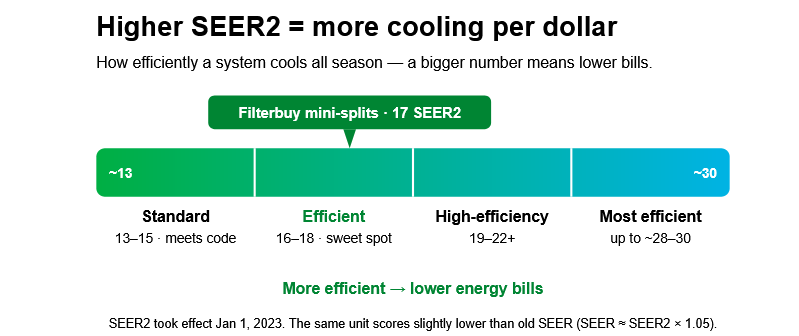
| Efficient Filterbuy mini-splits | ~16–18 | The sweet spot for most homes, with noticeably lower bills without paying for the top tier. Filterbuy’s mini-splits land here at 17 SEER2. |
| High-efficiency | ~19–22+ | Maximum savings for hot climates, high electric rates, or a forever home. The longer you stay, the more it pays off. |
| Mini-split territory | up to ~28–30 | The most efficient residential cooling you can buy, thanks to variable-speed technology. |
A quick reality check on those ranges: the legal minimum depends on where you live, since the DOE sets standards by region based on how much cooling a typical home needs.
The current federal minimum SEER2 ratings for split-system central air conditioners under 45,000 BTU look like this:
| Where you live | Lowest SEER2 you can install | Old-scale equivalent |
|---|---|---|
| North | 13.4 SEER2 | ~14 SEER |
| Southeast | 14.3 SEER2 | ~15 SEER |
| Southwest | 14.3 SEER2 + a peak-performance (EER2) requirement | ~15 SEER |
For split-system central air conditioners under 45,000 BTU, per U.S. Department of Energy standards effective January 1, 2023.
For split-system central air conditioners under 45,000 BTU, per U.S. Department of Energy standards effective January 1, 2023. See AHRI for the regional breakdown by state.
A couple of honest caveats to keep in mind: heat pumps follow a single national minimum rather than regional ones, and the way old “sell-through” inventory can still be installed differs by region. If you’re replacing a system, your installer should confirm exactly what’s compliant for your address.
Usually yes, though there is a catch you should know about. A higher-SEER system costs more upfront, and the energy savings need time to earn that money back. How fast depends on three things:
Your climate. The more you run your AC, the faster a high-SEER unit pays for itself. The savings that look modest in a mild climate become significant in a long, hot Southern summer.
Electricity prices. The higher your utility rate, the more each efficiency point is worth.
How long you’ll stay. If you’re moving in two years, chasing the maximum SEER rarely pencils out. If this is your forever home, it often does.
For many homeowners, a mid-to-upper-range SEER2 system hits the sweet spot, meaningfully more efficient than the legal minimum, without the steep premium of the absolute top tier.
Here’s the part the spec sheet leaves out, and it’s the advice our HVAC team gives most often: a high SEER rating only pays off if the system is sized and installed correctly.
A SEER number is earned in a controlled lab. In your actual home, two things can quietly erase that efficiency on paper:
Wrong size. Bigger is not better. An oversized system cools the air fast, then shuts off before it can pull out humidity, leaving your home cold and clammy, and short-cycling its way to a shorter lifespan. A right-sized system runs longer, gentler cycles and keeps you genuinely comfortable.
Sloppy installation. Leaky ducts, low refrigerant, or poor airflow can drag a 17 SEER2 system down to the real-world performance of a much cheaper one. Professional installation protects the efficiency you paid for.
SUGGESTED DRAFT, FOR DAVID CLARK TO APPROVE
“The biggest number on the box doesn’t guarantee the lowest power bill. I’ve watched oversized, high-SEER systems get beaten by a right-sized, mid-range unit that was installed correctly. Get the sizing and the ductwork right first, because that’s where your real savings actually live.”
David Clark, EPA-Certified HVAC Technician, Filterbuy HVAC Solutions
The takeaway: treat SEER as one important factor in a bigger decision, not the only scoreboard. The most efficient system on paper can still disappoint if it’s the wrong fit for your home.
If you’ve been reading about high SEER numbers and wondering how some systems reach the 20s and beyond, the answer is almost always ductless mini-splits.
Traditional central ACs largely run at one speed, either full blast or off. Mini-splits use variable-speed inverter compressors that ramp up and down to match exactly how much cooling a room needs at any moment. That steady, right-sized operation is precisely what the SEER test rewards, which is why mini-splits routinely post some of the highest efficiency ratings in residential HVAC. They also skip the ductwork entirely, sidestepping the duct losses that quietly waste energy in central systems.
For a lot of homes, that makes a mini-split the most efficient way to cool a space that the central system struggles with, like a garage, a bonus room, a sunroom, a converted attic, or an older home that never had ducts in the first place.
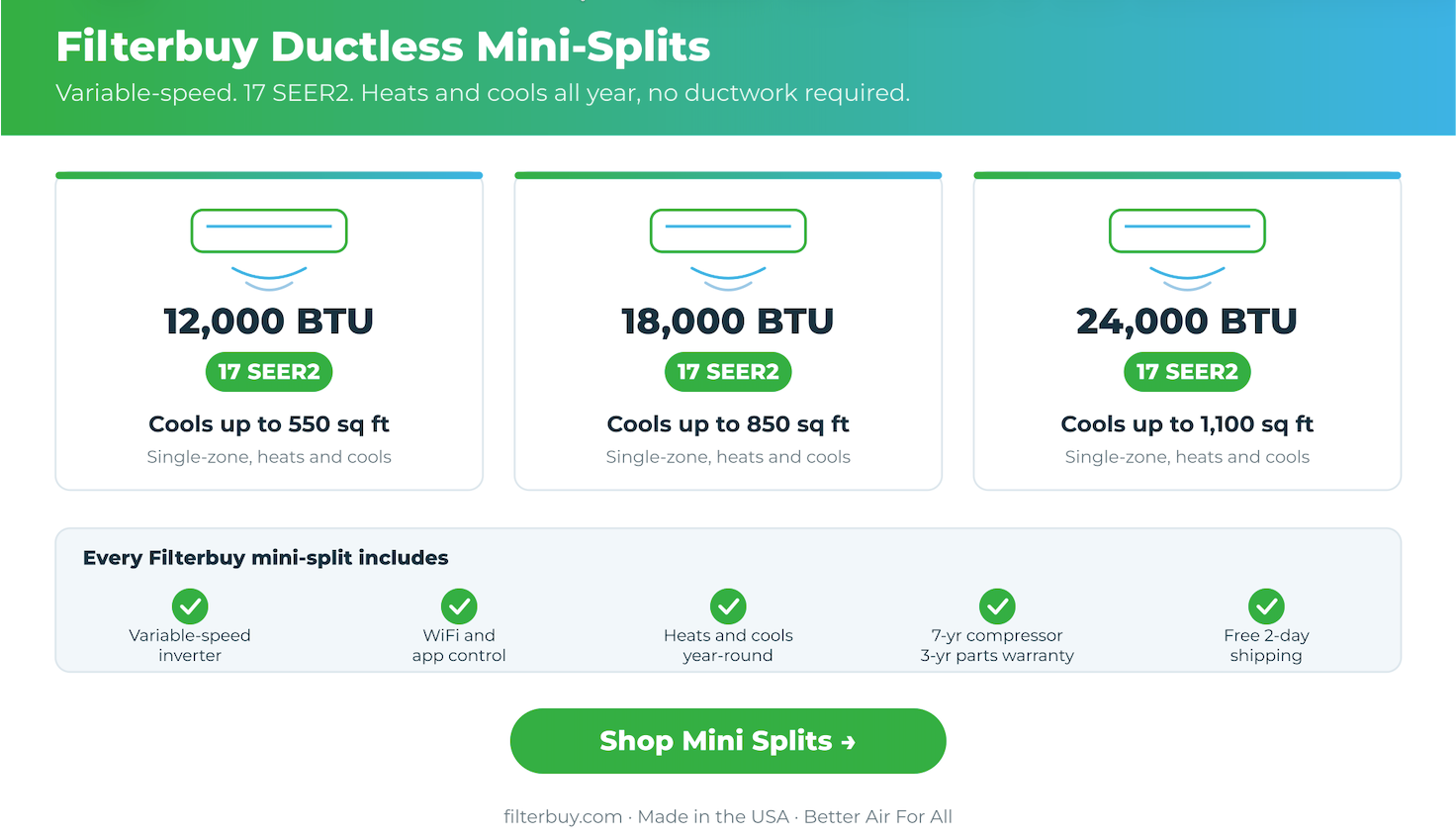
Filterbuy’s ductless mini-split systems are built around exactly this technology: variable-speed, 17 SEER2 units in 12,000, 18,000, and 24,000 BTU sizes that both cool and heat year-round. They come with a 7-year compressor and 3-year parts warranty, app-based control, and fast, free 2-day delivery, plus the same straightforward, no-runaround approach Filterbuy has brought to home air quality for years. If you’re weighing efficiency for a specific room or addition, a high-SEER2 mini-split is one of the simplest upgrades to get right.
What is a SEER rating in HVAC?
In HVAC, a SEER rating is the standard efficiency score for cooling equipment, meaning air conditioners and heat pumps. It tells you how much cooling the system delivers relative to the electricity it consumes over a season. Higher is more efficient.
What does 17 SEER2 mean?
A 17 SEER2 rating means the system produces 17 BTUs of cooling for every watt-hour of electricity it uses, measured under the current (post-2023) SEER2 test. It’s an efficient rating, comfortably above the federal minimum and typical of quality variable-speed and mini-split systems.
What is the difference between SEER and SEER2?
SEER2 is the updated version of SEER that took effect on January 1, 2023. It uses a more demanding, more realistic lab test, so the same unit shows a slightly lower number in SEER2 than it did in SEER. To compare an older rating to a new one, multiply the SEER2 figure by about 1.05 to estimate the old-scale equivalent.
Is a higher SEER rating always worth the extra cost?
Not always. A higher SEER system saves more energy, but it costs more upfront. It pays off fastest in hot climates, with high electricity rates, and when you plan to stay in the home long enough to recoup the difference. For shorter stays or mild climates, a mid-range rating is often the smarter buy.
What’s the minimum SEER rating allowed?
It depends on your region. As of 2023, the minimum is 13.4 SEER2 in the North and 14.3 SEER2 in the Southeast and Southwest for split-system central air conditioners under 45,000 BTU. The Southwest adds a separate peak-performance (EER2) requirement.
Do mini-splits have higher SEER ratings than central AC?
Often, yes. Because mini-splits use variable-speed inverter compressors and skip ductwork, they tend to post higher SEER2 ratings than comparable central systems, with some reaching the high 20s.
About the Author
Michelle Wan writes about home comfort, indoor air quality, and HVAC for Filterbuy, translating technical topics into plain-language guidance for homeowners.
About the Reviewer
David Clark is an EPA-certified HVAC technician, a graduate of the South Florida Academy of Air Conditioning, and President of Filterbuy HVAC Solutions. With more than a decade in the field, he has worked nearly every role in HVAC, from installation and service to dispatch, and reviewed this article for technical accuracy.
