July 14, 2026
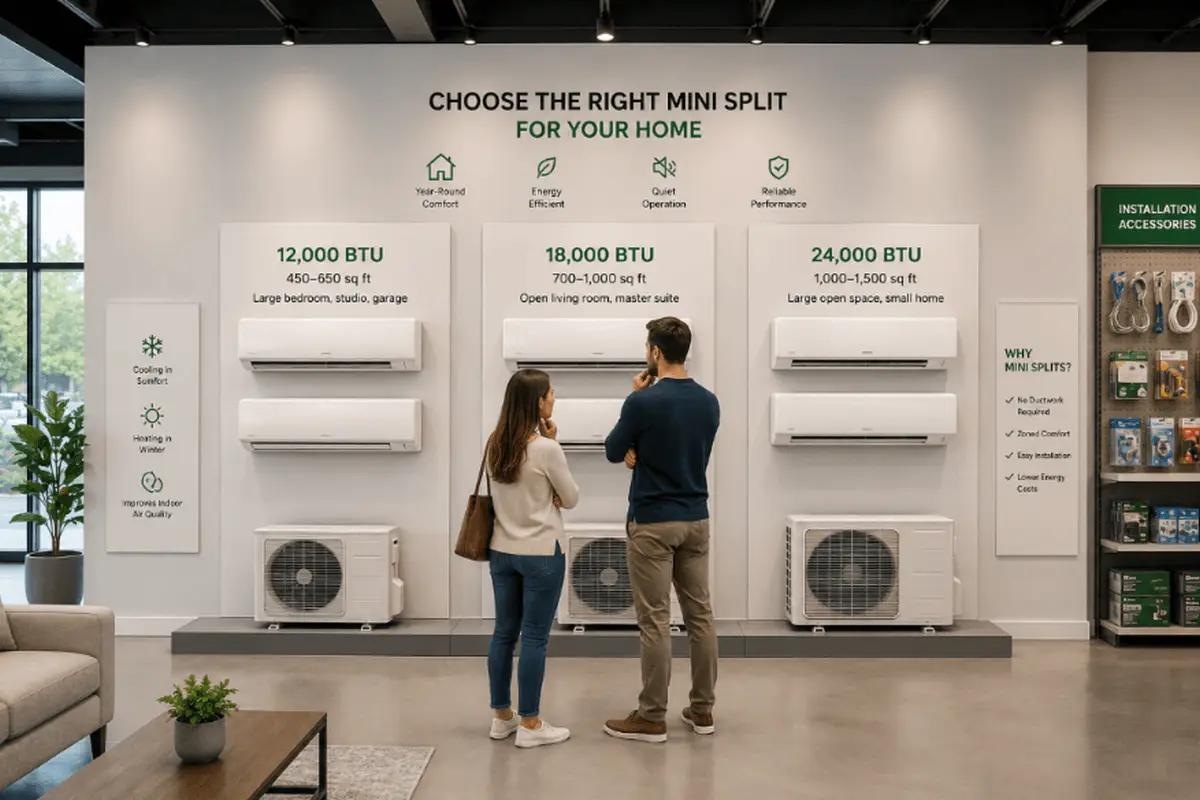
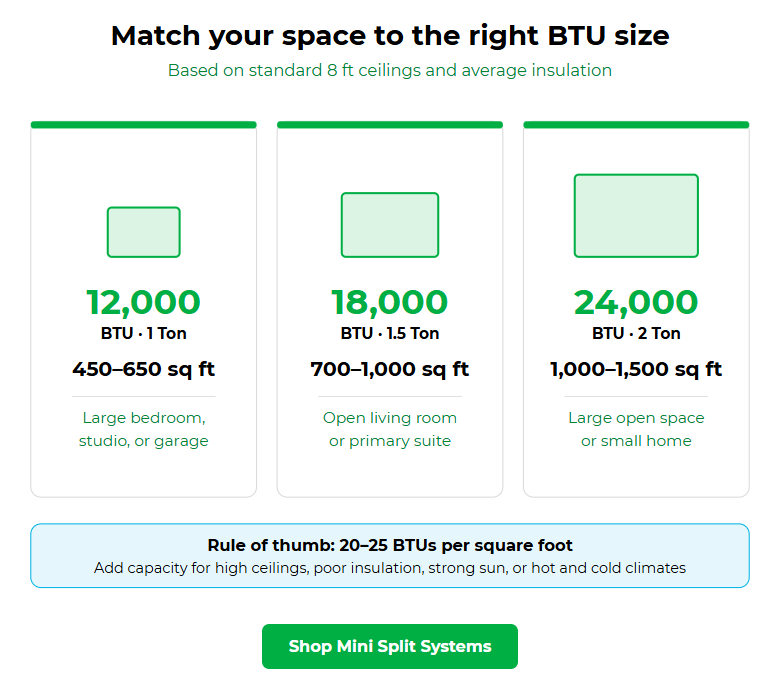
Most spaces need 20–25 BTUs per square foot — so a 12,000 BTU mini split covers about 450–650 sq ft, an 18,000 BTU unit covers 700–1,000 sq ft, and a 24,000 BTU unit covers 1,000–1,500 sq ft. Measure your room, multiply the square footage by 20–25, then add capacity for high ceilings, poor insulation, strong sun, or hot and cold climates.
12,000 BTU (1 Ton) — 450–650 sq ft · large bedroom, studio, or garage
18,000 BTU (1.5 Ton) — 700–1,000 sq ft · open living room or primary suite
24,000 BTU (2 Ton) — 1,000–1,500 sq ft · large open space or small home
Not sure which fits your room? Take the quick match quiz below and we’ll point you to the right size.
Answer a few quick questions and we’ll match you to the right mini split for your space.
You don't want a system that runs nonstop, but you also don't want one that blasts cold air for five minutes and shuts off. Getting the BTU size right matters more than most people realize.
BTU stands for British Thermal Unit, and it measures your mini split's cooling and heating capacity. Choose the right size, and you'll enjoy consistent comfort, lower energy bills, and a system that lasts years longer. Choose wrong, and you'll deal with humidity problems, temperature swings, and unnecessary wear on your equipment.
This guide breaks down exactly how to size a mini split for your space. Whether you're cooling a garage, a bedroom, or an open-concept living room, you'll know which system to choose by the end of this article.
Mini splits typically need 20–25 BTUs per square foot
12,000 BTU covers roughly 450–650 sq ft
18,000 BTU covers roughly 700–1,000 sq ft
24,000 BTU covers roughly 1,000–1,500 sq ft
Climate, insulation, ceiling height, and sun exposure all affect sizing
When in doubt, consult an HVAC professional from Filterbuy HVAC Solutions for a Manual J load calculation
BTU measures how much heat your system can remove from a room in one hour. A higher BTU number means more cooling power, but that doesn't always mean "better."
HVAC professionals use industry-standard Manual J load calculations to determine the right size for each space. These calculations account for your home's specific characteristics: insulation quality, window placement, ceiling height, and local climate.
Getting the size right delivers three major benefits:
Better humidity control. A properly sized system runs long enough to remove moisture from the air, preventing that sticky, clammy feeling.
Lower energy bills. Systems that cycle on and off efficiently use less electricity than oversized units that short-cycle.
Longer equipment life. When your mini split doesn't have to work harder than necessary, it lasts longer and needs fewer repairs.
| BTU Size | Coverage Area | Best For |
|---|---|---|
| 12,000 BTU | 450–650 sq. ft. | Large bedroom, studio, or garage |
| 18,000 BTU | 700–1,000 sq. ft. | Open living room or primary suite |
| 24,000 BTU | 1,000–1,500 sq. ft. | Large open space or small home |
Based on standard 8 ft ceilings and average insulation.
Start with the basics: measure your room's length and width, then multiply them together.
Example: A room that's 20 ft × 15 ft = 300 sq ft
For open concept spaces, measure the entire connected area. If your kitchen flows into your living room with no doors between them, treat it as one large space.
The standard guideline is 20–25 BTUs per square foot. This works for most spaces with typical conditions.
Using our 300 sq ft example:
300 sq ft × 20 BTU = 6,000 BTU (minimum)
300 sq ft × 25 BTU = 7,500 BTU (maximum)
This gives you a starting range before making adjustments.
Real rooms don't exist in a vacuum. Several factors affect how much cooling capacity you actually need:
High ceilings: Add 10–20% for ceilings above 8 ft. More air volume means more space to cool.
Poor insulation: Add 15–30% if your home is older or poorly insulated. Heat gain happens faster when insulation is inadequate.
Sun exposure: Add 10% for rooms with large windows or direct afternoon sun. South and west-facing rooms absorb more heat.
Kitchens: Add 4,000 BTUs. Appliances generate significant heat that your system needs to offset.
Hot climates: Add 15% if temperatures consistently exceed 90°F. Your system works harder when outdoor temperatures are extreme.
Cold climates: Add 20% for heating in regions where temperatures drop below 20°F. Heat pumps need extra capacity to maintain warmth in severe cold.
Let's revisit our 300 sq ft example with adjustments. If this room has 10 ft ceilings (+15%), poor insulation (+20%), and faces west (+10%), your calculation looks like this:
7,500 BTU × 1.45 = 10,875 BTU
In this case, a 12,000 BTU system would be appropriate.
A 12,000 BTU system handles single rooms and smaller spaces efficiently.
Best for:
Large bedrooms
Basements
Garages
Small apartments
Typical coverage: 450–650 sq ft
This size works well for spaces that don't have extreme temperature demands. It's also the most energy-efficient option for smaller areas, since it won't short-cycle or waste electricity cooling a space too quickly.
An 18,000 BTU system bridges the gap between single rooms and larger open areas.
Best for:
Open concept living rooms
Kitchen/living combinations
Large master suites
Coverage: 700–1,000 sq ft
Choose this size when you're cooling a space that's too large for a 12K unit but doesn't quite need the power of a 24K system. It's particularly effective in homes where the living room and kitchen share the same airflow.
A 24,000 BTU system delivers the highest cooling capacity for residential spaces.
Best for:
Large open spaces
Small homes
Multi-room areas with open layouts
Coverage: 1,000–1,500 sq ft
This size handles the demands of entire living areas or small homes with open floor plans. If you're replacing central air conditioning with a mini split, this capacity level often makes the most sense.
Choosing the wrong BTU size creates problems that affect both comfort and cost.
Too Small:
Your system runs constantly, trying to reach the set temperature but never quite making it. This leads to:
Higher wear and tear on components
Increased energy bills from nonstop operation
Uncomfortable temperature fluctuations
Shortened equipment lifespan
Too Large:
Your system cools the room too quickly and shuts off before completing a proper cycle. This causes:
Short cycling that wastes energy
Poor humidity removal (the air feels cold but clammy)
Uneven temperatures throughout the space
Increased long-term inefficiency
Both scenarios cost you money and comfort. The right size from Filterbuy makes all the difference.
Most homeowners start with a single-zone system where one outdoor unit is connected to one indoor unit. This setup works perfectly for cooling a specific room or area.
Multi-zone systems connect one outdoor unit to multiple indoor units. If you're considering this option:
Add up the BTU requirements for each indoor unit
Choose an outdoor unit that exceeds the total by roughly 20%
Understand that larger or segmented homes may need multiple outdoor units instead of one large multi-zone system
For example, if you need a 12,000 BTU unit for a bedroom and an 18,000 BTU unit for the living room, your total indoor load is 30,000 BTU. Your outdoor unit should be rated for at least 36,000 BTU to handle both zones effectively.
Modern mini splits use inverter technology, which changes how the system operates compared to traditional fixed-speed units.
Here's what that means for you:
Variable-speed compressors adjust output based on demand. Instead of turning completely on or off, the system ramps up or down gradually.
Smoother temperature control eliminates the temperature swings that happen with traditional systems.
Better humidity management comes from longer, more consistent run times.
Reduced energy waste happens because the system only uses the power it needs at any given moment.
Longer system life results from less stress on components.
Inverter technology doesn't eliminate the need for proper sizing, but it does mean small sizing errors won't cause the dramatic problems they would with older systems. A well-sized inverter mini split operates more efficiently and comfortably than an oversized traditional system ever could.
Now that you understand BTU sizing, you're ready to make an informed decision. Look for systems that offer:
High efficiency ratings (SEER 17+)
R32 refrigerant for better environmental performance
Strong warranties (5 years or more)
Fast, reliable shipping
Support from trusted indoor air quality experts
Whether you need a 12,000 BTU system for your garage, an 18,000 BTU unit for your living room, or a 24,000 BTU system for your open-concept home, the right size from Filterbuy makes all the difference in comfort, efficiency, and long-term performance.
Choosing the right BTU size ensures comfort year-round, lower energy bills, better humidity control, and a longer system lifespan.
Start by measuring your space carefully. Account for real-world conditions like insulation quality, ceiling height, and climate. Use the sizing chart and adjustment factors in this guide to narrow down your options.
If you're still unsure, reach out to a professional from Filterbuy HVAC Solutions for a Manual J load calculation. This detailed assessment accounts for every variable in your specific situation and eliminates guesswork.
The investment you make in proper sizing pays dividends for years to come.
Typically 450–650 sq ft under standard conditions with 8 ft ceilings and average insulation.
An 18,000 or 24,000 BTU system depending on layout, insulation, and climate. Use the adjustment factors in this guide to determine which size fits your specific situation.
No. Oversizing causes short cycling and poor humidity control. Your system won't run long enough to remove moisture from the air, leaving your space feeling clammy even when it's cool.
Most spaces require 20–25 BTUs per square foot before adjustments. Add more capacity for high ceilings, poor insulation, extreme climates, or rooms with high heat loads like kitchens.
Yes. Higher ceilings increase total air volume and require more BTUs. Add 10–20% to your base calculation for ceilings above 8 ft.
Yes, but cold climates may require additional BTU capacity and proper heat pump ratings. Look for systems rated for low-temperature operation if you live in an area with harsh winters.