filterbuy
 

Shop by

Home
>
resources
>
how to guides and hvac maintenance
>
How to Check If Your Filter Fits Properly (and Why It Matters)

How to Check If Your Filter Fits Properly (and Why It Matters)

On this page

Even a filter with the right MERV rating can't protect your home if it doesn't fit. Gaps as small as 1/8 of an inch around a filter's edges create bypass channels where unfiltered air flows directly into your ductwork — and from our quality control testing across more than 600 filter sizes, we've found that improper fit is one of the most overlooked causes of recurring dust buildup and premature HVAC strain. It's a problem our customer service team hears about daily from homeowners who didn't realize their filter was the wrong size until the damage was already adding up.

Below, we'll show you a simple hands-on check you can do right now at your return vent, explain the fit issues we see most often from our experience manufacturing filters for over two million households, and walk you through exactly how to fix them — so the filter you're counting on is actually doing its job.

TL;DR: Quick Answers

How to Check If Your Filter Fits Properly (and Why It Matters)

Check your filter's fit with three quick tests at your return vent:

  1. Press test — Push the center of the installed filter. It should feel snug with no shifting or rattling.
  2. Edge test — Run your fingers along all four sides. You should not be able to slide a fingertip into any gap.
  3. Light test — Shine a flashlight behind the frame. No light should pass around the edges.

Why it matters: A filter that doesn't seal against its housing lets unfiltered air bypass the media entirely. From our experience manufacturing over 600 filter sizes and serving more than 2 million households, gaps as small as 1/8 inch create bypass channels that allow dust, allergens, and particulates to flow straight into your ductwork, regardless of your filter's MERV rating.

The real-world cost of a poor fit:

The fix: Measure the interior dimensions of your filter housing to the nearest 1/8 inch. Match to the correct nominal size. If standard sizes don't fit, a custom-sized filter eliminates the problem permanently. Perform a fit check with every new filter install.

Top Takeaways

The Quick Fit Test You Can Do Right Now

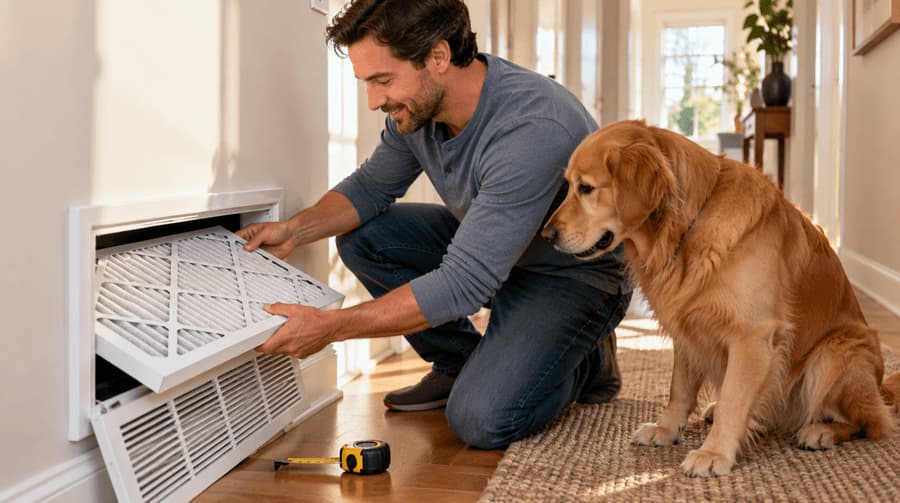
Start at your return vent or filter housing with the filter installed. Gently press on the center of the filter — it should feel snug against the frame with minimal movement in any direction. Next, run your fingers along all four edges where the filter meets the housing. If you can slide a finger into any gap, or if the filter shifts, rattles, or bows when your system kicks on, you have a fit problem that's allowing unfiltered air into your ductwork right now.

Here's what a properly fitted filter looks and feels like: the cardboard or plastic frame sits flush against the interior walls of the housing, there's no visible light passing around the edges when you shine a flashlight behind it, and the filter stays firmly in place without sagging or buckling under airflow pressure. If yours doesn't pass all three of those checks, keep reading — the fix is usually simpler than you'd expect.

Why Your Filter Might Not Be Fitting Correctly

From our experience manufacturing filters across more than 600 size variations, fit problems almost always come down to one of three things.

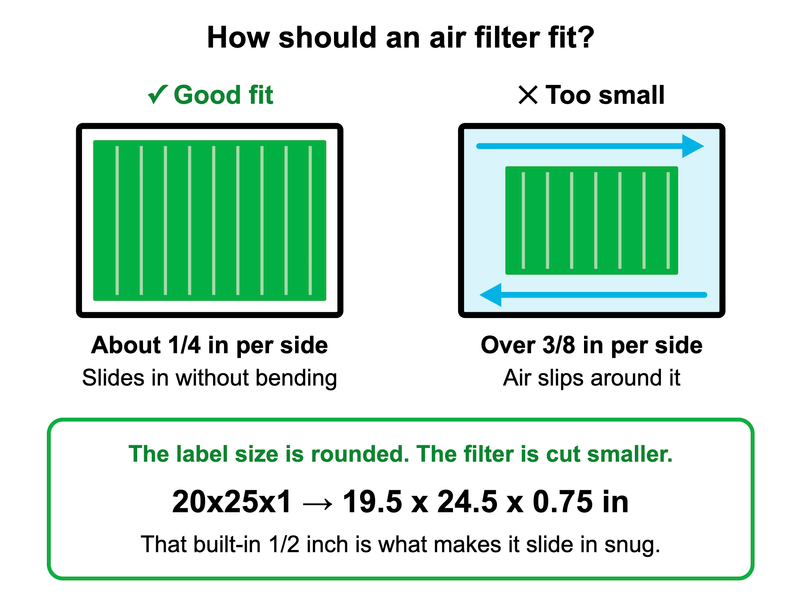
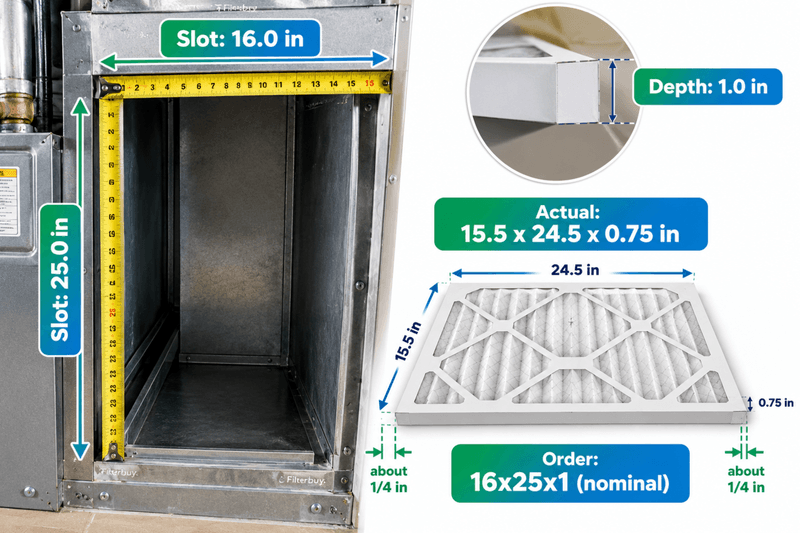
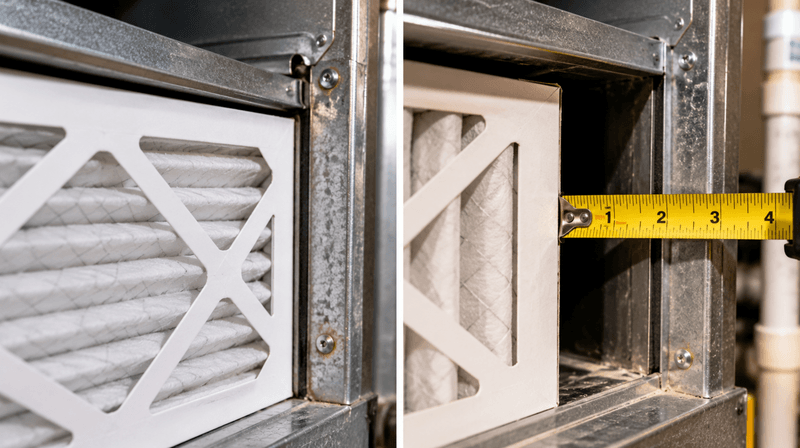
The first and most common is a sizing mismatch between the nominal size printed on your filter and the actual dimensions of your filter housing. Most air filters are labeled using nominal (rounded) sizes — so a filter labeled 20x25x1 may actually measure closer to 19.5x24.5x0.75 inches. That rounding is standard across the industry, but it means you can't always trust the numbers on the packaging without verifying them against your actual housing dimensions. Grab a tape measure and check the interior length, width, and depth of your filter slot to confirm you're working with the right size.

The second is a damaged or warped filter housing. Over time, metal filter tracks can bend, plastic clips can break, and duct connections around the housing can loosen — all of which create uneven gaps that even a correctly sized filter can't seal against. This is especially common in older HVAC systems or homes where the return vent has been painted over or improperly resealed after maintenance.

The third is using a filter with the wrong depth for your system. A one-inch filter installed in a housing designed for a four-inch media filter will leave inches of open space behind it, dramatically reducing filtration efficiency and allowing air to bypass the filter entirely. Our customer service team fields this question regularly from homeowners who inherit an HVAC system in a new home and don't realize their housing supports — and needs — a deeper filter.

How to Fix Common Filter Fit Issues

If your filter is the wrong nominal size, the solution is straightforward: measure your housing's interior dimensions to the nearest 1/8 inch and match those measurements to the correct filter size. At Filterbuy, we manufacture over 600 standard sizes and offer custom sizing for non-standard housings — because we've learned from serving more than two million households that "close enough" doesn't cut it when it comes to proper filtration.

For damaged housings, inspect the tracks or rails your filter slides into. Bent metal tracks can often be straightened with pliers, and worn-out sealing strips can be replaced inexpensively at any hardware store. If the housing itself is cracked or structurally compromised, it may be time to have an HVAC technician replace the filter rack — a relatively minor repair that makes a significant difference in your system's performance.

If you're dealing with a depth mismatch, check your system's documentation or measure the depth of the housing cavity. Systems designed for four- or five-inch filters deliver better filtration and longer service life between changes, so switching to the correct depth isn't just a fit fix — it's an upgrade to your home's air quality.

What Happens When You Ignore a Poor Filter Fit

A filter that doesn't seal properly is a filter that isn't filtering. Unfiltered air carrying dust, pet dander, pollen, and other particulates bypasses the media and circulates freely through your ductwork, coating your evaporator coil, clogging your blower motor, and settling on every surface in your home. According to the U.S. Department of Energy, a dirty or improperly installed filter can increase your HVAC system's energy consumption by 5% to 15% — and from what we've seen across millions of customer interactions, the compounding effects of bypass air on system components often lead to repair calls that could have been avoided entirely.

Beyond energy costs, a poor filter fit accelerates wear on parts that are expensive to replace. Your evaporator coil, blower motor, and heat exchanger all rely on filtered airflow to function efficiently. When particulates bypass your filter and coat these components, your system works harder, runs longer, and breaks down sooner — turning a simple fit issue into a costly repair bill.

Keep Your Filter Working as Hard as You Do

Checking your filter's fit is one of the easiest and most impactful things you can do to protect your HVAC system, lower your energy costs, and keep your family breathing cleaner air. Make it part of your routine every time you swap in a new filter: confirm the size, check the seal, and verify there are no gaps. If you're unsure about the right size for your system, Filterbuy's sizing resources and customer support team are here to help you find the exact match — because the best filter in the world only works if it fits.

Infographic showing how to check if your filter fits propertly.

"After manufacturing over 600 filter sizes and helping more than two million households get their air quality right, we can tell you that the number one issue we see isn't choosing the wrong MERV rating — it's installing a filter that doesn't actually seal inside the housing, and most homeowners don't catch it until their energy bills spike or their system starts struggling."

7 Essential Resources to Make Sure Your Air Filter Fits Right and Protects Your Home

Don't take your filter fit for granted. After manufacturing filters for over a decade and helping more than two million households breathe easier, we know that the right information makes the difference between a filter that actually protects your family and one that's just taking up space. We've pulled together the most valuable resources from our own manufacturing expertise and the government agencies we trust most — so you have everything you need to get your filter fit right the first time.

1. Learn Exactly How to Measure Your Filter Housing for a Perfect Fit

Here's something most homeowners don't realize until they've already ordered the wrong size: the number printed on your old filter may not match what your system actually needs. Our step-by-step measuring guide — built from the sizing questions our customer service team answers every single day — walks you through measuring your filter slot's interior dimensions, explains why nominal and actual sizes aren't the same thing, and shows you when a custom-sized filter is the smartest move for your home.

Source: Filterbuy — How to Measure Your Air Filter https://filterbuy.com/resources/air-filter-basics/measure-air-filter/

2. Find Your Filter Size Fast with a Complete Residential Size Chart

We manufacture over 600 filter sizes across our American facilities, and we've organized them all into one easy-to-scan reference chart. Once you've got your measurements, cross-reference them here to find your exact match — with clear nominal vs. actual dimensions straight from our production floor, so there's zero guesswork when you place your order.

Source: Filterbuy — Standard and Common Air Filter Sizes https://filterbuy.com/resources/air-filter-basics/air-filter-sizes/

3. Understand What the EPA Recommends for Home Air Filtration

We're obsessed with air quality, and so is the EPA. Their official consumer guide explains how a properly fitted HVAC filter works alongside ventilation and source control to reduce the indoor air pollutants you can't see, but your family is breathing every day. It includes specific guidance on ensuring a snug filter fit with no gaps around the edges — a recommendation we couldn't agree with more — and suggests replacement every 60 to 90 days based on your household conditions.

Source: U.S. Environmental Protection Agency — Guide to Air Cleaners in the Home https://www.epa.gov/indoor-air-quality-iaq/guide-air-cleaners-home

4. See How a Poorly Fitting Filter Drives Up Your Energy Bills

A filter that doesn't seal properly isn't just an air quality problem — it's a money problem. The U.S. Department of Energy confirms what we see across millions of customer interactions: dirty or improperly installed filters force your HVAC system to work harder, increasing energy consumption and accelerating wear on expensive components like your evaporator coil and blower motor. Their maintenance guide lays out exactly what to check and when.

Source: U.S. Department of Energy — Air Conditioner Maintenance https://www.energy.gov/energysaver/air-conditioner-maintenance

5. Follow ENERGY STAR's Monthly Filter Check Routine

Protecting your home's air quality isn't a set-it-and-forget-it task. ENERGY STAR recommends checking your filter every month during heavy-use seasons and replacing it at a minimum every three months. Their efficiency guide breaks down how a clean, properly seated filter prevents the kind of dust and dirt buildup that leads to costly system failures — the exact problems we help homeowners avoid every day.

Source: ENERGY STAR — Heat & Cool Efficiently https://www.energystar.gov/saveathome/heating-cooling

6. Choose the Right MERV Rating Without Restricting Your System's Airflow

Getting the fit right is only half the equation — your filter also needs the right MERV rating to match your home's air quality needs and your system's airflow capacity. ASHRAE's filtration FAQ explains the rating system they developed under Standard 52.2, recommends minimum filtration levels for residential systems, and addresses a concern we hear regularly from customers: how to capture more particles without choking your HVAC's airflow. At Filterbuy, we offer MERV 8, MERV 11, and MERV 13 options so you can find that balance for your home.

Source: ASHRAE — Filtration and Disinfection FAQ https://www.ashrae.org/technical-resources/filtration-and-disinfection-faq

7. Know Why "Close Enough" Filter Sizing Leads to Real HVAC Problems

We say it all the time on our manufacturing floor: close enough isn't good enough when it comes to filter fit. Carrier — one of the most recognized names in HVAC — reinforces exactly why. An undersized filter lets contaminants bypass filtration entirely, an oversized filter bends and restricts airflow, and both scenarios shorten your equipment's life and put your family's air quality at risk. Their sizing guide is a solid second opinion on why precise measurements matter.

Source: Carrier — Air Filter Sizes: What Size Air Filter Do I Need? https://www.carrierathome.com/blogs/air-filters/air-filter-sizing

The Numbers Behind Why Proper Filter Fit Matters

We've spent over a decade on the manufacturing floor and in conversations with more than two million households. The patterns we see in our own customer data consistently line up with what the leading government agencies are reporting. These three statistics reflect the real-world problems our customer service team troubleshoots every day.

1. Indoor air pollution is 2 to 5 times higher inside your home than outside — and can spike to 100 times higher.

The EPA has documented this regardless of whether you live in a rural neighborhood or an industrial corridor. Most homeowners we talk to are surprised. They assume their home is a safe haven from pollution.

Here's the reality:

It's why we manufacture over 600 sizes rather than forcing homeowners to settle for "close enough." Every filter is engineered to sit flush inside the housing — because clean air starts with a proper seal.

Source: U.S. Environmental Protection Agency — Indoor Air Quality https://www.epa.gov/report-environment/indoor-air-quality

2. A dirty or improperly installed filter can increase your HVAC system's energy consumption by 5% to 15%.

The U.S. Department of Energy confirmed what our teams have seen for years. But here's an insight most sources won't tell you — this applies equally to filters that don't fit, not just filters that are dirty.

What we've observed across millions of customer interactions:

That real-world pattern is exactly why we invested in custom sizing capabilities alongside our 600-plus standard sizes.

Source: U.S. Department of Energy — Air Conditioner Maintenance https://www.energy.gov/energysaver/air-conditioner-maintenance

3. Heating and cooling account for 52% of the average U.S. household's annual energy consumption.

The U.S. Energy Information Administration found that space heating and air conditioning represent the single largest share of home energy use. More than lighting, water heating, appliances, and electronics combined.

That number hits differently when you've manufactured filters for as many homes as we have:

It's why we don't treat filter sizing as an afterthought. From standard sizes to custom-cut options, every dimension is verified against real housing specifications — because we know what's at stake when the fit is off.

Source: U.S. Energy Information Administration — Use of Energy in Homes https://www.eia.gov/energyexplained/use-of-energy/homes.php

Final Thought — The Most Overlooked Step in Home Air Quality Is the One That Takes Five Minutes

Here's our honest take after manufacturing air filters for over a decade and helping more than two million households: the industry has spent years educating homeowners about MERV ratings, replacement schedules, and indoor air quality. All of that matters. But almost no one talks about the step that comes before any of it.

If your filter doesn't fit, nothing else you do makes a difference.

We see it every day in our customer service conversations. A homeowner invests in a high-quality MERV 13 filter, installs it on schedule, and assumes their family is protected. Meanwhile, a quarter-inch gap along one edge is quietly letting unfiltered air bypass the media entirely — carrying dust, allergens, and particulates straight into every room of the house. The filter is doing its job. The fit isn't letting it.

What frustrates us most is how preventable this is. A five-minute fit check catches the issue before it becomes:

It costs nothing. It requires no tools. And in our experience, it's the single most impactful thing a homeowner can do to make sure the money they spend on filtration is actually working.

This is also why we carry over 600 filter sizes and offer custom dimensions. We don't do it because it's convenient for us — it's the opposite:

"Close enough" is the silent reason most filter performance falls short.

Our belief is simple. You shouldn't have to be an HVAC expert to breathe clean air in your own home. You just need three things:

  1. A filter that fits.
  2. Installed correctly.
  3. Replaced on a regular schedule.

Get those right, and you're already ahead of the majority of homeowners — and your family, your HVAC system, and your energy bills will all be better for it.

You're the one protecting your home. We're here to make sure the filter you're counting on is actually doing its job.

Your Next Steps — Get Your Filter Fit Right Today

You know what to look for, why it matters, and what's at stake. Here's exactly what to do next.

Step 1: Do the Five-Minute Fit Check Right Now

Head to your return vent or filter housing and check three things:

If your filter shifts, rattles, or shows visible gaps, you have a fit problem.

Step 2: Measure Your Filter Housing

Grab a tape measure and record the interior length, width, and depth to the nearest 1/8 inch. Don't rely on the size printed on your old filter. It may be wrong. Write your measurements down and keep them for future reference.

Step 3: Match Your Measurements to the Right Size

Compare your measurements against Filterbuy's complete size chart:

Step 4: Choose the Right MERV Rating

Select based on your household's needs:

Step 5: Set a Replacement and Fit Check Schedule

A properly fitting filter only works if it's replaced on time:

Step 6: Reach Out If You Need Help

Not sure about your size, MERV rating, or whether you need a custom filter? We've helped more than two million households find the right fit.

Getting your filter fit right is one of the simplest ways to protect your HVAC system, lower your energy costs, and keep your family breathing cleaner air. Take the first step today.

FAQ on "How to Check If Your Filter Fits Properly (and Why It Matters)"

How do I know if my air filter fits properly?

A: We walk homeowners through this exact check every day. It comes down to three tests you can do in under a minute:

If your filter moves, rattles, or shows light leaks, the seal is compromised. After manufacturing over 600 sizes and troubleshooting fit issues with more than two million households, most failures trace back to three things:

  1. A nominal sizing mismatch.
  2. A wrong filter depth.
  3. A warped or damaged housing.

The good news — all three are fixable once you know what you're dealing with.

What happens if my air filter doesn't fit correctly?

A: This is the question our customer service team answers more than almost any other — usually after a homeowner has been dealing with the consequences for months. A poor fit creates bypass channels where unfiltered air skips the media entirely.

The downstream effects we see firsthand:

A problem that starts as a small gap becomes an expensive repair when left unchecked.

Why does my air filter keep sliding or falling out of the housing?

A: In over a decade of manufacturing and fielding customer calls, this is almost always a sizing mismatch. The filter is simply too small for the housing.

What typically happens:

The fix is straightforward. Measure the interior length, width, and depth of your housing to the nearest 1/8 inch. Match those dimensions to the correct nominal size. If your measurements land between standard sizes — which happens more often than most people expect — our custom sizing capability lets us manufacture a filter to your exact specifications. We built it specifically because we kept hearing from homeowners stuck between two standard sizes with no good option.

Is it okay if there's a small gap around my air filter?

A: There's an important distinction here that most resources don't explain clearly.

What's normal:

What's not normal:

From our quality control testing across hundreds of size variations, once gaps exceed that built-in tolerance, filtration efficiency drops significantly — even with a premium MERV 13 filter installed. The media can only clean the air that actually passes through it. Every bit of bypass undermines the investment.

How often should I check my air filter's fit?

A: Make a fit check part of every filter change. It adds less than a minute. Beyond that, inspect monthly during your heaviest usage months in summer and winter.

Here's something we've noticed from years of customer feedback that most guides leave out — filters can shift after installation:

Warning signs to watch for:

If the fit keeps failing after repeated installations, inspect your housing tracks for bends or damage. A $5 fix on a bent track or worn sealing strip can prevent hundreds of dollars in wasted energy and unnecessary component strain.

Stop Guessing Whether Your Filter Fits — Find Your Perfect Match Today

Now that you know how to check your filter's fit and why it matters, take the next step and find the exact size your system needs at Filterbuy.com. With over 600 standard sizes, custom sizing options, and a customer support team that's helped more than two million households get their fit right, we make it easy to protect your home's air quality, your HVAC system, and your family.

An image of 20x20x5 Filterbuy air filters in multiple colors (gray, blue, yellow, and white) neatly displayed on a kitchen counter.