Heat pump installation costs can range from $4,000 to over $20,000, and most online guides just throw out numbers without explaining why. At Filterbuy, we've seen the real invoices across thousands of installations, and here's what we've learned: the biggest cost swings almost always come down to three things most homeowners don't think about until they're already deep into a quote: system type, ductwork condition, and whether you're taking full advantage of available rebates.
We built this guide from our field experience, not recycled data. You'll get a clear breakdown of what drives pricing for air-source, mini-split, and geothermal systems, what labor and ductwork modifications actually cost, and which federal tax credits and local incentives can significantly reduce your out-of-pocket investment. No vague ranges, no filler, just the information you need to walk into any HVAC quote with confidence.
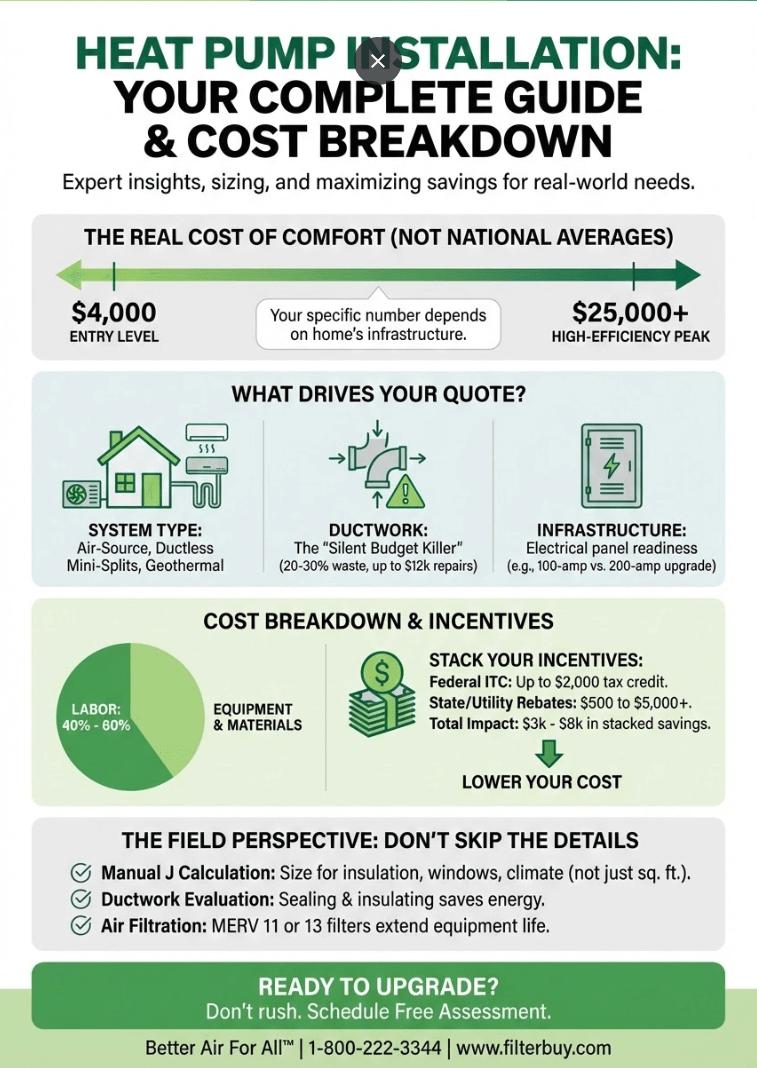
Short answer: Most homeowners pay between $4,000 and $25,000, but the real number depends on your specific home, not national averages.
What actually drives the cost:
System type — Air-source ($4,000–$8,000), ductless mini-split ($3,500–$18,000), geothermal ($15,000–$30,000+)
Ductwork condition — Leaky or damaged ducts can add $1,500–$12,000 to the project
Electrical panel readiness — Older 100-amp panels may need a 200-amp upgrade
System sizing — Properly matched systems save money; improperly sized ones cost more over time
What most people don't realize: The sticker price is rarely what you'll pay. Federal tax credits (up to $2,000), state rebates, utility incentives, and manufacturer promotions typically reduce out-of-pocket costs by $3,000–$8,000 when stacked together.
Filterbuy's take from the field: After thousands of installations, we've found that the biggest cost swings almost always trace back to what's behind the walls—not what's on the spec sheet. A proper in-home assessment, Manual J load calculation, and ductwork evaluation before quoting is the only way to give homeowners a number they can trust.
Three overlooked factors drive most of your costs. System type, ductwork condition, and electrical panel readiness. Know these before you request a quote.
You won't pay sticker price. Federal credits, state rebates, utility incentives, and manufacturer promotions stack together, often reducing out-of-pocket cost by $3,000 to $8,000 or more. Not applying for every available program is the most expensive mistake we see.
Sizing determines everything. Over 90% of households can save with a heat pump—but only when it's properly matched to the home. No Manual J load calculation? No guarantee of savings.
Ductwork is the silent budget killer. Leaky ducts waste 20–30% of your conditioned air. A premium system with neglected ducts performs like a mid-range one. It's the upgrade most contractors skip. We never do.
One extra week of research pays for itself. Confirm your rebates on DSIRE. Verify your equipment on the DOE lookup tool. Compare detailed written quotes—not just bottom-line numbers. That week can save you thousands.
Not every heat pump installation carries the same price tag, and from what we've seen across thousands of jobs at Filterbuy.com and Filterbuy HVAC Solutions, the variance usually comes down to a few core factors working together.
Home size and layout are the starting point. A 1,200-square-foot ranch home with a simple floor plan requires far less equipment capacity and less labor than a 3,000-square-foot multi-story home with complex zoning needs. In our experience, homeowners are often surprised by how much square footage and ceiling height influence the tonnage their system requires, which directly impacts equipment cost.
Climate zones matter just as much. A heat pump installed in the mild Southeast performs differently than one rated for sub-zero temperatures in the Northeast or Midwest. Homes in colder climates typically need cold-climate heat pumps or dual-fuel systems, which carry a higher upfront cost but deliver year-round efficiency that standard systems can't match.
Existing infrastructure is the factor most homeowners overlook. If your home already has compatible ductwork and a properly sized electrical panel, installation is more straightforward. But if your ducts need sealing, resizing, or replacing, or your electrical panel needs an upgrade to handle a heat pump's requirements, those additions can shift the budget significantly. Our install teams flag these issues during the in-home assessment, so there are no surprises on installation day.
Choosing the right system type is one of the biggest pricing decisions you'll make. Here's how the three main options compare based on what we typically see in the field.
Air-source heat pumps are the most common choice for residential installations. They transfer heat between indoor and outdoor air, work well in moderate to cold climates, and generally fall in the $4,000 to $8,000 range, including installation. They're the most budget-friendly option and the easiest to install, especially when existing ductwork is in good shape.
Ductless mini-split heat pumps are ideal for homes without ductwork, room additions, or spaces that need independent temperature control. Each indoor unit connects to an outdoor compressor, so you're only conditioning the rooms you're actually using. A single-zone mini-split installation typically runs $3,500 to $6,000, while whole-home multi-zone setups with four or more indoor heads can reach $12,000 to $18,000. We often recommend mini-splits for older homes where adding ductwork would be impractical or cost-prohibitive.
Geothermal (ground-source) heat pumps use the stable temperature underground to heat and cool your home with exceptional efficiency. They're the highest-performing option by far, but they also carry the highest upfront cost—typically $15,000 to $30,000 or more, depending on drilling or trenching requirements. The trade-off is dramatically lower operating costs and a system lifespan that can exceed 25 years. From our perspective, geothermal makes the most financial sense for homeowners who plan to stay in their home long-term and want the lowest possible energy bills.
Labor is a significant portion of any heat pump installation, and it's worth understanding what that line item covers. Based on our project data, labor typically accounts for 40% to 60% of the total installation cost, and it varies depending on the complexity of the job.
A straightforward swap replacing an existing heat pump with a similarly sized unit using the same ductwork and electrical connections is the most affordable installation scenario. Our crews can usually complete these in a single day.
More involved installations include jobs that require new refrigerant line sets, electrical panel upgrades from 100-amp to 200-amp service, thermostat wiring, or structural modifications for equipment placement. Each of these adds time and skilled labor to the project. We've found that being transparent about these potential add-ons upfront is something homeowners consistently appreciate, because it eliminates the "hidden cost" frustration that gives the HVAC industry a bad reputation.
Here's something we tell every homeowner during a consultation: your ductwork can make or break your heat pump's performance and your installation budget.
If your existing ducts are properly sized, well-sealed, and in good condition, you're in great shape; no additional work is needed. But in our experience, a significant number of homes we assess have ductwork issues that would compromise a new heat pump's efficiency if left unaddressed. Leaky ducts alone can waste 20% to 30% of the conditioned air your system produces, which means you'd be paying for a high-efficiency heat pump that's performing like a mid-range unit.
Duct sealing and insulation is the most common fix, typically running $1,500 to $3,000. Partial duct modification or resizing to match a new system's airflow requirements can range from $2,000 to $5,000. Full ductwork installation in a home that currently has none, common when switching from baseboard heat or radiators, can add $5,000 to $12,000 or more, depending on home size and accessibility.
We always recommend addressing ductwork issues during installation rather than after. It's more cost-effective to do it as part of a single project, and it ensures your new heat pump delivers the efficiency and comfort it was designed for from day one.
This is where the real math changes. The sticker price of a heat pump installation is rarely what you'll actually pay out of pocket, and we make it a point to help every Filterbuy HVAC Solutions customer identify every dollar of savings available to them.
The federal Investment Tax Credit (ITC) currently offers homeowners up to $2,000 in tax credits for qualifying heat pump installations under the Inflation Reduction Act. This applies to air-source heat pumps that meet Energy Star efficiency requirements, and most of the systems we install qualify.
State and local utility rebates vary widely but can add another $500 to $5,000 or more in savings depending on where you live. Some states offer enhanced incentives for low- and moderate-income households that can cover a substantial portion of the total project cost. Our team stays current on available programs in every region we serve so we can point you to the right applications before your installation is scheduled.
Manufacturer rebates are another layer of savings that many homeowners miss. Equipment manufacturers periodically offer seasonal promotions, and because Filterbuy HVAC Solutions works directly with top-tier brands, we can let you know when those windows open.
When you stack federal credits, state rebates, and manufacturer promotions together, it's not uncommon to see $3,000 to $8,000 or more come off the total cost of a heat pump installation. That's the kind of difference that can move a geothermal system into a realistic budget range or make an air-source upgrade a clear financial win over sticking with an aging furnace.
A heat pump is one of the smartest investments you can make in your home's comfort and efficiency, but only if the system is properly sized, correctly installed, and well-maintained. Here's what we recommend to every homeowner considering this upgrade.
Get a proper load calculation. Avoid any contractor who quotes a system size based on square footage alone. A Manual J load calculation accounts for insulation, window quality, sun exposure, and local climate data to determine exactly how much heating and cooling capacity your home needs. Every Filterbuy.com and Filterbuy HVAC Solutions installation starts with this step.
Don't skip the ductwork evaluation. As we covered above, duct condition directly impacts performance. Investing in duct sealing or modification during installation protects your system's efficiency for years to come.
Pair your heat pump with quality air filtration. This is where our roots as a company really come into play. A clean, properly rated air filter reduces strain on your heat pump, extends its lifespan, and keeps your indoor air quality high. We recommend checking your filter every 60 to 90 days and using a MERV 11 or MERV 13 rated filter for the best balance of airflow and filtration—something Filterbuy makes easy with hundreds of sizes and convenient auto-delivery.
Take advantage of every available incentive. File for your federal tax credit, apply for state and utility rebates, and ask about manufacturer promotions. These programs exist to make energy-efficient upgrades more accessible, and leaving that money on the table is the most common mistake we see homeowners make.
"After thousands of heat pump installations, the one thing we tell every homeowner is the same: the equipment is only half the equation. The real difference between a system that saves you money and one that underperforms comes down to what's happening behind your walls—your ductwork, your electrical capacity, and whether someone took the time to size the system correctly before anything got installed."
— Filterbuy HVAC Solutions Team
Here's the thing about heat pump research: there's no shortage of information out there, but a lot of it is either outdated, overly technical, or written by people who've never actually installed one. We have. And these are the seven resources our Filterbuy HVAC Solutions team keeps bookmarked because they're accurate, easy to use, and genuinely helpful when you're trying to figure out what a heat pump is going to cost you.
We've put them in the order that makes the most sense—starting with the basics and ending with the tools that help you make sure you're not leaving money on the table.
Source: U.S. Department of Energy — Air-Source Heat Pump Purchasing Guide URL: https://www.energy.gov/femp/purchasing-energy-efficient-residential-air-source-heat-pumps
You'll hear a lot of SEER2 and HSPF2 numbers thrown around during the quoting process. This DOE guide is the clearest, no-spin explanation of what those ratings actually mean for your energy bills. It compares life cycle cost savings across base models, ENERGY STAR-qualified models, and the highest-efficiency options, factoring in how local climate conditions affect real-world heat pump performance. We point homeowners here first because understanding efficiency before you shop keeps you from overpaying for features you don't need, or underpaying for ones you do.
Source: ENERGY STAR — Air-Source Heat Pump Buyer's Guide
URL: https://www.energystar.gov/products/air_source_heat_pumps
Ducted? Ductless? Cold-climate rated? It can feel like a lot. This guide breaks it all down without the jargon. It explains how air-source heat pumps work in both heating and cooling modes, covers the difference between standard and cold-climate models, and stresses that your contractor should use a Manual J calculation to properly size the system for your specific home. That last part matters a lot. We've walked into homes where an oversized system was wasting energy and money because nobody ran the numbers first. This guide helps you know what to ask for.
Source: U.S. Department of Energy — Tax Credit Product Lookup Tool
URL: https://www.regulations.doe.gov/product-lookup/
This one takes 30 seconds and could save you from a very frustrating surprise at tax time. You enter the model number and installation year, and the tool checks whether the manufacturer's rated efficiency meets the Consortium for Energy Efficiency's highest tier, one of the key criteria for the federal tax credit. We've seen homeowners assume their system qualifies, only to find out later it fell just short of the threshold. Check here before you sign anything.
Source: ENERGY STAR — Certified Heat Pump Product Finder
URL: https://www.energystar.gov/productfinder/product/certified-heat-pumps/results
When a contractor recommends a specific model, it's smart to do your own homework. This product finder gives you a comprehensive, searchable list of ENERGY STAR-certified heat pumps, ducted and ductless, along with associated rebate information for qualifying models. Think of it as a second opinion you can pull up on your phone. We like tools that put homeowners in the driver's seat, and this one does exactly that.
Source: Internal Revenue Service — Home Energy Tax Credits
URL: https://www.irs.gov/credits-deductions/home-energy-tax-credits
Skip the blog posts and go directly to the IRS on this one. For installations from 2023 through 2025, homeowners can claim 30% of qualifying costs, with heat pumps eligible for a separate annual credit of up to $2,000 and no lifetime dollar limit. This page also explains how to stack heat pump credits with other home energy improvement credits, like windows and insulation, for up to $3,200 in total annual tax savings. Our team walks every customer through this, but it helps to see it in writing from the people who actually process the returns.
Source: DSIRE — Database of State Incentives for Renewables & Efficiency
URL: https://www.dsireusa.org/
The federal tax credit gets all the attention, but the state and local incentives? That's where a lot of homeowners leave real money on the table. DSIRE is the most comprehensive source for energy efficiency incentives and policies in the U.S., operated by the N.C. Clean Energy Technology Center at North Carolina State University. Plug in your zip code, and you'll find utility rebates, property tax exemptions, and financing programs that can stack on top of the federal credit, sometimes adding $500 to $10,000 in additional savings. We check this for every customer, and we'd encourage you to do the same.
Source: EnergySage — Heat Pump Costs and Benefits Analysis
URL: https://www.energysage.com/heat-pumps/costs-and-benefits-air-source-heat-pumps/
Getting three quotes is great advice. But those quotes don't mean much if you don't have a baseline to compare them against. EnergySage's marketplace data breaks down average installed costs after state and local incentives by system type: ducted systems around $15,326, ductless mini-splits near $19,556, and hybrid setups approximately $15,712. If a quote comes in way above or way below those numbers, that's your cue to ask questions. We're all about transparency, and this tool gives you the context to hold any contractor, including us, to a fair price.
Statistics only tell part of the story. The rest comes from watching these systems perform in real homes across every climate zone we serve. Here are three government-backed data points that consistently match what our Filterbuy HVAC Solutions install teams see in the field.
The U.S. Department of Energy reports that today's heat pumps can reduce electricity use for heating by up to 75% compared to electric resistance systems like furnaces and baseboard heaters.
What we see in the field:
Homeowners switching from electric baseboard or older furnaces consistently notice the difference within their first billing cycle.
That 75% number isn't automatic; it depends on how the job is done. We've been on jobs where a previous contractor skipped the insulation check and duct evaluation, and the homeowner barely noticed savings.
Our approach: treat every installation as a complete system evaluation, not just an equipment swap. That's where the real savings come from.
Source: U.S. Department of Energy — Heat Pump Systems → https://www.energy.gov/energysaver/heat-pump-systems
Peer-reviewed research from two national laboratories, published by the U.S. Department of Energy, found that for over 90% of American households assessed, replacing worn-out heating equipment with a properly matched heat pump will save on energy bills.
The three words that matter most in that finding: "the right heat pump."
In our experience, installations that don't deliver savings almost always trace back to improper sizing, guesswork instead of a Manual J load calculation.
We've walked into homes where a 4-ton unit was crammed into a space that needed 2.5 tons. Bills went up, not down.
The technology works. But only when matched to your specific home, climate, and usage patterns.
That's why a proper load calculation isn't optional for us; it's where every Filterbuy HVAC Solutions project starts.
Source: U.S. Department of Energy — For Most Americans, A Heat Pump Can Lower Bills Right Now → https://www.energy.gov/policy/articles/most-americans-heat-pump-can-lower-bills-right-now
According to ENERGY STAR, about 20 to 30 percent of the air moving through a typical home's duct system is lost to leaks, holes, and poorly connected ducts, driving up utility bills and creating uneven comfort no matter how the thermostat is set.
Here's what that means for your heat pump investment:
A $10,000 high-efficiency system leaking 25% of its air into your attic performs like a mid-range unit. We've seen it happen.
When we seal and insulate ductwork as part of the installation, homeowners notice rooms that used to run hot or cold suddenly even out, and energy bills drop further than the heat pump alone would have achieved.
It's one of the highest-value additions to any heat pump project, and it's the fix most competitors skip because it adds time to the job. We don't skip it.
Source: ENERGY STAR — Duct Sealing → https://www.energystar.gov/sites/default/files/asset/document/ES_Duct_Sealing_flyer.pdf
Why these three? Our team fields the same three questions every week:
"Will I actually save money?" → Up to 75% reduction in heating electricity use says yes.
"Does this make sense for my home?" → Over 90% of households can benefit—with proper sizing.
"Is there anything else I should worry about?" → Your ductwork. Almost always, your ductwork.
These numbers come from federal research. The context comes from thousands of Filterbuy HVAC Solutions installations. That combination is what makes this guide different.
We've covered system types, pricing factors, labor costs, ductwork, rebates, resources, and the government data behind all of it. If you've read this far, you're already ahead of most homeowners. Here's the part where we step back from the data and share what we actually think.
The pattern is almost always the same: a homeowner gets three quotes, picks the lowest number, and signs within a week. We get it, a failing system in July or January doesn't leave room for patience. But the installations that lead to frustration and regret share a common thread:
No one ran a Manual J load calculation to properly size the system.
No one evaluated the ductwork before quoting.
No one verified whether the equipment actually qualifies for the tax credits the salesperson mentioned.
The "cheapest" quote turned out to be the most expensive once hidden add-ons showed up on installation day.
If we could give you four pieces of advice, it would be these:
Slow down by one week. That single week, reading this guide, checking rebate eligibility on DSIRE, confirming your model on the DOE lookup tool—can save you thousands of dollars and years of frustration.
Ask every contractor two questions before anything else: "Will you perform a Manual J load calculation?" and "Can I see the full scope of work before I sign?" If either answer is vague, keep looking.
Don't ignore your ductwork. It's not the exciting part of the project, but in our experience, duct sealing is the single most undervalued upgrade in residential HVAC. Skipping it is like buying a fuel-efficient car and driving it with the windows down on the highway.
Stack every incentive available to you. Federal tax credit. State rebate. Utility program. Manufacturer promotion. These aren't "nice to have"; they're part of the real cost of the project, and leaving them on the table is the most expensive oversight we see homeowners make.
A heat pump isn't just a heating and cooling upgrade. It's a decision that affects your indoor air quality, your energy bills, your home's value, and your family's comfort for the next 15 to 25 years. It deserves the same care you'd give any major investment, not a rushed decision driven by the lowest bid.
You've done the research. Now it's time to put it to work. Follow these seven steps to go from informed homeowner to confident heat pump buyer.
Do this before you talk to a single contractor. Incentives shape your real budget, not just the sticker price.
Check the IRS Home Energy Tax Credits page for federal eligibility. → https://www.irs.gov/credits-deductions/home-energy-tax-credits
Search DSIRE by zip code for state, local, and utility rebates. → https://www.dsireusa.org/
Write down every program you qualify for. Bring this list to every consultation.
Online calculators based on square footage aren't enough. You need someone in your home.
Request an assessment that includes a Manual J load calculation, ductwork inspection, and electrical panel review.
Ask the contractor to document your duct condition, leaks, insulation gaps, and sections needing repair or replacement.
If anyone offers to size a system without visiting your home, move on.
Not estimates—written proposals with a full scope of work. Each quote should include:
Equipment brand, model, and efficiency rating (SEER2/HSPF2)
Labor costs are broken out separately from equipment
Ductwork modifications, electrical upgrades, and permit fees
Timeline for completion
Warranty terms for both equipment and labor
Five minutes of research can prevent a five-figure headache.
Confirm the contractor is licensed and insured in your state.
Ask for certifications recognized under the DOE's Energy Skilled Heat Pump Programs.
Read reviews—prioritize ones that mention post-installation support, not just the sales experience.
Maximize every dollar before the work begins:
Federal tax credit — up to $2,000 for qualifying air-source heat pumps.
State and utility rebates — your DSIRE search from Step 1 tells you where to apply.
Manufacturer promotions — ask your contractor what's currently active. These aren't always advertised.
Financing options — many utilities and state programs offer low-interest or zero-interest loans for efficiency upgrades.
A heat pump is a 15- to 25-year asset. Maintenance in year one sets the tone for its entire lifespan.
Change your air filter every 60 to 90 days. A clogged filter reduces efficiency and shortens system life. We recommend MERV 11 or MERV 13—and Filterbuy's auto-delivery means you never miss a change.
Schedule annual professional maintenance. A yearly tune-up catches small problems before they become expensive ones and keeps your warranty intact.
Watch your energy bills. If costs creep up after the first year, it may signal a maintenance issue, a dirty filter, or a ductwork problem worth revisiting.
No pressure. No timeline. No obligation.
Request a personalized in-home assessment — we evaluate your home, size the system, inspect your ductwork, and walk you through every available incentive.
Get a transparent, all-inclusive quote — full scope of work upfront, no surprises on installation day.
Set up auto-delivery for your air filters — pick your size, choose your schedule, and we handle the rest.
Better air starts with a smart decision. We're here to help you make it.
A: Published ranges run $4,000 to $25,000—but "average" can be misleading. After thousands of installations, we've learned the final number depends on three things most guides barely mention:
Ductwork condition — sealed and intact ducts vs. ducts needing repair or replacement.
Electrical panel capacity — whether your panel can handle the load or needs upgrading.
System sizing accuracy — a proper Manual J calculation vs. a rough estimate.
We've quoted two nearly identical homes on the same street and come back with numbers $4,000 apart because one had sealed ducts and an updated panel, while the other needed both. The equipment matters. The infrastructure behind your walls matters more. That's why we never quote without stepping inside the home first.
A: Labor runs 40–60% of your total project. A complete quote should cover:
Removal of the old system
Mounting and connecting indoor and outdoor units
Refrigerant line installation
Electrical wiring and thermostat setup
Full system testing and commissioning
Permit fees and code-compliance inspections (if applicable)
What we've learned from homeowners who come to us after a bad experience: their original quote left out the electrical panel upgrade, the permit fees, or the ductwork modifications that were "discovered" on installation day. A thorough in-home assessment catches all of this upfront. Every Filterbuy HVAC Solutions quote details the complete scope of work before we pick up a tool. We'd rather have a transparent conversation about cost on day one than an uncomfortable one on day three.
A: Yes—and they stack. Here's how the savings typically layer together:
Federal tax credit — 30% of qualifying costs, up to $2,000 for air-source systems. Geothermal qualifies for 30% with no dollar cap.
State rebates — vary by location, often $500 to $5,000+.
Utility incentives — local power companies frequently offer $300 to $2,000.
Manufacturer promotions — seasonal rebates that aren't always advertised.
Combined savings we've helped customers claim regularly land between $3,000 and $8,000—sometimes higher. The homeowners who miss out almost always share the same story: nobody told them where to look. We research every available program in your area before your installation is scheduled, because we've seen too many families leave real money on the table simply because they didn't know it was there.
A: More than almost any other single factor. This is our soapbox topic; ask anyone on our team. Here's what ductwork issues typically cost to address:
Sealing and insulating — $1,500 to $3,000
Partial modification or resizing — $2,000 to $5,000
Full new ductwork installation — $5,000 to $12,000+
What we find in the majority of homes we assess:
Disconnected joints hidden behind drywall
Crushed flex duct in crawlspaces
Zero insulation on runs through unconditioned attics
Those numbers sound steep until you consider the alternative, paying for a high-efficiency system that's bleeding conditioned air into your attic. We walked into homes where exactly that was happening, and the homeowner had no idea why their bills hadn't dropped. We fix the ducts during installation, not after, because that's the difference between a system that performs on paper and one that performs in your home.
A: Incorrect sizing is the most common and most preventable mistake in residential HVAC. The right size depends on:
Square footage and ceiling height
Insulation quality and window placement
Local climate zone
Sun exposure and home orientation
The only way to get it right: a Manual J load calculation that accounts for all of these variables.
What happens when sizing goes wrong:
Oversized systems short-cycle every few minutes, create clammy rooms, drive up energy bills, and burn out compressors years early. We've seen 4-ton units installed in homes that needed 2.5 tons.
Undersized systems run nonstop without ever reaching thermostat settings, wasting energy and leaving rooms uncomfortable in peak weather.
Both scenarios cost the homeowner more than the correct system would have, in equipment wear, energy waste, and the eventual expense of doing it over. At Filterbuy HVAC Solutions, a load calculation isn't an add-on. It's step one. It's non-negotiable. And it's the reason our customers' systems actually deliver what they were promised.
Get a personalized in-home assessment from Filterbuy.com and Filterbuy HVAC Solutions, including proper system sizing, a full ductwork evaluation, and a transparent quote with every available rebate and incentive identified for your area. Schedule your free assessment today and take the guesswork out of your heat pump investment.

