April 16, 2026

Heating and cooling take up roughly 45% of the energy bill in a typical U.S. home. Which means the system you install today is not a maintenance item. It is the decision that shapes your comfort and your monthly costs for the next 15 to 25 years.
We have helped millions of homeowners with their HVAC systems, and this comparison comes up more than almost any other: heat pump or gas? There is no single right answer. There is, however, a right answer for your home, your climate, and your utility rates. This guide helps you find it.
We will cover efficiency, operating costs, comfort, and which system performs best in which climate. Straight comparisons, no hype.
One thing worth knowing upfront: whichever system you choose, your HVAC air filter affects its performance from day one. That is true for both systems. We will get into it after the comparison.
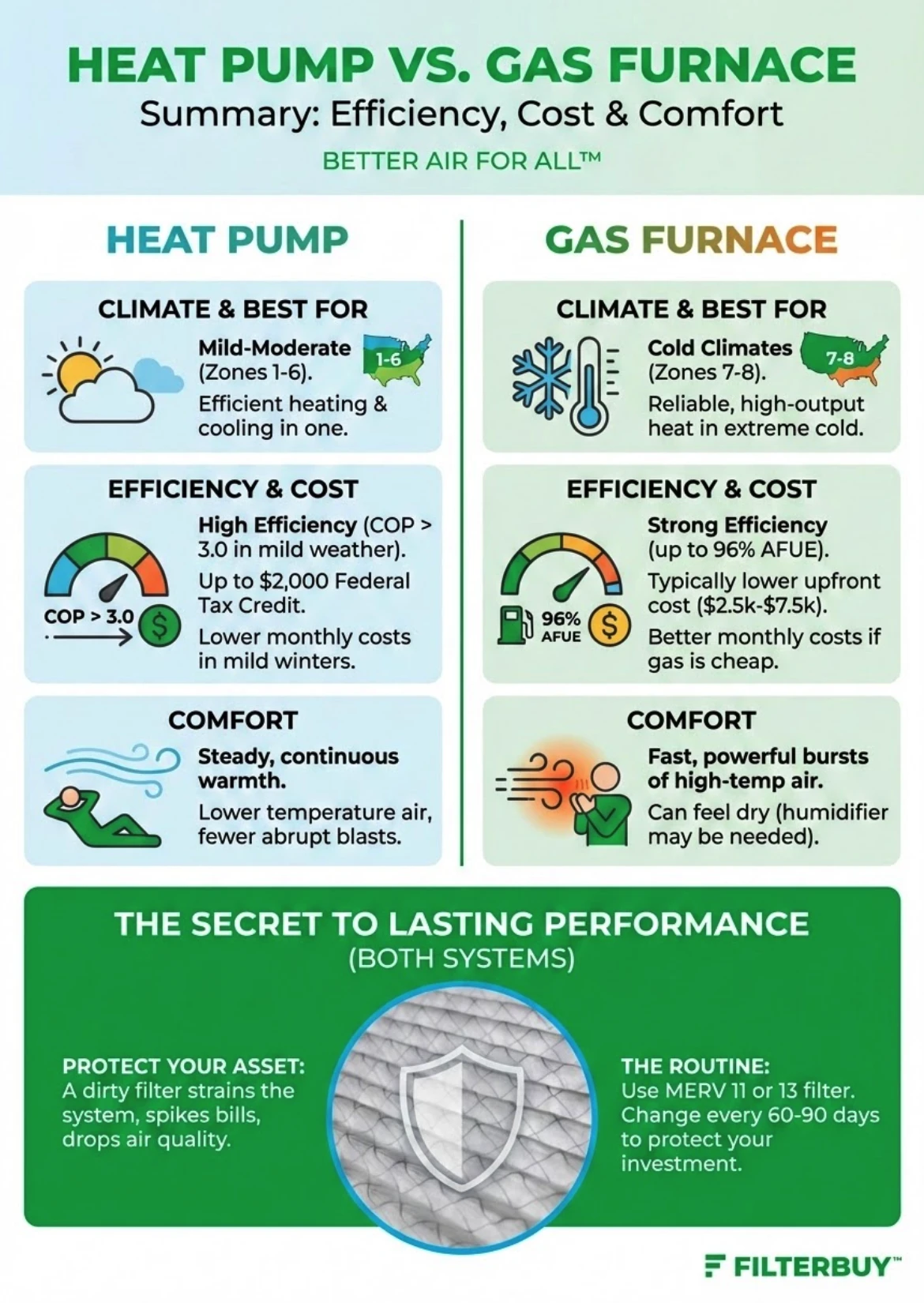
A heat pump and a gas furnace both heat your home, but they work differently and perform best in different climates. A heat pump moves heat from outdoor air into your home and doubles as an air conditioner. A gas furnace burns fuel to generate heat directly and excels in climates with long, severe winters.
Choose a heat pump if:
You live in a mild to moderate climate (Climate Zones 1 through 6)
You want one system to handle both heating and cooling
Your local electricity rates are competitive with natural gas
You want to qualify for federal tax credits up to $2,000 under the Inflation Reduction Act
Choose a gas furnace if:
You live in a cold climate where temperatures regularly drop below 20 degrees Fahrenheit
Natural gas is significantly cheaper than electricity in your area
You need reliable, high-output heat during sustained extreme cold
Key difference: Heat pumps are more efficient in moderate climates, delivering 2 to 3 units of heat per unit of electricity used. Gas furnaces are more reliable and often more cost-effective when outdoor temperatures stay well below freezing for extended periods.
Either way, both systems depend on a clean air filter to run at rated efficiency. A MERV 11 or MERV 13 filter changed every 60 to 90 days protects your equipment and keeps your indoor air quality where it should be.
Heat pumps outperform gas furnaces on raw efficiency in moderate climates. A COP of 2 to 4 beats any furnace's AFUE when outdoor temperatures stay above 20 to 30 degrees Fahrenheit.
When temperatures hold consistently below 20 degrees Fahrenheit, a high-efficiency gas furnace is more reliable and often more cost-effective. A 96 percent AFUE model holds its own when heat pump performance falls off in extreme cold.
One heat pump covers both heating and cooling. In mild climates where you would otherwise pay for two separate systems, that is a genuine advantage worth pricing out.
Before you decide, look up your local electricity rate per kWh and your natural gas rate per therm. What is true in Atlanta is not true in Minneapolis. The math varies considerably by region.
Qualifying heat pump installations may earn up to $2,000 in federal tax credits under the Inflation Reduction Act. Check current IRS requirements before filing.
In Climate Zones 5 and 6, a dual-fuel setup gives you a heat pump for mild days and gas backup for extreme cold, delivering the best year-round mix of efficiency and reliability.
Both systems need clean filters to run at rated efficiency. MERV 11 or MERV 13, changed every 60 to 90 days, protects your equipment and your air quality regardless of which system you have.
Gas furnace: A gas furnace burns natural gas or propane to produce heat. A heat exchanger warms the air, and a blower motor pushes it through your ductwork. High-efficiency condensing furnaces rated at 96 percent AFUE or better convert nearly every dollar of gas burned into usable heat. In climates where temperatures regularly fall below 20 degrees Fahrenheit, that direct combustion performance is a real advantage.
Heat pump: A heat pump does not produce heat. It moves heat from outside your home to inside it. Even cold outdoor air contains heat energy, and the pump extracts it and transfers it in. In summer the process reverses, and the same unit handles your cooling. For a closer look at the underlying mechanics, see how heat pumps work. Modern cold-climate models now run reliably at temperatures as low as -13 degrees Fahrenheit.
A lot of comparisons get this wrong, so let us be exact about what each metric actually measures.
Gas furnaces use AFUE — Annual Fuel Utilization Efficiency. A 96 percent AFUE rating means 96 cents of every dollar in gas becomes heat in your home. That is genuinely strong performance.
Heat pumps use COP — Coefficient of Performance. A COP of 3 means the system delivers three units of heat for every one unit of electricity it uses. In percentage terms, 300 percent efficiency. At moderate outdoor temperatures above 30 degrees Fahrenheit, most heat pumps run between a COP of 2.5 and 4.0, putting them well ahead of any gas furnace on a Btu-per-dollar basis in mild and moderate climates.
The catch is real. COP falls as outdoor temperatures drop. A heat pump running in a 5 degree Fahrenheit Minnesota winter may fall to a COP of 1.5 or lower, and a properly maintained 96 percent AFUE furnace becomes much more competitive at that point.
The short version: heat pumps win on raw efficiency in moderate climates. In climates with sustained extreme cold, gas furnaces are more reliable and often more cost-effective.
Every homeowner wants to know what it will actually cost to run. The answer has two parts: what you pay upfront and what you pay every month after.
Gas furnaces typically run $2,500 to $7,500 installed, depending on efficiency rating and existing ductwork. Heat pumps generally run $4,000 to $8,000 for a standard unit. Homeowners who install a qualifying heat pump may be eligible for a federal tax credit of up to $2,000 under the Inflation Reduction Act, which meaningfully closes that gap.
Your monthly bill depends on two things: your local electricity rate and your local natural gas rate. In Florida, Georgia, and the Carolinas, where winters are mild and electricity is relatively affordable, heat pumps typically come out ahead on operating costs. In the Midwest and Northeast, where temperatures hold well below 20 degrees Fahrenheit for weeks and natural gas runs cheap, gas furnaces often win on the monthly bill.
The U.S. Energy Information Administration tracks heating costs by region and fuel type. Before committing to either system, look up your utility's current rates and run the numbers for your specific address.
Both systems need annual professional servicing. Both require regular air filter changes. Here is what we have seen across millions of systems: a dirty filter is the single most common cause of reduced efficiency, poor air quality, and early system failure in both heat pumps and gas furnaces. A MERV 11 or MERV 13 filter, swapped every 60 to 90 days, keeps your system at its rated efficiency, whether that is 96 percent AFUE or COP 3.5.
Warm and mild climates (Climate Zones 1 through 4): A heat pump is the clear choice. The efficiency advantages are solid, it handles your cooling in the same unit, and operating costs run lower year-round.
Mixed climates (Zones 5 through 6): A dual-fuel setup, where a heat pump runs on mild days and gas kicks in for extreme cold, often delivers the best year-round balance of efficiency and reliability.
Cold climates (Zones 7 through 8): Gas furnaces have dominated here for good reasons, and they still make sense for many homeowners. That said, modern cold-climate heat pumps have changed the math significantly in this zone. Our guide on whether heat pumps work in cold climates breaks down performance by temperature and system type.
Efficiency figures tell you what a system costs to run. They do not tell you what it feels like to live with.
Gas furnace comfort: Gas delivers high-temperature air in short, powerful bursts. Your home warms up fast when the system kicks on. The trade-off is dry air, which is why many gas furnace owners add a whole-house humidifier.
Heat pump comfort: Heat pumps push lower-temperature air more continuously, giving you steady warmth rather than blasts of heat. A lot of homeowners prefer this. Some find the air does not feel warm enough. It is a real difference worth considering, especially in rooms with large air returns.
Both systems circulate air through your HVAC filter on every heating cycle. That is where your home's air quality is either protected or compromised. A filter at the right MERV rating keeps the circulated air clean without straining the equipment.
"The right answer in this comparison is always site-specific — I've seen heat pumps cut annual energy costs by 40 percent for homeowners in mild coastal climates, and I've seen them frustrate homeowners in Zone 7 climates where a well-tuned 96 percent AFUE furnace was simply the more reliable tool. Get your local heating degree days, pull your utility rates, and model the numbers for your address, not your neighbor's."
HVAC Systems Specialist — 12 years of residential and light-commercial HVAC systems design | Certified Energy Auditor | Contributing advisor, Filterbuy Air Quality Team
These are the seven sources we send homeowners to when they are ready to go deeper. All federal agencies or trusted technical references, sourced independently.
U.S. Department of Energy: Heat Pump Systems — The DOE's full guide to heat pump technology, covering types, efficiency metrics, and how to pick the right system. The best free starting point available.
U.S. Department of Energy: Furnaces and Boilers — DOE's reference page on gas furnace efficiency and AFUE ratings. Covers what to look for when upgrading, with performance benchmarks by fuel type.
ENERGY STAR: Certified Heat Pumps — The EPA's ENERGY STAR database lets you search and compare certified heat pump models by efficiency rating, climate zone, and brand. Worth checking before you commit to a purchase.
Wikipedia: How Heat Pumps Work — A clear technical explanation of heat pump operating principles, refrigerant cycles, and system types. Useful for understanding the science behind the efficiency numbers.
IRS: Energy Efficient Home Improvement Credit — Official IRS guidance on the federal tax credit for qualifying heat pump installations, up to $2,000 under the Inflation Reduction Act. Confirm current eligibility before filing.
Filterbuy: Do Heat Pumps Work in Cold Climates? — Our own in-depth resource on cold-climate heat pump performance, covering real-world temperature thresholds, modern cold-climate models, and when a gas backup or dual-fuel system makes sense.
U.S. Energy Information Administration: Residential Energy Costs — The EIA's Residential Energy Consumption Survey gives you real household data on heating costs by fuel type, region, and system. Use it to model what either system would cost in your specific situation.
All three figures come directly from federal agencies. These are the numbers that tend to settle the argument for most homeowners.
In moderate climates, heat pumps deliver 2 to 3 units of heat for every unit of electricity they use. That efficiency advantage is why they outperform gas on a Btu-per-dollar basis when temperatures stay reasonable. Source: U.S. Department of Energy
Homeowners who install a qualifying heat pump can claim up to $2,000 back from the federal government under the Inflation Reduction Act. That credit closes a meaningful portion of the gap between heat pump and gas furnace installation costs. Source: IRS.gov
Heating and cooling take up roughly 45 percent of energy use in a typical U.S. home. Your system choice, and how well you maintain it, affects nearly half your energy bill every month. Source: U.S. Department of Energy
We have shipped filters to homes in all 50 states, and across that span, a few things have become clear about this decision.
If you are in the South or Pacific Northwest, a heat pump is almost certainly the smarter call. It handles heating and cooling in one unit, performs exceptionally well in those climates, and gets more cost-effective every year as natural gas prices move around. The available federal tax credits close most of the upfront gap.
If you are in the upper Midwest, New England, or the northern Plains, where sub-zero temperatures run for days rather than overnight, model the numbers carefully before assuming a heat pump saves you money. A 96 percent AFUE gas furnace is genuinely efficient, genuinely long-lived, and genuinely reliable in extreme cold. The right call in those climates may be a gas furnace, a dual-fuel system, or a purpose-built cold-climate heat pump. Your utility rates and winter severity will tell you which.
Here is what we feel strongest about: whichever system you choose, the biggest performance variable you control after installation is not the equipment. It is the filter.
Your filter is the lungs of the system. When it is clean, your HVAC runs at rated efficiency, moves clean air through every room, and lasts longer. When it is clogged, your system strains against the restriction, your energy bills climb, and your indoor air quality drops. A MERV 11 or MERV 13 filter, changed every 60 to 90 days, is the simplest thing you can do to protect a $3,000 gas furnace or an $8,000 cold-climate heat pump. Treat it like the maintenance step it actually is.
Comparison guides are useful. Action gets you a comfortable home and a reasonable bill. Here is the practical sequence — heat pump, gas, or dual-fuel.
1. Pull your real numbers first. Three data points settle most of the decision for your address:
Your electricity rate per kWh (last two utility bills)
Your natural gas rate per therm (same bills)
Your climate zone (DOE Climate Zone map)
Without these, you are guessing.
2. Get at least 3 quotes. Demand a Manual J load calculation.
Manual J sizes the system to your home's actual heat loss and gain.
Oversized equipment short-cycles and wears out early.
Undersized equipment runs constantly and never catches up.
If a contractor skips Manual J, keep calling.
3. Price the dual-fuel option, even if you think you do not need it.
Heat pump paired with a gas backup often wins in Climate Zones 5 and 6.
Efficiency 80 percent of the year. Reliability the other 20 percent.
Worth a quote even if you end up choosing something else.
4. Check your federal tax credit before you sign.
Qualifying heat pumps may earn up to $2,000 under the Inflation Reduction Act.
Confirm current rules at IRS.gov: Energy Efficient Home Improvement Credit.
Ask your installer for the AHRI certificate and model numbers before install.
5. Stack local utility rebates on top.
Many utilities add $500 to $2,000 more.
Check the ENERGY STAR Rebate Finder by ZIP.
Your installer often knows current programs — ask.
6. Plan your filter strategy from day one.
MERV 11 — right balance for most homes.
MERV 13 — step up for allergies, asthma, or pets.
Skip MERV 16 and above in residential systems. Too restrictive for the blower.
7. Measure your filter slot on install day.
Write down length, width, and depth before the crew leaves.
Return openings are often odd, non-standard sizes.
Need a hand? See how to measure your air filter.
8. Put filter changes on autopilot.
Swap every 60 to 90 days — MERV 11 or 13.
Calendar reminder works. Filterbuy auto-delivery works better.
Cheapest way to protect a five-figure system.
9. Book your first tune-up at install.
Heat pumps: schedule for spring.
Gas furnaces: schedule for fall.
Annual servicing keeps both running near factory specs.
Work this list in order. You will land on the right system, capture every dollar of incentive you are owed, and protect the investment from day one.
The answer depends on your utility rates and climate. In mild-to-moderate climates with average electricity rates, heat pumps typically run cheaper. In cold climates where natural gas prices are low, gas furnaces often win on monthly costs. Run the numbers for your specific address before deciding.
Modern cold-climate heat pumps, such as Mitsubishi Hyper-Heat models, operate effectively at temperatures as low as -13 degrees Fahrenheit. Standard models lose efficiency significantly below 30 degrees Fahrenheit. In Climate Zones 7 through 8, look specifically for a cold-climate-rated heat pump or consider a dual-fuel system.
AFUE measures the percentage of fuel a gas furnace converts to heat. COP measures how many units of heat a heat pump delivers per unit of electricity. A COP of 3 equals 300 percent efficiency, though only at moderate outdoor temperatures where the pump is running optimally.
Yes, in most climates. In Climate Zones 1 through 4, a heat pump handles heating and cooling as a standalone system. In colder zones, a cold-climate heat pump or dual-fuel setup is typically the better approach for keeping comfort steady during extreme cold events.
Heat pumps use standard HVAC filters, the same sizes as any central air or gas furnace system. We recommend MERV 11 for most homes and MERV 13 for households with pets, allergies, or asthma. Stay away from MERV 16 and above in residential systems, since the added restriction reduces airflow and puts stress on the equipment.
Heat pumps typically last 15 to 20 years with proper maintenance. Gas furnaces run 15 to 30 years, with high-quality units on the longer end. Annual professional servicing and regular filter changes extend the life of both systems.
In most regions, yes, particularly where the electrical grid draws significantly on renewable sources. Heat pumps produce no direct combustion emissions at the home. As the grid gets cleaner over time, a heat pump installed today becomes progressively lower-carbon over its full lifespan.
Heat pump or gas furnace, one thing does not change: a clean air filter is the most important maintenance step you can take for your system and your air quality.
Filterbuy makes it easy. 600 plus standard sizes. Made in the USA. Free shipping. Factory-direct pricing. Subscribe to auto-delivery and your next filter shows up before you have to think about it.
