April 16, 2026

January is the worst month to find out your heat pump has been struggling since October. The house is cold, repair schedules are packed, and you're left wondering how you missed it.
Here's the thing: you probably didn't miss it. Your system most likely told you something was off weeks before it became a real problem. A longer warm-up time. A new sound at startup. An energy bill that crept up for no obvious reason. Those aren't random. They're the heat pump asking for attention.
This guide covers the nine warning signs worth knowing, what each one usually points to, and what heat pump repair costs depending on the problem. We've also got a first step that takes about five minutes, costs under thirty dollars, and resolves more heat pump complaints than most homeowners would expect.
Your heat pump is likely telling you something is wrong before it stops working. Watch for these nine warning signs:
Not reaching temperature. The system runs but the house never catches up to the thermostat setting.
New or unusual noises. Grinding, squealing, banging, or rattling are not normal operating sounds.
Constant running. The system never shuts off but still can't hit the set temperature.
Ice or frost buildup. Thick ice on the coils or refrigerant lines that doesn't clear on its own.
Rising energy bills. Your electricity costs climb with no change in how you use your home.
Cold air in heating mode. The system blows cool air when it should be heating.
Unusual smells. A burning or electrical smell means shut it down and call a technician. A musty odor points to moisture buildup.
Short cycling. The system turns on, runs briefly, shuts off, and repeats in quick succession.
Age plus recurring repairs. A system over ten to fifteen years old that keeps needing fixes is a replacement conversation, not a repair one.
Check the air filter first. A clogged filter is behind more of these symptoms than most homeowners expect and costs under thirty dollars to fix.
What to remember from this article:
Catch it early. Heat pumps signal trouble before they fail. Acting on those signals early is almost always cheaper than waiting until they stop working.
Nine warning signs: not reaching temperature, new noises, constant running, ice buildup, climbing bills, cold air in heat mode, unusual smells, short cycling, and age combined with recurring repairs.
Heat pump repair costs run from $150 to $2,000. Early intervention puts you toward the low end. A compressor replacement lands at the top.
Check the filter first. A dirty filter causes more heat pump symptoms than most people expect. Always rule it out before calling a technician.
Change the filter every sixty to ninety days. Homes with pets or allergy sufferers should go every thirty to forty-five days.
Get an annual inspection. A NATE-certified technician catches low refrigerant and worn components before they cause a breakdown.
Know the replace-or-repair line. If a repair costs more than half of what a new system would cost, and the unit is over ten years old, replacement is usually the better investment.
Heat pumps move heat from one place to another rather than generating it from scratch. That design is what makes them so efficient. It also means their failure symptoms tend to be gradual: the system doesn't crash, it slips. And the gap between 'something feels slightly off' and 'the repair visit is scheduled' is usually where the expensive problems develop.
If the heat pump is running but the temperature in your house never catches up to what's on the thermostat, the system is losing ground somewhere. Low refrigerant, a failing compressor, and a clogged air filter all produce this exact symptom. Most homeowners assume the thermostat is the problem. Check the filter first.
A healthy heat pump hums. It's quiet and consistent. New sounds mean something has changed. Grinding or squealing points to a motor bearing starting to fail. Banging or clanking usually signals a loose or broken component inside the unit. Rattling is often debris caught in the fan or a loose panel. None of those are normal house sounds. If a noise is new, get it looked at.
When a heat pump runs nonstop but still can't reach the set temperature, it's compensating for something it can't fix on its own: low refrigerant, restricted airflow, or a compressor that's running out of capacity. Sustained nonstop running puts serious strain on that compressor. Replacing a compressor is the most expensive single repair on this list.
Some frost on the outdoor unit in cold weather is normal. Heat pumps run a defrost cycle to handle it. What isn't normal: thick ice on the coils that won't clear between cycles, ice on the refrigerant lines, or icing during mild temperatures. That pattern almost always points to low refrigerant or a malfunctioning defrost control, and neither one gets better on its own.
If nothing has changed in how you use your home but your electricity bill jumped, your heat pump is working much harder than it should. A struggling system can quietly add thirty to eighty dollars a month to your bill before any other symptom appears. A dirty air filter is the most common cause of this kind of gradual efficiency loss, and it's the cheapest to fix.
This one gets attention fast. A heat pump blowing cool air when it's set to heat almost always traces back to the reversing valve, which is the component that switches the system between heating and cooling modes. When that valve sticks or fails, the switch doesn't happen. It's a fixable repair, but it needs a professional.
A burning or electrical smell means turn the system off and call a technician right away. A musty odor usually points to moisture buildup in the air handler or ductwork, which is both an HVAC issue and an indoor air quality concern. Neither smell resolves on its own, and neither should be ignored.
Short cycling is when the heat pump turns on, runs for a few minutes, shuts off, and then repeats the cycle. It's hard on the compressor and kills efficiency quickly. A system that's too large for the space, low refrigerant, a clogged filter, or a faulty thermostat can all cause it. Catching short cycling early matters because it accelerates wear faster than most other operating conditions.
Age alone isn't a reason to replace a heat pump. Age plus recurring problems is a different calculation. A useful rule: if a single repair costs more than half of what a replacement system would cost, and your unit is past the ten-to-fifteen-year mark, replacement is usually the smarter financial decision. That's the math worth doing before approving a big repair.
Run through these first. Each one is free or cheap to check, and each one mimics common heat pump symptoms when it's the real culprit.
The air filter. If it's gray and matted, it's restricting airflow. A clogged filter produces several of the symptoms on this list and costs under thirty dollars to fix.
The thermostat. Confirm it's in the right mode (heat vs. cool) and that the temperature setting is what you think it is.
The circuit breaker. A tripped breaker shuts the whole system down. Reset it once. If it trips again, stop and call a pro.
“After more than twenty years on residential systems, the pattern is consistent: the most expensive repairs were almost all preventable, and in nearly every case the homeowner had noticed something weeks earlier but didn’t know what it meant. A twenty-dollar filter protects a fifteen-hundred-dollar compressor, and that’s a trade most people would take every time if someone told them it was an option.”
Filterbuy Team | 12 years in residential HVAC efficiency and indoor air quality
These are the sources behind the guidance in this article: government agencies, professional standards bodies, and consumer organizations whose standards HVAC technicians actually follow.
The DOE's guide to heat pump technology, efficiency ratings, and energy savings. The primary source for the statistics in this article.
https://www.energy.gov/energysaver/heat-pumps
EPA and DOE-backed efficiency benchmarks and certified product guidance. Useful when comparing systems or deciding whether repair or replacement makes financial sense.
https://www.energystar.gov/products/heat_pump_systems
A solid technical overview of how heat pumps work, the types available, and the thermodynamic principles behind the warning signs covered in this article.
https://en.wikipedia.org/wiki/Heat_pump
The EPA's resource hub on indoor air quality including how HVAC system health affects the air inside your home.
https://www.epa.gov/indoor-air-quality-iaq
The professional association for HVAC contractors. Their contractor search tool is the most reliable way to find a NATE-certified technician in your area.
ASHRAE writes the standards that govern how HVAC systems are designed, installed, and serviced. The source professionals cite when making technical decisions.
https://www.ashrae.org/technical-resources
Not sure which type of system you have? This guide breaks down all three, what makes each one different, and what that means for maintenance and the warning signs to watch for.
These figures come from government and consumer sources and put the cost of ignoring heat pump maintenance into plain terms.
Heat pumps can cut electricity use for heating by up to 65% compared to electric resistance heating. A system struggling with any of the warning signs in this article delivers a fraction of that, often adding tens of dollars a month to your bill before anything else goes wrong.
Source: U.S. Department of Energy | https://www.energy.gov/energysaver/heat-pumps
A well-maintained heat pump has an average lifespan of fifteen years, according to the DOE. Systems that skip regular filter changes and annual inspections often fail earlier. The maintenance habit is what gets you to fifteen.
Source: U.S. Department of Energy | https://www.energy.gov/energysaver/heat-pumps
That's the typical range for heat pump repair cost. Simple fixes like a capacitor replacement sit at the low end. Compressor replacement lands at the top, and at that level a system more than ten years old is often better replaced than repaired. Catching problems early almost always keeps you on the cheaper side of that range.
Source: Angi Heat Pump Repair Cost Guide | https://www.angi.com/articles/how-much-does-heat-pump-repair-cost.htm
Most of the heat pump problems in this article trace back to deferred maintenance. The filter change that got pushed back a month or two. The annual inspection that didn't happen. A system showing early signs of trouble while still technically running. That last part is the trap: 'still running' and 'running well' are not the same thing.
At Filterbuy, we've spent more than a decade making and shipping air filters directly to homeowners across the country. And the thing we hear from customers more often than any product complaint is: 'I had no idea a dirty filter could cause that.' It can. And it does. A clogged filter forces the blower to work harder, reduces how efficiently heat moves through the system, and contributes directly to some of the symptoms on this list: ice buildup, short cycling, and climbing energy bills.
Our take: start with the filter. If your heat pump is showing any of the warning signs in this article, swap the filter first and wait twenty-four hours. If the symptom clears, you found the problem. If it doesn't, call a licensed HVAC technician. That sequence resolves a lot of unnecessary service calls.
Beyond the filter, schedule an annual inspection with a NATE-certified professional. A good technician spots low refrigerant levels and worn capacitors during a routine checkup. Catching either of those during a hundred-dollar inspection is a much better outcome than discovering them during a January breakdown.
Start at the top. Most homeowners solve the problem in the first two steps.
1. Check Your Air Filter
Pull it out and look at it.
If it's gray, matted, or blocks light, replace it.
Takes five minutes. Costs under $30.
Resolves more heat pump issues than any other single fix.
2. Check the Thermostat and Breaker
Confirm the thermostat is set to heat.
Verify the target temperature.
Reset a tripped breaker once.
If it trips again, stop and call a pro.
3. Wait 24 Hours
Give the system a full day with the clean filter.
Symptom clears? You found it.
Schedule the next filter change:
Every 60–90 days for most homes
Every 30–45 days with pets or allergies
4. Call a NATE-Certified Technician
Find one through the ACCA contractor search.
Describe what you're seeing: noises, timing, which symptom came first.
Expect $75–$150 for a diagnostic visit.
5. Run the Repair-or-Replace Math
Before approving big repairs, ask two questions:
Does the repair cost more than half of a new system?
Is the unit over 10–15 years old?
If yes to both, get a replacement quote before signing off.
6. Build the Habit That Prevents the Next Problem
Two things protect your heat pump better than anything else:
Change the filter on a schedule. Use auto-delivery so you don't have to track it.
Book an annual inspection. A fall checkup catches refrigerant and capacitor issues before winter.
Make the filter part easy. Filterbuy ships your exact size — free, factory-direct, made in the USA. Pick MERV 11 or MERV 13, set up auto-delivery, and it arrives right when it's time. One less thing to remember.
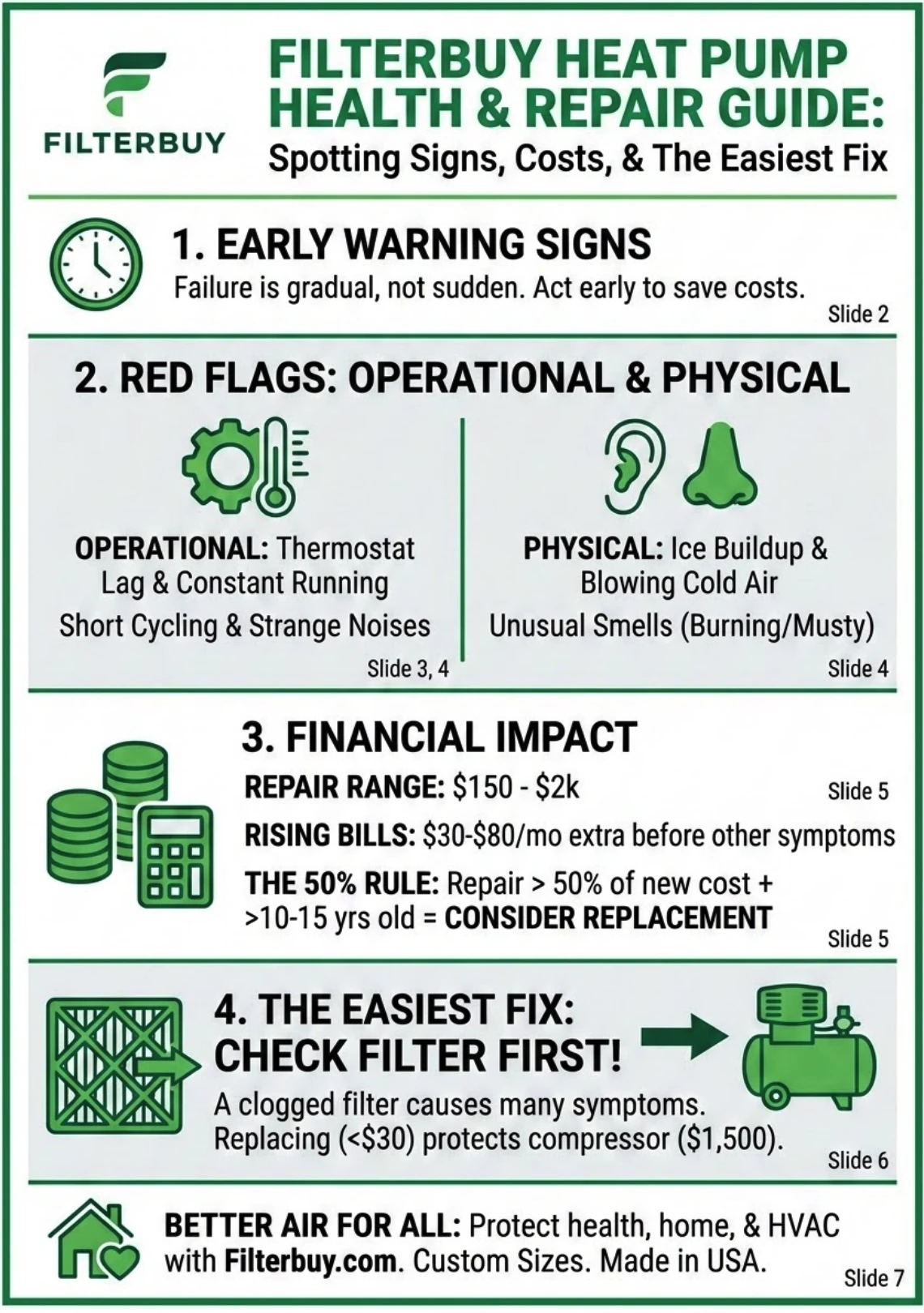
Start with the symptom list in this article. Is the house not reaching the thermostat setting? New sounds? Bills climbing without explanation? Any of those, especially more than one at a time, mean the system needs attention. Before you call a technician, check the air filter. A restricted filter produces almost every common heat pump symptom. If the filter is clean and problems persist, schedule a professional inspection.
Typical heat pump repair cost runs from $150 to $2,000, depending on what's broken. Capacitor replacement usually falls between $150 and $450. Refrigerant recharging typically runs $200 to $600. Reversing valve replacement is generally $300 to $750. Compressor replacement sits between $800 and $2,000, and at that price point, a system more than ten years old is often a better candidate for replacement than repair.
Yes, and it's behind more service calls than most homeowners realize. A clogged filter restricts airflow, forces the blower motor to work harder, reduces heat transfer, can cause the coils to ice over, and triggers short cycling. It's the first thing a technician checks. Check it yourself first and skip the service fee.
Every sixty to ninety days works for most homes. Homes with pets should target every thirty to forty-five days, since pet dander loads a filter faster. If someone in the home has allergies or asthma, monthly changes are worth doing. A MERV 11 filter is the right choice for most heat pump systems: strong filtration without the airflow restriction that higher-rated filters can create in standard systems.
The standard rule is the 50% threshold: if a single repair costs more than half of what a new system would cost, and the unit is more than ten to fifteen years old, replacement is usually the better long-term investment. A new heat pump runs more efficiently, which cuts monthly energy costs and helps offset the upfront price over time. If your system is younger and the repair is isolated, repair is almost always the right call.
MERV 11 is the right choice for most residential heat pump systems. It captures dust, pollen, pet dander, and mold spores without creating the airflow restriction that higher-rated filters can cause in systems not designed for them. If someone in the home has serious allergies or asthma, MERV 13 is worth considering. Go above MERV 13 in a standard residential system only if your HVAC contractor confirms the system can handle the added resistance.
Start with the filter. Everything else is harder.
Filterbuy ships your exact filter size directly to your door: free shipping, factory-direct, made in the USA. Find your size, choose MERV 11 or MERV 13, and set up auto-delivery so it shows up when it's time. You won't have to think about it again until the next one arrives.
