May 5, 2026

If you're looking for ways to improve your home's indoor air quality, you've probably come across pleated or "bacteria-blocking" HVAC filters. Using these filters is a great step toward cleaner air, but it often raises an important question: are these products regulated by the U.S. Environmental Protection Agency (EPA)?
Many homeowners assume that filters making health-related claims must have an "EPA-approved" seal, but the reality is a bit more complex. The EPA doesn't directly certify or regulate HVAC filters for their ability to block bacteria. Instead, their focus is on setting broader air quality standards.
This guide will clear up the confusion around EPA air filter regulation. We'll explain what makes an HVAC filter effective, what safety standards actually matter, and how to choose the right filter for your home. As a trusted provider of American-made filters, Filterbuy is committed to helping you make informed decisions for cleaner, healthier air.
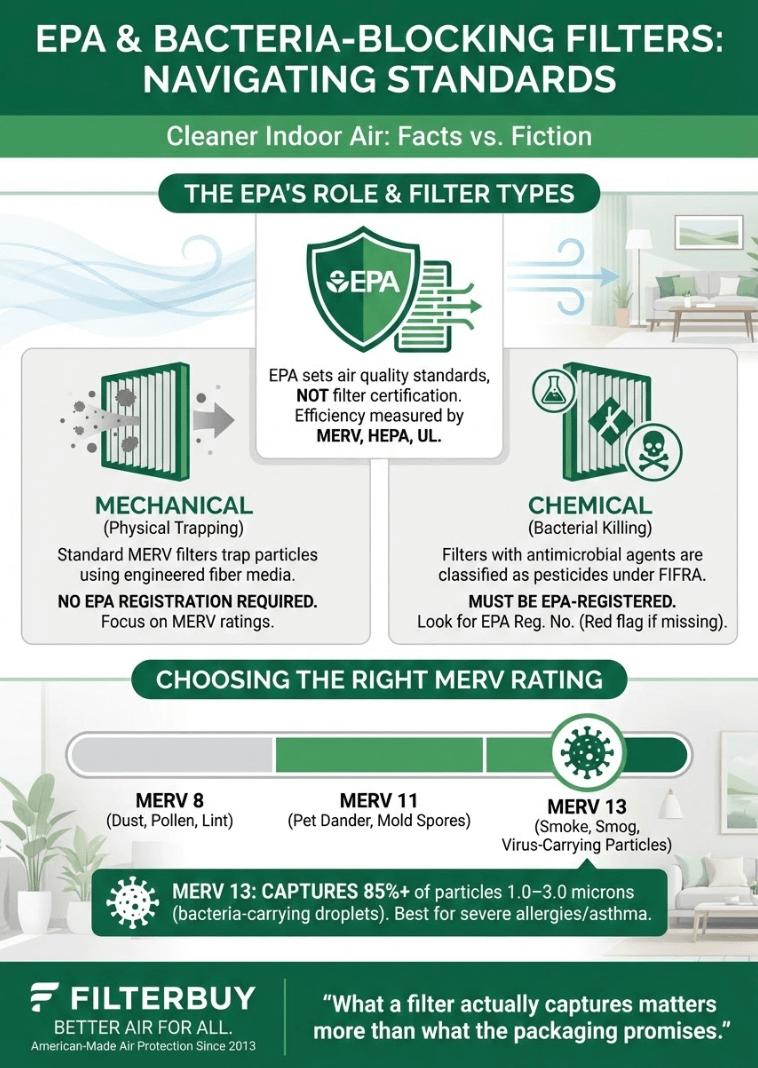
Yes — if the filter uses a chemical substance to kill bacteria. Under the Federal Insecticide, Fungicide, and Rodenticide Act (FIFRA), any HVAC filter treated with antimicrobial agents like nanosilver or copper coatings is classified as a pesticide product. It must be registered with the EPA and proven safe and effective before it can legally be sold.
Standard MERV-rated filters are not regulated as pesticides. These filters capture bacteria-carrying particles through mechanical filtration — engineered fiber media that physically trap airborne contaminants. No chemical action. No EPA pesticide registration required.
After manufacturing air filters in our American facilities for over a decade, we've seen the confusion these claims create firsthand. If a filter on your shelf makes antibacterial claims but shows no EPA registration number, that's a red flag worth acting on. A properly rated MERV 13 filter captures at least 85% of particles between 1.0–3.0 microns — including bacteria-carrying droplets — through material science you can verify and trust.
The EPA does not certify or approve claims that HVAC filters block bacteria. Its role is to set standards for air pollutants, not to endorse specific filter products.
The effectiveness of an air filter is measured by industry standards like MERV (Minimum Efficiency Reporting Value), HEPA (High-Efficiency Particulate Air), and UL (Underwriters Laboratories) ratings.
Pleated HVAC filters with a MERV 8–13 rating effectively trap airborne particles like dust, allergens, and HVAC filter bacteria.
Filterbuy provides a wide range of MERV 8–13 pleated HVAC filters that meet these trusted industry standards, helping you improve indoor air quality safely and effectively.
A common misconception is that the EPA tests and certifies air filters the same way it does pesticides or disinfectants. However, the EPA's primary role regarding air quality is to establish standards for acceptable levels of pollutants, such as particulate matter (PM) and volatile organic compounds (VOCs). The agency guides on improving indoor air quality, but does not run a certification program for HVAC filters.
So, when you see a filter marketed as "bacteria-blocking," that claim is based on its design and efficiency, not on an official EPA endorsement. According to the EPA's guidance on air cleaners and filters, the agency does not certify these products. This means it's up to consumers to look for other trusted benchmarks to verify a filter's performance.
If the EPA doesn't certify filters, how can you know if a filter is safe and effective? The answer lies in independent, third-party rating systems that have become the industry's gold standard.
Here are the key air filter safety standards to look for:
MERV (Minimum Efficiency Reporting Value): This is the most common rating for residential HVAC filters. Ranging from 1 to 20, the MERV scale measures a filter's ability to capture airborne particles of different sizes. A higher MERV rating means the filter can trap smaller particles more effectively. For most homes, filters rated between MERV 8 and MERV 13 offer the best balance of filtration and airflow.
HEPA (High-Efficiency Particulate Air): This standard applies to filters that can trap at least 99.97% of airborne particles that are 0.3 microns in size. While highly effective, true HEPA filters are typically used in standalone air purifiers or specialized commercial systems, as their density can restrict airflow in standard residential HVAC units.
UL (Underwriters Laboratories): UL is a global safety certification company that tests products for safety risks, including flammability. A UL mark on an air filter indicates that it has met specific safety and construction standards, giving you peace of mind that the product is well-made.
To put it plainly: no HVAC filter is "EPA-approved" or "EPA-certified" for blocking bacteria. The EPA's approval process is reserved for products classified as pesticides or disinfectants, which are substances intended to destroy or mitigate pests, including bacteria and viruses. An air filter, which physically traps particles, does not fall into this category.
However, this doesn't mean that filters are ineffective against airborne bacteria. High-efficiency pleated HVAC filters, particularly those with a MERV 13 rating, are designed to capture microscopic particles, including some bacteria, mold spores, and viruses. The filtration is a mechanical process. As air passes through the dense web of fibers in a pleated filter, contaminants get trapped. The higher the MERV rating, the smaller the particles it can capture.
When it comes to choosing an effective filter, pleated HVAC filters consistently outperform traditional flat-panel fiberglass filters. Their design offers several key advantages for improving indoor air quality.
More Surface Area: The pleated design creates significantly more surface area for trapping particles compared to a flat filter of the same size. This allows the filter to capture more dust, pollen, pet dander, and HVAC filter bacteria without quickly clogging.
Longer Lifespan: Because they have more room to collect debris, pleated filters generally last longer than their fiberglass counterparts. While a basic fiberglass filter might need changing every month, a quality pleated filter can last up to three months.
Balanced Efficiency and Airflow: Pleated filters provide an excellent balance between capturing tiny particles and maintaining proper airflow. This is crucial because a filter that is too dense can strain your HVAC system, leading to reduced efficiency and potential damage.
Filterbuy's pleated filters, available in MERV 8, 11, and 13 ratings, are designed to meet these high standards. They provide superior filtration to protect your home's air and HVAC system.
Matching the right MERV rating to your home's needs is the key to achieving cleaner air without compromising your HVAC system's performance.
MERV 8: This is a great starting point for most households. It effectively captures dust, pollen, and dust mites, offering a significant upgrade from basic fiberglass filters.
MERV 11: Ideal for homes with pets or occupants with mild allergies, a MERV 11 filter traps smaller particles like pet dander and mold spores.
MERV 13: For those with moderate to severe allergies, asthma, or a general desire for the cleanest possible air, a MERV 13 filter is the best choice. It can capture smoke, some bacteria, and even some virus-carrying particles.
Before purchasing a high-MERV filter, check your HVAC system's manual or consult a technician to ensure it can handle the increased airflow resistance. For most modern systems, a MERV 13 filter is perfectly suitable. At Filterbuy, we offer a complete range of MERV 8–13 pleated filters, so you can find the perfect fit for your home.
While there is no official EPA air filter regulation for bacteria-blocking claims, a high-quality pleated filter is a proven and effective tool for improving your home's air quality. By focusing on trusted industry standards like MERV ratings, you can confidently choose a filter that captures dust, allergens, and airborne bacteria.
For dependable indoor air quality, Filterbuy’s MERV 8–13 pleated filters offer an effective, affordable way to capture contaminants—giving your home cleaner, fresher air every day. Upgrade your air quality today with Filterbuy’s trusted pleated filters, all made in the USA and delivered to your door.
"After manufacturing millions of filters across four American facilities, we've learned that the best protection comes from precision-engineered filter media — not chemical additives that require EPA pesticide registration just to legally sit inside your ductwork. Our customers deserve to know exactly what's in the filter they're trusting with their family's air, and a verified MERV rating gives them that transparency in a way no unregulated antimicrobial claim ever can."
— Filterbuy, American Air Filter Manufacturer Since 2013
Don't take claims about bacteria-blocking filters at face value — arm yourself with the facts. After manufacturing air filters in our American facilities for over a decade, we've learned that the best decisions start with understanding how these products are actually regulated. These seven authoritative resources give you the same regulatory and scientific foundation our team relies on, so you can confidently evaluate any filter claiming to protect your family from airborne bacteria.
Here's something most homeowners never encounter until they start digging: HVAC filters that claim to kill bacteria are regulated as pesticides under federal law. The EPA's antimicrobial pesticides overview explains exactly why, walking you through the FIFRA registration requirements that apply to any product making antimicrobial claims. If you're going to install something in the system that circulates air through every room your family sleeps in, this is the first resource worth reading.
Source: U.S. Environmental Protection Agency — Antimicrobial Pesticides https://www.epa.gov/pesticides/antimicrobial-pesticides
This is the distinction that matters most — and the one we wish more filter companies were upfront about. The EPA's consumer guide explains the regulatory line between filters that capture particles mechanically through engineered fiber media and filters that use a chemical substance to kill bacteria. One requires EPA pesticide registration. The other relies on verified MERV-rated performance. Knowing which is which puts you in control of what's actually going into your ductwork.
Source: U.S. Environmental Protection Agency — Pesticide Devices: A Guide for Consumers https://www.epa.gov/pesticides/pesticide-devices-guide-consumers
The EPA doesn't just take a manufacturer's word for it when a product claims to destroy bacteria. The Pesticide Registration Manual details the specific efficacy testing, safety evaluations, and data submissions required before an antimicrobial product can legally reach your home. When you see how rigorous this process is, you'll understand why the absence of an EPA registration number on a "bacteria-blocking" filter should raise immediate concerns about whether that product has been properly vetted to protect your family.
Source: U.S. Environmental Protection Agency — Pesticide Registration Manual, Chapter 4 https://www.epa.gov/pesticide-registration/pesticide-registration-manual-chapter-4-additional-considerations
Your HVAC system pushes air through every room in your home, which is exactly why the EPA issued guidance specifically about antimicrobial products used in heating, ventilation, and air conditioning equipment. This document outlines the agency's concerns about risk and efficacy when chemical treatments are applied to HVAC components — concerns that any homeowner considering a bacteria-blocking filter should understand before making a purchase.
Source: U.S. Environmental Protection Agency — Draft PRN 2006-A https://www.epa.gov/pesticide-registration/draft-prn-2006-use-antimicrobial-pesticide-products-heating-ventilation-air
We talk to customers every day who assume that if a filter is on store shelves, it must be fully approved and verified. This EPA enforcement case tells a different story. Roughly 420,000 appliances containing filters with unregistered nanosilver treatments were flagged, and over 500,000 units ultimately had to be brought into compliance. It's a real-world reminder that bold antimicrobial marketing claims don't always mean a product has been through the regulatory process designed to protect you.
Source: U.S. Environmental Protection Agency — EPA and Electrolux Settlement https://www.epa.gov/enforcement/epa-and-electrolux-reach-settlement-illegal-imports-air-filter-products-incorporating
This is the standard our engineering team builds every day. ASHRAE Standard 52.2 defines how air filters are tested and rated for particle-capture efficiency using the MERV scale — a transparent, independently verified measurement of what a filter actually captures through precision fiber engineering. No chemical additives. No pesticide registration required. Just material science you can verify and trust to protect your home's air quality.
Source: American Society of Heating, Refrigerating and Air-Conditioning Engineers — ASHRAE Standard 52.2 https://www.ashrae.org/technical-resources/ashrae-standards-and-guidelines
Choosing the right filter shouldn't require a regulatory law degree. The EPA's consumer guide cuts through the noise with practical, science-based tips for evaluating portable air cleaners and HVAC filters in your home. It's the kind of straightforward, no-nonsense resource we believe every homeowner deserves — because protecting your family's air starts with having the facts, not falling for the most impressive-sounding claim on the packaging.
Source: U.S. Environmental Protection Agency — Air Cleaners, HVAC Filters, and Coronavirus (COVID-19) https://www.epa.gov/indoor-air-quality-iaq/air-cleaners-hvac-filters-and-coronavirus-covid-19
We manufacture millions of air filters every year across four American facilities. We've watched the gap between what some competitors claim on packaging and what federal regulators actually allow grow wider every year. These three statistics reflect the same concerns we hear from customers daily — and reinforce why we build every filter around verified MERV-rated mechanical performance instead of unregulated chemical additives.
The EPA reports that Americans spend roughly 90% of their time indoors, where pollutant concentrations are often 2 to 5 times higher than outdoor levels.
We see the evidence every time a customer sends us a photo of a filter pulled after just 30 days. The discoloration alone tells the story. That's why every Filterbuy filter earns its MERV rating through:
Engineered fiber density that captures particles mechanically
Precision pleat geometry tested to ASHRAE 52.2 standards
Independently verified performance — not unproven chemical coatings
When indoor air is potentially more polluted than outdoor air, your family needs a filter that makes promises it's been required to prove.
Source: U.S. Environmental Protection Agency — Indoor Air Quality https://www.epa.gov/report-environment/indoor-air-quality
In the first six months of 2025 alone, the EPA resolved at least 20 antimicrobial-related FIFRA allegations. Cases included:
Air filters sold with unregistered pesticide treatments
Products marketed with misleading bacteria-blocking claims
The enforcement pace has increased compared to prior years
After serving over two million households, we can tell you most homeowners have no idea this enforcement activity exists. Customers trust that if a filter is available for purchase, someone verified the claims on the packaging. The reality? The EPA is actively pulling products off shelves because that verification never happened.
This is one reason our team committed to mechanical filtration backed by standardized MERV testing years ago. Our customers should never have to wonder whether the filter in their ductwork went through the regulatory process or not.
Source: Beveridge & Diamond, P.C. — EPA Continues Focus on Antimicrobial Pesticide Enforcement in 2025 https://www.bdlaw.com/publications/epa-continues-focus-on-antimicrobial-pesticide-enforcement-in-2025/
Under FIFRA, every single occasion of selling an unregistered or misbranded pesticide product is a separate violation. Here's what that looks like in practice:
Per-violation penalty: up to $24,885
May 2025 settlement: $3,066,724 against a major national retailer
Violations cited: selling misbranded air filters with unregistered antimicrobial treatments
The federal government doesn't assess seven-figure penalties over minor labeling technicalities. These enforcement actions exist because unregistered antimicrobial substances circulating through residential HVAC systems represent a genuine consumer protection concern.
From our vantage point as a manufacturer, we take that concern personally — every time we design, produce, and ship a filter from our facilities to your front door.
Source: Beveridge & Diamond, P.C. — EPA Continues Focus on Antimicrobial Pesticide Enforcement in 2025 https://www.bdlaw.com/publications/epa-continues-focus-on-antimicrobial-pesticide-enforcement-in-2025/
After over a decade of manufacturing air filters across our facilities in Alabama, Pennsylvania, Texas, and Utah — and after serving more than two million households — we've developed a clear perspective on the bacteria-blocking filter conversation that most brands aren't willing to share openly.
The regulatory picture is straightforward:
Chemical antimicrobial filters — the EPA treats them as pesticides under FIFRA. They must be registered, tested, and proven safe before reaching your home.
Mechanical MERV-rated filters — the ASHRAE 52.2 standard provides transparent, independently verified particle-capture performance. No chemical additives required.
One path is heavily regulated. The other is independently verified. Both exist to protect you — but only if manufacturers actually follow through.
What concerns us isn't the existence of antimicrobial technology itself. It's the growing number of products reaching consumers with bold claims that were never submitted for EPA review. Consider what's happened recently:
20+ enforcement actions resolved in just the first half of 2025
$3 million settlement involving misbranded air filters at a major national retailer
Stop-sale orders issued against manufacturers marketing unregistered pesticide treatments
These aren't isolated incidents. They represent a pattern — and our customers are the ones left holding the filter when the claims don't hold up.
Here's our honest take as a manufacturer who built a business on verified performance rather than unverified promises: the most reliable way to protect your family from airborne bacteria isn't a chemical coating — it's a well-engineered filter with the right MERV rating, changed on schedule, inside a properly maintained HVAC system.
That combination works because it's:
Grounded in material science — not marketing
Measurable — through standardized ASHRAE testing
Transparent — no hidden substances circulating through your ductwork
We're not saying antimicrobial technology has no place in air filtration. We're saying that if a product makes that claim, it should have the EPA registration to back it up. You shouldn't have to dig through federal enforcement databases to find out whether it does. Every homeowner protecting their family deserves that basic transparency.
At Filterbuy, we chose a different path. We invest in fiber engineering, pleat design, and manufacturing precision so that every filter we ship earns its MERV rating through performance you can verify — not claims you have to take on faith. Because when it comes to the air your family breathes, what a filter actually captures matters more than what the packaging promises.
You understand how the EPA regulates bacteria-blocking HVAC filters. You know why verified mechanical filtration outperforms unregulated antimicrobial claims. Here's how to put that knowledge into action.
Pull the filter from your return vent. Look for two things:
A clearly stated MERV rating tested to ASHRAE 52.2 standards
Any antimicrobial or antibacterial language on the packaging
If your filter claims to kill bacteria using a chemical treatment, look for an EPA registration number on the label. No registration number means that the product may not have gone through the federal review process designed to protect your family.
Match your MERV rating to your home's specific needs:
MERV 8 — Common dust, pollen, and lint. Solid baseline for homes without allergy concerns.
MERV 11 — Adds pet dander, mold spores, and finer particles. Ideal for pet owners and mild allergy sufferers.
MERV 13 — Targets smoke, smog, and bacteria-carrying droplets down to 1.0 micron. Best for families prioritizing maximum mechanical particle capture.
Even the best filter loses effectiveness when overloaded:
Every 30 days — 1-inch filters in homes with pets, allergies, or high dust
Every 60–90 days, 1-inch filters in standard households
Every 6–12 months — 4- to 5-inch media filters, depending on conditions
Pro Tip: After working with millions of customers, we've found the number one reason filters underperform isn't the wrong MERV rating. It's waiting too long to replace it.
Run any filter through this quick checklist before purchasing:
Displays a specific MERV rating — not a vague "filtration level.l"
Tested to ASHRAE 52.2 standards
Includes an EPA registration number if it makes antimicrobial claims
Backed by independent testing data or third-party verification
Relies on unsubstantiated language like "kills 99% of bacteria" without methodology
If a filter can't pass this check, it's not earning your trust. It's asking you to gamble with your family's air.
The easiest way to maintain consistent protection is to never think about when your next filter is due.
Filterbuy offers subscription delivery on every size we manufacture — over 600 — shipped from our American facilities to your door on the schedule that fits your home.
No chemical additives. No unregulated claims.
Precision-engineered, MERV-rated filters delivered when you need them.
Protecting your family's air — simple, transparent, and reliable.
Find your size and choose your MERV rating at Filterbuy.com
Q: Does the EPA regulate all HVAC filters or only filters that claim to kill bacteria?
A: This is one of the most common misconceptions we encounter when talking with homeowners. The short answer:
Standard mechanical HVAC filters — not regulated by the EPA. MERV-rated filters capture particles through engineered fiber media using a purely physical process. No pesticide registration applies.
Filters with chemical antimicrobial treatments — regulated as pesticides under FIFRA. Must be registered with the EPA and proven safe before a single unit ships to a consumer.
We've spent over a decade engineering filters across our four American facilities that deliver verified particle capture through material science alone. We've never needed a chemical additive to do it.
Q. Does the EPA approve bacteria-blocking HVAC filters?A. No, the EPA does not approve, certify, or regulate HVAC filters for bacteria-blocking claims. Its approval process is for disinfectants and pesticides, not for filtration devices.
Q. What regulations apply to air filters in the U.S.?A. Air filters are not subject to direct federal regulation for performance claims. Instead, their effectiveness is measured by industry-developed standards like MERV, HEPA, and UL ratings.
Q. What is the EPA’s role in indoor air quality?A. The EPA sets standards for common air pollutants, conducts research, and provides public guidance on how to improve indoor air quality through methods like proper ventilation, source control, and air filtration.
Q. Are MERV 13 filters good for bacteria removal?A. Yes, MERV 13 filters are effective at capturing a variety of microscopic particles, including some airborne bacteria, smoke, and virus carriers. They offer a high level of filtration suitable for most residential homes.
Q. How do pleated filters compare to flat filters?A. Pleated filters have a much larger surface area than flat fiberglass filters, allowing them to capture more particles and last longer without restricting airflow. They are significantly more effective at improving indoor air quality.
Q. Can the EPA ban certain HVAC filters?A. The EPA does not typically ban specific types of HVAC filters. However, it can regulate materials used in their construction if they are found to be hazardous.
Q. What certifications matter when buying an air filter?A. Look for the MERV rating to determine its particle-trapping efficiency. Additionally, a UL certification indicates that the filter has met safety standards for its materials and construction.
Q. Are higher MERV ratings always better?A. Not necessarily. While a higher MERV rating means better filtration, it also means greater airflow resistance. It's important to choose a filter that is compatible with your HVAC system to avoid straining the fan motor. For most homes, MERV 8–13 is the ideal range.
Q. How often should I replace my HVAC filter for best performance?A. It is widely recommended to change your home’s air filter every 90 days. However, if you have pets, smokers, or high dust levels in your home, you should consider replacing it every 30 to 60 days.
Q. Where can I buy high-quality pleated filters for my HVAC system?A. You can purchase a wide selection of American-made, high-quality pleated filters for your HVAC system directly from Filterbuy.com. We offer filters in all standard and custom sizes to fit your needs.
Now that you know how the EPA regulates bacteria-blocking HVAC filters, protect your family with a precision-engineered, MERV-rated Filterbuy filter manufactured in our American facilities and shipped directly to your door. Find your size and get started at Filterbuy.com.
