
How MERV Ratings Affect Furnace Performance (Expert Guide)
February 5, 2026
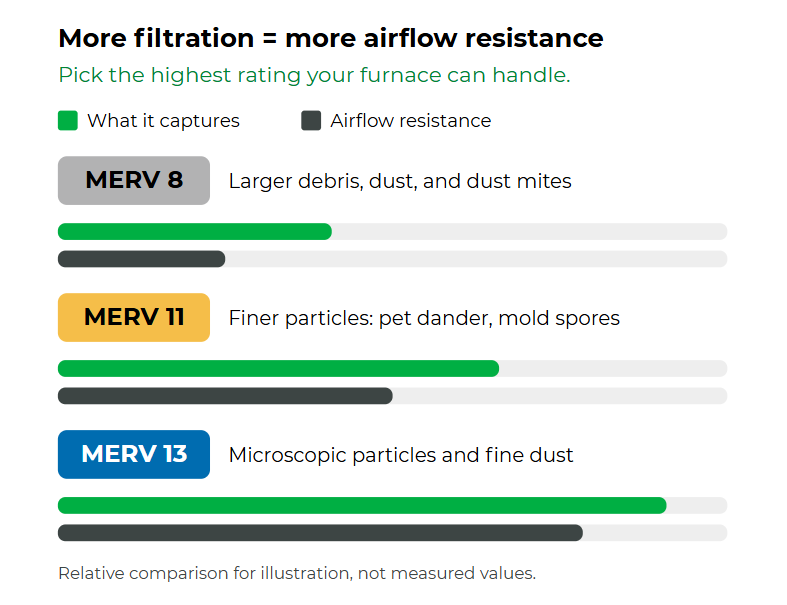
A filter's MERV rating sets the balance between what it captures and how easily air moves through your furnace. A higher MERV rating traps smaller particles, but it also pushes back harder on airflow. The right rating is the highest one your furnace is built to support, not the highest one on the shelf. For most homes that lands between MERV 8 and MERV 13.
MERV 8 — larger debris, dust, and dust mites. Easiest on airflow.
MERV 11 — finer particles like pet dander and mold spores. Fits most standard systems.
MERV 13 — microscopic particles; the highest residential filtration. Confirm your blower can support it.
Timing matters as much as the number: a clogged MERV 13 restricts airflow more than a fresh MERV 8. The U.S. Department of Energy reports that replacing a dirty filter can lower HVAC energy use by 5% to 15%. Not sure what your system can take? The match quiz below will narrow it down.
Answer a few quick questions and we will match you to the right filter for your system.
When buying a new air filter, you might wonder if a higher MERV rating will damage your furnace. You want to trap contaminants like dust and pollen, but you don't want to restrict airflow and cause your HVAC system to break down.
The good news is you can have both clean air and a healthy furnace. A high-quality pleated filter in the MERV 8 to MERV 13 range offers a safe and effective balance, capturing particles without straining your equipment.
This guide will explain how MERV ratings affect your furnace, what the ratings mean, and how to choose the right filter for your home.
Key Takeaways
MERV Ratings Matter: The MERV rating of your filter determines its efficiency at capturing contaminants. Ratings between MERV 8 and MERV 13 provide an ideal balance for residential HVAC systems.
Protect Your Furnace: Choosing a filter with the right MERV rating ensures good airflow, preventing unnecessary strain on your furnace and extending its lifespan.
Improved Indoor Air Quality: High-quality pleated filters from Filterbuy effectively capture dust, pollen, and other particles, helping to maintain a cleaner, healthier home environment.
Balance is Key: It's essential to select a filter that optimizes both air filtration and system performance to avoid compromising either.
What Are MERV Ratings on Furnace Filters?
Before we talk about airflow, we need to answer a fundamental question: what are MERV ratings on furnace filters?
MERV stands for Minimum Efficiency Reporting Value. It is a measurement scale designed by the American Society of Heating, Refrigerating and Air-Conditioning Engineers (ASHRAE) to report the effectiveness of air filters. The scale ranges from 1 to 20.
In simple terms, the rating tells you how good the filter is at catching particles of different sizes.
Low Ratings (1–4): These capture big particles like carpet fibers and dust mites but let most finer particles pass through. They are often cheap fiberglass filters that do little more than protect the fan motor.
Medium/High Ratings (8–13): These capture smaller particles like mold spores, pet dander, pollen, and even some bacteria and smoke. This is the standard for residential use.
Very High Ratings (14–20): These are used in hospitals and clean rooms to trap viruses and microscopic contaminants. They are generally too restrictive for home furnaces.
HVAC professionals and manufacturers rely on these ratings to ensure that a filter is strong enough to clean the air but not so dense that it blocks airflow.
What MERV Rating Is Best for Home Use?
When you are standing in the aisle or browsing online, you might wonder what MERV rating is best for home use. The answer depends on your specific household needs, such as whether you have pets or allergies.
Here is a breakdown of the three most common residential ratings:
MERV 8 – Everyday Home Protection
For the average household, MERV 8 is often the sweet spot. These filters are excellent at trapping:
Dust mites
Pollen
Mold spores
Lint
If you don't have severe allergies or indoor pets, a MERV 8 filter provides excellent airflow and sufficient filtration to keep your home clean.
MERV 11 – Homes With Pets or Allergies
If you share your home with furry friends, what MERV rating is best for home use shifts slightly higher. MERV 11 filters are tighter than MERV 8, meaning they can catch finer particles. They are ideal for targeting:
Pet dander
Auto emissions
Finer dust particles
This is a popular middle-ground option that significantly improves indoor air quality without placing a heavy load on most modern HVAC systems.
MERV 13 – Health-Sensitive Households
For homes that need maximum protection, MERV 13 is the gold standard for residential systems. These filters can capture:
Tobacco smoke
Bacteria
Virus carriers
Microscopic allergens
While MERV 13 offers superior filtration, it is crucial to use a high-quality pleated furnace filter to maintain airflow. This is why Filterbuy focuses exclusively on MERV 8, 11, and 13 pleated filters—they provide the highest level of protection safe for residential use.
What MERV Rating Is Best for Furnace Filters?
Many homeowners assume that "higher is better" and reach for the highest number they can find. However, asking what MERV rating is best for furnace filters is different from asking which filter traps the most dirt.
Residential furnaces and air conditioners are typically designed to handle filters rated between MERV 8 and MERV 13.
Once you go beyond MERV 13 (into the 14–20 range), the filter material becomes incredibly dense. While this is great for a hospital operating room with a massive, industrial-grade ventilation system, it can be disastrous for a home furnace. A typical residential blower motor cannot push air through a MERV 16 filter effectively. This restriction can cause the system to overheat, freeze up, or suffer from component failure.
Always check your manufacturer's guidelines, but you can generally feel confident that MERV 8–13 filters are safe for residential equipment.
How Does MERV Rating Affect Airflow?
This brings us to the mechanics of the system: how does MERV rating affect airflow?
Think of your furnace filter like a face mask. If you hold a piece of loose netting over your mouth, you can breathe easily, but it won't stop much dust. If you hold a piece of thick denim over your mouth, it stops the dust, but you have to struggle to breathe.
In HVAC terms, this struggle is called "pressure drop."
Low MERV filters have low resistance (low pressure drop), so air flows easily.
High MERV filters generally have higher resistance (higher pressure drop), making the furnace work harder to pull air through.
However, modern engineering has solved much of this problem through the use of pleated furnace filters.
Why Pleated Filters Matter
Unlike flat fiberglass filters, pleated furnace filters are folded back and forth like an accordion. This design drastically increases the surface area of the filter material.
More surface area means there are more spaces for air to pass through. This allows a pleated MERV 13 filter to trap tiny particles while still allowing enough air to flow through to keep your furnace happy. This is the key advantage of Filterbuy's design—we maximize surface area to give you better airflow without sacrificing air quality.
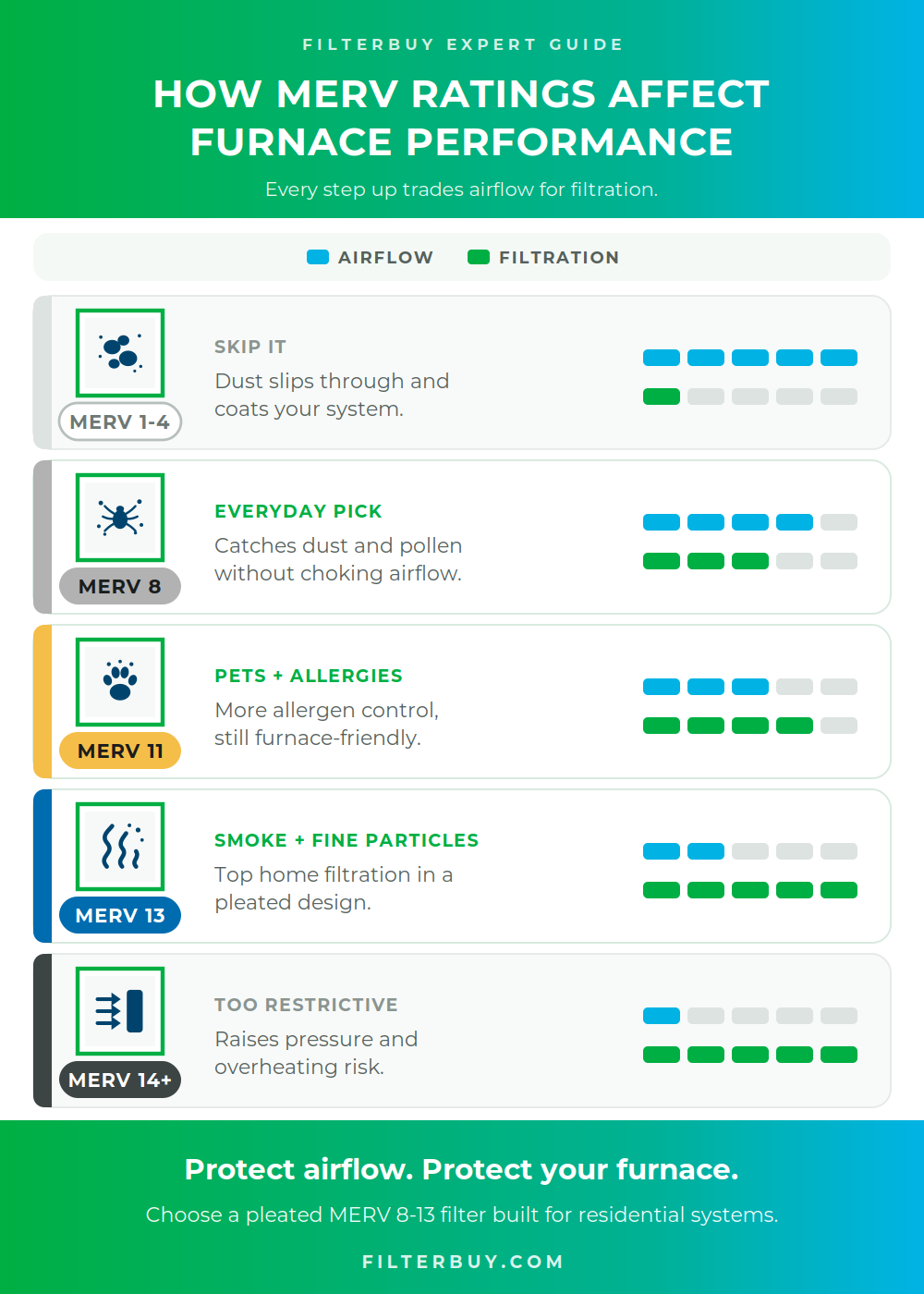
MERV Ratings & Furnace Performance (Quick Comparison)
To help you visualize the balance between filtration and airflow, here is a quick comparison of how different ratings impact your system.
| MERV Rating | Particle Capture | Impact on Airflow | Best For... |
|---|---|---|---|
| MERV 1–4 | Poor (Large dust only) | Very Low | Protecting equipment only (not recommended for healthy air) |
| MERV 8 | Good (Pollen, dust mites) | Low | Standard homes, budget-friendly airflow |
| MERV 11 | Better (Pet dander) | Moderate | Pet owners, mild allergies |
| MERV 13 | Best (Smoke, bacteria) | Moderate/High | High-efficiency filtration, sensitive lungs |
| MERV 14+ | Superior (Viruses) | Very High | Hospitals (unsafe for most home furnaces) |
As you can see, the best MERV rating for airflow while still actually cleaning the air is generally MERV 8, though pleated MERV 11 and 13 options are designed to keep resistance manageable.
Why Filterbuy's MERV 8–13 Pleated Filters Are the Smart Choice
At Filterbuy, we don't sell MERV 16 or HEPA filters for residential furnaces because we know they aren't compatible with most home systems. We have curated our product line to focus strictly on the safe, effective range of MERV 8 to MERV 13.
Our filters are:
Made in the USA: Manufactured locally for quality assurance.
Pleated for Performance: Designed to minimize pressure drop and maximize airflow.
Specifically for Homes: Engineered to protect residential HVAC motors while purifying the air.
Choosing a filter is about balance. You want to breathe clean air without risking a $500 repair bill for a burnt-out blower motor. By sticking to high-quality pleated filters in the recommended range, you get the best of both worlds.
Protect Your Air And Your System
Understanding how MERV ratings affect furnace performance is the first step toward a healthier home. While higher ratings do trap smaller particles, there is a limit to what residential systems can handle.
For most homeowners, the sweet spot lies between MERV 8 and MERV 13. These ratings offer robust protection against allergens, dust, and dander while maintaining the airflow your furnace needs to run efficiently. By choosing a pleated filter from a trusted manufacturer, you ensure that your air stays clean and your system stays safe.
Ready to find the perfect balance for your home? Shop pleated furnace filters from Filterbuy that are designed for better airflow and breathe easier today.
Frequently Asked Questions
What Are MERV Ratings On Furnace Filters?
MERV (Minimum Efficiency Reporting Value) is a rating scale from 1 to 20 that measures how effectively an air filter captures particles. Higher numbers indicate better filtration of smaller particles.
What Merv Rating Is Best For Home Use?
For most homes, MERV 8 to MERV 13 is ideal. MERV 8 is great for basic needs, MERV 11 is excellent for pet owners, and MERV 13 provides top-tier protection against smoke and bacteria.
What Merv Rating Is Best For Furnace Filters?
Residential furnaces are generally designed to handle MERV 8–13. Ratings higher than 13 are typically too restrictive for standard home HVAC motors and can cause system damage.
How Does MERV Rating Affect Airflow?
generally, higher MERV ratings create more resistance to airflow (pressure drop). However, using pleated furnace filters increases surface area, allowing high-efficiency filters (like MERV 11 or 13) to flow air effectively without choking the system.
Can A Merv Rating Be Too High For My Furnace?
Yes. Using a filter rated MERV 14 or higher in a standard residential system can restrict airflow significantly, leading to overheating, frozen coils, or blower motor failure.
Are Pleated Furnace Filters Better For Airflow?
Yes. Pleated filters have a much larger surface area than flat fiberglass filters. This allows them to capture more dirt and dust while maintaining better airflow for a longer period.
Is Merv 13 Safe For Residential HVAC Systems?
Yes, provided it is a standard 1-inch to 5-inch pleated filter and changed regularly. Most modern residential systems handle MERV 13 well, but if your system is very old, you may want to consult a technician.
Do Higher MERV Filters Increase Energy Costs?
They can if the filter is too restrictive or clogged. However, a clean, high-quality pleated MERV 8–13 filter should not significantly increase energy costs compared to the benefits of cleaner coils and air.
How Often Should I Replace A Merv 8–13 Filter?
It is recommended to replace your filter every 3 months. If you have pets, smoke, or a MERV 13 filter capturing fine particles, you may need to check it every month and replace it sooner.
How Do I Know Which MERV Rating My Furnace Can Handle?
Check your furnace manual. Most will state a recommended MERV limit. If you are unsure, MERV 8 is a universally safe starting point for almost all functioning units.
See More
Want to learn more about how MERV ratings can affect furnace performance and airflow? Explore the video, audio guide, and presentation below for additional tips and explanations.