
U.S. Cities With the Most Residents Who Smoke
August 24, 2026

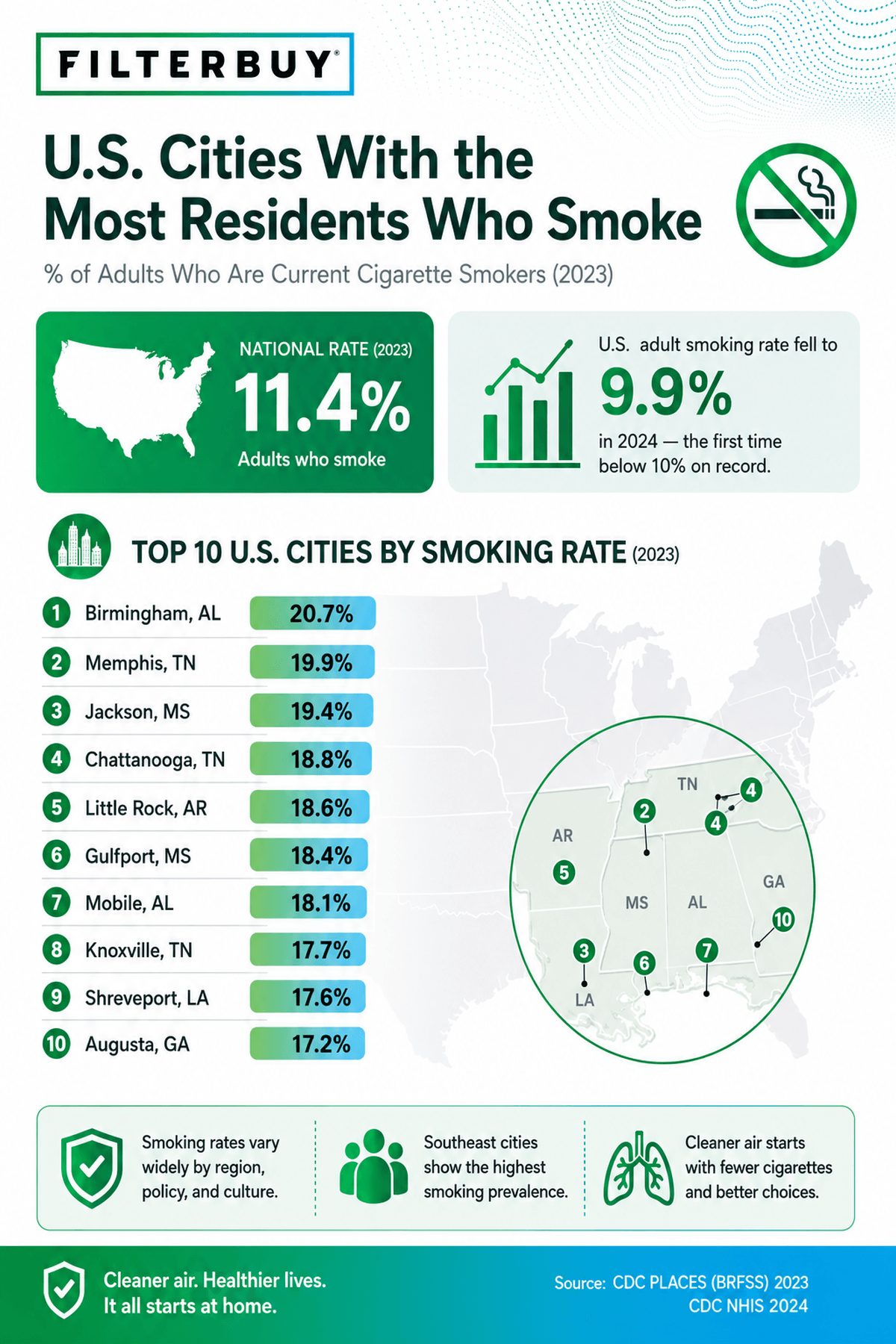
Which U.S. cities have the highest percentage of adults who smoke? Nationally, the news is good: adult cigarette smoking fell to 9.9% in 2024, the first time it has dropped below 10% since the CDC began tracking it. But that national average hides enormous local variation: in some cities, more than 1 in 4 adults still smoke.
Filterbuy researchers analyzed data from the CDC's Behavioral Risk Factor Surveillance System (BRFSS) to rank the U.S. cities where smoking remains most prevalent among adults. Beyond the rankings themselves, this analysis explores the link between high smoking rates and the indoor air quality challenges facing homes in these communities, including elevated exposure to secondhand smoke, particulate matter, and respiratory-aggravating pollutants that get trapped inside HVAC systems.
Key Stat
9.9%, the share of U.S. adults who currently smoke cigarettes, per 2024 National Health Interview Survey data. It's the first time the rate has dropped below 10% since the survey began, down from 10.8% in 2023 and from a peak of 42.4% in 1965 (source: CDC/NHIS, reported March 2026).
TL;DR: Quick Answers
City with the highest smoking rate: Detroit, MI: 28.9% of adults smoke, the highest among large U.S. cities (350,000+ population), followed by Cleveland, OH at 27.8%. That’s roughly 2.5 times the national rate of 11.4% measured at the county level by CDC PLACES, and nearly 3 times the 9.9% national NHIS rate.
States with the most smokers: West Virginia (23.8%), Kentucky (23.6%), and Louisiana (21.9%) lead the nation; California (10.0%) and Utah (7.9%) have the lowest rates. (Source: CDC PLACES, 2023 survey data, released March 25, 2026.)
Region with the most smokers: Southeastern states have the highest concentration overall, but at the city level, Midwestern cities in Ohio, Michigan, and Indiana dominate the rankings.
National trend: Adult smoking dropped to 9.9% in 2024 (NHIS), the lowest rate ever recorded, down from roughly 1 in 4 adults in the mid-1990s and 42.4% in 1965.
How smoking affects your home's air: Cigarette smoke introduces 7,000+ chemicals into indoor air that recirculate through HVAC systems. A MERV 13 air filter captures smoke particles as small as 0.3 microns.

Key Takeaways
Detroit leads the nation: 28.9% adult smoking rate, more than double the CDC PLACES national average (11.4%) and nearly triple the newer NHIS national rate (9.9%). Cleveland (27.8%) and Memphis (24.3%) round out the top three.
National smoking hit a historic low in 2024: 9.9% of U.S. adults currently smoke, the first time the rate has fallen below 10% since federal tracking began, per CDC/NHIS data reported in March 2026.
The Midwest dominates city-level rankings: Ohio, Michigan, and Indiana cities top the list, even though Southeastern states lead at the state level.
State policy correlates with lower rates: California (10.0%) and Utah (7.9%) have less than half the smoking rate of West Virginia (23.8%) and Kentucky (23.6%).
Smoking damages your home's air, not just your health: secondhand smoke carries 7,000+ chemicals through your HVAC system, and thirdhand smoke residue lingers on surfaces for weeks. In apartments, smoke can migrate between units through shared ductwork.
Your best defense is a MERV 13 air filter: it captures smoke particles down to 0.3 microns. Pair it with an activated carbon odor eliminator filter for lingering smoke smells.
National Smoking Trends
U.S. adult smoking reached a milestone in 2024: according to CDC National Health Interview Survey (NHIS) data, the cigarette smoking rate among adults fell to 9.9%, the first time it has dropped below 10% since the survey began, and a decline from 10.8% in 2023. Over the past six decades, the rate has fallen 77% from its 1965 peak of 42.4%.
A separate CDC dataset, the PLACES program (which combines BRFSS survey responses to produce county- and city-level estimates), puts the 2023 crude national prevalence at 11.4%, slightly higher than the NHIS figure because it measures a different sample and geographic unit. Because city- and state-level rankings in this article rely on PLACES/BRFSS data, we use 11.4% as the comparison point for city rankings and cite the NHIS 9.9% figure separately for the national headline trend.
Even as the national rate falls, regional gaps remain wide. The Southeast has the highest concentration of adult smokers at the state level, while the West has the lowest. California (10.0%) and Utah (7.9%) post the lowest state smoking rates; West Virginia (23.8%), Kentucky (23.6%), and Louisiana (21.9%) post the highest.
Several factors help explain these gaps. California restricts smoking across a wide range of indoor and outdoor public spaces. Utah's dominant religious population encourages abstention from tobacco. West Virginia has comparatively permissive smoking laws, and Kentucky remains the country's leading producer of burley tobacco, a key ingredient in cigarette blends. Louisiana has long struggled with tobacco use broadly; as of 2021, 7.0% of Louisiana high schoolers reported current cigarette smoking (versus 3.8% nationally), and a broader measure covering all tobacco products, including e-cigarettes, put youth tobacco use closer to 28–29% in earlier CDC survey years.
States With the Highest Adult Smoking Rates
| Rank | State | Adult Smoking Rate |
|---|---|---|
| 1 | West Virginia |
23.8%
|
| 2 | Kentucky |
23.6%
|
| 3 | Louisiana |
21.9%
|
States With the Lowest Adult Smoking Rates
| Rank | State | Adult Smoking Rate |
|---|---|---|
| 1 | Utah |
7.9%
|
| 2 | California |
10.0%
|
While Southeastern states lead at the state level, it's Midwestern cities, concentrated in Ohio, Michigan, and Indiana, that dominate the rankings once you drop down to the city level.
How Smoking Affects Indoor Air Quality in Your Home
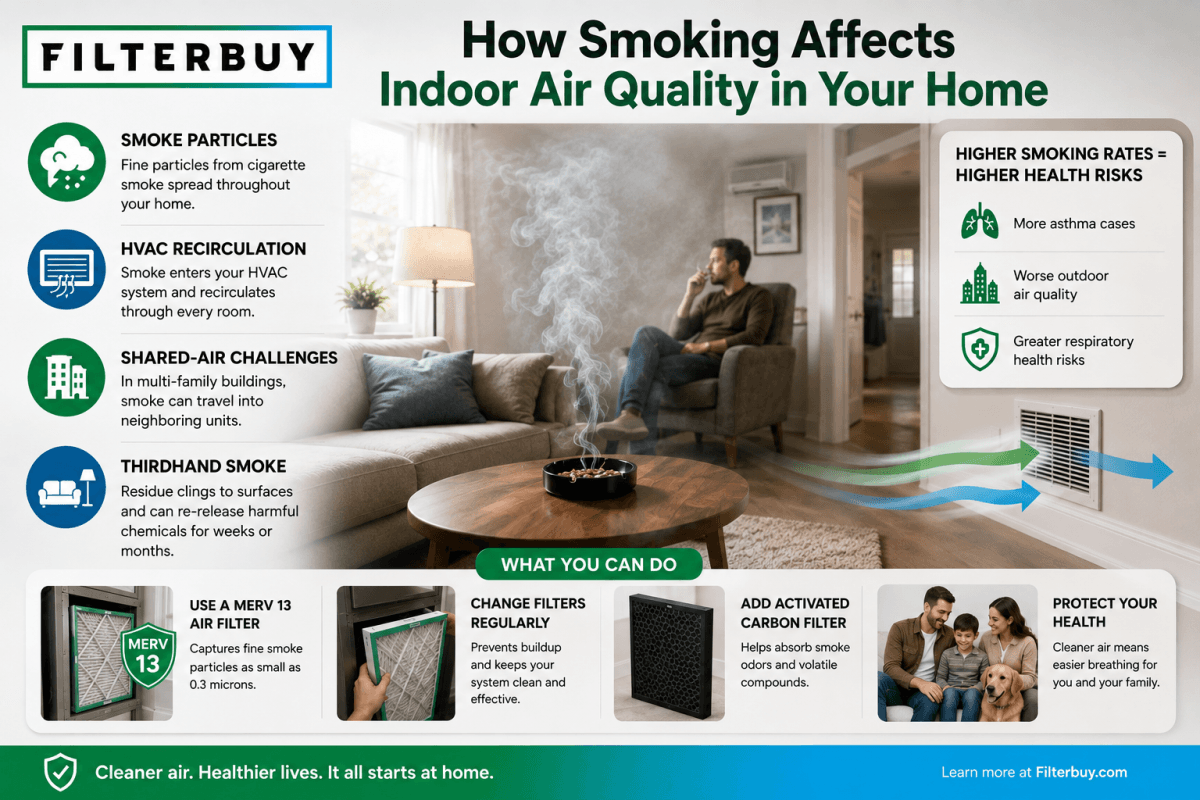
Cigarette smoke doesn't just affect the person lighting up. According to the EPA, secondhand smoke contains more than 7,000 chemicals, hundreds of which are toxic. When someone smokes inside a home, or even near open windows and doors, those fine particles infiltrate the HVAC system and recirculate through every room.
In cities with high smoking rates, the impact extends beyond individual households. Apartment complexes, condominiums, and multi-family homes face shared-air challenges, where smoke from one unit can migrate into neighboring units through HVAC ductwork, wall gaps, and ventilation systems.
The residue left behind by tobacco smoke, often called thirdhand smoke, clings to surfaces, carpets, and HVAC components. Even after a smoker leaves, these contaminants can be re-released into the air for weeks or months.
For homeowners in high-smoking cities, using a higher-rated air filter is one of the most effective steps to reduce indoor smoke exposure. MERV (Minimum Efficiency Reporting Value) 13 air filters are designed to capture fine particles, including smoke particulates as small as 0.3 microns, that lower-rated filters miss entirely. Paired with regular filter changes, a MERV 13 filter helps prevent smoke-related contaminants from accumulating in your system and recirculating through your home. For lingering smoke odors, an activated carbon odor eliminator filter can absorb the volatile compounds that standard particulate filters miss.
Many of the cities with the highest smoking rates also rank among the cities with the most asthma cases, suggesting a compounding effect of tobacco use on respiratory health. Several of the same metro areas also appear among the U.S. cities with the worst air quality, where outdoor pollution and indoor smoking combine to elevate health risks further.
Large Cities With the Most Residents Who Smoke
To identify the cities with the most smokers, Filterbuy researchers analyzed CDC BRFSS data. To qualify as a smoker, a respondent must have smoked at least 100 cigarettes in their lifetime and currently smoke every day or some days. Only cities with at least 350,000 residents were included in the large-city rankings below.
U.S. Cities by Adult Smoking Rate
| Rank | City | Adult Smoking Rate | Population |
|---|---|---|---|
| 15 | Tampa, FL | 19.1% | 407,599 |
| 14 | Las Vegas, NV | 19.3% | 662,368 |
| 13 | Oklahoma City, OK | 19.6% | 662,314 |
| 12 | Jacksonville, FL | 19.7% | 920,570 |
| 11 | New Orleans, LA | 19.8% | 389,476 |
| 10 | Wichita, KS | 20.0% | 391,731 |
| 9 | Tulsa, OK | 20.3% | 403,166 |
| 8 | Kansas City, MO | 21.1% | 497,159 |
| 7 | Columbus, OH | 21.4% | 903,852 |
| 6 | Baltimore, MD | 21.7% | 586,131 |
| 5 | Philadelphia, PA | 21.8% | 1,578,487 |
| 4 | Milwaukee, WI | 23.1% | 589,067 |
| 3 | Memphis, TN | 24.3% | 649,705 |
| 2 | Cleveland, OH | 27.8% | 378,589 |
| 1 | Detroit, MI | 28.9% | 665,369 |

Photo Credit: Sean Pavone / Shutterstock
Detroit, MI (#1)
Adults who smoke: 28.9%
Adults in poor physical health: 20.9%
Adults with COPD: 11.2%
Adults with cancer: 6.0%
Adults who have had a stroke: 6.2%
Adults with coronary heart disease: 8.9%
Detroit's 28.9% smoking rate is more than double the CDC PLACES national average (11.4%) and nearly three times the newer NHIS national rate (9.9%). It also correlates with some of the highest rates of COPD, stroke, and coronary heart disease among all large U.S. cities. That's not a coincidence: the CDC identifies smoking as a direct cause of COPD, stroke, coronary heart disease, and multiple cancers.

Photo Credit: Sean Pavone / Shutterstock
Cleveland, OH
Percentage of adults who smoke: 27.8%
Percentage of adults in poor physical health: 18.7%
Percentage of adults with COPD: 11.1%
Percentage of adults with cancer: 5.9%
Percentage of adults who have experienced a stroke: 5.6%
Percentage of adults with coronary heart disease: 9.0%
Population: 378,589

Photo Credit: Sean Pavone / Shutterstock
Memphis, TN (#3)
Adults who smoke: 24.3%
Adults in poor physical health: 17.4%
Adults with COPD: 9.3%
Adults with cancer: 5.6%
Adults who have had a stroke: 4.8%
Adults with coronary heart disease: 7.3%

Photo Credit: Sean Pavone / Shutterstock
Milwaukee, WI (#4)
Adults who smoke: 23.1%
Adults in poor physical health: 16.0%
Adults with COPD: 6.8%
Adults with cancer: 5.3%
Adults who have had a stroke: 3.7%
Adults with coronary heart disease: 6.0%

Photo Credit: Sean Pavone / Shutterstock
Philadelphia, PA (#5)
Adults who smoke: 21.8%
Adults in poor physical health: 14.8%
Adults with COPD: 7.3%
Adults with cancer: 5.8%
Adults who have had a stroke: 4.1%
Adults with coronary heart disease: 6.2%
Did you know? Air filters remove dust, smoke, mold, and bacteria from circulating through your HVAC system. For the best protection against cigarette smoke particles, consider Filterbuy's MERV 13 air filters.

Photo Credit: Sean Pavone / Shutterstock
Baltimore, MD (#6)
Adults who smoke: 21.7%
Adults in poor physical health: 13.4%
Adults with COPD: 7.4%
Adults with cancer: 5.7%
Adults who have had a stroke: 4.4%
Adults with coronary heart disease: 6.0%

Photo Credit: Sean Pavone / Shutterstock
Columbus, OH (#7)
Adults who smoke: 21.4%
Adults in poor physical health: 11.7%
Adults with COPD: 7.1%
Adults with cancer: 5.1%
Adults who have had a stroke: 3.1%
Adults with coronary heart disease: 5.6%

Photo Credit: Sean Pavone / Shutterstock
Kansas City, MO (#8)
Adults who smoke: 21.1%
Adults in poor physical health: 13.6%
Adults with COPD: 7.2%
Adults with cancer: 6.0%
Adults who have had a stroke: 3.6%
Adults with coronary heart disease: 6.0%

Photo Credit: Sean Pavone / Shutterstock
Tulsa, OK (#9)
Adults who smoke: 20.3%
Adults in poor physical health: 14.6%
Adults with COPD: 7.8%
Adults with cancer: 6.6%
Adults who have had a stroke: 3.7%
Adults with coronary heart disease: 7.5%

Photo Credit: Sean Pavone / Shutterstock
Wichita, KS (#10)
Adults who smoke: 20.0%
Adults in poor physical health: 13.2%
Adults with COPD: 7.1%
Adults with cancer: 6.4%
Adults who have had a stroke: 3.3%
Adults with coronary heart disease: 6.7%

Photo Credit: Sean Pavone / Shutterstock
New Orleans, LA (#11)
Adults who smoke: 19.8%
Adults in poor physical health: 13.7%
Adults with COPD: 7.5%
Adults with cancer: 5.5%
Adults who have had a stroke: 4.3%
Adults with coronary heart disease: 6.5%

Photo Credit: Sean Pavone / Shutterstock
Jacksonville, FL (#12)
Adults who smoke: 19.7%
Adults in poor physical health: 13.9%
Adults with COPD: 8.2%
Adults with cancer: 6.0%
Adults who have had a stroke: 3.6%
Adults with coronary heart disease: 6.8%

Photo Credit: Sean Pavone / Shutterstock
Oklahoma City, OK (#13)
Adults who smoke: 19.6%
Adults in poor physical health: 14.1%
Adults with COPD: 7.5%
Adults with cancer: 6.1%
Adults who have had a stroke: 3.5%
Adults with coronary heart disease: 7.3%

Photo Credit: Sean Pavone / Shutterstock
Las Vegas, NV (#14)
Adults who smoke: 19.3%
Adults in poor physical health: 15.1%
Adults with COPD: 7.7%
Adults with cancer: 6.1%
Adults who have had a stroke: 3.3%
Adults with coronary heart disease: 6.8%

Photo Credit: Bonnie Fink / Shutterstock
Tampa, FL (#15)
Adults who smoke: 19.1%
Adults in poor physical health: 13.9%
Adults with COPD: 7.5%
Adults with cancer: 5.5%
Adults who have had a stroke: 3.5%
Adults with coronary heart disease: 6.3%
Detailed Findings and Methodology
City and state rankings in this analysis are drawn from the CDC's Behavioral Risk Factor Surveillance System (BRFSS), via the CDC PLACES program (2023 survey data, released March 25, 2026). The national trend figure (9.9%) comes from a separate CDC dataset, the National Health Interview Survey (NHIS), 2024.
A city or state resident qualifies as a current smoker if they report having smoked at least 100 cigarettes in their lifetime and currently smoke every day or some days. In the event of a tie, the city with the higher percentage of adults in poor physical health was ranked higher. Only cities with at least 100,000 residents were included in the full dataset; cities were grouped by population into small (100,000–149,999), midsize (150,000–349,999), and large (350,000+) cohorts. This article covers the large-city rankings.
Protect Your Home's Air, No Matter Where You Live
Whether you live in a city with high smoking rates or simply want to ensure your family breathes cleaner air, your HVAC air filter is your first line of defense. Filterbuy manufactures over 600 air filter sizes in the U.S., including MERV 13 filters that capture smoke particles, allergens, mold spores, and bacteria.
Set up auto-delivery and never worry about when to change your filter again. Your home's air deserves better, and Filterbuy makes it easy. Set up an air filter subscription, and we'll deliver the right filter to your door on your schedule, with free shipping and no commitments.
Frequently Asked Questions
What U.S. city has the highest smoking rate?
Among large cities (350,000+ residents), Detroit, Michigan has the highest adult smoking rate at 28.9%, per CDC BRFSS data analyzed by Filterbuy. Among midsize and small cities, several Ohio and Indiana cities exceed 25%.
What is the national adult smoking rate in the U.S.?
9.9% of U.S. adults currently smoke cigarettes, according to 2024 CDC National Health Interview Survey data, the first time the rate has dropped below 10% since the survey began.
Which states have the most smokers?
West Virginia (23.8%), Kentucky (23.6%), and Louisiana (21.9%) have the highest adult smoking rates in the U.S. Utah (7.9%) and California (10.0%) have the lowest.
Does smoking affect indoor air quality?
Yes. Cigarette smoke introduces more than 7,000 chemicals into indoor air, many of which recirculate through HVAC systems. Secondhand and thirdhand smoke can linger in a home for weeks. A MERV 13 air filter helps capture fine smoke particles and protect indoor air.
What kind of air filter is best for removing cigarette smoke?
MERV 13 air filters are the most effective option for residential HVAC systems, capturing fine particulate matter down to 0.3 microns, which includes most smoke particles. For odor, pair it with an activated carbon odor eliminator filter.
How has smoking in the U.S. changed over time?
Adult smoking has fallen 77% since 1965, from a peak of 42.4% to 9.9% in 2024, the first time the rate has dropped below 10%. Anti-smoking campaigns, tax increases, and smoking bans have all contributed to the decline.
Can secondhand smoke enter my home through my HVAC system?
Yes, particularly in multi-family housing. Smoke particles can migrate through shared ductwork, wall gaps, and ventilation systems. A high-MERV-rated air filter is one of the most effective defenses against secondhand smoke infiltration in apartments and condos.
Sources
CDC PLACES, 2023 BRFSS survey data (released March 25, 2026)
CDC National Health Interview Survey, 2024 data (reported March 2026)
EPA, secondhand smoke chemical composition
Truth Initiative / CDC state tobacco fact sheets