
Furnace Filters vs. Air Filters: What's the Difference?
September 19, 2026
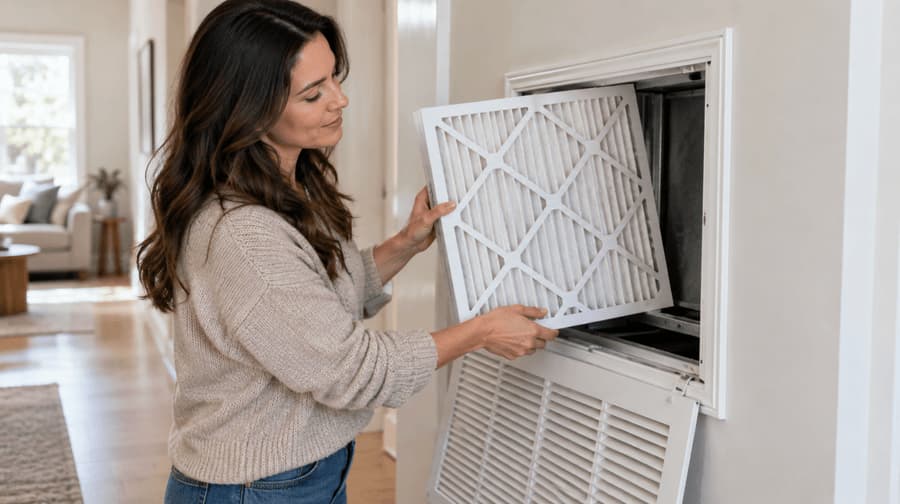
Standing in the filter aisle, squinting at the packaging, wondering whether you need an air filter and a furnace filter? You probably only need one.
These two terms trip up almost everyone, and that confusion leads to wasted money and filters bought for slots that don't exist. This guide breaks down what each term really means, how to find your filter, and how to tell — in about five minutes — whether your home runs on one filter or two.
The short answer
In most homes, yes — they're the same filter. “Air filter” and “furnace filter” usually name one component that cleans your air and protects your HVAC system. What matters isn't the label on the box — it's how your system is built, and that's what tells you whether you need one filter or two.
TL;DR
- In most homes, “furnace filter” and “air filter” mean the same thing.
- Most HVAC systems are designed for one filter, not two.
- Adding a second filter to a single-filter system can restrict airflow and make your system work harder.
- Where the filter sits matters more than what it’s called. Find your slot before you buy.
Why Is It Even Called a “Furnace Filter”?
Here's the part most guides skip. In a central forced-air home, the air returning to be heated or cooled passes through the furnace (or air handler) cabinet on its way back into the system. The filter sits right at that intake — so it gets called a "furnace filter" even though it's working all summer while the furnace is off.
That's why the names are interchangeable: it's one filter, in one airstream, doing one job year-round. "Air filter" describes what it does. "Furnace filter" describes where it lives. Same component.
Air Filter vs. Furnace Filter vs. Air Purifier
One more source of confusion worth clearing up: some people use "air filter" to mean a standalone air purifier — a plug-in machine that cleans one room. That's a different device from the filter in your HVAC system. Here's how the three terms line up.

Where to Find Your Filter
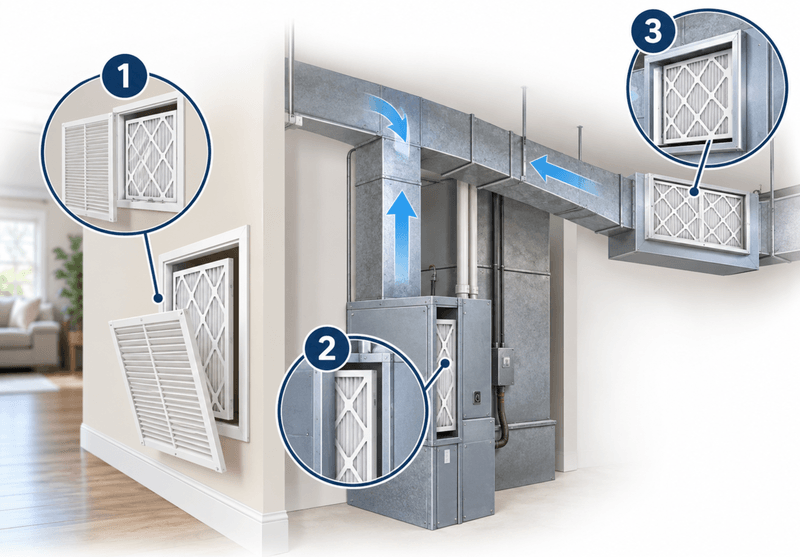
Before you buy anything, locate your filter slot. There are two common spots.
1. The main return air grille
Usually the largest vent in your home — often in a hallway, on a living-room wall, or in the ceiling.
2. The furnace or air handler compartment
Look near the blower motor, behind a removable panel.
Find only one slot? You need only one filter. It really is that simple for most homes.
One Filter or Two?
Single-filter setup (most common). One filter total, living at either the return air vent or inside the furnace. It handles both heating and cooling and is easy to replace. This is the standard residential setup.
Dual-filter setup (less common). Two filters in different spots: one at the return grille to catch larger debris, one inside the furnace for added protection. You'll mostly see this in larger homes, older systems, or homes with multiple return vents.
A second filter can help if you have heavy pet hair or dust, a large home with long duct runs, or you want to capture finer particles in part of the system. The trade-off is airflow: stacking two dense, high-MERV filters can choke your system and raise energy use. If you run two, match each one to its location and rating rather than maxing out both.
A single filter suits most systems. A dual setup helps in homes with pets, heavy dust, or a large conditioned area.
Before you add a second filter
Found an empty second slot? Don't automatically fill it. Many systems are designed to run on one filter to keep airflow correct. Adding a filter where one isn't intended can restrict airflow and reduce efficiency. If you find two slots but only one filter, check with an HVAC professional first — the original setup was probably on purpose.
Do Your AC and Heater Use the Same Filter?
In most homes, yes. Your heating and cooling systems share the same ductwork and air handler, so one filter serves both. Heat-pump homes are the same story: one compressor, one air handler, one filter. Replace it on schedule and you're keeping both heating and cooling running efficiently all year.
How to Choose the Right Filter
Text:
Once you know how many filters your system takes, the rest comes down to size and MERV rating. Ask yourself:
What type of HVAC system do I have?
Where are the filter slots?
How large is my home?
Do I have pets, dust, or smoke to manage?
What MERV rating does my system support?
As a general rule, most residential systems run well on MERV 8–11. A higher-efficiency filter (MERV 11–13) captures finer particles like fine dust, pollen, and smoke — as long as your blower can handle the added airflow resistance. If you're not sure which rating fits, our MERV rating guide walks through it step by step.
Check if You Have One Filter or Two (5-Minute Guide)
The 5-minute filter check
- Find your main return air vent.
- Check behind the grille for a filter.
- Inspect your furnace or air handler compartment.
- Take a photo and measure the filter dimensions.
- Note whether you have one slot or two.
Two slots, one filter installed? Talk to an HVAC pro before adding a second. The original setup was likely intentional.
Make Filter Maintenance the Easy Part
Once you know what your system needs, the hard part is over. Keeping your air clean comes down to having the right filter on hand the right size, at the right time.
Filterbuy Makes It Simple
- Custom sizes for a wide range of HVAC systems
- Subscriptions so you never forget a replacement
- Support to help you choose the right filter the first time
Key Takeaways
In a central HVAC system, the furnace filter and the air filter are the same physical part. The names describe where it sits and what it does.
Most homes use one filter, and an empty second slot is usually deliberate. Get a professional's sign-off before filling one the installer left empty.
Every filter restricts airflow, and two in series add up. The fix is more surface area rather than a looser filter.
What Is a Furnace Filter?
A furnace filter is the removable panel on the return side of a furnace or air handler, and it traps dust, pollen, pet dander and lint before that air reaches the blower and heat exchanger. Filters are rated on the MERV scale, set by ASHRAE Standard 52.2, and most homes run between MERV 8 and MERV 13, replaced every one to three months.
The sizes are where it gets slippery. Filters are sold by nominal size, so you order a 16x25x1 or a 20x25x1, but nobody cuts the filter to that number. At Filterbuy, the U.S. filter manufacturer publishing this guide, we cut about half an inch under nominal, which makes a Filterbuy 20x25x1 measure 19½" × 24½" × ¾". That clearance is deliberate, because it lets the filter seat in the slot and still seal against it.
Our clearance is ours, though, and other manufacturers cut differently. That is why we publish their dimensions alongside our own, including the rows where we come off worst. You cannot check a fit nobody told you about.
Furnace Filter vs. Air Filter: What's the Difference?
In a central forced-air home there is no difference, because both terms name the same component. The distinction only shows up when someone says "air filter" and means a standalone purifier, which is a separate machine altogether.
The reason the terms overlap is simple. Return air travels back through the air handler whether it is being heated or cooled, and the filter sits right at that intake, so it picked up the name "furnace filter" even though it works straight through cooling season.
Is a Return Air Filter the Same as a Furnace Filter?
Yes, and again it is one part with two names. A return air filter is the same filter described by its location, behind the return air grille that pulls household air back into the system.
Depending on the install you will find it there, in a slot at the air handler, or in a media cabinet. Run your hand along the seam where the return duct meets the cabinet, since you usually feel the cover's edge before you see it. Filterbuy's guide to HVAC air filter location walks it seam by seam.
Do You Need One Filter or Two?
Most homes need one, though larger homes sometimes hold a filter behind each return grille, so count first.
Find out in five minutes. Open your largest return air grille and look behind it, then open the access panel on the air handler and check near the blower. Note the size on each frame and whether every slot is filled, then match what you found:
Why an empty slot is usually deliberate. Filters in series add their resistance together. Take the figures further down this page: two MERV 8 filters come to roughly 0.38 i.w.c. between them, before the ducts, coil and grilles take their share. On a system already averaging 0.82 i.w.c. against a 0.5 rating, that gap is the difference between tight and unworkable. If yours genuinely takes two, run the lower MERV of the pair and go deeper rather than denser.
One pattern Filterbuy sees constantly is two filters bought for a house with one slot, or the wrong size for a slot nobody measured. A filter cut too small lets air slip around its edges instead of passing through the media, which defeats filtration at any MERV rating.
Air Purifier vs. Furnace Filter: Which One Do You Need?
These two do different jobs, so the choice is rarely either/or. A furnace filter cleans the air in every room the ductwork reaches, and protects the equipment while it does it. An air purifier is a plug-in appliance with its own fan that cleans one room and protects no equipment.
MERV ratings follow ASHRAE Standard 52.2. HEPA is a fixed threshold of 99.97% capture at 0.3 microns and is not part of the MERV scale.
For most homes with an allergy concern the answer is both. A MERV 13 on a continuous fan handles the house, and a purifier handles the bedroom where you spend eight hours a night. Filterbuy makes the HVAC filter and replacement filters for portable purifiers alike.
Do Furnace Filters Restrict Airflow?
Yes, every one of them does, because media dense enough to catch particles is dense enough to resist air. The real question is whether your system has room for that resistance, and field measurements suggest most homes have less than their owners assume.
Design protocols from the Air Conditioning Contractors of America (ACCA) assume a filter adds 0.10 inches of water column (i.w.c.). Real filters routinely run past that. Stephens, Novoselac and Siegel measured the following in HVAC&R Research:
Source: Stephens, Novoselac & Siegel, HVAC&R Research, Vol. 16 No. 3, 2010. ACCA design protocols assume 0.10 i.w.c. across the filter.
Two more figures put that in context. John Proctor, in ASHRAE Journal, found filter pressure drop across 34 California systems averaged 0.28 i.w.c., nearly triple the design assumption. And while a typical air handler is rated for 0.5 i.w.c., the National Comfort Institute puts the average system nearer 0.82, so plenty of homes are over their limit before anyone touches the filter.
"In a modern home, almost never. What actually hurts systems is the filter nobody remembered to change. I'd rather you run MERV 11 on a real schedule than MERV 13 for eight months." Michelle Wan, Brand Manager and Air Quality Writer, Filterbuy
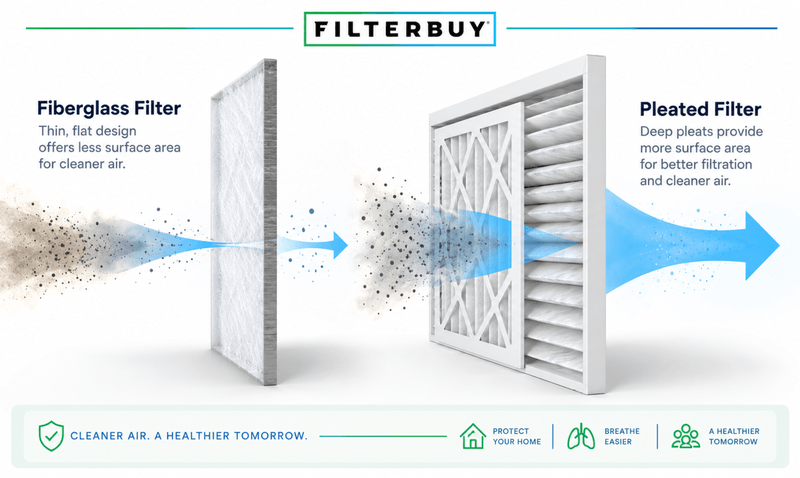
So the answer is not a looser filter. Cheap fiberglass panels barely filter anything, and what slips past them lands on the coil, where the buildup creates a restriction of its own. Buy headroom instead:
Make the filter bigger. Allison Bailes, PhD, of Energy Vanguard, says the fix is to "make the filter large enough to have a low face velocity". A MERV 13 in a 20x20 grille at 400 cfm measured 0.0274 i.w.c., an order of magnitude below the figures above.
Go deeper if your slot allows it. A 4-inch filter holds far more media than a 1-inch at the same MERV rating, so it runs at lower pressure drop and lasts longer.
Change it before it loads up. Pressure drop climbs as a filter fills, and a clogged filter restricts airflow far more than a high MERV rating does. The fastest check we know is to hold it up to a light: no light through the pleats means swap it, whatever the calendar says.
This is why Filterbuy makes residential filters in MERV 8, 11 and 13 and stops there. Higher ratings need more filter area than a standard home slot provides.
For resistance figures by rating, see our MERV air filter pressure drop chart and how MERV ratings affect furnace performance.
Is the Air Filter and AC Filter the Same in a Car?
No, and neither relates to your home system. Cars carry two filters that do separate jobs. The engine air filter cleans air entering the engine, catching particles roughly 5 to 100 microns across. The cabin air filter, what people mean by "car AC filter," cleans air coming out of the vents and catches particles down to roughly 0.1 to 0.3 microns.
Only the cabin filter affects what you breathe, and most sit behind the glove box. Filterbuy makes auto cabin air filters by vehicle.
Supporting Statistics
Three federal datasets back the guidance above.
Sources: eia.gov, epa.gov, energystar.gov. Verified September 2026.
Frequently Asked Questions:
Are Furnace Filters and Air Filters the Same Thing?
Furnace filters and air filters are often the same in function, but not always in purpose. In central HVAC systems, the term “furnace filter” typically refers to the air filter used to protect the furnace from dust and debris. Meanwhile, “air filter” can refer to filters used in AC units, purifiers, or return vents. While the filter type may be interchangeable, always choose a filter based on your specific system’s design and MERV rating needs.
Do I Need Both a Furnace Filter and a Return Air Filter?
Most homes only need one air filter, usually located at the main return air vent. However, some HVAC systems—especially older or larger ones—may use two filters: one at the return and one inside the furnace. If your system supports both, ensure each filter is clean and properly rated to avoid restricting airflow.
Does a Furnace Have a Built-in Air Filter?
Yes, most furnaces have an internal air filter located near the blower motor or return duct. Its job is to capture dust, allergens, and debris before they reach your heating system. Keeping this filter clean helps extend the life of your furnace and improve air quality.
Do Furnace Filters Clean the Air in Your Home?
Yes, furnace filters help clean indoor air by trapping pollutants like dust, pollen, and pet dander. However, their air purification ability depends on the MERV rating. For allergy relief or cleaner air, consider upgrading to a high-efficiency filter (MERV 11–13) or adding a standalone air purifier.
How Often Should You Replace a Furnace Filter?
Replace your furnace filter every 1 to 3 months, depending on its thickness, MERV rating, and your home’s conditions. If you have pets, allergies, or high dust levels, check it monthly. A clogged filter reduces airflow and makes your system work harder, raising energy bills.
Do the AC and Heater Use the Same Air Filter?
Yes, in most modern HVAC systems, the AC and furnace share the same air filter. It’s usually located at the return air vent or inside the air handler. Replacing this filter regularly ensures year-round efficiency in both heating and cooling modes.
What Happens if You Install a Furnace Filter Backwards?
Installing a furnace filter backwards restricts airflow, making your system less efficient and potentially damaging the blower motor. Always check the arrow on the filter’s frame—it should point in the direction of airflow toward the furnace or blower.
Do All HVAC Systems Have Two Filters?
Not all systems have two filters. Most homes have just one air filter in the return duct. However, multi-zone systems or larger homes might use two or more filters. Check your system’s manual or ask an HVAC technician to confirm your setup.
How Many Air Filters Does a Typical House Have?
Most homes have one air filter, but the number can vary. Larger homes, homes with multiple HVAC zones, or those using ductless mini-splits or air purifiers may have several filters. Always inspect each system individually to find and maintain all filters.
Where Is My Furnace Air Filter Located?
Your furnace filter is usually found in one of two places:
Inside the blower compartment behind a panel or
At the return air grille, especially in systems with shared filtering
Look for a removable cover near where the air enters the furnace. Consult your manual or a technician from Filterbuy HVAC Solutions if you’re unsure.
Does Central AC Use a Furnace Filter?
Yes, central AC systems typically use the same filter as the furnace. The filter removes particles from the air before it's cooled and distributed through your home. Regular filter changes help your AC run efficiently and keep your indoor air clean.
Is It Safe to Run a Furnace Without a Filter?
No, running a furnace without a filter is not safe. Without a filter, dust and debris can enter the furnace, clog internal parts, and cause overheating or system failure. It also degrades air quality. Always install a filter—and keep it clean.
Glossary
MERV: Minimum Efficiency Reporting Value. The 1–16 scale for how well a filter captures particles across defined size bands. Most homes use 8 to 13.
Filter bypass: Air slipping around a filter's edges rather than through the media, which defeats filtration at any MERV rating.
ASHRAE Standard 52.2: The test method that defines MERV ratings, from the American Society of Heating, Refrigerating and Air-Conditioning Engineers.
Static pressure: The resistance air meets moving through ducts, filters, coils and grilles. Most air handlers are rated for 0.5 i.w.c.
Nominal size vs. actual size: Nominal is printed on the box and used to order. Actual is the cut, so a Filterbuy 20x25x1 measures 19½" × 24½" × ¾".