Shop by

Each filter level is purpose-built to cater to specific needs, ensuring that whether your goal is to enhance residential comfort or achieve high commercial air quality standards, Filterbuy provides the perfect solution.
It’s important to note that anything in the size range between .001 microns and 10 microns can reach deep into the lungs by being inhaled. Any particulates under around 100 microns can be inhaled into the nose.
The MERV, MPR, and FPR rating systems each consist of a range of numbers that represent the filtration effectiveness based on the micron size that it can filter out. Below, we’ll break down where the rating systems come from and how to use them when shopping for your next filter.
Choosing the right air filter involves understanding how MERV, MPR, and FPR ratings compare. Each rating system serves a specific purpose and is tailored to different consumer needs.
Origin: Developed by ASHRAE, this is the standard measurement in the air filtration industry, used widely in both residential and commercial settings.
Scale: 1-16, with higher ratings indicating better filtration capabilities for a broader range of particles, from dust to bacteria.
Origin: Developed by The Home Depot for the brands sold in its stores, including popular ones like Honeywell.
Scale: 4-10, aligning closely with the MERV scale but tailored for Home Depot’s retail environment.
Origin: Created by 3M, this rating emphasizes a filter's ability to capture fine particles that are harmful to health, such as smoke, smog, and microscopic allergens.
Scale: 300-2800, specifically measuring filtration efficiency for particles smaller than 1 micron.
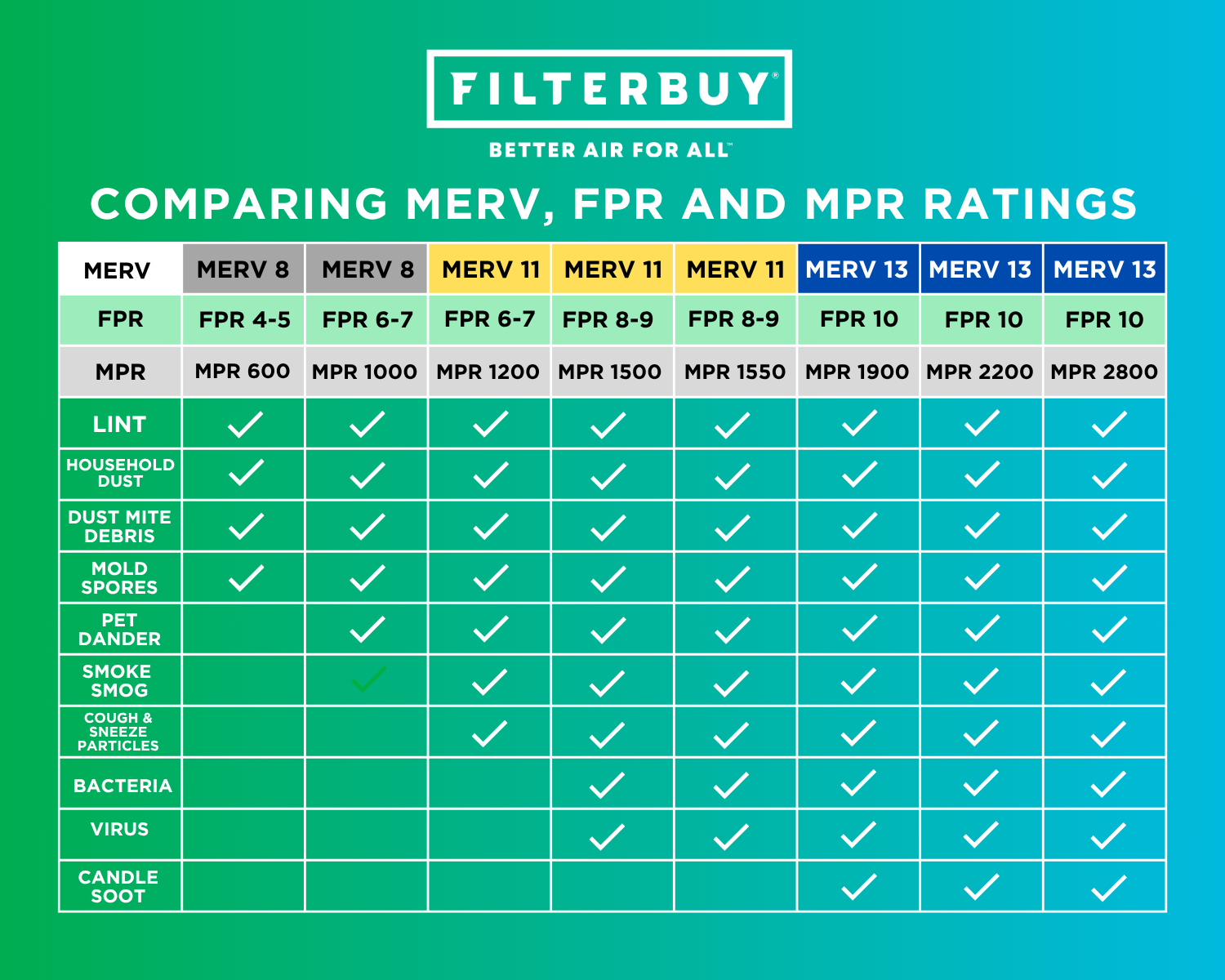
MERV (Minimum Efficiency Reporting Value) isn't merely technical jargon; it's your guide to selecting the perfect air filters, fitting for everything from cozy apartments to busy office spaces. Understanding MERV ratings is vital for maintaining indoor air that's both fresh and healthy.
Filterbuy boasts a range of air filters — MERV 8, MERV 11, and MERV 13 — each crafted to boost air quality wherever you are. Here’s how they break down:
Ideal for everyday residential use, MERV 8 filters are superb at capturing common air pollutants such as dust mites, pollen, and pet dander. They are an excellent choice for those upgrading from basic filters, designed to refresh your home's air efficiently without overburdening your HVAC system.

Looking for a bit more filtration strength? MERV 11 filters are the best air filters for pet owners, smokers, or people with mild allergies. These filters excel at catching finer particles that might pass through a MERV 8, enhancing air purity and significantly improving the freshness of your indoor air.

Dealing with more demanding air quality needs? Whether it’s for a hospital, an office building, or just a super clean home environment, MERV 13 is up to the challenge. These filters are pros at removing over 90% of airborne particles—fine dust, bacteria, smoke, you name it. Need top-of-the-line filtration to ensure a healthy and comfortable space? Consider MERV 13 your go-to solution.

Each rating system addresses specific filtration needs:
The decision on which rating system to follow largely depends on individual needs and where the filters are being purchased. MERV offers widespread recognition and versatility across various settings, MPR provides detailed filtering of microparticles, and FPR simplifies the buying process for Home Depot customers. Understanding your specific air quality requirements and filter availability will guide you to the best choice for your environment.
Deciding between FPR and MERV-rated air filters? Here’s a good way to compare FPR vs. MERV air filter ratings and capabilities.
If you’re looking at air filters rated for MPR compared to air filters rated by the MERV filter rating system, you can reference this chart below:
MPR stands for Microparticle Performance Rating. It indicates a filter's effectiveness at capturing tiny particles, between 0.3 and 1 micron in size.
FPR stands for Filter Performance Rating. It is a rating system developed by The Home Depot to help customers choose filters, rated from FPR 4 to FPR 10.
MERV stands for Minimum Efficiency Reporting Value. It's a standard measurement indicating how effectively an air filter captures airborne particles.
MERV is a widely-used industry standard for general filtration. MPR, created by 3M, specifically rates how well a filter captures small particles. FPR, used by The Home Depot, simplifies choosing air filters based on their efficiency.
A 300 MPR rating corresponds to about MERV 5, effective at capturing basic particles like dust and lint.
A 1500 MPR filter matches approximately a MERV 11 rating, capturing finer particles such as pollen and pet dander.
MERV 11 is comparable to an FPR 7. Additionally, MERV 12 equates roughly to MPR 1900 and an FPR between 8 and 9.
Generally, yes. Higher MPR or MERV ratings capture more airborne particles and allergens. However, they might restrict airflow, causing your HVAC system to work harder.
Yes. MERV 7 falls within the recommended residential range (MERV 7–13), providing a good balance between air quality and HVAC system efficiency.
FPR 12 represents the highest filtration level and is highly effective for home use, significantly improving indoor air quality.
An MPR 600 filter captures more fine particles than an MPR 300 filter, offering improved air filtration.
Good residential MPR ratings start at 300 (Basic) and can go up to 2800 (Premium). Higher numbers indicate better filtration performance.
The MPR rating often demands stricter performance than MERV alone, particularly for capturing finer microparticles, making it generally more effective at filtering tiny particles.
FPR ratings simplify consumer choices with ratings from 4 to 10 and are specific to The Home Depot. MPR ratings, developed by 3M, focus specifically on microparticle filtration efficiency.
Yes, an FPR 7 filter typically matches a MERV 11 rating, effectively filtering common airborne allergens.
Yes, an MPR 600 filter effectively captures common particles like dust, pollen, and pet dander, enhancing indoor air quality.
Yes, FPR 7 provides effective filtration suitable for most residential settings, offering a good balance between air quality and airflow.
No, MERV 11 is suitable for homes and is recommended for households with allergy sufferers or pets, effectively improving indoor air quality without significantly affecting airflow.
You can find your HVAC system’s maximum recommended MERV rating in the owner’s manual, on a label inside the furnace or air handler cabinet, or on the manufacturer’s website. Most residential systems are designed to operate with filters rated MERV 7–13. If the information is unavailable, a licensed HVAC technician can confirm the highest rating your system can safely handle.
Yes. Installing a filter rated higher than your system is designed for can restrict airflow. Poor airflow forces the HVAC system to work harder, which may increase energy consumption, reduce heating and cooling performance, and contribute to overheating or premature component wear. Always use the highest filter rating approved for your specific system.
Replacement frequency varies by filter efficiency and home conditions:
Homes with pets, allergies, smokers, or high dust levels may need more frequent changes. Checking your filter monthly helps prevent airflow restriction and performance issues.
No. MERV, MPR, and FPR are different rating systems developed by different organizations and use different testing methods. Conversion charts show approximate equivalencies, but the numbers are not exact matches. Use equivalency tables as general guidance when comparing filters.
MERV (Minimum Efficiency Reporting Value) is the most widely accepted industry standard, used by HVAC manufacturers and professionals. MPR (Microparticle Performance Rating) and FPR (Filter Performance Rating) are proprietary systems created by 3M and The Home Depot to simplify consumer comparisons.
Not usually. Higher-rated filters capture more particles, which means they tend to fill up and clog faster than lower-rated filters. As a result, they often require more frequent replacement to maintain proper airflow and filtration performance.
Keeping the air in your space clean is crucial for your health, but picking the right air filter can be a puzzle. Let’s break down the ABCs of air filters: MERV (Minimum Efficiency Reporting Value), MPR (Microparticle Performance Rating), and FPR (Filter Performance Rating). These benchmarks are your navigational tools for identifying filters that effectively capture everything from household dust to pollen and smoke.

