Mini Split AC in Nashville, TN
Installation, Costs & Filter Guide (TN Climate)
By Michelle Wan · Technically reviewed by David Clark, Licensed HVAC Technician · Published August 12, 2026 · Updated August 2026
What a Mini Split Costs in Nashville, TN
A single-zone mini split runs $1,400 to $2,900 installed in Nashville. Two to three zones run $4,000 to $11,000. Equipment is the fixed half of that number. Labor is the half that moves with your wiring, your walls, and your permit.
- One room, 12,000 BTU: $1,399 to $1,899 installed
- One room, 18,000 BTU: $1,599 to $2,199 installed
- One large room, 24,000 BTU: $2,149 to $2,849 installed
- Two to three rooms, multi-zone: $4,000 to $11,000 installed
Filterbuy systems are rated 17 SEER2, the level TVA EnergyRight's $800 rebate requires, and ship free in two days. Not sure which size fits your room? The quick match below narrows it down.

Answer 3 quick questions and we'll match you to your mini split.
TL;DR
A ductless mini split heats and cools a room without ductwork. In Nashville, a single zone runs $1,400 to $2,900 installed; two to three zones run $4,000 to $11,000 in 2026. The federal 25C credit is gone; TVA EnergyRight’s $800 rebate is what is left. The real problem here is humidity, not pollen.
Where this page comes from. Filterbuy has made air filters in U.S. plants since 2013, including replacements for every major ductless brand, across more than two million households. Filterbuy now builds a 17 SEER2 ductless line too. What we lack in Nashville is a truck. Filterbuy HVAC Solutions, the service arm, installs in Florida and Texas only. So this page covers how to buy and who to hire, not how to book us.
Key Takeaways
Single-zone runs $1,400 to $2,900 installed; three zones run $6,500 to $11,000.
TVA EnergyRight pays $800 for a ductless mini split rated 17 SEER2 or higher, installed by a Quality Contractor Network member.
Nashville ranks #61 of 100 for pollen allergy burden and earns an F for ozone but an A for particle pollution. The air problem here is indoors, not outdoors.
Heads use washable mesh pre-filters, not disposable panel filters. Clean them every two weeks, March through September. Filterbuy pleated filters go in your ducted system, not the head.
How Much Does a Mini Split Cost in Nashville, TN?
A single zone in Nashville costs $1,400 to $2,900 all-in. Two zones run $4,000 to $9,000, three zones $6,500 to $11,000. Equipment is the fixed half; labor the variable half. Nashville labor sits near the national mean, unlike the Northeast and Pacific Coast. For national figures, see our cost breakdown.
Table 1 · Nashville Installed Cost By System Size
Filterbuy set equipment prices, free 2-day delivery. Labor ranges are national figures for comparable work.
Three line items push a Nashville quote up. Pre-1990 stock in East Nashville, Sylvan Park, and Inglewood often needs a dedicated 240V circuit: $300 to $800. Filterbuy’s 18,000 BTU 115V unit skips that. Core drilling adds $150 to $400; Metro permits $100 to $500.
Ask for a line-item quote separating equipment, labor, line set, electrical, and permits. A bare total cannot be evaluated.
What Mini Split Rebates and Tax Credits Still Exist in Nashville in 2026?
The federal tax credit is gone. TVA EnergyRight’s $800 ductless mini split rebate is the only broad incentive left in Nashville for 2026, and whether you qualify depends on how your home heats today. The rebate requires 17 SEER2 or higher, a Quality Contractor Network installer, and an existing electric heat source. Gas-heated homes are the common disqualifier.
Section 25C expired for property placed in service after December 31, 2025, with no grandfathering. Plenty of local pages still say otherwise.
TVA EnergyRight, delivered locally through Nashville Electric Service, pays $800 for a ductless mini split rated 17 SEER2 or higher. Three conditions apply, and the second is where most Nashville projects fail:
A Quality Contractor Network member must do the work and file the rebate.
The system must replace an existing electric heat source: an old heat pump, electric furnace, or resistance heat. Confirm with Nashville Electric Service before you sign, because TVA’s mini split page does not spell this out.
Equipment must meet TVA standards on the install date. Filterbuy’s systems are 17 SEER2, clearing it.
Eligibility turns on what you heat with now. Census figures put Tennessee at roughly two-thirds electric heat statewide, while gas service is widespread inside Nashville. Check your own bill.
Budget the full installed cost, and treat the $800 as a bonus you confirm before signing.
How Do You Size a Mini Split for Nashville’s Mixed-Humid Climate?
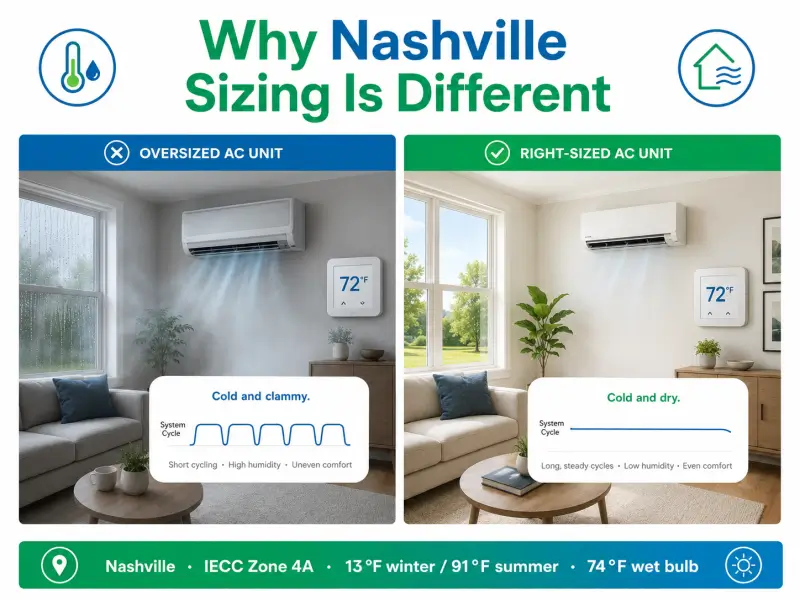
Nashville sits in IECC Climate Zone 4A, mixed-humid, with ASHRAE design conditions near 13°F in winter and 91°F in summer at a 74°F wet bulb. The wet bulb is the number that matters: a Nashville mini split spends the summer removing water, not just heat.
Middle Tennessee draws moisture off the Gulf, producing high latent loads June through September. An oversized unit hits setpoint fast, shuts off, and never runs long enough to pull water out. The room reads 72°F and still feels clammy.
Two rules follow:
Insist on a Manual J load calculation. Square-footage rules of thumb systematically oversize in humid climates. For the heating side, DOE points Zone 4 projects to cold-climate sizing methods rather than Manual S alone.
Take the smaller unit between sizes. An inverter unit running long, low cycles dehumidifies far better than a larger one short-cycling.
One thing mini split marketing rarely mentions: ductless generally dehumidifies worse than ducted, and the most efficient units remove the least moisture. In a humid climate, ask for the SHR and have dry mode configured.
Zone 4A also carries a real heating load, so check HSPF2, not just SEER2. Still deciding? Start with what a ductless mini split is or our guide to choosing a mini split.
How Do You Hire a Licensed Mini Split Installer in Nashville?
Most Nashville mini split projects fall below Tennessee’s $25,000 state licensing threshold, so the state contractor license you assume is required may not legally apply to your job. Four credentials still matter: a CMC-C mechanical license, a Limited Licensed Electrician for the 240V work, EPA Section 608 for refrigerant, and Metro Codes registration to pull the permit.
Under Tenn. Code Ann. § 62-6-102, that license is required at $25,000 or more, materials and labor included. Verify one with the Tennessee Board for Licensing Contractors. A one- to three-zone mini split sits well under that, which is a reason to know what to check, not a reason to hire unlicensed:
Table 2 · What To Verify Before You Hire
The Metro Codes row catches people out. Metro Nashville lets only registered licensed contractors pull permits through its ePermits system, so a state license alone is not enough. Ask: “Are you registered with Metro Codes, and are you pulling the permit?” Filterbuy is not bidding this job. Treat that as a checklist, not a sales filter.
For the $800 rebate, the installer must also be in TVA’s Quality Contractor Network, searchable by ZIP through TVA’s contractor finder.
What Filters Does a Nashville Mini Split Actually Need?
Mini split heads use washable mesh pre-filters, not disposable panel filters. You clean them rather than replace them, and in Nashville the cadence is every two weeks, March through September. No pleated Filterbuy filter fits a ductless head. The pleated filters belong to whatever ducted system still runs in the house, and in this climate that is where MERV 11 or 13 earns its keep.
The pre-filter slides out, rinses under a tap, and goes back once fully dry, every two to four weeks in season. Our filter cleaning guide covers it by brand. Never reinstall a damp filter.
Nashville’s calendar argues for the tight end of that range:
Table 3 · Nashville Pre-Filter Cleaning Calendar
Clean the washable mesh pre-filter; replace any secondary media every 3–6 months per the manufacturer.
Here is the counterintuitive part: Nashville’s outdoor air is not the problem. The city ranks mid-pack for pollen and near-best for particles (see Supporting Statistics), yet its households buy more allergy medicine than average.
Our read on that gap, and we will show our work. Nashville is better than average on pollen and among the cleanest metros for daily particles. Yet a federal lab reports that ductless heads collect moisture, grow fungus, and dehumidify worse than ducted units, in a 74°F wet-bulb summer. So the likeliest driver of Nashville’s allergy load is indoor: humidity, dust mites, mold. An under-maintained mini split is not just failing to help. Here it becomes part of the problem.
That is an inference from published research, not a study we ran. The inference still reverses the usual local claim that a mini split cleans the air in your house.
The EPA is blunt about why: head filters stop lint and pet hair, not fine particles, and treat one room only while running.
That ducted filter is also the one most often left in too long. Filterbuy builds MERV 11 and MERV 13 in 600+ standard sizes plus custom, factory-direct, on auto-delivery.

What Actually Goes Wrong With a Mini Split Here?
Six failure modes show up in humid climates, and five of the six are decided before the installer leaves your driveway. All six come from the DOE Building America Solution Center, run by Pacific Northwest National Laboratory. None appears on a typical Nashville mini split page. Read them as questions to ask a contractor, not problems to fear.
Turning off unused heads can cost you money. Shutting heads off can drop the load below the outdoor unit’s minimum capacity and start it cycling. Planning to run with heads off? Ask about two smaller outdoor units.
Wall-mounted heads are the mold-prone type. Their design collects moisture on the blower wheel; ceiling cassettes and floor consoles are less prone. In a 74°F wet-bulb summer that is a health decision.
The room will feel cooler than the number on the remote. Wall heads read temperature near the ceiling. Ask whether the model takes a wired wall thermostat.
Leave the fan on auto. Locking it to one speed reduces both capacity and efficiency.
Ask for the fan time-delay set to 30 seconds or less. In humid climates that stops coil moisture evaporating back into the room after the compressor stops.
Deep cleaning is not a DIY job. Every 1 to 3 years, sooner here. It needs a foaming sprayer and a bib, and an aerosol can is not a shortcut. The inspection is free: look into the blower wheel, and visible dust or mold means it is due.
That last one is where we would put money. The mesh filter is a two-minute job. The blower wheel behind it is where a Nashville summer accumulates.
“We build ductless systems now. We made the filters first, for every major brand, in our U.S. plants, since 2013. That order is why our advice in a humid climate starts with sizing and the mesh screen instead of a SEER2 number. The cheapest performance you will ever buy is a clean filter and a unit that is not too big.”
Filterbuy, manufacturing air filters in U.S. plants since 2013
Frequently Asked Questions
Is a mini split worth it in Nashville?
Yes, especially for spaces a ducted system serves poorly: bonus rooms, sunrooms, additions, converted attics, and older homes without ductwork. Duct losses exceed 30 percent where ducts run through unconditioned space.
Can a mini split heat a Nashville home in winter?
Yes. Nashville’s Zone 4A winter design temperature of roughly 13°F is well within range for modern inverter units. Check HSPF2 and rated capacity at 17°F before you buy.
How many mini split zones does a Nashville home need?
One zone per space you want independently controlled. Buy the multi-zone outdoor unit up front rather than replacing the condenser later. DOE does advise against more than three heads on one outdoor unit.
Does Filterbuy install mini splits in Nashville?
Filterbuy sells mini split systems nationwide with free 2-day delivery, plus filters on auto-delivery. Filterbuy HVAC Solutions installs in Florida and Texas, not Middle Tennessee. For a Nashville install, buy the system and hire a TVA Quality Contractor Network member.
Supporting Statistics
Three findings. Two measure Nashville, one measures the equipment. None comes from a company that sells mini splits, Filterbuy included.
1. Nashville Is Mid-Pack for Pollen
#61 of 100. Nashville’s 2026 pollen allergy rank. Score 78.14 against an 80.63 average.
Pollen score: better than average.
Specialist access: better than average.
Allergy medicine use: worse than average.
Knoxville ranks #21, Chattanooga #26. Both worse.
Takeaway: symptoms outrun the pollen count. Look indoors.
Source: AAFA, 2026 Allergy Capitals
2. The Metro Fails on Ozone, Leads on Soot
F for ozone. A for daily particles. Nashville metro, 2026 grades.
Ozone: 66th worst in the nation. Down from 75th.
Unhealthy ozone days: 4 per year, up from 3.
Daily particles: 0 unhealthy days in Davidson County.
Up from 139th worst and a C grade last year.
Takeaway: filters catch particles. They do not catch ozone.
Source: American Lung Association, State of the Air 2026
3. A Federal Lab Rates Ductless Filtration and Dehumidification Poorly
More than 30% of heating and cooling energy is lost to ducts in unconditioned space. Ductless removes that loss.
Mesh filters capture very little fine particulate.
Add-on filters cover part of the mesh. Most air bypasses them.
Ductless dehumidifies worse than ducted. Efficient models are worst.
Moisture collects on the blower wheel and can grow fungus.
Deep cleaning: every 1 to 3 years. Sooner in humid conditions.
Takeaway: every one of these worsens in a Zone 4A summer.
Source: U.S. Department of Energy, Building America Solution Center (PNNL)
Get Set Up
Size each space, confirm whether you heat with gas or electric, then get three line-item quotes from Metro Codes-registered, QCN-member contractors. Order your Filterbuy mini split and start filter auto-delivery in the same pass.
Glossary
Mini split: A ductless system pairing an outdoor compressor with indoor air-handling heads. Also called a ductless heat pump.
SEER2 / HSPF2: Federal cooling and heating efficiency metrics. TVA’s rebate requires 17 SEER2 or higher.
Manual J: The ACCA load calculation that sizes equipment to a specific home.
TVA EnergyRight / QCN: TVA’s rebate program and its required installer network, delivered locally through Nashville Electric Service.