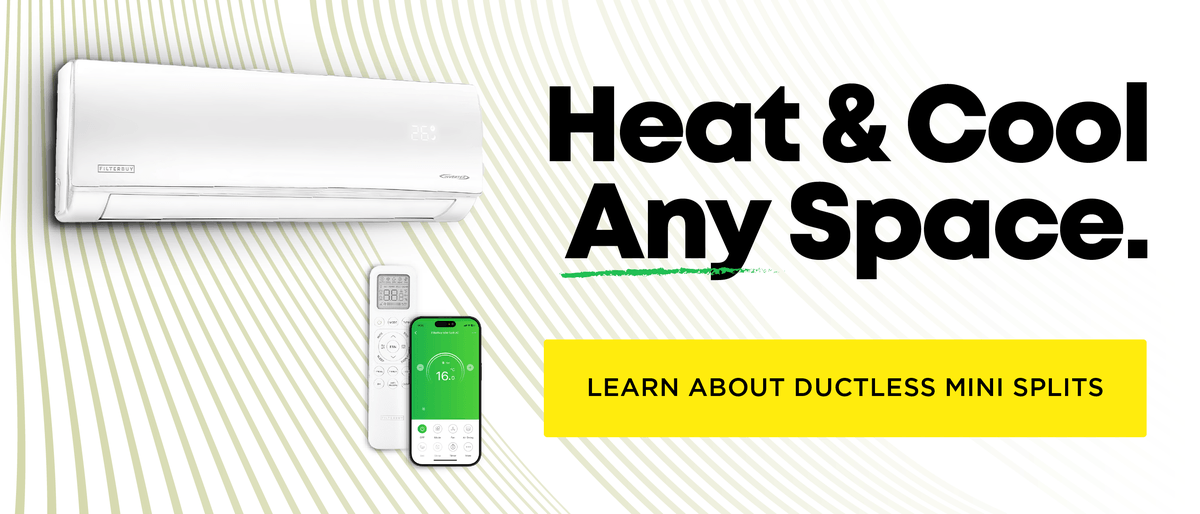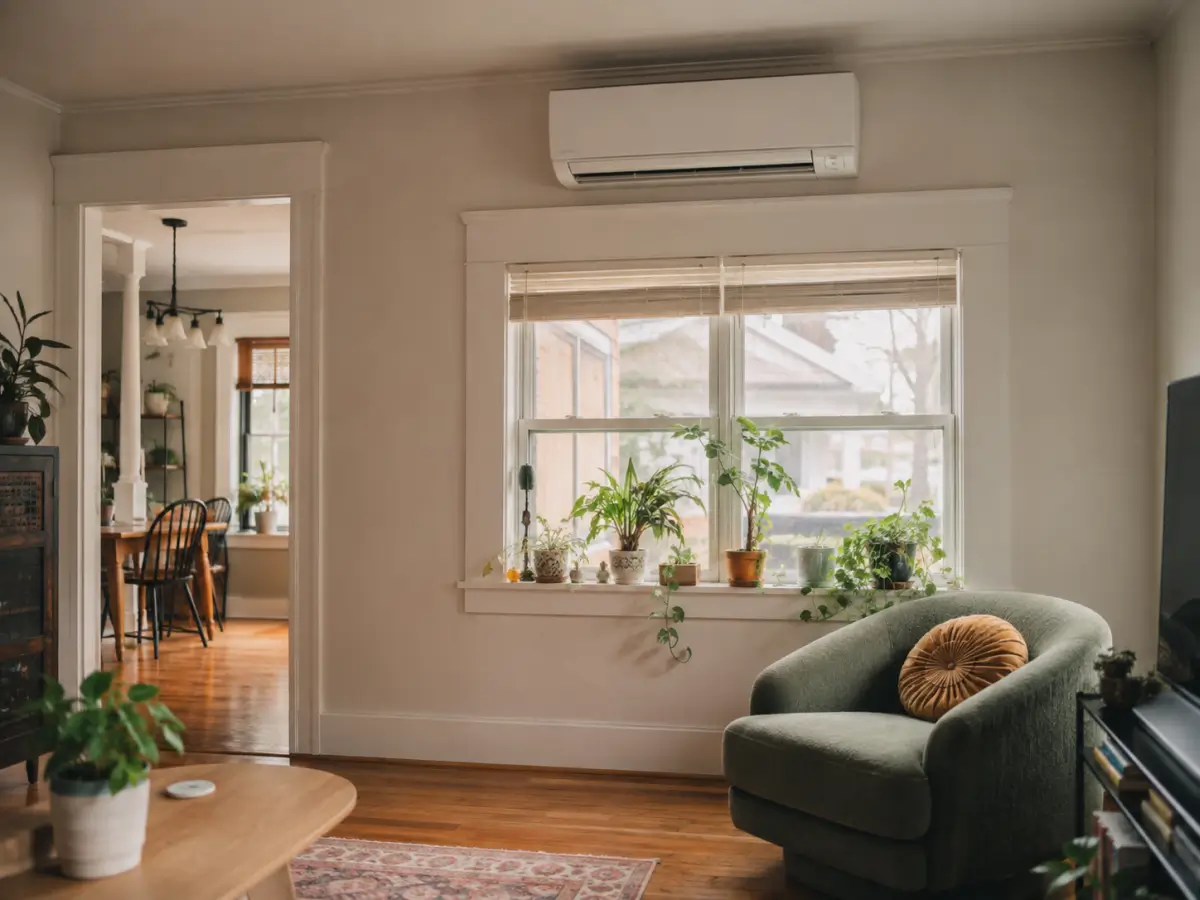
Mini Split AC In Memphis, TN
Installation, Costs & Filter Guide (TN Climate)
By Michelle Wan, Brand Manager and Air Quality Writer at Filterbuy, a U.S. air filter manufacturer. Technically reviewed by David Clark, Licensed HVAC Technician. Published and last updated August 12, 2026.
A ductless mini split in Memphis runs about $1,200 to $5,500 installed for a single zone, and $4,000 to $14,500 for a multi-zone system. Sizing matters more than brand here. An oversized unit cools fast, shuts off early, and leaves the house cold and clammy.
The federal 25C tax credit ended December 31, 2025. TVA EnergyRight still pays $800 on systems rated 17 SEER2 or higher when a Quality Contractor Network member installs it. Every Filterbuy mini split system is rated 17 SEER2. Confirm with your installer that a homeowner-supplied unit qualifies before you buy.
Start with the size your space actually needs.

Answer three quick questions and we will match you to the right size system for your space.
Prefer to browse? See all mini split systems, shipped free in 2 days.
TL;DR
A ductless mini split in Memphis costs roughly $1,200–$5,500 installed for a single zone and $4,000–$14,500 for a multi-zone system, with the national single-zone average near $3,000. The federal 25C tax credit that paid up to $2,000 toward heat pumps expired December 31, 2025. 2026 installs do not qualify, so ignore any quote that still promises it. In Memphis’s hot, humid Climate Zone 3A summers, correct sizing matters more than brand. An oversized unit cools fast, shuts off early, and leaves your house cold and clammy.
Key Takeaways
Single-zone installs run $1,200–$5,500; multi-zone $4,000–$14,500. Labor is 30–50% of that.
The federal 25C tax credit is gone. The One Big Beautiful Bill Act (P.L. 119-21) terminated it for equipment placed in service after December 31, 2025, confirmed in the IRS guidance on the OBBB energy provisions. Any Memphis contractor still quoting "$2,000 back from the IRS" for a 2026 install is working from an outdated script.
A $800 TVA EnergyRight mini split rebate is still available on systems rated 17 SEER2 or higher, but only when a TVA Quality Contractor Network member does the install.
2026 equipment costs 10–15% more, because new units use A2L refrigerants (R-32 or R-454B) instead of R-410A.
Shelby County runs its own contractor registration. A state license alone does not mean your installer can pull a permit here.
A mini split’s washable mesh filter is a comfort filter, not a health filter. It protects the coil from dust; it does not capture the fine particles that shape what you actually breathe.
Ductless is not always the answer. If your ductwork is sound, a central system is usually cheaper per ton.
Why this guide is different
Almost every "mini split Memphis" page you will read was written by a company that wants to install one for you. Filterbuy does not install mini splits in Memphis. We have manufactured air filters in the United States since 2013, in our own plants in Alabama, Florida, Pennsylvania, and Utah. Our HVAC Solutions crews service ductless systems in Florida and Texas, two markets with the same heat and humidity problem Memphis has.
That combination is the point. We know these systems from the inside and have no quote riding on your decision, so this guide says things a contractor’s website will not, including when you should not buy one at all.
What Does A Mini Split Cost In Memphis In 2026?
A ductless mini split in Memphis typically costs $1,200 to $5,500 installed for one zone and $4,000 to $14,500 for two to five zones. Labor is 30–50% of the bill. Tennessee is among the more affordable HVAC markets in the Southeast, so Memphis quotes tend to land in the lower-to-middle band of those national ranges.
Table 1: Mini split cost in Memphis by configuration
National 2026 installed ranges. Labor is 30–50% of the total, and Memphis quotes typically land in the lower-to-middle band.
Three line items surprise homeowners most, and they are the three our own installers add to quotes most often. Long line sets: each 10 feet past the standard 25 adds $50 to $150. Electrical: older homes often need a dedicated circuit. Permits, which belong on the estimate as their own line.
That bottom row is worth a note. Filterbuy ships mini split equipment to Memphis even though we do not install here, so buying the unit and hiring out the labor is a real path. One caution before you do: the TVA rebate is tied to the installation meeting TVA standards, so confirm with your Quality Contractor Network contractor that a homeowner-supplied unit still qualifies before you buy anything.
For the full national breakdown, see our mini split installation cost guide and our comparison of mini split cost by system type.
The 2026 Rebate Change Most Memphis Quotes Get Wrong
The federal Section 25C Energy Efficient Home Improvement Credit expired for equipment placed in service after December 31, 2025. It was terminated by the One Big Beautiful Bill Act (P.L. 119-21), signed July 4, 2025, and the IRS has published guidance confirming the termination dates. A mini split heat pump installed in Memphis in 2026 does not qualify for the $2,000 federal credit.
There is no grandfather clause. The trigger is the date the system is operational, not the date you signed the contract or paid a deposit.
The credit going away does not mean nothing is left. TVA EnergyRight offers an $800 rebate on ductless mini splits rated 17 SEER2 or higher, funded through TVA and your local power company. There is one condition that catches people out: the work has to be done by a member of the TVA Quality Contractor Network, and that contractor submits the rebate paperwork for you. Hire outside the network and the $800 is simply gone.
Table 2: What a Memphis homeowner can actually claim in 2026
Section 25C was terminated by the One Big Beautiful Bill Act (P.L. 119-21) for equipment placed in service after December 31, 2025. TVA EnergyRight rebate amounts verified August 2026; confirm eligibility with MLGW, since terms are set with your local power company.
Here is the practical use for this: if a Memphis contractor’s 2026 quote still lists a federal tax credit, treat it as a signal to scrutinize the rest of the estimate. It means their pricing sheet has not been updated in over a year, and it raises a fair question about whether they know the $800 rebate exists either.
Run the 17 SEER2 math before you pick equipment. The rebate is a cliff, not a slope. A unit at 16.9 SEER2 gets nothing; a unit at 17 gets $800. If the more efficient model adds $500 to your quote, taking it leaves you $300 ahead on day one, before you have saved a dollar on electricity. Ask every bidder to price both sides of that line.
Two smaller ones worth knowing: MLGW and TVA run Smart Thermostat Rewards, and Tennessee’s HEAR and HOMES rebates still have not launched — TDEC warns that anyone offering equipment under those programs today is not affiliated with them.
How To Size A Mini Split For Memphis Heat And Humidity
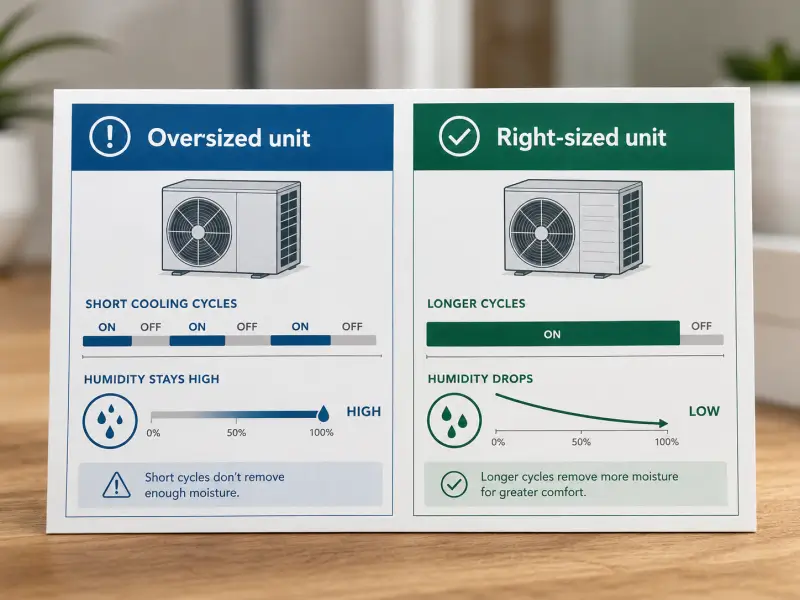
Memphis sits in IECC Climate Zone 3A, mixed-humid, where summer dew points routinely climb into the low-to-mid 70s F. In that climate an oversized mini split is worse than a slightly undersized one, because it never runs long enough to pull moisture out of the air.
Inverter-driven units modulate output like a dimmer rather than cycling on and off, which helps, but only if the equipment was sized right to begin with.
Here is the part most Memphis sales pitches leave out. The U.S. Department of Energy’s Building America Solution Center notes that ductless systems tend to provide poorer dehumidification than ducted systems, and that the trade-off is worst on the units marketed hardest on efficiency. DOE advises that in humid climates — which includes Memphis — you should consider adding a dehumidifier, and ask your contractor for the unit’s sensible heat ratio, where a lower number means better moisture removal. A mini split is a good answer for a Memphis summer. It is not automatically a complete one.
Ask your installer for an ACCA Manual J load calculation, not a square-footage rule of thumb. A real load calculation accounts for insulation, window area and orientation, ceiling height, air leakage, and occupancy. "About 20 BTU per square foot" is a sales shortcut. A leaky 1920s Central Gardens bungalow and a tight 2015 build in Collierville can have wildly different loads at identical square footage.
Two more things to raise with any bidder. Head placement: DOE notes high-wall units read room temperature up near the ceiling, so air at seated height can run colder than the remote says. Some models accept a wired wall thermostat, which fixes it. And ask whether the unit runs a self-drying cycle after cooling, which dries the coil instead of leaving it damp in a closed-up house. Filterbuy builds that into our own mini splits for exactly this reason, but plenty of brands offer it and it is worth having in Memphis whoever you buy from.
On heating: Zone 3A winters are mild enough that a properly sized ductless heat pump rarely needs supplemental heat in Memphis, a better story than the same equipment has in Nashville or Knoxville.
“Every summer in Florida and Texas we get the same call. The house hits temperature in ten minutes, the unit shuts off, and the homeowner still feels sticky. Nine times out of ten nothing is broken. The system is just too big for the room, so it never runs long enough to wring the water out of the air. Undersizing is uncomfortable on the five hottest days a year. Oversizing is uncomfortable every single day.”
— David Clark, Licensed HVAC Technician, technical reviewer for this guide
When A Mini Split Is The Wrong Call In Memphis
A mini split is not the right answer for every Memphis home, and we would rather say so here than after you have spent the money. Three situations where we would point you elsewhere:
You already have sound ductwork. If your ducts are in decent shape and you want whole-home cooling, a central system is usually cheaper per ton. Ductless earns its premium when there are no ducts, or ducts you would have to replace anyway.
You want more than three or four zones on one outdoor unit. DOE guidance is that connecting more than three indoor heads to a single condenser is generally not recommended. Past that, a second outdoor unit usually serves you better than one overloaded one.
You plan to run most heads only occasionally. In a multi-zone system, shutting heads off can push the load below the outdoor unit’s minimum capacity, which makes it cycle. DOE notes the savings can go negative, and refrigerant keeps flowing through an "off" head anyway.
None of that makes ductless a bad technology. It makes it a targeted one. It clearly wins on additions, converted garages and attics, sunrooms, bonus rooms, and older Memphis houses where new duct is impractical.
How To Vet A Mini Split Installer In Memphis
Memphis and Shelby County run their own contractor registration, separate from the state. Nobody can pull a permit here until their license is registered with the Office of Construction Code Enforcement, and registered mechanical contractors must carry a $25,000 permit bond. The state license (CMC or CMC-C) is only required on jobs over $25,000, and most single-zone mini split work falls under that. So the state license is usually not the credential that matters. The local registration is.
Six questions worth asking before you sign. The last one costs $800 if you skip it:
"Are you registered with Construction Code Enforcement, and will you pull the permit?" You can look up registered contractors and permit activity yourself. If the answer to the permit half is no, that is your answer to the whole thing.
"Can I see your EPA Section 608 certification?" Federally required for anyone handling refrigerant, and the credential does not expire.
"Will you run a Manual J load calculation?" Not a tape measure and a chart.
"Is this an A2L refrigerant system, and are your techs trained on it?" 2026 equipment uses R-32 or R-454B, which are mildly flammable and carry different handling and leak-detection requirements than the R-410A your installer used last year.
"What is covered in the labor warranty, and for how long?" Equipment warranties and labor warranties are different documents.
"Are you in the TVA Quality Contractor Network?" If not, you forfeit the $800 mini split rebate no matter how good the install is.
We will say it once more, because it is the reason this list is honest: we cannot install this for you. Our crews work Florida and Texas. Nobody at Filterbuy earns anything from which Memphis contractor you pick, which is exactly why we are willing to hand you the questions that make a bad one uncomfortable. What we ship to Memphis is equipment and filters.
Mini Split Filters In Memphis: What To Clean, What To Replace
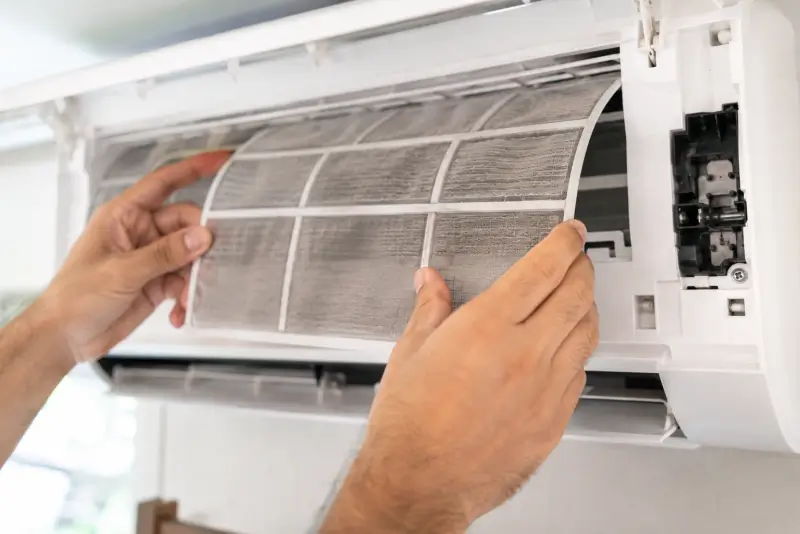
The mesh filter inside your mini split’s indoor head is washable and reusable. It is not a replaceable pleated filter, and no pleated filter fits in its place. Clean it every two weeks through a Memphis cooling season.
Power down the unit, lift the front panel, slide out the mesh screens, vacuum the loose dust, wash in warm water with mild soap, and let them air-dry completely before reinstalling. That last step is the one our service techs see skipped most often. A screen that goes back in damp is a mold problem waiting to happen, and in Memphis humidity it will not take long.
Table 3: Mini split filter care in a humid Memphis summer
The U.S. Department of Energy's Building America Solution Center notes that ductless mesh filters have very low particulate capture efficiency. The mesh keeps dust off the coil; it is not built to capture fine particulate.
Now the part most guides skip, and we are not the only ones saying it. The Department of Energy’s guide to ductless heat pumps states that these washable mesh filters have very low particulate capture efficiency, and warns that add-on filters are often designed so most of the air bypasses them.
“We have built replacement filters for every major mini split brand for over a decade, so I want to be straight about what that mesh screen in your indoor unit is for. It protects the machine. It was never designed to protect your lungs. People assume a new mini split upgraded their air, and that is a fair assumption. It is just not what the part is engineered to do.”
— Michelle Wan, Brand Manager and Air Quality Writer, Filterbuy
That is worth sitting with in Memphis. In the AAFA 2026 Allergy Capitals report, Memphis ranks 77th of 100 metros. It is better than average on tree, grass, and weed pollen, but worse than average on over-the-counter allergy medicine use. Below-average pollen, above-average allergy medicine. The report does not explain that gap and we will not claim to prove causation. But it is a reasonable hypothesis that in a humid Delta climate a meaningful share of Memphis allergy symptoms is indoor: dust mites and mold, both of which thrive above 50% relative humidity, and neither of which a mesh screen is built to catch. Memphis also leads Tennessee on fine particulate, which you can watch on our live Memphis air quality map.
Two responses. If you run central HVAC alongside your ductless zones, that system’s filter is doing the real filtration work. Use MERV 11 or MERV 13, changed on schedule. Filterbuy builds those in over 600 standard sizes plus custom, ships them factory-direct, and can put them on auto-delivery so the change actually happens. And hold indoor humidity between 30–50%, which AAFA recommends for mold control.
Step-by-step instructions live in our guides to cleaning a mini split and mini split filter cleaning by brand. For the full seasonal routine, see how to maintain your mini split.
Supporting Statistics
Three federal findings sit behind the advice on this page. Each one is linked so you can check it yourself.
Table 4: The research behind this guide
Sources verified August 2026. Memphis sits in the DOE Building America mixed-humid climate region.
How to use these numbers
No usable ductwork? Price ductless before you price a ducted retrofit.
Ask for the Manual J before you listen to the brand pitch.
Add real filtration. The mesh screen is not it.
Source citations — place in rich text beneath the table
Duct losses: U.S. Department of Energy, Ductless (Mini-Split) Heat Pumps.
Cooling costs: U.S. Energy Information Administration, Air conditioning accounts for about 12% of U.S. home energy expenditures.
Indoor air: U.S. EPA, Report on the Environment: Indoor Air Quality.
Frequently Asked Questions
Glossary
Mini split (ductless mini split): A system with an outdoor compressor connected by a refrigerant line to one or more indoor air handlers. No ductwork.
Zone: One indoor air handler and the space it conditions.
A2L refrigerant: The low-global-warming-potential class (R-32, R-454B) required in new 2026 equipment. Mildly flammable; needs trained handling.
Manual J: The ACCA-standard load calculation that sizes equipment to a home’s construction, not its square footage.
SHR (sensible heat ratio): How much of a system’s cooling lowers temperature versus removing moisture. Lower is better for humidity.
Short-cycling: When an oversized system hits setpoint and shuts off before running long enough to dehumidify.
SEER2: The federal cooling efficiency rating. TVA’s $800 rebate requires 17 SEER2 or higher.
TVA Quality Contractor Network (QCN): TVA’s vetted contractor list. Using a member is required to receive EnergyRight rebates.
Mesh pre-filter: The washable screen inside a mini split indoor unit. It protects the coil from dust.
MERV: The 1–16 scale rating a pleated filter’s particle capture. MERV 13 captures PM2.5.