How Many BTUs for a 400 Sq Ft Room? Mini Split Sizing & Top Picks
A 400 square foot room needs roughly 8,000 to 10,000 BTU per hour, so the real choice is between a 9,000 and a 12,000 BTU mini split. Nothing is manufactured in between. Pick 9,000 when the room is a straightforward 400 square feet with 8 foot ceilings, insulated walls and shaded glass in a moderate climate. Pick 12,000 once higher ceilings, sun, a hot-humid climate or a kitchenette push the number up, because an inverter compressor modulates down instead of short cycling.
- 9,000 BTU: 8 foot ceilings, insulated walls, shaded glass, moderate climate.
- 12,000 BTU: ceilings 9 feet or higher, sunny glass, hot-humid climate, a kitchenette or more than two people.
Not sure which side your room falls on? The quick match below sorts it out.

Answer a few quick questions and we will match your room to the right mini split size.
Already know your size?
TL;DR
A BTU, or British thermal unit, is a measure of heat, and cooling capacity is rated in BTU per hour. A 400 square foot room calculates to 8,000 to 10,000 BTU per hour, but mini splits are only built in 9,000 and 12,000 BTU increments, so the decision is which way to round. Choose 9,000 for a shaded, well-insulated room in a mild climate. Choose 12,000 once sun, high ceilings, a hot-humid climate, or winter heating load push the number up. Because inverter compressors modulate down, the larger head does not short cycle.
Key Takeaways
Inverter mini splits modulate output instead of cycling on and off, which is why rounding up to 12,000 works on a variable-speed system and fails on a fixed-speed one.
ENERGY STAR adjustments apply on top: minus 10 percent for shade, plus 10 percent for sun, plus 600 BTU per occupant beyond two, plus 4,000 for a kitchen.
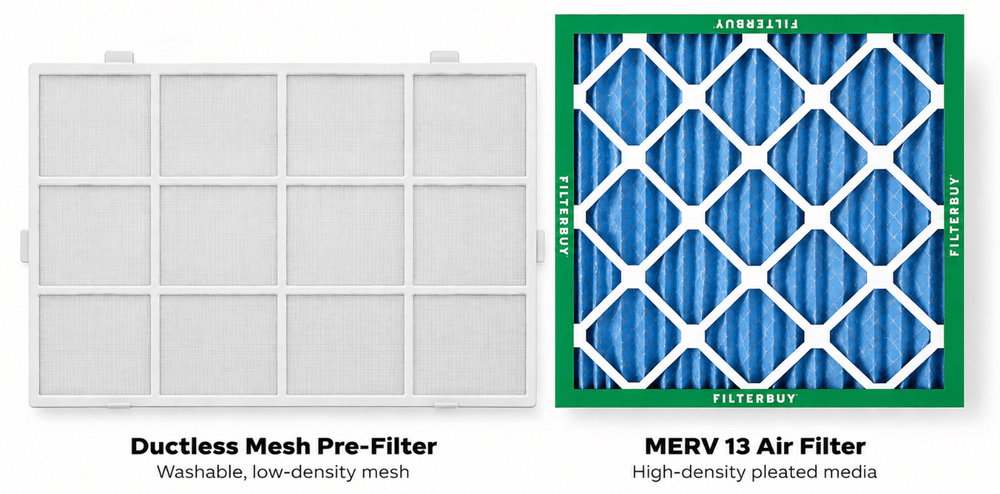
Mini splits do not take pleated filters in any size. The indoor head uses a washable mesh screen matched to a part number, not a size like 20x20x1.
Filterbuy's ductless line starts at 12,000 BTU, rated for up to 550 square feet, which covers 400 with room to modulate.
How Many BTUs Does A 400 Square Foot Room Need?
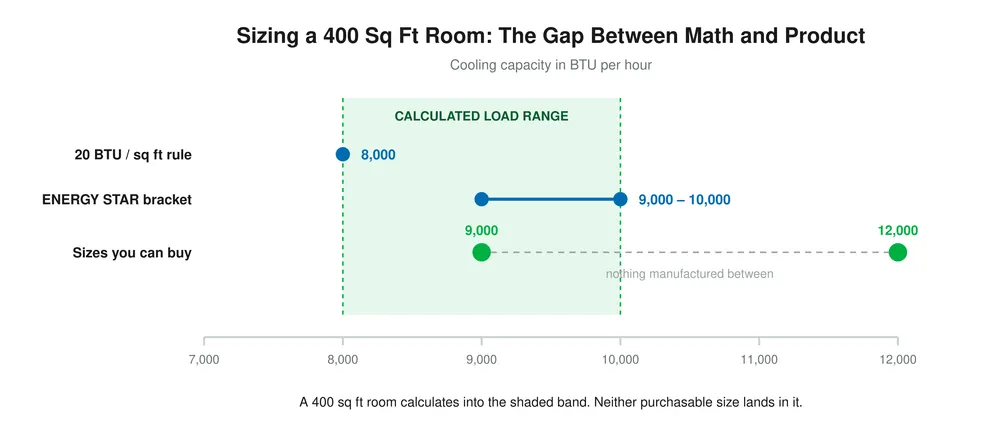
A 400 square foot room needs roughly 8,000 to 10,000 BTU per hour of cooling in average conditions. The ENERGY STAR room air conditioner sizing chart puts 350 to 400 square feet at 9,000 BTU per hour, and 400 to 450 at 10,000. Mini splits are not built in those increments. A load that calculates to 9,500 has to go somewhere, and the only places to put it are 9,000 or 12,000.
A 12,000 BTU mini split is one ton of cooling, which is more than the raw math calls for. On a variable-speed system that headroom is harmless. On a fixed-speed unit it turns into a humidity problem. Filterbuy is a US filter manufacturer that now builds its own ductless systems, and we sell the 12,000 rather than a 9,000, so we will say this plainly: the math points at 9,000, and the 12,000 has to be earned by the room.
The Sizing Math, And Why It Does Not Match A Real Product
Cooling capacity is measured in BTU per hour, and the usual starting point is 20 BTU per square foot. ENERGY STAR publishes brackets rather than a flat rate, and at this size the brackets land higher.
Source: ENERGY STAR room air conditioner sizing guidance. Brackets assume 8 ft ceilings and two occupants, before adjustments.
Manual J is the ACCA standard and the only method that accounts for your actual walls, glass, and air leakage. Manufacturers, meanwhile, build to a short list of capacities. Daikin, Mitsubishi Electric, MRCOOL, Senville, and Pioneer all center their single-zone lineups on 9,000, 12,000, 18,000, and 24,000 BTU, and nothing is made in between.
Nothing is manufactured at 8,000 or 10,000 BTU, so a 400 sq ft room falls between the two sizes on sale.
Rounding up is normal here, and inverter technology is why it works: a variable-speed compressor throttles its output instead of running flat out or shutting off. That is not a free pass, though. The Department of Energy warns that oversized or poorly placed air handlers short cycle, wasting energy and losing humidity control.
What A Filter Manufacturer Notices About Oversizing
We came to ductless from the other direction. Filterbuy made pleated filters in the United States since 2013 and shipped them factory-direct to millions of households before we ever built an indoor head, and that order changes what you notice. The tell of a badly sized fixed-speed unit is rarely the power bill, which the research below puts at a few percent. It is the coil. Short cycles leave it wet with the fan off, and what arrives a season later is a musty smell rather than a high bill. That is why our own head self-cleans the coil after every use.
How To Adjust The Number For Your Room
Square footage only sets the base figure. Four conditions move it, and together they push a 400 square foot room from 9,000 up to 12,000.
The first four are ENERGY STAR's published adjustment rules. The last reflects how the per-square-foot rate shifts by climate zone.
Sun and kitchen heat are ENERGY STAR's published adjustments. The last row works differently, reflecting climate and construction rather than a fixed percentage: a well-insulated bedroom sits near 18 BTU per square foot, an uninsulated garage nearer 35.
A Real 400 Square Foot Room, Worked Through
Take a 20 by 20 garage conversion in Tampa: nine-foot ceilings, a west-facing glass door, two people. Start at the ENERGY STAR bracket, 9,000. Scale for the ceiling and you are near 10,100. Add 10 percent for west sun and you are near 11,100. Nothing gets added for occupancy or cooking, since two people and no stove sit inside the baseline. That lands just under 12,000 and nowhere near 9,000, which is how a room measuring exactly 400 square feet ends up on a one-ton head. Insulate that door and the number falls back toward 9,000.
9,000 BTU Or 12,000 BTU For 400 Square Feet?
Pick 9,000 when the room is a straightforward 400 square feet: eight-foot ceilings, insulated walls, shaded glass, a moderate climate. It runs nearer its design point and dehumidifies better than a larger head loafing at part load.
If that is your room, buy the 9,000. Daikin, Mitsubishi Electric, MRCOOL, Senville, and Pioneer all sell one, and we would rather you got the right size than our size. Filterbuy is not affiliated with or endorsed by any of those brands.
Pick 12,000 when any two are true:
The ceilings run nine feet or higher.
The room is less insulated than the rest of the house.
The climate is hot-humid or hot-dry.
The space includes a kitchenette, or regularly holds more than two people.
The mini split is the room's only heat and the winters are cold.
That last one deserves a note. Heat pumps lose capacity as the outdoor temperature falls, so in a cold climate you size on the heating load rather than the cooling load and choose a cold-climate certified model.
The two mistakes are not equal, and that asymmetry decides more of these calls than the calculator does. An undersized head has no recovery: it runs flat out and still loses the room on the worst afternoon of the year. A generously sized inverter head simply modulates down.
That reframes the old warning against rounding up, which is really a warning about fixed-speed equipment. In lab testing, an oversized variable-capacity heat pump held indoor humidity near 52 percent through hot, humid weather, because it ran nearly continuously instead of cycling. For other room sizes, see the room-by-room mini split sizing guide, or guides for 500 square feet and 1,000 square feet.
Which Filters Fit A 12,000 BTU Mini Split?
No pleated filter fits a mini split, in any size or BTU rating. The indoor head uses a washable mesh screen ordered by part number, because a ductless fan cannot pull air through pleated media at any capacity. Rinse it every two to four weeks in peak season and it outlasts the unit. Our guides to cleaning mini split filters and mini split replacement filters cover the handful of cases where a part genuinely needs buying.
That screen protects the coil rather than the air in the room, and in our experience it is the filter homeowners forget most, sitting high on a wall and out of sight. The Department of Energy notes that ductless mesh is low-MERV and misses fine particles, so if the house also runs central heating and cooling, that is where filtration does the real work: MERV 13 air filters catch what the mesh cannot.
"The 400 square foot rooms that give people trouble are rarely the ones with the smaller unit. They are the garage conversions where somebody sized up because the room felt hot, and now it cools in ten minutes and stays clammy. Ceiling height is a reason to size up. A hot afternoon is not."
— David Clark, Licensed HVAC Technician
"We sell the twelve, so take this the right way. At four hundred square feet the calculator says nine. The reason twelve still works is the inverter, not the badge on the box. Put a fixed-speed twelve in that room and you will smell the mistake before you ever see it on a bill."
— David Heacock, Founder and CEO, Filterbuy
Top Pick For A 400 Square Foot Room
The Filterbuy 12,000 BTU ductless mini split is rated for up to 550 square feet, which puts a 400 square foot room mid-range rather than at an edge. It is $799 with free two-day delivery on in-stock systems, a published price with no quote form. It runs variable-speed at 17 SEER2, carries ETL and AHRI certification, uses R32 refrigerant, and comes in 115V or 230V, with a seven-year compressor and three-year parts warranty. Professional installation is required, and self-installing voids that warranty.
One limit, stated plainly: ours is rated for reliable heating down to 5°F. If this room is your winter heat and your winters run colder, buy a cold-climate model from another brand instead. The filter-clean reminder on the panel is there because we know which maintenance task gets skipped. Larger rooms step up to the 18,000 BTU and 24,000 BTU systems, and our maintenance guide covers filter care on all three.
Supporting Statistics
The federal and peer-reviewed research behind the sizing advice above, and behind the case for putting a 12,000 BTU mini split in a 400 square foot room.
Oversizing Is The Default Error
31 to 93 percent of cooling systems tested oversized, across seven states.
0 to 9 percent tested undersized.
33 to 48 percent oversizing is tolerated before a system is out of range.
Source: DOE, Residential HVAC Installation Practices (2018)
Variable-Speed Runs Best Below Full Capacity
45 percent more efficient at minimum capacity than at full nominal capacity.
11 cycles a summer day oversized and variable-speed, against 60-plus fixed-speed.
11 percent seasonal cooling energy saved by oversizing the variable-speed unit.
Source: Cummings and Withers, ACEEE Summer Study (2014)
Load Calculations Are Estimates
Up to 50 percent is how far Manual J can overestimate sensible load.
Latent load, the humidity side, gets underestimated.
Most replacements skip the load calculation entirely.
Sources: DOE/EE-1699 (2018) and ORNL, HVAC Sizing Research
Frequently Asked Questions
Get The Right Size For Your Room
Measure the room, apply the adjustments above, then buy the size that matches. Shop Filterbuy ductless mini split systems run from 12,000 to 24,000 BTU at 17 SEER2, with free two-day delivery on in-stock systems. If the rest of the house runs central heating and cooling, auto delivery keeps that filter on schedule.
Glossary
BTU (British Thermal Unit): the energy to raise one pound of water one degree Fahrenheit. Capacity is rated in BTU per hour.
Mini split (ductless mini split): an outdoor compressor paired with one or more indoor air handlers, no ductwork.
Inverter (variable-speed) compressor: a compressor that varies output continuously instead of switching on and off.
Short cycling: an oversized system reaching setpoint fast, shutting off, and restarting repeatedly, leaving humidity behind.