Installation, Costs & Rebates (ND Guide)
By Michelle Wan · Reviewed by David Clark, Licensed HVAC Technician · Published July 18, 2026 · Last updated July 18, 2026
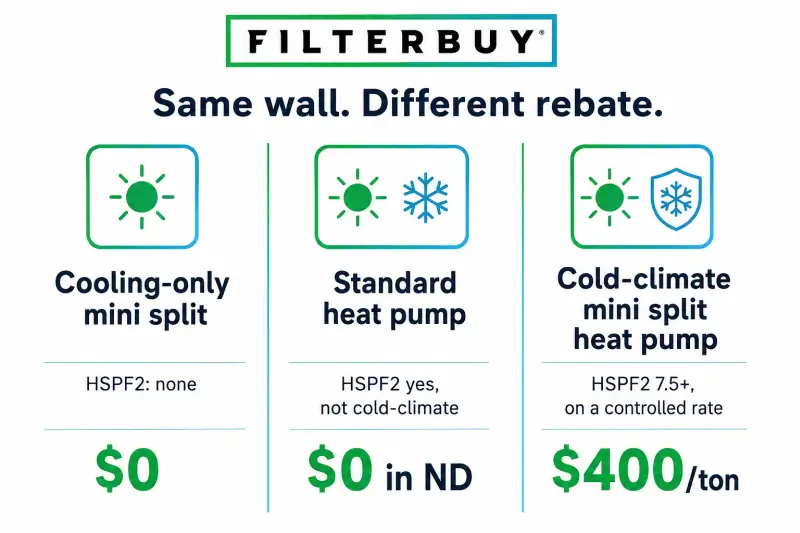
In North Dakota you can still get a mini split rebate in 2026, but only for heating, not cooling. Otter Tail Power pays $400 per ton for a cold-climate ductless heat pump on a controlled electric rate, and Minnkota member cooperatives pay $150 per ton. A cooling-only mini split earns nothing here, and the federal tax credit ended on December 31, 2025.

Not sure which mini split fits your space, or which rebate you qualify for?
Answer a few quick questions and we will point you to the right system for your home.
You can add a mini split in North Dakota, and the rebate money is real, but it is paid for heating, not cooling. Otter Tail Power pays $400 per ton for a cold-climate ductless heat pump on a controlled rate. Minnkota's member cooperatives pay $150 per ton. The federal tax credit expired December 31, 2025, and North Dakota's own federally funded rebates have never launched. A cooling-only mini split, and even a standard heat pump, earns nothing here.
Otter Tail Power pays $400 per ton for a cold-climate ductless mini split heat pump on a Dual Fuel, Deferred Load, or Residential Demand Control rate, with an HSPF2 of 7.5 or higher.
Minnkota's member cooperatives pay $150 per ton for air-source and mini-split heat pumps, capped at $1,500 across all eligible heating equipment per off-peak electric heat meter.
An air conditioner earns $0 in North Dakota. Otter Tail pays $100 for an ENERGY STAR AC in Minnesota and South Dakota. Its North Dakota schedule has no such line, and no standard heat pump line either.
The federal Section 25C credit no longer applies to 2026 installs. It was terminated for property placed in service after December 31, 2025. A system running before that date can still be claimed on a 2025 return using IRS Form 5695.
North Dakota's HEAR and HOMES rebates have not launched, despite $74.3 million allocated, and the state warns that offers circulating now tied to those programs are likely scams.
Rate enrollment decides eligibility. In North Dakota a controlled rate is the price of entry for a heat pump rebate, not a bonus on top of one.
Filterbuy has manufactured air filters in the USA since 2013, we have served more than two million households, and we also run a licensed HVAC install business, Filterbuy HVAC Solutions. We sell ductless mini splits. Which means we had every incentive to write the page everyone else wrote: lead with the $2,000 federal credit, wave at $8,000 from HEAR, and let you assume the money is waiting for you.
Instead we did the boring thing, and it is the reason this page disagrees with almost everything else written about North Dakota rebates.
We pulled Otter Tail Power's 2026 Programs and Services Guide for Contractors and read all three of its state rebate schedules side by side. Minnesota is on page 9. North Dakota is on page 29. South Dakota is on page 33. Same utility, same document, same year.
Minnesota pays $100 for an ENERGY STAR air conditioner. South Dakota pays $100. North Dakota's schedule does not have the line at all. It has no standard heat pump line either. Cross the state border and the air conditioner rebate simply stops existing.
You will not find that in a rebate database, because a database records what a state offers. It has no field for what a state conspicuously does not offer. That absence is the single most useful fact on this page, and reading three pages of a contractor PDF is the only way we found it.
"We sell mini splits, so the easy version of this page was the one everybody else published: lead with a $2,000 federal credit, wave at $8,000 from HEAR, and let a North Dakotan assume the money is sitting there waiting. One of those numbers expired in December. The other never arrived in this state. We would rather lose the sale than be the reason somebody budgeted around a rebate that does not exist."
- Filterbuy Team
Three figures from U.S. government sources. They explain the whole page: why the money is for heating, why cooling earns nothing, and why your furnace filter still matters.
1. Ten days a year, North Dakota never gets above 0°F.
NOAA counts the day's high, not its low.
So the warmest moment of the day is still below zero.
No air-source heat pump carries a house alone on those days.
That is why Otter Tail's North Dakota rebates assume a backup furnace.
And why the schedule pays only for cold-climate equipment.
Source: NOAA NCEI, North Dakota State Climate Summary 2022, Figure 4
2. Mini splits use up to 60% less energy than electric resistance heat.
Heat pumps move heat. They do not make it.
That efficiency is what your utility buys at $400 a ton.
It is a heating number, not a cooling one.
Which is why cooling earns $0 here.
ENERGY STAR tests cold-climate units down to 5°F. Below that, it recommends backup heat.
Source: ENERGY STAR (U.S. EPA and U.S. Department of Energy), Ductless Heating & Cooling
3. You spend about 90% of your time indoors. Pollutants there run 2 to 5 times higher than outside.
EPA points to tighter, more efficient homes with too little ventilation.
A North Dakota house is sealed from October to April.
The mesh screen in a mini split protects the coil, not your lungs.
Rinse it every two to four weeks. Expect nothing more from it.
Your backup furnace filter does the real winter work.
Source: U.S. Environmental Protection Agency, Indoor Air Quality (Report on the Environment)
North Dakota homeowners can get utility rebates only, and only on heat pumps. Otter Tail Power pays $400 per ton for a cold-climate ductless heat pump on a controlled rate. Minnkota Power Cooperative's member utilities pay $150 per ton for air-source and mini-split heat pumps. There is no federal tax credit for a 2026 install and no state rebate program running. Everything else advertised nationally for this state is expired, unlaunched, or simply not offered here.
Verified July 18, 2026 against Otter Tail Power's 2026 Programs and Services Guide for Contractors (p.29), Minnkota Power Cooperative, the North Dakota Department of Commerce, and the IRS. Programs change without notice; confirm with the utility named on your bill before you buy.
A mini split that only cools qualifies for no North Dakota rebate, and neither does a standard heat pump. Every incentive in this state is paid out of an electric heating program, and Otter Tail's North Dakota schedule only lists cold-climate, geothermal, and air-to-water heat pumps. The rebate is a reward for how you heat, not how you cool.
We found this by reading the utility's own contractor guide rather than a rebate database, and the comparison is unusually clean because Otter Tail serves three states and publishes a separate schedule for each. Its Minnesota and South Dakota schedules both pay $100 for an ENERGY STAR air conditioner and $300 per ton for a standard ducted or ductless heat pump. Its North Dakota schedule contains neither line. Twenty pages apart, in one PDF.
Sit with that for a second, because it reframes the whole purchase. The equipment does not change at the border. The winter does. North Dakota's utilities are not paying anyone to be comfortable in July; they are paying to shape a February load they have to serve whether you like it or not. Once you see the rebate as the utility buying something rather than giving you something, every rule on this page stops being bureaucracy and starts being a price.
Here is the full North Dakota schedule, straight from the 2026 Programs and Services Guide for Contractors (page 29):
Otter Tail Power's North Dakota schedule, 2026. Cold-climate and geothermal systems must be served on a Dual Fuel, Deferred Load, or Residential Demand Control rate and must be subject to control according to that rate. Rebates will not exceed 75% of project cost. Totals of $10,000 or more need prior approval.
There is a second, quieter version of the same rule. Otter Tail runs an air-conditioning cycling program called CoolSavings that pays North Dakota customers a credit of about $8.25 a month from May through October, and it is the one cooling-side incentive in the state. Ductless and window air-conditioning units do not qualify for it. So the only program in North Dakota that pays for cooling specifically excludes the kind of equipment this page is about.
What to do with this: ask your installer for the model's HSPF2 rating in writing, not just its SEER or SEER2, and ask whether the unit is classified as cold-climate. SEER2 measures cooling. HSPF2 measures heating, and it is the number on the rebate form. Watch for one trap in particular: SEER and SEER2 are different scales, so a unit advertised as "17 SEER" is not a 17 SEER2 unit, and neither number tells you a thing about heating. Look the model up yourself in the AHRI Certified Directory and confirm the rating the equipment actually earned in independent testing before you spend a dollar.
The federal Section 25C Energy Efficient Home Improvement Credit, worth up to $2,000 on a qualifying heat pump, was terminated for property placed in service after December 31, 2025 under the One Big Beautiful Bill Act (Public Law 119-21). Systems installed in 2026 do not qualify. The IRS page states plainly that the credit can be claimed for improvements made through December 31, 2025.
If your mini split was placed in service on or before December 31, 2025, the credit is still yours: claim it on your 2025 return with IRS Form 5695. Placed in service means installed and operational, not ordered, not paid for, not scheduled. Keep the invoice and the AHRI certificate. (Not tax advice; confirm with a CPA.)
Any 2026 page, calculator, or contractor still quoting you 30% back up to $2,000 on a heat pump is working from stale information, and on a tax question that is an expensive thing to be casual about.
North Dakota has been allocated $37.1 million for HEAR and $37.2 million for HOMES, has contracted Franklin Energy to run them, and is waiting on final approval from the U.S. Department of Energy. Neither has launched. The North Dakota Department of Commerce states there is no estimated launch date.
The part that matters more than the money: Commerce warns that any offers currently circulating in the state tied to these programs are, in its words, "likely scams or fraudulent." No one from Commerce or its contractors will contact you directly about the program, by phone, email, text, or at your door.
This is worth pausing on, because the well-meaning national advice creates the vulnerability. A North Dakota homeowner reads a rebate guide promising $8,000 from HEAR, then gets a call from someone offering to help them apply. The guide primed them to believe the call. If someone contacts you unprompted about North Dakota home energy rebates, that contact is the red flag, regardless of what they know about your house.
To be told when the program actually opens, watch the Commerce program page or email the ND Energy Program office at NDEnergyPrograms@nd.gov. Watch the page. Do not wait on a phone call.
In North Dakota, rebate eligibility is decided by which electric rate you are on as much as by which mini split you buy. Otter Tail's North Dakota schedule requires a cold-climate heat pump to be served on a Dual Fuel, Deferred Load, or Residential Demand Control rate, and to stay subject to control under that rate. Buy first and enroll later, and you can find the rebate closed to you on equipment that otherwise qualified perfectly.
A controlled rate is a deal: the utility can interrupt your electric heating during system peaks, and in exchange you pay a much lower rate for that load. Otter Tail says its off-peak rates run as low as about half its average price of electricity, and Cass County Electric describes its off-peak rate the same way. Over the life of a system, that discount usually dwarfs the one-time rebate.
Notice what North Dakota does differently. In Minnesota, putting a cold-climate heat pump on a controlled rate earns a $40-per-ton bonus on top of the standard rebate. In South Dakota it earns $100 per ton on top. In North Dakota there is no bonus, because there is no standard rebate to add it to: the controlled rate is the price of entry. That is the single most misreported fact about North Dakota heat pump rebates, and it is why a rebate database that lists one number per state will mislead you here.
Current as of July 18, 2026. The first three rows do not agree with one another, and that is not an error: Minnkota sets the wholesale incentive and each member utility implements it with its own requirements.
Minnkota sets the wholesale incentive, and each member cooperative implements it with its own requirements. Its own page says as much. The consequence for you is that there is no such thing as "the North Dakota mini split rebate." There is only your utility's rebate. Call them before you sign the quote and ask three questions: Is my planned unit eligible? Does it need to be on a controlled rate? What is the per-ton amount this year? Ten minutes on the phone is worth more than any calculator on the internet, this page included.
If your utility is not Otter Tail or a Minnkota member, ask anyway. Xcel Energy, Montana-Dakota Utilities, and the Basin Electric member cooperatives all serve parts of North Dakota, and as of July 2026 we could not find a published residential mini split rebate from any of them. That is not proof there isn't one. It is a reason to call rather than assume, and to run your ZIP through DSIRE, the national incentives database, before you buy.
A rebate paid per ton only means something once you turn it into a number for the box on your wall. Here is that arithmetic, using each utility's published rate.
Arithmetic on each utility's published per-ton rate, July 2026. Otter Tail pays this only for a cold-climate ductless heat pump on a Dual Fuel, Deferred Load, or RDC rate, and no rebate exceeds 75% of project cost. Minnkota member rebates are capped at $1,500 across all eligible heating equipment per off-peak electric heat meter. These are not quotes. Confirm with your utility.
Two things worth noticing. A 24,000 BTU single-zone unit is 2 tons, so it earns $800 from Otter Tail and $300 from a Minnkota cooperative for the identical install. And the columns are not stackable: you have one electric utility, so you get one of them, not both.
In North Dakota, the controlled rate you have to join in order to get the rebate is worth several times more than the rebate itself, and it pays every year instead of once. This is the most under-reported fact about heat pump money in this state, and it inverts the way nearly every guide frames the decision.
Otter Tail publishes the numbers itself, in the same guide as the rebate schedule. Its appliance energy-use chart models a 3-ton cold-climate heat pump running to 0°F at 8.1 HSPF2, using 9,648 kilowatt-hours over a winter. On firm service, heating it costs $1,089.26. On the off-peak rate, the same machine in the same house costs $628.08.
That is a $461 difference per winter, plus about $51 a summer on the cooling side. Call it roughly $512 a year, for enrolling in a rate.
Now put the rebate next to it. A 3-ton system earns $1,200 from Otter Tail, once.
The rate matches the rebate's entire value in about two and a half years.
Over five years: $1,200 from the rebate, about $2,560 from the rate. The rebate is a third of the money.
Over ten years: $1,200 from the rebate, about $5,100 from the rate. The rebate is under a fifth of the money.
Those are Otter Tail's own illustrative figures, calculated at 10.84 cents per kWh for firm service and 4.76 cents off-peak. Your house, your rate, and your winter will differ, and the utility says so plainly. Treat the shape of the answer as reliable and the exact dollars as an example.
Here is why this matters more than the arithmetic suggests. Every guide leads with the rebate, because a rebate is a single number you can put in a headline. So homeowners come to treat the controlled rate as the annoying hoop they jump through to collect it. They have it exactly backwards. The rebate is the marketing. The rate is the money. If you take one thing from this page, take that the interruptible rate is not a condition attached to the prize. It is the prize.
It also explains the rule that confuses everyone. North Dakota has no standard heat pump rebate, and no bonus for going on a controlled rate the way Minnesota and South Dakota do, because North Dakota's programs are not efficiency programs at all. They are load-management programs. The utility is buying the right to switch your heat off on the worst afternoon of the year. Every other rule on this page follows from that one sentence.
A mini split is an excellent answer for some North Dakota homes and a poor first move for others, and the rebate does not change which is which. Here is the honest sort.
It is likely a strong fit if you:
Are heating a garage, addition, shop, or finished basement with electric baseboard or propane right now. A heat pump undercuts both.
Have no ductwork in the space you are trying to fix.
Want summer cooling in a room that has never had it.
Already keep a furnace that works, so the coldest days are covered.
Think hard first if you:
Heat with natural gas and your furnace is healthy. Read this one twice: if your heating is already cheap and working, a mini split is mostly a cooling purchase, and North Dakota pays $0 for cooling. The rebate math on this page does not rescue that project, because none of it applies to you. Buy it if you want the comfort. Do not buy it expecting the state to help.
Are hoping to replace whole-house heat with ductless alone. Ten days a year the temperature never clears zero. Plan backup heat, or plan a different system.
Cannot or will not go on a controlled rate. Without it Otter Tail pays you nothing, and you have also given up the larger prize above.
Live in a rental or a mobile home. North Dakota's self-wire permit does not cover you, so budget for a licensed electrical contractor.
Talking one person out of the wrong purchase costs us a sale and saves them several thousand dollars. That trade is not close. On a page whose whole argument is that the internet keeps telling North Dakotans about money that is not there, the least we can do is say plainly when it is not there for you specifically.
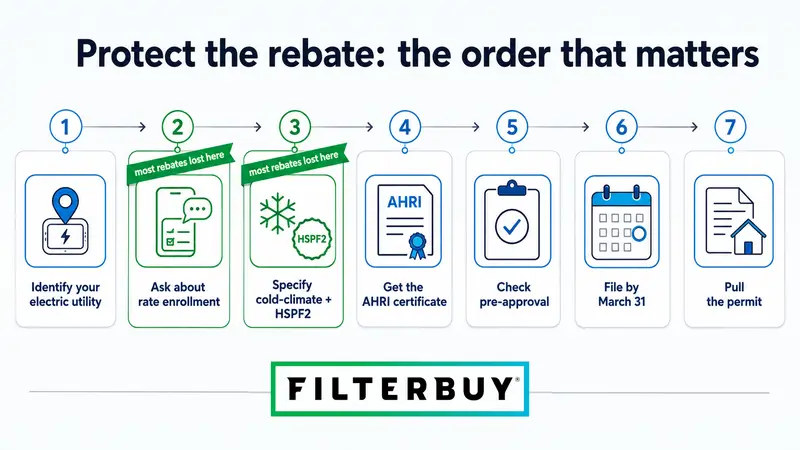
The order matters more than most homeowners expect. Rebates get lost on paperwork and timing far more often than on equipment.
Identify your electric utility. Not your gas utility. In North Dakota, mini split money comes from the electric side: Otter Tail Power, a Minnkota member cooperative such as Cass County Electric or Nodak Electric, Xcel Energy, Montana-Dakota Utilities, or a Basin Electric member co-op, depending on where you live.
Ask about rate enrollment before you buy. Confirm whether a Dual Fuel, Deferred Load, RDC, or off-peak rate is required, and what enrolling involves. This is the step that disqualifies people.
Specify a cold-climate heat pump and get the HSPF2 in writing. Otter Tail's North Dakota schedule needs cold-climate classification and an HSPF2 of 7.5 or higher. Cross-check the model in the AHRI Certified Directory yourself rather than trusting a spec sheet.
Get the AHRI certificate at installation. Otter Tail requires it, or a manufacturer spec sheet, attached to the application. Ask your contractor for it on the day of the install, when it is easy to get.
Check whether pre-approval applies. Otter Tail requires pre-approval where the expected rebate reaches $10,000 or more, and rebates will not exceed 75% of project cost.
File before the deadline. Rebate requests for a given calendar year's installation must reach Otter Tail by March 31 of the following year. Allow eight weeks for processing.
Pull the electrical permit. A mini split needs a dedicated circuit, and that is inspected work. The North Dakota State Electrical Board holds jurisdiction over all electrical installations in the state. Cities including Fargo issue electrical self-wire permits to homeowners who both own and live in a single-family home, with a rough-in and a final inspection, and NDSEB bills the fees. Rental property, mobile homes, and homes used for a daycare or home business must be wired by a licensed contractor.
A cold-climate mini split heat pump will heat a North Dakota home through most of the winter, but it needs a backup heat source for the coldest stretches, which is exactly why the state's rebate programs are built around Dual Fuel rates. A heat pump's capacity falls as the temperature drops, and North Dakota design temperatures run well below the point where any air-source unit carries a house alone. ENERGY STAR and the U.S. Department of Energy both document ductless heat pumps engineered for low-temperature performance, and the gap between those units and a generic one is the whole ballgame here.
The rate structures tell you what the utilities themselves expect. A Dual Fuel rate exists precisely because your electric heat will be interrupted at peak and something else has to carry the house. That something else is usually your existing furnace. A mini split in North Dakota is best understood as the system that does the easy 80% of the year cheaply and quietly, plus all of your cooling, while the furnace handles the genuinely brutal days.
This is the part of the page that costs us something, and North Dakota is the state where we have to say it plainly. Filterbuy's ductless mini splits are single-zone units on R-32 refrigerant, rated to heat down to about 5°F. We already say on our own mini split pages that a mini split is the best single-room fix in home comfort and a mediocre whole-house plan. Ten days a year, North Dakota does not get above zero. Do that arithmetic honestly and you get the shape of the answer: ours are a strong buy for the garage, the addition, the bedroom over the garage, the finished basement, paired with heat that already works. They are not the machine that carries a whole North Dakota house through February, and we are not going to pretend otherwise to move a unit.
We will also not tell you our units earn Otter Tail's $400 a ton, because we cannot show you that they do. That rebate requires cold-climate classification and a documented HSPF2 of 7.5 or better. Ask us, or any seller, for the AHRI certificate and read the heating number yourself. If a company selling you a heat pump cannot produce its HSPF2 on request, that silence is your answer.
Where our product does fit North Dakota better than most is a detail nobody markets, because it is unglamorous. Our 18,000 and 24,000 BTU units run on standard 115V household power. In a state where the electrical permit is the step homeowners actually trip on, not needing a new 240V circuit can save $500 to $2,000 and turns a self-wire application into a much smaller piece of paper. That is a real advantage. It is also narrow, it has nothing to do with rebates, and it is the only one we are going to claim.
"In North Dakota the mistake I see is people shopping the box and ignoring the rate. The unit is half the decision. What your utility will pay you for it, and what rate it has to sit on, is the other half, and you have to settle that before the equipment shows up, not after."
- David Clark, Certified HVAC Professional & President, Filterbuy HVAC Solutions
If you take a controlled rate to earn the rebate, your backup furnace stops being a backup. It becomes a scheduled participant that fires every time the utility curtails your heat pump. In North Dakota that means the filter in your furnace works harder than it would in almost any other setup in the country, and nobody mentions it when they sell you the rate.
Follow the logic of the page you have just read. To earn Otter Tail's $400 a ton you go on a Dual Fuel, Deferred Load, or RDC rate. The utility can then interrupt your electric heat during peaks, and on the Dual Fuel rate that permission runs up to 24 hours a day. Every time it exercises that right, your gas or propane furnace picks up the house. That is the deal, and it is a good one.
But look at what it does to the furnace. In a conventional home, a backup furnace is an emergency device that runs on the worst nights of the year. On a North Dakota dual-fuel setup it is a scheduled participant that fires whenever the grid is busy. It runs more hours, and it pulls more air through its filter, inside a house that is sealed shut from October to April.
The mini split's own filter is a mesh pre-filter. Rinse it every two to four weeks. It protects the coil, not your lungs.
The furnace filter is the one doing real work all winter, and the rate you just signed up for makes it do more. A pleated MERV 11 to MERV 13 filter catches the dust and dander a closed North Dakota house recirculates for six months.
Check it monthly through the heating season rather than seasonally. A furnace on a controlled rate is not running on a normal schedule, so it should not be maintained on one either.
We make those filters. More than 600 sizes, manufactured in the USA, shipped on a schedule you set with filter auto-delivery. That is not why we told you the air conditioner rebate does not exist in North Dakota. But it is why we noticed that the rate structure and the filter are the same story, and why most guides that cover one never mention the other.
Otter Tail Power pays $400 per ton for a cold-climate ductless heat pump on a Dual Fuel, Deferred Load, or RDC rate. Minnkota's member cooperatives, including Cass County Electric and Nodak Electric, pay $150 per ton for air-source and mini-split heat pumps. There is no federal credit for a 2026 install and no state program running.
No. Section 25C was terminated for property placed in service after December 31, 2025. If your system was installed and operating before that date, you can still claim it on your 2025 return using IRS Form 5695.
No state-funded one. The federally funded HEAR and HOMES programs have $74.3 million allocated to North Dakota combined but have not launched, and Commerce has announced no launch date. Everything available today comes from electric utilities.
There is no estimated launch date. The state is awaiting final DOE approval and says it will announce on its Home Energy Rebates Program page. Be sceptical of anyone who tells you otherwise: Commerce warns that offers circulating in the state now are likely fraudulent.
On Otter Tail Power in North Dakota, yes: a cold-climate heat pump must be on a Dual Fuel, Deferred Load, or RDC rate and stay subject to control. Minnkota's wholesale program says mini-split heat pumps do not require off-peak enrollment, but member cooperatives set their own rules, and Cass County Electric advertises its rebate with the off-peak program. Ask your utility before you buy.
Not on Otter Tail Power in North Dakota. Its North Dakota schedule lists only cold-climate, geothermal, and air-to-water heat pumps. The $100 ENERGY STAR air conditioner rebate and the $300-per-ton standard heat pump rebate exist in Minnesota and South Dakota, but not here.
A cold-climate mini split heat pump handles most of the heating season efficiently, but it needs backup heat for the coldest stretches. That is the premise of the Dual Fuel rates the utilities offer, and it is why we recommend pairing one with an existing furnace rather than replacing it.
Yes, for the electrical work. The North Dakota State Electrical Board has jurisdiction over all electrical installations statewide. Cities including Fargo issue self-wire permits to homeowners who own and occupy a single-family home, with rough-in and final inspections, and NDSEB bills the fees. Rental and commercial property must be wired by a licensed contractor. Handling refrigerant also requires EPA Section 608 certification, and a DIY install voids most warranties.
Both. Filterbuy has manufactured air filters in the USA since 2013, in more than 600 sizes, and also sells single-zone ductless mini split heat pumps from 12,000 to 24,000 BTU on low-GWP R-32 refrigerant. We are the only brand offering 18,000 and 24,000 BTU units on standard 115V power, which can save a costly 240V circuit. Our units heat to about 5°F, so in North Dakota pair one with backup heat, exactly as this guide recommends. We also cannot promise you they clear Otter Tail's cold-climate bar for the $400-per-ton rebate; ask us for the AHRI certificate and check the HSPF2 yourself.
Yes, and in North Dakota more often than you would think. Each mini split head has a washable mesh pre-filter to rinse every two to four weeks, but it protects the equipment rather than your air. If you keep a furnace for backup heat, and on a controlled rate you will, that furnace fires every time the utility curtails your heat pump. Its pleated MERV 11 to 13 filter is doing the real air-quality work all winter.
A dated invoice showing brand and model, the AHRI certificate or manufacturer spec sheet proving the ratings, your account number, and the signed application. Otter Tail requires installations from a given calendar year to be filed by March 31 of the following year, and allows eight weeks for processing.
How we verified this guide: every rebate amount, deadline, and tax detail here was checked against the primary sources below on July 18, 2026, not against a rebate database. Programs change, so we update this page as they do. If you spot a figure that has shifted, confirm it with the program administrator before you rely on it.
North Dakota Department of Commerce - Home Energy Rebates Program
IRS - Energy Efficient Home Improvement Credit (Section 25C)
NOAA NCEI - North Dakota State Climate Summary 2022 (NESDIS 150-ND)
DSIRE - Database of State Incentives for Renewables & Efficiency