Installation, Costs & Filter Guide (NC Climate)
By Michelle Wan, Brand Manager and Air Quality Writer at Filterbuy. Reviewed by David Clark, Licensed HVAC Technician and owner of Filterbuy HVAC Solutions. Published August 12, 2026. Updated August 12, 2026.
A single-zone mini split in Raleigh runs about $2,500 to $6,000 installed in 2026. The citywide average is $2,946, and multi-zone jobs reach $14,239. The first zone costs the most because its price includes the outdoor condenser that later zones share. Plan on a mechanical permit and a licensed contractor either way.
Browsing equipment? See Filterbuy mini split systems, available in 12,000, 18,000 and 24,000 BTU.

Answer a few quick questions and we will match you to the right mini split for your space.
A single-zone mini split in Raleigh runs about $2,500 to $6,000 installed in 2026, and the work needs a mechanical permit and a licensed contractor. The federal 25C credit expired December 31, 2025, so savings now come from Energy Saver NC. What most listings skip: the mesh filter protects the machine, not your lungs. Raleigh’s pollen needs real filtration elsewhere in the house.
A single-zone mini split installation in Raleigh costs roughly $2,500 to $6,000. The first zone costs most; it includes the outdoor condenser.
The federal 25C tax credit is gone. The IRS states it is not allowed for property placed in service after December 31, 2025. Pages advertising “up to $2,000 back” are out of date.
Energy Saver NC pays up to $8,000 toward a heat pump for income-qualified households. Wake County became eligible in January 2026.
A mechanical permit is required, plus a licensed contractor and EPA Section 608 refrigerant certification.
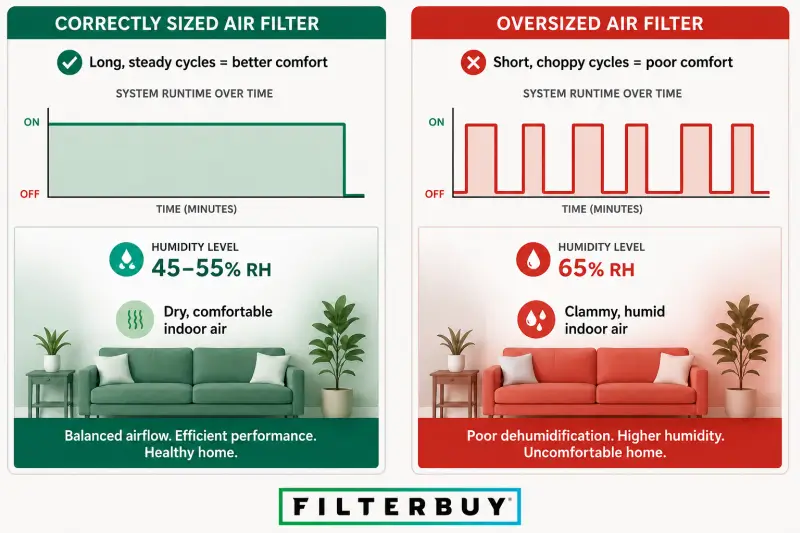
Oversizing is the #1 mini split mistake in Raleigh’s mixed-humid climate. It cools fast, then cycles off before the air dries out.
A mini split’s mesh filter is a coil guard, not an air purifier. The EPA states ductless systems generally do not filter fine particles.
Three findings back the guidance below.
Ductwork wastes more than 30% of a home’s heating and cooling energy. A ductless head has no ducts to lose it through.
ENERGY STAR Mini Split Heat Pumps Fact Sheet (U.S. EPA and DOE, 2024)
Raleigh ranks 7th of 100 U.S. metro areas for seasonal pollen allergies. Filtration earns more attention here than in most markets.
AAFA 2026 Allergy Capitals report (March 2026)
Indoor humidity should stay below 60%, ideally 30–50%. An oversized unit short-cycles and cannot hold that band.
Note: the ENERGY STAR sheet predates the 2025 repeal of 25C. Its incentive paragraph is stale; the duct-loss figure is not.
Expect $2,500 to $6,000 for a single-zone mini split installed in the Raleigh–Durham area in 2026, per local contractor pricing. Angi’s Raleigh cost data puts the citywide average at $2,946, with a range of $1,964 to $14,239 by zone count. The first zone costs most: it includes the outdoor condenser later zones share.
Source: Angi Raleigh mini-split cost data, updated July 2026. Get three written quotes before budgeting.
A unit price is not an installed price. Filterbuy sells single-zone mini splits at 12,000, 18,000 and 24,000 BTU, and like every reputable brand we require professional installation. Comparing an equipment sticker against another company’s installed quote is not a comparison.
That spread is the best argument for three written quotes. Raleigh labor runs slightly below the national average, but our long cooling season keeps installers booked and pushes rates up May through September. Quote in March or October–November for a better price and faster start.
The federal tax credit for mini splits is gone. The IRS confirms Section 25C is not allowed for any property placed in service after December 31, 2025, under the One, Big, Beautiful Bill Act (Public Law 119-21). See the IRS summary of One, Big, Beautiful Bill provisions and the detailed clean energy credit FAQs (FS-2025-05). A system bought in 2025 but installed in 2026 does not qualify. North Carolina has no state credit either.
Several Raleigh pages still advertise it. Budget as though it is gone. If you installed in 2025, our guide to heat pump tax credits and what replaced them covers claiming it that year.
Here is what a Wake County homeowner can actually claim:
Duke amounts are published tiers requiring a Home Energy Check. Duke's rules are written around full ducted replacement, so confirm ductless eligibility before purchase.
Energy Saver NC is run by NC DEQ. Wake County entered in January 2026, so Raleigh homeowners are eligible now. It runs until 2031 or until funds run out, first-come, first-served.
Two rules catch people out. HEAR rebates are not retroactive, so apply before work starts. Self-installation is excluded. Start at energysavernc.org.
One caution the other Raleigh pages skip. Duke Energy’s HVAC rebate is written around ducted replacement: condensing unit and air handler must change together, and a Home Energy Check must be on file. One tracker reports ductless is excluded outright, and Duke’s rules do not name it. Get eligibility in writing first.
Every Raleigh guide lists the incentives. None mention that the sequence decides whether you receive them. Three of these four steps happen before a contractor touches your house.
Confirm income eligibility at energysavernc.org. HEAR rebates are not retroactive, so a system already installed cannot be claimed.
Book Duke Energy’s free Home Energy Check. Duke’s prerequisites require one completed before work begins, or within the previous 24 months.
Hire a registered, licensed contractor and have them pull the mechanical permit. Self-installation disqualifies you from Energy Saver NC and voids the manufacturer warranty on most systems, ours included.
Install, then keep the invoice, the equipment certification, and the permit record together.
Get steps 1 and 2 out of order and the equipment still runs perfectly. You simply paid full price for it.
Size a Raleigh mini split by load, never by square footage. Raleigh sits in climate zone 4A, mixed-humid, where the summer job is removing moisture rather than just dropping temperature. Insist on a room-by-room Manual J calculation before anyone quotes equipment, and treat a contractor who skips it as a contractor who will oversize it.
Here is the trap. An oversized mini split hits setpoint quickly, then throttles down or shuts off. Short run times mean the coil never stays cold long enough to pull water from the air. You end up at 72°F and 65% relative humidity: cold, damp, prone to musty smells. EPA advises staying below 60%, ideally 30–50%.
This is not theoretical. David Clark, who reviewed this page, has spent over a decade in the field at Filterbuy HVAC Solutions. In his own guide to buying a new system he leads with “Forget ‘bigger is better.’” An oversized unit, he writes, cools fast but will not pull humidity out. In a Raleigh August that is the gap between comfortable and merely cold.
Multi-zone makes this worse. A large outdoor unit has a minimum capacity, so running one bedroom head overnight forces short, high-output bursts. Size conservatively.
Ask every contractor two things:
“Can you show me the Manual J output?” Not a square-footage rule of thumb.
“What is the outdoor unit’s minimum capacity with the zones I am buying?”
If a contractor sizes by square footage alone, keep interviewing. Damp air feeds mold on the coil and in the drain pan.
Yes to both. Wake County’s rules require a mechanical/HVAC permit to install, relocate, replace, or repair any heating or air-conditioning system. New wiring needs its own electrical permit and a licensed electrician.
One detail worth getting right: Wake County permits unincorporated areas, while homes inside Raleigh city limits go through the City of Raleigh. Check your address on iMAPS first. Raleigh treats HVAC replacement as a “no plans needed” permit, approved in about five business days.
Your installer needs two credentials: a North Carolina license from the State Board of Examiners of Plumbing, Heating and Fire Sprinkler Contractors, required under NC General Statute 87-21.
EPA Section 608 certification, which is federally required to handle the refrigerant in the line set.
Confirm any contractor with the Board’s free license verification search: search the company name, then check the license is active and covers heating. A reputable contractor pulls the permit and includes it in the quote. If a bid is unusually low and permitting goes unmentioned, ask why.
The mesh filter inside your mini split is a coil guard, not an air purifier. The EPA states plainly that ductless mini-split heat pumps generally do not filter fine particles.
That distinction matters more in Raleigh than almost anywhere. The NC DEQ pollen sampler on Reedy Creek Road is the only one in the state. On April 1, 2024 it logged 16,284 tree pollen grains per cubic meter, the highest since monitoring began in 1999 and far above the 10,995 record set in 2010. Oak is the primary tree allergen, peaking April through June. Pine makes the yellow dust but is less allergenic. Grass runs late May into July; ragweed peaks in September. Check today’s Raleigh pollen report before opening the windows.
Where we stand, plainly. Filterbuy is a family-owned air filter manufacturer that has built filters in the United States since 2013, in Alabama, Florida, Pennsylvania and Utah. One of our rules is that we do not make claims we cannot back, and here it cuts against us. We sell air filters. Your mini split does not take one of ours. Every ductless guide we publish lands on the same sentence: that mesh screen is made for airflow, not fine dust. Cleaning it protects your equipment, not your air.
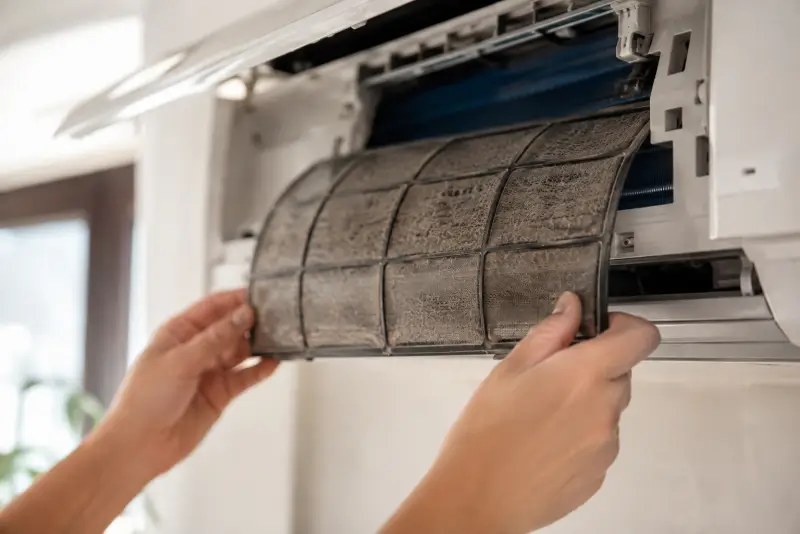
Clean the mesh every two to four weeks during pollen season. Power off, lift the panel, slide the filters out without shaking dust into the room, vacuum with a soft brush, wash in mild soapy water and dry fully. Never reinstall a damp filter. Our mini split filter cleaning guide covers brand variations; the full walkthrough adds coils and drain.
Then handle fine particles elsewhere. If a central system serves your other rooms, that is where a pleated filter earns its keep. The EPA benchmark for fine-particle capture is a documented MERV 13 rating or higher, repeated in its Guide to Air Cleaners in the Home. For rooms served only by ductless heads, a portable air cleaner covers what the mesh cannot. We compare both in mini split vs. air purifier.
Cadence reflects NC DEQ pollen seasons for the Raleigh sampler, which runs late February through mid-November. Homes with pets or allergies should stay on the two-week interval year-round.
One trick we would pass to a neighbor: hold the filter against white paper, a test the American Lung Association suggests. If it reads gray, clean it. Newer units ship with a reminder light, ours included, but it counts run hours, not dirt. In an April pollen surge, the paper test tells you sooner. For the routine, see how often to service a mini split. Our live NC wildfire and smoke map tracks smoke by county.
For rooms your central system cannot reach, like bonus rooms, sunrooms, additions and converted attics, a mini split is usually the most cost-effective fix. It is weaker as a whole-home swap if your ducts are sound.
One day for single-zone, two to three for multi-zone. Permit approval averages five business days.
Yes. Raleigh winters are mild enough that a modern inverter heat pump handles the season without strip heat.
Only if correctly sized. For serious moisture problems, a dedicated dehumidifier still wins.
Repair visits bill at local HVAC labor rates, roughly $50 to $65 an hour. Budget one professional service call a year for coil, refrigerant and drain checks. Filter cleaning stays free and stays yours.
On its own, no. Raleigh air quality depends on what filters the rest of the house, plus a portable cleaner in any room served only by a ductless head.
Ready to clean up the air in the rest of your home? Raleigh’s pollen season is long. Find your Filterbuy filter size for the system serving the rest of the house. American-made, factory-direct, 600+ sizes, shipped free. Auto-delivery sends the right filter on schedule.
Shopping for equipment? See the complete mini split buying guide.
Mini split: A ductless system pairing an outdoor compressor with indoor heads via refrigerant lines.
Manual J: The ACCA residential load calculation that sets equipment size from square footage, insulation, and windows.
MERV: Minimum Efficiency Reporting Value, the 1–16 scale rating an air filter’s particle capture. MERV 13 is the EPA benchmark for fine-particle filtration.
Mesh pre-filter: The washable screen behind a mini split’s front panel. Not rated for fine particles.
Section 25C: The federal Energy Efficient Home Improvement Credit, ended for property placed in service after Dec. 31, 2025.
Energy Saver NC: North Carolina’s federally funded rebate program, run by NC DEQ, covering HEAR and HOMES.
EPA Section 608: Federal certification to handle refrigerants.