The Quietest Mini Splits: Low-Noise Ductless Systems Ranked by Decibel Level
WRITTEN BY Michelle Wan | REVIEWED BY David Clark, Licensed HVAC Technician | PUBLISHED September 1, 2026
What Is the Quietest Mini Split?
The quietest mini splits publish 19 to 21 dB(A): the Daikin Emura at 19 dB, Mitsubishi's MSZ-FS series at 20 dB, and the LG Art Cool Mirror at 21 dB. Every one of those numbers comes from the lowest fan speed, and on the medium speed most people run, the same units sit between 29 and 35 dB(A).
- Daikin Emura FTXR09 — 19 dB(A) on quiet, 38 dB(A) on high
- Mitsubishi MSZ-FS09NA — 20 dB(A) on quiet, 40 dB(A) on super-high
- LG Art Cool Mirror LAN090HSV5 — 21 dB(A) on sleep, 41 dB(A) on high
- Value and DIY heads — 23.5 to 28 dB(A) at their lowest speed
Sizing and mounting shape what you hear more than the badge does, and a clogged filter can undo any of it. The quiz below matches your room to the right size system.
Disclosure: Filterbuy sells ductless mini splits, so our own unit is ranked here beside brands we compete with. It places last on noise, at its published 28 dB(A) Mute Mode figure.

Answer 3 quick questions and we'll match you to the right size system for your room.
Already know your size? Filterbuy 17 SEER2 single-zone systems come in 12,000, 18,000, and 24,000 BTU, with a 7-year compressor warranty and free 2-day delivery on in-stock systems.
TL;DR: The quietest mini splits publish 19 to 21 dB(A): the Daikin Emura at 19 dB, Mitsubishi's MSZ-FS series at 20 dB, and the LG Art Cool Mirror at 21 dB. Every one of those numbers comes from the lowest fan speed, and on the medium speed most people run, the same units sit between 29 and 35 dB(A). Sizing and mounting shape what you hear more than the badge does, and a clogged filter can undo any of it.
Key Takeaways
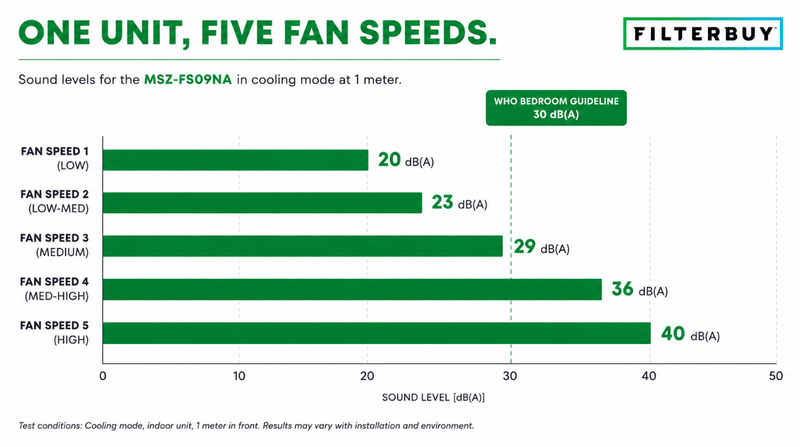
The advertised decibel rating is a floor, not an average. Mitsubishi's MSZ-FS09NA publishes 20 dB(A) on Quiet, 29 on Medium, and 40 on Super-high. Published figures also conflict: LG's 2023 sheet says 21 dB(A) where retail listings still say 19.
Capacity drives the quiet-mode number. In MRCOOL's DIY line, the 12,000 BTU head is rated 23.5 dB(A) on low and the 36,000 BTU head 35 dB(A). Buying more capacity than the room needs costs 11.5 decibels.
A clogged filter raises operating noise by pushing the fan higher to compensate for lost airflow, and on a ductless head the mesh sits right at the coil. Our mini split filter cleaning guide covers the routine.
Disclosure: Filterbuy sells ductless mini split systems as well as air filters, so our own unit is ranked here beside brands we compete with. It places last on noise, at its published 28 dB(A) Mute Mode figure. Where it competes is value: $799 with free 2-day delivery on in-stock systems and a 7-year compressor warranty. It is a single-zone system rated to 5°F and requires professional installation. Filterbuy is not affiliated with or endorsed by Mitsubishi Electric, Daikin, LG, Fujitsu, or MRCOOL.
The Quietest Mini Splits, Ranked by Published Decibel Level
The quietest ductless mini splits publish 19 to 21 dB(A) at their lowest fan speed. The Daikin Emura leads at 19 dB(A), with Mitsubishi's MSZ-FS series and the LG Art Cool Mirror behind it. Value and DIY heads open in the mid-20s, from 23.5 dB(A) up to 28.
Filterbuy makes air filters and services ductless systems in the field, so this page weighs the filter as heavily as the badge. Every figure below comes from the manufacturer's own submittal sheet: Daikin, Mitsubishi Electric, LG, Fujitsu, MRCOOL, and Filterbuy.
Indoor sound pressure, cooling mode, as published by each manufacturer. Measured in a controlled test environment, so your room will not reproduce these numbers exactly. LG's current submittal lists 21 dB(A); earlier LG documentation and many retailer listings still cite 19 dB(A).
Two gaps stand out. About 9 decibels separate the quietest premium unit from a value unit at low speed, but a single unit's own range runs 15 to 23 decibels. Speed matters more than badge.
How We Built This Ranking
Every figure came from a submittal sheet rather than a product page. Marketing copy quotes one number, almost always the lowest fan speed on the smallest unit in a series. The submittals publish the whole ladder.
It also caught a mistake we would have repeated. Nearly every roundup lists the LG Art Cool Mirror at 19 dB(A), but LG's own sheet, revised in 2023, lists 21 dB(A) on Sleep. Retail listings never updated, so we moved the unit down two places.
“I read spec sheets for a living. What surprised me here was not which brand won, but how much published noise data is marketing copy quoting other marketing copy. Read the submittals and half the numbers everyone repeats turn out to be the quietest setting on the smallest unit in the line.”
— Michelle Wan, Brand Manager and Air Quality Writer, Filterbuy
Our own product got the same treatment, which is why it sits at the bottom of the table. Quiet is not the axis the Filterbuy 12,000 BTU head wins on. We would rather publish a ranking we lose than one we cannot.
What the “19 dB” Number on the Spec Sheet Actually Means
A rating like 19 dB(A) describes the indoor unit at its slowest fan speed in a test chamber, so treat it as a floor. On a warm afternoon your unit settles a step or two above it, and Daikin, Mitsubishi, and Fujitsu all publish the full ladder.
Cooling mode. The Daikin and Fujitsu units have four fan speeds; the Mitsubishi MSZ-FS09NA has five.
A 10-decibel rise is heard as roughly twice as loud, so a unit advertised at 19 dB(A) can sound twice that once the fan steps up. The practical read: compare low and medium speeds, ask the distributor for the current submittal, and weigh the decibel gap against the installed price of each tier.
How Quiet Does a Bedroom Mini Split Need to Be?
Aim for under 30 dB(A) at the speed the unit holds overnight. The World Health Organization's community noise guidelines recommend keeping continuous indoor bedroom noise below 30 dB(A), and that threshold, rather than the lowest published rating, is the number worth designing around.
The U.S. EPA sets a parallel threshold of 45 dB indoors, the level below which activity interference and annoyance do not occur. For scale, 30 dB(A) is a whisper at a few feet and 40 dB(A) a quiet library. Outdoor units are a separate matter, running 47 to 49 dB(A) on the Mitsubishi FS series, which matters for neighbours rather than sleep. The scale is logarithmic, so every 10 dB reads as double the loudness and the 9-decibel gap across our table is no rounding error.
What Quiet Mode Actually Costs You
Quiet mode is not free. The speed that produces the advertised decibel number also moves the least air, and manufacturers publish both figures in the same submittal without setting them side by side.
Mitsubishi Electric MSZ-FS09NA, cooling mode, dry-coil airflow, from the manufacturer submittal. Share of maximum airflow is our own calculation from those published figures.
On Mitsubishi's 9,000 BTU MSZ-FS09NA, the 20 dB(A) headline arrives with 137 CFM, about a third of the air the unit can move. Reaching 58% airflow puts you at 29 dB(A).
Sizing beats badge for that reason. A head matched to the room holds the load at 36 to 44% airflow and near 20 to 23 dB(A) overnight, while an undersized or short-cycling one climbs the ladder. Capacity works the same way: MRCOOL's DIY line runs 23.5 dB(A) on low at 12,000 BTU and 35 dB(A) at 36,000 BTU, so our BTU sizing guide starts with square footage, not a product tier.
How a Dirty Filter Makes Your Mini Split Louder
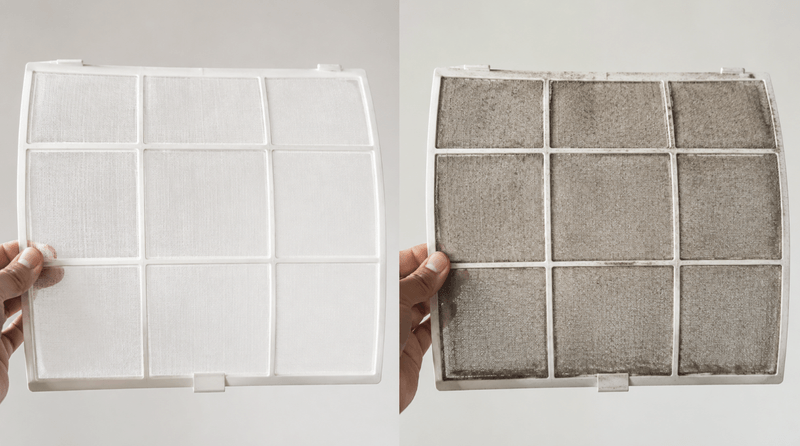
A clogged filter raises noise two ways. Forcing the same airflow through a blocked mesh raises air velocity at the open spots, adding a rushing or whistling character. The system then compensates by running the fan faster, and the published fan-speed ladders show what that costs: one speed adds 3 to 10 dB, two speeds adds 9 to 15.
Ductless heads feel this fast, because the mesh sits directly at the evaporator coil. The EPA notes that mini split filters exist mainly to keep large debris out of the equipment, so a loaded mesh becomes a performance problem before an air-quality one.
Our HVAC Solutions team services ductless systems in Florida and Texas, and the pattern rarely varies: the head that got louder is almost never broken. It is a mesh nobody has checked since spring. In our service data a restricted filter cuts efficiency by 5–30%, showing up as longer run times at higher fan speeds. Both mean louder.
Our factory testing found fine dust under 10 microns is harder on a system than visible dirt, because it settles deeper in the coil. By the time the mesh looks dirty the airflow loss has already happened.
The fix is free. The mesh is washable, and Mitsubishi, Daikin, Fujitsu, and LG all say clean it every two weeks during heavy heating or cooling season. Full walkthrough: how to clean mini split filters. Ignore the reminder light, which counts run hours rather than dirt, and hold the mesh against white paper instead.
Four Ways to Quiet a Mini Split You Already Own
Most noise complaints trace back to maintenance or mounting. Work through these first.
Clean the mesh filter. Ten minutes, no tools, and the usual cause of a unit that got louder. See the brand-by-brand method.
Turn on quiet or sleep mode. Filterbuy calls it Mute Mode; other brands use Quiet, Sleep, or Silent.
Confirm the sizing. A unit that hits setpoint fast then cycles is oversized, and a head bolted to a hollow stud bay transmits vibration. A load calculation during an annual service visit.
Listen for what changed. Rattling or gurgling is mechanical, not fan speed. A musty smell alongside it points to something deeper in the unit, covered in our ductless troubleshooting guide.
“Nine times out of ten, when a homeowner tells me their mini split got louder, the equipment is fine. It's a filter no one has touched in a season, or a head that was mounted to a wall that acts like a drum. Both are fixable in an afternoon.”
— David Clark, Licensed HVAC Technician
Frequently Asked Questions
Your Next Step
If your mini split is louder than last summer, start with the filter. Pop the panel and hold the mesh up to white paper. If it looks gray, give it ten minutes at the sink. Nine times out of ten that is the repair.
Running a central system too? Filterbuy ships American-made filters in 600+ sizes, free, with auto-delivery. For unit-specific questions, our Mini Split Support Center can help.
Michelle Wan is Filterbuy's Brand Manager and air quality writer, working with the U.S. manufacturing team across factories in Alabama, Florida, Pennsylvania, and Utah. Reviewed by David Clark, Licensed HVAC Technician.
Glossary
Quiet mini split AC: A ductless system whose indoor head publishes a low sound pressure rating at its lowest fan speed, marketed also as a silent ductless AC or a low noise mini split. None are actually silent; the quietest publish 19 to 21 dB(A).
dB(A): A-weighted decibels, adjusted to match how human hearing responds across frequencies. The standard unit for rating HVAC noise.
Sound pressure level: Noise measured at a set distance, and the figure manufacturers publish for indoor units.
Submittal sheet: A manufacturer's engineering specification for a model, including its sound pressure at every fan speed.