How Long Do Mini Splits Last? Lifespan Guide + Maintenance Tips
Most ductless mini splits last 15 to 20 years. Well-installed systems that are cleaned on schedule often run past 20, and neglected ones can fail in under a decade. Installation quality and filter cleanliness move that number more than the brand on the wall does.
How that compares with other home cooling equipment:
- Ductless mini split: 15 to 20 years
- Central air conditioner: 12 to 15 years
- Ducted air-source heat pump: 10 to 15 years
- Window or portable AC: 8 to 10 years
If yours is closing in on that range, the quick match below points you to a Filterbuy mini split system sized for your space.

Answer a few quick questions and we will match you to the right mini split.
Already know it is time to replace? Browse Filterbuy mini split systems
A ductless mini split is one of the longest-lived pieces of equipment in a modern home, and one of the easiest to shorten the life of by accident. Most last 15 to 20 years. Some quietly pass 20. Others fail at nine, almost always for reasons the homeowner never saw coming.
Filterbuy has manufactured air filters in the United States since 2013, more than 50 million of them, for over two million households, and our HVAC Solutions team services ductless systems in Florida and Texas homes. That gives us an odd but useful vantage point on this question. We see the filters that come back, and we see the systems they came out of. The pattern holds: the mini splits that reach 20 years are rarely the most expensive ones. They are the clean ones.
TL;DR
Most ductless mini splits last 15 to 20 years, and well-installed, consistently maintained systems often exceed that. Lifespan depends far more on how the system was installed and how clean it is kept than on the brand on the wall. Climate matters too. Replace rather than repair when a compressor fails past 12 years, or when a repair quote approaches half the price of a new system. Cleaning the washable filters every two to four weeks is the highest-return habit any owner has.
Top Takeaways
The average mini split lifespan is 15 to 20 years, longer than the 12 to 15 years typical of a central air conditioner.
The U.S. Department of Energy puts the energy-consumption gap between a well-maintained heat pump and a severely neglected one at 10% to 25%. Filterbuy service data on ductless heads runs wider, 5% to 30%.
Installation quality sets the ceiling. Sizing, refrigerant charge, and condensate slope set how long a system can last; maintenance decides whether it gets there.
Coastal salt air, heavy pet dander, and year-round runtime all pull real years off a mini split's service life.
A failed compressor on a system past 12 years is usually a replacement, not a repair. Since 2025, the federal refrigerant transition has factored into that call.
Washable mini split filters need cleaning every two to four weeks. A clogged filter starves the evaporator coil of airflow, the most common preventable cause of compressor strain.
How Long Do Mini Splits Last on Average?
A ductless mini split lasts 15 to 20 years on average, and a well-installed system with consistent maintenance can run past 20. Mini splits outlive central air conditioners for two structural reasons: no ductwork to leak or fill with debris, and inverter-driven compressors that modulate output rather than slamming on and off. The Department of Energy notes duct losses can exceed 30% of space-conditioning energy, a load a ductless system never carries. Neglected units can fail in under a decade.
Service-life ranges reflect published manufacturer guidance and industry consensus for well-installed residential equipment.
One caveat most lifespan guides skip: a mini split heat pump works in both seasons. A primary-zone head in a cold climate accumulates far more run hours than the same model used for supplemental cooling, and it wears out sooner. The Filterbuy HVAC Solutions systems we service in Florida and Texas age the opposite way, from cooling-dominant runtime and salt or humidity load rather than winter hours.
What Determines Whether Your Mini Split Lasts 10 Years or 20?
Mini split longevity comes down to five variables: installation quality, maintenance consistency, run hours, environment, and equipment tier, roughly in that order of impact. Brand matters less than buyers expect. A premium unit installed with the wrong refrigerant charge loses to a mid-tier unit installed correctly and cleaned on schedule. Correct sizing starts with an ACCA Manual J load calculation; our guide to what size mini split you need covers the BTU ranges by room.
The Filterbuy Mini Split Lifespan Ledger below is our own framework for weighing those variables. The ranking is our editorial judgment, drawn from published manufacturer guidance, federal research, and what our HVAC Solutions technicians report from ductless service calls. It is not a controlled study, and we would rather say so than dress it up as one.
Impact is ranked by how much each factor moves service life, highest first. The ranking is Filterbuy editorial judgment; the filter and coil row is supported by Filterbuy service data cited below the table.
What We See in the Field
Two things in that table come from our own records rather than the literature.
A dirty, restricted filter cuts a mini split's efficiency by 5% to 30% in our service data, depending on how bad the buildup is. On a ductless head the mesh sits directly in front of the coil, so airflow loss shows up faster than it does on a central system.
Restoring a dust-coated coil after a neglected filter runs about $350 to $600 in our customer-service data. That is the price of skipping a free, ten-minute rinse.
The counterintuitive finding came from our own factory testing: fine dust under 10 microns proved harder on a system than visible dirt, because it settles deeper into the coil and is far tougher to clean off later. The practical translation is that waiting until the mesh looks filthy is already waiting too long.
Warning Signs Your Mini Split Is Nearing the End
A mini split near the end of its service life shows a cluster of symptoms, not one dramatic failure. The reliable tells are rising energy bills with no change in habits, run times that never quite reach setpoint, repeat service calls in a single season, and mechanical noise that was not there before. Any one can be a cheap repair. Three at once, on a system past 12 years, is a replacement conversation, and an annual professional service visit catches most of them early.
Repairs are clustering. Two or more service calls in one season signals systemic wear.
Bills climb while comfort drops. A fouled coil or slow leak shows on the utility bill months before it shows as a breakdown.
New noises appear. Grinding or banging suggests a failing bearing; hissing suggests a refrigerant leak, a repair with a deadline.
Ice forms on the indoor coil in cooling mode. Repeated icing traces to restricted airflow or low charge and shortens compressor life.
The musty smell survives cleaning. An odor returning days after you wash the filter points to growth on the coil or blower wheel. See our mini split mold guide.
Repair or Replace Your Mini Split? The 2026 Math
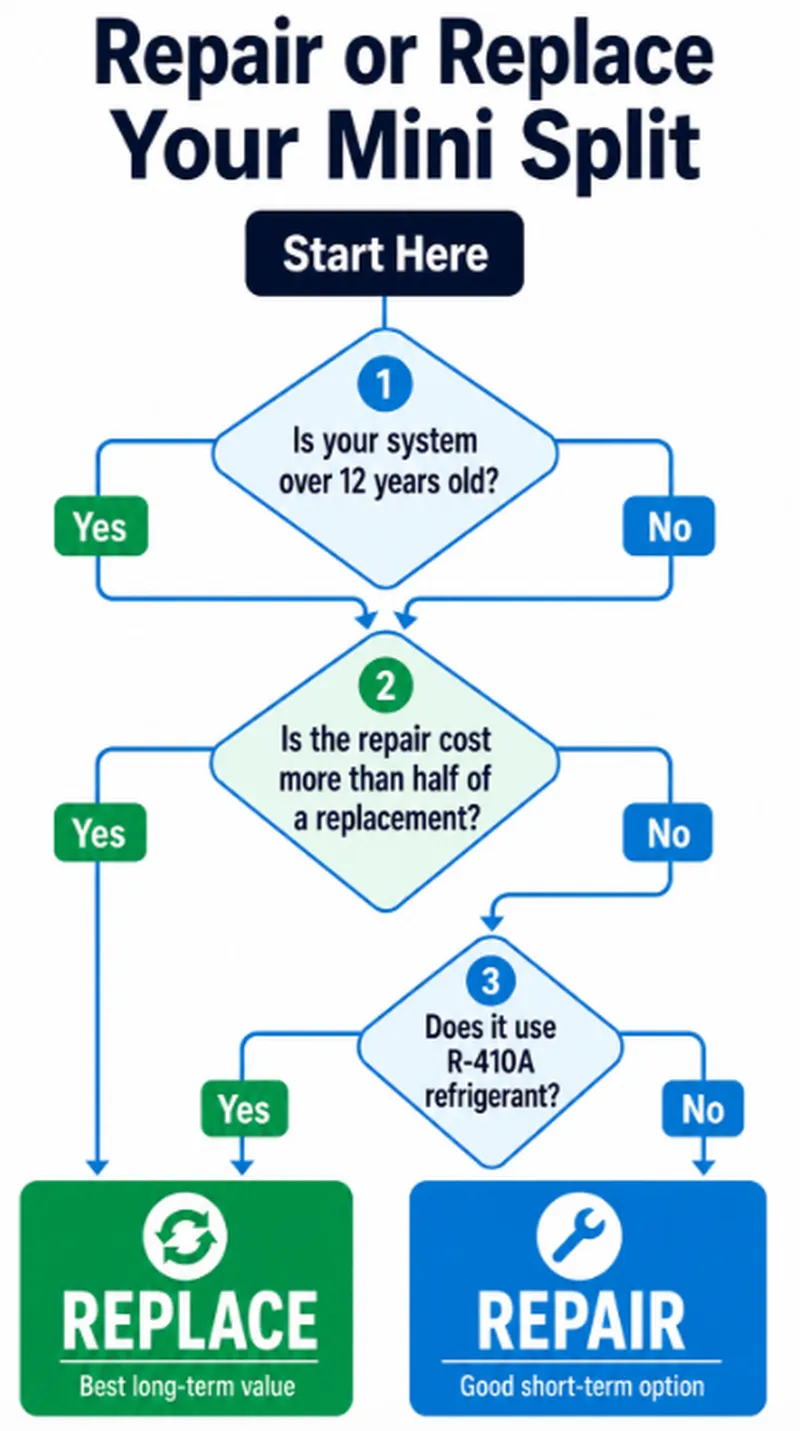
Our HVAC Solutions team applies one rule consistently: if a mini split is 12 to 15 years old and the compressor repair exceeds $800, full replacement almost always makes better financial sense. Below that age, repair an inexpensive fault: a capacitor, a sensor, a control board. The two general tests are the ones contractors use: whether a repair quote approaches half the cost of a new system, and whether repair cost multiplied by system age exceeds about $5,000. As of 2026 there is a fourth question most lifespan guides have not caught up with.
The refrigerant test. Under the EPA's AIM Act refrigerant phase-down, manufacture and import of new residential R-410A systems ended January 1, 2025, and new equipment now uses lower-GWP A2L refrigerants, primarily R-454B and R-32. Two practical consequences for owners of existing systems:
Your R-410A mini split is still legal to run, service, and recharge. The phase-down targets production, not your right to keep an installed system going. The EPA states there is no requirement to stop using equipment already in service, which can run to the end of its useful life.
You cannot retrofit an R-410A system to R-454B or R-32. The new refrigerants require equipment built for them, so a large refrigerant-side repair on an aging unit buys time on a platform whose service refrigerant grows scarcer as the phase-down deepens.
That is not a reason to rush. It means that on a 12-plus-year-old R-410A system facing a compressor or major leak repair, the scale tips toward replacement sooner than it did five years ago. Budget for the full cost: the federal 25C tax credit ended for equipment placed in service after December 31, 2025, so state and utility rebates are now the incentives that remain.
Ranges are 2026 national estimates and vary by region, zone count, and access. Replace when a repair quote approaches half the like-for-like replacement figure above.
Ranges are 2026 national estimates and vary by region, zone count, and access. See our mini split cost breakdown for full pricing detail, or browse Filterbuy mini split systems if replacement is the call.
The Lifespan Factor Most Guides Skip: Your Warranty Window
Registering your mini split within 60 to 90 days of installation can double its parts coverage. Most systems ship with a base warranty near five years on parts and seven on the compressor. Register on time and both typically rise to ten years. Have it installed by a brand-certified contractor and some lines reach twelve. Miss the window and those years are gone permanently. Filterbuy mini splits ship with a five-year warranty, and the same advice applies to ours as to anyone else: register it, keep the invoice, and store the confirmation somewhere you will still find it in year nine.
Typical ranges across major ductless brands. Exact terms vary by brand and model, so confirm against your own warranty booklet.
Four things the fine print usually does:
Covers parts, not labor. Free labor is commonly limited to the first year. After that you pay the hourly rate on a covered repair.
Assumes a licensed installer. On many brands a DIY installation voids coverage outright, which is a real cost of the DIY route.
Assumes documented maintenance. Skipped annual service can be grounds to deny a claim, so keep invoices and service records together.
Does not fully survive a home sale. Extended terms are often non-transferable and revert to the base period for the next owner.
One multi-zone detail worth knowing: indoor heads installed at the same time as the outdoor unit generally share its warranty, while heads added later can carry different terms and dates. On a multi-zone system the outdoor unit is also a single point of failure, since one condenser serves every head in the house.
This is why registration belongs in a lifespan article at all. A compressor that fails in year nine is a covered repair on a registered system and usually a full replacement on an unregistered one. The failure is identical. The five minutes you spent after installation decides which it is.
How Filter Maintenance Extends Mini Split Lifespan
Consistent filter cleaning is the cheapest lifespan insurance a mini split owner has. The Department of Energy's heat pump maintenance guidance puts the energy-consumption gap between a well-maintained heat pump and a severely neglected one at 10% to 25%. Our own service range runs wider, 5% to 30%, because a ductless mesh sits closer to the coil than a central filter does. Either way, the gap costs more than money. Restricted airflow across the evaporator coil forces longer run cycles and pushes the compressor to work against conditions it was never designed for.
The mechanism is simple. A mini split pulls the same room air across its coil thousands of times a day. Dust and pet dander load the mesh filter first, then slip past onto the coil fins. A fouled coil cannot transfer heat efficiently, so refrigerant returns to the compressor at the wrong temperature and pressure, cycle after cycle. Nothing breaks on day one. It just ages faster.
The routine that protects the compressor:
Wash the mesh filters every two to four weeks in heavy season, or every one to two weeks with pets. Our mini split filter cleaning guide covers the method by brand.
Do not trust the reminder light alone. Filterbuy mini splits include a filter-clean reminder, but like most of them it counts run hours rather than actual dirt. Hold the mesh against white paper; if it looks gray, wash it.
Dry filters completely before reinstalling. A damp filter reintroduces moisture into a dark enclosure.
Swap secondary filters on schedule. Carbon and ion inserts are replaced, not washed. See mini split replacement filters.
Flush the condensate drain line each season so water leaves the unit instead of pooling in the pan.
Rinse the outdoor coil and clear debris twice a year, more often near the coast or under tree cover.
Book a professional coil and blower cleaning annually. The surfaces you cannot reach are where efficiency disappears. See our complete mini split maintenance guide.
One clarification we make often: most ductless mini splits use a proprietary washable mesh pre-filter and cannot accept a standard boxed pleated filter. Do not force one in. If your home also has central HVAC, run a quality pleated filter there to cut the dust load reaching the mini split, and see our guide to choosing the right MERV rating. Pairing that with an ENERGY STAR certified ductless system is where efficiency and longevity compound.
7 Essential Resources Before You Repair, Replace, or Buy
Each resource answers one question this article raises, and each comes from a separate independent source.
1. Verify Your Exact System Is Certified Before You Pay
AHRI Directory of Certified Product Performance, the public database of the industry's independent certification body. Search your outdoor and indoor model numbers to confirm the pair is certified as a matched system. Rebate programs require the AHRI reference number, and an unlisted system is a warning sign.
2. See Real Heating Performance at 5 Degrees, Not Just SEER2
NEEP Cold Climate Air Source Heat Pump Product List, maintained by Northeast Energy Efficiency Partnerships. SEER2 describes cooling only. This list publishes heating capacity at 5 degrees Fahrenheit and below, which decides whether a mini split carries the winter load or leans on backup heat and wears out early.
3. Check the Research Behind the 15-to-20-Year Estimate
HUD Cityscape, Volume 26 Number 3, the peer-reviewed journal of HUD's Office of Policy Development and Research. Its 2024 heat pump study is the class of independent research behind the recent upward revision of modern service life estimates.
4. Know Exactly What Happened to the Federal Tax Credit
IRS Instructions for Form 5695, the official guidance of the Internal Revenue Service. The 25C Energy Efficient Home Improvement Credit ended for property placed in service after December 31, 2025. Treat any 2026 quote still advertising it as a reason to question the rest of the numbers.
5. Find the Rebates That Still Exist in 2026
DSIRE, the Database of State Incentives for Renewables and Efficiency, run by the N.C. Clean Energy Technology Center at N.C. State University. Enter your ZIP code for state, local, and utility rebates on ductless heat pumps, now the main incentives open to homeowners.
6. Hire the Installer Who Sets Your System's Ceiling
NATE, North American Technician Excellence, the HVAC industry's independent technician certification body. Installation quality sets the ceiling on lifespan, so this locator matters more than any brand comparison. The Department of Energy recognizes NATE's heat pump certifications as Energy Skilled.
7. Spot a Real Load Calculation Before You Sign the Quote
Building America Solution Center, maintained by Pacific Northwest National Laboratory for the Department of Energy. Learn what a Manual J report should contain. That is how you tell a genuine load calculation from a rule-of-thumb guess written on the back of an estimate.
3 Supporting Statistics
Three measured numbers behind the guidance above.
1. Bad Installation Costs About 30% More Energy
NIST tested seven common installation faults on a residential heat pump.
Improper installation raised household heating and cooling energy use by roughly 30%.
Worst offenders: duct leakage, refrigerant undercharge, restricted airflow.
Why it matters: Installation outranks brand. That is the Lifespan Ledger's top row.
Source: NIST, Underperforming? Energy Efficiency of HVAC Equipment Suffers Due to Poor Installation
2. Restricted Airflow Costs 10% to 15% More Energy
Airflow 36% below the manufacturer's rate raises annual heat pump energy use by 10% to 15%.
A smaller 15% shortfall still costs 3% to 5%.
A clogged filter is the most common cause of that shortfall.
Why it matters: Filter neglect is not just a bill problem. It becomes compressor strain.
Source: OSTI, Impact of Installation Faults in Air Conditioners and Heat Pumps on U.S. Energy Usage
3. 42% of U.S. Homes Now Heat With Electricity
Electricity was the main space heating fuel in 42% of U.S. households in 2024.
Natural gas fell from 49% to 47% over the same period.
EIA credits air-source heat pump improvements for part of the shift.
Why it matters: More mini splits run in both seasons, and run hours shorten service life.
Source: EIA, Electricity Use Is Becoming More Common for Residential Heating
Frequently Asked Questions
Glossary
Ductless mini split: An outdoor compressor paired with one or more indoor wall, ceiling, or floor units, conditioning rooms without ductwork.
Evaporator coil: The cold coil inside the indoor unit that absorbs heat from room air. Filter maintenance protects airflow across it.
Inverter compressor: A variable-speed compressor that modulates output instead of cycling fully on and off, reducing stress and extending service life.
Compressor: The pump circulating refrigerant through the system. It is the most expensive component and the usual dividing line between repair and replacement.
R-410A: The HFC refrigerant in most residential systems built between roughly 2010 and 2024. Its production is being phased down under the U.S. AIM Act.
A2L refrigerant: A mildly flammable, lower-global-warming-potential refrigerant class, including R-454B and R-32, now used in new residential systems.
AIM Act: The American Innovation and Manufacturing Act of 2020, directing the EPA to phase down high-GWP hydrofluorocarbon refrigerants.
Manual J: The ACCA load calculation that sets correct equipment size for a space. Skipping it is a leading cause of oversized, short-cycling systems.