Best Mini Split for a Basement in 2026 | Sizing, Install & Moisture Tips
What Size Mini Split Do You Need For A Basement?
A basement's cooling problem is about moisture, not just temperature. Size your mini split at 20 to 25 BTU per square foot, then round up to the nearest 12,000, 18,000, or 24,000 BTU tier. Basements typically need a condensate pump and Dry Mode since gravity drainage rarely works below grade. Keep humidity between 30% and 50%, and check the filter every 2 to 4 weeks instead of monthly.
- 12,000 BTU: 300 to 550 sq ft basements
- 18,000 BTU: 700 to 900 sq ft basements
- 24,000 BTU: 1,000 to 1,200 sq ft basements

Answer 3 quick questions and we will match you to the right mini split for your basement.
By Michelle Wan, Brand Manager and Air Quality Writer | Reviewed by David Clark, EPA-Certified HVAC Technician and President of Filterbuy HVAC Solutions | Published July 22, 2026 | Updated July 22, 2026
A basement's cooling problem is mostly about moisture, not temperature, so buying a mini split based on square footage alone is the most common mistake shoppers make. Match Filterbuy's 12,000, 18,000, or 24,000 BTU tier to your square footage, plan for a condensate pump and Dry Mode since basements rarely drain by gravity alone, keep humidity between 30% and 50%, and check filters every two to four weeks instead of monthly.
Key Takeaways
Size at 20 to 25 BTU per square foot, then round to Filterbuy's nearest 12,000, 18,000, or 24,000 BTU tier.
Basements carry a moisture-heavy latent load, not a heat-heavy sensible one, so an oversized unit short-cycles and leaves the room cold and clammy.
Most basement installs need a condensate pump, since the indoor unit typically sits below the nearest drain point.
Keep relative humidity between 30% and 50%. Dry Mode helps, but peak-humidity days may need a dehumidifier.
Check filters every 2 to 4 weeks rather than monthly, since basement humidity loads them faster.
Why Basements Need Different Math Than Upstairs Rooms
A bedroom's cooling load is mostly sensible (temperature). A basement's load is mostly latent (moisture). The EPA identifies basement seepage as one of the most common ways moisture enters a home and recommends dehumidifiers and air conditioners to bring it down. A basement mini split conditions the air and pulls out moisture at once, which is why sizing, drainage, and filter care follow from that fact rather than square footage alone.
How to Size a Mini Split for a Basement
Multiply your finished basement's square footage by 20 to 25 BTU. Use 20 for a well-insulated, average basement and 25 if it runs damp, has poor insulation, or includes a walkout wall with extra window area. Round up to the next standard size rather than down, since an undersized unit runs constantly and still won't keep up on the most humid days.
See Filterbuy's mini split sizing guide for the full room-by-room breakdown, and lean toward the higher end of the range if the basement is only partially insulated.
Sizing up “just to be safe” backfires in a basement. An oversized unit reaches its setpoint quickly, shuts off, and restarts soon after, a pattern called short cycling. Dehumidification depends on runtime rather than temperature alone, so a short-cycling unit chills the air without drying it, leaving the room cold and clammy instead of dry. A correctly sized, or even slightly undersized, inverter-driven Filterbuy mini split running longer at a steadier output typically outperforms an oversized unit on humidity control, even with lower peak capacity on paper.
Moisture Control and Dehumidification
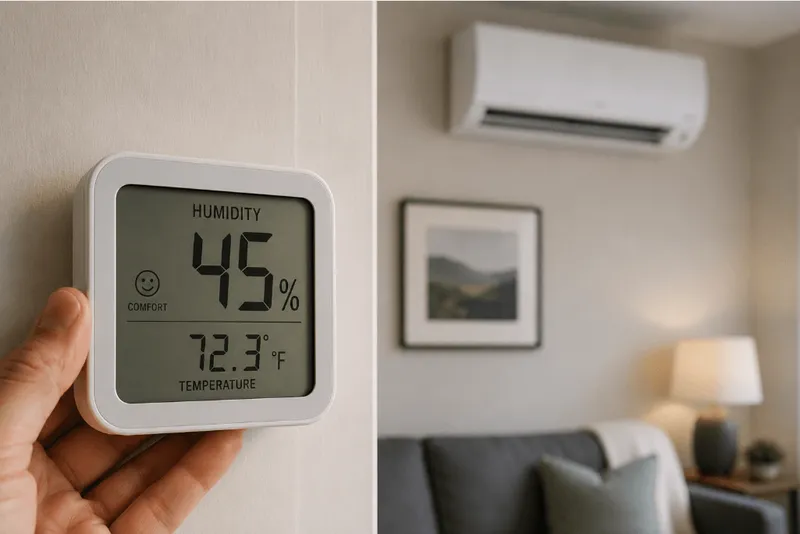
Keep basement relative humidity between 30% and 50%, the range EPA mold prevention guidance recommends, since humidity above 60% strongly predicts condensation and mold.
Filterbuy mini splits include a Dry Mode built for this. It slows the indoor fan and holds the coil steadier and cooler so more moisture condenses out, typically with only a 2 to 3°F temperature drop. Reach for it during humid shoulder seasons, when a basement can feel damp even though it isn't hot enough for full cooling.
A single mini split can struggle with humidity spikes from laundry, a bathroom, or heavy rain, especially when the system runs least in spring and fall. A portable or whole-basement dehumidifier working alongside it covers the margin Dry Mode can't handle alone, standard practice for finished basements in humid climates.
Condensate Drainage and Installation
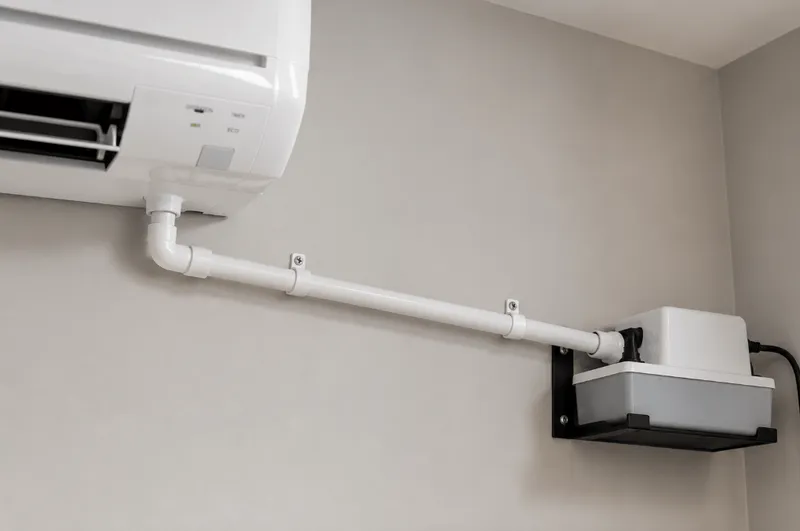
Every mini split removes moisture from the air as it cools, and that water has to go somewhere. Gravity drainage, a hose sloped continuously downward to an exterior wall or floor drain, is simplest, but it depends on the indoor unit sitting higher than the drain exit point. A below-grade unit is often installed at or below that level, so a condensate pump lifts the water out, and a float switch shuts the system off if the pump fails.
Confirm the indoor unit is mounted level, a common, avoidable cause of drainage problems. Size the pump to the unit's BTU rating and vertical lift, and insulate any drain line passing through unconditioned space. Many jurisdictions require a check valve or trap in the condensate line and prohibit tying it into a sanitary drain without an air gap, so confirm local code with an installer.
Three placement checks matter more in a basement than upstairs: clear the mounting bracket from any exposed joist or beam, keep the outdoor condenser clear of any code-required egress window, and keep its condensate discharge away from a sump pump's discharge line or French drain outlet.
For a broader look at ductless installation, see the DOE's Building America Solution Center guide to ductless heat pumps, and Filterbuy's DIY mini split installation guide for the added electrical and permit requirements.
Electrical Requirements
A basement finish project often runs into an already-full electrical panel. The 12,000 BTU tier is available in 115V or 230V. The 18,000 BTU model runs on standard 115V, useful where new 230V wiring isn't practical. The 24,000 BTU tier needs a dedicated 208/230V circuit, the same standard as a central air conditioner, typically requiring an electrician. If your panel is at capacity, the 18,000 BTU tier solves two problems at once.
Filter Care for High-Humidity Basements
A dirty filter makes every problem on this page worse. Restricted airflow lets moisture linger on the cooling coil, one of the most common causes of mold inside a mini split's indoor unit. Basement air carries more moisture than air upstairs, so filters load up faster. Check and clean them every 2 to 4 weeks rather than monthly, and inspect for visible mold or a musty odor.
CDC data shows current asthma affects about 7.7% of the U.S. population, and damp, moldy air is a documented trigger. A clean filter and a dry coil are a basement's first line of defense. See Filterbuy's mini split maintenance guide for the full cleaning schedule, and Filterbuy's guide to spotting and preventing mold in a mini split to tell surface buildup from a coil problem needing a technician.
Choosing the Best Mini Split for Your Basement
A few features separate a mini split built for basement duty from one that merely fits the BTU math: a strong Dry Mode, an inverter compressor that dehumidifies better than single-speed equipment, a climate-appropriate SEER2 rating, an HSPF2 score if the unit will also heat in winter, and a low sound rating if the basement doubles as a media room or guest bedroom.
Filterbuy's mini split line is built around a 17 SEER2 variable-speed inverter compressor as the standard, so Dry Mode and the inverter criteria above are already covered. A single indoor head suits one continuous open basement, while a multi-zone system fits basements split into distinct rooms needing independent control. See Filterbuy's single-zone vs. multi-zone comparison and Filterbuy's guide to what a SEER rating means for more.
“The mistake we see most often with basement mini splits isn't the brand or model. It's sizing the system for square footage and ignoring the moisture. The equipment was matched to the wrong problem.”
David Heacock, Founder and CEO, Filterbuy
Frequently Asked Questions
7 Resources We Trust Before You Size, Buy, or Install a Basement Mini Split
The CDC's overview of mold and health effects confirms indoor humidity at or below 50% is the front-line defense.
The EPA's introduction to indoor air quality explains how excess moisture and poor ventilation drive basement problems.
The EIA's home energy use data shows heating and cooling use more than half of household energy.
The American Lung Association's guidance on mold and asthma explains why humidity below 50% limits a documented asthma trigger.
The AHRI Directory of Certified Product Performance lets you verify tested ratings for any matched unit.
This Environmental Health Perspectives review links home dampness and mold to roughly 21% of current U.S. asthma cases.
ACCA's Manual J is the industry-standard load calculation contractors use, worth requesting when a basement's insulation or windows are unusual.
3 Supporting Statistics Behind This Guide
Duct systems lose 20 to 30 percent of their air to leaks, a loss ductless mini splits skip.
Source: ENERGY STAR, Duct Sealing.
53% of new Northeast homes built in 2024 have a basement, common enough to need its own playbook.
Source: U.S. Census Bureau, Highlights of 2024 Characteristics of New Housing.
Air sealing can cut heating and cooling costs up to 20 percent, the same logic behind correct sizing.
Source: HUD User, Insulation and Air Sealing.
Glossary
Mini Split: A ductless heating and cooling system with an indoor air handler connected by a refrigerant line to an outdoor condenser, requiring no ductwork.
BTU: The unit used to measure a mini split’s heating or cooling capacity per hour.
Dry Mode: An operating mode that slows the fan and cools the coil more steadily to remove additional moisture from the air with minimal temperature reduction.
SEER2: The current U.S. metric used to measure a cooling system’s efficiency. Higher numbers indicate greater efficiency.
Manual J Load Calculation: An ACCA-standard calculation that determines a room’s exact heating and cooling load, providing more accurate sizing than a basic square-footage estimate.