Adding a Mini Split AC System in Arkansas
Costs, Rebates & 2026 Guide
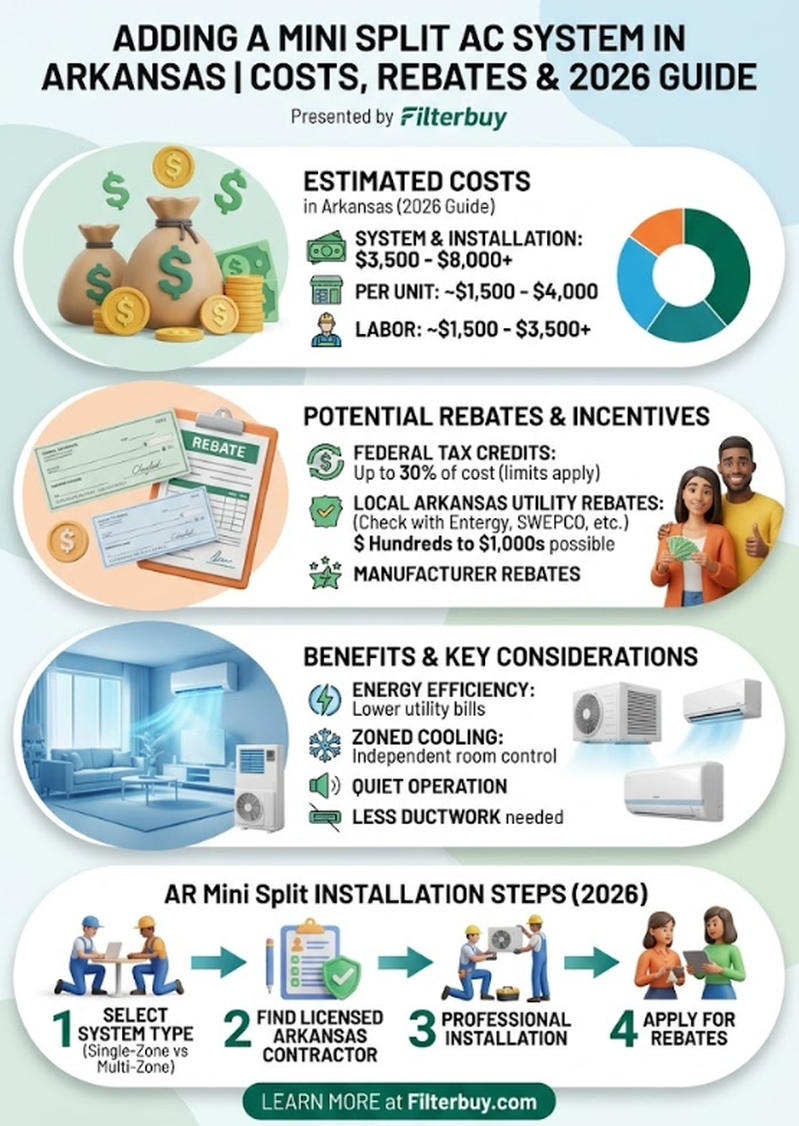
A mini split AC system in Arkansas runs about $2,500 to $15,000 installed in 2026, depending on how many rooms you cool. The federal $2,000 heat pump tax credit expired on December 31, 2025, but the math still works for most Arkansas homeowners because the savings moved to utility and state programs.
- Single-zone (1 room): $2,500 to $6,000
- Multi-zone (2–3 rooms): $5,000 to $11,000
- Whole-home (4–5 zones): $11,000 to $15,000+
SWEPCO customers in Northwest Arkansas can still claim $2,500 to $3,000 with pre-approval, and the Arkansas HOMES/HEEHRA program rolls out in 2026 with up to $8,000 for income-qualified households. Take the quick match quiz below to see which mini split setup fits your home and budget.

Answer 3 quick questions and we will match you to the right mini split for your Arkansas home.
Ready to browse? Explore Filterbuy mini split systems ›
The federal $2,000 heat pump tax credit, which used to take a chunk off the cost of a new mini split, expired on December 31, 2025. If you’re shopping for a ductless system in Arkansas this spring and you’d been counting on that money, the next question is whether the math still works without it. For most Arkansas homeowners, it does. You just need to know where the rebates moved to.
Mini splits keep showing up as the right answer to specific Arkansas problems: the bonus room over the garage that the central AC never quite cools, the converted attic, the 1940s house that was built without ductwork in the first place, or the failing central system that’s about to need a $10,000 replacement. They handle our humidity better than cycling central AC does. They run on a heat pump, so they cool in July and heat in January. And the U.S. Department of Energy estimates they are roughly 30% more efficient than traditional split systems.
We’ve put together this guide to walk through what installation actually costs in Arkansas in 2026, which utility rebates and state programs are still active, how to size the right unit for our hot, humid summers, and what to do about indoor air quality after the install. Because here’s the part most install guides skip: a mini split’s washable mesh filter isn’t the same thing as a real HVAC filter.
TL;DR: Quick Answers
Adding a Mini Split AC System in Arkansas
A mini split AC system in Arkansas runs $2,500 to $15,000 installed in 2026, depending on how many zones you need. Here's the short version:
Single-zone (one room): $2,500 to $6,000
Multi-zone (2–3 rooms): $5,000 to $11,000
Whole-home (4–5 zones): $11,000 to $15,000+
What you need to know about rebates:
The federal 25C tax credit ($2,000 toward heat pumps) expired December 31, 2025.
SWEPCO customers in Northwest Arkansas can still claim $2,500 to $3,000 through the residential HVAC incentive (pre-approval required).
Entergy Arkansas offers smaller stackable rebates on smart thermostats, heat pump water heaters, and demand-response programs.
The Arkansas HOMES/HEEHRA program rolls out in 2026 with up to $8,000 for income-qualified households.
Why mini splits work in Arkansas:
Roughly 30% more efficient than central AC (per the U.S. Department of Energy), thanks to zero duct losses.
They dehumidify better than cycling central AC, which matters in Arkansas's humid summers.
Every mini split sold in the US is a heat pump, so the same unit cools in July and heats in January.
The one thing most install guides miss: A mini split's washable mesh filter wasn't built to capture pollen, smoke, or pet dander. In Arkansas, where Little Rock ranks #6 in the country for pollen allergies (AAFA 2025), pair the install with a MERV 11 or MERV 13 filter on your central system, or a HEPA purifier in the bedrooms if you've gone whole-home ductless.
Sizing rule of thumb: Plan on roughly 20 BTU per square foot in Arkansas (humidity adds load). Always insist on a Manual J load calculation before signing any install contract.
Top Takeaways
The seven things every Arkansas homeowner should know before installing a mini split in 2026.
1. The federal 25C tax credit expired December 31, 2025.
2. SWEPCO offers the strongest Arkansas rebate.
3. Plan on $2,500 to $15,000 installed.
4. New refrigerant rules took effect January 1, 2026.
5. Insist on a Manual J load calculation before signing anything.
6. Mini splits are 30% more efficient than central AC, but they don't filter the air.
7. In Arkansas, the filter strategy is the missed half of the install.
How a Mini Split AC System Actually Works
A ductless mini split has two main parts. Outside the house sits a small compressor-condenser. Inside, one or more air handlers (usually wall-mounted, sometimes ceiling or floor) blow conditioned air directly into the room. The two pieces connect through a refrigerant line set that runs through a 3-inch hole in the wall. There’s no ductwork, which means no duct leaks and no 20 to 30% efficiency loss to your crawl space. That figure is what the EPA and DOE Energy Star program use to describe typical residential duct loss.
The interesting part is what’s inside the outdoor unit: an inverter-driven compressor. A traditional central AC slams on at full power, runs for 10 minutes, and shuts off. An inverter mini split does something different. It modulates, running long, low-speed cycles that hold the room at a steady temperature and pull humidity out of the air while it does. That’s exactly what you want during an Arkansas August.
Every mini split sold in the U.S. is technically a heat pump, which means the same unit cools your bonus room in July and heats it in January. Across most of the state (Little Rock, Hot Springs, Pine Bluff), a standard-efficiency mini split handles winter fine. Up in Northwest Arkansas, where you’ll see the occasional teens at night, it’s worth spending the extra $500 to $1,000 on a cold-climate rated model that won’t lose efficiency below 20°F.
Mini splits are part of the broader HVAC system family alongside central air, window units, and packaged terminal units. They’re not a new invention, just one that took a while to catch on in the U.S. The rest of the world, especially Asia and Europe, has used them as the dominant heating and cooling solution for decades.
Are Mini Splits a Good Fit for Arkansas’s Hot, Humid Climate?
For most Arkansas homeowners asking us this, the answer is yes. For some, no. The difference comes down to your house, your humidity load, and where in the state you live.
The humidity case
Arkansas sits in USDA Climate Zones 3A through most of the state and 4A in the northern counties. Both are humid climates, which means dehumidification is often more important than raw cooling capacity. Modern inverter mini splits run those long, low-speed cycles and pull humidity out of the air more effectively than central AC, which blasts cold for 10 minutes and shuts off. Customers tell us their house feels cooler at 75°F with a mini split than it did at 72°F with the old central system. That’s the dehumidification working in your favor.
The electric rate case
Arkansas residential electricity averages around 12¢/kWh, well below the national average of roughly 18¢/kWh according to the U.S. Energy Information Administration. Mini splits are heat pumps, and the U.S. Department of Energy puts them at roughly 30% more efficient than traditional split systems. So the operating savings show up on your bill, especially during heating season when you’re replacing resistance electric heat or an aging gas furnace.
Where mini splits make the strongest case in Arkansas
Room additions and bonus rooms the central system can’t reach
Garage apartments, she-sheds, and detached workshops
Older homes (pre-1960s) that were never built with ductwork
Whole-home conversions when the central system finally dies
Rooms that always run hotter or colder than the rest of the house
Two caveats worth saying plainly
A mini split has less filtration than a central HVAC system. The washable mesh filter inside the indoor head is built to protect the coil, not to capture pollen, pet dander, or smoke. If air quality matters to you (and in Arkansas, with Little Rock ranked among the worst U.S. cities for pollen allergies in the AAFA’s 2025 report and the wildfire smoke that drifts in from Oklahoma and Texas, it probably should), Section 8 covers how we’d handle that.
Second: in cold weather, a standard-efficiency mini split can ice up. If you’re in Fayetteville, Bentonville, or anywhere north of I-40 where sub-20°F nights happen most winters, ask your installer about cold-climate (CCHP) rated models. The premium runs $500 to $1,000 and pays off the first time temperatures drop.
2026 Mini Split Installation Cost in Arkansas
Three things drive what you’ll pay for a mini split installation in Arkansas this year: how many indoor zones you want, the total BTU capacity, and how much electrical work your home needs to support the new system.
A single-zone install (one outdoor condenser, one indoor head, one room) typically runs $2,500 to $6,000 installed. Smaller units in the 9,000 to 12,000 BTU range come in toward the bottom of that range. An 18,000 to 24,000 BTU single-zone for a larger open space pushes toward the top. We’ve seen most single-zone installs in Northwest Arkansas clearing the $3,000 to $6,000 mark in early 2026.
Multi-zone systems scale up quickly. Two zones runs $5,000 to $8,000. Three zones goes $7,500 to $11,000. A whole-home setup with four or five zones (typically replacing a dying central system) runs $11,000 to $15,000 or more.
Arkansas mini split installation cost ranges (2026)
| Configuration | 2026 installed cost | Typical use case |
|---|---|---|
| Single-zone, 9–12K BTU | $2,500 to $6,000 | Bonus room, bedroom, home office |
| Single-zone, 18–24K BTU | $4,000 to $7,500 | Large open room or small apartment |
| 2-zone multi-split | $5,000 to $8,000 | Two bedrooms or a bedroom plus living space |
| 3-zone multi-split | $7,500 to $11,000 | Partial-home retrofit |
| Whole-home (4–5 zones) | $11,000 to $15,000+ | Replacing a failed central system |
What drives the variance
Two nearly identical homes can get quotes that come in thousands of dollars apart. Here’s why.
Electrical panel capacity. A lot of older Arkansas homes have 100-amp panels that can’t support a new mini split without a subpanel upgrade. Add $1,500 to $3,000.
Line-set length. Standard line sets run 15 to 25 feet. Routing them longer, around obstacles, or hidden inside walls adds labor.
Mounting style. Wall-mounted heads are the cheapest at $2,500 to $5,000 per zone. Ceiling cassettes and concealed-duct units cost $3,500 to $6,500 per zone.
Brand premium. Mitsubishi and Fujitsu sit at the top end. LG, Daikin, and Samsung fill the middle. MRCool and Pioneer anchor the value end. Warranty terms and parts availability vary by brand, so it pays to ask.
Permits. Most Arkansas cities require a mechanical and electrical permit. Budget $100 to $400.
A worked example
A Fort Smith homeowner adding one 12,000 BTU unit to a 400 sq. ft. bonus room in 2026, with a standard wall-mount, no panel upgrade, standard line-set length, and a mid-range brand: roughly $3,500 to $5,200 all-in. Add a second zone for the guest bedroom and that climbs to $6,500 to $8,000.
One thing to watch this year. Starting January 1, 2026, all new residential heat pump systems must use refrigerants with a global warming potential of 700 or lower under the EPA’s Technology Transition Rule. That means R-32 or R-454B instead of the older R-410A. Contractors are still adjusting pricing as their distributors clear out old inventory, so some 2026 quotes are running higher than they would have last fall.
The Rebates & Tax Credits You Can Actually Use in Arkansas (2026)
This is the section where most 2026 online guides get the math wrong. Here’s what actually changed and what’s still on the table for Arkansas homeowners this year.
What happened to the 25C tax credit
The federal Section 25C Energy Efficient Home Improvement Credit covered 30% of installation cost up to $2,000 for a qualifying air-source heat pump. It expired on December 31, 2025. The “One Big Beautiful Bill,” signed in July 2025, cut short what had been scheduled to run through 2032. For systems installed in 2026 or later, 25C is gone.
If you installed a qualifying mini split by December 31, 2025, you can still claim the credit on your 2025 federal return using IRS Form 5695. You’ll need the manufacturer’s certification PIN and proof the system met the Consortium for Energy Efficiency’s highest tier. Talk to your tax preparer.
The only federal credit still active for 2026 heat pumps is Section 25D, which covers 30% of the cost of a geothermal (ground-source) heat pump with no dollar cap through 2032. Geothermal is a different system altogether: much higher upfront cost, in-ground loop field required. Most Arkansas homeowners considering a ductless mini split aren’t candidates for 25D.
What Arkansas rebates are active in 2026
SWEPCO (Southwestern Electric Power Company) serves western and northwestern Arkansas and offers the strongest residential HVAC incentive in the state. A qualifying high-efficiency heat pump installed through a SWEPCO-approved contractor can earn up to $2,500 to $3,000 per service address. The catch: your contractor has to submit a pre-approval application before installation. SWEPCO doesn’t accept retroactive claims.
Entergy Arkansas serves central and eastern Arkansas. Entergy doesn’t publish a dedicated whole-system mini split rebate, but it runs several programs that stack well with a mini split upgrade:
Smart thermostat rebates through the Entergy Arkansas Marketplace
Heat pump water heater discounts up to $500 at participating Lowe’s locations
Room air conditioner rebates of $50 on qualifying ENERGY STAR models
Summer Advantage and Smart Direct Load Control demand-response programs that pay you for letting Entergy cycle your AC during peak hours
Black Hills Energy covers natural gas service in parts of Northwest Arkansas. Up to $400 rebate for a qualifying high-efficiency furnace, which is useful if you’re upgrading heating at the same time as your mini split install.
Ozarks Electric Cooperative doesn’t currently offer HVAC-specific equipment rebates. Members should still check for weatherization and home-assessment programs that pair well with a mini split retrofit.
The state program still rolling out
The Arkansas Division of Environmental Quality was allocated roughly $105 million under the Inflation Reduction Act to administer the federal HOMES and HEEHRA programs. As of early 2026, Arkansas hasn’t officially launched its program. State officials expect a rolling launch during 2026, with income-qualified point-of-sale rebates for low- and moderate-income households.
When it does launch: low-income households (under 80% of area median income) may qualify for rebates covering up to 100% of a heat pump installation, capped at $8,000. Moderate-income households (80 to 150% AMI) may qualify for up to 50% covered, capped at $4,000. Sign up for updates on the ADEQ website. Funding is limited, and it’ll go first-come, first-served once it opens.
| Program | What it covers | 2026 status |
|---|---|---|
|
Federal 25C (air-source) |
Up to $2,000 for qualifying heat pumps | EXPIRED Dec. 31, 2025 |
|
Federal 25D (geothermal) |
30% of cost, no cap | Active through 2032 |
| SWEPCO HVAC Incentive | High-efficiency heat pumps | $2,500 to $3,000 per address |
| Black Hills Energy | Qualifying furnace | Up to $400 |
| Entergy Arkansas | Smart thermostats, HPWH, room AC | Varies by program |
| Arkansas HOMES/HEEHRA | Income-qualified electrification | Rolling out 2026 |
What Size Mini Split Do I Need for My Arkansas Home?
The size of the unit is the most important decision you’ll make on a mini split install, and it’s the one most often gotten wrong. Undersize the system and it runs constantly, never quite gets the room cool, and burns out early. Oversize it and it short-cycles, fails to dehumidify, and costs you more upfront for worse comfort.
The Arkansas rule of thumb
In a humid climate like ours, plan for roughly 20 BTU per square foot. That’s slightly higher than the 15 to 18 BTU/sq. ft. you’ll see quoted for dry-climate homes, and the uplift covers the extra dehumidification load. A 400 sq. ft. bonus room needs about 8,000 BTU. A 1,000 sq. ft. open-concept living space needs around 20,000 BTU.
Rules of thumb miss a lot of variables, though. A south-facing room with a wall of windows can need 30 to 40% more capacity than the same-size north-facing room. An uninsulated attic conversion can need double. A kitchen that gets heavy cooking use needs more. For anything bigger than a single bedroom, insist on a Manual J load calculation. It’s the industry-standard sizing method, and any installer worth hiring will do one for free before quoting.
Quick sizing reference for Arkansas homes
| BTU capacity | Approx. coverage | Best for |
|---|---|---|
| 9,000 BTU | 250 to 400 sq. ft. | Small bedroom, office, nursery |
| 12,000 BTU (1 ton) | 400 to 550 sq. ft. | Master bedroom, large office, sunroom |
| 18,000 BTU (1.5 ton) | 550 to 900 sq. ft. | Open-concept living room, bonus room, studio |
| 24,000 BTU (2 ton) | 900 to 1,300 sq. ft. | Large great room or small home |
| 36,000 BTU (3 ton) | 1,300 to 1,800 sq. ft. | Whole-home multi-zone |
Common sizing mistakes we see on Arkansas installs
Bigger isn’t better. A 24,000 BTU head in a 500 sq. ft. room cools the room fast, then shuts off before pulling enough humidity out. The room ends up cold and clammy.
Ignoring ceiling height. A room with 10-foot ceilings holds 25% more air volume than the same square footage with 8-foot ceilings. Sizing by floor area alone leaves you short.
Forgetting about sun exposure. A west-facing room catches brutal afternoon sun in late August. You may need 20% more capacity than the standard Manual J number suggests.
Sizing for peak instead of comfort. You don’t need enough BTU to handle the hottest day of the year. You need enough to handle typical summer days efficiently. Slight under-sizing actually improves humidity control.
When you’re not sure, err slightly small. An inverter mini split will run harder to compensate on the hottest days, and it’ll dehumidify better the other 95% of the time.
Mini Split vs. Central AC: Which Makes More Sense for an Arkansas Home?
Whether a mini split or central AC makes more sense for your Arkansas home comes down to what you’re trying to solve. Here’s a fair comparison.
Where mini splits win
No duct losses. Central AC loses 20 to 30% of conditioned air through leaky ductwork (a figure cited by both the EPA and the DOE Energy Star program), especially in Arkansas homes where ducts run through uninsulated attics or crawl spaces. Mini splits have zero duct losses.
Zone control. Each indoor head has its own thermostat. The bedroom can sit at 70°F while the home office sits at 74°F, and nobody’s fighting over a single setting.
Easier retrofits. Adding a room? Finishing a basement? Converting a garage? A mini split drops in with a 3-inch wall hole instead of months of drywall tear-out for new ducts.
Lower heating bill. In heat-pump mode, mini splits cost roughly 30 to 40% less to operate than an aging propane furnace, and up to 50% less than electric resistance heat per the U.S. Department of Energy.
Where central AC still wins
Whole-home cost-per-ton is lower. For a 2,000 sq. ft. home that already has ductwork in good shape, replacing a central unit is usually cheaper than converting to a four-zone mini split system.
Whole-home filtration. This is the big one. A central HVAC system pulls all the air through a pleated MERV-rated filter (MERV 8, 11, or 13, depending on what you need) that catches pollen, pet dander, dust, and fine particulates. Mini splits can’t do that.
Aesthetics. No wall units visible. Purely a preference thing.
One thermostat to manage. Some homeowners prefer the simplicity of a single whole-home setting.
What a lot of Arkansas homeowners actually do
A growing number of homeowners aren’t choosing between the two at all. They keep the central system running for the main living areas and add a mini split to fix the one room that never cools right: the master bedroom over the garage, the upstairs bonus room, the sunroom addition. Whole-home filtration through the central system, targeted comfort in the problem room.
Step-by-Step: How to Get Your Mini Split Installed in Arkansas
The Arkansas homeowners who save the most on mini split installs aren’t the ones who shop hardest. They’re the ones who line up rebates before signing the contract. Here’s the order we recommend.
Get a Manual J load calculation. Any installer worth hiring will do this as part of the quote. It’s the actual answer to “what size do I need.” If a contractor tries to sell you a system without measuring, get another quote.
Match the system to your part of Arkansas. In central and southern Arkansas (Little Rock, Hot Springs, Pine Bluff, Texarkana), a standard-efficiency heat pump handles winter fine. In Northwest Arkansas and the Ozarks, spend the extra $500 to $1,000 for a cold-climate rated unit.
Pre-qualify for utility rebates. If you’re a SWEPCO customer, this matters most. SWEPCO’s HVAC incentive requires pre-approval before the install, and SWEPCO won’t honor retroactive applications. Your contractor should know the process. If they don’t, that’s a red flag.
Get 2 to 3 quotes from licensed, bonded, NATE-certified installers. Licensing and bonding are required by Arkansas state law. NATE certification isn’t required, but it’s a strong quality signal. Ask for proof, ask for references, and check Google reviews from the last 12 months.
Confirm 2026 refrigerant compliance. The EPA Technology Transition Rule requires new systems installed on or after January 1, 2026 to use refrigerants with a global warming potential under 700. Ask which refrigerant the system uses. You want R-32 or R-454B, not R-410A.
Schedule for shoulder season when you can. May through August is the busiest stretch for HVAC contractors in Arkansas. You’ll pay more and wait longer. If you can schedule in March or April or in October or November, you’ll usually get a better price and a faster install.
File for rebates right after install. Keep every receipt, the AHRI certificate (which confirms system efficiency), and the manufacturer’s certification statement. Submit utility rebate paperwork within 60 to 90 days. Most programs tie their submission deadlines to the install date.
Keeping Your Indoor Air Clean After a Mini Split Install
Here’s the part most install guides skip, and it’s the part we care about most. A mini split doesn’t clean your air the way a central HVAC filter does. In Arkansas, where Little Rock ranks among the worst U.S. cities for pollen allergies (AAFA 2025) and wildfire smoke drifts in from Oklahoma and Texas most summers now, that matters.
What’s actually inside a mini split head
A washable mesh filter, sometimes a thin charcoal layer, sometimes a silver-ion mesh on premium models. That mesh is built to keep dust off the coil. It’s not built to capture the particle sizes that trigger allergies (5 to 10 microns), the fine smoke particles called PM 2.5 (under 2.5 microns), or pet dander (2.5 to 10 microns).
The U.S. Department of Energy says it plainly: minisplits “generally have lower MERV filters that are not typically able to capture small particles” and the agency recommends a separate air-cleaning solution if you want better filtration. For that, you need MERV-rated media.
The three-layer approach we recommend for Arkansas homes
Clean the mesh filters monthly. It takes about 90 seconds per head. Rinse them under the sink, let them dry, pop them back in. A clogged mesh filter makes the unit work harder and cuts efficiency. Do it more often during pollen season.
If you kept your central HVAC system, upgrade the filter. Most Arkansas homes do well with MERV 11 if allergies are the main concern, or MERV 13 if you’re worried about wildfire smoke and the finest particles. Filterbuy makes pleated filters in over 600 sizes, ships them free, and builds them in our Alabama factory. We’ve shipped millions of them to families across the country, including a lot of Arkansas homes. Set up auto-delivery so a fresh filter shows up every 60 or 90 days, and you don’t have to think about it.
Add a HEPA purifier for the bedrooms. If you’ve gone whole-home mini split with no central system at all, a bedroom-sized HEPA purifier is the closest equivalent to what a central MERV 13 filter would do. It earns its keep during high-pollen weeks and any time air quality alerts hit Arkansas.
The short version: your mini split handles temperature and humidity. Your filter strategy handles everything else floating around. You need both.
"In over a decade of shipping filters to Arkansas homes, the most common mistake we see after a mini split install isn't sizing or rebate paperwork — it's assuming the washable mesh inside the indoor head does the work a real HVAC filter would do. It doesn't, and in a state where Little Rock ranks 6th in the country for pollen allergies, that gap shows up fast."
-The Filterbuy Team
The 7 Resources We Tell Every Arkansas Homeowner to Bookmark Before Their Mini Split Install
After a decade of helping families across the country sort out what to install, what to filter, and what to claim, we've narrowed it down to seven sources that actually save Arkansas homeowners money and headaches. Bookmark them in this order. The sequence matters.
1. Find Out Which Heat Pumps Actually Qualify for Federal Money
Before you let any contractor talk you into a specific model, run it past the ENERGY STAR lookup. It's the federal government's official list of heat pumps that qualify for the credits still in play, including the geothermal 25D credit that runs through 2032. Two minutes here saves you from a contractor who's quoting equipment that doesn't actually qualify.
URL: https://www.energystar.gov/about/federal-tax-credits/air-source-heat-pumps
2. Get the Right IRS Form Before Tax Season Sneaks Up
If your mini split was installed before December 31, 2025, this is the form you (or your tax preparer) needs to claim up to $2,000 back on your 2025 return. The IRS page has the current form, the instructions, and a clear list of what documentation to keep from your installer. Print the manufacturer certification statement now while you can still find it.
URL: https://www.irs.gov/forms-pubs/about-form-5695
3. Lock In SWEPCO's $3,000 Rebate Before You Sign Anything
If SWEPCO is your utility, this rebate is the difference between a good install and a great one. The catch we talked about earlier still applies here: pre-approval is non-negotiable, and the contractor handles the paperwork. The SWEPCO page tells you exactly what equipment qualifies and which contractors are in their approved network. Read it before the quote, not after.
URL: https://www.swepco.com/save/residential
4. Stack Entergy's Smaller Rebates Into Real Money
Entergy doesn't write one big check the way SWEPCO does, but the smaller rebates add up if you combine them while you're already upgrading. Smart thermostats. Up to $500 off a heat pump water heater at Lowe's. $50 back on a qualifying room A-C. Plus the demand-response programs that pay you to let Entergy cycle your unit during peak hours. The Entergy Arkansas Marketplace lives here too, which is where most of those point-of-purchase discounts get redeemed.
URL: https://www.entergy-arkansas.com/save-money/residential/
5. Get on the ADEQ List for the $8,000 State Rebate Before It Opens
This is the one nobody wants to find out about after the fact. Arkansas got roughly $105 million from the federal HOMES and HEEHRA programs, and once ADEQ launches the rollout during 2026, the income-qualified rebates will go first-come, first-served. Up to $8,000 for low-income households. Up to $4,000 for moderate-income. Get on the email list now so you're not refreshing the page in November.
URL: https://www.adeq.state.ar.us/
6. Bring the Federal Energy Authority Into Your Contractor Conversations
This page is our favorite tool for keeping contractor conversations honest. The DOE backs up the 30-percent efficiency case, the 20 to 30 percent duct-loss figures we keep citing, and (this is the one we wish more homeowners knew) the federal government's own admission that mini splits "generally have lower MERV filters that are not typically able to capture small particles." If a contractor brushes off the filtration question, this page is your receipt.
URL: https://www.energy.gov/energysaver/ductless-mini-split-air-conditioners
7. Verify Your Installer's License in Two Minutes Flat
The Arkansas HVACR Licensing Board keeps a public lookup tool that tells you whether an installer is actually licensed, bonded, and clear of disciplinary actions. We tell every customer to run this check before signing anything. It's the simplest fraud-prevention step in the whole process, and the one most homeowners skip.
URL: https://www.hvacr.arkansas.gov/
Supporting Statistics
Three numbers we come back to whenever an Arkansas homeowner asks us whether a mini split is worth it. Each one is sourced to a US federal agency or established research nonprofit, and each one shaped how we wrote this guide.
1. Most Arkansas Homes Are Cooling Their Attic, Not Their House
The U.S. Department of Energy reports that ductwork in central forced-air systems can account for more than 30% of energy consumption for air conditioning. The EPA and DOE Energy Star program peg typical residential duct losses at 20% to 30%. The older the home, the closer the loss tracks to the high end.
What we see on every install:
Duct seams pull apart over the years.
Attic insulation flattens.
Conditioned air leaks before reaching the room.
Why it matters: Eliminating ductwork eliminates the loss. It's also why SWEPCO is willing to write a $2,500 to $3,000 rebate check. They're paying you to stop heating the attic.
Source: U.S. Department of Energy — Ductless Mini-Split Air Conditioners
2. The Heating Math Is What Surprises People, Not the Cooling Math
Most homeowners shop for a mini split because their house is too hot in July. The number that changes their mind is usually a January electric bill twelve months later.
The federal numbers:
Air-source heat pumps cut electricity use for heating by up to 75% versus electric resistance, per the U.S. Department of Energy.
The EPA estimates 30% to 40% savings when switching from an older furnace-and-AC combo to a heat pump.
What we see in Arkansas: Homeowners replacing electric resistance heat typically see the install premium pay back in three to five winters. The federal 25D credit and the SWEPCO rebate accelerate that.
Source: U.S. Department of Energy — Heat Pump Systems
3. The Allergy Number That Should Change Your Filter Strategy
This is the statistic we wish more Arkansas install guides led with. It changes the whole conversation about what a mini split actually does for your home.
The 2025 ranking:
Little Rock: 6th most challenging US city for pollen allergies (up 11 spots from the prior year).
Fayetteville: also in the top 20.
Ranking weighs pollen counts, OTC allergy medication use, and allergists per resident.
The filter gap: A mini split's washable mesh wasn't designed for that pollen load. The DOE itself notes that mini splits "generally have lower MERV filters that are not typically able to capture small particles."
What works (in our experience):
MERV 11 or MERV 13 pleated filter on the central system.
Monthly mesh cleaning on the indoor heads.
HEPA purifier in the bedrooms if you've gone whole-home ductless.
Source: Asthma and Allergy Foundation of America — 2025 Allergy Capitals Report
Our 2026 Recommendation for Arkansas Homeowners
If you’re in Northwest Arkansas and SWEPCO is your utility, the math still works without 25C. Stack the SWEPCO residential HVAC rebate (up to $2,500 to $3,000) with a high-efficiency cold-climate unit, and you’ll recover most of the premium within the first few years on what you save operating it.
If you’re in central or eastern Arkansas under Entergy, the rebate picture is thinner. But mini splits still make the strongest case for room additions, garage conversions, and older homes without ducts. Focus on the humidity control and zone control. Those pay off every Arkansas summer regardless of rebate math.
If your central system is failing and you’re weighing a full conversion to a whole-home mini split, get three quotes, insist on a Manual J calculation, and ask about cold-climate ratings if you’re north of I-40. Don’t let anyone rush you into a replacement in July when contractor schedules are packed.
Whatever you decide, your filter strategy still matters once it’s installed. Clean the mesh filters monthly. Upgrade your central filter if you’re keeping one. Indoor air quality is the one thing most install guides forget to mention, which is the part we keep coming back to. We’ve spent over a decade building filters for families across the country, and we know what makes a difference.
Frequently Asked Questions
Ready to Add a Mini Split AC System to Your Arkansas Home?
Skip the guesswork on sizing, rebates, and refrigerant compliance and let our local NATE-certified technicians handle the install (and the paperwork) for you. Book a free Arkansas mini split estimate with Filterbuy and we'll walk you through what's available in your ZIP code.